The security guard had worked at La Princesa long enough to know that something about the building frightened him.
Doors opened when no one was nearby. Windows moved without an obvious explanation, furniture seemed to shift on its own, and lights switched on and off after the offices had emptied for the night. Eventually, he became so uncomfortable that he requested a transfer.
He still avoided the building afterward.
In December 2006, ISLANDS magazine published an account of a nighttime visit to Old San Juan in which the writer encountered the guard near one of the city's old sentry posts. The man claimed to have witnessed mysterious lights, moving shadows, and heard voices along the historic walls. When the conversation turned to his former workplace, his attitude changed.
The old jail, he explained, had been worse.
He described doors and windows opening unexpectedly, chairs moving, and lights behaving strangely. Even after leaving the assignment, he preferred to keep his distance from the building.
The old jail was La Cárcel de la Princesa, a nineteenth-century prison standing beside the southern walls of Old San Juan.
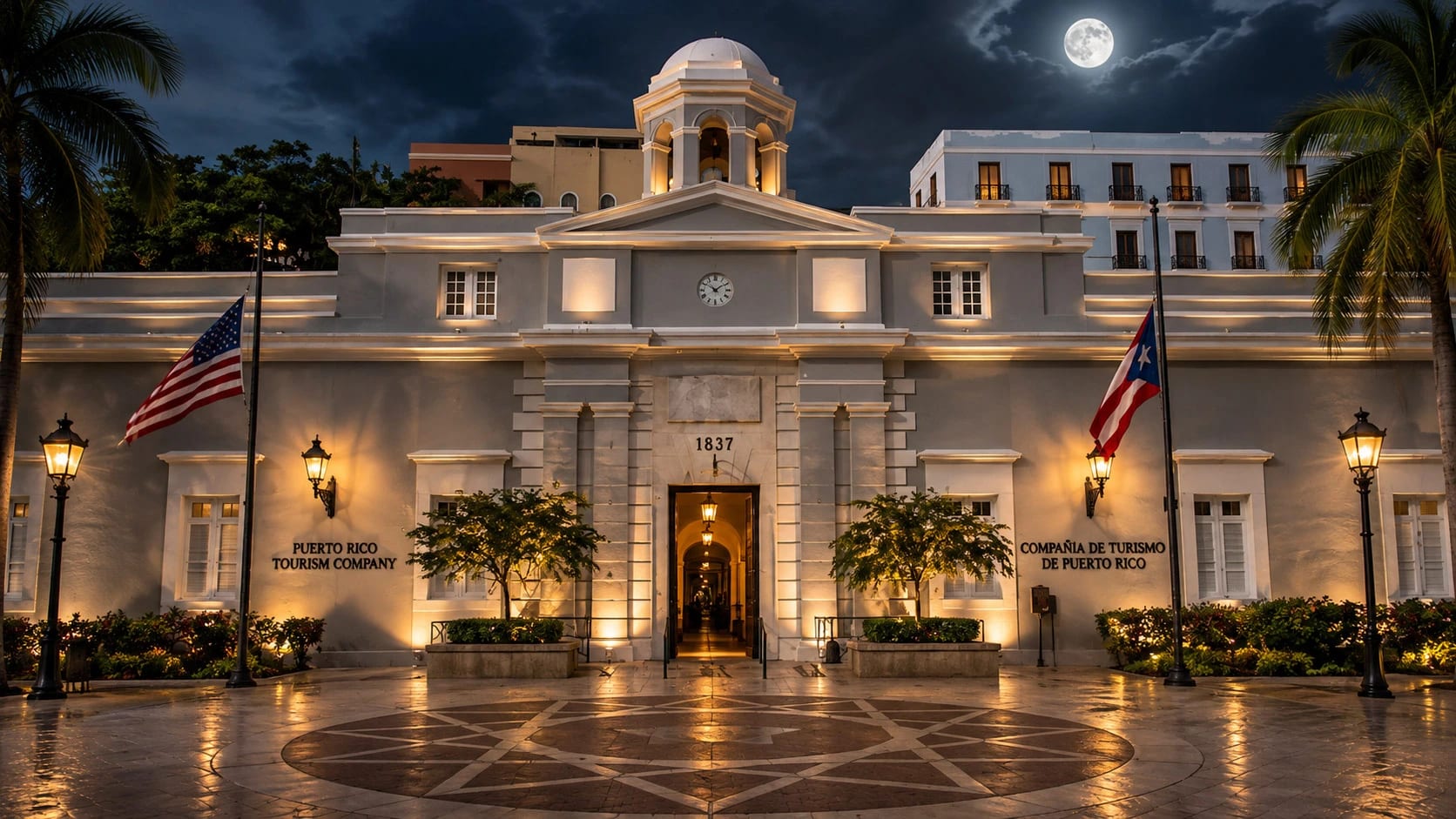
Today, visitors encounter a handsome gray-and-white building with a neoclassical façade, an elegant clock tower, and carefully maintained gardens. It houses the Puerto Rico Tourism Company, and its interior spaces have been adapted for offices, cultural exhibitions, and public events.
Few of the people passing through its doors realize what happened there.
For nearly 140 years, La Princesa confined accused criminals, convicted prisoners, and people imprisoned during periods of political unrest. Its cells became overcrowded, its conditions deteriorated, and men died within its walls. Prisoners were executed in its courtyard, including two men whose hanging in 1927 followed one of the most notorious murder cases in Puerto Rican history.
In 1974, hundreds of incarcerated men took control of the prison to demand better treatment. Two years later, a federal judge inspected the building and documented conditions so severe that he ordered its use as a prison to end.
The haunting stories are difficult to verify. The suffering that occurred behind the walls is not.
Of all the places associated with ghosts in Old San Juan, La Princesa offers one of the most disturbing contrasts between what visitors see today and what the building once contained.
The Beautiful Building That Was Built to Hold Prisoners
La Princesa stands at 2 Paseo de la Princesa, near San Juan's waterfront and the historic walls that once enclosed the Spanish colonial city.
From the street, it hardly resembles a prison.
The main entrance sits beneath a classical pediment and a small tower topped by a dome. Decorative moldings and orderly rows of windows give the building the appearance of a nineteenth-century government residence or civic institution.
Above the entrance, the year 1837 is displayed prominently.
The date marks the construction of the prison during the final decades of Spanish colonial rule in Puerto Rico.
At that time, San Juan was a densely inhabited fortified city. Its narrow streets contained government buildings, churches, merchants' houses, military installations, workshops, and residences occupied by people from widely different social backgrounds.
The surrounding walls were designed to protect the capital against foreign invasion. For the people living inside them, however, the city also represented an extensive system of colonial administration.
Spanish authorities exercised control over the courts, military, customs, and police. Maintaining public order was a central responsibility of the governor, whose authority extended across the island.
The construction of a substantial prison formed part of that system.
La Princesa was intended to hold people awaiting trial as well as those serving sentences. Its location near the waterfront and defensive walls placed it within reach of the city's government and judicial institutions while keeping its prisoners behind a controlled entrance.
Although its exterior incorporated fashionable architectural details, there was nothing luxurious about the building's original purpose.
A prisoner entering La Princesa would not have encountered the carefully arranged galleries and offices that occupy the property today.
He would have entered a place of confinement, where his movement was controlled by guards and his future depended on officials and courts beyond the prison walls.
For some, imprisonment lasted until trial or the completion of a sentence.
Others never left alive.
Why Was the Prison Called La Princesa?
The prison's name comes from its association with the adjacent Paseo de la Princesa, one of Old San Juan's most celebrated historic promenades.
The walkway was developed during the middle of the nineteenth century, when Spanish colonial officials were investing in improvements intended to make San Juan more orderly and attractive.
The promenade honored Isabel de Borbón y Borbón, the daughter of Queen Isabella II of Spain and, at the time, the Princess of Asturias.
Born in 1851, the young princess was heir presumptive to the Spanish throne until the birth of her younger brother, the future Alfonso XII.
The promenade was formally dedicated on December 20, 1854, during the administration of Governor Fernando de Norzagaray.
The naming history is often confused in modern visitor descriptions. Because the prison was constructed in 1837, it could not originally have been named for a promenade dedicated to a princess who had not yet been born. Its later identity became closely associated with the surrounding walkway.
Historian Carmen Alicia Morales explored the promenade's history in a 2019 article published by El Adoquín, explaining its relationship with the Spanish royal family and the urban improvements carried out during Norzagaray's administration.
The result was an extraordinary architectural contradiction.
On one side stood a building where prisoners were confined.
Immediately outside, a fashionable promenade offered residents the opportunity to walk beneath trees, enjoy the waterfront, and participate in the social life of the colonial capital.
The prison and the public walkway existed side by side, representing two entirely different experiences of the same city.
The contrast became even more apparent as the promenade developed.
Gardens were established near the prison, and according to a historical publication issued by MAPFRE Puerto Rico, incarcerated men helped maintain the grounds.
The people enjoying the flowers and shaded paths could therefore have been looking at landscaping cared for by men who were not free to leave the building beside them.
Visitors today see the beauty of Paseo de la Princesa.
Its history includes the prisoners whose labor helped maintain that beauty.
The Clock Tower Above the Prison Gate
One of La Princesa's most distinctive architectural features is the small tower rising above its main entrance.
It was added in 1854, during the same period that the adjacent promenade was receiving official attention.
The Puerto Rico Historic Buildings Drawings Society documents the installation of the tower and clock under Governor Fernando de Norzagaray.
The addition gave the building a stronger civic appearance.
Its clock also offered a practical way to regulate the daily routines of the prison and the surrounding neighborhood.
Time had a particular significance inside a correctional institution.
Prisoners lived according to schedules they did not control. Meals, work assignments, periods of confinement, and other activities were governed by the institution's rules.
Beyond the walls, people walked along the promenade, attended social gatherings, and returned to their homes when they wished.
Inside, a prisoner might spend hours waiting for a guard to open a door or for an official decision concerning his case.
The clock above the entrance measured both experiences.
The architectural contrast remains visible today. The same tower that once overlooked generations of incarcerated men now rises above an institution devoted to welcoming visitors to Puerto Rico.
Yet some of the old prison's most revealing features survive beyond the restored façade.
They are not decorative.
They are the cells.
The Calabozos: The Cells Hidden Behind the Courtyard
Visitors who know La Princesa only from its exterior may be surprised to discover that portions of the original prison remain visible.
Historical photographs and architectural surveys document a group of surviving cells inside the complex.
These enclosed spaces contain masonry walls, iron-barred openings, and heavy gates that reveal the building's former purpose far more clearly than the main entrance.
Some cells have small openings high in their walls. Others retain the narrow proportions and restricted visibility associated with their use as places of confinement.
The Puerto Rico Architectural Heritage Archive preserves photographs from 2012 showing several of these spaces, including a group of three cells near the courtyard.
They provide an important physical connection to the people once imprisoned there.
But the most revealing description of La Princesa's confinement cells comes from a federal court investigation conducted in 1976.
The court identified two types of restrictive housing areas within the prison: galeritas, or small galleries, and calabozos, sometimes translated as dungeons.
The distinction was not merely architectural.
These spaces were used to confine prisoners under particularly difficult conditions.
During his investigation, United States District Judge Juan R. Torruella examined an area containing three larger cells and fifteen smaller confinement cells.
The rooms were constructed beneath a common roof, with metal bars enclosing their fronts and upper portions.
The court found that the roof was badly deteriorated. Some areas required improvised wooden supports, while the cells themselves were poorly ventilated, insufficiently illuminated, and difficult to keep sanitary.
Beds were missing from the smaller confinement cells.
Access to drinking water was severely inadequate.
The judge's description leaves little doubt about the conditions experienced by prisoners placed there.
What makes this evidence particularly important is its date.
These were not conditions described by a nineteenth-century visitor shocked by an unfamiliar colonial prison.
They were observed in February 1976, within living memory of many Puerto Rican families.
While tourists were exploring Old San Juan's picturesque streets, people were still being held in cramped, deteriorating cells a short distance from the waterfront.
Those cells are among the most important surviving reminders of La Princesa's history.
And they were only part of the problem.
A Prison Designed for 240 Men Held Nearly 500
Architectural histories of La Princesa generally describe a prison designed to accommodate approximately 240 inmates.
By the 1970s, however, the institution was holding far more people than its original design could reasonably support.
The federal court case Martínez Rodríguez v. Jiménez provides unusually precise information.
During the fiscal year ending June 30, 1975, the prison held an average of 490 inmates per day.
At certain points, the number was considerably higher.
The court documented periods in early 1975 when the population reached approximately 588 prisoners.
There were not enough beds.
Some men slept on floors, while others occupied overcrowded galleries or makeshift sleeping areas. Mattresses were often worn, dirty, or damaged, and basic bedding was not always available.
The institution also suffered from severe staffing shortages.
According to the court's findings, some shifts operated with only six or seven guards. At one post, a single guard was responsible for supervising an area containing approximately 275 inmates.
Such staffing levels made it extremely difficult to prevent violence or respond quickly to emergencies.
The court documented serious assaults, intimidation, and sexual violence within the prison.
People awaiting trial were held alongside convicted prisoners, and minors were sometimes confined among adults.
In February 1976, the court found that approximately 35 to 40 incarcerated people were younger than eighteen or otherwise classified as minors.
Some were only fifteen or sixteen years old.
Medical care was also inadequate, and the prison lacked sufficient resources to meet the needs of its population.
The conditions became so severe that the court determined that the institution could not be made suitable for continued use without a major reconstruction.
For anyone researching the haunted history of La Princesa, these findings are more disturbing than the usual stories of unidentified spirits.
They reveal exactly what happened inside the prison, who documented it, and why the building eventually ceased to be used for incarceration.
The Executions in La Princesa's Courtyard
Long before the federal investigation, La Princesa was associated with another form of suffering.
Executions.
During the Spanish colonial period, capital punishment formed part of the legal system imposed on Puerto Rico. People convicted of certain serious crimes could be sentenced to death, and execution methods changed over time.
A historical guide to Old San Juan published by MAPFRE Puerto Rico in 2008 states that the garrote was used inside La Princesa into the early twentieth century.
The garrote was an execution device used in Spain and parts of its former empire. It employed a metal collar and mechanical apparatus to cause death through compression of the neck.
Its association with the prison is a grim reminder that La Princesa was not merely a place where people waited to complete a sentence.
For some, it was the location where their lives ended.
After Puerto Rico passed from Spanish to American control in 1898, the legal system changed, but capital punishment remained a possibility during parts of the early twentieth century.
By the 1920s, executions were carried out by hanging.
One of the most notorious cases culminated in La Princesa's own courtyard in 1927.
Two men, Carlos Arocho and Jacinto Clemente, had been convicted in connection with the murder of a thirteen-year-old girl named Guillermina Rodríguez Morales.
The crime took place in February 1924 and caused widespread outrage across Puerto Rico.
The case generated extensive newspaper coverage and became the subject of complicated legal proceedings. Puerto Rican and federal appellate courts considered questions relating to the trials and the legality of capital punishment during the period.
Ultimately, both men were sentenced to death.
Their executions were carried out by hanging inside La Princesa.
Contemporary accounts describe journalists and invited observers attending the event, while a crowd gathered outside the prison.
The atmosphere reflected the public anger generated by the murder and the controversy surrounding the death sentences.
The execution date is inconsistently reported in later accounts, with sources providing dates in June and July 1927. The year, identities, location, and method of execution are well established, but the exact day should be checked against contemporary records before being presented as definitive.
The event became part of Puerto Rican cultural memory.
A 1970 film, Arocho y Clemente, dramatized the crime and its aftermath, preserving the names of the two men in the island's popular culture decades after their deaths.
It is important to remember that the men were not the final people executed in Puerto Rico.
Pascual Ramos was executed in September 1927, several months after the double hanging.
Puerto Rico abolished capital punishment in 1929, and its 1952 Constitution expressly prohibited the death penalty under the Commonwealth's legal system.
The executions at La Princesa therefore belong to the closing chapter of a long and often brutal penal tradition.
The prison's courtyard has since been restored and adapted for other purposes.
For those who know its history, however, it is difficult to look at the space without remembering the people who died there.
The Political Prisoners of La Princesa
The history of La Princesa was not limited to people convicted of ordinary criminal offenses.
It also became associated with Puerto Rico's political struggles.
During the nineteenth and twentieth centuries, the island experienced repeated conflicts over colonial authority, political reform, autonomy, and independence.
Those disputes sometimes resulted in arrests and imprisonment.
La Princesa held individuals associated with the Puerto Rican independence movement, including some of the most recognizable political and literary figures of the twentieth century.
Among them was Pedro Albizu Campos.
Born in 1891, Albizu Campos became president of the Puerto Rican Nationalist Party and one of the leading advocates of independence from the United States.
He was a Harvard-educated lawyer whose political career included speeches, organizing, protests, prosecutions, and long periods of imprisonment.
For his supporters, he became a symbol of resistance to colonial rule. His opponents regarded his activities and the Nationalist movement's confrontations with government authorities very differently.
His imprisonment remains one of the most debated subjects in Puerto Rico's modern political history.
The Academia Puertorriqueña de Jurisprudencia y Legislación identifies La Princesa as one of the prisons where Albizu Campos was confined.
He was not the only prominent nationalist associated with the building.
Historical material published by MAPFRE Puerto Rico identifies Francisco Matos Paoli, Clemente Soto Vélez, and Juan Antonio Corretjer among the writers and independence advocates who were held there.
These were not anonymous prisoners whose identities have been lost.
They were influential figures whose poetry, political writing, and public activities helped shape Puerto Rican cultural and political life.
Matos Paoli became known for his poetry and his association with the Nationalist movement. Soto Vélez and Corretjer likewise contributed to Puerto Rican literature while participating in political struggles during periods when independence activism was closely monitored by authorities.
Their imprisonment highlights a different use of La Princesa.
A prison can serve the ordinary criminal justice system while also becoming a place where political conflicts are fought through detention, prosecution, and punishment.
The conditions experienced by particular political prisoners require examination of their individual records rather than assumptions based on the prison's general reputation.
Still, their documented presence helps explain why La Princesa remains important beyond its architecture.
It was part of the history of political expression, government authority, and the limits placed on dissent during different periods of Puerto Rico's development.
The prison confined people whose names later appeared in books, historical studies, and public commemorations.
Its cells were not occupied exclusively by forgotten criminals.
The Night Prisoners Took Control of La Princesa
On February 20, 1974, La Princesa became the scene of a major prisoner uprising.
The institution was already severely overcrowded, and inmates had been protesting conditions they considered intolerable.
One of the men associated with the uprising was Carlos Torres Meléndez, known as Carlos La Sombra.
He later became an important figure in the development of the prison organization known as Los Ñeta, whose history is connected with prisoner solidarity, internal prison conflicts, and organized violence in Puerto Rican correctional institutions.
During the uprising, approximately 350 inmates took control of portions of La Princesa.
Their demands concerned prison conditions and the treatment of incarcerated people.
The protest attracted attention from government officials, attorneys, journalists, and members of the public.
One remarkable firsthand account was published years later in Claridad, the Puerto Rican newspaper associated with the independence movement.
Journalist Dixie Bayó remembered receiving word of the uprising around seven o'clock in the evening. She contacted the newspaper and arranged for photographer José Ramón Charrón, known as Pucho Charrón, to accompany her to La Princesa.
They went to the prison to document what was happening.
Once inside, they found themselves among the men who had taken control of the institution. Bayó recalled that prisoners surrounded her for protection while Charrón moved through the building photographing the conditions.
He reached the calabozos and documented the spaces where inmates were being confined.
The photographs later became part of the visual record of Puerto Rico's prison conditions.
The uprising did not end peacefully for everyone involved.
Government authorities eventually regained control of the institution. Some participants were injured, and prisoners were transferred to other facilities.
Accounts of the negotiations and the actions of officials differ in their details, particularly concerning the agreements proposed during the protest and the authorities' response.
What is clear is that the uprising brought renewed attention to serious problems that had been allowed to continue for years.
The prison did not close immediately.
Instead, the problems that had motivated the protest remained sufficiently severe that incarcerated men eventually turned to the federal courts.
Their case would expose conditions inside La Princesa in remarkable detail.
The Federal Judge Who Entered La Princesa in 1976
On February 3, 1976, United States District Judge Juan R. Torruella personally inspected La Princesa.
The visit was part of the federal civil rights case Martínez Rodríguez v. Jiménez, brought by Roberto Martínez Rodríguez and other incarcerated people challenging their treatment.
The defendants included Irving Jiménez, the Commonwealth's administrator of corrections, and Pedro J. Rodríguez Fortier, the prison's warden.
The court examined prison records, testimony, staffing levels, living conditions, and the physical condition of the institution.
The resulting judicial opinion provides one of the most important primary sources for understanding La Princesa.
Its findings were devastating.
The prison was overcrowded. Violence was widespread, and authorities lacked the staff necessary to protect inmates adequately. Some prisoners had no beds, medical care was insufficient, and the physical plant was badly deteriorated.
The court described prisoners being housed in areas unsuitable for ordinary confinement, including the restrictive calabozos.
The judge also documented an alarming lack of proper separation between vulnerable populations.
Minors were confined in the institution despite the dangerous conditions, and prisoners awaiting trial were held alongside people already convicted of crimes.
The evidence concerning the treatment of minors was especially troubling.
The court found that inadequate supervision and the failure to separate younger inmates from adults exposed them to serious danger.
It concluded that the conditions violated constitutional protections.
The judge described the institution as "totally unfit and inadequate" for continued use as a correctional facility without extensive reconstruction.
That language appeared in a federal judicial opinion, not a dramatic retelling of the prison's history.
The ruling imposed numerous requirements intended to protect the people still confined there.
Among other measures, the court prohibited the continued confinement of minors, imposed restrictions on the use of the calabozos, required improvements to sleeping arrangements and basic sanitation, and set limits on the prison population.
It also ordered the government to stop using La Princesa as a correctional institution after August 1, 1976.
The decision brought an end to the building's long history as an operating jail.
It did not erase what had happened inside.
The Ghosts Reportedly Haunting the Former Prison
The strongest published paranormal account associated with La Princesa comes from the 2006 ISLANDS magazine feature.
The writer encountered a security guard near Old San Juan's historic walls and asked whether he had ever experienced anything unusual while working in the area.
The guard described mysterious lights, moving shadows, and whispering voices.
Then he mentioned his former assignment at the old jail.
According to the published interview, unexplained activity inside the building had been so persistent that he could no longer tolerate working there.
He claimed that doors and windows opened unexpectedly, furniture moved, and lights switched on and off.
Eventually, he requested a transfer.
He told the writer that he still avoided the building when passing it, even during daylight hours.
The account is particularly interesting because it differs from the generic ghost stories often attached to historic prisons.
The guard did not describe a dramatic apparition wearing nineteenth-century clothing. He did not claim to have seen the spirit of an executed prisoner or to have received a supernatural warning.
Instead, he described ordinary objects behaving in ways he found difficult to explain.
The story also included a personal consequence: he had reportedly asked to change assignments.
That detail makes the account memorable, although it does not establish that anything paranormal occurred.
The guard's name was not provided in the published article, and there is no independent investigation confirming the incidents or the employment transfer.
Building maintenance, electrical faults, drafts, mechanical movement, and the actions of other people could account for at least some of the experiences.
The interview therefore offers a documented report of a person's claimed experiences, rather than proof that the prison is haunted.
Even so, it is considerably more substantial than the usual assertion that unidentified prisoners have been heard crying within the walls.
It gives the story a publication date, a reported witness, specific incidents, and a reason the witness considered them disturbing.
The account has continued to circulate through later paranormal publications and podcasts, helping establish La Princesa as one of Old San Juan's supposedly haunted buildings.
Are the Spirits of Executed Prisoners Still There?
The prisoners executed at La Princesa are an obvious subject for modern ghost stories.
The building contained a place where people were put to death, and the executions attracted considerable attention when they occurred.
It is easy to imagine a condemned prisoner spending his final hours inside the institution, listening to guards moving through the corridors and knowing that he would not leave alive.
But imagining the circumstances of an execution is different from documenting a haunting.
There is no reliable evidence identifying a specific apparition at La Princesa as Carlos Arocho, Jacinto Clemente, or any other person executed there.
Nor has an established historical source been identified that describes a named prisoner's ghost repeatedly appearing at a particular cell or courtyard location.
Some modern paranormal summaries refer broadly to the spirits of former inmates haunting the building. Others suggest that the executions explain unusual activity reported by security personnel.
Such interpretations are understandable, but they remain speculative.
The 2006 security guard did not identify the presence he believed was responsible for the activity.
He described unexplained events.
Assigning those events to a particular dead prisoner would require evidence that is not available.
The distinction is important because La Princesa contains enough documented tragedy without inventing ghostly identities.
Its history includes executions, political imprisonment, overcrowding, violence, and a prison population that ultimately had to appeal to a federal court for protection.
Those events have a historical significance independent of any supernatural interpretation.
The ghost stories reflect how people continue to respond to that history.
They do not establish that the dead have returned.
The Caja de Chinches and the Stories of Cruel Punishment
Some accounts of La Princesa describe a particularly disturbing punishment cell known as the caja de chinches, or bedbug box.
According to these stories, prisoners who violated institutional rules could be confined in a small space infested with bedbugs.
The insects supposedly made the experience intolerable, and later retellings sometimes exaggerate the punishment into descriptions of victims losing consciousness from repeated bites.
The story is repeated in paranormal accounts of the prison, including a 2022 episode of the podcast History Goes Bump.
However, the available historical sources do not provide sufficient evidence to confirm the details as a formal punishment practice at La Princesa.
The 1976 federal court opinion describes the calabozos in considerable detail, but it does not identify a particular cell under that name or document the sensationalized punishment described in modern paranormal writing.
That does not mean prisoners were treated humanely.
The same court opinion provides overwhelming evidence of dangerous, unsanitary, and degrading conditions.
It simply means that a specific story about an insect-filled punishment chamber should not be presented as an established historical fact without stronger documentation.
If prison records or firsthand testimony eventually confirm the existence of such a cell, it would be an important addition to the building's history.
Until then, the responsible approach is to distinguish the circulating story from the documented conditions.
The real calabozos were bad enough.
The Transformation from Prison to Tourism Headquarters
After the prison closed in 1976, La Princesa entered another period of change.
Puerto Rico was investing in the preservation of Old San Juan, whose colonial buildings had become increasingly valuable as cultural landmarks and tourism attractions.
The old prison occupied an especially prominent location.
Its façade faced one of the city's most attractive promenades, and its architecture offered opportunities for restoration and adaptive reuse.
During the late 1980s, the building underwent extensive rehabilitation.
The work restored and improved portions of the structure while converting its interior for government offices and cultural purposes.
By 1989, La Princesa had emerged as the headquarters of the Puerto Rico Tourism Company.
The transformation was remarkable.
A building once devoted to confinement was now associated with welcoming visitors from around the world.
Its corridors accommodated employees and guests rather than incarcerated people, while its courtyards and exhibition spaces were adapted for cultural activities.
A 1990 Los Angeles Times travel article offers an interesting glimpse of the transition.
Journalist Horace Sutton described arriving in San Juan and telling a taxi driver that he intended to visit La Princesa. The driver jokingly responded as though Sutton had announced plans to go to jail.
The exchange only made sense because the prison remained so firmly associated with the building.
During his visit, Sutton was shown the surviving cells by Miguel Domenech, then the executive director of the Puerto Rico Tourism Company.
The restored building had already become an attraction partly because of the history it had been designed to conceal.
Today, the Puerto Rico Tourism Company continues to use La Princesa for administrative purposes, exhibitions, and events.
The agency's official website identifies the building's lobby and arcaded areas as spaces available for cultural and other functions.
The contrast between past and present remains extraordinary.
A visitor might attend an exhibition in a building where generations of prisoners once waited behind barred doors.
The restoration gave La Princesa a new purpose.
It did not make its old purpose disappear.
What Remains of the Original Prison?
La Princesa is not an abandoned building, and its restoration has changed much of the interior.
Nevertheless, important remnants of the prison survive.
The most recognizable are the former confinement cells, which have been photographed and documented by architectural preservation organizations.
Their small barred openings, heavy walls, and restricted spaces provide a visual reminder of the conditions described in historical records.
A 2012 photographic survey preserved by the Puerto Rico Architectural Heritage Archive identifies three surviving cells, including examples with original-style iron gates and masonry partitions.
The surviving cells are not an exact representation of every confinement area described in the 1976 court opinion.
La Princesa underwent repeated alterations during its long history, and visitors should not assume that every preserved feature dates from 1837 or that the remaining cells represent all the different forms of confinement used within the building.
Their historical importance is nevertheless considerable.
Architectural preservation often emphasizes the grandest features of a structure: its façade, decorative moldings, staircases, and formal rooms.
At La Princesa, the most revealing spaces may be the smallest.
The cells remind us that the building's elegant exterior was only one part of its history.
Inside, people lived under circumstances they could not control.
Some eventually walked out.
Others were transferred, remained incarcerated elsewhere, or died before leaving.
The preserved cells allow the modern building to acknowledge its history rather than erase it completely.
The Promenade Outside the Prison Walls
La Princesa is surrounded by one of Old San Juan's most pleasant public spaces.
Paseo de la Princesa runs along the southern waterfront, beneath the massive masonry walls that once protected the colonial city.
Trees provide shade along the pedestrian walkway, while ornamental lamps, benches, and gardens contribute to its distinctive atmosphere.
On weekends, the area often hosts artisans, food vendors, public events, and cultural activities.
The contrast with the prison's past is difficult to miss.
Where nineteenth-century authorities once maintained a correctional institution, visitors now gather to enjoy views of San Juan Bay.
The promenade leads toward Fuente Raíces, the large bronze fountain created by Spanish sculptor Luis Sanguino and unveiled in 1992.
Its allegorical figures represent the Indigenous, African, and Spanish roots of Puerto Rican cultural identity.
Farther west, the walkway approaches the historic San Juan Gate, one of the surviving entrances through the city's defensive walls.
From there, visitors can continue exploring portions of the historic waterfront and the neighborhood surrounding La Fortaleza.
The setting also provides a useful way to understand the prison's original location.
La Princesa was constructed beside the fortifications of a city where military security and government authority shaped the physical landscape.
The same walls that defended San Juan against foreign armies also helped define the environment in which colonial officials exercised control over the population.
Prisoners inside La Princesa could hear a city continuing beyond them.
They were close to the waterfront, public streets, gardens, and the daily activities of the capital.
Yet they remained separated from that life.
Today, the promenade is associated with freedom of movement, public recreation, and cultural expression.
For much of its history, the building beside it represented precisely the opposite.
Is La Princesa One of Puerto Rico's Most Haunted Places?
La Princesa has the historical background that often inspires prison ghost stories.
It confined prisoners for well over a century, served as a place of execution, and eventually became the subject of a federal investigation documenting serious mistreatment.
The building also has a published paranormal account involving a security guard who claimed to have experienced unexplained nighttime activity.
Those elements have contributed to its reputation as a haunted location.
However, the evidence does not establish that ghosts inhabit the building.
The guard's reported experiences were not independently verified, and the available sources do not identify an apparition connected to a specific historical prisoner.
Claims concerning cries from the cells, ghostly footsteps, or the spirits of executed men should be evaluated according to their sources rather than accepted simply because the building was once a jail.
The distinction becomes particularly important at a place where actual suffering has been documented so thoroughly.
La Princesa does not need an invented murder or an anonymous ghost assigned to every locked door.
The historical record already contains executions, famous political prisoners, a violent uprising, and a federal judicial opinion describing conditions that would be difficult to imagine from the building's present appearance.
Its supernatural reputation is part of the way people remember that history.
But the darkest events associated with La Princesa occurred while the prison was filled with living people.
Where Is La Princesa, and Can You Visit It?
The former La Princesa prison is located at 2 Paseo de la Princesa, Old San Juan, Puerto Rico, along the southern edge of the historic district.
Today, the building serves as the headquarters of the Puerto Rico Tourism Company.
Its exterior can be viewed from the public promenade, which is one of the most popular walking areas in Old San Juan.
The building's restored façade, clock tower, and architectural details are visible from the street.
Portions of the interior have historically been accessible through the tourism offices and public exhibitions, and some visitors have been able to see the preserved prison cells.
However, access to particular rooms and courtyards may change depending on office operations, special events, and security arrangements.
The building is an active government facility rather than an unrestricted prison museum.
Visitors interested in seeing the surviving cells should ask on-site staff about current access rather than assume that every part of the historic complex is open.
Information about the building and its public use is available through the Puerto Rico Tourism Company.
Paseo de la Princesa itself remains a convenient destination for visitors exploring Old San Juan on foot.
The nearby waterfront, Fuente Raíces, San Juan Gate, and historic defensive walls make it possible to experience several important chapters of the city's history within a relatively short walk.
Even those who do not enter the former prison can appreciate its relationship to the surrounding city.
The restored façade stands only a short distance from places where families gather, musicians perform, and visitors enjoy the evening atmosphere.
It is difficult to imagine a greater contrast with the institution that once operated behind those walls.
Explore the Darker History of Old San Juan
The story of La Princesa belongs to a much larger history of imprisonment, colonial authority, and the people whose lives unfolded behind Old San Juan's fortified walls.
At El Morro, soldiers defended the harbor against foreign invasions while other portions of the fortress were used to confine prisoners.
Castillo San Cristóbal became associated with the mysterious disappearances of sentries assigned to the isolated lookout known as La Garita del Diablo.
Elsewhere in the old city, religious institutions, theaters, historic homes, and burial grounds preserve traditions shaped by centuries of death, conflict, devotion, and human uncertainty.
Some of those stories are supernatural legends.
Others are documented events so disturbing that they need no embellishment.
La Princesa belongs to both categories.
Its reputation for unexplained activity continues to circulate, but the prison's most important stories concern identifiable people whose experiences can be traced through court records, historical publications, and firsthand accounts.
At Ghost City Tours, we explore the history and supernatural traditions of Old San Juan through guided evening walking tours.
Our family-friendly Night of Souls Ghost Tour introduces visitors to the city's historic landmarks, mysteries, and enduring folklore.
For guests interested in the darker side of San Juan's past, The Dead at the Gate offers an adults-only exploration of the history and unsettling stories associated with the old city.
The prison's history is a reminder that a beautiful building can conceal a very different past.
For generations, people entered La Princesa through its imposing doorway without knowing when they would leave. Some waited for trial. Others endured punishment, imprisonment, or the final hours of their lives.
In 1976, a federal judge helped bring that chapter to an end.
The prison became a place devoted to welcoming visitors, and its old cells became reminders of a history that Puerto Rico has reason to preserve.
But according to a security guard interviewed decades later, the building was not entirely at peace.
Long after the prisoners departed, he claimed that doors still opened, furniture still moved, and lights still came on in empty rooms.
He eventually found another place to work.
The people once confined at La Princesa did not always have that choice.
Historical References and Sources
1. United States District Court — The 1976 Prison Investigation
Martínez Rodríguez v. Jiménez, 409 F. Supp. 582 (D.P.R. 1976)
Decided February 18, 1976, by Judge Juan R. Torruella. The single most important primary source for this article. The opinion documents inmate populations, overcrowding, confinement conditions, inadequate beds, physical violence, the treatment of minors, staffing problems, and the condition of the calabozos. It also records the court's order prohibiting the continued use of La Princesa as a correctional institution after August 1, 1976.
2. University of Michigan — Civil Rights Litigation Clearinghouse
Martínez Rodríguez v. Jiménez — Case History
A legal research collection documenting the federal lawsuit, constitutional claims, court rulings, and subsequent appeals. Useful for verifying the case's procedural history and its significance within Puerto Rican prisoner-rights litigation.
3. ISLANDS Magazine — Published Security Guard Ghost Account
Puerto Rico: Haunted Island Ghost Tour — December 5, 2006
One of the most important paranormal sources for La Princesa. The article contains the account of a security guard who said he previously worked at the jail and experienced unexplained nighttime activity involving doors, windows, furniture, and lights. The guard reportedly requested a transfer and continued to avoid the building afterward.
4. Primera Hora — Arocho and Clemente Executions
Un asesinato de 100 años — February 21, 2024
By journalist Normando Valentín. A retrospective account of the murder of Guillermina Rodríguez Morales, the prosecution of Carlos Arocho and Jacinto Clemente, and their execution by hanging in La Princesa's courtyard in 1927.
5. Supreme Court of Puerto Rico — People v. Arrocho
Pueblo v. Arrocho, 34 P.R. Dec. 847 (1926)
Historical court opinion documenting the capital prosecution of Carlos Arocho and his legal appeals. Useful as a primary legal source establishing the case rather than relying entirely on modern crime summaries.
6. Death Penalty Information Center — Puerto Rico
History of the Death Penalty in Puerto Rico
Documents Puerto Rico's historical executions, the final execution in 1927, abolition in 1929, and the prohibition incorporated into the Commonwealth Constitution in 1952.
7. MAPFRE Puerto Rico — Historical Guide to Old San Juan
Por las calles del Viejo San Juan — 2008 (PDF)
See the section titled Paseo La Princesa, approximately pages 138–140. An important locally produced historical publication discussing the former prison, the adjacent promenade, prisoner labor, the use of the garrote, and political prisoners including Pedro Albizu Campos, Francisco Matos Paoli, Clemente Soto Vélez, and Juan Antonio Corretjer.
8. Puerto Rico Historic Buildings Drawings Society — Architectural History
Cárcel La Princesa — Historic Building Records
Documents the prison's construction in 1837, its historic capacity of approximately 240 inmates, the addition of the tower and clock in 1854, and restoration during the 1980s.
9. Puerto Rico Architectural Heritage Archive — Preserved Prison Cells
Antigua Cárcel La Princesa — 2012 Photographic Record
Photographic archival documentation of surviving confinement cells, masonry walls, barred openings, and historic architectural features.
10. University of Puerto Rico Architectural Archive — Historic Prison Building
Edificio de la Antigua Prisión La Princesa — Frederick C. Gjessing Collection
An archival photograph dating to approximately 1953, with historical description identifying the building as part of Puerto Rico's Spanish colonial prison system.
11. El Adoquín — History of Paseo de la Princesa
Historia del Viejo San Juan: La princesa del Paseo de la Princesa — January 9, 2019
By historian Dr. Carmen Alicia Morales. Explains the promenade's development, dedication in 1854, royal namesake, and relationship to the historic prison.
12. Claridad — Eyewitness Account of the 1974 Uprising
¡Hasta siempre Pucho! — January 19, 2021
Includes journalist Dixie Bayó's firsthand recollection of entering La Princesa during the 1974 prisoner uprising alongside photographer José Ramón "Pucho" Charrón. Describes his photographic documentation of confinement conditions inside the prison.
13. University of Georgia — Scholarly Research on Prisoner Rights
Master's thesis by Alexandra Sun Vélez. Examines Puerto Rico's prisoner-rights movement, the 1974 uprising at La Princesa, the role of Carlos La Sombra, and the federal litigation that contributed to the prison's closure.
14. Academia Puertorriqueña de Jurisprudencia y Legislación — Pedro Albizu Campos
Pedro Albizu Campos, el abogado federal y el notorio caso de Velázquez v. People of Puerto Rico
By Gustavo A. Gelpí. A scholarly legal discussion confirming Albizu Campos's incarceration at La Princesa and providing historical context for his political and legal activities.
15. Los Angeles Times — La Princesa After Restoration
Puerto Rico Is Beginning to Live Up to Its Name — May 13, 1990
By Horace Sutton. A contemporary travel account describing the restored La Princesa building, its new role as the Tourism Company's headquarters, and the surviving prison cells shown to visitors.
16. Puerto Rico Tourism Company — Official Building Information
Use of Puerto Rico Tourism Company Facilities
Official government information identifying La Princesa as the headquarters of the Puerto Rico Tourism Company and describing the use of its lobby, arcades, and surrounding promenade for exhibitions and other events.
17. Puerto Rico Day Trips — Surviving Cells and Courtyard
Not So Usual Sights in Old San Juan
Visitor-focused historical description identifying surviving prison cells and the former execution courtyard. Useful for understanding the visitor experience, although current access arrangements should be confirmed independently.
The former La Princesa prison on Paseo de la Princesa in Old San Juan