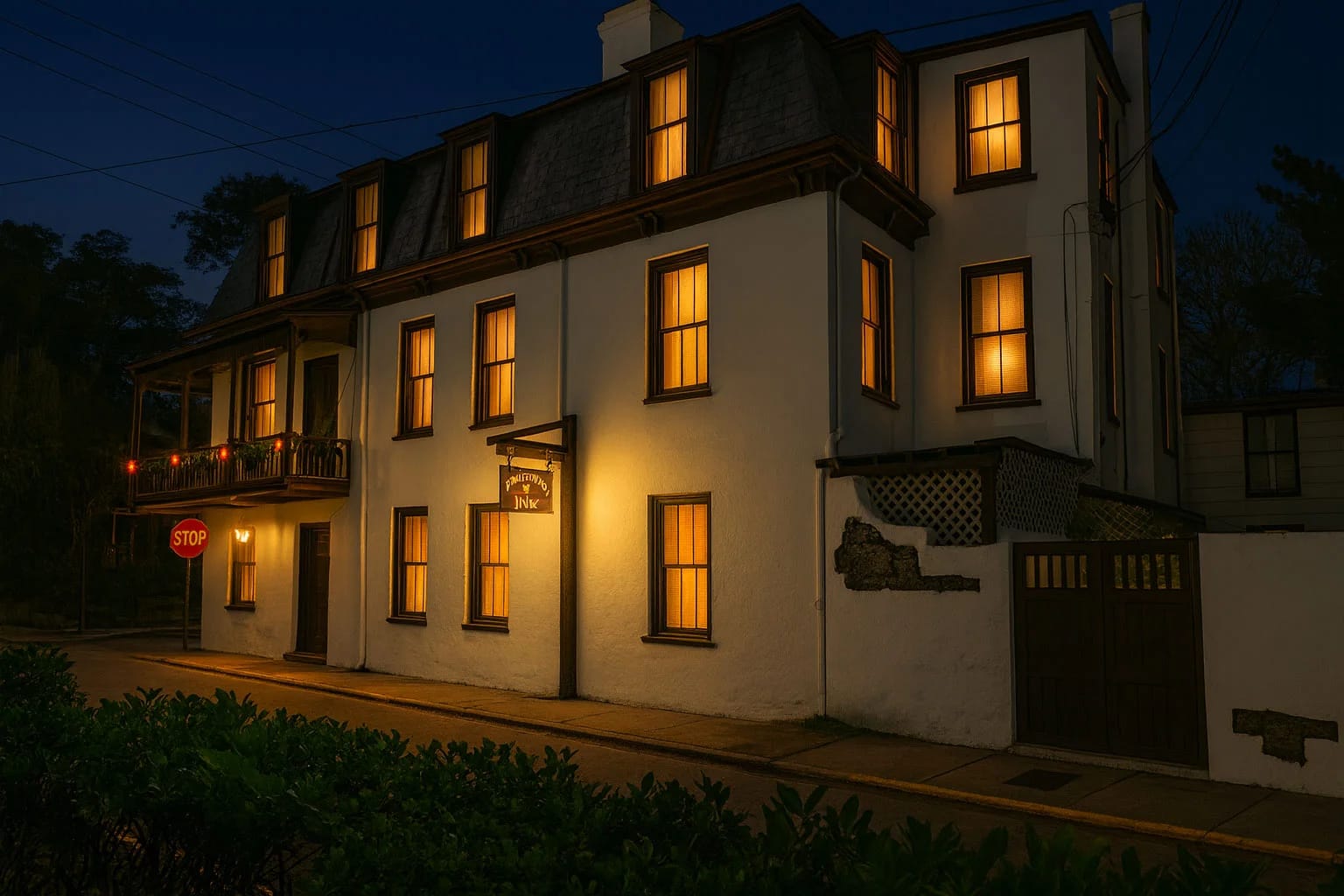
Rows of headstones at the Soldiers' National Cemetery in Gettysburg at dusk, with the Soldiers' National Monument beyond

Civil War Haunted Places in America

Battlefields, field hospitals, war prisons, occupied homes and soldiers' cemeteries: what the war brought to each place, the ghost stories told there today, and which ones you can visit.

100 places in 25 destinations · Sources checked October 29, 2026

The Civil War did not stay on its battlefields. Churches, courthouses, hotels and family parlors became hospitals; jails and harbor forts held prisoners of war; occupied cities quartered soldiers in their homes and theaters; and every town buried its dead. More than 600,000 soldiers died, most of them from disease and wounds, and many of the places that held them are the ones people now call haunted.

This collection brings together the places we write about whose war history is part of their story, from Gettysburg, Franklin and Chattanooga to cities few people think of as Civil War towns: Boston, San Francisco, Galveston and St. Louis. Each entry says what the war brought to the place, using only history we could check against cited sources; where a place's wartime role survives only as local lore, we say so. The ghost stories are presented as legend and reported experience, not as fact.

These places come from our own coverage and were chosen by our team. Many are in cities where we run tours, but being listed here does not mean a tour visits a place. This is not a survey of every Civil War site, and we do not rank them. Use it to see how far the war reached, then read our full article on any place that catches your interest.

How we chose these places. Every place has a full article, history checked against cited sources, and its ghost stories told as the accounts people share.

This collection covers the places we have written about whose Civil War history is central to their story or a substantial part of it: battle sites, hospitals, prisons and forts, occupied homes and headquarters, and burial grounds. Places where the war is only background are not included. Every entry is named by its actual city and state and shows its status as we last checked it. A tour includes a place only where its entry says “Featured on.”

  1. A real wartime role or event at the place (a battle, hospital, prison, headquarters, occupation or burial), or a wartime role told in local lore and presented as lore
  2. We publish a full article on the place and its stories, and it is identified by its actual city and state
  3. Historical statements checked against cited sources; where a story cannot be checked, it is told as legend
  4. Ghost stories presented as reported accounts and local lore, not as fact
  5. Each entry shows whether you can visit as we found it on the date shown, including private homes and places that no longer stand
Today
Role in the war

100 places

See the places

Battlefields and fighting ground

Ground where the armies met: Gettysburg's ridges, boulders and streets, Franklin's Carter and Lotz houses, the mountains around Chattanooga, and Fort Sumter, where the first shots were fired.

Charleston, SC

Fort Sumter

1861–65Phantom artilleryman

The war's opening shots fell here at 4:30 a.m. on April 12, 1861, and the unfinished island fort was surrendered a day later. Confederates then held it through a failed 1863 ironclad attack and a botched small-boat raid. Unlike most battlefields, it is reached only by boat: an authorized tour boat carries visitors out to the fort, where a museum sits in Battery Huger.

The story people tell

The best-known spirit is said to be Private Daniel Hough, killed when a cannon fired early during the surrender salute. Legend says Confederate defenders soon reported a Union soldier walking the walls. Visitors describe a figure rising from the shadows to salute the flag, the smell of gunpowder, and a crushing weight on the chest, and some believe Hough's face appears in a faded patch of the fort's flag.

History we checked · 2 sources
  • The American Battlefield Trust says no one was killed in the bombardment; the only deaths came from a premature round during the 100-gun salute afterward. (American Battlefield Trust)
  • The National Park Service says the fort's storm flag flew throughout the battle and was shown in the Fort Sumter museum from 1985 to 2023. (National Park Service)

Today: Open to the public (national historical park; reached only by the authorized tour-boat ferry) — verified October 29, 2026 (source)

Fort Oglethorpe, GA

Chickamauga Battlefield

Also known as: Chickamauga and Chattanooga National Military Park

1863Battlefield apparitions

In September 1863 about 125,000 soldiers fought in these dense woods, and more than 34,000 became casualties. Longstreet's breakthrough routed the Union right, and George Thomas's stand on Snodgrass Hill saved the army from destruction. In 1890 the field became the nation's first national military park, and its roads, trails and monuments are open to visitors daily.

The story people tell

Visitors report figures in uniform at the tree line, distant gunfire and drums on quiet mornings, and a heavy pressure on the chest in certain parts of the park. The best-known legend is the Green Eyes: glowing eyes that watch from between the trees at night, said to belong to a Confederate soldier whose head was never found, or to a soldier blinded in the battle.

History we checked · 2 sources
  • The American Battlefield Trust estimates 34,624 casualties at Chickamauga: 16,170 Union and 18,454 Confederate. (American Battlefield Trust)
  • The American Battlefield Trust calls the Chickamauga and Chattanooga park, created by Congress in 1890, the nation's first national military park. (American Battlefield Trust)

Today: Open to the public (national military park; battlefield open daily during daylight hours, free) — verified October 29, 2026 (source)

Lookout Mountain, TN (near Chattanooga)

Lookout Mountain Battlefield

Also known as: Point Park

1863Phantom soldiers in fog

On November 24, 1863, Hooker's Union troops climbed the steep, fog-wrapped slopes and broke the Confederate position, and that night Bragg pulled his men off the mountain, a key step in lifting the siege of Chattanooga. The fog gave the fight its name, the Battle Above the Clouds. Today the National Park Service's Point Park keeps overlooks, cannon and monuments on the summit.

The story people tell

Visitors say figures take shape at the edge of the fog and dissolve when approached, voices carry across the slopes at a conversational pitch, and single rifle shots crack through the mist on the heaviest mornings. Accounts from the trails where the fighting was fiercest describe a steady sense of being watched from the trees, as if the soldiers who fought blind here never left.

History we checked · 2 sources
  • The American Battlefield Trust says heavy fog screened the Union advance up Lookout Mountain on November 24, 1863, and that Bragg decided that night to pull his troops off the mountain. (American Battlefield Trust)
  • The National Park Service notes that after Chickamauga the Union army retreated into Chattanooga and was besieged by Bragg's army from Lookout Mountain and Missionary Ridge. (National Park Service)

Today: Open to the public (national military park; Point Park charges a small per-person entrance fee) — verified October 29, 2026 (source)
Chattanooga, TN

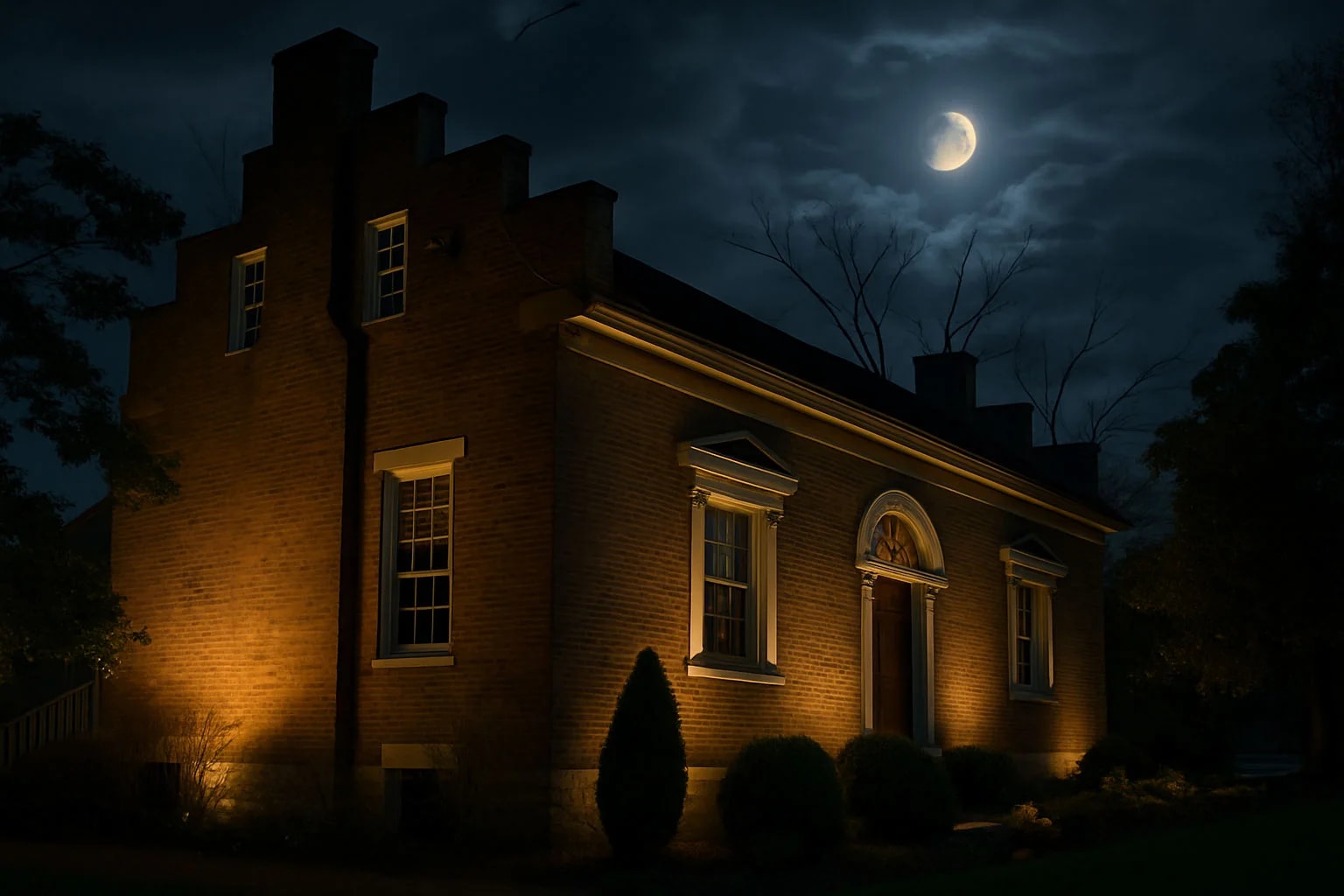
Missionary Ridge

1863Charging soldiers

On November 25, 1863, Union troops sent only to seize the rifle pits at its foot kept climbing, broke Braxton Bragg's center and sent the Confederate army retreating toward Dalton. Unlike sealed-off battlefields, the ridge is now a neighborhood: small national park reservations with monuments and cannon line Crest Road between private homes, open daily from sunrise to sunset.

The story people tell

Residents and visitors describe battlefield ghosts that never linger: figures glimpsed on the slope or near the monuments, caught mid-climb or mid-fall, then gone. People living along the crest report the rapid, scattered footsteps of many men running through their yards in the early evening, and walkers say the air sometimes turns cold and tense in a sudden rush before it passes.

History we checked · 2 sources
  • The National Park Service says the Bragg Reservation marks Bragg's headquarters, where Thomas's troops broke the center of the Confederate line. (National Park Service)
  • Wikipedia's account of the battle notes that Grant had ordered only the rifle pits taken and asked who had sent the men up the ridge. (Wikipedia)

Today: Open to the public (small national military park reservations along a residential crest road; homes are private) — verified October 29, 2026 (source)
Franklin, TN

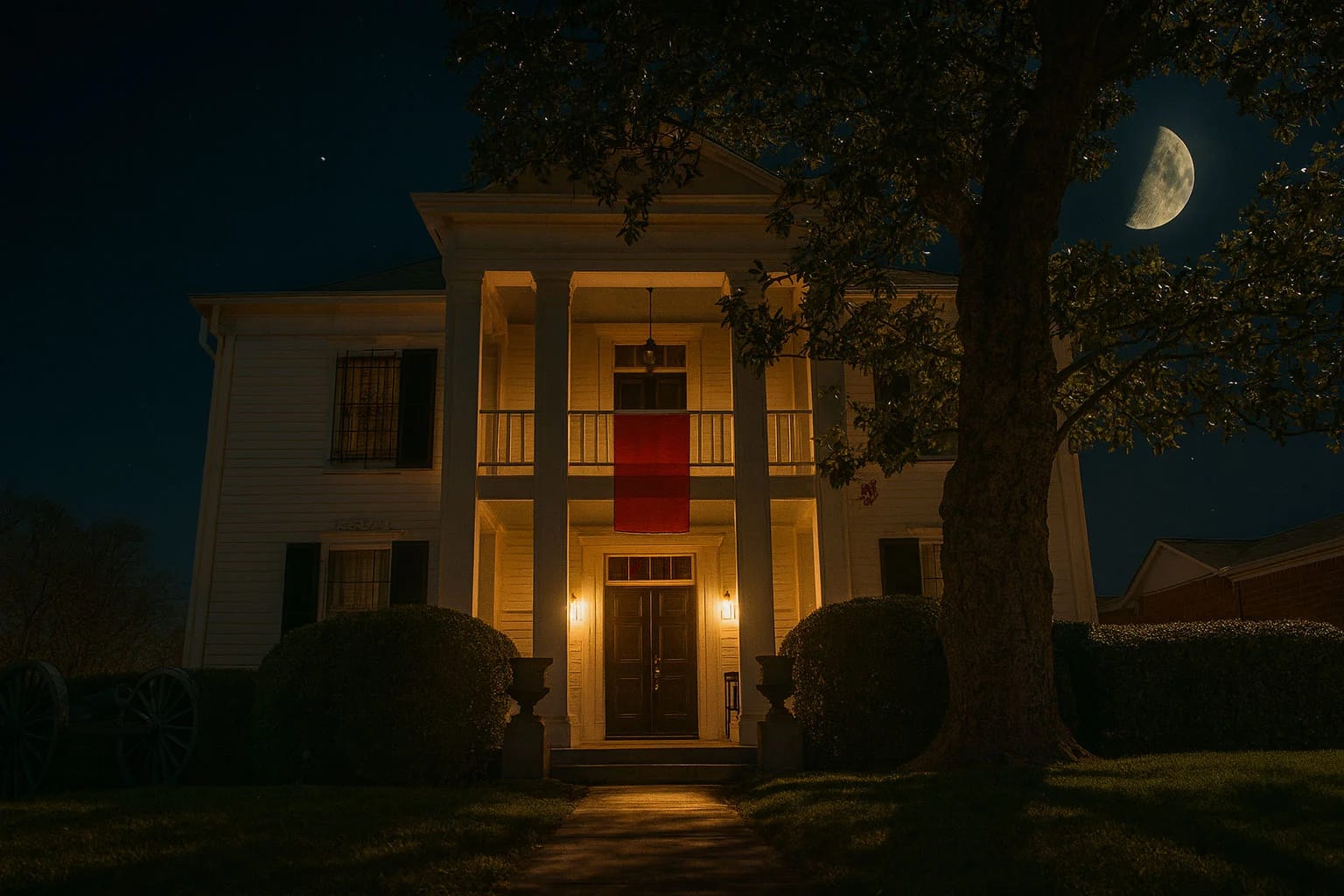
Carter House

1864Fallen son

Union Gen. Jacob Cox made the parlor his headquarters as some 20,000 Confederates attacked the works around the farm on November 30, 1864, while the Carters, neighbors and enslaved people sheltered in the cellar. Tod Carter was shot charging toward his own home and died inside two days later. Guided tours show the house and bullet-riddled outbuildings.

The story people tell

Visitors report a young man in Confederate uniform sitting on the bed or watching from the window of the room where Tod Carter died. Staff describe hearing Tod and his sister Annie talking just out of earshot, and say Annie tugs at sleeves. Neighbors tell of hoofbeats in the dark, said to be Tod's horse still searching for him.

History we checked · 2 sources
  • The Battle of Franklin Trust says Union Brig. Gen. Jacob D. Cox made the Carter parlor his headquarters during the battle. (Battle of Franklin Trust)
  • A Battle of Franklin Trust timeline says Tod Carter was found wounded on the field on December 1 and died in the house on December 2, 1864. (Battle of Franklin Trust)

Today: Entry only with an authorized guided tour: state historic site operated by the Battle of Franklin Trust; house seen on guided tours — verified October 28, 2026 (source)

Franklin, TN

Lotz House

Also known as: Lotz House Museum

1864Field-hospital ghosts

German-born woodworker Johann Albert Lotz finished this house in 1858, and on November 30, 1864, it stood in the path of Hood's assault at Franklin, a five-hour fight with nearly 10,000 casualties and six Confederate generals killed or mortally wounded. Cannon fire blew out its south wall, and it served as a field hospital afterward. It is now a house museum shown on guided tours.

The story people tell

Visitors describe dark stains on the floorboards and figures in Civil War uniforms moving around the outside of the house, along with screams, shouted orders and cannon fire. Inside, a woman in period dress is said to stand on the staircase holding a candle and calling 'Where is Ann?' Others report small hands tugging at their clothes, which some believe belong to the Lotz children or to drummer boys.

History we checked · 2 sources
  • The National Park Service estimates the Battle of Franklin cost 9,933 casualties and says six Confederate generals were dead or mortally wounded by its end. (National Park Service)
  • Wikipedia's entry on the Lotz House says the damaged house became a field hospital after the battle. (Wikipedia)

Today: Entry only with an authorized guided tour: privately run house museum; interior seen on guided tours — verified October 28, 2026 (source)

Gettysburg, PA

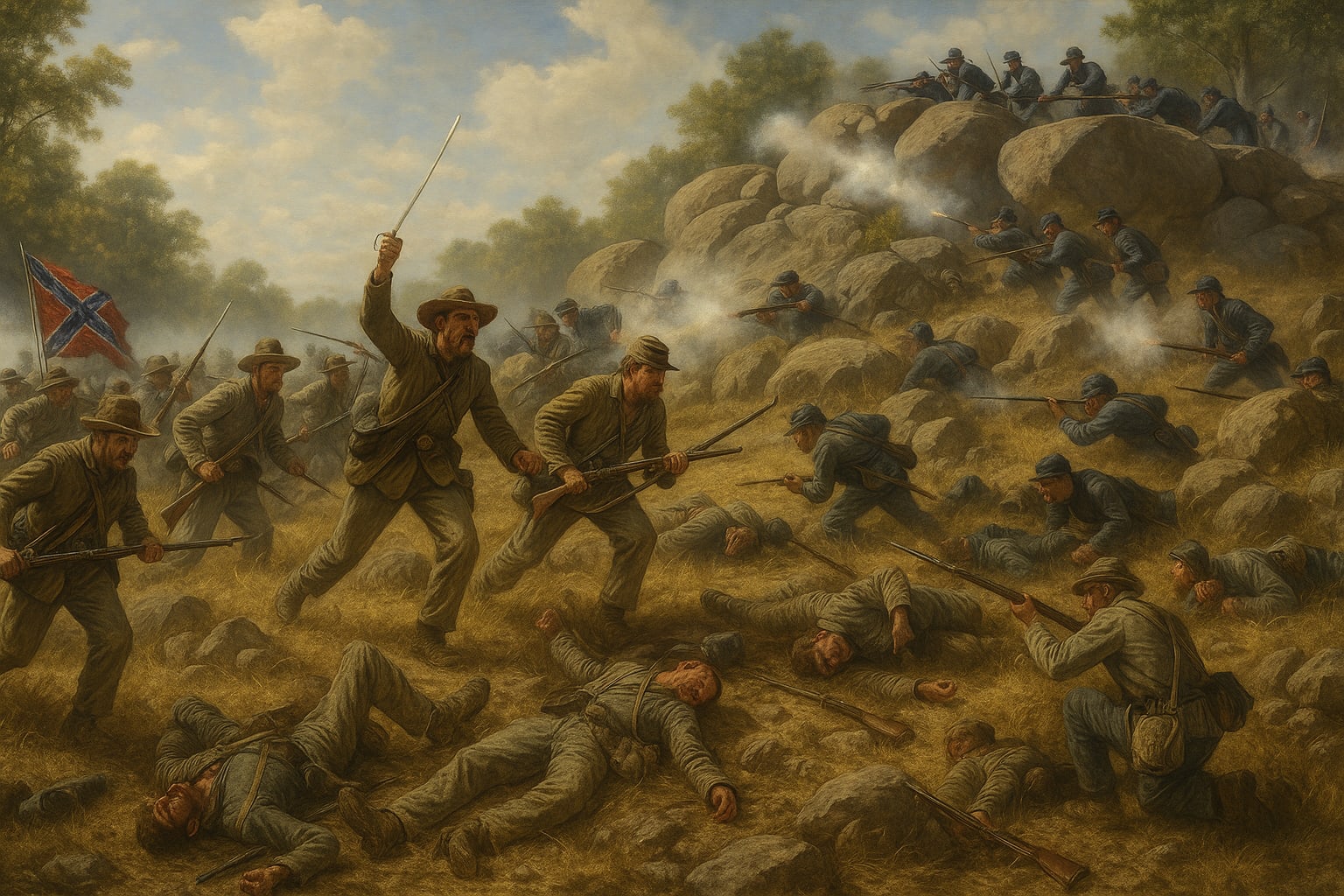
Devil's Den

1863Barefoot soldier

On the afternoon of July 2, 1863, Texans, Arkansans, Alabamians and Georgians in Hood's division fought Union troops from Maine and New York at close quarters among these granite boulders, driving off Smith's battery. Days later, photographers posed a fallen Confederate here for one of the war's most famous images. The boulders sit inside the national military park, open daily from dawn to dusk.

The story people tell

Visitors describe a barefoot man in a ragged Confederate uniform who points toward the rocks and vanishes when approached, while cameras reportedly die at the moment of the shot. Accounts tell of shadow figures crouched on the boulders, sharp gunfire on calm days, shouted commands from inside the rocks, and boots on granite when no one else is there.

History we checked · 2 sources
  • The National Park Service says Gardner's assistant moved a dead Confederate about 40 yards to stage the famous 'sharpshooter' photograph at Devil's Den in July 1863. (National Park Service)
  • Wikipedia's account of Devil's Den notes that Hood's assault began around 4 p.m. on July 2, with Smith's Union battery posted on the ridge above the rocks. (Wikipedia)

Today: Open to the public (national military park; grounds open from just before sunrise to just after sunset) — verified October 29, 2026 (source)

Gettysburg, PA

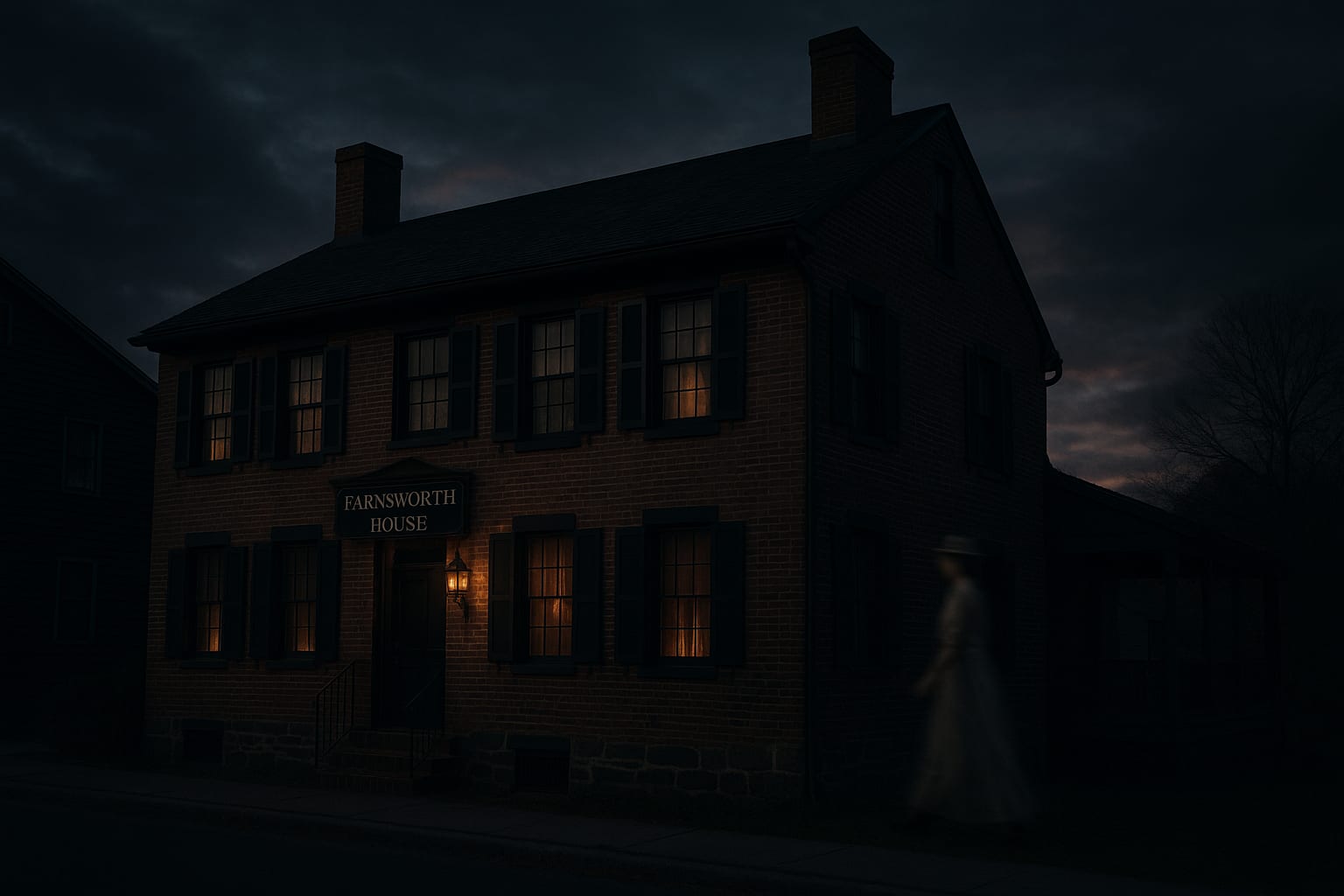
Farnsworth House Inn

1863Phantom sharpshooter

In July 1863 Harvey Sweney's house on Baltimore Street stood in the Confederate-held part of town, within range of Union lines on Cemetery Hill. Union return fire left the bullet holes still visible on its south wall, and wounded U.S. soldiers were brought inside after the battle. Named in the 1970s for General Elon Farnsworth, it is now an inn for overnight guests.

The story people tell

Tradition holds that Confederate sharpshooters fired from the attic, and local lore claims one of their bullets killed Jennie Wade. Guests say a Confederate soldier still paces the attic above their rooms, and others report boots echoing through empty halls at night. Stories also tell of Mary, a weeping mother in mourning, a young boy giggling on the stairs, and a silent Smiling Man.

History we checked · 2 sources
  • Gettysburg Daily says Union troops returning fire from the Cemetery Hill area made the bullet holes in the house's south wall. (Gettysburg Daily)
  • According to Gettysburg Daily, wounded U.S. soldiers were brought into the house after the battle. (Gettysburg Daily)

Today: Operating as a hotel or inn — verified October 28, 2026 (source)

Gettysburg, PA

Federal Pointe Inn

Lady in gray

The building itself postdates the battle: it opened in 1896 as the Meade School, named for the Union commander at Gettysburg, and local lore holds that it stands where Union troops held a defensive line. Around it, the town became the battle's aftermath, with wounded soldiers of both armies tended in homes and churches. Today the restored school is a boutique hotel taking overnight guests.

The story people tell

Guests describe a woman in a gray dress or cloak by the stairwells and lobby late at night; some believe she was a Civil War nurse or a townswoman caught in the battle's aftermath, others a former teacher. Uniformed Union soldiers, among them a wounded officer still writing dispatches, belong to the inn's lore, and running footsteps and giggling are credited to children from the school years.

History we checked · 2 sources
  • The National Park Service says wounded US and Confederate soldiers were tended by townspeople in homes and churches across Gettysburg. (National Park Service)
  • The inn's own site says the building was originally built in 1896 as the Meade School and converted to a boutique hotel in 2012. (Federal Pointe Inn (official site))

Today: Operating as a hotel or inn — verified October 28, 2026 (source)

Gettysburg National Military Park, Gettysburg, PA

Little Round Top

July 2, 1863Phantom soldiers

On July 2, 1863, this rocky hill anchored the Union left at Gettysburg. Colonel Joshua Chamberlain's 20th Maine held the far end of the line against the 15th Alabama, then broke the attack with a downhill bayonet charge, one of the best-known moments of the war. The hill is part of Gettysburg National Military Park and reopened in 2024 with new trails.

The story people tell

Visitors report soldiers walking among the boulders, the sounds of battle and the cries of the wounded. Legend tells of a drummer boy named Gideon whose drumming is still heard, and of a Confederate soldier called William, shot while climbing the slope, whose figure appears in gray beside a sudden cold breeze and the crack of a musket.

History we checked · 2 sources
  • Wikipedia's account of the battle says Chamberlain, low on ammunition, ordered a downhill bayonet charge that captured a large part of the 15th Alabama. (Wikipedia)
  • The National Park Service says Little Round Top reopened on June 24, 2024, after almost two years of rehabilitation work. (National Park Service)

Today: Open to the public (part of Gettysburg National Military Park; summit trails and monuments open, reopened 2024 after rehabilitation) — verified October 29, 2026 (source)
Cumberland Township, near Gettysburg, PA

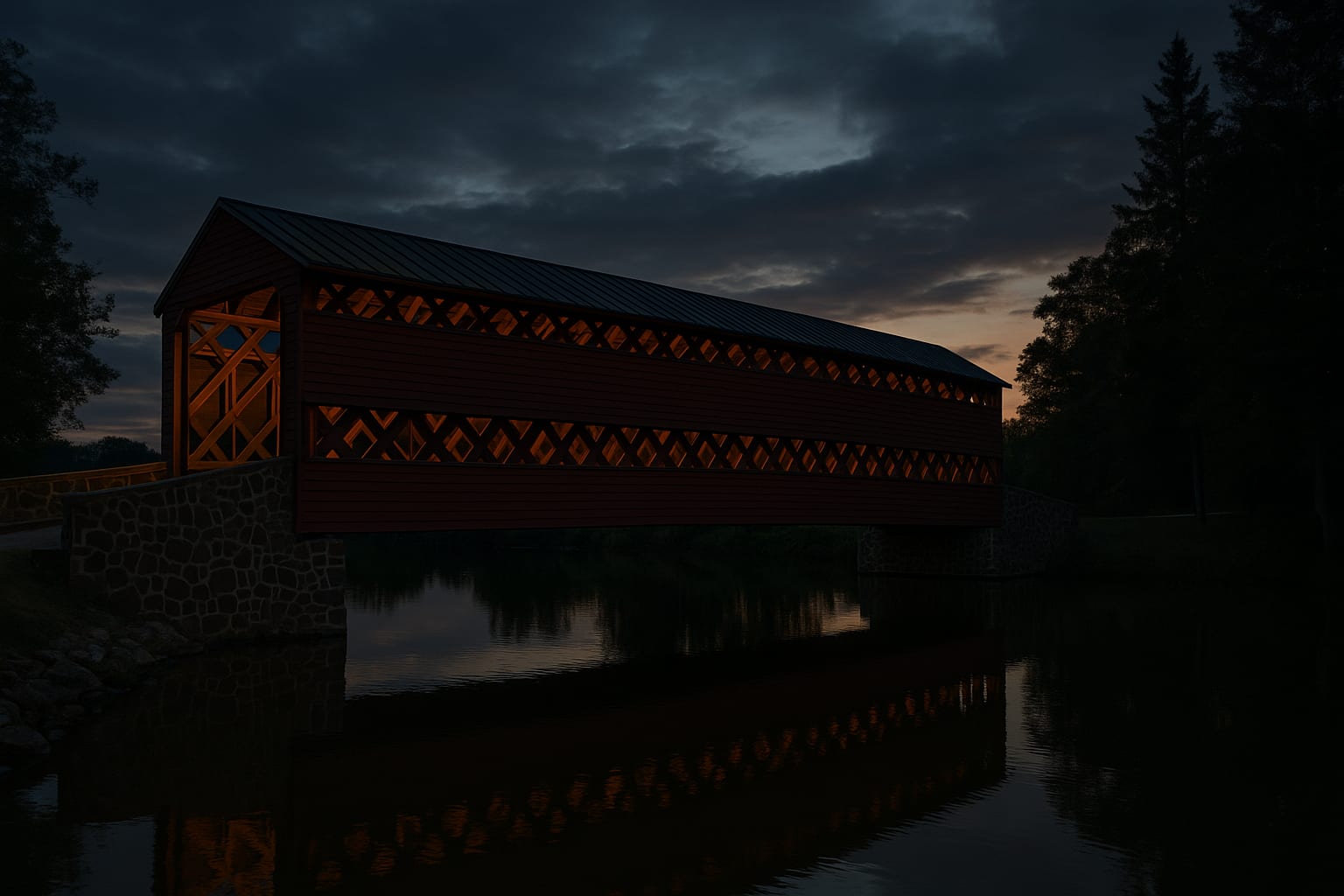
Sachs Covered Bridge

Also known as: Sauck's Bridge

1863Hanged soldiers

This 1850s Town-truss span over Marsh Creek carried both armies. Union brigades crossed on July 1, 1863, Longstreet's Confederates used it on July 2, and Lee's troops crossed it as the retreat began. Wounded men lay along the creek after Pickett's Charge. Closed to cars since the 1960s and restored after a 1996 flood, it is free to walk across on foot.

The story people tell

Legend says Confederate deserters were hanged from the bridge's beams by their own army, and visitors claim to feel a rope tighten at their throats or hear choking overhead. Others describe uniformed figures pacing the planks, lantern lights swinging with no one holding them, and a drowned soldier from the retreat whose pale face, some say, rises from the creek below.

History we checked · 2 sources
  • The Gettysburg Experience says Union brigades crossed the bridge on July 1, 1863, and Longstreet's Corps used it the next day. (The Gettysburg Experience)
  • According to Clio, Robert E. Lee's troops crossed Sachs Bridge as they began their retreat from Gettysburg. (Clio)

Today: Open to the public (pedestrian-only historic bridge; free to walk, best visited in daylight) — verified October 29, 2026 (source)

Gettysburg, PA

The Doubleday Inn

1863Union soldier ghosts

The inn sits on Oak Ridge, ground of the first day's fighting on July 1, 1863, and takes its name from Abner Doubleday, who took over the Union First Corps that morning when Gen. Reynolds was killed. The 1939 house is the only bed and breakfast on the battlefield itself, and guests can book a room and walk straight out among the monuments.

The story people tell

Guests describe a blue-eyed Union soldier in a tattered uniform standing by the windows and looking out toward the battlefield; some say they met his eyes in the glass, then turned to find no one there. Others report marching boots outside at night and the smell of gunpowder even on still, humid days, and investigators claim an EVP of a man's voice saying 'Hold the line.' Some say General Doubleday still makes his inspections.

History we checked · 2 sources
  • The National Park Service says command of the First Corps passed to Abner Doubleday after Reynolds was killed on July 1, 1863. (National Park Service)
  • The Gettysburg Times says the inn stands on Oak Ridge, scene of fierce fighting on the battle's first day. (Gettysburg Times)

Today: Operating as a hotel or inn — verified October 28, 2026 (source)

Gettysburg, PA

The Streets of Gettysburg

1863Phantom marching columns

On the afternoon of July 1, 1863, Confederate attacks broke the Union lines north and west of town and drove the retreating soldiers through these streets to Cemetery Hill, leaving the town in Confederate hands. Afterward the railroad depot on Carlisle Street shipped thousands of wounded north. The downtown streets are public and open to walk any time.

The story people tell

Visitors on Baltimore Street at night report heavy boots marching in formation with no one in sight and shadowy figures moving in lockstep before vanishing at the corner. Stories place a ragged, bloodstained Confederate under a Chambersburg Street lamp, a soldier at the foot of a guest's bed, and a headless soldier near Lefever Street, said to be a casualty of cannon fire.

History we checked · 2 sources
  • The American Battlefield Trust describes Union troops being pushed back through the Lutheran Seminary and into the streets of town on July 1, 1863. (American Battlefield Trust)
  • According to Wikipedia's history of the depot, nearly 15,000 wounded soldiers passed through the Gettysburg station by the end of July 1863. (Wikipedia)

Today: Open to the public (public streets of the historic downtown; walk them any time) — verified October 29, 2026 (source)
Hospitals and the wounded

Churches, schools, hotels, courthouses and homes that filled with the wounded after Gettysburg, Franklin, Chickamauga and other battles, from a Gettysburg college hall to a Nashville record shop.

Alexandria, VA

Green's Mansion House

Also known as: Mansion House Hospital

1861–65Unidentified spirits

In occupied Alexandria, Union authorities took James Green's Mansion House hotel and opened it on December 1, 1861 as Mansion House Hospital, the city's largest military hospital and the setting of PBS's Mercy Street. Most of the hotel was torn down in the 1970s; the surviving Bank of Alexandria building on North Fairfax Street houses a private business and is seen from the sidewalk.

The story people tell

Former employees interviewed by Ghost City Tours describe the same four figures: a worried man in a dark 19th-century suit who fades mid-stride, a weeping woman in white at the upper windows, and two girls in old-fashioned dresses who laugh on the third floor and vanish when noticed. Staff also tell of dinner-party voices in empty rooms, doors that will not stay locked, and a table set overnight with antique dishes.

History we checked · 2 sources

Today: The house no longer stands here — the hotel no longer stands as built; its surviving portion, restored as the historic Bank of Alexandria building, houses a private business — verified October 28, 2026 (source)

Austin, TX

The Stephen F. Austin Royal Sonesta Hotel

Also known as: Stephen F. Austin Hotel; planned as 'The Texas'; renamed Royal Sonesta Dec 2020

Hospital-site ghosts

Its war role is local lore: Austin tradition holds that this Congress Avenue tower rose over the site of a Civil War hospital and morgue, the story behind its soldier and nurse ghosts. Austin's first high-rise hotel when it opened in 1924, it still operates as a full-service Sonesta hotel, so visitors can book a room or stop in at the historic bar.

The story people tell

According to local lore, the hotel stands where wounded soldiers were treated and the dead laid out during the Civil War, and guests report ghostly nurses and phantom soldiers moving through the property. One guest's account of Room 408 describes a light that switched on and flashed by itself, then a closed bathroom door slowly swinging wide open before the room went dark again.

History we checked · 2 sources

Today: Operating as a hotel or inn — verified October 28, 2026 (source)

Chattanooga, TN

Tennessee Riverwalk

1862–63Phantom patrols

Chattanooga was a prize of the war, and its riverfront saw it up close. In 1862–63 the city became a hub for Confederate hospitals, and on November 24, 1863, Sherman's troops crossed the Tennessee by pontoon near the mouth of South Chickamauga Creek, by today's RiverPoint trailhead. The Riverwalk is a free public trail, open to walkers and cyclists around the clock.

The story people tell

Walkers and joggers report Union and Confederate soldiers moving along the path at dawn and dusk as if still on patrol, and say they hear drums, marching feet and shouted commands with no source. Local lore places Confederate hospital grounds along the riverfront, and visitors describe that stretch as especially active, along with cries from the water and a Woman in White on the Walnut Street Bridge.

History we checked · 2 sources
  • The National Park Service says Chattanooga's rail junction made it a center for treating the wounded as fighting reached Tennessee in late 1862 and early 1863. (National Park Service)
  • According to the National Park Service, Sherman's men crossed in pontoon boats and bridged the Tennessee near the mouth of South Chickamauga Creek before the attack on Missionary Ridge. (National Park Service (via NPS History))

Today: Open to the public (free public riverside trail; lit and patrolled around the clock) — verified October 29, 2026 (source)
Chattanooga, TN

The Read House

1861–63Hospital soldiers

In January 1861 Jefferson Davis spoke for secession at the Crutchfield House, the hotel that stood here, and Unionist William Crutchfield called him a traitor to his face. Confederates later used the hotel as a headquarters and hospital; after September 1863 it cared for Union wounded from Chickamauga. Today's 1926 Read House is an operating hotel.

The story people tell

Guests have reported ghostly soldiers roaming the fourth floor, and the hotel's stories tie them to men who may have died here when the Crutchfield House was a Civil War hospital. The best-known lore belongs to Room 311, where legend places a woman's brutal murder and guests describe an unsettling presence; one urban legend even puts Al Capone in that room behind barred windows.

History we checked · 2 sources
  • Wikipedia's history of the hotel says Confederates converted the Crutchfield House into a military hospital in the winter of 1862, and it later served Union soldiers wounded at Chickamauga. (Wikipedia)
  • The Read House's own history page says the Crutchfield House on the site was used as a Civil War hospital in 1863 and burned in 1867. (The Read House (official site))

Today: Operating as a hotel or inn — verified October 28, 2026 (source)

Franklin, TN

Carnton

Also known as: Carnton Plantation; McGavock house

1864Field-hospital ghosts

After the Battle of Franklin on November 30, 1864, Carnton became the area's largest Confederate field hospital, and four generals' bodies lay on its back porch. The McGavocks, who enslaved 44 people here in 1860, later reburied nearly 1,500 soldiers beside the house. The Battle of Franklin Trust shows the bloodstained house on guided tours; the cemetery sits alongside.

The story people tell

Visitors report a solemn woman in a long dark dress, believed to be Carrie McGavock, moving between rooms as if checking on patients. Witnesses describe a figure in a Confederate general's uniform, often said to be Patrick Cleburne, on the porch where the generals lay. Others tell of phantom soldiers crossing the fields at twilight and battle sounds drifting over the graves.

History we checked · 2 sources
  • The Battle of Franklin Trust says Carnton was the largest field hospital in the area, and its restored floors are still stained with the blood of the men treated there. (Battle of Franklin Trust)
  • According to the Trust, the bodies of Generals Cleburne, Granbury, Adams and Strahl lay on Carnton's back porch the morning after the battle. (Battle of Franklin Trust)

Today: Entry only with an authorized guided tour: historic site run by the Battle of Franklin Trust; house seen on guided tours — verified October 28, 2026 (source)

Franklin, TN

Franklin Masonic Hall

Also known as: Hiram Masonic Lodge No. 7

1864Shadow soldiers

Franklin's oldest public building, the 1823 Gothic hall was occupied by both Confederate and Union troops during the war, damaged in the Battle of Franklin on November 30, 1864, and used afterward to treat wounded Union soldiers. It is still a working Masonic lodge, so most visitors see its battlemented facade from Second Avenue; the lodge opens it for occasional tours.

The story people tell

Accounts here never settle on one named spirit. People describe footsteps crossing empty rooms, movement on the stairs, sounds from the upper floors, and human-sized shadows that pass across the narrow Gothic windows and doorways. Many believe the figures are soldiers from the war years, when the hall served as quarters and then as a hospital ward, while others say departed Masons still keep the lodge.

History we checked · 2 sources
  • Wikipedia's history of the lodge says the building was used to treat wounded Union soldiers after the Battle of Franklin. (Wikipedia)
  • Hiram Lodge No. 7 says both Confederate and Union troops occupied the hall and that it was damaged during the battle. (National Historic Hiram Masonic Lodge No. 7)

Today: Limited public access: active Masonic lodge; open to the public only for occasional tours and events — verified October 29, 2026 (source)

Franklin, TN

Historic Williamson County Courthouse

1864Cigar-smoking specter

Built in 1858, this Greek Revival courthouse on Franklin's Public Square served as Federal headquarters during the war, and after the Battle of Franklin on November 30, 1864, its offices became hospital wards for the wounded. It is one of seven antebellum courthouses left in Tennessee. Today it holds county offices; its iron-columned front faces the square.

The story people tell

Stories from the holding cells describe a bearded man in old-fashioned clothes who blows cigar smoke at prisoners, tells them to get out and vanishes. Some believe he was an officer who died in the wartime wards; others say a man hanged on the grounds. Staff report footsteps in empty halls, moving cold spots and whispered arguments in empty courtrooms.

History we checked · 2 sources
  • Williamson County's own history of the courthouse says its offices were used as hospital wards after the Battle of Franklin in November 1864. (Williamson County, Tennessee)
  • The courthouse marker says the building served as Federal headquarters during the Civil War and as a hospital during the Battle of Franklin. (Read the Plaque)

Today: Open to the public (historic courthouse, now county offices; exterior on the Public Square) — verified October 29, 2026 (source)

Franklin, TN

Old Franklin City Hall

1864Balcony sentries

On November 30, 1864, the Battle of Franklin cost about 8,500 casualties, and local historian Allen Sircy says the fighting reached the Public Square, where every building became a hospital. Local lore holds that Union officers made this building their headquarters before it filled with wounded. Today it is a commercial building on the square, and its balcony is easy to see from a bench.

The story people tell

Witnesses describe two figures in Union blue standing at attention on the balcony at twilight, solid enough to pass for reenactors until they vanish. People who have worked inside tell of footsteps on upper floors, doors that move on their own, barked commands and groans of pain, and the smell of blood and gunpowder where hospital wards are said to have stood.

History we checked · 2 sources
  • The American Battlefield Trust estimates about 8,578 casualties at Franklin on November 30, 1864: 2,326 Union and 6,252 Confederate. (American Battlefield Trust)
  • Author Allen Sircy told WKRN that the battle was fought all the way to the square and that every building on the square became a hospital. (WKRN News 2)

Today: Open to the public (commercial building on the Public Square; balcony visible from the square; businesses open to customers) — verified October 29, 2026 (source)

Franklin, TN

St. Paul's Episcopal Church

1862–64Quiet presence

Union troops occupying Franklin in 1862 turned this church into a barracks, burning its pews and pipe organ and damaging its columns to make horse troughs. After the Battle of Franklin it served as a hospital, first for Federal and then for Confederate wounded. Still an active church, it welcomes visitors, and the damaged columns remain.

The story people tell

Visitors describe an unusual stillness in the old nave where wounded men once lay, the impression of unseen occupants among the pews, and faint footsteps or movement when the sanctuary is empty. Local tradition holds that the haunting is a quiet one, less a single named ghost than the sense, as many put it, that the building remembers the barracks, the hospital and the stable it once was.

History we checked · 2 sources
  • St. Paul's own history says Union soldiers used the church as a barracks in 1862, burning the pews and pipe organ and damaging the columns to make watering troughs. (St. Paul's Episcopal Church)
  • According to the Tennessee Encyclopedia, soldiers built fires on the floor and cut holes in the roof to let the smoke out. (Tennessee Encyclopedia)

Today: Open to the public (active Episcopal church; visitors welcome at services, self-guided nave tour leaflet in the narthex) — verified October 29, 2026 (source)

Franklin, TN

The White Building

1864Drummer-boy ghost

After the Battle of Franklin on November 30, 1864, dozens of buildings in this small town filled with wounded and dying soldiers. The White Building, raised in 1923 at Five Points, stands in the heart of that downtown, and local lore ties its corner to a Union drummer boy. Its ground floor is a Starbucks today, and the upper floors are private.

The story people tell

Paranormal researcher Allen Sircy says that when he played the Battle Hymn of the Republic inside, the lights flared and meters spiked. Upstairs, someone asked the presence its name and the group heard 'Drake.' Sircy believes it is Thomas Jefferson Drake, a Union drummer boy. Visitors also report faint drumming, cold spots and shadow figures on the upper floors.

History we checked · 2 sources
  • The City of Franklin's preservation plan says dozens of Franklin buildings were converted into makeshift hospitals after the fighting. (City of Franklin, TN)
  • Williamson Source reports the White Building was built in 1923 and named for Dr. John White, who kept his office and drugstore there. (Williamson Source)

Today: Open to the public (ground floor is a Starbucks, open during business hours; upper floors are private) — verified October 29, 2026 (source)
Galveston, TX

Trinity Episcopal Church

1862–63Wounded soldier's ghost

Finished in 1857, this Gothic brick church stood through Galveston's war years, when Union troops held the city until Confederates drove them out on New Year's Day 1863. Local lore holds that its pews were pushed aside for cots and wounded soldiers of both sides were nursed here. It is still an active parish, and visitors are welcome at Sunday services.

The story people tell

According to staff and parishioners, a young man in a tattered Confederate uniform stands at the back of the church, meeting witnesses' eyes before he disappears; some believe he died here when the church was a hospital. Others describe a woman in mourning black in the same left-side pew, phantom organ music in the locked church, and storm sounds some report on the anniversary of the 1900 hurricane.

History we checked · 2 sources
  • Galveston.com's history of the parish says architect John De Young designed the brick church, begun in 1855 and opened two years later. (Galveston.com)
  • Wikipedia's account of the Battle of Galveston says Confederate forces under John B. Magruder expelled the occupying Union troops on January 1, 1863. (Wikipedia)

Today: Open to the public (active Episcopal parish; visitors welcome at Sunday services) — verified October 29, 2026 (source)
Gettysburg, PA

Dobbin House Tavern

1863Field-hospital ghosts

Gettysburg's oldest building, the 1776 stone home of Rev. Alexander Dobbin, became a field hospital during and after the battle, and the house says it treated wounded soldiers of both North and South. It sits a few hundred yards from the National Cemetery where Lincoln spoke. Today it is the Dobbin House Tavern, where diners eat in its candlelit rooms.

The story people tell

Diners and staff describe a wounded Union soldier wandering the lower levels near the basement stairs, where accounts say the grimmest hospital work took place, and some catch a sudden smell of antiseptic. A woman in a blue gown is said to glide through the upstairs rooms. Legend also ties a hidden crawl space to the Underground Railroad and to spirits still seeking freedom.

History we checked · 2 sources
  • The Dobbin House's own history says it served as a hospital for wounded soldiers of both the North and the South after the battle. (Dobbin House Tavern)
  • Wikipedia's entry on the tavern says the house served as a field hospital during and after the Battle of Gettysburg. (Wikipedia)

Today: Open to the public (operating as Dobbin House Tavern, with a casual tavern and candlelit dining rooms) — verified October 29, 2026 (source)

Gettysburg, PA

Gettysburg College

Also known as: Pennsylvania College

1863Field-hospital time slip

On July 1, 1863, Union officers climbed Pennsylvania Hall's cupola to watch the fighting; by nightfall the campus lay behind Confederate lines and Lee used the same lookout. The building became a hospital for both armies until late July, treating more than 700 men. Today it is an active campus: walk the grounds, but its buildings are for students and staff.

The story people tell

The best-known story says two administrators rode the Pennsylvania Hall elevator to the basement after hours and stepped out into a Civil War operating room, with surgeons at work and wounded men moaning, before it vanished. Students and staff report soldiers in blue and gray crossing the lawns and slipping through doorways, and a Woman in White some believe was a wartime nurse.

History we checked · 2 sources
  • Gettysburg College says Pennsylvania Hall became a hospital for hundreds of soldiers from both North and South during the battle. (Gettysburg College)
  • Journey Through Hallowed Ground says officers including General Lee used the cupola, and more than 700 casualties were treated in the building. (Journey Through Hallowed Ground)

Today: Limited public access: active college campus; walk the grounds, but buildings are for students and staff — verified October 29, 2026 (source)

Gettysburg, PA

Gettysburg Field Hospitals

1863Phantom surgeons

After the battle, some 20,000 wounded men were left behind in Gettysburg, and farms, churches, college halls and homes became more than sixty hospital sites until the last tent hospital closed in November 1863. Most are now private homes or farms seen from the road, but the Spangler Farm and the Seminary Ridge Museum let visitors step inside.

The story people tell

Visitors and investigators describe moaning, the clink of surgical tools and footsteps in the Spangler barn loft, with recorded voices said to plead "Help me." Seminary staff report slamming doors and dragging boots, and some believe a wounded Confederate still keeps to the attic. At Pennsylvania Hall, legend tells of an elevator opening onto a living Civil War operating scene before it vanishes.

History we checked · 2 sources
  • The American Battlefield Trust says about 14,000 wounded Union and 6,000 wounded Confederate soldiers were left in Gettysburg, at more than sixty hospital sites. (American Battlefield Trust)
  • The Gettysburg Experience reports that the XI Corps hospital at the Spangler Farm held an estimated 1,800 wounded at once, including the dying Gen. Lewis Armistead. (The Gettysburg Experience)

Today: Limited public access: most are private homes and farms; a few, like Spangler Farm and Seminary Ridge Museum, are museums — verified October 29, 2026 (source)
Gettysburg, PA

Gettysburg Lincoln Railroad Station

1863Wounded soldiers' ghosts

This 1858 depot served as a hospital during the battle, then became the town's lifeline: nearly 15,000 wounded soldiers left through it by the end of July 1863, along with the bodies of the dead. On November 18, 1863, Abraham Lincoln stepped off a train here on his way to the Gettysburg Address. It now opens seasonally as a free museum.

The story people tell

Visitors and staff report moaning, shuffling footsteps and the creak of stretchers crossing the empty platform, and cries of 'Medic!' through the halls. Many describe a woman in 19th-century dress, believed to be a nurse, reaching toward passersby. A few accounts claim a tall, thin man in a stovepipe hat walks the platform for a few seconds before he is gone.

History we checked · 2 sources
  • The National Park Service says the 1858 station served as a hospital during the battle, carried the wounded and the dead out of Gettysburg, and received Lincoln on November 18, 1863. (National Park Service)
  • Wikipedia's history of the station says nearly 15,000 wounded troops had passed through it by the end of July 1863. (Wikipedia)

Today: Open to the public (free museum open seasonally (spring through fall); check current days) — verified October 29, 2026 (source)

Gettysburg, PA

Hotel Gettysburg

Also known as: Gettysburg Hotel; , 1 Lincoln Square

Phantom sentry

Tracing its roots to a 1797 tavern on Lincoln Square, this hotel is steps from the David Wills House, where the National Park Service says Lincoln stayed the night before the Gettysburg Address. Local accounts say the hotel, then known as the McClellan House, took in wounded Union soldiers during the battle. It operates today as Hotel Gettysburg, so guests can stay on the square itself.

The story people tell

Guests describe a Union soldier standing at attention in rooms and hallways, sometimes checking doors as if still on duty, before vanishing. A spirit known as Rachel, believed to be a Civil War nurse, is said to open drawers and move belongings, and skirts are heard swishing down the halls at night. Others report a woman in period dress dancing alone in the ballroom, and some believe Lincoln's spirit lingers nearby.

History we checked · 2 sources
  • The National Park Service says Lincoln spent the night before the Gettysburg Address at the David Wills House on the square. (National Park Service)
  • ABC27 reports the hotel traces its roots to 1797, when it opened as Scott's Tavern. (ABC27 (WHTM))

Today: Operating as a hotel or inn — verified October 28, 2026 (source)

Gettysburg, PA

Tillie Pierce House

Also known as: James Pierce House

1863Wounded-soldier ghosts

Fifteen-year-old Tillie Pierce fled this Baltimore Street butcher's house for the Weikert farm and nursed the wounded there; her memoir is one of the battle's best-known civilian accounts. Back home, Confederate sharpshooters raided the cellar, and her mother later nursed five wounded Union soldiers in the house. Restored to its 1860s look, it is now a bed and breakfast open to overnight guests.

The story people tell

Guests describe a dark male figure in a long coat climbing or descending the staircase and vanishing, believed by some to be a soldier who died in the house. Others report a woman sobbing in an upstairs bedroom, children's laughter in empty halls said to belong to young drummer boys, and recorded voices whispering 'Help him' and 'Mama.'

History we checked · 2 sources
  • Gettysburg Daily says five wounded Union soldiers were nursed by Mrs. Pierce in the house, and Colonel William Colvill of the 1st Minnesota later recovered there. (Gettysburg Daily)
  • According to Gettysburg Daily, Tillie left with Henrietta Shriver for the Jacob Weikert farm when the battle began. (Gettysburg Daily)

Today: Limited public access: now a bed-and-breakfast inn; interior for overnight guests — verified October 28, 2026 (source)

Nashville, TN

Ernest Tubb Record Shop

1862–65Hospital soldier ghosts

Nashville surrendered in February 1862, the first Confederate state capital to fall, and became a major Union supply depot. Occupation forces turned buildings across town into hospitals, and this one at 417–423 Broadway served as Federal Hospital No. 3, with 250 beds. Since 1951 it has been home to the Ernest Tubb Record Shop, open to customers on Lower Broadway.

The story people tell

Employees describe a feverish young soldier in gray sitting on boxes in the basement stockroom, calling for 'Mother' or 'Sarah' before fading away. Staff also report moaning, boots marching and a sound like a saw on bone, a woman in a long dark dress tending patients no one can see, and two soldiers, one in blue and one in gray, resting side by side.

History we checked · 2 sources
  • The Metro Nashville Historical Commission says the building now housing the Ernest Tubb Record Shop was used as Hospital No. 3 in the Federal hospital system, with 250 beds. (Metro Nashville Historical Commission)
  • Nashville Sites says Gen. Don Carlos Buell accepted the city's surrender on February 25, 1862, making Nashville the first Southern capital captured and occupied by the Federal army. (Nashville Sites)

Today: Open to the public (operating record store on Lower Broadway; open to customers) — verified October 29, 2026 (source)

Nashville, TN

St. Mary of the Seven Sorrows Catholic Church

1864Confederate priest

Nashville's oldest standing church, dedicated in 1847, was the last in the occupied city turned into a Union hospital, and during the Battle of Nashville in December 1864 it took in wounded from both armies. Some 300 soldiers are said to have died inside. It remains an active Catholic parish, open to visitors at Mass.

The story people tell

Legend holds that a Catholic priest serving in the Confederate Army was carried into the church after being shot and died here, and many believe he still walks the sanctuary. Stories also tell of Monsignor John Morgan woken twice by pounding at his door and then on his headboard, and locals say Bishop Miles, who was buried beneath the altar, makes himself known when the bell misses the hour.

History we checked · 2 sources
  • Nashville Sites, the local history project, says St. Mary's was the last Nashville church converted into a Union hospital and that roughly 300 soldiers died there. (Nashville Sites)
  • Wikipedia notes the church served wounded Union and Confederate soldiers during the Battle of Nashville in December 1864. (Wikipedia)

Today: Open to the public (active Catholic parish; visitors welcome at Mass) — verified October 29, 2026 (source)
San Antonio, TX

The Menger Hotel

1861–65Wartime ward ghosts

Opened beside the Alamo in 1859, the Menger shut its guestrooms during the war, fed Confederate military personnel from its dining room and gave space to care for wounded soldiers. After the war it hosted Union generals Sheridan and Grant. It still operates as a hotel, so a Civil War traveler can book a room in the original wing.

The story people tell

Hotel lore says the wartime sick and wounded who never recovered left their mark on the old building. Guests and staff describe the maid Sallie White still tending rooms, cattleman Richard King, a Confederate cotton trader who died in his suite in 1885, leaving papers on the desk, and Rough Riders said to drink in the Menger Bar.

History we checked · 2 sources

Today: Operating as a hotel or inn — verified October 28, 2026 (source)

Savannah, GA

The Marshall House

1864–65Amputee soldier ghosts

When Sherman's army occupied Savannah in December 1864, Union troops took over the Marshall House and ran it as a hospital until the war ended. The 1851 hotel on Broughton Street was fully restored and reopened in 1999, and it still takes overnight guests, so you can sleep inside a building that once served as a Union hospital.

The story people tell

A story long told at the hotel says late-1990s renovation crews found bones under the floorboards of the old surgery room, believed to be amputated limbs of Civil War soldiers. Guests describe amputee soldiers wandering the halls, one in the lobby holding his missing arm and pleading for a surgeon, and phantom doctors still treating the wounded.

History we checked · 2 sources

Today: Operating as a hotel or inn — verified October 28, 2026 (source)

Washington, DC

United States Capitol

1861–65Hospital soldier's ghost

In 1861 Union troops were quartered in the House and Senate chambers while brick ovens in the basement baked bread for the army, and after Second Bull Run in 1862 the unfinished Capitol became a hospital for wounded soldiers. In April 1865 Abraham Lincoln lay in state beneath its new dome. Free guided tours start at the Capitol Visitor Center.

The story people tell

Legend tells of a Union soldier who died when the Capitol was a hospital, seen in the basement in a bloodied uniform asking for water and his mother; night janitors are said to leave water out for him. Lore also says General John Logan walks the halls in uniform, and that the Demon Cat appeared before Lincoln's assassination.

History we checked · 2 sources
  • The U.S. Senate's history office says troops were quartered in the chambers, basement ovens supplied bread, and after Second Bull Run in 1862 the Capitol was used as a hospital. (U.S. Senate)
  • The Architect of the Capitol says Lincoln lay in state in the Rotunda from April 19 to 21, 1865, on a bier built for him that is still in use. (Architect of the Capitol)

Today: Entry only with an authorized guided tour: free guided tours from the Capitol Visitor Center; reservations recommended — verified October 29, 2026 (source)

Williamsburg, VA

George Wythe House

Phantom surgeries

Its Civil War role is local lore: tradition holds that the house, already George Washington's headquarters before Yorktown, served as a field hospital in two wars, including after the May 5, 1862 Battle of Williamsburg, when Union troops occupied the town for the rest of the war. Today it is a Colonial Williamsburg historic site, included with Foundation admission.

The story people tell

According to local lore, amputations were performed in the parlor, and visitors report phantom surgeries there: bone saws, agonized screams and the smell of gangrene in an empty room. Phantom soldiers from both wars are said to haunt the house, while upstairs Lady Ann Skipwith is seen and heard, and George Wythe's ghost is tied to his study, especially around June 3, said to be his birthday.

History we checked · 2 sources
  • The American Battlefield Trust says the Battle of Williamsburg was fought on May 5, 1862, as a Confederate delaying action during the Peninsula Campaign. (American Battlefield Trust)
  • William & Mary says Union forces occupied the town after the battle and were quartered on the college campus from 1862 to 1865. (William & Mary News)

Today: Open to the public (Colonial Williamsburg historic site, included with Colonial Williamsburg admission; check the Foundation's site for how the house is currently shown) — verified October 28, 2026 (source)

Williamsburg, VA

Peyton Randolph House

1862Hospital screams

After the Battle of Williamsburg on May 5, 1862, the colonial home of Peyton Randolph, then owned by the Peachy family, became a hospital for wounded Union and Confederate soldiers. It is among the oldest houses in Colonial Williamsburg, and visitors see its rooms today on guided tours included with Colonial Williamsburg admission.

The story people tell

Local lore says hundreds of soldiers died in agony while the house was a hospital, and visitors report the screams of dying men at night and blood said to seep up through the floors in humid weather. Older legends tell of three British soldiers murdered in their beds during the Revolution, and guests describe being pushed, scratched and choked by unseen hands.

History we checked · 2 sources
  • Wikipedia's entry on the house says it was used as a hospital for Union and Confederate troops wounded in the Battle of Williamsburg. (Wikipedia)
  • Virginia's Department of Historic Resources identifies it as the home of Peyton Randolph, first president of the Continental Congress. (Virginia Department of Historic Resources)

Today: Entry only with an authorized guided tour: Colonial Williamsburg historic site; interior seen on guided tours included with Colonial Williamsburg admission — verified October 28, 2026 (source)

Williamsburg, VA

Sir Christopher Wren Building, William & Mary

1861–62Field-hospital ghosts

When war closed William & Mary in 1861, Confederate troops defending the Peninsula used college buildings as hospitals, and the 1695 Wren Building served as a hospital during the Union occupation. In September 1862, troopers of the 5th Pennsylvania Cavalry set it ablaze and gutted it. Today it is again a working college building, its first two floors open to visitors with student-led tours.

The story people tell

Stories say wounded soldiers still call out for water, morphine and their mothers in the old classrooms, and phantom screams echo in the Great Hall, said to have served as an operating room. Campus lore adds six students said to have died in the 1705 fire, a lost French soldier of the Revolution on the third floor, and whispered Latin prayers in the chapel crypt.

History we checked · 2 sources

Today: Open to the public (working college building; first two floors open to visitors, student-led tours) — verified October 29, 2026 (source)

Forts and prisons

Harbor forts and jails that held prisoners of war, spies and political prisoners, from Boston Harbor and the Delaware River to Alcatraz, plus the Confederate forts that guarded Savannah.

Alexandria, VA

Alexandria City Hall

1861–65Prisoner ghosts

Union troops occupied Alexandria in May 1861 and held it for the rest of the war, keeping Confederate soldiers, Union soldiers and civilians in several military prisons around town. Local lore holds that the old City Hall on Market Square, gutted by fire in 1871 and rebuilt to an Adolf Cluss design, served as one more. The building and square are closed for renovation until about 2028.

The story people tell

Local lore says gaunt men in tattered Civil War-era clothing appear in the basement and stairwells, then vanish — the prisoners some believe were held on this ground. Employees describe hushed voices below stairs, a woman in white on the upper floors said to be a wife waiting for word of her husband, and footsteps climbing the empty clock tower.

History we checked · 2 sources
  • Emerging Civil War notes that Union troops entered Alexandria on May 24, 1861, and held the city for the rest of the war. (Emerging Civil War)
  • Wikipedia's history of the building says fire gutted the 1817 hall on May 19, 1871, and architect Adolf Cluss designed its replacement. (Wikipedia)

Today: Temporarily closed (closed for renovation, about 2026–2028; Market Square fenced off) — check reopening plans before you go; verified October 29, 2026 (source)

Baltimore, MD

Fort McHenry National Monument and Historic Shrine

1861–65Prisoner ghosts

In the Civil War, Union authorities turned the star fort that had withstood the 1814 bombardment into a prison. With habeas corpus suspended, Baltimore's mayor and a third of the Maryland legislature were held here without trial, and after Gettysburg the fort held 6,957 Confederate prisoners at once. Now a national park site, its Star Fort and grounds are open to visitors year-round.

The story people tell

Fort lore says Union guards in the prison years kept meeting the ghost of Sergeant John Clemm, killed in the 1814 bombardment, pacing the western wall as if troubled to see Americans jailing Americans. Visitors describe crying and pleading voices in the old prison spaces and sudden panic in the powder magazine, and psychics claim an angry Confederate officer who died in custody still lingers.

History we checked · 2 sources
  • The National Park Service says 6,957 Confederate prisoners were held at the fort at one time after the Battle of Gettysburg. (National Park Service)
  • According to the National Park Service, about 15 men died at the 'Baltimore Bastille,' and at least three were executed there. (National Park Service)

Today: Open to the public (national park site; Star Fort and grounds open year-round except three holidays) — verified October 29, 2026 (source)
Georges Island, Boston Harbor, MA

Fort Warren

1861–65Lady in Black

A granite harbor fort that became a Union prison for Confederate soldiers, officials and political prisoners, among them the Trent Affair diplomats Mason and Slidell and Vice President Alexander Stephens. Only 13 of more than 2,300 prisoners died here. Visitors take a seasonal ferry to Georges Island and explore its casemates and dark passageways.

The story people tell

The fort's most famous ghost is the Lady in Black. Legend says she rowed out to free her imprisoned Confederate husband, accidentally killed him in a struggle with a guard, and was hanged in black robes. Soldiers reported being chased by her, and visitors describe black shadow figures moving across the island.

History we checked · 2 sources
  • The National Park Service says Fort Warren held more than 2,300 prisoners during the war, and only 13 of them died. (National Park Service)
  • According to the National Park Service, soldiers of the 'Tiger Battalion' composed 'John Brown's Body' at the fort in May 1861. (National Park Service)

Today: Open to the public (island park reached by seasonal ferry; fort open to explore, with ranger tours in season) — verified October 29, 2026 (source)

Charleston, SC

Old Charleston Jail

Also known as: Old City Jail

1861–65Prisoner ghosts

During the Civil War the county jail held prisoners of war from both sides, among them Black soldiers of the 54th Massachusetts captured in the July 1863 assault on Fort Wagner. Few places tie Charleston's war so directly to the men who fought to end slavery. The building is now offices; its ground floor is seen only on a ticketed ghost tour.

The story people tell

Stories say the jail never emptied. Visitors describe being touched or scratched by an unseen presence, workers during the 2000 renovation reported fresh footprints in sealed rooms and a phantom guard with a rifle patrolling the third floor, and legend holds that Lavinia Fisher still walks the floor where she awaited the gallows, alongside the prisoners of war who died here.

History we checked · 2 sources
  • The National Park Service says Confederate and Federal prisoners of war were held in the jail, which served Charleston County from 1802 to 1939. (National Park Service)
  • According to Wikipedia, the prisoners included many Black soldiers of the 54th Massachusetts captured after the July 1863 attack on Fort Wagner. (Wikipedia)

Today: Entry only with an authorized guided tour: now offices; interior seen only on a ticketed ground-floor ghost tour — verified October 29, 2026 (source)
Nashville, TN

Maxwell House Hotel

Also known as: original, 1869–1961

1861–65Prisoner ghosts

Begun in 1859 with enslaved labor, the unfinished hotel became Confederate 'Zollicoffer Barracks,' then a Union prison for captured Confederates after Nashville fell in 1862. In September 1863 a staircase collapsed under moving prisoners, killing several. The hotel finally opened in 1869 and burned in 1961; modern downtown buildings now stand on the site, viewable only from public sidewalks.

The story people tell

People working in the buildings on the site describe men in ragged gray uniforms in basements and stairwells, some calling for water. One office worker recalled a sickly young man saying 'I just want to go home' before vanishing. Others report a surgeon in a bloodied apron washing his hands, a woman in black mourning dress, and the sound of sawing and rattling chains.

History we checked · 2 sources
  • Metro Nashville Parks' Civil War walking tour says Confederates first used the unfinished building as 'Zollicoffer Barracks' before the Federal army made it a prison for captured Confederates. (Metro Nashville Parks (Fort Negley))
  • The same walking tour says a staircase collapsed on September 29, 1863, as prisoners were moved, killing several men and injuring seventy-five. (Metro Nashville Parks (Fort Negley))

Today: The hotel no longer stands — verified October 28, 2026 (source)

New Orleans, LA

Morro Castle

Also known as: the "Old Spanish Garrison"

1862Prisoner ghosts

When Union forces under Gen. Benjamin Butler occupied New Orleans in 1862, local accounts say the military government took over this 1830s building at Burgundy and Barracks as a jail for Confederate sympathizers and residents who opposed the occupation, and local lore holds that it also served as a Union military hospital. Now private apartments, it can be seen only from the sidewalk.

The story people tell

Visitors describe soldiers' spirits stepping straight out of the walls, and lore holds that ghostly Confederate soldiers are still seen inside, an echo of the building's days as a Union jail. Older legend tells of Spanish mutineers who murdered their officers for hidden treasure and were tortured to death, and passersby on the sidewalk after dark tell of faint cries and shadows creeping along the building.

History we checked · 2 sources
  • According to the Southern Spirit Guide, historian Stanley Clisby Arthur dated the building to the 1830s, long after Spanish rule ended. (Southern Spirit Guide)
  • Butler's General Order No. 28 of May 15, 1862, threatened to treat any woman who insulted Union soldiers 'as a woman of the town,' Wikipedia notes, and some women were jailed. (Wikipedia)

Today: Private residence, not open to visitors — we do not encourage anyone to approach the house; please respect the residents' privacy — verified October 29, 2026 (source)

Philadelphia, PA

Fort Mifflin

1863–65Faceless Man

Besieged by the British in 1777, this Delaware River fort became a Union military prison in 1863, beginning with Confederates captured at Gettysburg. Its damp casemates also held Union soldiers and civilians, and in August 1864 Private William Howe was hanged here for desertion and murder. Fort Mifflin is a museum today, open seasonally, with tours, living history and paranormal investigations.

The story people tell

Its best-known ghost is the Faceless Man, said to wander the grounds in Civil War clothes. Many believe he is William Howe, hooded on the gallows. Visitors also report soldiers cleaning their guns when no reenactors are present, cries from the old prison casemates, a woman's scream at all hours, and phantom hands that touch and push.

History we checked · 2 sources
  • Fort Mifflin's own history says Confederate prisoners from Gettysburg arrived in July 1863, with as many as 216 held in the largest casemate at peak. (Fort Mifflin on the Delaware)
  • According to the fort, William H. Howe of the 116th Pennsylvania was executed there on August 26, 1864. (Fort Mifflin on the Delaware)

Today: Open to the public (historic fort museum, open Wednesday–Sunday from March to mid-December; paranormal investigations by booking) — verified October 29, 2026 (source)

Salem, MA

Old Salem Jail

Also known as: Essex County Jail

Prisoner ghosts

Built in 1813 as the Essex County jail, this brick-and-stone lockup was in service through the Civil War, and local lore holds that captured Confederate soldiers were confined here. It held prisoners until 1991, when it was the oldest active penitentiary in the country. Today the restored building is private apartments, seen from St. Peter Street beside Howard Street Cemetery.

The story people tell

Local lore holds that Confederate prisoners once filled these cells, and some link them to agonized cries heard through the night and to a shadowy man carrying a candle past an upstairs window, on a floor said to have collapsed years ago. Other accounts describe escapees sprinting across the front lawn to the rattle of chains and shadow people moving through the empty halls.

History we checked · 2 sources
  • The National Park Service says the jail was constructed in 1813, expanded in 1884, and declared unfit for human habitation in 1991. (National Park Service)
  • The History of Massachusetts Blog says the jail was the oldest active penitentiary in the U.S. when a judge ordered it closed in 1991. (History of Massachusetts Blog)

Today: Private residence, not open to visitors — we do not encourage anyone to approach the house; please respect the residents' privacy — verified October 29, 2026 (source)

San Francisco, CA

Alcatraz Island

Also known as: Fort Alcatraz; Alcatraz Federal Penitentiary

We write about San Francisco but do not run tours there.

1861–65Prison-island spirits

Long before the gangsters, Alcatraz was a Union fort guarding San Francisco Bay, and by 1861 it was the Army's military prison for the Pacific. It held soldiers, civilians accused of treason and Confederate sympathizers, and in 1863 the crew of the would-be Confederate raider J.M. Chapman, whose ringleaders were kept in the guardhouse basement. Ferry tours from Pier 33 are paused for dock repairs until about November 19, 2026.

The story people tell

Stories say the island's long military era left its own weight here, with a figure in 19th-century clothing reported near the old lighthouse. Later legends crowd the cellhouse: banjo music said to be Al Capone's drifting from the shower room, sudden cold and dread at Cell 14-D, and guards' accounts of cell doors clanging shut and footsteps in empty corridors.

History we checked · 2 sources
  • The National Park Service says that by 1861 Alcatraz was the official military prison for the Department of the Pacific, later holding civilians accused of treason. (National Park Service)
  • According to the park's military timeline, the crew of the seized Confederate privateer J.M. Chapman was imprisoned on Alcatraz in 1863. (National Park Service)

Today: Temporarily closed (ferry-dock repairs; tours paused until about Nov 19, 2026; otherwise open daily by ferry) — check reopening plans before you go; verified October 29, 2026 (source)

Richmond Hill, GA

Fort McAllister State Park

1862–64Headless commander

This earthwork fort on the Ogeechee River guarded Savannah's southern approach and turned back seven Union naval attacks in 1862 and 1863, some of them by ironclad monitors. On December 13, 1864, Hazen's division took it by land in about fifteen minutes, opening Sherman's supply line at the end of the March to the Sea. Today it is a state park with restored earthworks and a Civil War museum.

The story people tell

Park staff are said to have seen a headless soldier standing on the earthworks, believed to be Major John Gallie, the commander killed during a naval attack. Legend says the workers Henry Ford hired to restore the fort in the 1930s would not stay the night after hearing shouted commands, cannon fire and moaning. A ghostly cat is reported too.

History we checked · 2 sources
  • The American Battlefield Trust says about 4,000 Union troops overran some 230 defenders on December 13, 1864, reopening Sherman's supply line. (American Battlefield Trust)
  • According to the New Georgia Encyclopedia, the fort repelled seven Union naval attacks in 1862 and 1863, and Major John Gallie was among the casualties. (New Georgia Encyclopedia)

Today: Open to the public (state park with preserved earthwork fort and Civil War museum; historic site open daily, admission charged) — verified October 29, 2026 (source)
Savannah, GA

Old Fort Jackson

Also known as: Fort James Jackson

1861–64Phantom sentry

Georgia's oldest standing brick fort became the headquarters of the Confederate defenses on the Savannah River and, with Forts Pulaski and McAllister, helped defend Savannah. As Sherman's army closed in, the garrison abandoned the fort on December 20, 1864; its last wartime occupants were Black soldiers of the 55th Massachusetts. Today it is a museum with daily cannon firings, open every day.

The story people tell

Local lore centers on Private Patrick Garrity, said to have beaten his lieutenant with a musket at the drawbridge late in the war and drowned in the moat while fleeing. A former site manager reported a gray-coated soldier in the evening shadows, staff tell of a Confederate figure glaring from a doorway, and broken musket pieces are said to turn up near the drawbridge.

History we checked · 2 sources
  • The American Battlefield Trust says the fort served as headquarters for the Confederate defenses on the Savannah River and is the oldest standing brick fortification in Georgia. (American Battlefield Trust)
  • The Coastal Heritage Society says the Confederate garrison was forced to abandon Fort Jackson on December 20, 1864, during Sherman's March to the Sea. (Coastal Heritage Society)

Today: Open to the public (state-owned museum run by the Coastal Heritage Society; open daily, admission charged) — verified October 29, 2026 (source)

St. Augustine, FL

Castillo de San Marcos

Also known as: Fort Marion

1861–65Prisoner spirits

The Civil War came to this 17th-century Spanish fort, then called Fort Marion, without a shot: Florida militia took it from a lone Union sergeant who insisted on a receipt in January 1861, and Union forces raised the flag again in March 1862, quartering soldiers on the gun deck. Today it is a national monument open daily for daytime visits.

The story people tell

Visitors describe a Spanish officer, Captain Domingo Martinez, keeping watch on the gun deck late in the day, solid enough to cast a shadow. Local accounts say the casemates hold spirits of British and Confederate prisoners, felt as cold spots, pleading voices and rattling chains. Legend also tells of the Lost Company, sealed-in soldiers heard marching before dawn, and of Osceola's sorrowful presence in the northwest bastion.

History we checked · 2 sources
  • The National Park Service says Sgt. Henry Douglas, the only Federal soldier in town, demanded a receipt before handing the fort's keys to Florida militia in 1861. (National Park Service)
  • According to the National Park Service, the U.S. flag was raised over Fort Marion on March 12, 1862, after Confederate forces withdrew. (National Park Service)

Today: Open to the public (national monument; open daily for daytime visits, closed Thanksgiving and Christmas) — verified October 29, 2026 (source)

Washington, DC

U.S. Supreme Court Building

Also known as: site of the Old Brick Capitol / Old Capitol Prison

1861–65Phantom prison

Built in 1815 as Congress's temporary home, the Old Brick Capitol became the Union's Old Capitol Prison. It held Confederate prisoners of war, spies such as Rose Greenhow and Belle Boyd, and people arrested after Lincoln's assassination. Andersonville's commandant Henry Wirz was hanged in its yard in 1865. The prison is gone; the Supreme Court, open weekdays, stands on the site.

The story people tell

Legend says the prison never truly left. Witnesses describe transparent brick walls and barred windows over the Court, and chains dragging after dark. Stories tell of Rose Greenhow's ghost searching the Court library, of deserters in tattered uniforms begging for mercy, and of a sickly boy called Willie, said to have died of typhoid, crying for his mother.

History we checked · 2 sources
  • The Library of Congress says the Old Capitol Prison held Confederate prisoners of war, spies and blockade runners, and that Henry Wirz was hanged in its yard on November 10, 1865. (Library of Congress, In Custodia Legis)
  • According to Wikipedia's history, the building was razed after the site was taken by eminent domain in 1929 to make way for the Supreme Court Building. (Wikipedia)

Today: The building no longer stands — prison is gone; the site is now the U.S. Supreme Court, open to visitors on weekdays — verified October 29, 2026 (source)

Homes, headquarters and the home front

Occupied homes, headquarters, capitols and city streets, and the places where civilians, enslaved people and presidents lived through the war, including Lincoln's White House and Ford's Theatre.

Alexandria, VA

The Schafer House

1861–65Executed spy

Alexandria fell to Union troops on May 24, 1861, and stayed under martial law for the rest of the war, the longest Union occupation of any town in the conflict. Local legend holds that this house on North Fairfax Street was taken over as Union officers' quarters. It is a private building today, seen only from the public sidewalk.

The story people tell

Legend says a young man accused of spying for the Confederacy was executed in the backyard during the occupation, and neighbors describe a youth with bound hands standing silently among the trees. One family reported their television turning to static at 3:17 a.m., the hour lore gives for his death. Inside, residents describe a veiled woman in black mourning dress at the old nursery door and a despairing man at the top of the stairs.

History we checked · 2 sources
  • The City of Alexandria says Union troops occupied the city on May 24, 1861, and held it under martial law for the rest of the war. (City of Alexandria)
  • Boundary Stones, WETA's local history blog, says Laura Schafer died in 1868 after a cracked lamp set her dress alight in the family's North Fairfax Street home. (WETA Boundary Stones)

Today: We could not confirm this house's current status or public access (checked October 28, 2026)

Fairfax County, VA (Alexandria mailing address)

Woodlawn

1861–65Phantom soldier

Woodlawn shows a quieter side of the war in Northern Virginia. Quaker owners bought it in 1846 to prove free labor could replace slavery, Union soldiers made the nearby Quaker meetinghouse a headquarters, and local lore says the mansion became a staging area. Today it is a historic house museum near Mount Vernon; the interior is shown on seasonal guided tours.

The story people tell

According to local lore, Union troops occupied the estate, and a Confederate sympathizer died on the grounds under unexplained circumstances. Night staff describe a man in a Confederate uniform watching from west-wing windows. Other accounts tell of harp music from Nelly Custis Lewis's empty music room, a woman in white on the stairs, and crying heard from the cellar where enslaved people lived and worked.

History we checked · 2 sources
  • Clio says Union soldiers used the nearby Woodlawn Quaker Meeting House as a headquarters during the war, and some carved their names into its woodwork. (Clio)
  • According to Wikipedia, the Quakers who bought Woodlawn in 1846 split it into small farms to show that free labor could work as well as slave labor. (Wikipedia)

Today: Entry only with an authorized guided tour: historic house museum (National Trust site); interior on guided tours only, grounds open on operating days; seasonal, check before visiting — verified October 28, 2026 (source)
Austin, TX

AGE Building

Also known as: Texas Confederate Woman's Home

1908–1963Widows' spirits

Not a battlefield but the war's long aftermath: from 1908 to 1963 this Hyde Park building sheltered more than 3,400 elderly wives and widows of Confederate veterans, first under the United Daughters of the Confederacy and then the State of Texas. Today it holds AGE of Central Texas offices, so visitors see it from Cedar Street rather than inside.

The story people tell

Staff of the senior-services nonprofit describe an elderly woman in a white suit, gloves and hat who stepped out of a storage closet and vanished in the break room. Others report women talking and laughing outside an empty second-floor office, and a night worker said a photo by the elevator showed a white mist. Local lore ties the restless spirits to experimental treatments, electroshock among them, said to have been used on women in their final years here.

History we checked · 2 sources

Today: Limited public access: now AGE of Central Texas offices and senior services; not open for touring — verified October 29, 2026 (source)

Austin, TX

Littlefield House

Also known as: Littlefield Home

1861–63Veteran's widow

Built in 1894 by George Littlefield, who enlisted in Terry's Texas Rangers in 1861, fought with the Army of Tennessee and left the war on crutches as a major after Mossy Creek. It is a Civil War story told through one veteran's later life. Today the University of Texas uses it as offices; view it from campus.

The story people tell

Campus legend says the ex-Confederate major feared Union troops would carry off his wife, Alice, and locked her in the attic whenever he left. Staff and students describe footsteps on the stairs, screams, and a piano playing upstairs, the instrument Alice loved. Some say her face appears in the upper windows.

History we checked · 2 sources

Today: Not open to the public (university office and event space; not open for public tours; exterior visible from campus) — verified October 28, 2026 (source)

Charleston, SC

20 South Battery

Also known as: Battery Carriage House Inn; Stevens-Lathers House

1859–1874Headless soldier

Bought by merchant John Blacklock on the eve of the war, this 1843 mansion faces the harbor where the conflict began. Afterward Union Colonel Richard Lathers made it a meeting place for northern politicians and Charlestonians during Reconstruction. Today it is an operating boutique hotel on the Battery, so the only way inside is to book a room.

The story people tell

Ghost stories here are said to begin just after the Civil War. Some guests believe the headless torso reported in Room 8, which growled at a skeptic who reached out to touch it, was a soldier who died a painful death. In Room 10, staff and guests describe a gray 'Gentleman Ghost' who lies on the bed beside sleeping visitors.

History we checked · 2 sources

Today: Operating as a hotel or inn — verified October 28, 2026 (source)

Charleston, SCOpen to the public

Chalmers Street

1856–65Lost Confederate soldier

Chalmers Street was a center of Charleston's slave trade: after an 1856 ordinance ended public sales at the Exchange, auction marts opened along it, and the 1859 sales shed at No. 6 survives as the Old Slave Mart Museum. Union troops took the surrendered city in February 1865. Today it is a public cobblestone street, open to walk at any hour.

The story people tell

Local lore says a young Confederate soldier in a tattered gray uniform appears near the Church Street corner at dusk, searching for someone before vanishing through a wall, and accounts tie him to the siege and occupation years. Witnesses also describe a woman watching from upper windows, phantom footsteps on the cobblestones, children's laughter, and a lamplighter tending lamps that no longer exist.

History we checked · 2 sources
  • The National Park Service says an 1856 ordinance banning public slave sales at the Exchange led to sales marts along Chalmers, State and Queen, and that Ryan's 1859 sales shed at 6 Chalmers survives as the Old Slave Mart. (National Park Service)
  • A State Department telegram of February 18, 1865, reports that Charleston's mayor surrendered the city to Union troops that morning. (U.S. Department of State, Office of the Historian (FRUS))

Today: Open to the public (public cobblestone street; walk it anytime; most buildings are private) — verified October 29, 2026 (source)

Charleston, SC

White Point Garden

Also known as: The Battery

1861–65Pirate gallows ghosts

Charlestonians crowded the Battery in April 1861 to watch the firing on Fort Sumter, and the garden soon became Confederate earthworks bristling with heavy guns. From 1863 Union shells fell on the lower city, striking Battery mansions. Today it is a free public park where Civil War cannons, mortars and monuments look out over the harbor toward Fort Sumter.

The story people tell

The park's ghost lore is older than the war. Stories say the pirates of Stede Bonnet's crew, hanged here in 1718, never left: visitors report faces peering from the oaks, an apparition hanging from the branches and screams in the night air, and legend holds that the faces of the executed pirates still stare up from the water near Water Street.

History we checked · 2 sources
  • Charleston Living recounts that Charlestonians gathered on the High Battery on April 12, 1861, to watch the firing on Fort Sumter, and that the park's walks gave way to Confederate earthworks. (Charleston Living)
  • The American Battlefield Trust says Union guns began shelling Charleston in August 1863, and residents moved out of the lower city, beyond the guns' range. (American Battlefield Trust)

Today: Open to the public (free public city park on the Battery, open daily; Civil War guns and monuments on display) — verified October 29, 2026 (source)

Chattanooga, TN (unconfirmed)

The Former Lee House

Confederate officer ghost

Local lore holds that Colonel James Lee, a Confederate officer, used this antebellum Chattanooga mansion as an unofficial headquarters and that his family nursed wounded Confederates inside, in a city the Confederacy held until Union troops occupied it in September 1863. The stories also remember the enslaved people who served the household. The house is described as private property, so please do not approach it.

The story people tell

According to the story, Colonel Lee still keeps watch in his study: residents describe an officer in Confederate uniform reading at the desk, boots pacing to the window and back, and pipe smoke in the air. A young soldier in a tattered uniform, said to be a courier shot while carrying a message, waits beneath the old magnolia, and hoofbeats and urgent knocking are reported at the door at night.

History we checked · 1 source
  • Wikipedia's history of wartime Chattanooga says the city remained in Confederate hands until September 1863 and was occupied continuously by the Union afterward. (Wikipedia)

Today: We could not confirm this house's current status or public access (checked October 28, 2026)

Chattanooga, TN

Underground Chattanooga

Buried-city ghosts

Chattanooga was a Union supply base after the battles of November 1863, and local lore holds that the spaces now buried beneath downtown stored wartime goods. After the great 1867 flood, the city raised about 40 blocks of streets, burying old storefronts and basements. The underground is not open to the public, but some entrances can be seen downtown.

The story people tell

Local lore says the buried passages hold the city's forgotten dead. In one story told on our tours, a man who worked in a Broad Street basement turned to find a pained-looking figure in old work clothes, who walked straight through the doorway into the underground. Others describe voices echoing through the walls.

History we checked · 2 sources
  • The National Park Service says that after November 1863 the city became a supply and communications base for Sherman's 1864 Atlanta Campaign. (National Park Service)
  • According to Wikipedia's history of the site, about 40 downtown blocks were raised after the 1867 flood, and Market and Broad Streets were completely filled. (Wikipedia)

Today: Not open to the public (no public access below ground; some old entrances and buried storefronts visible downtown) — verified October 29, 2026 (source)

Franklin, TN

Shuff's Music

Also known as: Gaut House

1862–64Confederate spy's ghost

Family and local accounts place Sallie Carter Gaut, a reputed Confederate spy who drew information from Union officers in occupied Franklin, in this house on Third Avenue North, where she is said to have sheltered her children during the November 30, 1864 Battle of Franklin and fed wounded men afterward. Today it is Shuff's Music, a music store and lesson studio open to shoppers during business hours.

The story people tell

Staff and young students describe a woman sitting in an upstairs rocking chair, footsteps crossing empty rooms, and a figure who walks through the building and vanishes. Local tradition names her Sallie Carter, Franklin's Confederate spy, who kept the house through occupation and battle. Most striking, staff say, is a handprint that returns to the glass over the front door even after it has been cleaned.

History we checked · 2 sources
  • Wikipedia's biography of Sarah Ewing Sims Carter Gaut says she moved to a house on Third Avenue North in 1860 and passed information gathered from Union officials to Confederate officers. (Wikipedia)
  • The American Battlefield Trust says the Battle of Franklin was fought on November 30, 1864, after which Union general John Schofield pulled his army back to Nashville. (American Battlefield Trust)

Today: Open to the public (now a music store and lesson studio; open to shoppers during business hours) — verified October 28, 2026 (source)

Galena, IL

DeSoto House Hotel

1861–68Union soldier ghosts

The DeSoto House is the hotel of Grant's hometown. The leather-store clerk who marched Galena's volunteers off in 1861 came back in August 1865 as the Union's top general, welcomed by some 25,000 people and a 2,000-guest ball here. He later ran his 1868 campaign from rooms 209 and 211. It still operates as a hotel on Main Street.

The story people tell

Guests and staff describe Union soldiers in Civil War uniforms appearing briefly in the lobby and hallways before fading away, a presence many link to the town's wartime past. The best-known spirit is the Lady in Black, said to vanish into a wall where a sealed doorway was found in 2011. Third-floor guests report footsteps, closing doors and the bustle of a busy hotel floor from storeys removed in 1880.

History we checked · 2 sources
  • The hotel's history page says 25,000 citizens filled the streets to welcome Grant home after the war, with a reception ball for 2,000 at the DeSoto House. (DeSoto House Hotel (official site))
  • Visit Galena says Grant led the Jo Daviess Guards out of Galena in 1861 and ran his 1868 campaign from rooms 209 and 211 at the DeSoto House. (Visit Galena)

Today: Operating as a hotel or inn — verified October 28, 2026 (source)

Galveston, TX

1859 Ashton Villa

1861–65Phantom Confederates

Built in 1859 with enslaved labor, James Moreau Brown's Broadway mansion served as Confederate headquarters for most of the war and as Union headquarters during the brief Federal occupation of Galveston in late 1862, and local tradition ties it to Juneteenth. The Galveston Historical Foundation now runs it as an event venue, open only for rentals and occasional ticketed events such as seasonal ghost tours.

The story people tell

Local lore says the villa served as a makeshift hospital, and phantom Confederate soldiers are reported marching through and around the mansion. Inside, the stories belong to the Brown family: Bettie Brown, the free-spirited 'Texas Princess,' is said to linger in the rooms she loved, and a phantom piano heard in the house is often credited to her sister Tilly.

History we checked · 2 sources
  • Wikipedia's history of Ashton Villa says the house became Confederate headquarters in 1861 and served Union forces as headquarters after they took Galveston in fall 1862. (Wikipedia)
  • The Handbook of Texas says James Moreau Brown built the house with enslaved labor and skilled European craftsmen. (Texas State Historical Association, Handbook of Texas)

Today: Limited public access: Galveston Historical Foundation event venue; interior open only for rentals and occasional ticketed events such as seasonal ghost tours — verified October 28, 2026 (source)

Galveston, TX

The Tremont House

1861–65Marching soldier

From the north gallery of the original Tremont House, Sam Houston gave his last public address on April 19, 1861, warning a hostile crowd that secession would bring 'fire and rivers of blood.' Confederate soldiers were quartered in that hotel when fire destroyed it in June 1865. Today's Tremont, an operating hotel in the 1879 Blum Building, carries the name forward.

The story people tell

Guests and staff describe a Civil War soldier marching through the front lobby, stepping past the elevator shaft, turning toward the front desk and back again; when he isn't seen, his boots are said to clatter across the floor. Employees report him in the bar, the dining room and the offices. Other stories tell of 'Lucky Man' Sam, a playful boy called Jimmy and phantom dinner parties.

History we checked · 2 sources
  • The Tremont Houses historical marker says Sam Houston made his last public address from the hotel's north gallery on April 19, 1861. (Galveston.com)
  • The same marker says fire destroyed the old hotel on June 21, 1865, while Confederate soldiers occupied it. (Galveston.com)

Today: Operating as a hotel or inn — verified October 28, 2026 (source)

Cashtown (mailing: Orrtanna), PA

Cashtown Inn

1863Confederate headquarters ghosts

When Lee ordered his army to concentrate at Cashtown in late June 1863, A.P. Hill made this 1797 stagecoach inn his headquarters, and from here Heth's division marched toward Gettysburg on the errand that opened the battle. Wounded Confederates were sheltered at the inn, and Imboden's 17-mile train of wounded rolled out from nearby on July 4. The inn still welcomes overnight guests.

The story people tell

Guests describe a tall, stern Confederate officer at the top of the stairs or watching the road, believed by many to be General Hill, and voices barking orders late at night. A surgeon in a blood-stained apron is said to appear in doorways, and in Room 5 visitors report boots circling, drawers opening, and the sound of a belt tightening, as if a wounded man were strapped down for surgery.

History we checked · 2 sources
  • The Cashtown Inn's own history says Hill's corps reached Cashtown on June 29, 1863, and Hill set up his headquarters at the inn. (Cashtown Inn (official site))
  • The inn's history adds that John Imboden, commander of the 17-mile Confederate wagon train of wounded, also made his headquarters there before the column left on July 4. (Cashtown Inn (official site))

Today: Operating as a hotel or inn — verified October 28, 2026 (source)

Gettysburg, PA

Jennie Wade House

Also known as: Georgia Wade McClellan House

1863Civilian casualty

On the morning of July 3, 1863, a bullet passed through two doors of her sister's Baltimore Street home and killed 20-year-old Jennie Wade as she kneaded dough for soldiers, making her the only civilian killed in the battle. It is Gettysburg's most personal civilian story. The house is now a museum seen on guided tours.

The story people tell

Visitors report the scent of freshly baked bread, an echo of her final task, and describe a young woman in a long dress moving through the rooms. Others say they hear soft footsteps and voices whispering her name, and some believe she still lingers in the house where she spent her last hours tending her sister and the newborn baby.

History we checked · 2 sources

Today: Entry only with an authorized guided tour: house museum; interior seen on guided tours, check hours before visiting — verified October 28, 2026 (source)

Gettysburg, PA

Soldiers' Orphanage

Also known as: National Homestead at Gettysburg

1863–1878Orphan ghosts

The war's toll on families has a home here. The 1836 building on Baltimore Street, used as a field hospital in 1863, opened in 1866 as a home for children of fallen Union soldiers, inspired by Sgt. Amos Humiston, who died holding his children's picture. It closed by 1878 amid an abuse scandal. Today it is seen on guided history and ghost tours.

The story people tell

Visitors say children's giggles and whispers drift through empty rooms, small handprints appear on dusty surfaces, and unseen hands tug at women's skirts. The basement "dungeon" tied to matron Rosa Carmichael is said to be the heaviest spot, with reports of rattling chains and quiet sobbing. Some describe a silent girl in a tattered dress who meets their eyes, then vanishes, and a stern woman watching from the stairs.

History we checked · 2 sources
  • The Civil War Monitor says the home formally opened in November 1866, inspired by Sgt. Amos Humiston, who died at Gettysburg clutching an image of his children. (The Civil War Monitor)
  • The Gettysburg Times reports that the 1836 building served as a Civil War field hospital before it became the orphanage. (Gettysburg Times)

Today: Entry only with an authorized guided tour: seen on guided history and ghost tours run from the building — verified October 29, 2026 (source)

Kansas City, MO

Alexander Majors House

1861–65Border-war soldiers

Built in 1856, most likely with enslaved labor, as the home of Pony Express co-founder and army freighter Alexander Majors, this farmhouse on the Missouri-Kansas line stood through the border war; in October 1864 the Battle of Westport, one of the largest fought west of the Mississippi, was waged in what is now Kansas City. It is a house museum open limited days in season or by appointment.

The story people tell

Witnesses report Union and Confederate soldiers glimpsed on the grounds as if standing guard, along with phantom gunshots, screams and panicked horses at night; local lore holds the house may have sheltered men during the war. Inside, a tall, bearded man in 1850s clothes believed to be Majors is seen in the parlor and study, and figures in 1860s work clothes, said to be riders and teamsters, cross the yard.

History we checked · 2 sources
  • The National Park Service says the house was built in 1856, most likely using the labor of enslaved people, and is one of only four pre-Civil War buildings left standing in Kansas City. (National Park Service)
  • Wikipedia's account of the Battle of Westport says the October 23, 1864 Union victory ended Price's Missouri campaign. (Wikipedia)

Today: Limited public access: house museum open limited days in season, otherwise by appointment; check before visiting — verified October 28, 2026 (source)

Gallatin, TN

Fairvue

Also known as: Isaac Franklin Plantation

Union soldier ghost

Isaac Franklin built Fairvue in the early 1830s with profits from Franklin and Armfield, one of the most powerful slave-trading firms in the country. Union troops held Gallatin, where the house stands, for most of the war; the Tennessee Encyclopedia says the house stood empty, while local legend makes it a Union barracks and hospital. The mansion is a private home inside a residential development and is not open.

The story people tell

Local legend says wounded Union soldiers died in the main house and that one wrote his last will in his own blood inside a library book. The Wemyss family told of a man in Union blue pacing upstairs at night, and of that soldier waving Mr. Wemyss toward the ice house where his wife had fallen. Accounts also describe a girl's ghost and a blue light racing across the old fields.

History we checked · 3 sources
  • The Tennessee Encyclopedia says the Fairvue house remained vacant during the Civil War. (Tennessee Encyclopedia)
  • Wikipedia's history of Gallatin says Union troops retook the town in November 1862 and occupied it through the rest of the war. (Wikipedia)
  • The National Park Service's landmark listing ties the plantation to slave trader Isaac Franklin, who built it in the early 1830s. (National Park Service)

Today: Private residence, not open to visitors — we do not encourage anyone to approach the house; please respect the residents' privacy — verified October 28, 2026 (source)

Nashville, TN

Tennessee State Capitol

1862–65Cupola sentry

Built from 1845 to 1859 with convict labor and rented enslaved men, the Capitol fell to Union troops in February 1862. Soldiers ringed it with cedar logs and fifteen cannon as Fort Andrew Johnson. It remains a working statehouse, with free weekday tours inside and President Polk's tomb on the grounds.

The story people tell

Legend says that when Union soldiers climbed to the cupola in 1862 to tear down the Confederate flag, they shot an armed guard who tumbled down the spiral stairs. Renovation crews later reported a dark, misty figure at the top of those stairs, shoves, and a voice ordering them not to touch the furniture. Others describe architect Strickland and commissioner Morgan still quarreling inside the walls.

History we checked · 2 sources
  • Wikipedia's history of the building says Union troops fortified the Capitol with cedar logs and a 15-gun battery, calling it Fort Andrew Johnson. (Wikipedia)
  • Nashville Sites notes that the Union occupation of Nashville began on February 25, 1862, with troops reaching the Capitol that day. (Nashville Sites)

Today: Open to the public (working state capitol; free guided tours on weekdays, with a security check) — verified October 29, 2026 (source)

New Orleans, LA

Beauregard-Keyes House

Also known as: Le Carpentier House

1865–68Phantom battle

After commanding Confederate forces from Fort Sumter to Shiloh and Petersburg, General P.G.T. Beauregard came home to New Orleans in late 1865 and rented this 1826 Chartres Street house with his two sons for about eighteen months. Novelist Frances Parkinson Keyes later restored it, and the house museum is seen today on guided tours.

The story people tell

Visitors and passers-by describe soldiers in gray or butternut uniforms standing silently with vacant stares before fading away. Reports from after World War II tell of gunfire, groans and the smell of musket smoke, and writer Victor Klein described a phantom battle of mangled men and horses cut down by cannon. Some believe the spirits followed the general home from Shiloh.

History we checked · 2 sources
  • The Beauregard-Keyes House museum says Beauregard rented the entire house with his two sons after returning from the war in late 1865 and never owned it. (Beauregard-Keyes House & Garden Museum)
  • Wikipedia's biography of Beauregard says he took command at Shiloh after Albert Sidney Johnston was mortally wounded and defended Petersburg in June 1864. (Wikipedia)

Today: Entry only with an authorized guided tour: house museum owned by the Keyes Foundation; interior seen on guided tours; check the museum's schedule — verified October 28, 2026 (source)

New Orleans, LA

Hermann-Grima House

1862–65Occupying soldiers

This French Quarter house shows occupation from the inside. At least sixty enslaved people served its two families from 1831 through the war. When Felix Grima refused the Union oath of allegiance after New Orleans fell, his family was forced out of the city and Union troops moved in. Today it is a house museum seen on guided tours, including one on urban enslavement.

The story people tell

Most of the house's ghosts are described as gracious: spirits said to leave the scent of lavender and roses, tied in lore to Mrs. Hermann and Mrs. Grima, and another believed to light the fireplaces on cold mornings. The exception, according to occasional reports, is the Union soldiers who occupied the house, blamed for unfriendly acts in the wine cellar and on the grand staircase, where lore places bullet holes from their target practice.

History we checked · 2 sources
  • The museum says Felix Grima refused to sign an oath of allegiance to the United States, the family was forced to leave the city, and Union troops occupied the house until the family returned in 1865. (Hermann-Grima + Gallier Historic Houses (The Woman's Exchange))
  • New Orleans Historical says at least sixty people of African descent were enslaved by the Hermann and Grima families here, from 1831 through the Civil War. (New Orleans Historical)

Today: Entry only with an authorized guided tour: house museum run by The Woman's Exchange; interior seen on scheduled guided tours; check the museum's schedule — verified October 28, 2026 (source)

New Orleans, LA

Le Petit Théâtre du Vieux Carré

1862Union soldier ghosts

Its Civil War chapter is local lore: the story goes that after New Orleans fell in 1862, troops under Union General Benjamin Butler, the occupied city's military governor, used the old corner building at St. Peter and Chartres as a barracks. Founded in 1916 and built around a 1790s colonial structure, it is still an operating French Quarter playhouse with a full season of shows.

The story people tell

According to the story, the Union soldiers stirred after the Drawing Room Players revived the building in 1922: people report heavy boots and muffled voices, as if men were discussing strategy, and one vain soldier is seen checking his uniform in a mirror that isn't there. The theatre's other ghosts include a slapping nun, a feared former manager, an actress on the catwalk, and Captain, whose applause is said to foretell a hit.

History we checked · 2 sources
  • 64 Parishes says Butler arrived in New Orleans on May 1, 1862, as military governor and quartered himself in commandeered Southern homes before Lincoln recalled him in December. (64 Parishes (Louisiana Endowment for the Humanities))
  • Wikipedia notes that the 1922 theatre building incorporated a 1790s colonial building on the corner. (Wikipedia)

Today: Open to the public (operating playhouse with a full season of plays and musicals) — verified October 29, 2026 (source)
San Antonio, TX

The Gunter Hotel

Also known as: Sheraton Gunter; Marriott Tribute Portfolio

1861–62Frontier and Jazz Age ghosts

The U.S. Army's San Antonio headquarters stood on this corner when, in February 1861, General David Twiggs surrendered Federal property in Texas to Confederate Texas forces, and the site then served for a year as a Confederate military headquarters. The Vance building later became a hotel, replaced by the 1909 Gunter; the renovated hotel still welcomes overnight guests.

The story people tell

Like much of downtown San Antonio, the Gunter is said to be visited by spirits of fallen Alamo defenders, felt as sudden chills and the sense of being watched. Guests also tell of two feuding 1920s women nicknamed Ingrid and Peggy, of Robert Johnson's spirit lingering in Room 414, where he recorded in 1936, and of a 1965 killing said to replay in Room 636.

History we checked · 2 sources

Today: Operating as a hotel or inn — verified October 28, 2026 (source)

San Francisco, CA

The Presidio of San Francisco

We write about San Francisco but do not run tours there.

1861–65Spy's ghost

Far from the fighting, the Presidio helped secure northern California for the Union: its 9th Infantry garrison kept order in the region, California Volunteers mustered at neighboring Camp Sumner, and the post grew to house more than 1,500 men by 1865. Union spy Pauline Cushman lies in its national cemetery. Today the whole former post is a national park, open to explore.

The story people tell

The war's best-known ghost here is said to be Pauline Cushman, the actress turned Union spy, who legend says walks the national cemetery at night in her stage costumes. Visitors also describe phantom cavalry, some in Union blue, riding soundlessly through the fog near the old stables, and voices in Spanish and English calling out across the post when the mist rolls in.

History we checked · 2 sources

Today: Open to the public (national park site with public grounds, trails and museums; national cemetery open daily) — verified October 29, 2026 (source)

Savannah, GA

Andrew Low House Museum

1870General Lee's ghost

Cotton merchant Andrew Low's house on Lafayette Square holds one of Savannah's postwar Confederate stories: in April 1870, months before his death, Robert E. Lee was taken here to sleep after crowds gathered to see the former Confederate commander. The house is now a museum and garden run by the Colonial Dames of Georgia, with ticketed tours.

The story people tell

Former employees and visitors describe an older gentleman in a fine suit standing at the top of the stairwell, and some believe he is Robert E. Lee, still lingering in the house where he slept in 1870. Others say the figure is Tom the butler. Stories also tell of a Low family rocking chair that rocks on its own, which many believe is Andrew Low, and of perfume drifting on the grand staircase.

History we checked · 2 sources

Today: Open to the public (house museum and garden run by the Colonial Dames of Georgia; ticketed tours; check hours before visiting) — verified October 28, 2026 (source)

Savannah, GA

Forsyth Park

1861–65Phantom sentries

Savannah set aside a military parade ground at this park in 1853, and local accounts say its lawns served as drill fields for Confederate companies and as camp ground for Union soldiers after Sherman took the city in December 1864. A Confederate monument, dedicated in 1875 and topped by a bronze soldier in 1879, rises at its center. The park is free and open daily, 7 a.m. to 11 p.m.

The story people tell

Visitors describe figures like soldiers walking slowly among the oaks in the park's southern half, as if on patrol or guard duty, before dissolving into the shadows. Ghost City Tours guides walking home late say they have heard heavy footsteps following them on the gravel paths, stopping when they stop, and seen shadow figures at the path's edge that vanish when noticed.

History we checked · 2 sources
  • Wikipedia notes the city dedicated part of the grounds as a 'Military Parade Ground' in 1853. (Wikipedia)
  • The Georgia Historical Society says the park was conceived in the 1840s on ten wooded acres and named for Governor John Forsyth. (Georgia Historical Society)

Today: Open to the public (free city park; open daily 7 a.m. to 11 p.m.) — verified October 29, 2026 (source)

Springfield, IL

Old State Capitol State Historic Site

1858–65Lincoln's apparition

Here, in June 1858, Lincoln warned that a nation half slave and half free could not stand; in 1860 he ran his presidential campaign from its governor's rooms; and on May 3–4, 1865, his body lay in state in the same chamber. Few buildings span the coming of the war and its end so closely. It is now a state historic site open to visitors.

The story people tell

Visitors and staff describe a tall, lean, slightly stooped man in dark old-fashioned clothes in the Hall of Representatives, there for a moment and then gone, and most believe it is Lincoln. Accounts tell of measured footsteps on empty stairs after closing, the murmur of debate in the vacant chamber, and a heavy, watched feeling in the room where he spoke and where he lay.

History we checked · 2 sources
  • The American Battlefield Trust notes that Lincoln used the building's governor's rooms as his 1860 campaign headquarters and lay in state there on May 3–4, 1865. (American Battlefield Trust)
  • Wikipedia records that the statehouse was dismantled and rebuilt stone by stone in 1966–69 to look as it did in 1860. (Wikipedia)

Today: Open to the public (Illinois state historic site; open to visitors) — verified October 29, 2026 (source)

St. Augustine, FL

46 Avenida Menendez

Also known as: Harry's Seafood Bar & Grille

1862–65Confederate colonel

St. Augustine changed hands early in the war: Confederate troops withdrew in March 1862 and Union forces held the city from then on. Local lore holds that this bayfront building served as headquarters for both sides at different times, with its basement used as a military prison. Today it is Harry's Seafood Bar & Grille, open to dining guests.

The story people tell

Legend says Colonel James Morrison, a Confederate officer mortally wounded during the Union occupation, still haunts the library, poring over battle maps and refusing to accept the war's end; visitors describe books rearranged and candles flickering there. Stories also tell of a Spanish soldier called Don Carlos patrolling the halls, a woman named Isabella on the staircase, and moans and rattling chains in the basement.

History we checked · 1 source
  • Wikipedia's history of St. Augustine in the Civil War says Confederate forces withdrew on March 10, 1862, and Union sailors and Marines landed unopposed the next day. (Wikipedia)

Today: Open to the public (now a restaurant (Harry's Seafood Bar & Grille); dining guests can sit inside the historic building or its courtyard) — verified October 28, 2026 (source)

St. Augustine, FL

St. Francis Inn

1861–65Confederate officer

Run as lodging since 1845, the inn kept operating while Union troops held St. Augustine through 1865, under an innkeeper who backed the Confederacy and whose sister married future Confederate Gen. William Hardee. It shows how an occupied Southern town lived through the war. It still takes guests on St. George Street.

The story people tell

Local lore holds that the house quartered Confederate officers and later Union troops, and guests report a Confederate officer in the main parlor still conducting military business. The best-known spirit is Lily, said to haunt Room 3A after a doomed love affair. Others describe a young enslaved girl in the kitchen and boots on the second floor.

History we checked · 2 sources

Today: Operating as a hotel or inn — verified October 28, 2026 (source)

Washington, DC

Ford's Theatre

1865Presidential ghost

The war's last great shock happened here. On April 14, 1865, as the fighting was ending, actor John Wilkes Booth shot Lincoln in the presidential box, leapt to the stage shouting 'Sic semper tyrannis,' and fled on horseback. Lincoln died across the street at the Petersen House. Now a National Historic Site and working theater, it is open daily by timed-entry ticket.

The story people tell

According to theatre lore, a tall, sorrowful figure appears in Box 7, slumping forward as if shot, and some nights at about 10:15 PM a phantom gunshot and the smell of gunpowder fill the box. Stage crews say they hear Booth's footsteps and his cry on the empty stage. Visitors also describe Mary Todd Lincoln's screams and a transparent audience frozen in shock.

History we checked · 2 sources
  • The White House Historical Association says Booth leapt from the box to the stage, caught his spur in a flag, and limped across shouting 'Sic semper tyrannis' before escaping on horseback. (White House Historical Association)
  • The National Park Service says Booth shot Lincoln during Act 3, Scene 2 of 'Our American Cousin,' at about 10:15 pm, and Lincoln was carried to the Petersen Boarding House across the street. (National Park Service)

Today: Open to the public (National Historic Site open daily by timed-entry ticket; working theater with a performance season) — verified October 29, 2026 (source)

Washington, DC

Lafayette Square

Also known as: Lafayette Park

1861–65Phantom guards

Across from Lincoln's White House, this square, once a slave market, became a soldiers' encampment during the war. On April 14, 1865, as Booth shot Lincoln at Ford's Theatre, conspirator Lewis Powell attacked Secretary of State William Seward in his home on the square. Today it is a National Park Service park, open to visitors apart from occasional security closures.

The story people tell

Local lore says Union soldiers still patrol the square with muskets at the ready, guarding a president who no longer needs them, while Lincoln's ghost walks over from the White House during national crises. Mary Surratt, hanged across town for the assassination plot, is said to return nightly to protest her innocence, and visitors report chains dragging where enslaved people were once sold.

History we checked · 2 sources
  • The National Park Service lists a slave market and an encampment for soldiers among the park's past uses. (National Park Service)
  • Emerging Civil War recounts that Lewis Powell attacked William Seward at his Lafayette Square home around 10 p.m. on April 14, 1865. (Emerging Civil War)

Today: Open to the public (National Park Service park across from the White House; open, with occasional security closures) — verified October 29, 2026 (source)

Washington, DC

The White House

1861–65Lincoln's ghost

Lincoln ran the Union war from an upstairs office and Cabinet room, today's Lincoln Bedroom, and signed the Emancipation Proclamation there on January 1, 1863. Kansas volunteers camped in the East Room in 1861, and 11-year-old Willie Lincoln died upstairs in 1862. It is still a working residence; free public tours are requested through a Member of Congress.

The story people tell

Lincoln is the mansion's best-known ghost: Grace Coolidge and Queen Wilhelmina are said to have seen him, and staff describe him at the Lincoln Bedroom windows in times of national crisis. Staff also tell of a child's laughter and moved toys, believed to be Willie. Mary Lincoln, who held séances in the Red Room, claimed she heard Andrew Jackson stomping and swearing.

History we checked · 2 sources

Today: Limited public access: working residence and office of the President; free public tours of selected rooms must be requested in advance through a Member of Congress (foreign visitors through their embassy); visible from the street and Lafayette Square — verified October 28, 2026 (source)

Where the dead rest

National, city and churchyard cemeteries holding Union and Confederate soldiers, generals and prisoners of war, from Gettysburg's Soldiers' National Cemetery to Richmond's Hollywood Cemetery.

Baltimore, MD

Westminster Hall and Burying Ground

Lost Confederate soldier

Baltimore's 1786 burying ground is chiefly a resting place of Revolutionary and War of 1812 dead, among them Generals Samuel Smith and John Stricker. Its Civil War tie is local tradition: accounts say Union soldiers from city hospitals were buried here, and lore links the catacombs to the war years. The grounds are open daily, and the catacombs on guided tours.

The story people tell

Witnesses describe a young man in a torn, mud-stained Confederate uniform standing among the graves at dawn as if on guard. A reenactor told of greeting him, hearing him say he couldn't find his unit, and watching him fade away. Lore holds he may be one of the unidentified soldiers buried here during the war. Visitors also report Poe and the gravedigger Edgar Tuttle among the stones.

History we checked · 2 sources
  • Wikipedia's entry on the site lists War of 1812 generals Samuel Smith and John Stricker among those buried here. (Wikipedia)
  • The University of Maryland says the burying ground dates to 1786 and that Westminster church was built over it in 1852, creating the catacombs. (University of Maryland, Baltimore)

Today: Open to the public (Burying Ground open daily 9am–5pm (closes for ice/snow); self-guided entry at Greene & Fayette gates is free; catacombs only on guided tours (public tours first Saturday monthly, 11am & 1pm)) — verified October 28, 2026 (source)

Charleston, SC

Circular Congregational Church Graveyard

1861–65Phantom sentry

The great fire of December 1861, in the first year of the war, left Robert Mills's 1804 round church in ruins, and the congregation did not rebuild until 1890–92, when the present sanctuary rose partly from salvaged bricks. In 1867, just after the war, the church's Black members withdrew to form Plymouth Congregational Church. The graveyard, with monuments from 1695, welcomes respectful visitors.

The story people tell

Visitors report a young Confederate sentry in a tattered gray uniform who stands at attention before dawn, then walks the graveyard's edge as if making rounds and fades by the iron gates. Some believe a mourning woman in black kneeling at a grave is a widow of the war. Others describe children's laughter and whispered voices.

History we checked · 2 sources

Today: Open to the public — verified October 28, 2026 (source)

Charleston, SC

St. Philip's Church

1861–65Soldier spirits

St. Philip's gave its bells to the Confederacy to be melted into cannon, and its tall steeple became a sighting point for Union gunners shelling Charleston; shells struck the church ten times. In 1863, John C. Calhoun's coffin was secretly reburied in its churchyard for fear of Union troops. It is still an active Anglican church, and visitors may walk its graveyards respectfully.

The story people tell

Visitors describe Confederate soldiers standing in formation near their burial plot, an officer on horseback riding through the eastern graveyard, and drums and marching feet at night. According to staff accounts, the bells sometimes ring on anniversaries of the Civil War bombardment with no one in the locked tower, and a 2015 photograph is said to show a gray-uniformed soldier with a rifle beside a tombstone.

History we checked · 2 sources
  • The South Carolina Encyclopedia says the church gave its bells to the Confederate government for cannon, and that shells struck it ten times during the bombardment of Charleston. (South Carolina Encyclopedia)
  • According to The Civil War Monitor, Calhoun's coffin was secretly moved to the eastern churchyard in 1863 and returned to his tomb in 1871. (The Civil War Monitor)

Today: Open to the public (active Anglican church; churchyards open to respectful visitors, hours vary with services and funerals) — verified October 29, 2026 (source)

Galveston, TX

Broadway Cemetery Historic District

Also known as: Broadway Cemeteries

1863Executed deserter

Union and Confederate dead lie in three of these seven cemeteries, among them Union naval officer Edward Lea, mortally wounded in the January 1, 1863, Battle of Galveston, and the Episcopal ground holds a monument to Gen. John Magruder and his forces. Local lore places an executed deserter here too. The sections are owned separately, so check access before visiting.

The story people tell

Local lore says the executed deserter Nicaragua Smith is one of the district's most restless spirits, and stories place Confederate soldiers walking among the weathered stones. Visitors describe phantom battles playing out beneath the old oaks, alongside the spirits of yellow fever victims and of Elize Alberti, the mother buried with the children she poisoned.

History we checked · 2 sources
  • Clio says Confederate and Union soldiers are buried in the Old City, Episcopal and Old Catholic cemeteries, and that the Episcopal Cemetery has a monument to Gen. Magruder. (Clio)
  • Civil War historian Andy Hall writes that Thomas 'Nicaragua' Smith was shot by a Confederate firing squad in Galveston on January 8, 1863. (Dead Confederates (Andy Hall))

Today: We could not confirm current public access (checked October 28, 2026) — contact the cemetery before you visit (source)

Gettysburg, PA

Gettysburg National Cemetery

Also known as: Soldiers' National Cemetery

1863Phantom soldiers

Created on Cemetery Hill in the fall of 1863 for the Union dead of Gettysburg, it holds 3,512 Civil War graves, 979 of them unknown, laid out by state in William Saunders's semicircles. Lincoln gave the Gettysburg Address at its dedication. Part of Gettysburg National Military Park, it is open to visitors daily from just before sunrise to just after sunset.

The story people tell

Visitors describe shadowy figures in uniform walking among the headstones or standing still near the Soldiers' National Monument, vanishing when approached. Some believe they are Union soldiers guarding their comrades, or unknown men still searching for their names. Others report soft weeping, whispers, and distant drums and bugles, said to be strongest in early July and late November.

History we checked · 2 sources
  • The National Park Service says Adams County citizens proposed the cemetery and Governor Andrew Curtin had attorney David Wills buy the land, with graves arranged by state around a central monument. (National Park Service)
  • According to the National Park Service, the cemetery was dedicated on November 19, 1863, when Lincoln delivered the Gettysburg Address. (National Park Service, Gettysburg NMP)

Today: Open to the public (Battlefield and park roads, including the National Cemetery, open daily from 30 minutes before sunrise to 30 minutes after sunset) — verified October 28, 2026 (source)

Houston, TX

Elder Street Artist Lofts

Also known as: Jefferson Davis Hospital

Graveyard soldiers

Houston's 1840 City Cemetery held Confederate soldiers alongside formerly enslaved people, city officials and epidemic victims. In 1924 a charity hospital was built over the graves, and the state marker says it was named for Jefferson Davis at the request of Confederate veterans and their families. Today it is a private apartment building for artists, seen from the street.

The story people tell

Residents describe Confederate soldiers in ragged gray uniforms in the halls and basement. One woman said she woke to find a soldier lying beside her, who faded when she screamed and left a smell of blood and gunpowder. Others report sounds of battle from the lower floors, gaunt fever victims, and shadow figures watching from doorways.

History we checked · 2 sources
  • The Texas Historical Commission marker says the hospital was named for Jefferson Davis at the request of Confederate veterans and their families, and its basement was built above ground rather than disturb the graves. (Texas Historical Commission Atlas)
  • According to Wikipedia's history, the cemetery held more than 6,000 people, including Confederate soldiers, former slaves, and yellow fever and cholera victims. (Wikipedia)

Today: Private residence, not open to visitors — we do not encourage anyone to approach the house; please respect the residents' privacy — verified October 29, 2026 (source)

Houston, TX

Glenwood Cemetery

1861–65Drilling soldiers

Opened in 1871 as Houston recovered from the war, Glenwood holds both founders of Terry's Texas Rangers, Col. Benjamin Terry and Col. Thomas Lubbock, and also Sarah Emma Edmonds Seelye, who served in the Union Army as a soldier, nurse and spy, so both sides of the war rest in the same ground. The grounds are open daily, with photography only by permission.

The story people tell

Visitors and groundskeepers describe soldiers in gray walking among the graves of the Confederate burials, sometimes alone, sometimes in formation. One groundskeeper told of hearing drums, fifes and shouted orders one autumn evening, then watching a whole company drill among the headstones before it faded. Others report a weeping mother at the children's graves.

History we checked · 2 sources
  • Glenwood lists Col. B. F. Terry, who organized Terry's Texas Rangers, among its notable burials. (Glenwood Cemetery)
  • According to the cemetery, Sarah Emma Edmondson Seelye, buried here, served in the Union Army as a soldier, nurse and spy. (Glenwood Cemetery)

Today: Open to the public (Open 7am–5:30pm; enter via the Washington Ave. front entrance (Kane St. entrance closed); video/photography prohibited without prior authorization from the Executive Director) — verified October 28, 2026 (source)

Nashville, TN

Nashville City Cemetery

1862Generals' graves

Four Confederate generals, including Felix Zollicoffer and Richard Ewell, lie here, and during the war the grounds temporarily held Union and Confederate dead. Here too is the grave of William Driver, the Unionist sea captain who hid his 'Old Glory' flag in a quilt until federal troops took Nashville in 1862, while two of his sons fought for the Confederacy. Open daily, dawn to dusk.

The story people tell

Legend centers on the great boulder headstone known as 'Suicide Rock,' said to be haunted by the woman buried beneath it, where visitors claim to see apparitions and a lantern glowing with no one holding it. Others tell of ghostly figures drifting among the old stones and faint music on the night air.

History we checked · 2 sources
  • Nashville Sites says the cemetery temporarily held Union and Confederate soldiers during the war and is the burial place of four Confederate generals. (Nashville Sites (Nashville Public Library / partners))
  • Clio says Gen. William Nelson ordered Driver's flag raised over the statehouse after the Union Army occupied Nashville. (Clio)

Today: Open to the public (Open for public visitation daily from dawn to dusk. All tours must be booked through the Metropolitan Historical Commission (615-862-7970). Gravestone rubbings are not allowed; removing gravestones, fragments, fencing or plant material is prohibited. Buses and large vans are not allowed.) — verified October 28, 2026 (source)

Nashville, TN

Two Rivers Mansion

1862–65Soldiers' burial ground

Begun in 1859 on the eve of war, with bricks and millwork made by enslaved laborers on David McGavock's plantation, Two Rivers was still unfinished when Nashville became the first Confederate state capital to fall to Union forces in February 1862. Local accounts say war dead of both armies were buried on its land. Metro Parks rents it for private events; there are no regular public hours.

The story people tell

According to local accounts, Union and Confederate soldiers were buried on the McGavock land when the city's cemeteries overflowed, and some believe their pain takes shape as the estate's 'Lady in Black,' a dark figure that glides through the mansion and races across the golf course. Event staff describe footsteps, phantom laughter after guests leave, and doors that unlock and creak open on their own.

History we checked · 2 sources
  • The Friends of Two Rivers Mansion say the house was built on the eve of the Civil War, with bricks and millwork crafted on the plantation by enslaved labor. (Friends of Two Rivers Mansion)
  • Nashville Sites says Nashville surrendered to Union general Don Carlos Buell on February 25, 1862, the first Confederate state capital to fall. (Nashville Sites)

Today: Limited public access: Metro Parks historic house used for private event rentals and occasional public events; no regular public hours — verified October 28, 2026 (source)

New Orleans, LA

Lafayette Cemetery No. 1

1861–65Soldier spirits

Gen. Harry T. Hays, who led the 'Louisiana Tigers' brigade and sent it up Cemetery Hill in a night attack at Gettysburg in July 1863, is buried among these Garden District tombs, in a cemetery laid out in 1833. The City lists it as closed to the public, but guided tours can be booked through the Preservation Resource Center.

The story people tell

Visitors on tours describe an uneasy sense that someone is watching from between the old family vaults, and stories tell of the spirits of Civil War soldiers and yellow fever victims who still move along the narrow aisles. Some report apparitions and unexplained sounds near the family vaults.

History we checked · 2 sources
  • Wikipedia's biography says Hays took command of the First Louisiana Brigade, the 'Louisiana Tigers,' in July 1862 and is buried at Lafayette Cemetery No. 1. (Wikipedia)
  • According to the National Park Service's register file, the cemetery was laid out in 1833 by city surveyor Benjamin Buisson. (National Park Service NPGallery)

Today: Entry only with an authorized guided tour: Closed to the public while repairs and improvements take place; guided tours can be scheduled through the PRC (prcno.org); family members of those interred may visit by appointment (504-658-3781). — verified October 28, 2026 (source)

New Orleans, LA

Metairie Cemetery

1861Rival generals

When the war came in 1861, racing stopped and the Metairie Race Course became a Confederate camp. The cemetery built on the track in 1872 holds Generals Beauregard, John Bell Hood and Richard Taylor, Confederate veterans' group tombs, and Union captain P.B.S. Pinchback, later the nation's first Black governor. Jefferson Davis lay here from 1889 to 1893. Visitors can walk the grounds in daytime.

The story people tell

Stories hold that the old racetrack still hosts phantom horse races, and visitors describe ghostly funeral processions winding among the tombs. Legend says the Confederate generals laid to rest here keep up their old rivalries after death, and that Storyville madam Josie Arlington, whose remains were moved to an undisclosed spot in the cemetery, still wanders the grounds.

History we checked · 3 sources
  • The American Battlefield Trust says racing stopped when the war began in 1861 and the race course became a Confederate camp. (American Battlefield Trust)
  • The Trust lists Generals P.G.T. Beauregard, John Bell Hood and Richard Taylor among the Confederate officers buried at Metairie. (American Battlefield Trust)
  • The Trust says Union captain P.B.S. Pinchback, the first African American governor in the United States, is buried here. (American Battlefield Trust)

Today: Open to the public (active cemetery; grounds open to visitors in the daytime) — verified October 29, 2026 (source)

Richmond, VA

Hollywood Cemetery

1861–65Soldiers in gray

Hollywood was the Confederate capital's great soldiers' cemetery: more than 11,000 Confederate dead were buried here by 1865, and nearly 3,000 more arrived from Gettysburg in 1872. A 90-foot granite pyramid has stood over them since 1869. Generals J.E.B. Stuart and George Pickett lie here, and Jefferson Davis was reburied in 1893. The cemetery is open daily with free admission.

The story people tell

Visitors report men in gray uniforms near the soldiers' section and the pyramid, sometimes mistaken for reenactors until they step behind a monument and never reappear. Lore says a condemned prisoner set the pyramid's capstone for his freedom, and that an iron dog guarding a little girl's grave was hidden here from wartime melting. The cemetery is also home to the Richmond Vampire legend.

History we checked · 2 sources
  • Friends of Richmond Cemeteries says more than 11,000 Confederate soldiers were buried here by 1865, and the memorial association moved nearly 3,000 more from Gettysburg in 1872. (Friends of Richmond Cemeteries (richmondcemeteries.org))
  • According to Wikipedia, Jefferson Davis was first buried in New Orleans and reinterred at Hollywood in 1893; Generals Stuart and Pickett are also buried here. (Wikipedia)

Today: Open to the public (Open daily 8am–5pm (8am–6pm during Daylight Saving Time); free admission; leashed dogs allowed; photo shoots need written permission; no skateboards/one-wheels.) — verified October 28, 2026 (source)

Savannah, GA

Laurel Grove Cemetery

Also known as: North and South

1861–65Phantom footsteps

Savannah's main burial ground of the war years holds a Confederate Field of about 700 soldiers, a few dozen of them Gettysburg dead, watched over since 1878 by the 'Silence' statue moved from Forsyth Park. Confederate officers including General Lafayette McLaws and Colonel Francis Bartow are buried here too. The city-run cemetery is open to visitors every day, free of charge.

The story people tell

The ghost stories here are personal ones. Our CEO says that while photographing the graves in broad daylight he watched part of a hand slide out from behind a tombstone and crawl toward him before vanishing. Another of our writers describes heavy footsteps crunching through the leaves behind them, stopping at every turn and ending only after a sharp 'Will you cut that out!?!'

History we checked · 2 sources
  • Gettysburg Daily says about 700 Confederates are buried in Laurel Grove's Confederate Field, no more than 40 of them killed at Gettysburg. (Gettysburg Daily)
  • According to Gettysburg Daily, the 'Silence' statue was moved here from Forsyth Park's Confederate monument in 1878. (Gettysburg Daily)

Today: Open to the public (Open daily 8am–5pm.) — verified October 28, 2026 (source)

St. Augustine, FL

Huguenot Cemetery

1861–65Phantom judge

St. Augustine's old Protestant burying ground, just outside the City Gate, holds soldiers from both sides: Confederates of the 3rd and 10th Florida Infantry and Union Captain John B. Stickney of the 35th Massachusetts, whose monument still stands though his remains went to Washington. Used for burials from 1821 to 1884, it can be seen through the fence daily, and docents open it one Saturday a month.

The story people tell

Witnesses say Judge Stickney appears beside his towering monument in 19th-century dress, gesturing as if arguing before an invisible jury, and his voice is said to carry during thunderstorms. Visitors also report the laughter of children who died in yellow fever epidemics, a phantom minister offering comfort at the gate, and phantom funeral processions winding between the graves on moonlit nights.

History we checked · 2 sources
  • According to Wikipedia's burial list, the cemetery holds Confederates of the 3rd and 10th Florida Infantry and Union Captain John B. Stickney of the 35th Massachusetts. (Wikipedia)
  • Visit St. Augustine says the cemetery was established in 1821. (Visit St. Augustine (St. Johns County VCB))

Today: Limited public access: Open only on the third Saturday of each month, 11am–2pm, with docents; can be viewed from outside the fence any day. — verified October 28, 2026 (source)
St. Louis, MO

Bellefontaine Cemetery and Arboretum

1861–65Confederate patrol

Founded in 1849, this 314-acre garden cemetery holds many Union and Confederate soldiers and a striking roll of wartime leaders: Union generals Don Carlos Buell, John Pope and Frank Blair, Confederate general Sterling Price, wartime governor Hamilton Gamble, and James Eads, who built ironclad warships. The grounds are open to visitors daily, year-round except in severe weather.

The story people tell

Visitors describe figures in gray uniforms moving among the graves of Confederate soldiers at dusk, sometimes alone and sometimes in groups, as if on patrol, and some report faint drums, shouted commands and marching feet when no reenactors are present. Other stories tell of beer baron Adolphus Busch, a famous host in life, near his mausoleum, and of gentle child spirits where children rest.

History we checked · 2 sources
  • Wikipedia's Bellefontaine Cemetery article lists Union generals Don Carlos Buell, John Pope and Francis P. Blair Jr. and Confederate general Sterling Price among those buried here. (Wikipedia)
  • The American Battlefield Trust lists Bellefontaine as a Civil War heritage site with some 87,000 interments on 314 acres. (American Battlefield Trust)

Today: Open to the public (Open 8:00am–4:30pm; gates lock at 5:00pm; open year-round except during severe weather.) — verified October 28, 2026 (source)

St. Louis, MO

Calvary Cemetery

Praying spirits

The Archdiocese of St. Louis's great Catholic cemetery holds the grave of Union General William T. Sherman, buried in his family's plot, and of Thomas Reynolds, who led Missouri's Confederate government in exile. Dred Scott, whose Supreme Court case deepened the crisis before the war, rests here too. The grounds are open to visitors daily.

The story people tell

Lore holds that Union and Confederate soldiers buried at Calvary carry their quarrel past death. Visitors most often describe translucent figures kneeling before graves or walking with rosary beads, fading when approached. Other accounts tell of children's laughter among the small graves, a slight mustached figure near Tennessee Williams's grave, and recordings said to catch prayers in Latin.

History we checked · 2 sources
  • The American Battlefield Trust says Calvary contains the grave of William T. Sherman and that Thomas Reynolds, leader of Missouri's Confederate government in exile, is also buried here. (American Battlefield Trust)
  • The Cultural Landscape Foundation lists Dred Scott, Tennessee Williams and Kate Chopin among Calvary's burials. (The Cultural Landscape Foundation)

Today: Open to the public (Visiting hours 8:00am–5:00pm every day.) — verified October 28, 2026 (source)

How the war shaped these places

  1. Where the fighting was

    Battlefields and the towns caught in them: Gettysburg's streets and ridges, Franklin's Carter and Lotz houses, Chattanooga's Lookout Mountain and Missionary Ridge, and Fort Sumter, where the war began. Their stories are of soldiers still holding their ground.

  2. Where the wounded went

    After every battle, nearly any large building could become a hospital: churches, schools, hotels, courthouses and family homes. These places carry some of the war's most personal stories, of nurses, surgeons and the men who did not leave.

  3. Forts and prisons

    Harbor forts and city jails held prisoners of war, spies and political prisoners, from Boston's Fort Warren and Philadelphia's Fort Mifflin to Washington's Old Brick Capitol and Alcatraz. Their legends are of confinement, executions and long waits for home.

  4. The home front

    Occupied cities quartered troops in houses, theaters and public buildings, generals made headquarters in parlors, and enslaved people's lives were bound up in the war's outcome. Lincoln's White House and Ford's Theatre belong here too.

  5. Where the dead rest

    National and city cemeteries hold Union and Confederate soldiers, prisoners of war and the generals who led them. Many of their stories are of phantom drums, marching and soldiers seen among the graves.

Visiting Civil War sites

  • Battlefields are memorials

    National military parks and cemeteries are places of remembrance. Follow park hours and rules, stay on marked paths, and never dig, collect relics or leave anything behind.

  • Check hours and access

    Park grounds, house museums and historic churches keep their own hours, and some open only for guided tours. Each entry shows access as we last checked it; confirm on the site's own page before you go.

  • Private homes and offices

    Some places here are private homes, inns or working offices. View them from the street, respect residents and guests, and do not try to get in.

Compare all 100 places in one table

Every place, its era, its story and its status today, side by side.
Comparison of the places in this collection
PlaceLocationEraThe storyToday
Fort SumterCharleston, SC1861–65Phantom artillerymanOpen to the public
Chickamauga BattlefieldFort Oglethorpe, GA1863Battlefield apparitionsOpen to the public
Lookout Mountain BattlefieldLookout Mountain, TN (near Chattanooga)1863Phantom soldiers in fogOpen to the public
Missionary RidgeChattanooga, TN1863Charging soldiersOpen to the public
Carter HouseFranklin, TN1864Fallen sonGuided entry only
Lotz HouseFranklin, TN1864Field-hospital ghostsGuided entry only
Devil's DenGettysburg, PA1863Barefoot soldierOpen to the public
Farnsworth House InnGettysburg, PA1863Phantom sharpshooterOperating hotel
Federal Pointe InnGettysburg, PA—Lady in grayOperating hotel
Little Round TopGettysburg National Military Park, Gettysburg, PAJuly 2, 1863Phantom soldiersOpen to the public
Sachs Covered BridgeCumberland Township, near Gettysburg, PA1863Hanged soldiersOpen to the public
The Doubleday InnGettysburg, PA1863Union soldier ghostsOperating hotel
The Streets of GettysburgGettysburg, PA1863Phantom marching columnsOpen to the public
Green's Mansion HouseAlexandria, VA1861–65Unidentified spiritsNo longer standing
The Stephen F. Austin Royal Sonesta HotelAustin, TX—Hospital-site ghostsOperating hotel
Tennessee RiverwalkChattanooga, TN1862–63Phantom patrolsOpen to the public
The Read HouseChattanooga, TN1861–63Hospital soldiersOperating hotel
CarntonFranklin, TN1864Field-hospital ghostsGuided entry only
Franklin Masonic HallFranklin, TN1864Shadow soldiersLimited access
Historic Williamson County CourthouseFranklin, TN1864Cigar-smoking specterOpen to the public
Old Franklin City HallFranklin, TN1864Balcony sentriesOpen to the public
St. Paul's Episcopal ChurchFranklin, TN1862–64Quiet presenceOpen to the public
The White BuildingFranklin, TN1864Drummer-boy ghostOpen to the public
Trinity Episcopal ChurchGalveston, TX1862–63Wounded soldier's ghostOpen to the public
Dobbin House TavernGettysburg, PA1863Field-hospital ghostsOpen to the public
Gettysburg CollegeGettysburg, PA1863Field-hospital time slipLimited access
Gettysburg Field HospitalsGettysburg, PA1863Phantom surgeonsLimited access
Gettysburg Lincoln Railroad StationGettysburg, PA1863Wounded soldiers' ghostsOpen to the public
Hotel GettysburgGettysburg, PA—Phantom sentryOperating hotel
Tillie Pierce HouseGettysburg, PA1863Wounded-soldier ghostsLimited access
Ernest Tubb Record ShopNashville, TN1862–65Hospital soldier ghostsOpen to the public
St. Mary of the Seven Sorrows Catholic ChurchNashville, TN1864Confederate priestOpen to the public
The Menger HotelSan Antonio, TX1861–65Wartime ward ghostsOperating hotel
The Marshall HouseSavannah, GA1864–65Amputee soldier ghostsOperating hotel
United States CapitolWashington, DC1861–65Hospital soldier's ghostGuided entry only
George Wythe HouseWilliamsburg, VA—Phantom surgeriesOpen to the public
Peyton Randolph HouseWilliamsburg, VA1862Hospital screamsGuided entry only
Sir Christopher Wren Building, William & MaryWilliamsburg, VA1861–62Field-hospital ghostsOpen to the public
Alexandria City HallAlexandria, VA1861–65Prisoner ghostsTemporarily closed
Fort McHenry National Monument and Historic ShrineBaltimore, MD1861–65Prisoner ghostsOpen to the public
Fort WarrenGeorges Island, Boston Harbor, MA1861–65Lady in BlackOpen to the public
Old Charleston JailCharleston, SC1861–65Prisoner ghostsGuided entry only
Maxwell House HotelNashville, TN1861–65Prisoner ghostsNo longer standing
Morro CastleNew Orleans, LA1862Prisoner ghostsPrivate home
Fort MifflinPhiladelphia, PA1863–65Faceless ManOpen to the public
Old Salem JailSalem, MA—Prisoner ghostsPrivate home
Alcatraz IslandSan Francisco, CA1861–65Prison-island spiritsTemporarily closed
Fort McAllister State ParkRichmond Hill, GA1862–64Headless commanderOpen to the public
Old Fort JacksonSavannah, GA1861–64Phantom sentryOpen to the public
Castillo de San MarcosSt. Augustine, FL1861–65Prisoner spiritsOpen to the public
U.S. Supreme Court BuildingWashington, DC1861–65Phantom prisonNo longer standing
The Schafer HouseAlexandria, VA1861–65Executed spyStatus not confirmed
WoodlawnFairfax County, VA (Alexandria mailing address)1861–65Phantom soldierGuided entry only
AGE BuildingAustin, TX1908–1963Widows' spiritsLimited access
Littlefield HouseAustin, TX1861–63Veteran's widowNot open to the public
20 South BatteryCharleston, SC1859–1874Headless soldierOperating hotel
Chalmers StreetCharleston, SC1856–65Lost Confederate soldierOpen to the public
White Point GardenCharleston, SC1861–65Pirate gallows ghostsOpen to the public
The Former Lee HouseChattanooga, TN (unconfirmed)—Confederate officer ghostStatus not confirmed
Underground ChattanoogaChattanooga, TN—Buried-city ghostsNot open to the public
Shuff's MusicFranklin, TN1862–64Confederate spy's ghostOpen to the public
DeSoto House HotelGalena, IL1861–68Union soldier ghostsOperating hotel
1859 Ashton VillaGalveston, TX1861–65Phantom ConfederatesLimited access
The Tremont HouseGalveston, TX1861–65Marching soldierOperating hotel
Cashtown InnCashtown (mailing: Orrtanna), PA1863Confederate headquarters ghostsOperating hotel
Jennie Wade HouseGettysburg, PA1863Civilian casualtyGuided entry only
Soldiers' OrphanageGettysburg, PA1863–1878Orphan ghostsGuided entry only
Alexander Majors HouseKansas City, MO1861–65Border-war soldiersLimited access
FairvueGallatin, TN—Union soldier ghostPrivate home
Tennessee State CapitolNashville, TN1862–65Cupola sentryOpen to the public
Beauregard-Keyes HouseNew Orleans, LA1865–68Phantom battleGuided entry only
Hermann-Grima HouseNew Orleans, LA1862–65Occupying soldiersGuided entry only
Le Petit Théâtre du Vieux CarréNew Orleans, LA1862Union soldier ghostsOpen to the public
The Gunter HotelSan Antonio, TX1861–62Frontier and Jazz Age ghostsOperating hotel
The Presidio of San FranciscoSan Francisco, CA1861–65Spy's ghostOpen to the public
Andrew Low House MuseumSavannah, GA1870General Lee's ghostOpen to the public
Forsyth ParkSavannah, GA1861–65Phantom sentriesOpen to the public
Henry Willink CottageSavannah, GA1862–64Grieving shipbuilderStatus not confirmed
Old State Capitol State Historic SiteSpringfield, IL1858–65Lincoln's apparitionOpen to the public
46 Avenida MenendezSt. Augustine, FL1862–65Confederate colonelOpen to the public
St. Francis InnSt. Augustine, FL1861–65Confederate officerOperating hotel
Ford's TheatreWashington, DC1865Presidential ghostOpen to the public
Lafayette SquareWashington, DC1861–65Phantom guardsOpen to the public
The White HouseWashington, DC1861–65Lincoln's ghostLimited access
Westminster Hall and Burying GroundBaltimore, MD—Lost Confederate soldierOpen to the public
Circular Congregational Church GraveyardCharleston, SC1861–65Phantom sentryOpen to the public
St. Philip's ChurchCharleston, SC1861–65Soldier spiritsOpen to the public
Broadway Cemetery Historic DistrictGalveston, TX1863Executed deserterStatus not confirmed
Gettysburg National CemeteryGettysburg, PA1863Phantom soldiersOpen to the public
Elder Street Artist LoftsHouston, TX—Graveyard soldiersPrivate home
Glenwood CemeteryHouston, TX1861–65Drilling soldiersOpen to the public
Nashville City CemeteryNashville, TN1862Generals' gravesOpen to the public
Two Rivers MansionNashville, TN1862–65Soldiers' burial groundLimited access
Lafayette Cemetery No. 1New Orleans, LA1861–65Soldier spiritsGuided entry only
Metairie CemeteryNew Orleans, LA1861Rival generalsOpen to the public
Hollywood CemeteryRichmond, VA1861–65Soldiers in grayOpen to the public
Laurel Grove CemeterySavannah, GA1861–65Phantom footstepsOpen to the public
Huguenot CemeterySt. Augustine, FL1861–65Phantom judgeLimited access
Bellefontaine Cemetery and ArboretumSt. Louis, MO1861–65Confederate patrolOpen to the public
Calvary CemeterySt. Louis, MO—Praying spiritsOpen to the public

Ghost tours

Hear these stories in person

We run tours in 23 of the destinations on this page. A tour visits a place only where its entry says “Featured on”.

Show all 23 destinations
See every tour by destination

Researched by the Ghost City Tours editorial team, reviewed by Tim Nealon

History checked against the sources cited with each place on October 29, 2026; approved October 29, 2026. Ghost stories are presented as the accounts people tell, not as established fact.

Opening hours, ownership and access change. Confirm with each place before you travel.