On the northern edge of Old San Juan, a small stone sentry box stands alone against the Atlantic Ocean. Waves crash against the rocks beneath it, and beyond its narrow windows there is nothing but open water. It looks much like the other Spanish guard posts scattered along the city's ancient fortifications, except for one detail: generations of Puerto Ricans have believed that this particular outpost belonged to the Devil.
They call it La Garita del Diablo, the Devil's Sentry Box.
According to one of San Juan's oldest and most enduring legends, a Spanish soldier stationed here disappeared during the night. His fellow guards called out to him from the fortress above, expecting the customary response that confirmed he was awake and watching. When no answer came, they grew concerned. By morning, the soldier was gone, leaving behind his weapon and no satisfactory explanation for his disappearance.
Some versions of the story claim he was only the first. Other soldiers supposedly vanished from the same lonely post, convincing the garrison that something supernatural was taking the men assigned to guard it.
But there is another version of the legend, one involving a young woman named Dina, a lovesick soldier with a guitar, and a forbidden romance that may explain the mysterious disappearance.
The two stories have been told for generations, and both remain attached to a real military structure that has watched over San Juan for centuries. The history of La Garita del Diablo is inseparable from the history of the fortress above it, the men who defended the city, and the fears that followed them into the darkness.
A Lonely Outpost Beneath Castillo San Cristóbal
La Garita del Diablo stands on a narrow coastal projection known as El Espigón, beneath the northern walls of Castillo San Cristóbal. The enormous Spanish fortress dominates the eastern approach to Old San Juan, but the famous sentry box sits much closer to the ocean than the positions most visitors explore.
Its placement made military sense. From the rocky shoreline, a sentry could watch an exposed section of coast and help protect the northern approaches to the fortified city. The location also made the assignment particularly unpleasant. Soldiers stationed there faced Atlantic winds, salt spray, heavy surf, and considerable isolation from the garrison above.
Spanish colonial engineers constructed numerous garitas, or sentry boxes, throughout San Juan's defensive walls. Most were small masonry shelters with narrow openings that allowed guards to observe the surrounding territory while receiving some protection from the weather and enemy fire. Their rounded or domed roofs eventually became one of the most recognizable architectural features of Puerto Rico's capital.
El Espigón was different. It extended toward the Atlantic below the higher fortifications, separated from the main defensive positions by the steep coastal terrain. During bad weather, waves could strike the stonework with enough force to send spray high above the shoreline.
The National Park Service dates El Espigón to approximately the 1650s, although other historical material places its origins as early as 1634. Either chronology makes the outpost one of the oldest surviving elements of San Juan's colonial defenses.
When visitors look down toward the little guardhouse today, its isolation is immediately apparent. It is easy to admire the view from the fortress above. Spending an entire night alone at the water's edge, surrounded by darkness and the constant noise of the ocean, would have been a different experience altogether.
Why Spain Built a Fortress at the Edge of the Caribbean
To understand why soldiers were posted along this stretch of coastline, it helps to understand the danger San Juan faced during its early centuries.
Puerto Rico occupied an important strategic position along the sea routes connecting Spain with its territories in the Americas. Ships traveling through the Caribbean could use San Juan Bay as a protected anchorage, and the island's location made it valuable to a colonial empire increasingly threatened by competing European powers.
The city had already endured several serious attacks before construction began on Castillo San Cristóbal. In 1595, the English privateer Francis Drake attempted to capture San Juan. Three years later, an English force under George Clifford, Earl of Cumberland, succeeded in occupying the city for a period before withdrawing.
The most devastating attack came in 1625, when a Dutch expedition led by Boudewijn Hendricksz assaulted San Juan. Unable to capture El Morro, the Dutch ultimately withdrew, but not before setting fire to much of the city.
Spain responded by strengthening San Juan's defenses. Construction began on Castillo San Cristóbal and sections of the surrounding city walls in 1634. By the middle of the seventeenth century, a defensive wall enclosed the city, while additional batteries and strongpoints helped guard approaches that the major forts could not cover alone.
El Morro, at the western end of Old San Juan, primarily protected the entrance to San Juan Bay from naval attack. San Cristóbal defended the city against forces approaching from the east by land. Together with smaller coastal works, these fortifications formed an extensive defensive system that continued to develop through the eighteenth century.
Behind the thick walls and cannon batteries were ordinary soldiers whose duties rarely resembled the dramatic battles commemorated in military histories. Most spent far more time standing watch, maintaining equipment, drilling, and waiting than fighting an enemy.
Night duty was especially important because an approaching vessel or raiding party might use darkness to conceal its movements. Guards had to remain alert throughout their assignments, regardless of exhaustion, rain, or the isolation of their posts.
For the soldiers assigned to El Espigón, the dangers were not entirely imaginary. The Atlantic could turn violent without warning, and the stone lookout offered little comfort when storms moved along the northern coast.
As the story goes, it was during one of these lonely night watches that something happened no military officer could explain.
The Night the Sentry Failed to Answer
Spanish military guards used shouted challenges to confirm that neighboring sentries remained attentive. The exchange was simple. One soldier would call, ¡Centinela, alerta! — sentry, be alert — and another would answer to acknowledge the warning.
The practice provided reassurance across a fortress where guards were often stationed beyond one another's immediate view. A missing response could mean that a soldier had fallen asleep, abandoned his post, become incapacitated, or encountered an enemy.
In the traditional account of La Garita del Diablo, a soldier was assigned to the isolated lookout beneath San Cristóbal. The night passed much like any other until a fellow sentry issued the customary call. From the distant post came no reply.
The challenge was repeated. Still nothing.
Eventually, the silence prompted a search. The details vary between retellings, but the guards discovered that their companion had disappeared. His weapon remained behind, and there were no obvious signs of a struggle that might explain what had happened.
The oldest surviving literary versions are not identical. Some describe the discovery of an abandoned rifle; later accounts add clothing or other equipment left in the guardhouse. What remains consistent is the absence of the soldier himself.
According to Manuel Fernández Juncos, writing in 1883, the disappearance was followed by others. The first vanished sentry caused alarm throughout the city, but the incident gradually faded from public conversation. Then another soldier assigned to the same location disappeared under similarly mysterious circumstances.
Fernández Juncos describes a growing series of losses, eventually involving several sentries. The repeated disappearances supposedly convinced the garrison that the isolated lookout was dangerous for reasons beyond the weather and the sea.
People began whispering that the Devil himself was responsible.
In this version of the legend, the military eventually stopped assigning guards to the position, and the passage leading toward the outpost was closed. The abandoned structure acquired the sinister name by which it remains known.
These are elements of the traditional story, not verified entries from surviving military records. No established historical evidence confirms that multiple soldiers were taken by an unexplained force at El Espigón. Nevertheless, the narrative had become sufficiently familiar by the nineteenth century for Puerto Rican writers to preserve and develop it.
One of those writers offered a very different explanation for the fate of the missing soldier.
Sánchez, Dina, and the Forbidden Romance
In 1924, Puerto Rican historian and writer Cayetano Coll y Toste published a version of La Garita del Diablo that transformed the supernatural mystery into a story of forbidden love. His narrative, set in 1790, introduced two characters whose names remain associated with the legend: a young woman called Dina and a Spanish soldier named Sánchez.
Dina was eighteen years old and lived near Castillo San Cristóbal under the supervision of her aunt. Coll y Toste described her as the daughter of a Spanish father and an Indigenous mother, reflecting the social distinctions and romanticized portrayals of ancestry found in the literature of his period.
Her life was closely supervised. She seldom went out alone, and her aunt was especially suspicious of soldiers, whom she considered unsuitable companions for a respectable young woman.
That did not prevent Dina from admiring the men stationed at the nearby fortress. On Sundays, she watched the military companies march through the neighborhood on their way to religious services, accompanied by drums and music.
One soldier in particular attracted her attention.
His name was Sánchez, an Andalusian serving in the Spanish garrison. His unusually pale complexion had earned him the nickname Flor de Azahar, or Orange Blossom. Coll y Toste portrayed him as a talented guitarist who delighted in composing songs, particularly when he had an audience.
Before long, Sánchez began singing beneath Dina's window.
What started as a soldier's flirtation developed into an attachment that neither could openly pursue. Dina's aunt would not permit the young man to visit, while Sánchez's military obligations kept him within the rigid routines of the fortress.
The lovers found opportunities to see one another when Dina accompanied her aunt on walks near San Cristóbal. As the relationship developed, those brief encounters became increasingly important to them.
Eventually, according to the story, Dina could no longer bear their separation.
One night, after her aunt had fallen asleep, she quietly left the house and made her way toward the lonely sentry post where Sánchez was standing guard. He was surprised to see her approaching through the darkness, but the two were finally able to speak without interference.
Their meeting took place beneath a fading moon, with the Atlantic moving against the rocks below.
Soon afterward, a challenge sounded from another position in the fortress.
¡Centinela, alerta!
No answer came from Sánchez.
When the soldiers arrived to relieve him the following morning, his rifle and cartridge belt remained at the abandoned post. Sánchez had disappeared, and Dina was missing from her home.
The obvious explanation, at least to those who knew about their relationship, was that the lovers had fled together. Coll y Toste suggested they might have escaped to the mountains of Luquillo, where they could begin a life beyond the reach of the garrison and Dina's disapproving aunt.
The more superstitious residents of San Juan refused to accept such an ordinary explanation. To them, Sánchez had been taken by the Devil, just as other sentries supposedly had been before him.
Dina's disappearance was dismissed as a coincidence.
Whether Sánchez and Dina corresponded to actual historical people is not established by the surviving evidence cited for the legend. Their romance belongs to Coll y Toste's literary retelling rather than a documented military investigation. But the story became one of the best-known explanations for the mystery, and it gave the Devil's Sentry Box a second identity: a place where love might have succeeded where fear and military discipline had failed.
An Older Version Blamed a Cigar, Not the Devil
Coll y Toste's romantic account is memorable, but an earlier published version of the legend offered another explanation, and its details are considerably less familiar today.
In 1883, Manuel Fernández Juncos included La Garita del Diablo in his collection Costumbres y tradiciones. After recounting the frightening rumors surrounding the guardhouse, he introduced an elderly man who claimed to know what had happened during at least one mysterious disappearance.
The old man revealed that he himself had once been stationed at the notorious lookout.
During a rainy night watch, he had been tormented by a craving to smoke one of the cigars he carried in his pocket. Military regulations prohibited smoking while on duty, but he eventually decided to risk it. He took out his equipment, prepared to light the cigar, and was promptly frustrated when seawater from a breaking wave soaked his means of starting a fire.
Determined to smoke, the sentry noticed a light in a nearby settlement. He reasoned that he could make a quick trip, find a flame, and return before anyone discovered his absence.
He left his post and headed toward the light.
The building turned out to be a small establishment where a family was celebrating a child's baptism. There was music, dancing, alcohol, and a room full of guests enjoying themselves. After hours of miserable duty on the exposed shoreline, the temptation to remain was considerable.
A young woman caught his attention, and the soldier became so absorbed in the festivities that he lost track of time. When the fortress bell announced the arrival of his replacement, he realized that he had remained away far longer than intended.
He hurried back toward the guardhouse but discovered that the other soldiers had already arrived and were searching for him.
In the story, abandoning a military post exposed a sentry to severe punishment, potentially even execution. The frightened soldier decided that returning to the garrison would be more dangerous than fleeing.
He escaped from San Juan, eventually reaching the countryside, where he found shelter, work, and a new life. Years later, he learned that his disappearance had become another chapter in the legend of the Devil's Sentry Box.
Fernández Juncos gave the tale an ironic conclusion. The Devil had played no part in the man's disappearance, unless one considered the temptation of a cigar and the attractions of a young woman to be the Devil's handiwork.
It is a wonderfully human explanation for a supposedly supernatural occurrence. A bored soldier made a foolish decision, missed his chance to return unnoticed, and escaped rather than face military discipline. Meanwhile, his comrades and the people of San Juan transformed his disappearance into evidence of a demonic presence.
The encounter with the elderly veteran is part of Fernández Juncos's written narrative; it should not be mistaken for an independently authenticated eyewitness interview. Even so, the story preserves something important about the culture surrounding the legend. More than a century ago, Puerto Rican writers were already questioning whether ordinary human behavior offered a better explanation than supernatural intervention.
Why Did People Believe the Devil Haunted the Garita?
There is a reason La Garita del Diablo acquired a reputation that other sentry boxes did not.
The physical setting encouraged fear. The outpost stood apart from the busy fortress above, where the sound of crashing waves could overwhelm voices and approaching footsteps. A guard stationed there after dark had limited visibility, few comforts, and a long period of isolation in which ordinary sounds might become difficult to identify.
Military discipline added another element of danger. For a soldier who deserted his post, the consequences could be severe. A disappearance might therefore have a perfectly human explanation, yet still leave behind the kind of uncertainty that allowed rumors to flourish.
The Devil was also a familiar figure in the religious imagination of Spanish colonial society. Accounts of demonic intervention circulated alongside stories of miracles, apparitions, divine protection, and supernatural punishment. An unexplained disappearance could be interpreted through that understanding of the world, particularly when the missing man was believed to have been in spiritual or moral danger.
The legend's different versions reveal how flexible such stories can become. Fernández Juncos offered the possibility of a frightened deserter escaping punishment. Coll y Toste imagined lovers choosing freedom over their obligations. Other retellings dispense with these explanations and return to the more frightening possibility that something inhuman had taken the sentry.
Modern versions sometimes include the smell of sulfur, strange sounds, or evidence supposedly left behind by the Devil. These embellishments should be understood as part of the evolving folklore rather than established observations from the colonial period.
The supernatural explanation has survived because it leaves the central question unresolved. The reader can imagine a man escaping down the coastline in the darkness, or picture something far less natural entering the little stone guardhouse.
The abandoned rifle fits either interpretation.
The Real History Beneath the Legend
While there is no established evidence that the Devil carried away soldiers from El Espigón, the structure's military history is very real.
La Garita del Diablo remained part of a fortified coastline through enormous changes in Puerto Rico's history. San Juan's defensive works expanded during the eighteenth century, survived the British invasion attempt of 1797, and later experienced the Spanish-American War of 1898. When Spain ceded Puerto Rico to the United States, the city's historic military installations entered another period of use and alteration.
By the twentieth century, preservation had become an increasingly important concern. The fortifications were aging, and their position beside the Atlantic exposed them to continuous erosion. The same waves that made El Espigón such an intimidating guard post also threatened the masonry and surrounding terrain.
During conservation work in the 1990s, archaeologists and engineers studied the area around the Devil's Sentry Box while addressing serious structural problems. The National Park Service documented the danger posed by an eroding cliff and unstable masonry near the outpost.
Investigations uncovered archaeological layers associated with the seventeenth, eighteenth, and nineteenth centuries, as well as material connected with the American military period. These findings offered tangible evidence of the long history of human activity around El Espigón.
Such discoveries are more valuable than any supposed proof of a haunting. The remains beneath the fortifications help historians understand the soldiers and military communities who occupied the coastline, revealing details that written records do not always preserve.
La Garita del Diablo is now protected as part of San Juan National Historic Site. The larger historic district and fortifications also form part of the UNESCO World Heritage designation recognizing the extraordinary importance of Old San Juan's colonial defenses.
The little guardhouse has survived long enough for its appearance to change, its military function to disappear, and its legend to be retold through generations of Puerto Rican history.
Is La Garita del Diablo Still Haunted?
People continue to associate La Garita del Diablo with unexplained voices and the presence of the soldiers who supposedly disappeared there. The accounts are difficult to verify, particularly because the most dramatic details have been repeated and modified over time.
There is no reliable historical documentation establishing that a supernatural event occurred inside the guardhouse. Nor does the absence of a proven explanation for the traditional story establish that soldiers actually vanished in the manner described.
What can be established is that the site had acquired its sinister reputation by the nineteenth century. Fernández Juncos was already writing about the Devil's Sentry Box in 1883, and subsequent authors continued to preserve the legend in Puerto Rican literature and folklore.
The story has become part of the cultural identity of the location. Even visitors who know nothing about the supposed disappearances can recognize why such a lonely structure might inspire unsettling tales.
At night, the ocean continues to strike the same stretch of shoreline. The fortress walls still rise above El Espigón, and the sentry box remains exposed to the weather, just as it was when Spanish soldiers guarded the coastline.
Whether anything supernatural ever occupied the little stone shelter is a matter of belief. The history of the legend, however, is considerably older and more interesting than many visitors realize.
Where Is La Garita del Diablo, and Can You Visit It?
La Garita del Diablo is located on the northern, ocean-facing side of Castillo San Cristóbal in Old San Juan, Puerto Rico. The historic fortress is administered by the National Park Service as part of San Juan National Historic Site.
Visitors can see the famous lookout from an overlook within Castillo San Cristóbal, although the isolated sentry box itself is not open for ordinary public entry. Its position below the main fortifications and near the rocky shoreline makes unauthorized attempts to reach it dangerous.
Castillo San Cristóbal is located at 501 Calle Norzagaray, Old San Juan. The National Park Service currently lists the historic fortifications as open from 9:00 a.m. until 5:00 p.m., except for designated holidays. Visitors should verify current operating hours and access restrictions before planning a visit.
The overlook provides an excellent opportunity to appreciate the physical setting of the legend. From above, the difference between the comfortable vantage point of a modern visitor and the exposed position of a colonial sentry becomes clear.
The experience also offers a chance to explore the broader history of Castillo San Cristóbal, including its defensive walls, military quarters, tunnels, and extensive views of the Atlantic coastline.
La Garita del Diablo is only one chapter in the history of this enormous fortress, but it is among the most memorable.
For more of the city's haunted history, explore our guide to haunted San Juan.
Discover the Ghost Stories of Old San Juan
For centuries, San Juan's walls were built to keep enemies outside the city. Within them, generations of residents experienced war, occupation, hardship, love, loss, and the ordinary uncertainties of life in a heavily fortified colonial port.
The stories they left behind are as varied as the people who lived there. Some concern soldiers who never returned from their assignments. Others tell of forbidden relationships, mysterious apparitions, and extraordinary events that gradually became part of Puerto Rican folklore.
La Garita del Diablo is a reminder that a city's history does not end when its battles are over. Long after the soldiers departed, their stories continued to occupy the places where they once stood watch.
Experience more of this history on a San Juan ghost tour with Ghost City Tours. Our evening walking tours explore the legends, haunting stories, and darker chapters of Old San Juan, with the history behind the stories given the attention it deserves.
And if you happen to look toward the old fortifications after dark, remember the challenge that once traveled between San Juan's sentry posts.
¡Centinela, alerta!
Somewhere beyond the walls, a soldier was supposed to answer.
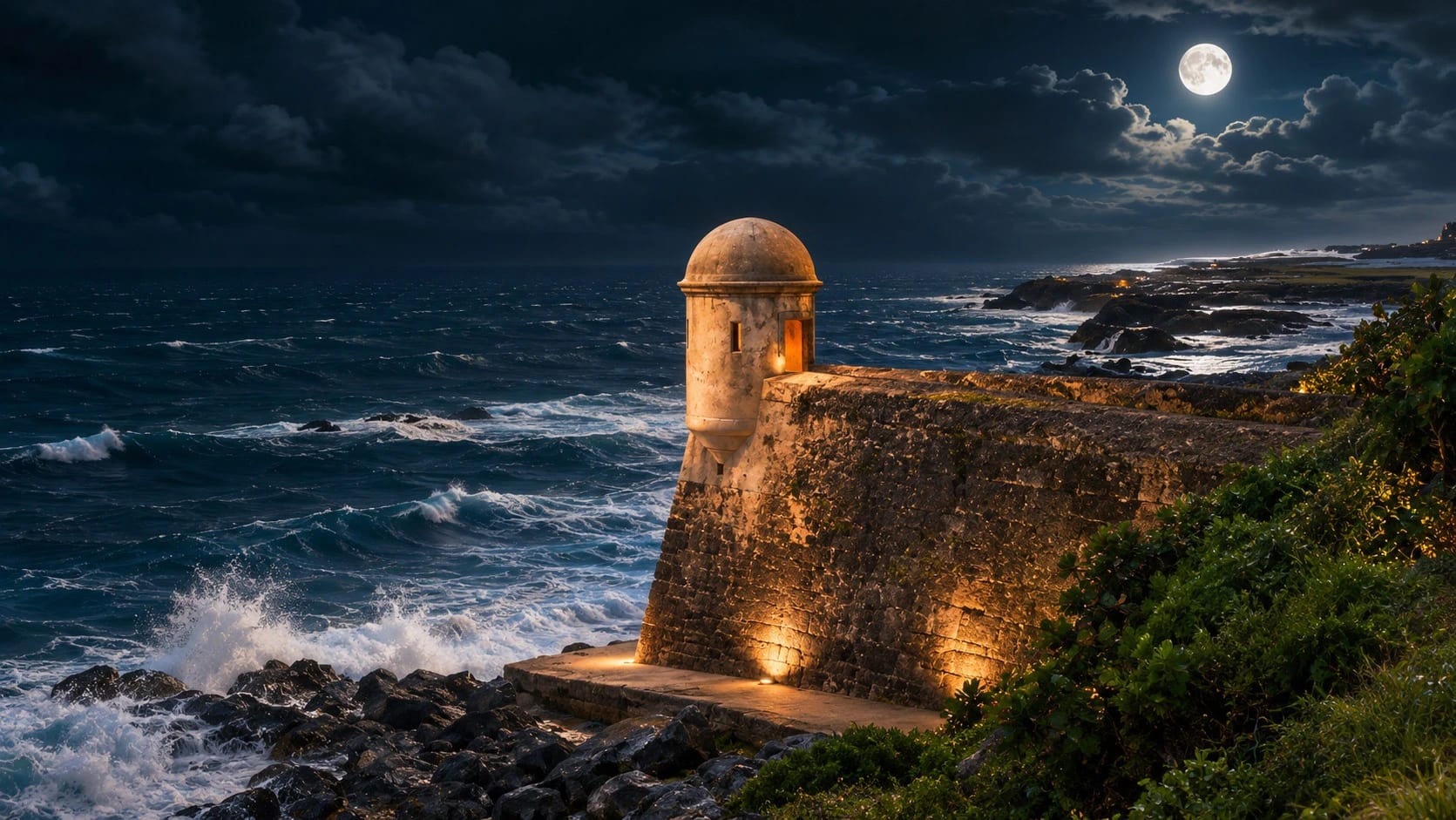
La Garita del Diablo on El Espigón, below the walls of Castillo San Cristóbal


