The museum staff had grown accustomed to unusual things happening inside Casa Blanca.
Doors reportedly opened and slammed without anyone touching them. Employees spoke of shadowy figures moving through the rooms and of strange voices heard where no one appeared to be speaking. Some believed the disturbances had intensified after an Indigenous ceremonial stone was placed in the gardens.
By 2013, the stories had attracted the attention of paranormal investigator John Zaffis, host of the Syfy television series Haunted Collector. He and his team traveled to Puerto Rico to examine the reported activity at the historic house, which stood in one of the oldest neighborhoods of San Juan.
The building had an impressive history. Its construction dated to the earliest decades of Spanish settlement on the San Juan islet, and generations of the Ponce de León family had lived there. Later, Spanish and American military officers occupied the property. By the time the investigators arrived, it had become a museum devoted to Puerto Rico's colonial past.
But the house's most famous supposed resident had never lived there.
Juan Ponce de León, the Spanish conquistador whose name became inseparable from the legend of the Fountain of Youth, died before Casa Blanca was completed.
That detail has not prevented ghost stories from attaching themselves to him. Some modern accounts speculate that his spirit may have found its way into the residence he never occupied in life.
The more unusual stories involve other presences, however. Shadows appear where no one is standing. Doors behave as though someone has entered or departed. And a stone associated with Puerto Rico's Indigenous past has become the subject of speculation about the source of the disturbances.
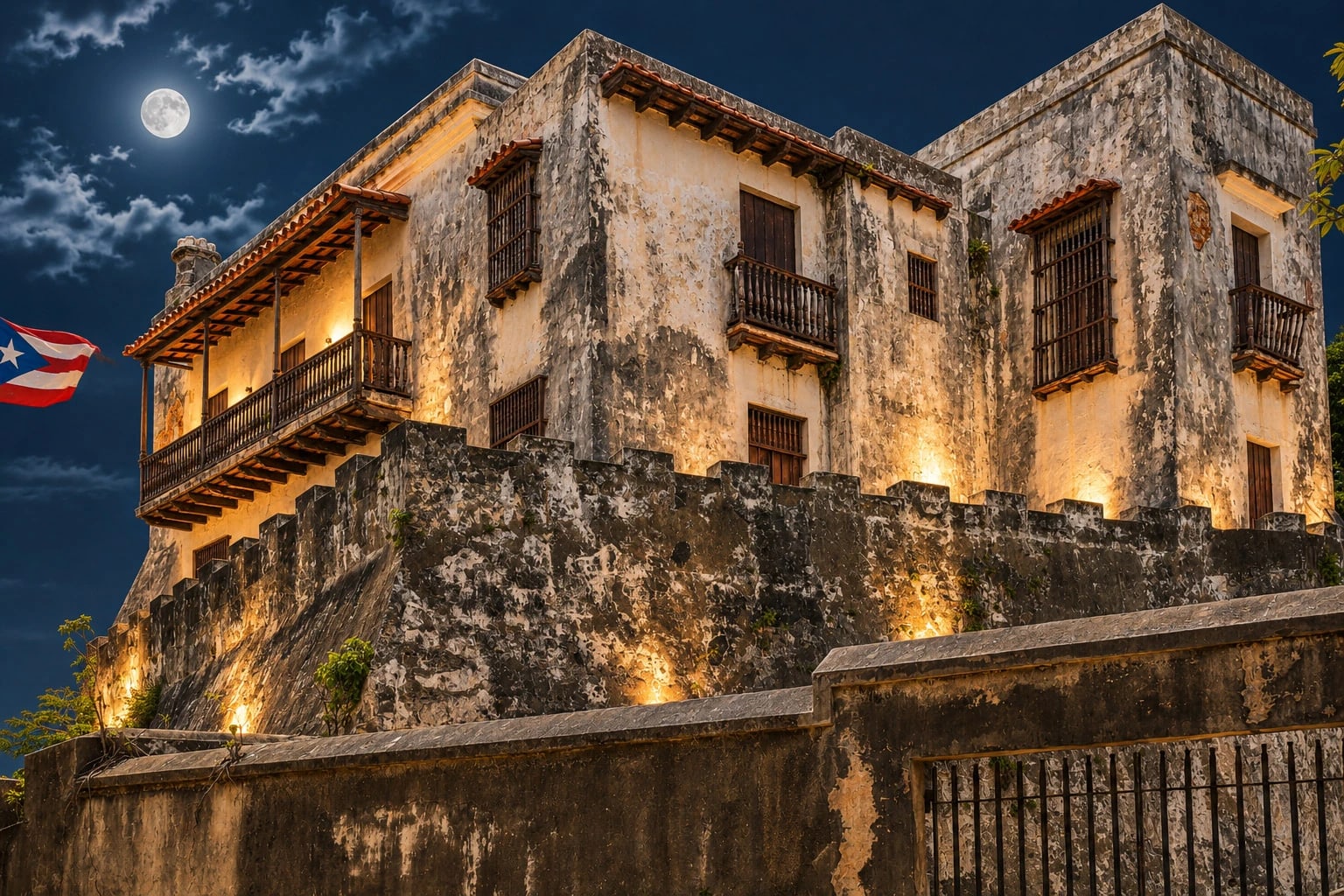
Casa Blanca is located at 1 Calle San Sebastián in Old San Juan, Puerto Rico, a short walk from Castillo San Felipe del Morro. Its whitewashed walls, historic rooms, and lush gardens conceal a history extending back more than 500 years.
The property began as a fortified residence built to protect one of the most powerful families in the emerging Spanish colony. Over the centuries, it became a military installation, an American officer's home, and eventually a protected historic landmark.
Its supernatural reputation is comparatively recent and far less securely documented than its architectural history.
Nevertheless, the stories raise an interesting question about a place that has survived so many changes in ownership and purpose.
If Casa Blanca really is haunted, who would have the strongest reason to remain there?
The famous conquistador who died before moving in, the descendants who occupied the property for generations, or the countless other people whose lives were connected to the house but whose names rarely appear in its history?
The House Juan Ponce de León Never Saw
In 1521, Juan Ponce de León was preparing for another attempt to establish a Spanish settlement in Florida.
He was already an experienced colonial administrator and military leader. After participating in Spain's expansion into the Caribbean, he had established the settlement of Caparra in Puerto Rico and served as the island's first Spanish governor.
His position was not secure indefinitely.
Political struggles involving Diego Columbus, the son of Christopher Columbus, complicated Ponce de León's authority. By 1511, he had lost his governorship, although he continued pursuing opportunities to expand his influence through additional expeditions.
One of those expeditions took him to Florida in 1513.
Eight years later, he returned with plans to establish a permanent colony. The venture ended disastrously.
Shortly after reaching Florida's southwestern coast, the Spanish expedition encountered resistance from Indigenous inhabitants, generally identified in historical accounts as Calusa people. During the fighting, Ponce de León was seriously wounded.
His companions withdrew and carried him to Havana, Cuba, where he died in 1521.
Back in Puerto Rico, preparations had been underway for a residence intended for him and his family in the newly developing city of San Juan.
The house was not ready.
Ponce de León never crossed its threshold, slept in its chambers, or walked through the gardens visitors admire today.
This is not merely a correction offered by modern historians. The fact is acknowledged in Puerto Rico's own legislation.
When the Commonwealth government declared Casa Blanca a protected historic monument in 1968, the law's explanatory statement explicitly noted that Ponce de León had died during his Florida expedition before occupying the property.
The Library of Congress also makes the distinction in its Historic American Buildings Survey documentation.
Despite that evidence, Casa Blanca is frequently described as the home of Juan Ponce de León.
The statement is understandable as a shorthand for the family's association with the building, but it is not accurate if interpreted to mean that the conquistador himself lived there.
His descendants did.
And the story of how they came to occupy the house is closely connected with the earliest development of Old San Juan.
From Caparra to the New City of San Juan
Before San Juan occupied its present location, Spain's principal settlement in Puerto Rico stood at Caparra, near what is now Guaynabo.
Ponce de León established Caparra in 1508, selecting a site inland from the sheltered waters of San Juan Bay.
The settlement offered some protection from ships approaching the coast, but its location created practical problems. Movement between the town and the harbor was difficult, and the low-lying environment presented challenges for transportation, supplies, and everyday life.
Other Spanish settlers favored moving closer to the port.
The resulting political struggle involved Ponce de León, other colonial officials, and the Crown. Eventually, the decision was made to relocate the capital to the islet that would become Old San Juan.
The transfer took place in 1521.
The new settlement occupied a position overlooking San Juan Bay, with the Atlantic on one side and the harbor on the other. Its location offered better access to maritime trade while allowing military defenses to be developed around the port.
The Spanish initially constructed modest buildings of wood, masonry, and other available materials. Streets gradually took shape as the settlement expanded.
Casa Blanca belonged to this first generation of construction.
It was planned for Ponce de León and his family, whose political and economic interests remained significant despite his loss of the governorship.
The property occupied elevated ground near the western end of the new settlement.
From this location, its occupants could look toward the bay and observe approaches to the city.
That made the residence more than a comfortable place to live.
It also gave the property a defensive purpose during a period when Spain had not yet constructed the enormous fortresses that would later define San Juan.
Juan García Troche and the First Casa Blanca
After Ponce de León's death, responsibility for the family's interests in San Juan passed to his surviving relatives.
An especially important figure was his son-in-law, Juan García Troche, who was married to Ponce de León's daughter Juana.
García Troche assumed responsibility for developing the family residence on the land associated with his father-in-law.
Historical accounts describe an initial wooden structure dating to the early 1520s. That building was destroyed by fire, prompting the construction of a more substantial residence using stone and masonry.
The chronology differs slightly between sources.
Some describe Casa Blanca as beginning in 1521. Others date the construction of the stone building to 1523 or 1525. These dates reflect different stages in the development of the property rather than necessarily describing the completion of the same structure.
The National Park Service identifies the stone fort-house as a building of approximately 1525.
An architectural history prepared for the Old San Juan Historic District's National Historic Landmark documentation attributes the residence to García Troche and places its construction during the third decade of the sixteenth century.
The original building was relatively small.
According to the National Historic Landmark documentation, the fortified residence began as a square structure measuring approximately 24 feet on each side, with defensive projections along the top of its walls.
It followed a Spanish architectural tradition known as a casa-fuerte or casa-torre, meaning a fortified house or tower-house.
Such buildings combined residential accommodation with defensive features.
A family living inside enjoyed the protection of thick masonry walls and a structure designed to resist a sudden attack.
That design was especially important in early colonial San Juan.
Spain's settlement remained vulnerable, and the powerful defenses associated with El Morro and Castillo San Cristóbal would not be fully developed until much later.
For a time, Casa Blanca was among the city's most important defensive structures.
The building was intended to protect the Ponce de León family's possessions and position while contributing to the security of the developing settlement.
The irony is considerable.
A residence built for one of Puerto Rico's most famous conquistadors became part of the city's early defenses, but the man whose name it carried was already dead.
A Fortress Before There Was an El Morro
Modern visitors generally think of Old San Juan's fortifications in terms of El Morro and Castillo San Cristóbal.
Their enormous stone walls, artillery platforms, and sentry boxes dominate the historic district.
Casa Blanca belongs to an earlier stage of military development.
The National Park Service identifies Casa Blanca and La Fortaleza as two of the earliest fortified structures constructed by the Spanish in San Juan.
Casa Blanca protected a prominent household while offering a small defensive strongpoint. La Fortaleza, constructed during the 1530s, was intended to provide a more formal military installation and official residence for the colonial governor.
Both reflected the difficulties of protecting an emerging settlement.
A fortification needed to resist attack, but it also had to be positioned where its defenders could effectively control movement through the city and harbor.
The early Spanish defenses were not always placed advantageously.
La Fortaleza, for example, occupied a position along the southern waterfront that offered limited protection against warships approaching the entrance to San Juan Bay.
Spanish authorities eventually recognized the need for a larger fortification at the harbor mouth.
Construction began on Castillo San Felipe del Morro in 1539.
Over the following centuries, additional military projects gradually transformed San Juan into one of the most heavily fortified colonial cities in the Caribbean.
Casa Blanca's original defensive role became less important as these larger installations developed.
The house nevertheless remained valuable.
Its elevated location, thick walls, and extensive grounds made it a desirable residence, particularly for a family with longstanding connections to colonial authority.
The original tower-house gradually acquired additional rooms and architectural features.
What visitors see today is the result of centuries of changes.
The small fortified residence built in the 1520s lies at the heart of a much larger historic complex.
The Family That Lived There for More Than Two Centuries
Although Juan Ponce de León never occupied Casa Blanca, members of his family remained associated with the property for approximately 250 years.
Successive generations lived there as San Juan developed from a small colonial settlement into a major Spanish military and administrative center.
Their lives unfolded against the backdrop of enormous changes.
During the sixteenth century, Spanish settlers established institutions and commercial activities throughout Puerto Rico while Indigenous communities suffered the consequences of conquest, disease, forced labor, and displacement.
The colonial economy developed through agriculture, livestock, trade, and labor systems that included the exploitation of Indigenous people and, increasingly, enslaved Africans.
Ponce de León himself participated in those systems.
His career involved military conquest, the extraction of resources, and the use of coerced Indigenous labor. The romantic image of an explorer seeking eternal youth obscures the far more consequential reality of his involvement in Spain's colonial expansion.
Casa Blanca was associated with the family that benefited from that expansion.
Its history therefore cannot be separated entirely from the society in which it was built.
The surviving documentation does not establish the names or experiences of everyone who lived and worked within its walls. Nor does it justify inventing particular tragedies involving servants or enslaved people at the property.
Still, the museum's elegant furnishings represent only one aspect of early colonial domestic life.
A large household required people to prepare food, clean rooms, maintain clothing, care for children, and perform the many forms of labor necessary to sustain an elite family.
In Spanish colonial society, that work could be performed by relatives, hired servants, Indigenous laborers, and enslaved people, depending on the household and period.
Any complete account of life at Casa Blanca must acknowledge the people whose labor supported the residence, even when the historical record preserves far more information about its owners than about those who worked for them.
The house also witnessed the changes that shaped San Juan during the seventeenth and eighteenth centuries.
In 1598, English forces captured the city under George Clifford, Earl of Cumberland.
In 1625, a Dutch expedition occupied much of San Juan and burned significant portions of the settlement.
The city recovered and expanded its defenses, while the Ponce de León family's residence remained part of the developing colonial capital.
By the late eighteenth century, the family had occupied Casa Blanca for generations.
Then the building passed into military hands.
When Casa Blanca Became a Military Property
In 1779, Casa Blanca was acquired by the Spanish Crown.
The transaction ended the family's long period of ownership and brought the residence into San Juan's formal military establishment.
According to the National Historic Landmark documentation, the property was assigned to the Maestranza de Ingenieros Militares, the military engineers' organization responsible for construction, maintenance, and related military activities.
Puerto Rico's 1968 historic-preservation law also identifies 1779 as the year the property was acquired for military purposes.
The change was significant.
Casa Blanca had originally been constructed to provide both security and accommodation for a prominent colonial family. It now became a building used by the military institution responsible for maintaining San Juan's defenses.
The property served different purposes during the following decades, including workshops and residences for military officers.
A new wing was added during the nineteenth century, continuing the process of architectural expansion that had begun centuries earlier.
Its military occupants inherited a building that was already considered historically important.
An English-language account of Puerto Rico published in 1834 described Casa Blanca as an old fortified residence carefully preserved by order of the government.
The writer mistakenly identified Ponce de León as someone who had lived there.
That error is revealing.
Even in the nineteenth century, the building's association with the conquistador had become strong enough to displace the more complicated history of its actual residents.
More than a century before modern ghost-tour descriptions began speculating about Ponce de León returning to Casa Blanca, an ordinary historical account had already placed him inside a house he never occupied.
The legend of the residence was becoming simpler than its history.
American Officers Move into Casa Blanca
The Spanish-American War of 1898 brought another dramatic change to Puerto Rico.
Following Spain's defeat, the Treaty of Paris transferred the island to the United States.
Military installations and government properties previously held by Spain became subject to American administration.
Casa Blanca was among them.
The United States Army incorporated the property into Fort Brooke, the military installation that included historic areas of Old San Juan.
Rather than demolish the old residence, the Army continued using it as accommodation for senior officers.
The National Historic Landmark documentation identifies the property as the residence of the post's commanding officer during the American military period.
This use continued for much of the twentieth century.
The interior of the house changed to accommodate the needs of American officers and their families. Electrical systems, plumbing, furnishings, and other domestic conveniences were introduced as the building adapted to modern life.
The grounds also underwent important changes.
Historical research indicates that the formal gardens visitors associate with Casa Blanca today probably developed substantially during the American military period.
Their Spanish-inspired appearance can make them seem far older than they actually are.
The gardens are beautiful, but they should not be described as untouched sixteenth-century landscaping created for Ponce de León.
They represent another stage in the property's history.
The military association continued until the 1960s, when ownership passed to the government of Puerto Rico.
Casa Blanca was then recognized as a building deserving permanent protection.
On June 21, 1968, the Commonwealth enacted Law 105, declaring the property a historic monument and assigning responsibility for its preservation to the Institute of Puerto Rican Culture.
The legislation directed that the building remain accessible to the public under appropriate regulations.
It was a decisive moment in the house's history.
After centuries as a private residence and military property, Casa Blanca became a place where Puerto Ricans and visitors could explore the earliest architectural and domestic history of San Juan.
Today, it is known as Museo Casa Blanca.
Its ghost stories, however, suggest that not everyone believes the transition to museum life was entirely peaceful.
The Shadows Reported Inside Casa Blanca
The most recognizable supernatural claims associated with Casa Blanca concern dark figures appearing inside the museum.
Unlike the ghost stories of El Morro, where apparitions are often imagined as soldiers wearing historical uniforms, Casa Blanca's reported presences are less clearly identified.
Some accounts describe shadowy shapes passing through rooms or appearing unexpectedly near doorways.
Others concern unexplained noises and the impression that someone is moving through the house when no visitor or employee is visible.
The reports became sufficiently persistent that paranormal investigator John Zaffis and his television crew visited the property in 2013.
Accounts associated with the investigation describe museum personnel reporting doors that opened or slammed without an obvious cause and shadow figures observed inside the building.
Modern ghost tours also repeat claims of unexplained voices and unusual movement in the rooms.
The descriptions are intriguing, but they have limitations.
Most published summaries do not identify the original witnesses by name, establish the dates of the earliest incidents, or provide independent documentation confirming what occurred.
The stories are therefore best understood as reported experiences, not established supernatural events.
There is also no verified historical identification for the shadow figures.
They have not been conclusively connected to a member of the Ponce de León family, a Spanish officer, an American military resident, or anyone else associated with the property.
That uncertainty makes Casa Blanca different from haunted locations where an apparition has acquired a specific name.
The ghost stories suggest a presence.
They do not reveal who, if anyone, that presence might represent.
The Doors That Would Not Stay Closed
One of the more distinctive claims repeated about Casa Blanca concerns its doors.
During the property's paranormal investigation, staff members reportedly described doors opening or slamming without anyone touching them.
The accounts became part of the material used to investigate the museum's haunted reputation.
Old houses can produce unexpected noises and movements for many reasons.
Casa Blanca has been constructed, expanded, and altered over approximately five centuries. Its walls include masonry from different periods, while its interior spaces contain doorways, windows, and building materials installed or modified long after the original fortified residence was completed.
Changes in temperature and humidity can affect wooden doors and frames. Airflow through open windows or adjoining rooms can cause sudden movement.
Older latches and hinges may also behave differently from the hardware found in modern buildings.
Those possibilities do not establish what happened during the experiences described by museum staff.
They do mean that a door opening unexpectedly is not, by itself, evidence of a ghost.
Yet the story has an obvious emotional appeal.
A door suggests that someone is entering or leaving a room. When it opens or closes without a visible person nearby, observers may naturally wonder whether someone they cannot see is responsible.
At a historic residence, that impression can be especially strong.
The rooms of Casa Blanca were occupied by generations of people who came and went through doors that have since been repaired, replaced, or relocated.
The building's modern visitors see a furnished museum.
Its former occupants knew it as a working household, military residence, or administrative property.
The haunting stories imagine that the ordinary movement of people through the house has somehow continued.
Haunted Collector Comes to Puerto Rico in 2013
Casa Blanca's supernatural reputation received national television exposure in March 2013.
The Syfy series Haunted Collector featured the property in an episode titled "Island of Fear / Tropical Terror."
The episode aired on March 27, 2013, according to contemporary television listings and distribution records.
The series followed paranormal investigator John Zaffis and his team as they examined reports of unexplained activity at homes, businesses, and historic locations.
Zaffis approached investigations with a particular interest in objects.
His premise was that paranormal activity might sometimes be associated with a specific possession, artifact, or item that had acquired an attachment during its history.
At Casa Blanca, the investigation centered on reports from museum personnel.
The team examined the old residence and considered the possibility that a ceremonial stone associated with Puerto Rico's Indigenous past might be connected to the reported activity.
A second segment of the episode involved a separate investigation at a private residence in Guayama.
The visit to Casa Blanca is a documented television event.
The conclusions suggested by the program, however, should not be mistaken for scientific findings.
Paranormal investigations on television frequently rely on interpretations of sounds, shadows, electronic recordings, and other ambiguous experiences. Such material does not independently demonstrate that supernatural entities exist.
The episode is nevertheless an important chapter in the museum's modern reputation.
Before 2013, stories about unusual activity at Casa Blanca were known primarily through local accounts and people familiar with the property.
After the broadcast, the historic residence became recognizable to a much wider audience interested in haunted places.
It also introduced a new element into the legend.
The mysterious activity was no longer discussed solely in relation to former occupants of the house.
Attention turned toward an object associated with the people who lived in Puerto Rico before Spanish colonization.
The Taíno Stone and the Question of a Haunted Artifact
The most unusual part of Casa Blanca's paranormal reputation involves a stone said to bear Indigenous markings.
Modern ghost-tour accounts describe an object associated with Taíno culture that was reportedly placed in the museum's garden.
Some versions suggest that unusual activity increased after the stone arrived.
During the 2013 Haunted Collector episode, the investigation included discussion of an ancient Puerto Rican ceremonial stone.
The implication was that the artifact might have a connection to the unexplained events reported by museum personnel.
It is an effective supernatural premise.
An object associated with an earlier culture enters a centuries-old Spanish colonial house, after which staff members begin reporting disturbing experiences.
But several important historical questions remain unanswered.
The available public accounts do not establish the artifact's precise archaeological provenance, the date it was acquired, or a complete documented history of its placement at Casa Blanca.
Nor is there reliable evidence demonstrating that the stone caused doors to move, shadows to appear, or voices to be heard.
It would be especially inappropriate to claim that a Taíno religious object was cursed or carried a dangerous spirit merely because a paranormal television program suggested a connection.
The Taíno and other Indigenous peoples of Puerto Rico developed sophisticated religious, artistic, and ceremonial traditions long before European colonization.
Their surviving artifacts are important archaeological and cultural materials deserving careful interpretation.
Stone carvings, petroglyphs, and objects associated with ceremonial practices can reveal aspects of Indigenous belief and social organization, although their meanings are not always fully understood.
An archaeological object does not become evidence of supernatural activity simply because its original purpose is unfamiliar to modern observers.
Casa Blanca's history makes the distinction particularly significant.
The residence was built during the first decades of Spanish colonization, when Indigenous communities were experiencing profound disruption through conquest, forced labor, disease, and the imposition of colonial institutions.
An Indigenous artifact placed within such a setting creates an opportunity to examine those histories together.
It does not justify portraying Indigenous spiritual traditions as the source of a haunting.
The stone's documented history, if available through the museum's collection records, would be far more useful than speculation about its supernatural influence.
For now, the supposed connection between the artifact and the reported disturbances remains part of the modern Casa Blanca ghost story.
Does the Ghost of Juan Ponce de León Haunt Casa Blanca?
Because Casa Blanca bears Ponce de León's name, it is almost inevitable that ghost stories eventually began associating him with the property.
Some haunted-tour descriptions speculate that the conquistador might have returned to the residence after death.
The idea contains an obvious irony.
Ponce de León never entered the completed house while he was alive.
Nevertheless, the suggestion that he might occupy it as a ghost has become part of its modern supernatural reputation.
There is no documented historical evidence establishing that his apparition has been identified at Casa Blanca.
Nor have the reports of shadow figures been reliably connected to a person matching his appearance.
The claim is an imaginative interpretation of the house's famous association with him.
Ponce de León died in Havana in 1521 after being wounded during his attempted colonization of Florida. His remains were eventually brought to Puerto Rico and are now entombed at the Cathedral Basílica Menor de San Juan Bautista.
That cathedral is another important landmark in Old San Juan, located within walking distance of Casa Blanca.
Visitors interested in the conquistador's actual burial place should go there rather than assume his remains are associated with the family residence.
His connection to Casa Blanca is nevertheless historically significant.
He helped establish the colonial order that made the house possible, and the residence remained associated with his descendants for centuries.
But a name attached to a historic building does not identify a ghost.
It is worth remembering that the property's history includes many people besides its most famous intended occupant.
Generations of family members lived there. Military officers and their households occupied it for much of the nineteenth and twentieth centuries. Workers maintained the building and its grounds.
If one wished to speculate about the identity of a supposed presence, those actual residents would have a more direct personal connection to the house.
Even that observation remains speculation.
The available reports do not establish the identity of any supernatural occupant.
The Fountain of Youth: Another Legend That Changed History
The haunted reputation of Casa Blanca is not the only legend associated with Juan Ponce de León.
His most famous story concerns the Fountain of Youth.
According to popular tradition, the conquistador sailed to Florida in 1513 searching for a magical spring whose waters could restore youth to anyone who drank from it.
The story became one of the most enduring legends in American history.
It appears in books, paintings, tourist attractions, and countless retellings of early European exploration.
Yet historians have found little evidence that Ponce de León actually undertook his expedition for that purpose.
Research discussed by the Smithsonian Institution and historians such as J. Michael Francis indicates that the surviving documents associated with Ponce de León's expeditions concern exploration, colonization, political authority, and economic opportunity.
They do not identify the Fountain of Youth as his objective.
The strongest connection between Ponce de León and the mythical spring appeared in writings published after his death.
In 1535, the Spanish chronicler Gonzalo Fernández de Oviedo y Valdés associated the explorer with the search for rejuvenating waters.
Historians have suggested that Oviedo's account was influenced by political rivalry and intended to make Ponce de León appear foolish.
Later writers repeated the story, and the legend gradually became more famous than the documented purposes of his expeditions.
The parallel with Casa Blanca is fascinating.
A man who never lived in a house became widely described as its former resident.
The same man, whose expeditions were driven by political and economic ambitions, became famous for supposedly seeking a magical fountain.
Both stories demonstrate how historical memory can become dominated by details that are easier to remember than the complicated truth.
Casa Blanca provides a rare opportunity to examine those legends at a place directly associated with Ponce de León's family.
Visitors can admire the residence while recognizing that its most famous historical association is more complicated than it first appears.
The house exists.
The Fountain of Youth remains a legend.
And the ghost of Ponce de León has never been verified.
The Gardens of Casa Blanca
The gardens surrounding Casa Blanca are among its most attractive features.
Unlike many historic houses in Old San Juan, where limited space leaves little room for extensive landscaping, Casa Blanca occupies grounds large enough to create a sense of separation from the surrounding streets.
Visitors move through shaded paths, courtyards, and areas planted with tropical vegetation.
Fountains and architectural features provide additional points of interest, while the elevated position offers views across portions of Old San Juan and its waterfront.
The gardens can feel unusually peaceful compared with the busy streets beyond the property.
That atmosphere has contributed to the museum's reputation as a place where visitors can escape the noise and crowds of the historic district.
But the garden's history is not identical to that of the house.
The National Historic Landmark documentation notes that the formal Spanish-inspired landscaping probably dates largely to the American military period.
This is an important distinction for visitors interested in seeing the property as it existed during the sixteenth century.
The gardens are part of Casa Blanca's historical development, but their present arrangement does not reproduce a documented landscape personally designed or occupied by Ponce de León.
Over time, the grounds have been adapted to meet the needs of different residents and institutions.
The gardens once associated with military officers are now part of a public historic property.
They also feature in the modern haunting stories through claims concerning the ceremonial stone investigated in 2013.
No reliable evidence establishes that the grounds themselves are haunted.
Their appeal lies partly in the contrast between their calm appearance and the extraordinary history of the building beside them.
A visitor can walk through the same property where Spanish colonial officials and American military commanders once lived, then encounter a museum displaying objects associated with a much earlier period.
For a place that has existed for approximately five centuries, the changes are remarkably visible.
How Much of Casa Blanca Is Original?
One of the most common misconceptions about historic houses is that everything visible inside them belongs to the period in which they were first constructed.
Casa Blanca is an excellent example of why that assumption is unreliable.
Its original fortified structure dates to the 1520s, but the property was expanded and altered repeatedly during subsequent centuries.
The National Historic Landmark documentation identifies a small early tower-house at the core of the residence, with additional construction during the Spanish military period and a wing added in the nineteenth century.
The United States Army introduced further modifications after 1898.
By the twentieth century, the building had been adapted to accommodate modern domestic life.
Restoration work beginning during the 1960s sought to preserve historically significant features while preparing the property for its new role as a museum.
Later conservation efforts continued addressing changes introduced during previous occupations.
The building therefore contains architectural evidence from several different centuries.
Some sections of the walls use adobe. Others incorporate brick, stone, and traditional masonry.
An architectural overview published by EnciclopediaPR describes Casa Blanca as a palimpsest—a structure in which successive periods of construction remain layered upon one another.
That description is particularly appropriate.
The house is not a frozen moment from 1525.
It is a building that has been modified by generations of people who used it for different purposes.
The antique furnishings displayed inside the museum also require careful interpretation.
They help visitors understand the domestic life of wealthy colonial households, but they should not automatically be identified as objects personally owned by Ponce de León or his immediate family.
The Institute of Puerto Rican Culture describes the museum's collection as illustrating the furnishings and decorative traditions of affluent San Juan families during the sixteenth and seventeenth centuries.
The distinction matters because museums often recreate historical environments using period objects that did not originally belong to a particular building.
Those displays can be historically valuable without being untouched collections from one household.
A chair from the seventeenth century may help explain how a room was furnished during that period.
It does not mean that a member of the Ponce de León family necessarily sat in that exact chair.
Understanding the difference makes the museum more interesting, not less.
Casa Blanca's rooms preserve centuries of change, and the layers of its history are part of what makes it extraordinary.
Is Casa Blanca Really Haunted?
There is no independently verified evidence that Casa Blanca is inhabited by ghosts.
The supernatural reputation is supported primarily by reports attributed to museum personnel, modern ghost-tour accounts, and the 2013 television investigation.
Those sources describe unusual occurrences involving doors, shadows, and other unexplained activity.
The experiences may have been sincere, but sincerity alone does not establish a supernatural cause.
The property has undergone centuries of construction and modification. Sounds may travel through its rooms in unexpected ways, and older building materials or mechanical systems can produce movement and noises that are difficult to identify.
Those possibilities do not explain every reported experience, but they demonstrate why unusual activity requires careful investigation before it can be attributed to a ghost.
The identity of any supposed apparition remains unknown.
Ponce de León himself never lived in the house, and the available reports do not establish that a member of his family returned after death.
Similarly, the theory that an Indigenous ceremonial stone caused paranormal activity has not been substantiated.
The television investigation documents the existence of the claims, not the existence of the supernatural forces proposed to explain them.
What can be established is the property's extraordinary historical significance.
Casa Blanca is among the oldest surviving residential structures in San Juan. Its beginnings date to the first generation of Spanish construction on the islet, and its occupants included members of one of Puerto Rico's most influential colonial families.
The building later became part of the Spanish military establishment before passing into American military use.
Its preservation as a museum has made those histories available to the public.
The ghosts remain a matter of belief.
The people who lived within its walls were real, even when the surviving documents tell us very little about their individual experiences.
And the person whose name is most closely associated with the building never lived there at all.
Visiting Museo Casa Blanca in Old San Juan
Museo Casa Blanca is located at 1 Calle San Sebastián, near the western end of Old San Juan, Puerto Rico.
The museum is administered by the Institute of Puerto Rican Culture, known in Spanish as the Instituto de Cultura Puertorriqueña.
Visitors can explore historic interiors furnished to illustrate colonial domestic life, architectural features from different periods, and the gardens surrounding the property.
Displays include furnishings, decorative objects, and material associated with Puerto Rico's Spanish colonial past.
The elevated location also provides attractive views of the surrounding historic district.
Casa Blanca is within walking distance of several important landmarks.
Castillo San Felipe del Morro stands to the northwest, while the former Cuartel de Ballajá and the Museo de las Américas are nearby.
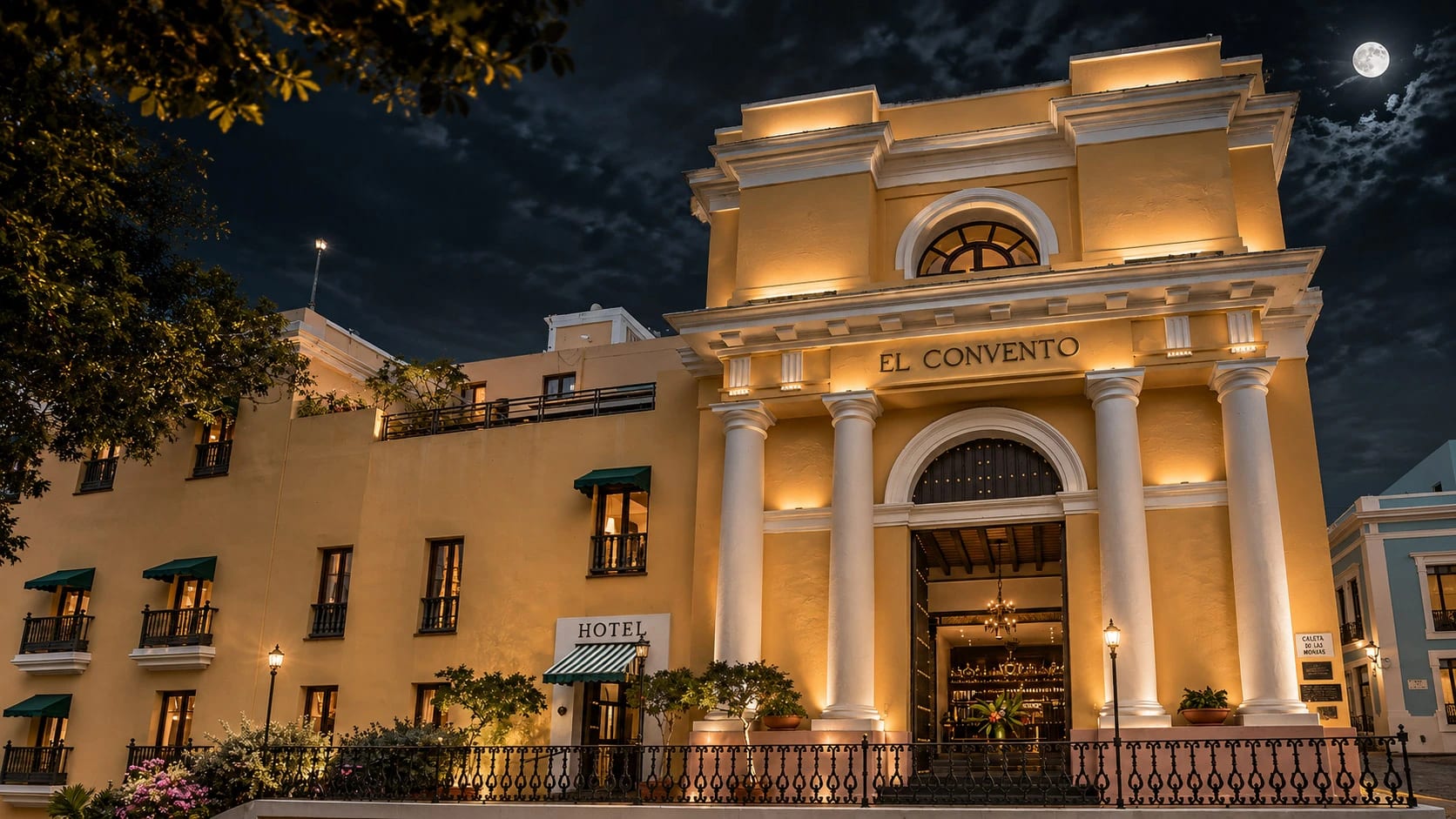
Iglesia San José, one of the oldest religious buildings in San Juan, is also within a short walk. Farther east and south are the Cathedral of San Juan Bautista and Hotel El Convento.
The neighborhood offers an excellent opportunity to compare several different chapters of the city's history.
Casa Blanca represents the earliest decades of Spanish settlement and the development of a fortified colonial household.
El Morro reveals how the city later invested in large-scale military defenses, while Cuartel de Ballajá demonstrates how the Spanish military expanded its infrastructure during the nineteenth century.
Museum hours and admission
The official Discover Puerto Rico listing currently describes Museo Casa Blanca as open Wednesday through Sunday, with a morning session from 8:00 a.m. to 11:45 a.m. and an afternoon session from 1:00 p.m. to 4:00 p.m.
A separate museum-route publication issued through the Institute of Puerto Rican Culture lists Tuesday through Sunday, 8:30 a.m. to 4:30 p.m., with admission of $5 for adults and $3 for minors and students.
Because these published schedules differ, visitors should confirm current hours, prices, and access arrangements with the museum before arriving.
The museum's listed telephone number is 787-725-1454.
Its historic gardens and interior spaces may also be affected by special events, temporary exhibitions, and conservation work.
For general visitor information, consult the Museo Casa Blanca listing on Discover Puerto Rico.
Casa Blanca is a historic museum, not a public ghost-hunting venue.
Ordinary admission does not authorize visitors to enter the grounds after closing, conduct paranormal investigations, or access restricted areas.
The surrounding streets, however, can be explored as part of a broader visit to Old San Juan.
The House That Outlived Its Most Famous Owner
Casa Blanca began as a residence for a man whose ambitions extended far beyond Puerto Rico.
Juan Ponce de León had already helped establish Spanish colonial rule on the island when his family began developing the property that would bear his name.
He never lived to see it completed.
Instead, his descendants occupied the building for generations, while San Juan grew around them.
The residence survived the English occupation of 1598, the Dutch invasion of 1625, the growth of Spain's enormous military defenses, and the transfer of Puerto Rico to the United States in 1898.
It accommodated military officers and their households before becoming a public museum.
Few surviving buildings in San Juan can claim a comparable association with the city's earliest European settlement and the centuries that followed.
Yet the house's most famous historical story remains a contradiction.
It is the home of a man who never lived there.
The modern ghost stories add another layer to that unusual identity.
They imagine figures moving through rooms occupied by generations of people, and they suggest that some presence may have remained even after the building's last military residents departed.
No reliable evidence identifies such a presence.
But the questions raised by the stories are revealing.
Who do we remember when we preserve an old house?
The wealthy family that owned it? The military officers who occupied it? The workers whose labor maintained it? Or the many people whose experiences never became part of the written record?
At Casa Blanca, those questions are especially important because the building's most celebrated name has overshadowed the people who actually spent their lives there.
Discover More Ghost Stories in Old San Juan
Casa Blanca is one of the historic properties that make Old San Juan an extraordinary place to explore after dark.
The city's narrow streets connect buildings associated with centuries of warfare, religious devotion, political struggles, and stories that became part of Puerto Rican folklore.
At Castillo San Cristóbal, the isolated lookout known as La Garita del Diablo became famous for the legend of Spanish soldiers who supposedly vanished during their night watches.
Castillo San Felipe del Morro has its own traditions involving a mysterious Woman in White and ghostly soldiers said to remain along the ancient ramparts.
Hotel El Convento, a former Carmelite monastery, is associated with reports of nuns moving through its historic corridors.
At Teatro Tapia, stories describe unexplained footsteps, a mysterious woman in the audience, and performers whose supposed spirits continue to occupy the stage.
Casa Blanca's legends are different.
They concern the strange experiences reported inside an ordinary-looking historic residence and the question of whether some former presence remains attached to the property.
At Ghost City Tours, we explore the history and supernatural traditions of Old San Juan on guided evening walking tours.
Our family-friendly Night of Souls Ghost Tour introduces visitors to Puerto Rican legends, mysterious events, and the people who shaped the old city.
For guests interested in darker historical subjects, The Dead at the Gate explores the more unsettling stories associated with San Juan's colonial past.
The history behind these legends matters just as much as the mysteries themselves.
Casa Blanca offers a perfect example.
For more than five centuries, the property has been associated with one of Puerto Rico's most famous historical figures.
He died before he could live there.
Generations of other people occupied the house, but most are far less familiar to modern visitors.
And when paranormal investigators finally arrived in 2013, the stories they encountered did not identify an elderly conquistador searching for eternal youth.
They concerned doors opening, shadows moving, and an unexplained presence inside a building whose original owner had never seen it completed.
Casa Blanca was built for a man who never came home. According to the ghost stories, someone else may never have left.
Historical References and Sources
1. National Park Service — Old San Juan Historic District National Historic Landmark Documentation
Old San Juan Historic District — National Historic Landmark Nomination (PDF)
See page 20 of the National Historic Landmark documentation. One of the strongest architectural and historical sources for Casa Blanca. Identifies Juan García Troche as the builder, explains the original tower-house design, describes the 1779 transfer to the Spanish Crown, and documents later use by the American military. Also provides details about the original fortified structure, subsequent construction, and the historic gardens.
2. Library of Congress — Historic American Buildings Survey
Casa Blanca, San Sebastián Street, Old San Juan — HABS PR-106
Official architectural documentation containing historic drawings and historical information. Confirms that Casa Blanca was built for Ponce de León and his family, but the conquistador died before occupying the completed residence. Also documents later Spanish and American military uses.
3. National Park Service — Early Fortifications of San Juan
Puerto Rico: San Juan National Historic Site
Official overview identifying Casa Blanca and La Fortaleza as among the earliest fortified structures developed by the Spanish in San Juan. Describes Casa Blanca as a defensive blockhouse dating to approximately 1525 and explains its role in protecting the governor's family and the emerging settlement.
4. Puerto Rico Legislature — The 1968 Casa Blanca Preservation Law
Law 105 of June 21, 1968 — Casa Blanca Historic Monument (PDF)
An especially valuable primary source. The law formally declared Casa Blanca a historic monument and assigned responsibility for its preservation to the Institute of Puerto Rican Culture. Its explanatory statement explicitly acknowledges that Juan Ponce de León died before occupying the house. The legislation also confirms the 1779 acquisition by the Spanish Crown and subsequent use as a military property.
5. EnciclopediaPR — Colonial Architecture and Urban Development
City, Architecture, and Colonization Under Spanish Rule
Detailed historical discussion of the architectural development of Spanish colonial Puerto Rico. Describes the early defensive purpose of Casa Blanca, its construction beginning during the early 1520s, the mixture of building materials, and the many changes made by Spanish and American authorities. Especially useful for explaining why the museum is not an untouched sixteenth-century residence.
6. Instituto de Cultura Puertorriqueña — Official Museum Guide
Ruta de Museos — Institute of Puerto Rican Culture (PDF)
Official museum brochure describing Casa Blanca as an early defensive structure and residence of Ponce de León's descendants. Also identifies the museum's collection as representing the domestic environment of affluent San Juan families during the sixteenth and seventeenth centuries. Provides the museum address, contact information, and published visiting schedule.
7. Discover Puerto Rico — Museo Casa Blanca
Museo Casa Blanca — Official Visitor Listing
Puerto Rico's official destination-marketing organization provides visitor information about Casa Blanca, including its location, gardens, historic rooms, collections, and current published hours.
8. University of Puerto Rico — Historic Casa Blanca Photograph
Casa Blanca, San Juan, P.R. — University of Puerto Rico Architectural Collection
A historic postcard preserved by the University of Puerto Rico's School of Architecture. Identifies the building as a former Ponce de León family residence and later headquarters or residence associated with American military command. Useful for illustrating the property's appearance during the American military period.
9. University of Puerto Rico — Casa Blanca Architectural History
Casa Blanca: Residence of the Ponce de León Family
Additional historic photographic material and description identifying the property as a fortified residence developed in the 1520s. Notes the building's early defensive use and its subsequent association with the Ponce de León family.
10. Puerto Rico Herald — The Casa Blanca Museum
Casa Blanca Museum — September 18, 2002
Historical overview discussing the property's development by Juan García Troche, the initial wooden structure, the construction of the stone fortified residence, and later restoration and public use.
11. Haunted Collector — The 2013 Casa Blanca Investigation
Haunted Collector: Island of Fear / Tropical Terror — Season 3, Episode 4
Official distribution listing confirming the television episode and its March 27, 2013 release. The episode features John Zaffis and his investigative team visiting Puerto Rico.
12. TheTVDB — Haunted Collector Episode Information
Haunted Collector: Season 3 Episode Guide
Independent television episode listing identifying the visit to Ponce de León's estate in Puerto Rico and the investigation of reported apparitions.
13. American Ghost Walks — Casa Blanca Paranormal Tradition
A contemporary ghost-tour operator's description identifying Casa Blanca as a location investigated by John Zaffis in 2013. Useful as evidence that the museum's paranormal reputation circulates within San Juan's ghost-tour industry, rather than as independent proof of the reported activity.
14. Puerto Rican Guide — Casa Blanca Ghost Accounts
San Juan Haunted History Walking Tour
A modern account of the reported phenomena associated with the museum, including unexplained door movement, voices, and the theory concerning a stone associated with Taíno culture. The paranormal interpretation is unverified.
15. Smithsonian Magazine — The Fountain of Youth Myth
Ponce de León Never Searched for the Fountain of Youth — June 2013
By Matthew Shaer. Discusses modern historical research demonstrating that the Fountain of Youth story was not established in surviving documents from Ponce de León's lifetime. Explains the role of Gonzalo Fernández de Oviedo and later writers in popularizing the legend.
16. Florida Museum of History — Ponce de León's Expeditions
Encounters: Juan Ponce de León
Official historical material concerning Ponce de León's Florida expeditions, his contact with Indigenous communities, and the distinction between documented colonial objectives and the Fountain of Youth legend.
17. Yale-New Haven Teachers Institute — The Early Settlement of San Juan
Spain in Puerto Rico: The Early Settlements
By Doris M. Vázquez. Provides historical background concerning the relocation of Puerto Rico's colonial capital from Caparra to San Juan in 1521 and the early development of residential and governmental buildings.
18. Puerto Rico's Current Historic Monument Law
23 L.P.R.A. § 183 — Casa Blanca, Former Residence of the Ponce de León Family
The codified legal provisions establishing Casa Blanca's protected status and assigning its preservation and maintenance to the Institute of Puerto Rican Culture. Confirms the property's statutory designation as a historic monument.
Museo Casa Blanca on Calle San Sebastián in Old San Juan