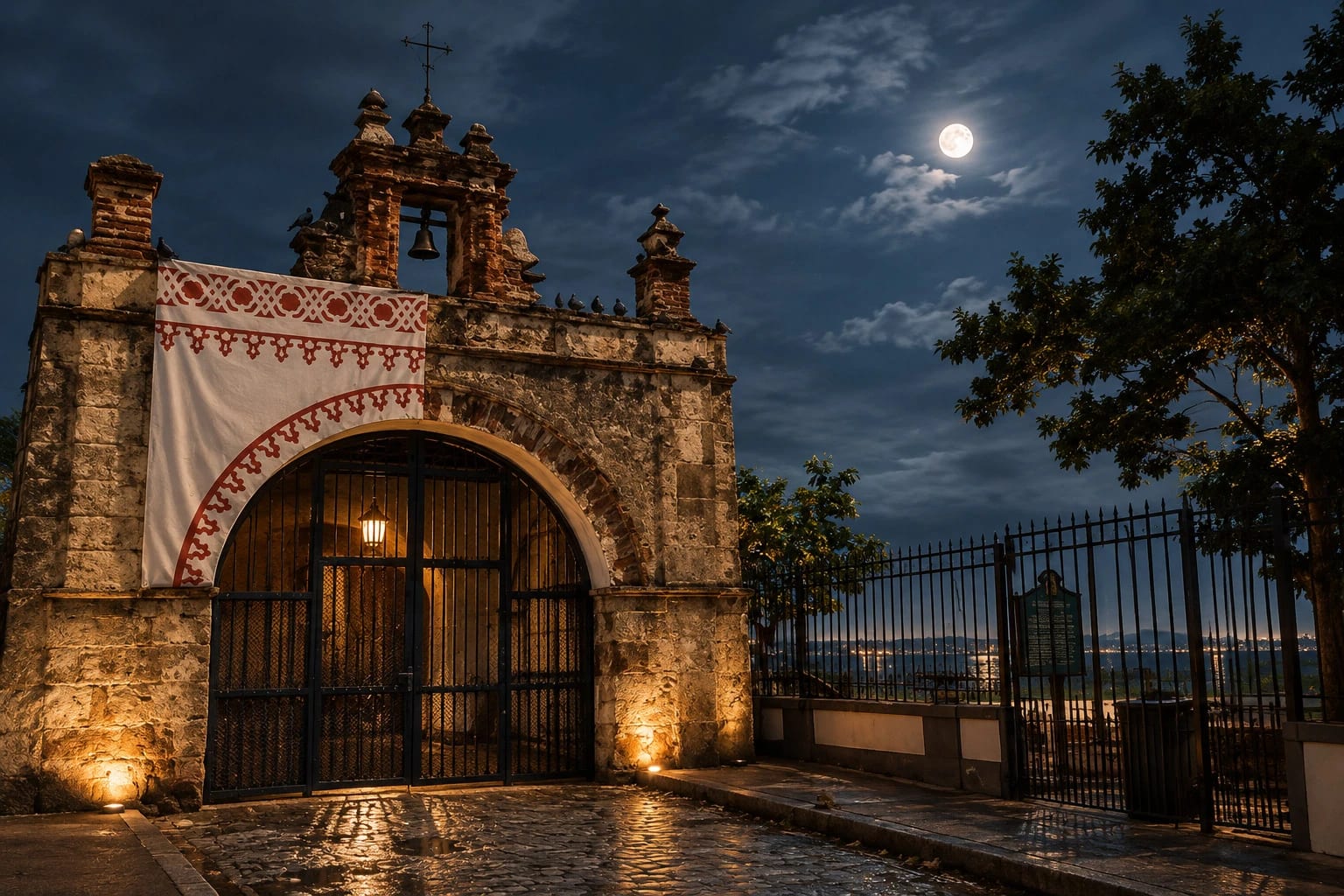
The woman in green is said to fly over the graves after dark.
For generations, residents of Old San Juan have repeated stories about a mysterious figure seen moving above the tombstones of Santa María Magdalena de Pazzis Cemetery. Some call her a witch. Others insist she is an apparition whose presence is connected to an unusual grave within the cemetery walls.
The story became familiar enough that students, tourists, and even university groups began asking cemetery employees where they could find the witch's burial place.
In February 2010, the Puerto Rican newspaper Primera Hora interviewed the cemetery's administrator, Thelma Díaz, who had spent years caring for the graves. She knew the legend well, although she had a rather different opinion of it than the people who came looking for ghosts.
Díaz explained that the story originated with children from La Perla, the historic neighborhood adjoining the cemetery. They had told tales of a woman dressed in green flying over the graves. The children grew older, but their story survived, eventually becoming part of the cemetery's supernatural reputation.
The administrator had never seen the mysterious woman. In fact, she was amused by the idea of encountering her and made no secret of her frustration with people inventing supernatural stories about the dead.
Yet there were things about the cemetery that genuinely troubled her. Some graves were deteriorating. Others had been neglected by the families responsible for maintaining them. Beneath the marble monuments and elaborate statues rested generations of Puerto Ricans whose names were gradually disappearing from public memory.
What Díaz could not have known was that archaeological researchers would eventually investigate a forgotten burial ground near the cemetery and recover hundreds of human bone fragments from an area associated with one of the deadliest epidemics in Puerto Rican history.
Those remains were real. So was the catastrophe that led to the creation of a mass burial ground outside San Juan's defensive walls.
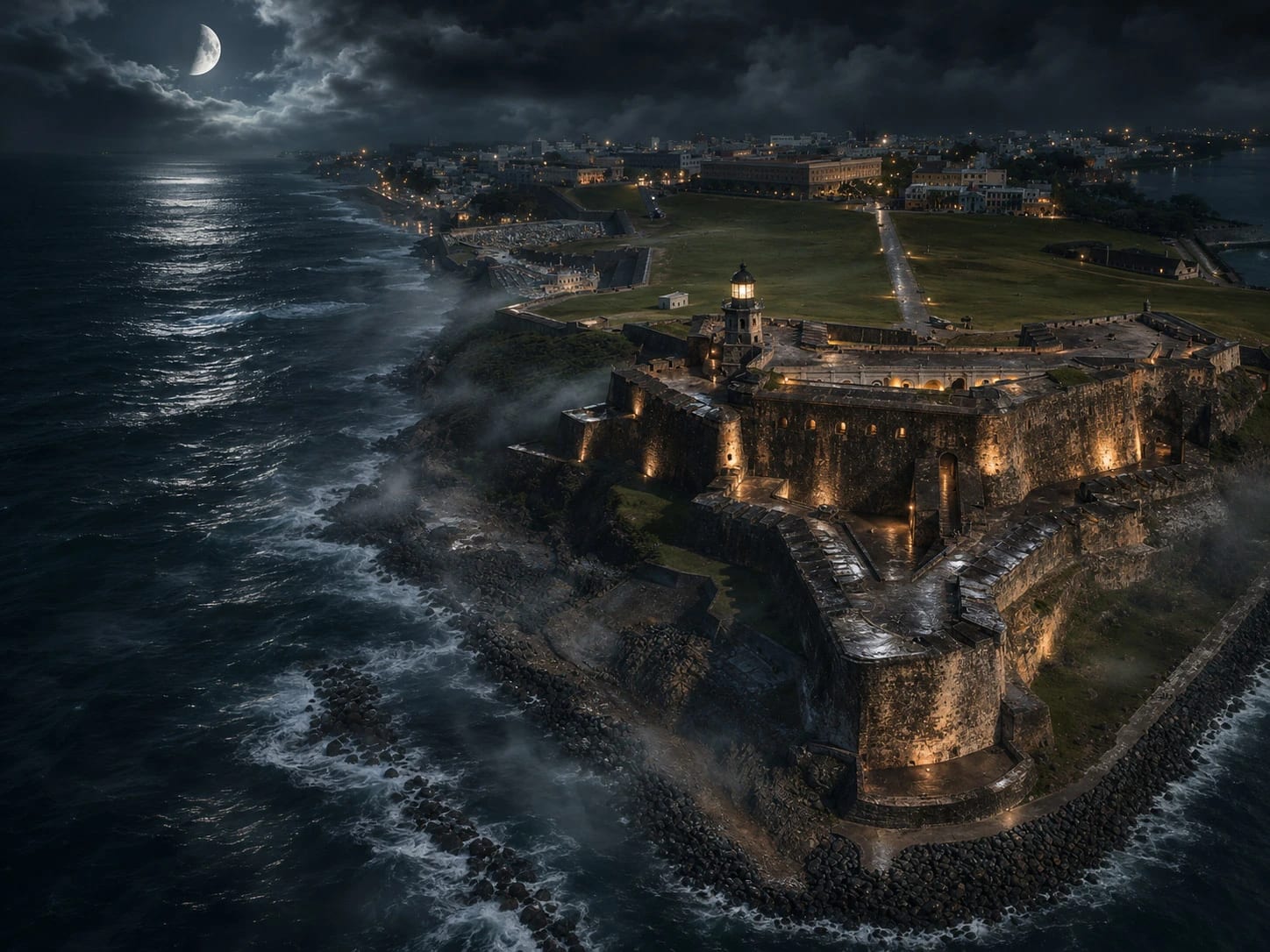
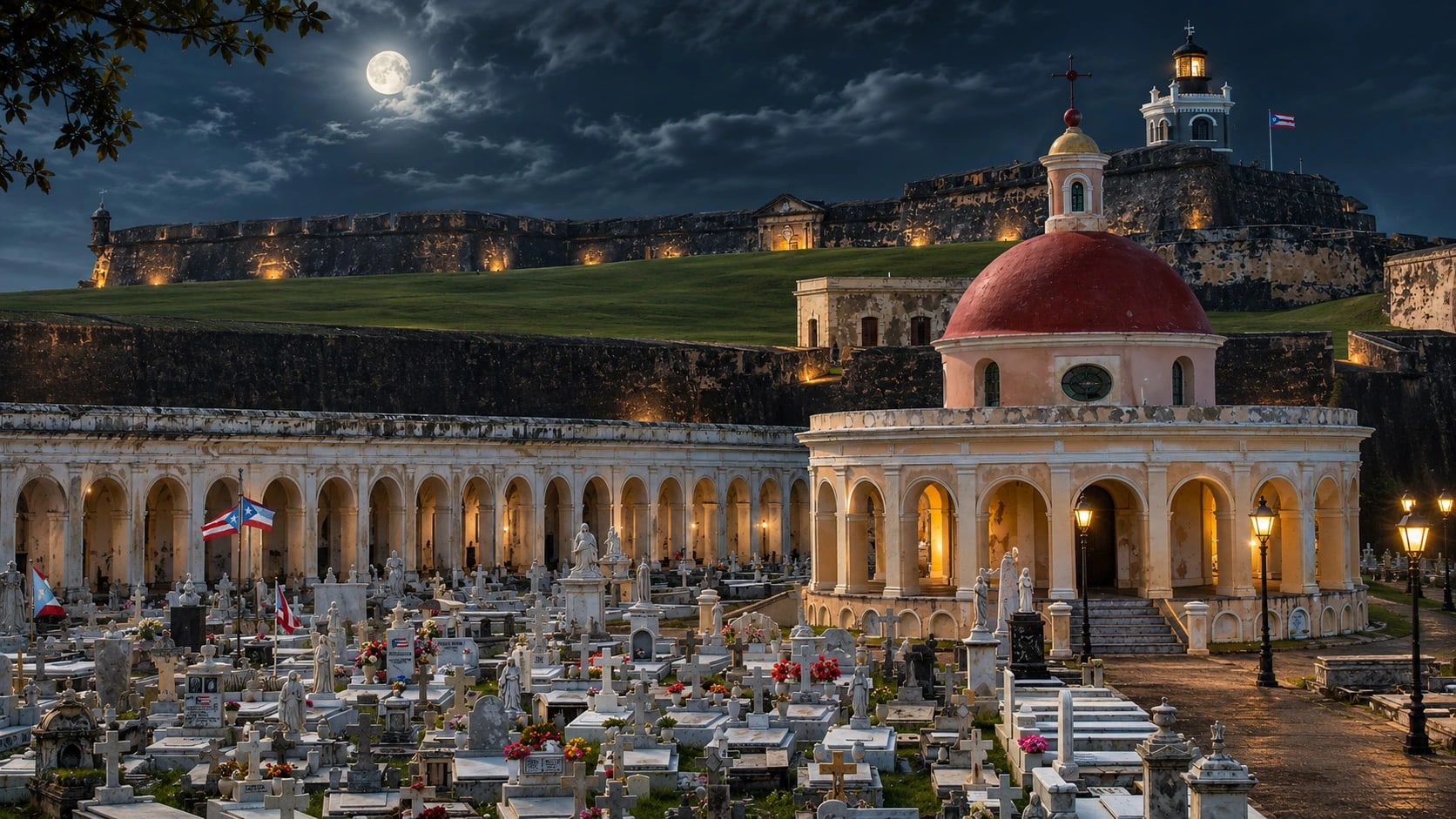
Santa María Magdalena de Pazzis Cemetery occupies one of the most extraordinary locations in the Caribbean. It stands between the Atlantic Ocean and the massive stone fortifications of Castillo San Felipe del Morro, where Spanish soldiers once guarded the entrance to San Juan Bay.
The graves are arranged around a beautiful domed chapel, their white marble monuments contrasting with the dark walls of the fortress above them. Beyond the cemetery, waves crash against the rocky shoreline. To the east, the colorful houses of La Perla rise along the coast.
The setting has inspired ghost stories for generations. But the history beneath those graves is considerably darker than most visitors realize.
Why San Juan Built a Cemetery Outside Its Walls
For much of Puerto Rico's early colonial history, the dead were buried much closer to the living than they are today.
Catholic churches served as important burial places, and families frequently arranged for deceased relatives to be interred beneath church floors, in chapels, or in surrounding grounds. The practice reflected religious beliefs concerning death and resurrection, but it also reinforced the social distinctions of colonial society.
Wealthy families could secure prominent burial places inside churches, often near altars or chapels associated with their patrons. Other residents were buried in less prestigious locations, while poorer families had fewer choices concerning the final resting places of their relatives.
In San Juan, burials took place at the cathedral, Iglesia San José, Iglesia San Francisco, and religious institutions such as the Carmelite convent on Calle del Cristo.
As the population increased, the practice created serious problems.
Churches needed to accommodate worshippers while also receiving the bodies of deceased parishioners. Burial spaces became crowded, and decomposing remains could produce unpleasant odors inside buildings used for religious services.
European governments began reconsidering the practice during the eighteenth century.
In Spain, royal orders issued under Charles III called for burial grounds to be established outside populated urban areas. The Crown wanted cemeteries placed in well-ventilated locations rather than within crowded churches and residential neighborhoods.
The reforms reflected contemporary ideas about disease and public health. Physicians did not yet understand the mechanisms through which many infectious illnesses spread, and foul air was widely believed to contribute to sickness.
The Spanish Crown issued additional orders as authorities struggled to overcome financial difficulties and resistance from communities attached to traditional burial customs.
San Juan eventually moved toward establishing a new cemetery outside its defensive walls.
The location selected was along the northern coast, beneath the imposing fortifications of El Morro.
In 1814, the cemetery was formally established and blessed. Its use was initially sporadic, becoming more regular during the 1840s.
This earlier date is important because many modern visitor descriptions give 1863 as the cemetery's founding year. That date refers to an important period of construction and architectural development, not the beginning of burial activity at the site.
The cemetery was already receiving the dead decades before its familiar domed chapel and rows of monuments acquired their present appearance.
Why Does the Cemetery Face the Atlantic Ocean?
One of the most frequently repeated explanations for the cemetery's location concerns an old belief about the journey of the soul.
According to the tradition, San Juan's dead were buried facing the Atlantic because the ocean symbolized their passage into eternity. The water represented the boundary between the world of the living and whatever awaited beyond death.
Puerto Rico's official tourism organization, Discover Puerto Rico, repeats this interpretation, as do several local historical and travel publications.
The symbolism is certainly compelling.
From the cemetery, the Atlantic stretches toward the horizon without interruption. The graves stand on a narrow shelf of land beneath the city, separated from the streets above by heavy stone walls.
For someone contemplating death, the endless water offers a powerful image of departure.
It is easy to imagine generations of mourners standing beside a freshly filled grave, looking beyond the white monuments toward an ocean whose distant shores they could not see.
But the cemetery's actual location was also dictated by practical considerations.
San Juan needed a burial ground outside its crowded urban center. The rocky coastal land beneath El Morro provided a location beyond the main residential streets while remaining accessible to the city.
The public-health reforms of the late eighteenth and early nineteenth centuries offer a documented explanation for why authorities wanted burials moved beyond the walls.
The belief that the ocean represented the soul's journey is part of the cemetery's traditional interpretation, but it should not be treated as the sole proven reason that colonial officials selected the site.
Both explanations have become part of its identity.
The practical decision to move burials away from inhabited neighborhoods eventually produced one of the most visually striking cemeteries in the Americas.
The symbolic explanation gave the location a meaning that extended beyond its original function.
Who Was Santa María Magdalena de Pazzis?
The cemetery takes its name from Saint Mary Magdalene de' Pazzi, a sixteenth-century Italian Carmelite nun celebrated for her religious mysticism.
She was born Caterina de' Pazzi in Florence on April 2, 1566, into a prominent family associated with the city's political and social history.
From an early age, Caterina expressed a powerful interest in religious life. She eventually entered the Carmelite monastery of Santa Maria degli Angeli, where she took the name Maria Malena.
During her years in the convent, she became known for extraordinary religious experiences, including visions and prolonged periods of spiritual ecstasy.
Other members of the community recorded many of these experiences, which contributed to her reputation as a significant figure in Catholic mysticism.
She died on May 25, 1607, and was canonized in 1669.
Her association with the Carmelite order provides an interesting connection to another historic San Juan landmark.
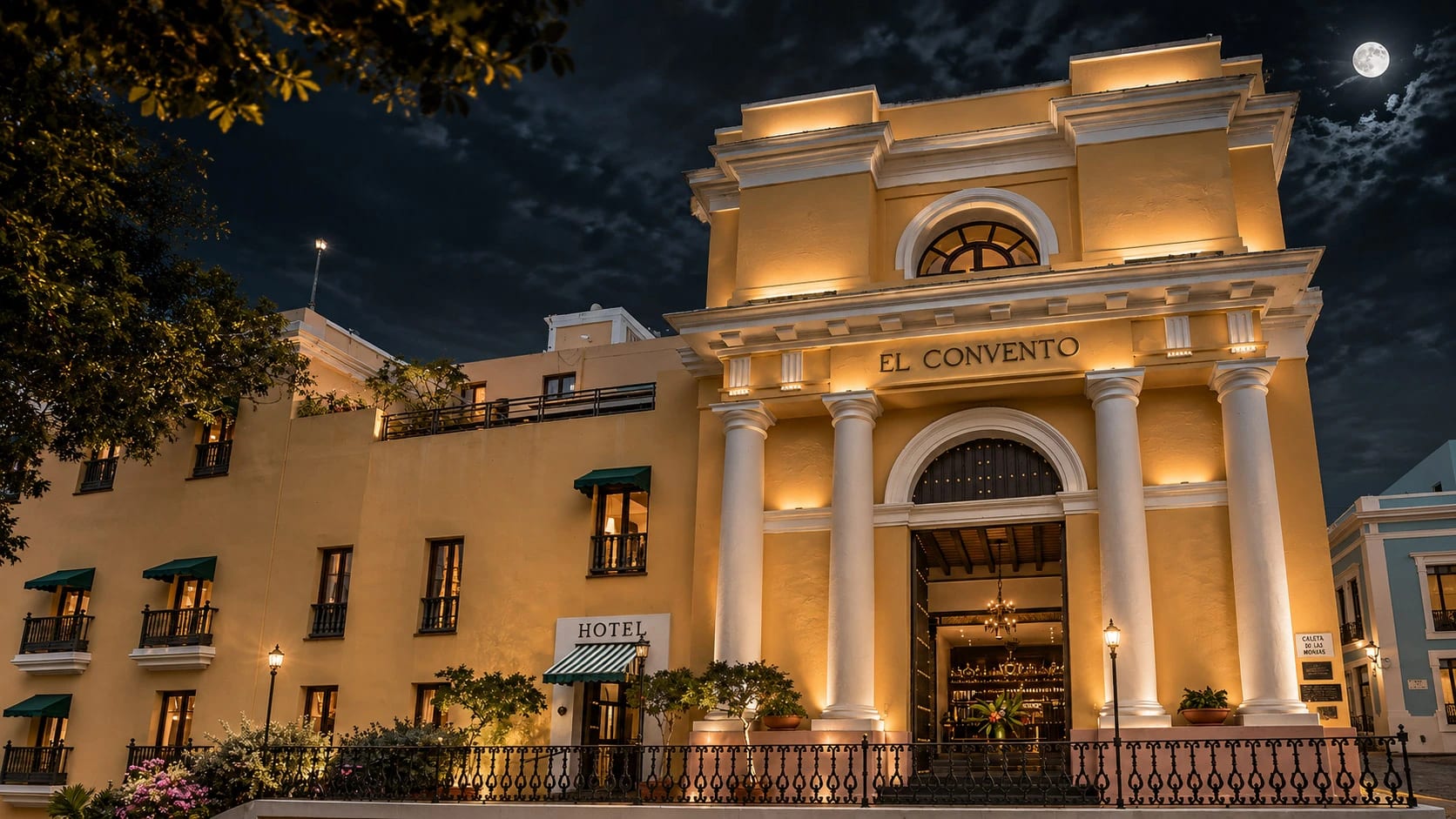
Hotel El Convento, located on Calle del Cristo, occupies the former Monastery of Saint Joseph, a Carmelite institution established during the seventeenth century.
The cemetery and the former convent are separate places with different histories, but both reflect the influence of Catholic religious traditions on colonial San Juan.
It is also important not to confuse Saint Mary Magdalene de' Pazzi with Mary Magdalene, the biblical follower of Jesus.
They are entirely different historical figures.
The saint honored by the cemetery was a Florentine Carmelite nun who lived more than 1,500 years after the events described in the New Testament.
Her name became permanently associated with one of Puerto Rico's most important burial grounds.
The Beautiful Chapel Surrounded by the Dead
The most recognizable structure inside Santa María Magdalena de Pazzis Cemetery is its circular chapel.
Its warm yellow walls, arched openings, and reddish dome stand in striking contrast to the white marble graves surrounding it. From the fortifications above, the chapel appears almost like the center of an elaborate geometric arrangement of monuments.
The building developed during the nineteenth century as the cemetery expanded.
Historical architectural research identifies Manuel Sicardó, an architect associated with the city, as the designer of the chapel during the 1860s. The work was subsequently completed by José I. Hernández Costa.
The cemetery's earlier development had involved engineer Ignacio Mascaró, whose plans formed part of the effort to establish a formal burial ground outside San Juan's walls.
The surrounding grounds gradually acquired additional graves, burial niches, monuments, and family mausoleums.
Some of the most elaborate tombs resemble miniature churches or classical temples. Others contain sculpted angels, crosses, urns, mourning figures, and decorative architectural elements.
Many memorials were constructed with expensive materials, including marble, reflecting the wealth and social prominence of the families who commissioned them.
Elsewhere, simpler graves preserve the names of people who lived far less celebrated lives.
This contrast is one of the cemetery's most revealing features.
Death might be universal, but the ways people were commemorated were not.
Families with resources could construct substantial monuments intended to survive generations. Those without similar means depended on more modest markers or forms of burial that were less likely to remain identifiable.
The cemetery also contains funerary artwork influenced by religious and fraternal traditions.
Historian Carmen Alicia Morales has described a section where tombs display symbols associated with Freemasonry, including broken columns, pyramids, torches, and other decorative features.
Elsewhere, sculpted angels, mourning women, and religious imagery reflect more familiar Catholic traditions.
The result is not a uniform field of headstones, but an open-air record of changing beliefs about death, social identity, and remembrance.
Some of its monuments tell elaborate stories about their occupants.
Others reveal almost nothing.
The Green Witch of Santa María Magdalena de Pazzis
The cemetery's best-documented supernatural legend concerns the woman in green.
According to stories circulated among residents of La Perla, a mysterious female figure was seen flying over the graves after dark.
The apparition was described as wearing green clothing, and the tales eventually became associated with a particular tomb inside the cemetery.
In 2010, a Primera Hora reporter documented the story during an interview with Thelma Díaz, the cemetery's administrator.
Díaz explained that children from La Perla had been responsible for spreading the story. According to her account, they described a woman dressed in green flying above the cemetery.
Years later, visitors continued to ask about the mysterious grave.
Some of the people looking for it were students who had encountered the legend through school or local storytelling. Others were simply curious about a place associated with such an unusual apparition.
The administrator was unimpressed.
She said she had never witnessed anything supernatural at the cemetery and expressed irritation at stories being invented about the people buried there.
Her response was memorable because she joked that if she ever encountered the flying witch, she would gladly accompany her for a better view of the grounds.
Díaz also described the grave traditionally associated with the story. It was unusual because it had a stone covering rather than the more familiar tomb construction.
She refused to direct visitors to the location.
For her, the grave belonged to a deceased person deserving respect, not a supernatural attraction.
The story illustrates how cemetery folklore can develop within a community and survive long after its original storytellers have grown older.
What may have begun as a frightening tale shared among children became a local legend repeated by people who had never met those children or heard the story directly from them.
As the legend spread, the mysterious figure acquired a recognizable identity.
She became the Green Witch.
There is no verified eyewitness evidence establishing that a woman flew over the cemetery or that the associated grave belonged to someone accused of witchcraft.
The cemetery administrator's account is valuable precisely because it provides a traceable explanation for how the story was circulated.
It also offers an unusually candid response from someone who knew the cemetery intimately.
She had spent years among the graves and had no interest in inventing a ghost to make her workplace more exciting.
The folklore survived anyway.
The Grave of the Girl Who Died on Her Fifteenth Birthday
During the same 2010 interview, Thelma Díaz shared another story about a young woman buried at Santa María Magdalena de Pazzis.
According to the administrator, the girl had died in an accident on the day of her fifteenth-birthday celebration.
She was buried wearing the dress and crown associated with her quinceañera, an important coming-of-age tradition in Puerto Rican and other Latin American communities.
The details are heartbreaking.
A celebration intended to mark the beginning of a new chapter in the girl's life instead became the day her family mourned her death.
Díaz did not provide a name or enough identifying information to independently verify the accident, so the account should be understood as testimony from the cemetery's administrator rather than a fully documented historical case.
Her reason for discussing the grave, however, was not to tell a ghost story.
She described discovering two young women behaving suspiciously near it. One appeared to be sitting on the tomb while the other was digging.
Díaz approached them and demanded that they stop.
She believed they were attempting to bury something at the grave, although the report did not establish precisely what the object was or why they had chosen that location.
The administrator considered their actions a desecration and threatened to contact the police.
The incident is an important reminder that cemeteries sometimes attract people seeking experiences or rituals that have little connection with the wishes of surviving relatives.
It would be irresponsible to claim that the women were practicing witchcraft or attempting to summon the deceased girl. The published account does not establish either conclusion.
What it does reveal is how fiercely the administrator protected the burial ground.
She regarded the graves as places where real people rested, and she considered their care a personal responsibility.
For a cemetery already associated with ghost stories, her attitude provides a necessary counterweight.
The dead were not characters created for entertainment.
They had been someone's children, parents, spouses, and friends.
The Cholera Epidemic That Filled San Juan's Graves
The most disturbing chapter in the cemetery's history began in 1855.
A devastating cholera epidemic swept through Puerto Rico, causing an enormous loss of life.
Cholera is a bacterial infection that can produce severe diarrhea and rapid dehydration. Without adequate treatment, especially in the nineteenth century, patients could die with frightening speed.
The disease spread through contaminated water and food, although the scientific understanding of its transmission was still developing during the period.
Across Puerto Rico, estimates of the epidemic's death toll vary considerably. Research cited by the University of California, Berkeley, places the number of deaths between approximately 20,000 and 50,000 people, representing a substantial portion of the island's population.
The crisis affected San Juan particularly severely.
Families watched relatives become ill, while local authorities struggled to provide medical assistance and dispose of the dead.
The cemetery outside the city walls could not accommodate the number of bodies arriving for burial.
For the colonial government, the situation created an emergency.
The existing cemetery had already been established for decades, but an epidemic of this magnitude overwhelmed its available space. Officials needed somewhere to bury people quickly while attempting to prevent further deterioration of sanitary conditions.
The municipal Board of Health approved the creation of a mass burial ground near the cemetery, outside its existing boundaries.
The site became associated with the term cementerio colérico, or cholera cemetery.
During the worst period of the epidemic, the burial area received human remains that could not be accommodated in the ordinary cemetery.
It continued in use until late 1856, when the epidemic began to subside.
Unlike the elaborate mausoleums and marble memorials erected elsewhere in the cemetery, the emergency burial ground did not preserve generations of individual names in monumental stone.
Its purpose was to provide a place for the dead during a public-health catastrophe.
The people buried there included individuals whose lives may have left little surviving documentary evidence.
The contrast is extraordinary.
Within the cemetery walls, prominent families erected lasting memorials. Just beyond them, people who died during one of Puerto Rico's worst epidemics were placed in a burial ground that would eventually disappear from public memory.
The Forgotten Mass Grave Outside the Cemetery
The emergency burial ground did not vanish immediately after the epidemic.
In 1867, municipal officials considered incorporating the area into the existing cemetery as part of an expansion.
Medical authorities opposed the proposal.
They were concerned about the condition of the human remains and feared that disturbing the burial ground might create another health risk.
The decision reflected the scientific understanding and public-health concerns of the period. It should not be interpreted as evidence that cholera bacteria remained capable of causing an outbreak more than a decade after the original burials.
Historical maps from 1877 continued to identify the area as the location of the cholera cemetery.
After that, the burial ground largely disappeared from the available municipal record.
Its boundaries became less clearly understood, and the people buried there gradually faded from public remembrance.
Over the following century, the coastline changed.
Storms, rain, erosion, and continued human activity affected the terrain outside the cemetery walls. Footpaths and later recreational routes crossed portions of the surrounding landscape.
Eventually, researchers began finding human skeletal material exposed at the surface.
The discovery prompted a major archaeological investigation.
The Proyecto Bioarqueológico del Viejo San Juan, led by researchers associated with the University of California, Berkeley, was established to examine the area, recover exposed remains, and help protect the people buried there.
Researchers worked in consultation with Puerto Rican public agencies, the National Park Service, and members of the nearby La Perla community.
Their work combined archival research, historical maps, geophysical surveys, and archaeological methods.
Ground-penetrating radar and magnetometer surveys helped identify areas that might contain archaeological deposits.
During surface investigations beginning in 2022, researchers identified more than 500 fragments of human bone across an area of slightly more than 200 square meters.
The discovery provided physical evidence that the area outside the cemetery contained disturbed human remains.
But the most important questions remained unanswered.
Who were these people? When had they been buried? And why were their remains found outside the cemetery's existing walls?
What Archaeologists Found Beneath the Ground
In the summer of 2023, researchers conducted preliminary excavations in two small areas associated with the investigation.
The results were published in a 2024 research report by José L. Marrero-Rosado and Sabrina C. Agarwal, both associated with UC Berkeley.
Human skeletal material was recovered from multiple archaeological layers.
The remains included fragmented bones, teeth, parts of a jaw, and other skeletal elements. Investigators also recovered objects associated with burial practices, including buttons, pieces of clothing, pins, fragments of tombstones, and a glass candle jar decorated with religious imagery.
Some of the recovered bones showed marks consistent with earlier digging or disturbance.
The archaeological findings complicated the original understanding of the site.
Although the area was associated historically with the cholera burial ground, the excavated deposits did not necessarily represent undisturbed graves from 1855.
The researchers reported that the material appeared to occur within layers of fill. Some artifacts suggested that portions of the deposits could have been moved or placed there as late as the 1940s.
That raised the possibility that at least some of the recovered remains had originally been buried elsewhere and later relocated.
It is a crucial distinction.
The historical existence of the cholera mass burial ground is documented, but the identity and original burial circumstances of the individual remains recovered during the excavations have not all been established.
The researchers did not claim to have identified every fragment as belonging to a victim of the 1855 epidemic.
Their work instead revealed a more complicated history of burial, disturbance, and the treatment of human remains around the cemetery.
The project was intended not merely to recover archaeological material but to restore a measure of dignity to people whose graves had been forgotten or damaged.
Its stated goals included studying the remains, learning more about the individuals represented, and arranging for their respectful reburial.
For a site frequently described in terms of ghosts and supernatural mystery, the discovery presents a far more consequential question.
How could human remains remain unprotected and unidentified for so long in the shadow of one of Puerto Rico's most famous historic landmarks?
The Famous Puerto Ricans Buried Beneath El Morro
Santa María Magdalena de Pazzis has often been described as a national pantheon because so many influential Puerto Ricans are buried there.
Its graves include writers, political leaders, musicians, artists, and people whose contributions helped shape the island's cultural identity.
Among the most prominent is Pedro Albizu Campos (1891–1965), a leading figure in Puerto Rico's independence movement and longtime president of the Puerto Rican Nationalist Party.
Albizu Campos became one of the most consequential and controversial political figures of twentieth-century Puerto Rico. His life included political organizing, imprisonment, conflict with colonial and federal authorities, and a prominent role in the independence movement.
His burial site became a place of historical remembrance, particularly for people who identify with the political causes he represented.
Another important figure is José de Diego (1866–1918), a poet, lawyer, and political leader who advocated greater self-government and independence for Puerto Rico.
De Diego's literary and political work earned him a prominent place in the island's history. His grave reflects the overlap between cultural expression and political life that characterized much of Puerto Rico's late nineteenth- and early twentieth-century experience.
José Celso Barbosa (1857–1921), a physician and political leader associated with Puerto Rican statehood, is also buried in the cemetery.
Barbosa helped establish important political institutions following the transition from Spanish to American rule, and his work made him a central figure in a different vision for Puerto Rico's future.
Their presence in the same cemetery illustrates its historical significance.
People whose political beliefs differed substantially are buried within the same grounds, forming part of a shared historical landscape.
The cemetery also contains the graves of musicians whose work became internationally recognized.
Rafael Hernández Marín (1892–1965) was one of Puerto Rico's most celebrated composers. His songs, including Lamento Borincano and Preciosa, became enduring expressions of Puerto Rican identity and cultural memory.
Catalino "Tite" Curet Alonso (1926–2003) was a prolific songwriter whose compositions became essential to the development of salsa and Latin popular music.
Other notable figures buried at the cemetery include singer Daniel Santos, composer Pedro Flores, actor José Ferrer, and historian and cultural preservationist Ricardo Alegría.
Alegría's presence is particularly meaningful because his work helped preserve Old San Juan's historic buildings and archaeological heritage.
Writers are also well represented.
Alejandro Tapia y Rivera, the important nineteenth-century playwright whose name was given to Teatro Tapia, is among the figures associated with the cemetery's burials.
Each of these individuals has a history worthy of its own article.
Together, their graves demonstrate why Santa María Magdalena de Pazzis is more than an architectural attraction.
It is a place where generations of Puerto Rican history have been gathered into a relatively small area beside the Atlantic.
The Graves Nobody Comes to Visit
Not every grave in Santa María Magdalena de Pazzis bears a famous name.
Many contain people whose lives were important to families and communities but left little trace in official histories.
The cemetery's former administrator, Thelma Díaz, spoke openly about her concern for these neglected burials.
She told Primera Hora that some family tombs had fallen into poor condition and that relatives needed to take greater responsibility for their maintenance.
She also described graves with inscriptions that revealed unexpectedly personal relationships.
One belonged to Juan León, who had served as secretary to José de Diego. His memorial expressed a continuing attachment to the political leader, proclaiming that he would remain beside him in life or death.
Others reflected humor even in the presence of mortality.
The grave of Puerto Rican comedian Ramón Rivero, better known as Diplo, contained an inscription whose meaning could be translated as an apology for not getting up.
The joke offered a glimpse of the personality that had made him famous.
Elsewhere, however, some graves had no visible inscriptions at all.
Díaz mentioned a small tomb believed to be among the cemetery's oldest. Its size suggested that it might belong to a child, but the absence of identifying information made its history uncertain.
Such graves demonstrate how easily a person's identity can disappear.
A marker may deteriorate. A family may move away. Records may be damaged or lost, and eventually even the people responsible for maintaining a cemetery may no longer know who occupies a particular space.
The possibility of being forgotten is a recurring theme in cemetery folklore.
Ghost stories often imagine the dead returning because they have unfinished business or because something about their lives remains unresolved.
The historical problem is more immediate.
People can lose their names, monuments, and connections to surviving families without anything supernatural occurring at all.
The Cemetery's Struggle Against Time
The Atlantic setting that makes Santa María Magdalena de Pazzis so beautiful also contributes to its deterioration.
Salt-laden air, tropical rainfall, intense sunlight, and severe storms gradually damage stone, masonry, metal, and decorative materials.
The cemetery has faced maintenance problems for decades.
In April 2023, El Nuevo Día published an investigation describing serious deterioration throughout portions of the grounds.
Journalist Víctor Ramos Rosado documented damaged tombs, deteriorating structures, and burial spaces where human remains had become visible.
The report raised questions about the preservation of a cemetery containing some of Puerto Rico's most significant historical graves.
Restoration funding had been discussed, but the physical condition described by the newspaper demonstrated how much work remained necessary at the time.
The difficulties reflect broader preservation challenges.
A historic cemetery is not a conventional monument.
It contains individual family property, active burial spaces, structures constructed in different periods, and memorials whose upkeep may depend on relatives living far away.
Preservation also requires specialized knowledge.
Restoring a damaged marble monument, repairing a burial vault, or stabilizing a nineteenth-century chapel demands more than ordinary landscaping or maintenance.
There is also the question of responsibility.
A cemetery that serves as an important public historic site may still contain graves whose maintenance obligations are distributed among families, institutions, and government authorities.
Those practical complications can make preservation difficult even when the cultural importance of the place is widely recognized.
The 2023 reporting should not be assumed to describe every grave's condition today, and repairs may have occurred since its publication. Nevertheless, it documents the scale of the preservation problems confronting the cemetery in recent years.
For visitors interested in Old San Juan's history, the situation offers another perspective on the meaning of remembrance.
It is easy to admire a beautiful cemetery from a distance.
Keeping the people buried there from being forgotten requires continuing effort.
Is Santa María Magdalena de Pazzis Cemetery Really Haunted?
The cemetery has a recognizable supernatural legend, but reliable evidence of paranormal activity is limited.
The Green Witch story was documented in Puerto Rican newspaper reporting, and the cemetery's former administrator explained its circulation among children and residents of La Perla.
She did not claim to have witnessed the apparition.
Other online descriptions refer more generally to ghostly figures, unexplained sounds, or strange sensations experienced among the tombs. Such accounts are usually too vague to establish when the incidents supposedly occurred or whether anyone independently examined them.
There is no credible basis for claiming that the cemetery's famous historical figures return as ghosts.
Nor should the archaeological discoveries outside the cemetery be presented as evidence that a supernatural haunting exists.
The exposed human remains, the forgotten burial ground, and the uncertainty surrounding some of the archaeological deposits are documented historical and preservation concerns.
They are not paranormal events.
What makes the cemetery interesting is the way these different subjects intersect.
The Green Witch belongs to the folklore of a living community. The elaborate monuments preserve the accomplishments of prominent Puerto Ricans. The unmarked and deteriorating graves reveal how easily personal histories can disappear.
The cholera burial ground records a moment when death arrived faster than the city could respond.
All of those stories occupy the same narrow stretch of land beneath El Morro.
For generations, San Juan's residents have lived beside the cemetery, passed its walls, and looked down upon its graves from the fortress above.
Some people see a beautiful place of remembrance.
Others see a location whose association with death makes the possibility of ghosts difficult to ignore.
The historical record cannot establish that any apparition walks among the graves after dark.
It does establish that the cemetery contains stories far more complicated than the legends usually told about it.
Visiting Santa María Magdalena de Pazzis Cemetery
Santa María Magdalena de Pazzis Cemetery is located along Calle Cementerio in Old San Juan, Puerto Rico, directly below the northern fortifications near Castillo San Felipe del Morro.
Visitors approaching from the historic district can reach the cemetery by descending toward Calle Cementerio and passing through an opening in the old city walls.
The descent provides an unusual view of San Juan's military architecture.
From above, the cemetery appears tightly arranged against the Atlantic coastline. Once inside, visitors encounter a network of narrow paths between tombs, memorials, family burial vaults, and the circular chapel.
The location offers striking views toward El Morro, the ocean, and the neighboring community of La Perla.
Because the cemetery is a burial ground rather than a conventional tourist attraction, visitors should behave respectfully.
Photography of historic architecture and monuments is common, but funeral services, mourners, and people visiting family graves deserve privacy.
The cemetery's pathways can be narrow and uneven, and some burial structures may be fragile or deteriorating.
Visitors should remain on established routes and avoid climbing onto tombs, disturbing memorial objects, or entering restricted areas.
Can you visit the cemetery at night?
The cemetery is not ordinarily open for unrestricted nighttime exploration.
Published visitor guides recommend going during daylight hours when staff are present and the grounds are accessible. Opening schedules vary between sources, so visitors should confirm current hours rather than assume they can enter in the evening.
The surrounding historic district offers opportunities to see El Morro and portions of the city walls after dark without entering the cemetery.
The archaeological area associated with the former cholera burial ground should not be treated as a place for independent ghost hunting. It contains sensitive cultural resources, and visitors must respect any access restrictions and preservation work.
For location information, consult the official Discover Puerto Rico cemetery listing.
The cemetery is also visible from portions of the grounds surrounding El Morro, which provide an excellent opportunity to appreciate its relationship with the fortress.
The Dead Beneath San Juan's Walls
Santa María Magdalena de Pazzis is one of the few places in Old San Juan where the city's history is physically arranged before visitors.
The fortress above it represents centuries of military power. Its walls were built to resist invasion and protect the colonial capital from foreign enemies.
The cemetery below serves a different purpose.
It preserves the names of people who shaped Puerto Rico through politics, literature, music, scholarship, and everyday life.
Some were celebrated during their lifetimes. Others became important only to the people who loved them.
Beyond the cemetery walls lies the history of an epidemic that overwhelmed the city's capacity to bury its dead, leaving an emergency burial ground whose location and occupants were eventually forgotten.
The stories of the Green Witch add another dimension.
They remind us that historic places continue to acquire new meanings through the people who live near them and the stories they share.
The children who supposedly invented the legend grew older. The cemetery administrator who spoke about it in 2010 has become part of the documented history of the place. Archaeologists working generations after the cholera epidemic have begun recovering evidence of lives that had disappeared from public memory.
The cemetery has not remained unchanged.
Neither have the stories told about it.
Discover the Haunted History of Old San Juan
Old San Juan is a city where some of the most remarkable stories are hidden behind familiar landmarks.
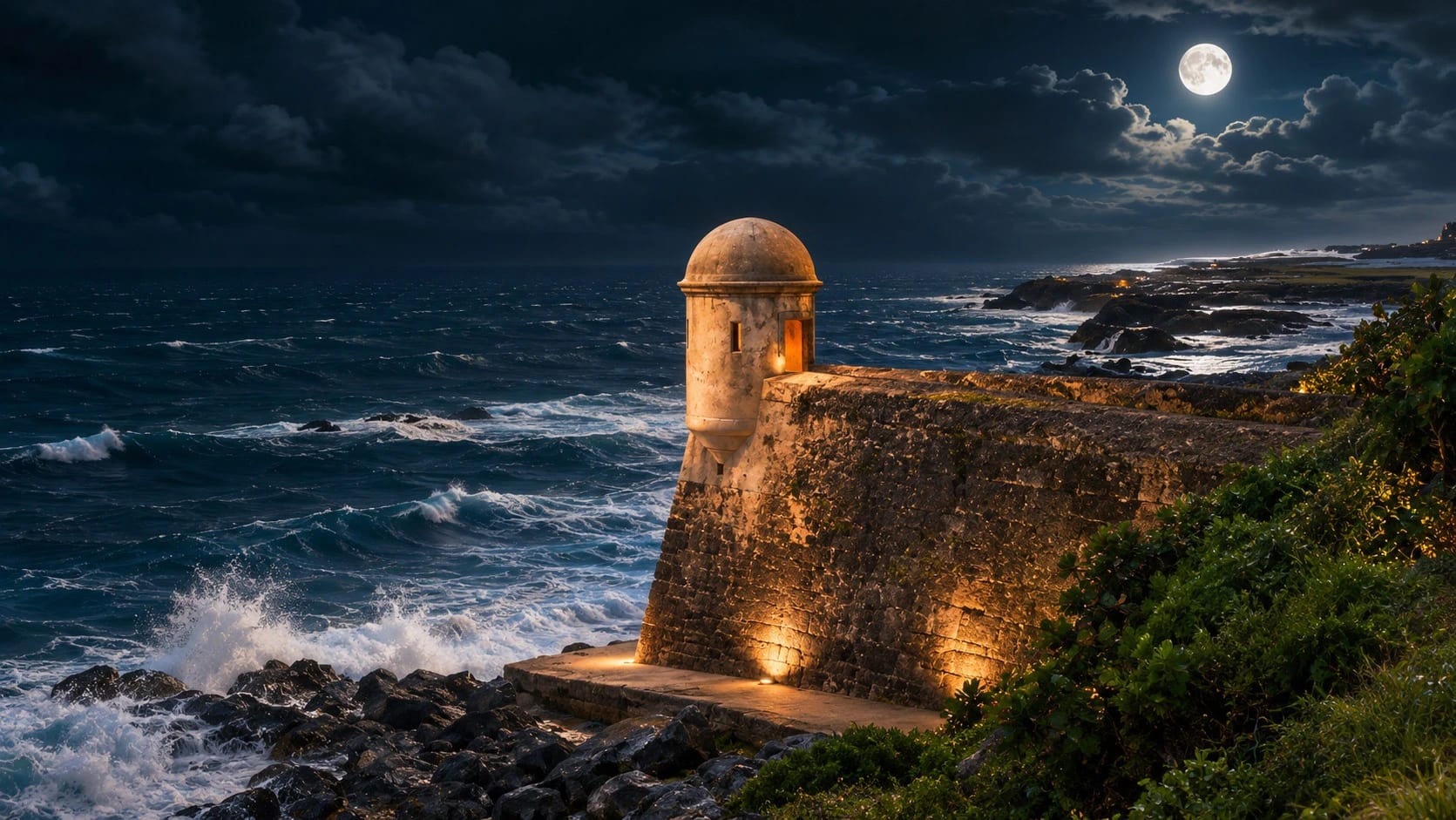
The fortifications at El Morro and Castillo San Cristóbal preserve centuries of military history, while their sentry boxes and underground passages have inspired legends of phantom soldiers and mysterious disappearances.
Historic churches and former convents contain stories of religious devotion, death, and reported apparitions. Elsewhere, theaters and public squares preserve traditions associated with performers, tragedies, and events that became part of Puerto Rican folklore.
Santa María Magdalena de Pazzis offers a particularly powerful connection to those stories.
Its graves contain people who lived through many of the changes that transformed Puerto Rico from a Spanish colony into the society visitors encounter today.
The cemetery's history is also a reminder that the dead of Old San Juan were not always famous or honored with elaborate monuments.
Some were buried hastily during epidemics. Others left behind ordinary graves that no longer bear readable names.
At Ghost City Tours, we explore the legends and darker history of Old San Juan through guided evening walking tours.
Our family-friendly Night of Souls Ghost Tour introduces guests to Puerto Rican folklore, mysterious stories, and the history of the old city.
For visitors interested in more unsettling subjects, The Dead at the Gate explores the darker chapters of San Juan's past, including the history of conflict, death, and the enduring legends associated with its historic streets.
The cemetery itself is a place of remembrance, not a nighttime attraction. Its stories belong to the broader history visitors can discover while exploring Old San Juan.
Above Santa María Magdalena de Pazzis, the soldiers of El Morro once watched the horizon for enemy ships.
Below them, generations of Puerto Ricans eventually found their final resting places.
The fortress was built to keep danger away from the living. The cemetery was built to give the dead somewhere to rest.
For centuries, the Atlantic has crashed against the rocks beneath them both.
According to the old stories, something still moves above the graves after dark.
But the most unsettling discovery may be that some of the people buried beside those walls were forgotten long before anyone came looking for ghosts.
Historical References and Sources
1. Puerto Rico State Historic Preservation Office — The Cholera Burial Ground
Patrimonio, Volume XII (2024): Cuando nuestros ancestros son patrimonio — PDF
By José L. Marrero Rosado and Sabrina C. Agarwal, pages 90–95. An exceptionally important scholarly source documenting the cemetery's establishment in 1814, the cholera epidemic of 1855, the forgotten burial ground, historical maps, and archaeological findings. The article reports the recovery of more than 500 human bone fragments during surface investigations and describes the work undertaken to protect and study the remains.
2. University of California, Berkeley — Archaeological Research Project
Proyecto Bioarqueológico del Viejo San Juan
Official university research overview describing the forgotten mass burial ground associated with the 1855 cholera epidemic, the exposure of human remains, and the project's preservation and reburial objectives.
3. University of California, Berkeley — Preliminary Excavation Report
Preliminary Excavations of Secondary Burials in San Juan, Puerto Rico (2024)
By José L. Marrero-Rosado and Sabrina C. Agarwal. Documents the 2023 excavations, recovered skeletal remains and artifacts, and the researchers' conclusion that some deposits may represent later disturbed or relocated burials rather than undisturbed cholera graves. This distinction is essential to interpreting the archaeological discoveries accurately.
4. Primera Hora — The Green Witch and Cemetery Administrator
Nació para estar entre los muertos — February 27, 2010
A particularly valuable firsthand newspaper interview with cemetery administrator Thelma Díaz. Documents the Green Witch legend, its reported origins among children of La Perla, the administrator's skepticism, the unusual grave associated with the story, and her account of a young girl's burial. Also includes information about important graves, their inscriptions, and ongoing maintenance concerns.
5. El Adoquín — Historical Development of the Cemetery
Historia del Viejo San Juan: El Cementerio Santa María Magdalena de Pazzi — May 6, 2019
By historian Dr. Carmen Alicia Morales. Explains eighteenth-century burial reforms, the selection and blessing of the cemetery in 1814, its development during the nineteenth century, and the architectural and funerary symbolism of different burial sections. Important for distinguishing the cemetery's original establishment from later construction.
6. NotiCel — Cemetery History and Notable Burials
Memoria Viva: El Cementerio de Santa María Magdalena de Pazzi — September 29, 2019
By Nahira Montcourt. Detailed historical article drawing on university archival photographs, Library of Congress material, and historical research. Includes the cemetery's nineteenth-century development, architectural information, and a substantial list of notable Puerto Ricans buried there.
7. El Nuevo Día — Cemetery Deterioration Investigation
Crónica: El cementerio de los abandonados — April 9, 2023
By Víctor Ramos Rosado. Investigative reporting documenting deterioration at the cemetery, damaged burial structures, exposed human remains, and concerns about the preservation of an important Puerto Rican historic site.
8. El Nuevo Día — Life and Death at the Cemetery
Amanecer en el cementerio — October 30, 2011
A historical and human-interest feature describing the cemetery, its administrator, notable graves, and everyday life at the burial ground.
9. OnCubaNews — The Green Witch Tradition
El mágico cementerio de La Perla — 2019
By photographer and writer Alejandro Ernesto. Independent travel reporting that also describes the legend of the woman in green supposedly flying over the graves, while noting cemetery employees' skepticism.
10. Discover Puerto Rico — Official Cemetery Listing
Cementerio Santa María Magdalena de Pazzis
Official destination-marketing listing confirming the cemetery's location, historical significance, and traditional association between the ocean and the journey into the afterlife. Useful for visitor information and the symbolic interpretation of the location.
11. Puerto Rico Historic Buildings Digital Archive — Architectural Record
Cementerio Santa María Magdalena de Pazzi — PRAHA Digital Archive
Archival record associated with San Juan National Historic Site, identifying figures connected with the cemetery's architectural development, including Ignacio Mascaró, Manuel Sicardó, and José I. Hernández Costa.
12. Vatican — Saint Mary Magdalene de' Pazzi
Saint Mary Magdalene de' Pazzi — Vatican City State
Biographical information about the Italian Carmelite saint for whom the cemetery was named, including her religious life, mystical experiences, and historical significance.
13. Atlas Obscura — Cemetery Visitor Information
Provides practical information about approaching the cemetery, its historic tombs, architectural setting, and recommendations for respectful daytime visiting.
Santa María Magdalena de Pazzis Cemetery between El Morro and the Atlantic Ocean