On the night of April 30, 1797, the people of San Juan were running out of hope.
For nearly two weeks, British warships had surrounded the city while thousands of enemy soldiers attempted to break through its defenses. Artillery fire echoed across the water. The roads leading toward the interior of Puerto Rico were threatened, supplies had become difficult to obtain, and the enormous Spanish fortifications that protected the capital were facing one of their greatest tests.
According to a famous Puerto Rican legend, the city's residents decided to do something extraordinary.
Led by their bishop, women carrying candles and burning torches gathered for a religious procession. They moved through San Juan's narrow streets, praying aloud while church bells rang from the towers above them. Their destination was not a battlefield but the city's historic cathedral, where they hoped divine intervention might save them from the British army.
From a distance, the flickering lights created an unusual spectacle.
British sentries watching the fortified city supposedly mistook the procession for thousands of soldiers arriving as reinforcements. The torches appeared to move through the streets in growing numbers, accompanied by sounds the enemy could not clearly identify.
General Ralph Abercromby, commanding the invading army, feared that San Juan was preparing a massive counterattack.
Rather than risk the destruction of his forces, he ordered the British to withdraw.
By the following morning, the siege was over.
It is one of Puerto Rico's most beloved historical legends. A city threatened by a powerful foreign army was supposedly saved not by its cannons, but by the prayers and ingenuity of ordinary people.
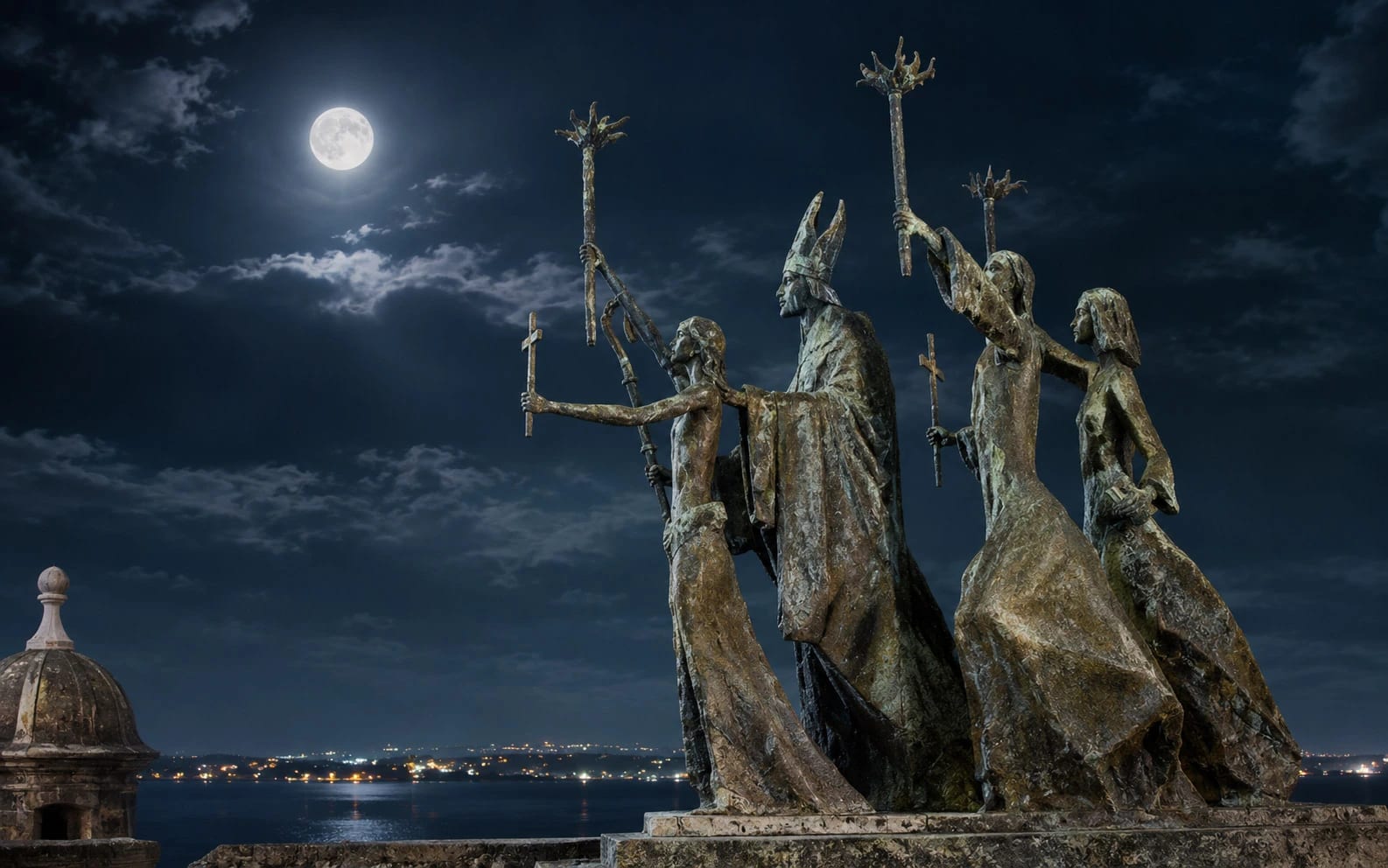
Today, a remarkable bronze sculpture overlooking San Juan Bay commemorates the event. Known as La Rogativa, it depicts a bishop and three women raising torches and religious symbols toward the sky.
Thousands of visitors photograph the monument every year. Many leave believing that the procession really frightened the British into abandoning their invasion.
But historians have uncovered a much more complicated story.
The British retreat is documented. The military battles are documented, and so are the contributions of Puerto Rican soldiers, free Black militiamen, and civilians who helped defend the island.
The famous procession, however, belongs to folklore.
Even Cayetano Coll y Toste, the Puerto Rican writer who preserved one of its best-known literary versions, ultimately concluded that the victory belonged to the military defenders rather than the intervention of eleven thousand heavenly virgins.
His story also contains a remarkable historical error: the bishop he identifies as leading the procession had stopped serving in Puerto Rico eight years before the British invasion.
La Rogativa is therefore more than a monument to a supposed miracle. It is a fascinating example of how an actual military victory became a story of religious devotion, how the roles of different defenders were remembered, and how a legend eventually became part of Old San Juan's permanent landscape.
The Night San Juan Was Supposedly Saved by Prayer
The traditional story begins inside a city under siege.
British forces had landed east of San Juan and established artillery positions overlooking the approaches to the fortified capital. Their warships threatened the harbor, and their soldiers repeatedly attempted to push through Spanish defensive positions.
Within the city walls, the residents lived with uncertainty.
They could hear the bombardment but had little way of knowing how long their defenders could continue resisting. The Spanish garrison had successfully prevented the invaders from entering San Juan, but victory was far from assured.
According to the legend, the city's bishop decided to organize a rogativa, a public act of supplication in which worshippers gathered to ask God for help.
The Spanish word comes from rogar, meaning to plead, beg, or pray earnestly.
The procession was not intended as an ordinary religious celebration. It was a desperate appeal for protection during a military emergency.
The participants carried candles, torches, and religious objects. Some versions describe women leading the procession, while others include elderly residents, clergy, and a larger congregation.
Church bells rang as the worshippers walked through the streets.
Their prayers were directed toward Saint Ursula and the legendary Eleven Thousand Virgins, whose protection was supposedly invoked against the British attackers.
In the version preserved by Coll y Toste, the procession began at the cathedral and moved throughout San Juan. Those who could afford candles carried them; poorer participants used simpler lights or torches made from available materials.
The illumination spread through the darkened streets, and the bells continued ringing.
British lookouts reportedly observed the activity from positions outside the city.
They could see lights moving within the fortifications, but they could not identify the people carrying them.
The legend claims that they reported the unusual movement to General Abercromby.
He interpreted the lights as evidence that reinforcements were arriving from the Puerto Rican countryside.
If fresh troops were gathering inside San Juan, the British might soon face an attack from defenders whose numbers were greater than expected.
The general had already failed to breach the Spanish defenses. Continuing the invasion against a reinforced garrison might result in unacceptable losses.
He decided to withdraw.
By morning, British soldiers were boarding their ships and abandoning the effort to capture Puerto Rico.
For the worshippers who had prayed through the night, the retreat seemed almost miraculous.
But the actual military campaign had begun long before anyone was said to have raised a torch along the city walls.
Why Britain Wanted to Capture Puerto Rico
In 1797, the Caribbean was a major theater of warfare between European empires.
Britain and revolutionary France were engaged in a prolonged conflict, while Spain had become an ally of France after abandoning its previous alignment with Britain.
That shift exposed Spain's Caribbean possessions to British attack.
Puerto Rico occupied an especially valuable position.
San Juan Bay provided a protected harbor near the principal routes connecting Europe with the Caribbean and the Americas. Spanish military installations guarded the entrance, while the island's location gave its rulers an advantage in monitoring shipping and supporting naval operations.
Control of Puerto Rico could strengthen Britain's position in the eastern Caribbean and weaken Spain's ability to defend its remaining possessions.
But the British campaign involved more than naval strategy.
The Caribbean was also experiencing the enormous upheaval of the Haitian Revolution, which had begun in the French colony of Saint-Domingue in 1791.
The uprising challenged a plantation economy built upon the enslavement of African people. Its consequences spread throughout the region as European governments, plantation owners, enslaved communities, and free people of color responded to the conflict.
British forces had intervened in Saint-Domingue and conducted military operations against French and allied forces in other Caribbean colonies.
By 1797, their commanders were searching for ways to expand British influence while accommodating plantation owners fleeing revolutionary violence.
Puerto Rican historian Juan Ángel Giusti Cordero argues that the British expedition against Puerto Rico was connected in part to the possibility of providing a new location for French plantation owners displaced from Saint-Domingue.
Such an outcome could have profoundly changed the island's economy and political development.
The British had already achieved a significant victory that year.
In February 1797, their forces captured the Spanish colony of Trinidad.
The conquest demonstrated the vulnerability of Spain's Caribbean possessions and encouraged further operations.
Puerto Rico was the next major objective.
General Ralph Abercromby and Admiral Sir Henry Harvey assembled a substantial expedition and sailed toward San Juan.
They expected to confront an important fortified city.
What they encountered was a defensive system that had been strengthened for generations.
The British Fleet Arrives on April 17, 1797
During the early hours of April 17, British vessels appeared off Puerto Rico's northern coastline.
The fleet approached the region of Cangrejos, east of San Juan, where the invading army intended to establish a foothold before advancing toward the capital.
Historical sources disagree about the exact number of vessels and personnel involved.
Puerto Rican historical research identifies approximately 63 ships carrying thousands of soldiers and sailors. Other official accounts describe a fleet of roughly 68 vessels, while estimates of the total expeditionary force vary according to whether they include sailors, auxiliaries, and troops who never landed.
The important point is that the British possessed a substantial military advantage at sea.
Their warships carried powerful artillery, while transport vessels brought infantry, ammunition, provisions, and equipment needed to sustain a landing operation.
The British intended to approach San Juan from the east.
It was a strategy that had succeeded almost two centuries earlier.
In 1598, George Clifford, Earl of Cumberland, captured San Juan after advancing from the landward side of the city. The Spanish defenses at El Morro had been designed primarily to resist attacks by sea, leaving the eastern approaches comparatively vulnerable.
By 1797, however, the situation had changed.
Spain had spent much of the eighteenth century improving San Juan's fortifications.
Castillo San Cristóbal now dominated the eastern approach, while a system of batteries, walls, outlying positions, and defensive obstacles protected the roads and waterways leading onto the San Juan islet.
These improvements were associated with military reforms begun under Alexander O'Reilly in 1765 and continued by engineers including Thomas O'Daly.
The investment was about to be tested.
On April 18, British troops landed in the Cangrejos area and began moving toward San Juan.
Local defenders resisted the landing, but the British succeeded in establishing positions on shore.
The invasion had begun.
The Governor Who Refused to Surrender
The responsibility for defending Puerto Rico fell to Governor Ramón de Castro y Gutiérrez.
A career military officer, Castro understood the importance of San Juan's fortifications and the consequences of allowing the British to occupy the capital.
His forces included Spanish regular troops, the Puerto Rican Fixed Regiment, trained local militia units, and civilian defenders drawn from communities across the island.
Some were experienced soldiers.
Others had limited military training and carried relatively simple weapons, including machetes, knives, and agricultural implements.
The defenders were not a single uniform army.
They represented different social classes, towns, backgrounds, and legal statuses within Spanish colonial Puerto Rico.
Castro organized the available forces and prepared the city for a prolonged confrontation.
The British advance threatened the land routes connecting San Juan with the rest of the island. Their naval forces also attempted to restrict supplies arriving by sea.
As pressure increased, the fortified capital became increasingly dependent on its defenders' ability to maintain access to provisions and reinforcements.
Abercromby demanded the surrender of San Juan.
Castro refused.
According to National Park Service historical research, the governor pledged to defend the city even at the cost of his own life.
His refusal transformed the invasion into a siege.
The British could not simply march through the city gates. They would have to defeat the defensive positions protecting the approaches and overcome a garrison determined to resist.
The fighting concentrated on locations that are now part of the greater San Juan metropolitan area.
Among them were Cangrejos, Miramar, the Martín Peña waterway, Condado, and the approaches to the San Antonio Bridge.
The battle was fought outside the picturesque streets where visitors now encounter the La Rogativa monument.
That difference would later become important.
The famous legend places the decisive event inside the walled city.
Much of the actual fighting occurred beyond it.
The Fortifications That Stopped the British
At the eastern approach to Old San Juan, the British encountered a series of military positions designed to prevent them from reaching the main city defenses.
Two fortifications were particularly important.
One was Fort San Jerónimo, positioned near the entrance to the Condado Lagoon.
The other was the defensive installation associated with the San Antonio Bridge, which controlled an important crossing toward the San Juan islet.
Together, they helped deny the British easy access to the city.
Abercromby's forces established artillery batteries in areas including Miramar and Condado, hoping to destroy or suppress the Spanish positions.
The resulting bombardment was intense.
British cannons fired toward the defenders, who responded from their fortifications and supporting positions.
The British also attempted to establish control over waterways and approaches that might allow troops to bypass the strongest defenses.
But San Juan's military engineers had anticipated the danger of a landward invasion.
The system built during the previous decades forced an attacking army to confront several defensive positions before reaching the capital.
The British could capture ground outside the city without obtaining access to the city itself.
Their artillery could threaten the fortifications without necessarily opening a passage for infantry.
The defenders also used small vessels and floating batteries in the surrounding waterways.
These allowed Spanish and Puerto Rican forces to move, supply positions, and challenge British activity despite the enemy's naval superiority.
The fighting continued for days.
The British army was unable to force its way onto the San Juan islet.
Meanwhile, local militias began conducting operations against the invaders' positions and routes of withdrawal.
Those actions would become essential to the outcome of the campaign.
And the people who performed them are often missing from the popular version of La Rogativa.
The Black and Mixed-Race Militiamen Who Helped Save San Juan
One of the most important findings in modern research on the invasion of 1797 concerns the role of free Black and mixed-race Puerto Ricans.
The traditional Rogativa legend emphasizes the courage and religious devotion of women inside the walled city.
That symbolism is meaningful, but it does not fully represent the people who defended Puerto Rico.
Giusti Cordero's historical study documents the contributions of Black and mixed-race militia units from communities including Cangrejos, Loíza, and San Antón.
These men fought the invading forces in the countryside and along the approaches east of San Juan.
Some participated in raids against enemy positions.
Others helped control routes that the British needed for their advance or withdrawal.
Among the local leaders identified in historical research was Lieutenant Miguel Canales, who commanded militia operations involving free Black and mixed-race defenders.
Another important figure was Pedro de Córdoba, associated with a company of Black militiamen.
The participation of these units was especially significant because Spanish colonial society imposed restrictions based on race, ancestry, and legal status.
Free Black Puerto Ricans could serve in militia organizations, although their opportunities and treatment differed from those of white colonists.
Their military service nevertheless became a means of defending the communities where they lived and asserting their importance within Puerto Rican society.
The British did not encounter a population waiting passively for a foreign army to determine the island's future.
They encountered resistance from local people who knew the terrain and were willing to fight.
That resistance affected the invasion's progress.
Puerto Rican forces attacked British positions and made movement through the surrounding countryside dangerous.
Their knowledge of roads, waterways, and local geography helped prevent the invaders from establishing complete control of the approaches.
Historical research has increasingly emphasized these contributions.
A scholarly study titled The Silence of the Black Militia: Socio-Historical Analysis of the British Attack to Puerto Rico of 1797 examines how the role of Black defenders became marginalized in later narratives.
The argument is especially relevant to La Rogativa.
A dramatic story about a religious procession can become so memorable that the contributions of real soldiers, militia units, and civilians receive less attention.
The women with torches became the most recognizable figures in the city's story of survival.
But the men fighting outside the walls played a documented role in defeating the invasion.
The two forms of remembrance should not be confused.
José Campeche: The Famous Painter Who Helped Defend San Juan
Among the Puerto Ricans associated with the defense of the city was José Campeche y Jordán, one of the island's most important eighteenth-century artists.
Born in San Juan in 1751, Campeche was the son of an artisan of African ancestry who had purchased his freedom.
He developed a reputation as a talented painter of religious subjects, portraits, and scenes associated with Puerto Rican society.
His work attracted prominent patrons, including governors, clergy, and members of established colonial families.
By the time of the British invasion, Campeche was already a respected artist.
But he was also part of the city's militia system.
Puerto Rican historical research identifies him as a member of the Urban Militia during the defense of San Juan in 1797.
His association with the event provides an unusual connection between art and military history.
Campeche created works depicting the British attack and commemorating the city's defense.
The Smithsonian Institution's inventories of American art document a painting attributed to him titled Sitio de la Ciudad de San Juan de Puerto Rico por los Ingleses en el Año de 1797.
The work presents a panoramic view of the city during the siege.
Its surviving description identifies the British attack and the defense organized under Governor Ramón de Castro.
Unlike the bronze monument constructed almost two centuries later, Campeche's painting was produced close to the time of the event.
It is therefore a particularly valuable artistic record of how the conflict was understood by someone living through the period.
That does not make every element of the painting a literal documentary reconstruction.
Historical paintings often arrange events to communicate their significance rather than reproduce exactly what one observer could see at a particular moment.
Nevertheless, the work belongs to the era of the invasion itself.
The La Rogativa sculpture belongs to a much later effort to commemorate the event through folklore.
Both works reflect Puerto Rican historical memory.
They simply preserve different aspects of the story.
April 30, 1797: The British Begin to Withdraw
By the end of April, the British campaign was in serious trouble.
The invaders had landed successfully and established positions outside San Juan, but their attempts to breach the city's eastern defenses had failed.
The fortifications around San Antonio and San Jerónimo continued resisting.
Puerto Rican militia units harassed British positions and threatened routes through the surrounding countryside.
The longer the operation continued, the more difficult it became to justify the costs of an extended siege.
The British army also faced logistical difficulties.
Supplying troops on a hostile island required constant coordination between the fleet and the soldiers on shore. Illness, fatigue, and the limitations of available water and provisions complicated military operations.
These problems were familiar to British commanders who had already experienced the difficulties of conducting campaigns in the Caribbean.
In the final days of April, local defenders intensified their operations.
Giusti Cordero's historical account identifies further fighting near the Martín Peña waterway on April 30 as an important event preceding the British withdrawal.
The invaders began reembarking their troops that night.
The process continued into May.
By May 1, much of the fighting had ceased, and the British fleet departed over May 1 and 2.
The invasion was over.
British forces left behind artillery and other military equipment during their withdrawal.
Some of the abandoned cannons later acquired an unusual place in Puerto Rico's history.
According to local historical accounts, metal from captured British artillery was used in creating the statue of Juan Ponce de León now standing in Plaza San José.
The connection is an extraordinary example of how the material remains of a battle can be transformed into a public monument.
Weapons brought to conquer San Juan became part of the city's commemorative landscape.
The military outcome was clear.
Britain had failed to capture the capital.
What remained uncertain was how later generations would explain the sudden withdrawal.
The legend of La Rogativa supplied an answer that was considerably easier to remember than the complicated battles fought outside the walls.
Saint Ursula and the Eleven Thousand Virgins
The best-known literary version of La Rogativa is closely connected with Saint Ursula and the Eleven Thousand Virgins.
According to Christian tradition, Ursula was a young woman associated with an early medieval legend involving a pilgrimage, religious devotion, and martyrdom.
The most familiar version describes Ursula traveling with a large company of virgin companions who were killed near Cologne, Germany, after encountering hostile forces.
The number eleven thousand became part of the story through centuries of religious tradition.
Historians have questioned the factual basis of the account, and the number of companions may reflect changes or misunderstandings that occurred as the legend developed.
Nevertheless, Ursula became an important figure in European religious art and popular devotion.
Her story eventually traveled to the Americas through Catholic religious culture.
In Puerto Rico, the tradition became associated with the supposed divine protection of San Juan during the invasion of 1797.
Coll y Toste's story is titled Las Once Mil Vírgenes, or The Eleven Thousand Virgins.
In his account, the bishop organized a procession dedicated to Saint Catherine, Saint Ursula, and the legendary virgins.
The participants carried lights through the city and appealed for deliverance from the British army.
The religious imagery provides a direct connection between two different kinds of stories.
One concerns women believed to have died because of their faith.
The other concerns women whose prayers supposedly saved a city from destruction.
In the Rogativa legend, the female worshippers became instruments of protection rather than victims.
The story therefore combined religious devotion with the idea of collective courage.
It suggested that ordinary residents, especially women who were not part of the formal military establishment, had played a decisive role in preserving San Juan.
But the famous literary account contains a historical problem that makes its reliability far more complicated.
The bishop named in the story was not actually the bishop of Puerto Rico in 1797.
The Bishop Who Couldn't Have Led the Procession
Cayetano Coll y Toste's version of La Rogativa identifies Bishop Trespalacios as the religious leader who organized the procession.
According to the narrative, the bishop consulted with a senior church official on April 30 and agreed to hold a public act of supplication.
He instructed the worshippers to gather candles, torches, and other lights before proceeding through San Juan.
It is an elaborate scene, complete with dialogue between the bishop and his adviser.
But the chronology does not match the historical record.
Felipe José de Tres-Palacios y Verdeja stopped serving as bishop of Puerto Rico in 1789, when he was appointed to the Diocese of Havana.
The bishop of Puerto Rico during the invasion of April 1797 was Juan Bautista de Zengotita y Bengoa, who served from 1795 until his death in 1802.
The episcopal chronology establishes the discrepancy.
Trespalacios could not have led a procession in San Juan in the official capacity attributed to him by Coll y Toste eight years after leaving the diocese.
That does not establish that no religious procession took place.
It does demonstrate that the famous literary account cannot be accepted as a completely accurate reconstruction of events.
The author may have confused the identities of bishops serving during different periods. He may also have been reproducing a family tradition in which names and details had changed over generations.
Whatever the explanation, the error is significant.
A modern visitor reading the popular legend might reasonably assume that the bishop's identity was drawn from a contemporary historical record.
It was not.
The bishop represented in the 1971 monument is not individually identified through an inscription naming Trespalacios or Zengotita.
He functions primarily as a symbol of religious leadership.
The historical question of who actually organized any prayers or processions during the siege requires evidence beyond the familiar literary narrative.
There is also another detail that many modern retellings omit.
Coll y Toste himself did not ultimately accept the story's supernatural explanation for the British withdrawal.
What Cayetano Coll y Toste Really Believed
One of the most revealing parts of Coll y Toste's account comes near the end.
After describing the grand procession and the supposed British panic, he introduces a family connection to the event.
According to the writer, his grandmother had heard the story from her brother, a militia lieutenant who entered San Juan during the invasion.
The relative remembered the city's deliverance as a triumph associated with Saint Ursula and the Eleven Thousand Virgins.
The grandmother repeated the story to Coll y Toste, who accepted it for many years.
The narrative therefore presents itself as a tradition passed down through generations rather than as a description taken directly from British military records.
But Coll y Toste did not stop there.
He concluded by questioning the idea that the saints had caused the British retreat.
Rather than credit the miraculous intervention, he expressed the view that the city's defenders had won through military courage and effective leadership.
He named Governor Ramón de Castro and several military figures associated with the defense.
The conclusion is almost startling when compared with the way La Rogativa is commonly described today.
The writer whose work helped preserve the legend also cautioned readers against taking its supernatural explanation literally.
He treated the tale with affection and respect, recognizing its place in Puerto Rican memory, but did not allow the miracle to replace the accomplishments of the defenders.
Modern historian Juan Ángel Giusti Cordero makes the same distinction in his analysis of the invasion.
The victory was military.
The procession story became a popular interpretation of that victory.
That distinction does not make the legend meaningless.
It makes the legend itself a subject worthy of historical investigation.
Why did generations remember the retreat through the image of women carrying torches when the military record contained so many identifiable defenders?
And why did that version become the one eventually commemorated by a permanent monument?
How the Legend Changed the Memory of the Battle
The story of La Rogativa is unusually powerful because it transforms the relationship between military force and civilian courage.
The British arrived with warships, cannons, and thousands of soldiers.
The women inside San Juan supposedly possessed candles, torches, bells, and prayers.
The legend reverses the expected outcome of that confrontation.
Instead of defeating the invaders through superior weapons, the city's residents save themselves through faith, courage, and the accidental appearance of overwhelming strength.
It is a story in which the powerless discover an unexpected form of power.
That helps explain its endurance.
Military history can be difficult to follow. The outcome of the 1797 invasion depended on multiple defensive positions, operations across unfamiliar terrain, decisions made by commanders, supply problems, and the efforts of different groups of defenders.
The traditional Rogativa story reduces those events to a single unforgettable scene.
A city in darkness.
Women carrying torches.
An enemy mistaking prayer for an army.
It is easy to remember and almost impossible to forget once heard.
But the simplification comes at a cost.
The bravery of local militia units can disappear from view.
The contributions of free Black and mixed-race Puerto Ricans may be overlooked, while the women and children whose experiences were never recorded remain anonymous.
The actual military victory becomes a story about a miraculous misunderstanding.
This is not necessarily the fault of the legend.
Folklore is not the same as an official military report.
It expresses the way people choose to remember events, including the emotions and beliefs that formal histories often neglect.
The difficulty arises when folklore is presented as literal historical explanation.
At La Rogativa, the most interesting approach is to preserve both stories.
The women with torches remain part of Puerto Rico's traditional memory.
The soldiers and civilians who actually fought the British deserve recognition alongside them.
Lindsay Daen and the Monument Built in 1971
The bronze sculpture commemorating La Rogativa was created in 1971 by artist Lindsay Daen.
Born in New Zealand in 1923, Daen became an important sculptor in Puerto Rico, where he lived and worked for many years.
His artistic style often involved elongated figures, textured surfaces, and expressive gestures that emphasized movement and emotion rather than precise anatomical realism.
La Rogativa is a striking example.
The sculpture depicts four figures: a bishop and three women engaged in a religious procession.
The women's bodies rise in dramatic vertical forms, their arms lifted as they carry torches and religious symbols.
The bishop stands among them, his ceremonial clothing and staff identifying his religious authority.
The bronze surfaces are rough and expressive, giving the figures a sense of urgency.
They do not look like people standing quietly for a formal portrait.
They appear to be moving together, united by a common purpose.
The monument stands approximately twelve feet high and occupies a small plaza overlooking San Juan Bay.
Its construction formed part of the commemorations surrounding the 450th anniversary of the establishment of San Juan on its present islet, dating from 1521 to 1971.
The inscription on the monument makes the connection explicit.
It describes the procession of women led by the bishop and identifies the British withdrawal as an event attributed to the legend.
That wording matters.
Even the monument's inscription acknowledges the traditional character of the explanation rather than treating the procession as a fully documented military maneuver.
The Puerto Rico Architectural Heritage Archive preserves photographs and historical information identifying Daen as the artist and 1971 as the year of construction.
Its description also situates the sculpture within discussions of Puerto Rican cultural identity and historical remembrance.
The monument is therefore important for two reasons.
It commemorates a story associated with an eighteenth-century invasion.
It is also an example of twentieth-century Puerto Rico deciding which parts of its complicated colonial history should be represented in public art.
The women of La Rogativa became permanent figures overlooking the same harbor the British had failed to capture.
Why the Monument Faces San Juan Bay
La Rogativa occupies one of the most attractive overlooks in Old San Juan.
The small plaza is located beside the historic city walls, near La Fortaleza, the former Spanish fortress that became the governor's residence.
From the overlook, visitors can see across San Juan Bay toward the opposite shoreline.
The setting is peaceful today.
Boats move through the water, and the surrounding streets are filled with residents and travelers exploring the historic district.
But in 1797, the harbor and surrounding coastline were part of an active military conflict.
British warships attempted to isolate the capital, while Spanish and Puerto Rican defenders depended on the waterways for transportation, communication, and supplies.
The city walls provided protection, but they also created a boundary between the population inside and the fighting taking place beyond them.
That geography is central to the Rogativa legend.
The women are imagined moving through the city while enemy soldiers watch from a distance.
The sculpture's elevated position makes it easy to picture the walls illuminated by hundreds of flames.
It does not establish that the historical procession followed the precise route now imagined by visitors.
Nor should the monument's location be interpreted as the documented place where Abercromby observed the supposed lights.
The bronze figures are a commemorative work of art, not a marker identifying a verified observation point.
Nevertheless, the plaza offers an excellent setting for considering the story.
Visitors can stand beside the monument, look toward the harbor, and imagine a city preparing for an uncertain night.
The visible landscape connects the military history with the religious legend in a way that a written account alone cannot accomplish.
Is La Rogativa a True Story or a Legend?
The British invasion of Puerto Rico in April 1797 is thoroughly documented.
The expedition's commanders, military objectives, defensive preparations, battles, and eventual retreat are subjects of historical research.
The British failed to capture San Juan.
That fact is not disputed.
The famous claim that a torchlit religious procession caused the retreat is much less secure.
The best-known literary narrative appeared long after the event and contains a demonstrable mistake concerning the identity of the bishop.
More importantly, historians examining the military campaign point toward defensive resistance, logistical difficulties, and the actions of Puerto Rican forces as the reasons the invasion failed.
There is no established British military record demonstrating that General Abercromby mistook a religious procession for reinforcements and consequently ordered his army to depart.
It is possible that religious processions or public prayers occurred during the siege.
Such gatherings would have been consistent with Catholic practice in eighteenth-century San Juan, especially during a crisis that threatened the entire city.
But the existence of prayer does not prove that the British interpreted the activity as an approaching army.
The historical distinction is straightforward.
San Juan was defended successfully by military and civilian forces. The claim that a procession of women frightened the British into retreat is a traditional explanation whose decisive role has not been established.
The legend remains valuable because it reveals how Puerto Ricans remembered the danger and celebrated their survival.
The monument gives that memory a permanent physical form.
Its women carry torches for a victory won more than two centuries ago.
Whether the original procession happened precisely as described is a question the historical evidence has not resolved.
Is La Rogativa Haunted?
La Rogativa is primarily a site of religious and historical folklore rather than a place with a well-established tradition of ghost sightings.
Its central story concerns a supposed act of divine protection during a military invasion.
There is no reliable evidence identifying a particular apparition associated with the monument, nor is there a documented tradition of the bronze women coming to life or ghostly processions appearing regularly along the city walls.
Those would be dramatic additions to a ghost story, but they should not be invented and attributed to Puerto Rican folklore.
The site's supernatural association lies in the belief that prayer and the intervention of saints helped deliver the city from an invading army.
Such traditions form an important part of the larger supernatural history of Old San Juan.
Not every mysterious story involves a dead person returning as a ghost.
Some concern extraordinary acts of protection, unexplained disappearances, religious visions, or events whose meaning has changed through generations of storytelling.
La Rogativa belongs to that broader tradition.
Its historical setting also connects it with darker subjects.
The British invasion was a real military crisis in which people were killed, wounded, displaced, and placed in danger.
The defenders faced the possibility that their city would be captured and occupied by a foreign army.
That uncertainty gives the legend its emotional power.
The story imagines frightened residents responding with the only protection they believed they could provide: collective prayer.
The military victory that followed became evidence, in their telling, that those prayers had been answered.
Where Is La Rogativa, and Can You Visit It?
The La Rogativa monument is located in Plazuela de la Rogativa, on Caleta de las Monjas in Old San Juan, Puerto Rico.
The small public square stands near La Fortaleza and overlooks the southern waterfront.
Unlike many of Old San Juan's historic government buildings and fortresses, the sculpture can be viewed from the public plaza without purchasing admission.
The location is within walking distance of several important landmarks.
La Fortaleza stands nearby, while the historic San Juan Gate is a short walk toward the waterfront.
The Cathedral Basílica Menor de San Juan Bautista is also nearby and is traditionally associated with the religious life of the colonial city.
Visitors approaching from the cathedral area can walk toward the western end of the historic district and descend through the adjoining streets toward the plaza.
The monument is recognizable by its four bronze figures, raised torches, and dramatic position beside the stone wall.
What is the best time to visit La Rogativa?
During the day, the plaza offers panoramic views across San Juan Bay.
The bronze sculpture is especially striking in late-afternoon sunlight, when its textured surfaces cast deep shadows.
Near sunset, the surrounding water and historic walls provide a particularly atmospheric setting.
An evening visit can also help visitors imagine why the legend of a torchlit procession has survived.
As the streets grow darker and the city lights become more visible, the relationship between the sculpture and the story it commemorates becomes easier to appreciate.
The plaza is an outdoor public space, but temporary security arrangements, maintenance, and nearby government activities can affect access.
Visitors should respect posted restrictions and avoid climbing on the sculpture or the surrounding historic walls.
For official location information, consult the Plazuela de la Rogativa listing from Discover Puerto Rico.
The City That Survived the Night
La Rogativa stands in a small square, but the story it commemorates belongs to the history of an entire island.
The British invasion threatened far more than the buildings inside San Juan's walls.
Had the expedition succeeded, Puerto Rico's political and economic development might have followed a very different course.
The island was already part of a Caribbean world shaped by imperial competition, plantation slavery, military conquest, and the extraordinary upheaval of the Haitian Revolution.
The people defending San Juan were not fighting in isolation from those events.
They were protecting a colony whose future depended in part on the outcome of a European war.
The defense brought together soldiers, militia units, civilian volunteers, free Black Puerto Ricans, and people from communities beyond the capital.
Their efforts stopped an invading force that had already succeeded in capturing Trinidad.
But the most familiar monument to the victory does not show cannons or soldiers.
It shows women.
That choice is significant.
The bronze figures represent the courage of people who could not necessarily participate in formal military combat but whose lives were directly threatened by the invasion.
Their prayers became a symbol of collective resolve.
The legend gives them a decisive role in the city's survival, even though the documented military history points elsewhere.
For modern visitors, the distinction between folklore and military fact is not a reason to dismiss the monument.
It is an invitation to understand both stories.
The women with torches represent the way San Juan remembered its deliverance.
The historical defenders represent the people whose actions made that deliverance possible.
Together, they form a more complete picture of Puerto Rico in 1797.
Discover More Legends and Ghost Stories in Old San Juan
La Rogativa is one of several historic landmarks in Old San Juan where documented events and supernatural traditions have become inseparable.
Elsewhere in the city, the massive walls of Castillo San Cristóbal preserve centuries of military history alongside legends of phantom soldiers and mysterious disappearances.
At La Garita del Diablo, an isolated stone sentry box became associated with Spanish guards who supposedly vanished during their night watches.
Castillo San Felipe del Morro has its own traditions involving a mysterious Woman in White and soldiers whose apparitions are said to remain along the old ramparts.
At Capilla del Cristo, another famous San Juan legend describes a horse and rider plunging from the city walls, followed by a miraculous rescue that later historical research has called into question.
These stories reflect the religious beliefs, military conflicts, fears, and everyday experiences of generations who lived within the fortified capital.
Some are supported by contemporary documents.
Others survive through literary retellings and oral tradition.
Both can reveal something meaningful about the people who preserved them.
At Ghost City Tours, we explore Old San Juan's history, ghost stories, and local folklore through guided evening walking tours.
Our family-friendly Night of Souls Ghost Tour is ideal for guests interested in mysterious legends, fascinating historical events, and the stories that have shaped Puerto Rico's capital.
For those interested in the darker side of the city's history, The Dead at the Gate explores the conflicts, tragedies, and unsettling traditions associated with life behind San Juan's ancient walls.
You do not need to believe every legend to appreciate the history that inspired it.
La Rogativa is a reminder of that.
In April 1797, British forces attempted to conquer San Juan. The city's defenders resisted, its fortifications held, and the invaders ultimately withdrew.
Generations later, the story most people remembered was not about artillery positions or militia maneuvers.
It was about women walking through the darkness, holding torches above their heads while they prayed for the survival of their city.
The bronze figures still stand above San Juan Bay, their arms raised toward a sky that has witnessed centuries of change.
They commemorate a legend whose details remain uncertain.
The victory, however, was real.
The British came with an army. San Juan answered with an entire city.
Historical References and Sources
1. EnciclopediaPR — The British Invasion and Puerto Rican Victory of 1797
Invasión inglesa y victoria criolla de 1797
By Dr. Juan Ángel Giusti Cordero. Originally published September 12, 2014, and updated in 2022. The strongest modern historical source for this article: a detailed account of the invasion, military operations, local resistance, the participation of Black and mixed-race Puerto Rican militias, and the British withdrawal. The author explicitly identifies La Rogativa as a legend and explains that Coll y Toste considered the procession's supposed military effect a fictional explanation.
2. Cayetano Coll y Toste — Original Literary Version of La Rogativa
Las Once Mil Vírgenes (1797) — Transcription from Tradiciones y Leyendas Puertorriqueñas
The essential literary reference for understanding how the famous legend was told. Describes the British invasion, Governor Ramón de Castro's defenses, the supposed procession, prayers to Saint Ursula and the Eleven Thousand Virgins, and the British decision to withdraw. Especially important is Coll y Toste's own conclusion attributing the victory to Puerto Rican military defenders.
3. Catholic-Hierarchy — Bishops of Puerto Rico
Historical Episcopal Succession of the Diocese of Puerto Rico
Documents the service dates of Felipe José de Tres-Palacios y Verdeja and Juan Bautista de Zengotita y Bengoa. Establishes that Trespalacios left the Puerto Rico diocese in 1789 and that Zengotita served during the British invasion of 1797, which explains the chronological error in Coll y Toste's account.
4. National Park Service — The 1797 Defense of San Juan
Commemoration of the 1797 Defense of San Juan
Official historical summary describing the British expedition, military leadership, local defenders, and San Juan's successful resistance. Confirms the participation of Spanish soldiers, Puerto Rican military units, and civilians.
5. National Park Service — History of San Juan
History of San Juan National Historic Site
Provides the historical context for the British invasion, especially the major military improvements associated with Alexander O'Reilly and Thomas O'Daly, and explains how those improvements helped prevent the British from reaching the city in 1797.
6. National Park Service — The Historic City Walls
San Juan's Historic City Walls
Official information explaining San Juan's defensive system and the importance of its fortifications during the 1797 invasion. Particularly useful for understanding the military strategy that prevented the British army from entering Old San Juan.
7. Smithsonian Institution — José Campeche's Painting of the Siege
Sitio de la Ciudad de San Juan de Puerto Rico por los Ingleses en el Año de 1797
Smithsonian Inventories of American Painting and Sculpture. Documents a painting by José Campeche depicting the British siege, dated approximately 1797 — an important visual source connected to the period of the invasion itself.
8. Smithsonian Institution — José Campeche and the Defense of San Juan
Governor Ramón de Castro — Painting by José Campeche
Historical art inventory describing a painting commemorating Governor Ramón de Castro and the successful defense of Puerto Rico in 1797. The Smithsonian record notes that Campeche participated in the event as a member of the Urban Militia.
9. Smithsonian American Art Museum — José Campeche Biography
Official artist biography discussing Campeche's life, Afro-Caribbean ancestry, artistic career, and importance to Puerto Rican cultural history.
10. Puerto Rico Architectural Heritage Archive — The La Rogativa Monument
Statues in Old San Juan: La Rogativa — Fundación Luis Muñoz Marín Collection
Archival documentation identifying Lindsay Daen as the sculptor and 1971 as the monument's construction year. Includes a photograph from 1995 and information about the sculpture's symbolism, location, and relationship to Puerto Rican cultural identity.
11. Historical Marker Database — Original La Rogativa Inscription
Photographic documentation of the monument's inscription, including its reference to Saint Ursula and the Eleven Thousand Virgins, and the 1521–1971 dedication commemorating San Juan's 450th anniversary. The inscription itself acknowledges that the British withdrawal is attributed to the procession by legend.
12. Primera Hora — The Legends of La Rogativa and Capilla del Cristo
Leyendas sanjuaneras — December 13, 2016
Puerto Rican newspaper article exploring the local stories attached to two major Old San Juan landmarks, with historical context concerning the British invasion.
13. The Mint Museum — Saint Ursula and the Eleven Thousand Virgins
Santos: The Art of Devotion in Puerto Rico
Museum exhibition material explaining the Catholic tradition of Saint Ursula and the Eleven Thousand Virgins and its association with Puerto Rico and the 1797 invasion of San Juan.
14. Discover Puerto Rico — Official La Rogativa Visitor Listing
Puerto Rico's official destination-marketing organization provides the location and visitor description of the monument, identifying the sculpture near La Fortaleza and explaining the popular story of the procession.
15. Lonely Planet — Plazuela de la Rogativa
Plazuela de la Rogativa: Old San Juan
Travel reference describing the monument, the bishop and three women, and the familiar story of the torchlit procession.
16. Puerto Rico Architectural Heritage Archive — Images and Conservation Context
La Rogativa — Archive Collection
Spanish-language version of the architectural heritage record, including the bronze sculpture's historical context and photographic documentation.
17. Wikimedia Commons — Photographic Reference Collection
La Rogativa Monument, Old San Juan
A collection of photographs documenting the actual sculpture from different angles and at different times of day.
La Rogativa in Plazuela de la Rogativa, above San Juan Bay