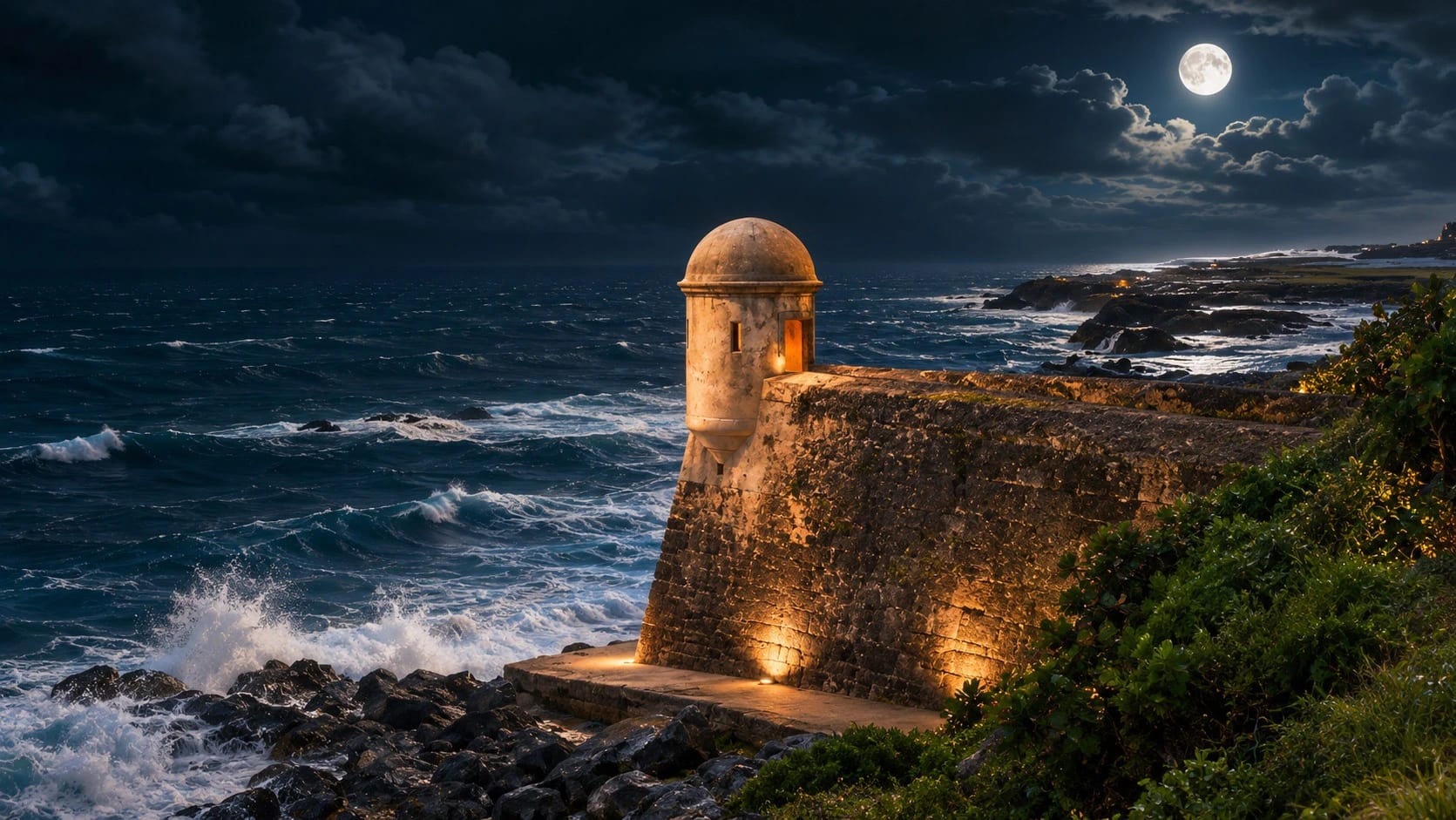
A woman dressed in white has reportedly been seen moving along the ancient walls of El Morro, her face hidden as she passes through the shadows. Other accounts describe soldiers in old-fashioned uniforms standing guard where no living sentry has been stationed for decades. Somewhere inside the fortress, visitors claim to have heard voices coming from empty rooms and footsteps echoing through passages that should be deserted.
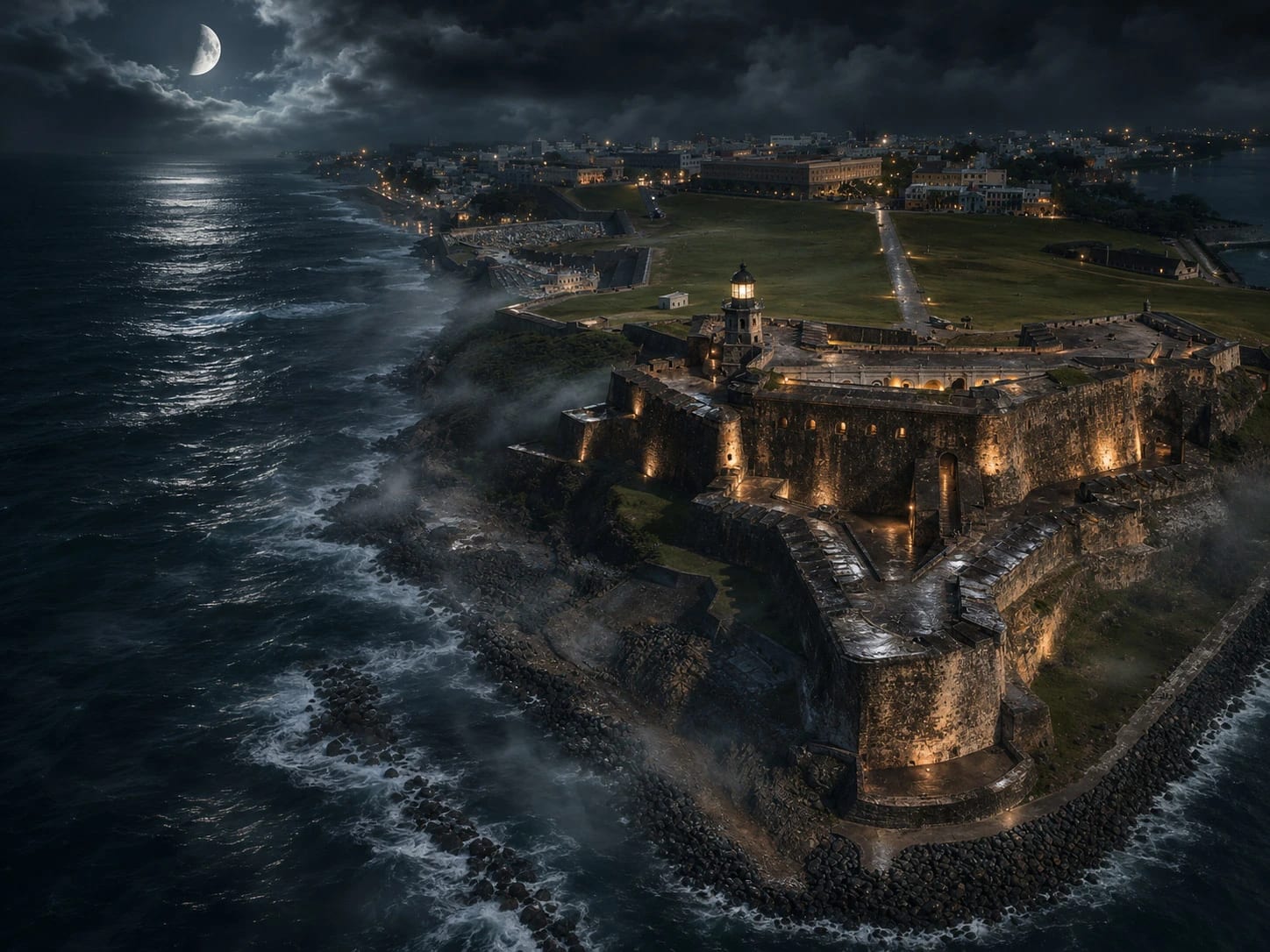
These stories belong to Castillo San Felipe del Morro, the enormous Spanish fortress overlooking the entrance to San Juan Bay in Puerto Rico. For nearly five centuries, its walls have witnessed naval battles, invasions, imprisonment, epidemics, and the final collapse of Spanish colonial rule on the island.
El Morro was built to protect San Juan from its enemies. Its cannon batteries commanded the narrow entrance to one of the Caribbean's most valuable harbors, while the soldiers stationed behind its walls watched for hostile ships approaching from the Atlantic. The Spanish Crown spent more than two centuries expanding the fortress, eventually transforming a modest sixteenth-century defensive tower into a six-level military stronghold.
Today, El Morro is one of Puerto Rico's most recognizable landmarks. Visitors walk its enormous grassy approach, explore centuries-old military quarters, and look out from the stone sentry boxes that have become symbols of Old San Juan.
Yet the history preserved inside those walls is far more complicated than the beautiful views suggest. The fort was attacked repeatedly, captured by an invading army, and used to confine prisoners, including people caught up in Puerto Rico's nineteenth-century political struggles.
For those who believe the fortress is haunted, that history offers plenty of reasons why the dead might still linger. The woman in white and the ghostly soldiers remain matters of folklore, but the conflicts, suffering, and human lives behind their stories are very real.
The Fortress That Guarded the Gateway to the Caribbean
Long before El Morro became a tourist attraction, San Juan was one of the most strategically important ports in Spain's American empire.
Its location near the northeastern entrance to the Caribbean made Puerto Rico valuable to ships traveling between Europe and the Spanish colonies. San Juan Bay offered a sheltered harbor where vessels could seek protection, take on supplies, and prepare for the next stage of their journeys. Whoever controlled the harbor possessed an important military and commercial advantage.
During the early sixteenth century, Spain was expanding its possessions throughout the Americas. That expansion brought extraordinary wealth to the Spanish Crown, much of it extracted through colonial exploitation, forced labor, and the displacement of Indigenous peoples. It also attracted enemies eager to disrupt Spanish shipping and seize territory.
English privateers, French corsairs, and eventually Dutch military expeditions threatened Spanish interests in the Caribbean. San Juan's position made it an obvious target.
The city's earliest major fortress, La Fortaleza, was constructed during the 1530s. Its location along the southern waterfront, however, left the actual entrance to San Juan Bay inadequately defended. Enemy ships could potentially pass the harbor mouth before coming under effective fire from the fortification.
In 1539, Spain began building a new defensive structure on the rocky headland at the western end of San Juan's islet. Officially named Castillo San Felipe del Morro, it occupied a commanding position overlooking the channel that ships needed to navigate to enter the bay.
The name El Morro refers to the promontory itself. The original fortification was considerably smaller than the enormous structure standing today, but its purpose was clear: prevent enemy ships from entering the harbor and attacking San Juan from the water.
Over the following centuries, military engineers added batteries, barracks, storage chambers, reinforced walls, and multiple levels of artillery positions. The fortress eventually rose approximately 140 feet above the sea, with sections of masonry reaching 18 to 25 feet in thickness.
The resulting defensive complex was formidable. Cannons placed at different elevations could fire upon vessels approaching the harbor, while the massive walls provided protection against the artillery available to European warships of the period.
A hostile captain looking toward San Juan would have seen a heavily fortified headland bristling with guns. Behind those guns were men whose lives depended on the strength of the walls and their ability to keep the enemy at a distance.
The first great test came in November 1595.
The Night Francis Drake Attacked San Juan
Sir Francis Drake had already become one of the most famous English privateers of the sixteenth century. His expeditions against Spanish possessions had earned him admiration in England and bitter resentment throughout Spain's colonial territories.
By 1595, Drake's reputation was considerable. He had attacked Spanish settlements, captured valuable cargo, and taken part in England's struggle against the Spanish Armada. When his fleet appeared near Puerto Rico, San Juan's defenders had every reason to expect a serious assault.
The English were particularly interested in Spanish treasure being held in the harbor. Drake hoped to capture the valuable cargo and weaken Spain's position in the Caribbean.
Spanish preparations complicated his plans. The harbor defenses had been strengthened, and ships positioned within the bay helped protect its entrance. Drake's forces encountered an enemy that understood the dangers of an attack and had made arrangements to resist it.
During the fighting on November 22 and 23, English vessels attempted to approach the defensive positions. Spanish artillery responded, and Drake's plans began to unravel.
One dramatic account preserved in National Park Service historical material describes a Spanish cannonball striking Drake's ship while he was at supper. The shot reportedly killed several officers and narrowly missed the privateer himself.
Whether that particular incident unfolded exactly as later chroniclers described it, the outcome of the battle is clear. Drake failed to capture San Juan.
The English expedition withdrew, leaving the Spanish in possession of their fortress and harbor. Drake continued his campaign elsewhere in the Caribbean, but he died near Panama in January 1596.
His defeat at San Juan helped establish El Morro's reputation as a powerful obstacle to invading forces.
For the soldiers who defended it, however, victory was only a temporary reassurance. The English had discovered the city's strategic value, and Spain knew that another expedition could arrive.
It did, less than three years later.
The English Conquest of El Morro in 1598
George Clifford, the third Earl of Cumberland, approached San Juan with a different strategy from Drake's.
Rather than concentrate his attack against the heavily defended harbor entrance, Clifford recognized that San Juan was more vulnerable from the eastern, landward side of the islet.
In June 1598, English forces landed east of the city and advanced toward its defenses. The Spanish fortifications along this approach were not yet as extensive as those that would be built in later centuries, allowing the invaders to threaten El Morro from behind.
After fighting their way toward the fortress, Clifford's troops besieged the Spanish defenders. The English cut off supplies and brought pressure against the position until the garrison surrendered.
For the first and only time in its history, El Morro had been captured by an invading enemy.
Clifford's victory appeared to offer England a valuable foothold in the Caribbean. San Juan's harbor could potentially become a base for further attacks against Spanish shipping and colonial possessions. The English had accomplished what Drake had failed to do.
But the occupation quickly became a disaster.
Disease spread among Clifford's soldiers, particularly dysentery. The illness weakened the occupying force and killed enough men that maintaining control of Puerto Rico became increasingly difficult.
After approximately six weeks, the English abandoned San Juan.
The fortress returned to Spanish control, but the experience exposed a terrifying weakness. A strong harbor defense meant little if an enemy could simply approach the city from another direction and capture its principal fortification.
Over the following decades, Spain began strengthening San Juan's defensive system. Additional walls and military positions would eventually transform the entire city into a fortified enclave.
The siege also introduced a darker lesson. Military conquest did not always require an overwhelming defeat in battle. Disease could accomplish what enemy guns could not, and the men who survived an assault might still die far from home.
Their names are largely absent from the ghost stories told about El Morro today. Their suffering, unlike the reported apparitions, belongs to the historical record.
The Dutch Invasion That Left San Juan in Flames
In September 1625, another European expedition arrived at San Juan. This time the attackers came from the Netherlands, which was engaged in a prolonged struggle against Spanish power.
The Dutch commander, Boudewijn Hendricksz, led a naval force into the harbor and launched an assault on the city.
Spanish resistance initially proved insufficient to prevent the attackers from occupying much of San Juan. Residents fled, buildings were seized, and the invading soldiers established positions throughout the settlement.
El Morro, however, continued to resist.
The surviving Spanish defenders withdrew into the fortress, where its strong walls and elevated artillery positions gave them an advantage. Hendricksz's troops attempted to force a surrender, but the garrison refused.
The siege continued for weeks. Supplies grew scarce, the attackers faced resistance, and the Dutch eventually recognized that holding San Juan without capturing El Morro would be difficult.
Before withdrawing, they plundered the city and set buildings on fire.
Much of San Juan was devastated. The destruction affected homes, institutions, businesses, and the civilian population, leaving damage that extended far beyond the military installations.
El Morro had survived another invasion, but the city it was supposed to protect had suffered terribly.
The Spanish response was to make San Juan even more defensible. Construction began on Castillo San Cristóbal in 1634, and additional walls gradually enclosed the city. Over time, the two great fortresses became parts of a broader military system, with El Morro guarding the harbor and San Cristóbal defending the eastern approaches.
The fortifications visible today are the result of this long period of construction and expansion. Their walls record centuries of attempts to prevent another catastrophe like the burning of 1625.
The military history is well documented. What is far more difficult to determine is when stories of supernatural activity first became attached to the fortress.
One of its most persistent ghostly residents is a woman whose identity remains unknown.
The Woman in White Who Haunts El Morro
Among the ghost stories associated with Castillo San Felipe del Morro, one of the best known concerns a mysterious woman dressed entirely in white.
According to the legend, her figure appears along the fortress ramparts, moving through the shadows as though following a path that only she understands. Witness accounts repeated in haunted-history writing describe her gliding beside the old stone walls rather than walking like an ordinary visitor.
Her face is often said to be hidden or impossible to make out.
The apparition is generally referred to as the White Lady or Woman in White, a description familiar from ghost traditions around the world. Stories of pale, sorrowful women have long appeared in European and American folklore, where they are frequently associated with lost lovers, tragic deaths, or places marked by suffering.
At El Morro, however, the legend is less specific.
Some modern accounts mention a woman moving silently along the upper walls. Others connect her appearance more generally with the fortress's long history of soldiers, prisoners, and military occupation. The stories rarely identify her by name or provide a reliable account of how she supposedly died.
This uncertainty is important. There is no established historical source identifying a particular woman whose death can be connected with the apparition, nor is there reliable evidence establishing how far back the ghost story goes.
The Woman in White appears in published descriptions of San Juan's haunted locations, including travel writing that predates the current wave of online ghost-tour content. But those references generally repeat the legend without documenting a specific eyewitness or identifying its origins in older Puerto Rican folklore.
That leaves a compelling mystery.
If witnesses really have seen a mysterious figure on the ramparts, who do they believe she represents? A woman searching for someone lost during a battle? A resident whose life was bound to the old fortress? Or an apparition whose story has changed so much over time that her identity has been forgotten?
None of those explanations can be verified. They illustrate the possibilities people naturally imagine when a ghost story survives without a clear beginning.
The setting certainly helps the legend endure. El Morro's upper walls are exposed to powerful Atlantic winds, and the ocean beyond them becomes almost completely dark after sunset. The old fortifications stretch along the headland, their angles and openings producing deep shadows as the light fades.
During the day, visitors can see across the harbor toward the distant shoreline. At night, much of the surrounding landscape disappears into darkness.
It is easy to understand why stories of a pale figure moving along the walls would become attached to such a place.
The Woman in White has no confirmed name, no documented burial, and no established historical identity. Nevertheless, she remains one of El Morro's recognizable supernatural legends.
And she is not the only ghost reportedly seen there.
The Phantom Soldiers Who Never Left Their Posts
El Morro was a military installation for more than four centuries. Generations of soldiers occupied its barracks, guarded its entrances, maintained its artillery, and stood watch over the waters approaching San Juan.
Their responsibilities changed as military technology evolved, but the routines of fortress life endured. Sentries watched the horizon, officers enforced discipline, and artillery crews prepared for attacks that might never come.
In modern ghost stories, some of those soldiers are said to have remained behind.
Visitors and tour guides have described apparitions resembling men in historical military uniforms, sometimes appearing near sentry boxes, along the walls, or within the old fortress passages. Other accounts concern fleeting shadows or the sensation that someone is standing nearby when no other person is visible.
In December 2010, Puerto Rican newspaper Primera Hora published an account of a paranormal television production filming at El Morro and San Cristóbal. The article included comments from Eric López, a historian then working with the National Park Service.
López explained that visitors and even park employees had reported seeing figures dressed like historical soldiers. Some visitors had reportedly shown park rangers photographs containing unusual shadows or anomalies. He emphasized that he had not personally witnessed the supernatural activity being described.
That distinction matters because the reports were not presented as verified encounters. They were accounts of what people believed they had experienced, collected at historic sites already famous for their ghost stories.
The descriptions also concerned the broader San Juan fortification system, rather than definitively placing each apparition inside El Morro.
Nevertheless, soldiers in old uniforms are a recurring feature of the supernatural folklore associated with the fortress.
Unlike the Woman in White, the phantom soldiers have an obvious connection to the historical function of the building. Thousands of men served in San Juan's military defenses over the centuries. Some were professional Spanish troops; others belonged to colonial militias, while later generations served under the United States.
Not all of them experienced combat, and many surely completed their assignments without witnessing anything extraordinary. Yet the men stationed here lived with the knowledge that an enemy attack could come at any time.
A sentry watching the harbor during a storm had no way of knowing whether the vessel approaching in the darkness was a merchant ship, a friendly naval patrol, or an enemy preparing to attack.
Centuries later, those uncertainties have become part of the atmosphere surrounding El Morro's ghost stories.
The most famous legend involving disappearing Spanish soldiers actually belongs to another fortress farther east. At Castillo San Cristóbal, the isolated lookout known as La Garita del Diablo became associated with sentries who supposedly vanished during their night watches.
It is a separate legend with its own literary history, although modern descriptions of haunted San Juan sometimes confuse the two locations.
El Morro's supernatural reputation rests on its own traditions: the Woman in White, reported figures in military clothing, and unexplained activity within the fortification itself.
The Prisoners Behind El Morro's Walls
Stories about imprisoned spirits are common at old fortresses, but El Morro has something more substantial than vague tales of anonymous captives.
It has documented records of prisoners.
The National Park Service explains that neither El Morro nor San Cristóbal contained a purpose-built dungeon resembling those in popular movies. However, rooms both above and below ground level were used at various times to confine prisoners.
That makes the repeated descriptions of screams emerging from El Morro's underground chambers more interesting, although the ghostly sounds themselves remain unverified.
The fortress's prison history also extended well beyond the early colonial period.
One particularly revealing piece of evidence appears in the National Park Service's archival finding aid for the San Juan National Historic Site Resource Records Collection.
Among the materials listed is a group of documents concerning political prisoners held at El Morro in 1887. The records include correspondence associated with Puerto Rican poet and political activist Lola Rodríguez de Tió, as well as documentation relating to prisoners confined within the fortress.
Another archival entry describes a notification concerning the arrival of sixteen prisoners at Castillo del Morro in 1887, accompanied by a list of their names.
These are not ghost stories. They are references to surviving historical documents preserved in the park's research collections.
Their existence gives us a glimpse into a chapter of El Morro's history that receives considerably less attention than its military battles.
By the late nineteenth century, Puerto Rico was experiencing growing demands for political reform and greater autonomy from Spanish rule. Colonial authorities monitored and suppressed various forms of opposition, and political imprisonment became part of that struggle.
For the people held inside El Morro, the fortress was no longer simply a defensive installation. Its walls represented confinement, separation from family, and the authority of a colonial government capable of restricting their freedom.
The archived correspondence may eventually offer researchers a more personal account of those experiences. What can already be established is that the fort served as a place of imprisonment during a politically turbulent period.
That history should not be reduced to a convenient explanation for ghostly cries. Real prisoners endured real circumstances within these walls, and their experiences deserve attention regardless of whether any supernatural activity occurred.
Still, the knowledge changes how visitors might perceive the old chambers.
A vaulted room that appears empty today may once have held someone waiting to learn whether he would be released, transferred, or punished. The heavy masonry that protected soldiers from enemy cannon fire could also prevent a prisoner from leaving.
Stories of ghostly voices inside El Morro may be impossible to confirm. The prison history behind the setting is not.
The Chapel, the Dark Passages, and the Ghost Hunters Investigation
A fortress is more than a wall with cannons.
El Morro contains an interconnected series of courtyards, passageways, military chambers, and defensive positions. Some spaces open toward the sea, while others lie beneath thick masonry, where daylight enters only through narrow openings.
Soldiers could move between different levels using ramps, stairways, and passages built into the fortification. Storage rooms held provisions and military equipment. Other chambers accommodated troops, while defensive positions allowed artillery crews to operate behind the protection of the walls.
The fort also contained a chapel.
Religion played an important role in Spanish military life, especially in an era when death from battle, illness, or injury remained a constant possibility. Soldiers living far from home could attend religious services and seek spiritual comfort within the same fortified complex where they performed their duties.
The presence of the chapel has also attracted paranormal interest.
In February 2011, the television series Ghost Hunters International aired an episode titled "Soldiers of Misfortune: Puerto Rico." The program investigated El Morro and Teatro Tapia, another historic Old San Juan landmark associated with ghost stories.
Puerto Rican newspaper Primera Hora reported on the production, and the episode remains identifiable through television distribution records.
The investigation brought international attention to the supernatural reputation of San Juan's historic buildings. It also encouraged viewers to think about the fortress as a place where unexplained activity might occur, rather than solely as a military monument.
Any evidence presented by a paranormal television program must be understood within that context. Recording an unusual sound or interpreting a shadow as an apparition does not establish that the source was supernatural.
The production's visit is a documented event. The existence of ghosts inside El Morro remains an unproven claim.
The chapel itself has a much longer history than the television program. In 1956, National Park Service historian Frederik Gjessing prepared a report concerning its investigation and restoration, reflecting the attention given to the fortress's religious and architectural features.
These older spaces are important because they remind us that the garrison had needs beyond military defense.
Soldiers prayed, slept, ate, worked, became sick, and waited for news from outside the walls. Officers made decisions that affected the men under their command, and prisoners endured periods of isolation from the city surrounding them.
Some of those experiences have left documentary evidence. Others survive only in the stories people tell.
The British Return in 1797
By the late eighteenth century, Spain had invested enormous resources in strengthening San Juan.
Military engineers transformed El Morro into a sophisticated fortress, while Castillo San Cristóbal, the city walls, and additional coastal batteries created a formidable defensive system. The work was extensive enough to change the entire character of the city.
The improvements came under the direction of military reformers and engineers, including Alexander O'Reilly and Thomas O'Daly, whose efforts during the latter half of the eighteenth century helped produce the fortifications visible today.
In April 1797, the British returned.
General Ralph Abercromby and Admiral Sir Henry Harvey led a major expedition against Puerto Rico, hoping to capture San Juan and weaken Spanish power in the Caribbean.
Their forces approached from the east, attempting to exploit the route that had allowed George Clifford to capture the city in 1598.
This time, however, the defensive situation was very different.
San Cristóbal and the surrounding fortifications complicated the British advance. Spanish regular troops, local militia, and other defenders resisted the invasion, while the integrated defensive network made it difficult for the attackers to reach the city.
After weeks of fighting, the British abandoned their attempt.
El Morro was not the principal battleground of the invasion, which concentrated on the eastern approaches, but it formed part of the military system that enabled San Juan to resist.
The victory became an important event in Puerto Rican historical memory. It also inspired another famous Old San Juan tradition: the legend of La Rogativa, in which a nighttime religious procession supposedly caused British forces to mistake the lights of worshippers for approaching reinforcements.
That account belongs to the city's folklore rather than an established explanation for the British withdrawal. Yet like the ghost stories of El Morro, it shows how military history gradually becomes entangled with legend.
For the people who lived through the invasion, the danger was immediate. They could not know that their city would survive or that later generations would remember the battle as another triumph of San Juan's defenses.
For almost another century, those walls continued to represent Spanish military authority in Puerto Rico.
Then, in 1898, the fortress faced weapons far more powerful than anything its original builders could have imagined.
The Bombardment of El Morro in 1898
On May 12, 1898, American warships approached San Juan during the Spanish-American War.
Admiral William T. Sampson commanded the United States naval force assigned to attack Spanish positions around the harbor. The American ships carried modern artillery capable of striking the old fortifications from distances that earlier naval commanders could scarcely have contemplated.
El Morro's thick stone walls had been designed to resist the cannons of sailing ships. Although the fortress had undergone centuries of improvements, much of its structure still reflected the military engineering of an earlier age.
American guns opened fire on San Juan, and shells struck the fortifications and portions of the city.
The bombardment damaged El Morro, including its lighthouse. The sight of an old Spanish stronghold being struck by modern naval artillery illustrated how thoroughly military technology had changed since the sixteenth century.
The Americans did not capture San Juan during the bombardment. Sampson's fleet eventually withdrew, and American land forces later entered Puerto Rico from the southern coast.
By the end of the war, Spain's centuries of rule over the island were coming to an end.
The Treaty of Paris, signed on December 10, 1898, formally transferred Puerto Rico from Spain to the United States.
One of the Spanish officers associated with El Morro's final period of Spanish military service was Colonel José Antonio de Iriarte y Travieso, identified by the National Park Service as the fortress's last military governor.
He received military decorations recognizing his service, including actions associated with the Spanish-American War.
His story has an unusual modern continuation.
In 1992, three of Iriarte's historical medals were stolen from a military museum once housed inside El Morro. For nearly eighteen years, the decorations remained missing.
Then, during National Park Service maintenance work in 2009, employees preparing a shoreline trail discovered the medals buried in the ground. The agency announced their recovery in January 2010.
The rediscovery provided a tangible connection to the men who had defended the fortress during Spain's final war in Puerto Rico.
Unlike stories of phantom soldiers, the medals could be examined, dated, and connected to a named historical figure. They had survived military upheaval, theft, and years underground before finding their way back into the historical record.
The fortress itself was also entering an entirely new chapter.
From Spanish Stronghold to American Military Base
After the Spanish-American War, the United States Army incorporated El Morro and other historic military installations into Fort Brooke.
The change was more than a replacement of one flag with another. It altered the purpose of the centuries-old defensive complex and introduced new equipment, personnel, and methods of warfare.
During the two world wars, the American military continued to use the site. Twentieth-century additions included observation positions, a bunker, and anti-aircraft defenses. The fortress that had once aimed cannons at wooden sailing vessels was now associated with threats from submarines and aircraft.
The lighthouse also changed.
Puerto Rico's first lighthouse had been established at El Morro in 1846, providing navigational assistance to ships approaching San Juan Bay. After subsequent reconstruction and damage during the war of 1898, a new lighthouse was completed in 1908.
That structure remains one of the fortress's most recognizable features.
The U.S. military maintained its presence at El Morro well into the twentieth century, although the historic fortification increasingly became recognized for its architectural and cultural importance rather than its usefulness in modern warfare.
San Juan National Historic Site was established in 1949, and El Morro gradually came under National Park Service administration.
In 1983, the fortifications were included in the UNESCO World Heritage designation for La Fortaleza and San Juan National Historic Site in Puerto Rico.
The decision recognized the extraordinary military architecture preserved across Old San Juan and the importance of the structures in understanding centuries of Caribbean and American history.
Today, the fortress is protected for the public rather than maintained against an invading fleet.
Its long military life has ended. Its reputation for haunting has not.
The Cemetery Beneath the Fortress Walls
Just east of El Morro, along the northern shoreline of Old San Juan, stands the Santa María Magdalena de Pazzis Cemetery.
Its rows of tombs and monuments occupy a dramatic position between the city's historic fortifications and the Atlantic Ocean. Established in the nineteenth century, the cemetery became the burial place of numerous prominent Puerto Rican residents, including writers, political figures, artists, and community leaders.
The contrast between the cemetery and the fortress above it is striking. El Morro was built to resist destruction and protect the living, while the cemetery became a place where generations of families gathered to remember their dead.
Together, the two landmarks form one of the most recognizable historic landscapes in Puerto Rico.
Some contemporary ghost stories associate the cemetery and the fortress, suggesting that the proximity of so many graves contributes to the supernatural atmosphere of the old walls.
There is no established evidence that the cemetery explains the apparitions reported at El Morro. Nor is there a documented connection between the Woman in White and any particular person buried there.
The historical relationship is nevertheless worth exploring.
San Juan developed as a city shaped by Catholic traditions of death, burial, and remembrance. The location of its cemeteries, churches, and chapels reflected changing beliefs and public-health concerns over the centuries.
El Morro's own chapel, the cemetery beyond the walls, and the religious institutions of the old city all belonged to that larger world.
For a soldier serving in the fortress, death was not an abstract possibility. Disease, military service, and the dangers of colonial life made mortality an everyday concern.
The cemetery is deserving of its own history, including the lives of the people buried there and the traditions associated with their remembrance. Its setting also contributes to the distinctive atmosphere that makes El Morro's ghost stories so compelling.
The fortress and the cemetery remain separate historic places, each with a story that should be told on its own terms.
Are the Ghosts of El Morro Real?
El Morro's supernatural reputation is supported by recurring stories, not by independently verified evidence of paranormal activity.
The Woman in White is described in modern accounts of haunted San Juan, but her identity and the origin of the legend remain uncertain. Stories of soldiers in historical uniforms have been reported by visitors and repeated by people familiar with the fortifications, although the accounts do not establish that the figures were supernatural.
The 2011 Ghost Hunters International investigation demonstrates that the fortress had acquired enough of a haunted reputation to attract a national television production. It does not establish that ghosts were discovered there.
The prison history is different. Archival records confirm that prisoners were held at El Morro, including people incarcerated during the political upheavals of the late nineteenth century.
The battles are equally well documented. We know when Francis Drake attacked, when English forces captured the fortress, and when the Dutch burned San Juan. We can identify the American fleet that bombarded the city in 1898 and the Spanish officers who defended its military installations.
Those events give El Morro an unusually substantial historical foundation for its supernatural legends.
They also reveal the limits of what can honestly be claimed.
A photograph containing a strange shadow does not establish that a dead soldier has returned. An unexplained sound inside a centuries-old stone building may have many possible causes, from wind and human activity to the unusual acoustics of vaulted chambers.
Yet folklore does not need to be accepted as literal truth to be worth preserving.
Ghost stories often reveal what people remember, fear, or imagine about a historic place. At El Morro, those memories are tied to military service, imprisonment, invasion, and the countless individuals whose lives intersected with the fortress.
The stories may never produce an identifiable ghost, but they preserve another way of understanding the building's past.
There is something particularly affecting about the idea of a soldier who continues to guard a fortress long after the war has ended.
For centuries, men stood watch over the entrance to San Juan Bay, not knowing whether the next ship on the horizon would bring supplies, visitors, or an enemy fleet.
The legend suggests that some never received permission to leave their posts.
Visiting Castillo San Felipe del Morro in Old San Juan
El Morro is located at the western end of Old San Juan, overlooking the entrance to San Juan Bay. It is administered by the National Park Service as part of San Juan National Historic Site.
Visitors approach the fortress across a broad grassy field that has become a popular gathering place for local families and tourists. On windy afternoons, the lawn is often filled with colorful kites, creating a peaceful scene far removed from the military activity that once dominated the area.
Inside the fortification, visitors can explore several levels of historic rooms, artillery positions, passageways, and overlooks. Exhibits explain the building's military history, while the views toward the Atlantic and San Juan Bay reveal why the location was so valuable to Spain.
Some of the most interesting features are the small sentry boxes built into the defensive walls. These garitas sheltered soldiers during their watch and remain among the most distinctive architectural elements of Old San Juan.
The fortress's extensive masonry and changing elevations are also worth examining closely. Its design represents centuries of military engineering, with successive generations altering the structure to respond to increasingly powerful weapons.
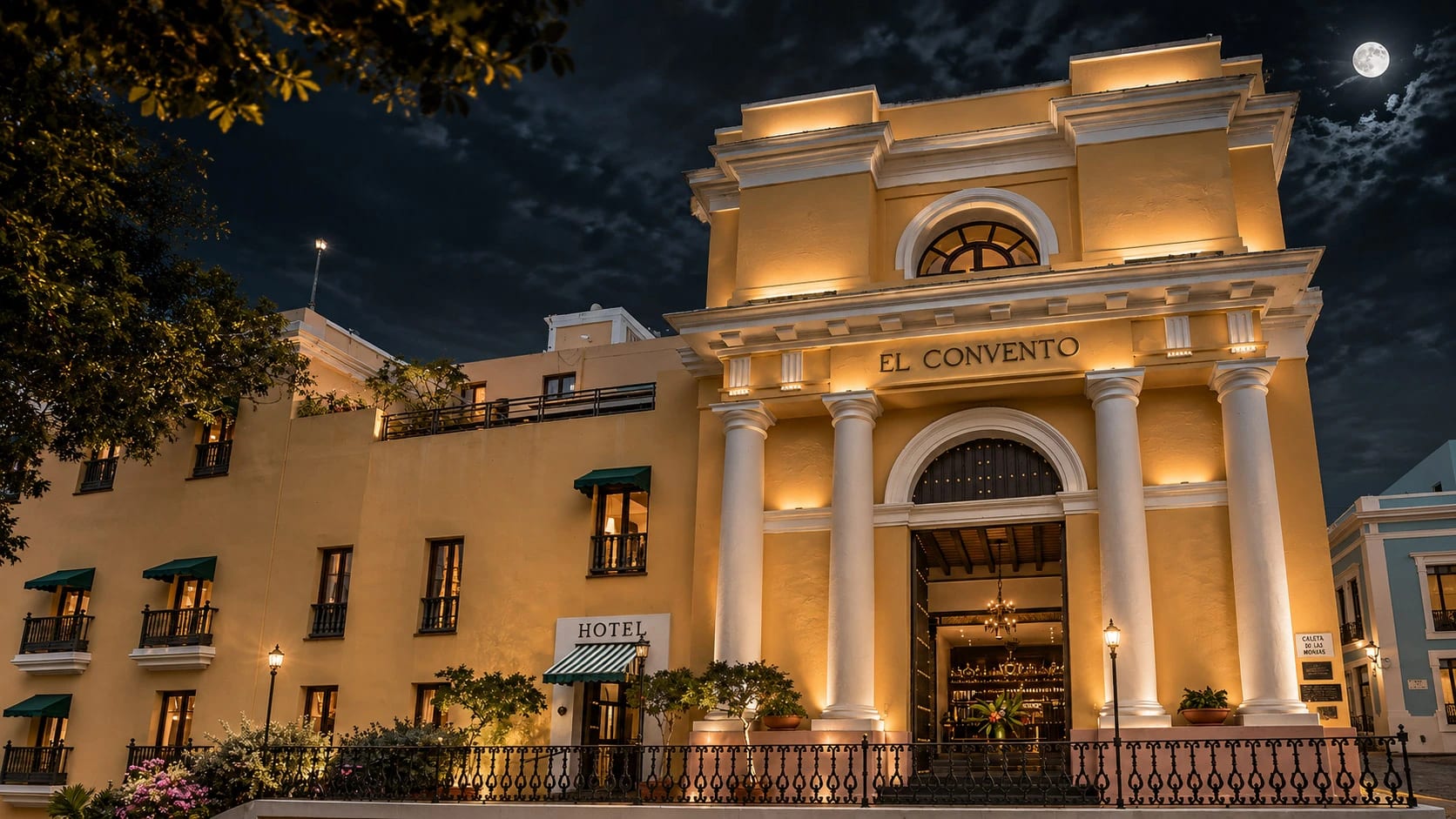
For more of the city's haunted history, read about La Garita del Diablo at Castillo San Cristóbal and Hotel El Convento, or explore our guide to haunted San Juan.
Hours, admission, and access
The National Park Service generally operates the interior of El Morro from 9:00 a.m. to 5:00 p.m., except for designated holidays and special closures.
The standard admission is currently $10 per person aged 16 or older, with the ticket valid for 24 hours at both El Morro and Castillo San Cristóbal. Children aged 15 and younger are admitted free.
The surrounding grounds and historic exterior walls have different public-access arrangements from the fort's interior. Visitors should check current National Park Service guidance, including any temporary closures or restrictions, before planning their visit.
For official information, consult the San Juan National Historic Site visitor guide.
El Morro is best visited during daylight hours if you want to explore the interior. A return to Old San Juan after sunset offers a very different experience of the city's historic streets and fortifications, although ordinary nighttime access does not include entering the closed fortress.
The change in atmosphere can be remarkable. The crowds thin, the stone buildings become illuminated by streetlights, and the walls that dominate the city during the day take on a different appearance.
It is an appropriate setting for the ghost stories that have accumulated over nearly five centuries.
Discover the Haunted History of Old San Juan
El Morro is among Puerto Rico's most famous landmarks, but its history cannot be separated from the larger story of Old San Juan.
The surrounding city was shaped by the same military conflicts that brought invaders to the fortress. Its streets were home to soldiers, merchants, enslaved people, craftspeople, religious communities, and generations of Puerto Rican families whose experiences rarely appear in accounts devoted entirely to colonial architecture.
Within the city walls, life continued through wars, political upheaval, epidemics, and the transformation from Spanish colony to American territory.
Those events also inspired some of San Juan's most enduring legends.
From ghostly figures said to wander ancient fortifications to stories attached to churches, former convents, and historic homes, Old San Juan has developed a rich tradition of supernatural storytelling.
At Ghost City Tours, we explore the stories behind that history on guided evening walks through the old city.
Our family-friendly Night of Souls Ghost Tour introduces visitors to San Juan's centuries of history, local legends, and mysterious folklore. For guests interested in the darker side of the city's past, The Dead at the Gate explores subjects such as warfare, colonial power, death, and the unsettling stories associated with Old San Juan's historic streets.
Both experiences offer an opportunity to learn about the people and events that shaped San Juan after the daytime crowds have departed.
The gates of El Morro once closed against invading armies, and its soldiers spent centuries watching the Atlantic for signs of approaching danger.
The walls are still standing. The cannons are silent.
Whether the last of its sentries ever left is a question that belongs to the ghost stories.
Historical References and Sources
These are the principal sources supporting the documented history, visitor information, and reported folklore discussed in the article.
1. National Park Service — Castillo San Felipe del Morro
Castillo San Felipe del Morro: History and Culture
Official historical overview of the fortress, including its construction beginning in 1539, military engineering, English and Dutch attacks, eighteenth-century expansion, American military occupation, and historic preservation.
2. National Park Service — History of San Juan
Historical account of San Juan's defenses, the attacks of 1595, 1598, and 1625, British military operations in 1797, and the American naval bombardment of 1898.
3. National Park Service — Historical Timeline
San Juan National Historic Site Timeline
Official dates for major events in the development of the city and its fortifications, including construction, sieges, the Spanish-American War, and UNESCO recognition.
4. National Park Service — Frequently Asked Questions
San Juan National Historic Site FAQs
Provides important clarification about the fortifications, their battles, military architecture, underground rooms, prisoner confinement, and misconceptions about dungeons and secret tunnels.
5. National Park Service — San Juan NHS Resource Records Collection
Archival Finding Aid: San Juan National Historic Site Resource Records Collection, 1940–2010 (PDF)
Especially relevant are the archival references to political prisoners incarcerated at El Morro in 1887, correspondence associated with Lola Rodríguez de Tió, and the record documenting the admission of sixteen prisoners to Castillo del Morro.
6. Primera Hora — Reported Apparitions and Paranormal Investigation
¿Logran cazar fantasmas en Puerto Rico? — December 16, 2010
Puerto Rican newspaper reporting on a paranormal television production at the historic fortifications. Includes comments from National Park Service historian Eric López concerning reports of apparitions and unusual photographs.
7. Primera Hora — Ghost Hunters International
Cierra temporada de Ghost Hunters International con episodio en Puerto Rico — February 16, 2011
Contemporary reporting on the television episode investigating El Morro and Teatro Tapia.
8. Ghost Hunters International — Episode Record
Soldiers of Misfortune: Puerto Rico — Season 2, Episode 26
Confirms the title, release date, and locations of the 2011 paranormal television investigation.
9. TripSavvy — Haunted Places in San Juan
Haunted Places in San Juan, Puerto Rico — June 3, 2019
Secondary source documenting modern versions of El Morro's Woman in White legend and reports of apparitions resembling historical soldiers and prisoners. Useful as evidence of the circulation of folklore, not as proof of supernatural events.
10. National Park Service — Iriarte's Military Medals
Unexpected Discovery of Historic Relics Buried in Castillo San Felipe del Morro — January 11, 2010
Documents the recovery of military decorations associated with Colonel José Antonio de Iriarte y Travieso, the last Spanish military governor of El Morro.
11. United States Coast Guard — El Morro Lighthouse
Port San Juan (El Morro) Lighthouse
Documents the lighthouse established in 1846, its reconstruction in 1908, and its continued navigational significance.
12. UNESCO World Heritage Centre
La Fortaleza and San Juan National Historic Site in Puerto Rico
Official description of the internationally recognized historic fortifications and their importance to the history of European colonial military architecture in the Caribbean.
13. National Park Service — Visitor Information
Official sources for access, admission, hours, and planning a visit to the fortifications.
Castillo San Felipe del Morro at the entrance to San Juan Bay