For generations, a dog watched the Atlantic from a lonely stretch of reef near San Juan.
He never moved. Storms rolled across the Caribbean, waves crashed against the rocks, and ships passed through the waters beyond him. Still, he remained in the same position, sitting upright with his head raised toward the horizon.
People called him La Piedra del Perro, the Stone Dog.
According to one of Puerto Rico's most touching legends, the animal had once been a living dog named Amigo. He belonged to a young Spanish soldier who was sent away to fight in a distant war. Before departing, the soldier promised that he would return.
Amigo believed him.
The dog waited on the rocks overlooking the ocean, watching for the ship that would bring his master home. Days became weeks, and weeks became months. Eventually, news reached San Juan that the soldier's vessel had been lost in battle.
But Amigo refused to abandon his vigil.
He continued sitting beside the sea until, according to the legend, his body slowly became stone.
The little dog remained there long after the Spanish military departed Puerto Rico. Generations of residents watched him from the shore, and visitors learned his story from parents, grandparents, and local guides.
The legend became so important that in 2000, Puerto Rico's legislature passed a law formally protecting the coral formation.
Then, in October 2016, something happened that no one had expected.
Powerful waves battered the northern coast of San Juan, striking the reef where the Stone Dog had stood for as long as anyone could remember. The rock's recognizable head broke away, leaving behind a damaged formation that no longer looked quite like the faithful animal.
News of the loss spread throughout Puerto Rico.
People shared photographs, debated whether the dog had actually disappeared, and mourned the destruction of a landmark that had become part of the island's cultural identity.
Some found a bittersweet ending in the disaster. Perhaps, they suggested, the dog had finally stopped waiting and gone to find the man he loved.
La Piedra del Perro is not a conventional ghost story. There are no verified apparitions, haunted houses, or restless spirits wandering the shoreline.
It is something different: a legend about loyalty that survived long enough to become part of Puerto Rican law, only for the physical landmark that inspired it to be claimed by the same ocean it had watched for generations.
And like many old legends, there is more than one version of the story.
A Lonely Soldier at Fortín San Jerónimo
The best-known version of La Piedra del Perro begins at Fortín San Jerónimo del Boquerón, a small Spanish military fortification guarding the eastern approaches to San Juan.
Long before modern hotels and busy roads occupied the surrounding coastline, the fort stood in an exposed position beside the waters connecting the Atlantic Ocean with the protected waterways south of the San Juan islet.
Its soldiers watched for approaching vessels and helped defend the entrance to the city.
Among them, according to the legend, was a young man named Enrique.
He had not grown up dreaming of military glory. Before joining the Spanish Army, he had been a farmer accustomed to working the land.
Military service promised adventure and an opportunity to see places beyond the small community where he had spent his early life.
But the reality was not what he expected.
Stationed far from his family, Enrique found himself increasingly lonely. His days were governed by military routines, and the excitement of travel had given way to the monotony of garrison duty.
The soldiers around him had their own responsibilities and friendships, but Enrique longed for a companion.
One day, while walking through the streets of San Juan, he heard an animal crying from a nearby alley.
Following the sound, he discovered a small dog lying in a gutter.
The animal was thin and weak. One of its legs was injured, and it appeared to have been abandoned.
Enrique approached carefully, picked up the frightened dog, and carried him back to the fort.
He cleaned the wound and began caring for the animal.
Over the following weeks, the dog recovered. As his strength returned, he began following Enrique everywhere, staying close to his heels as the soldier moved through his daily activities.
The other members of the garrison noticed the inseparable pair.
One day, a superior officer asked Enrique what he intended to call his new companion.
The soldier had already chosen a name.
Amigo.
Friend.
It was simple, but it described exactly what the animal had become.
The story is preserved in an extraordinary source: Puerto Rico's Law 86 of May 24, 2000, which recounts the legend while explaining why the government considered the rock formation worthy of official protection.
That legislation is not proof that Enrique and Amigo were real historical individuals. It is, however, proof that their story had become an important part of Puerto Rican cultural memory.
For a time, the soldier and his dog lived happily together at the fort.
Then Enrique received orders that would change everything.
The Ship That Never Returned
Spain needed soldiers for military operations in Cuba.
According to the legend recorded in Law 86, Enrique was among the men ordered to depart Puerto Rico.
The news was devastating.
He had found companionship in a place where he had previously felt isolated, but military orders were not something he could simply refuse.
Before leaving, Enrique arranged for the other soldiers to care for Amigo.
He reassured the dog that he would come back.
Amigo watched as his master boarded the departing vessel.
The ship sailed away from San Juan, moving into the open Atlantic until it disappeared beyond the horizon.
The dog remained near the fort.
Then he did something the other soldiers had not expected.
Amigo entered the water, swam toward a rocky reef, and climbed onto a raised portion overlooking the sea.
From that position, he could watch the route by which ships approached San Juan.
He waited.
Whenever a vessel appeared in the distance, Amigo could look toward it, hoping that Enrique had returned.
The weeks passed without his master.
Eventually, the soldiers received terrible news.
Enrique's ship had been lost during a naval battle, and the men aboard had died.
The garrison mourned their companion.
In the traditional story, Amigo somehow sensed what had happened. He became distressed but refused to accept that the man who had saved his life would never return.
He went back to the reef.
There, the dog continued his vigil.
Years passed in the retelling, and the little animal remained at his familiar lookout until his body seemed to merge with the rock itself.
By the time the story ends, Amigo has become part of the coastline.
His raised head and seated posture are preserved in stone, forever directed toward the place where Enrique disappeared.
The legend does not establish the name of Enrique's ship, his regiment, the battle in which he supposedly died, or a verifiable military record of his service.
Modern retellings sometimes place his departure during the Spanish-American War of 1898, when Spain was fighting to retain Cuba and its remaining Caribbean possessions. The legislation itself speaks of military service in Cuba without identifying a precise date.
The historical conflict provides a plausible background, but it does not establish that the soldier existed.
Enrique and Amigo belong to the legend.
The reef where generations of Puerto Ricans believed they could see the faithful dog was entirely real.
Another Legend: The Fisherman Who Never Came Home
The soldier's story is not the only explanation for La Piedra del Perro.
A second tradition replaces Enrique with a fisherman.
In this version, the dog's owner was a humble man who earned his living from the waters near San Juan.
Every morning, he prepared his small boat and went to sea. His dog accompanied him to the shore, watching as the fisherman rowed away toward the open water.
Sometimes the animal swam to a nearby reef, where he could see farther into the distance.
The routine continued for years.
The man went fishing, and the dog waited for his return.
Eventually, the familiar sight of the small boat approaching the shoreline would send the animal rushing back to greet him.
Then, one day, a storm moved across the coast.
The sea grew rough, with strong waves and dangerous currents.
In the account published by Primera Hora in October 2016, the fisherman left his dog on shore because he knew the water was dangerous.
He went out anyway.
The man never returned.
Other versions describe the fisherman being overtaken by a violent wave or disappearing during a sudden storm. Some imaginative retellings introduce a sea creature, but that detail is not necessary to the central tradition.
Whatever happened beyond the reef, the dog never saw his master again.
He continued going to the same place, looking toward the ocean and waiting for the familiar boat.
As time passed, the animal stopped leaving his lookout.
Eventually, according to the legend, his body turned to stone.
The formation became a permanent reminder of his loyalty.
This version differs from the soldier story in several important ways.
There is no military service, no distant war, and no promise of return made before a long voyage.
The fisherman simply disappears during the ordinary work that sustained his life.
The dog's vigil begins as part of a familiar daily routine and becomes a tragedy when that routine is interrupted.
The two stories share the same emotional foundation: a loyal animal continues waiting for someone who will never come home.
Neither version has been established as a documented historical event.
Both are part of Puerto Rico's folklore.
Where Was La Piedra del Perro?
La Piedra del Perro was located on a coral and rocky outcrop near the entrance to Condado Lagoon, between Fortín San Jerónimo and the area known as Playita del Condado.
The formation was visible from the vicinity of Puente Dos Hermanos, the bridge connecting the San Juan islet with Condado.
This is important for visitors because the landmark was not located inside the historic walled district of Old San Juan.
It stood farther east, near the shoreline associated with Fortín San Jerónimo, the Caribe Hilton, and the entrance to the lagoon.
The surrounding waters form part of a complicated coastal landscape where the Atlantic meets protected channels and estuarine environments.
Rocky outcrops and reef structures are exposed to waves moving toward the coast.
Over many years, the movement of water, storms, erosion, and other environmental forces can alter the shape of these formations.
La Piedra del Perro acquired its name because of the way one particular portion of the outcrop appeared when viewed from the correct angle.
From the shore, it resembled a small dog sitting upright with its head raised.
The resemblance was especially noticeable when the surrounding water was relatively calm.
People who knew the landmark could point it out to visitors, although its appearance depended on the viewing position.
From another angle, the shape might seem like an ordinary piece of coral or stone.
That is what made the landmark so unusual.
It was not a statue commissioned by an artist.
No sculptor had carved a recognizable dog into the rock.
Its shape came from a natural formation that generations of observers interpreted through a familiar image.
The legend gave that image a personality.
People were no longer looking at an interesting coastal feature.
They were looking at Amigo, still waiting for his master.
Fortín San Jerónimo and the Real History of the Coast
The military setting of La Piedra del Perro is an important part of the story.
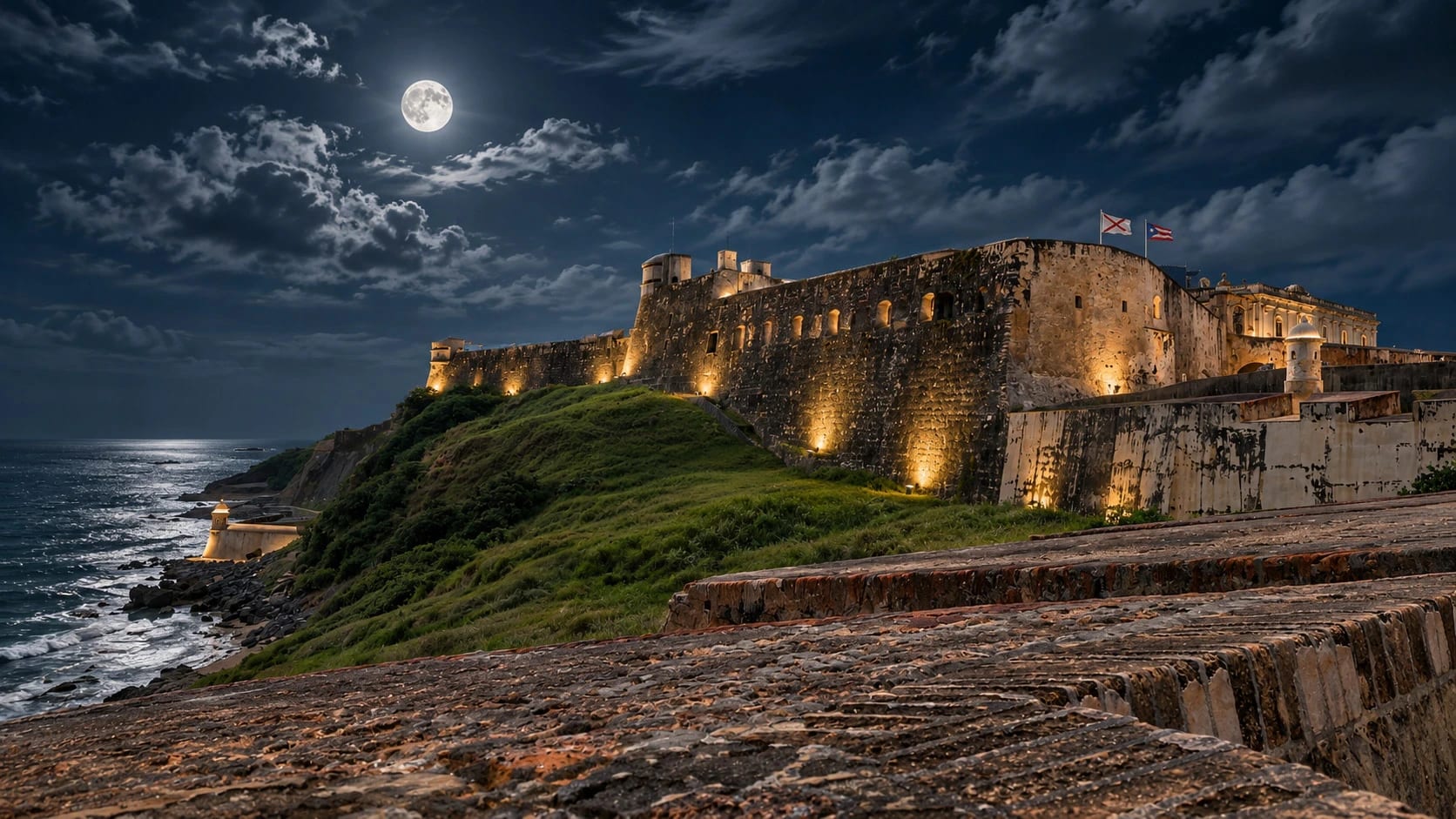
Fortín San Jerónimo del Boquerón was one of the fortifications protecting the eastern approaches to San Juan.
Unlike the enormous walls of El Morro or Castillo San Cristóbal, San Jerónimo occupied a smaller, exposed coastal position.
Its defenders were responsible for helping control access through the waterways separating the San Juan islet from the mainland and surrounding areas.
The fort was part of a larger defensive network developed by Spain over several centuries.
The most important period in its military history came during the British invasion of 1797.
British forces commanded by General Ralph Abercromby attempted to capture San Juan by advancing from the east.
Their army landed outside the city and sought to overcome defensive positions protecting the approaches.
San Jerónimo played an important role in the fighting.
According to National Park Service historical information, the fort's defenders resisted British attacks during the campaign.
The fortification suffered severe damage, but the British failed to break through and capture San Juan.
The defenders' success formed part of a broader military victory that involved Spanish regular troops, Puerto Rican militia units, and civilian participation.
Following the invasion, the fort was reconstructed around 1799.
It continued serving military purposes into the twentieth century.
The surviving structure eventually became recognized as an important historic landmark and was listed on the National Register of Historic Places in 1983.
Its position beside the water makes the setting of the Stone Dog legend especially appropriate.
Soldiers stationed there really did watch the coastline, guard important approaches, and serve an imperial military system that sometimes required men to leave their homes.
Military departures were part of the fort's world.
So were ships arriving from distant places.
The legend of Enrique and Amigo gives those ordinary historical experiences a personal dimension.
But the record does not establish that a particular soldier stationed at San Jerónimo left his dog behind before dying aboard a ship bound for Cuba.
The fortress is real, its military history is documented, and the rock formation was recognizable for generations.
The story connecting them remains folklore.
Why Do People Remember a Dog That Turned to Stone?
La Piedra del Perro belongs to a much broader tradition of stories about animals whose loyalty continues beyond their owners' deaths.
Such narratives appear in different cultures and historical periods.
They are often associated with dogs because people recognize the powerful bonds that can develop between dogs and their human companions.
A dog waiting at a doorway, returning to a familiar location, or refusing to leave a place associated with its owner can become a symbol of devotion.
When the person never returns, that devotion becomes heartbreaking.
The Stone Dog legend uses a supernatural transformation to preserve the animal's loyalty permanently.
Turning to stone is an especially effective ending because it explains a physical feature of the landscape.
Anyone who could see the rock formation was invited to recognize the dog.
The story gave the object an origin, and the object appeared to confirm the story.
The rocky silhouette became a form of evidence within the imagination of the people telling the legend.
It also allowed the story to survive without requiring listeners to know exactly when it happened.
Generations of Puerto Ricans could look at the same rock and tell the same essential story even when details changed.
One family might remember the dog's owner as a soldier.
Another might describe a fisherman lost during a storm.
The name Enrique could disappear from one version, while Amigo remained central to another.
The specific circumstances changed, but the animal's loyalty did not.
In October 2025, the Puerto Rican publication Platea interviewed archaeologist and historian Miguel Rodríguez López about several of the island's legends.
Rodríguez López explained that the Stone Dog tradition had been known since at least the early twentieth century.
He also recalled that people associated with the old Hotel San Gerónimo had reportedly used cement to restore the formation's doglike outline when the sea damaged it.
That detail is particularly revealing.
It suggests that the landmark's recognizable appearance was important enough for people to attempt to preserve it physically.
The story had become more than an explanation for the rock.
The rock had become something people wanted to keep looking like the story.
The Day Puerto Rico Protected a Legend by Law
On May 24, 2000, Puerto Rico enacted Law 86, officially recognizing La Piedra del Perro as a resource of cultural and natural value.
The measure was introduced through legislation associated with Representative Roberto Vigoreaux.
Its purpose was straightforward: protect the coral formation near Fortín San Jerónimo and formally recognize its importance to Puerto Rican culture.
But the text of the law was unusually literary.
Rather than simply identify the protected formation and explain its location, the legislation included an extended version of the legend.
It told the story of Enrique, the lonely Spanish soldier who rescued an injured dog.
It described their friendship, the soldier's departure for Cuba, and Amigo's long vigil beside the sea.
The law did not establish that the story was historically true.
It identified the narrative as a legend, recognizing that the relationship between the story and the formation had cultural importance.
The distinction was meaningful.
La Piedra del Perro was not protected because it contained valuable minerals or because of an extraordinary engineering accomplishment.
It was protected because Puerto Ricans had attached a story to it.
The rock represented loyalty, friendship, and remembrance.
The law declared the coral formation a resource of cultural and natural value and directed the Institute of Puerto Rican Culture and the Department of Natural and Environmental Resources to place a commemorative plaque in the nearby beach area.
The declaration was later incorporated into Puerto Rico's conservation statutes as 12 L.P.R.A. § 5024.
The original law remains available through the government's official legal archive.
For researchers interested in folklore, it is an exceptional document.
The legislature preserved a traditional narrative inside the formal language of public law.
In doing so, the government effectively acknowledged that a natural landmark could become important because of the stories generations of people had created around it.
The legislation also established a remarkable connection between the past and the future.
As long as the formation remained recognizable, the story had a physical reference point.
Anyone visiting the shoreline could look toward the reef and understand why people had wanted to protect it.
But the law could not protect the rock from everything.
October 2016: The Day the Stone Dog Lost His Head
On October 18 and 19, 2016, strong swells struck Puerto Rico's northern coastline.
The waves were powerful enough to damage La Piedra del Perro.
News of the incident spread rapidly through social media.
Photographs showed the reef, but the familiar outline of the dog appeared to have changed dramatically.
Some observers thought the entire formation had disappeared.
Others believed that high water was temporarily concealing the shape.
As the reports continued, Puerto Rican newspapers attempted to determine what had happened.
On October 19, Primera Hora published an article confirming that the dog-shaped rock had lost its upper section.
The head had broken away.
The remaining formation still contained part of the body, but the distinctive silhouette had been severely damaged.
Tour guide Steven Telvin, who frequently brought visitors to see the landmark, spoke to the newspaper about the loss.
He had known the formation well and considered the destruction a sad event.
The following day, Primera Hora published another article discussing the reaction and the continuing legend.
The loss drew attention from people who had grown up seeing the Stone Dog.
For them, the rock was not simply an unusual natural formation.
It was a familiar part of the coastline, a landmark parents could point out to their children, and a story connected with their memories of San Juan.
The reaction was surprisingly emotional.
Some residents insisted that the dog was still visible from the correct angle.
Others acknowledged that the formation had been permanently altered.
There were also attempts to give the destruction a more comforting meaning.
Perhaps Amigo had finally stopped waiting.
Perhaps the waves had allowed him to go in search of Enrique.
Those interpretations belonged to the same folklore that had given the formation its identity in the first place.
The destruction created a new ending for an old story.
One point is especially important: La Piedra del Perro lost its recognizable head in October 2016, not during Hurricane Maria in September 2017.
Some later travel descriptions incorrectly connect the damage with Hurricane Maria.
Contemporary newspaper reporting establishes that the major break had already occurred nearly a year earlier.
The distinction matters because the destruction itself has become part of the landmark's history.
For generations, people told a legend about a dog waiting for someone who never returned.
In 2016, the familiar dog-shaped landmark itself disappeared from view.
Did La Piedra del Perro Completely Disappear?
The answer depends on what one means by La Piedra del Perro.
The distinctive dog-shaped silhouette was severely damaged during the October 2016 swells.
Its recognizable head broke away, and the remaining section no longer presented the same clear outline familiar from earlier photographs.
But the entire reef did not simply vanish.
Contemporary reports distinguished between the missing upper section and the portion of the formation that remained above or beneath the water.
The Primera Hora coverage included eyewitness descriptions indicating that parts of the dog's body were still visible.
This distinction is important because some modern descriptions refer to La Piedra del Perro as though the entire coral formation was destroyed.
The landmark's cultural identity depended on the recognizable image of a dog.
When that image was lost, the Stone Dog disappeared in a symbolic sense even though portions of the underlying rock remained.
The 2000 legislation had protected the coral formation itself.
That legal designation did not guarantee that the formation would retain its shape indefinitely.
Natural coastal structures are affected by waves, storms, erosion, and changing environmental conditions.
The very location that allowed La Piedra del Perro to be seen from the shore also left it exposed to the forces that eventually altered it.
The damage was therefore both a physical event and a cultural loss.
For people familiar with the legend, the rock's shape had become inseparable from the story.
Once the head disappeared, the shoreline no longer told the tale in quite the same way.
The Forgotten History of Condado's Coastline
The setting of La Piedra del Perro has changed enormously over the past century.
During the period when Fortín San Jerónimo served as an active military installation, much of the surrounding coast had a defensive purpose.
The waterways near El Boquerón and Condado Lagoon helped define the eastern approaches to the San Juan islet.
Spanish military positions guarded important crossings and prevented hostile forces from easily reaching the fortified capital.
By the early twentieth century, San Juan was expanding beyond the old city walls.
New roads, bridges, residential neighborhoods, and commercial developments began transforming the coastline.
The construction of Puente Dos Hermanos in 1915, associated with the Behn brothers, helped connect the San Juan islet with Condado.
The bridge encouraged the development of the surrounding neighborhood.
Over subsequent decades, Condado became associated with hotels, apartment buildings, restaurants, and tourism.
The opening of the Caribe Hilton in 1949 further established the area as an important destination for international visitors.
The fortifications that had once guarded the coastline became historic landmarks surrounded by modern development.
La Piedra del Perro remained visible through those changes.
People could look across a landscape of roads, hotels, and bridges and still recognize the small dog-shaped formation on the reef.
That continuity made the rock especially meaningful.
It belonged to a coastline that had changed almost beyond recognition, yet its familiar outline appeared unchanged.
The 2016 destruction finally broke that connection.
Unlike the old fortifications, the formation could not simply be restored without raising questions about how much of its original natural character remained.
The government had recognized the value of the formation.
But the sea did not recognize the boundaries of its designation.
The Coral Reef and the Natural World Behind the Legend
La Piedra del Perro was not an isolated object placed in the ocean.
It formed part of a larger coastal environment associated with the entrance to Condado Lagoon.
The surrounding waters support a variety of marine and estuarine habitats.
Puerto Rico's Department of Natural and Environmental Resources has documented the ecological importance of the lagoon and its adjoining coastal features through the Management Plan for the Condado Lagoon Estuarine Natural Reserve.
The plan identifies La Piedra del Perro as an important rocky prominence near El Boquerón and acknowledges its cultural and natural significance under the 2000 legislation.
It also describes the broader lagoon environment, its coastal connections, and the natural resources requiring protection.
The area's ecological importance provides another reason that visitors should not attempt to climb onto or disturb the remaining reef.
Rocky coastal features can be fragile, particularly when exposed to heavy waves and human activity.
They may also support marine organisms and habitats that are not immediately visible from the shore.
The Stone Dog legend gave the formation a cultural meaning.
Its natural setting had value independent of the story.
Those two forms of significance were recognized together in Law 86.
That combination makes the history of La Piedra del Perro unusual.
The same formation was a natural coastal resource, a recognizable local landmark, and the physical setting of a traditional legend.
Its destruction reminds us that historical and cultural landscapes can change through natural processes even when governments attempt to preserve them.
Not every loss results from neglect, demolition, or redevelopment.
Sometimes the sea itself alters the things people have come to regard as permanent.
Can You Still Visit La Piedra del Perro?
The location associated with La Piedra del Perro can still be viewed from the surrounding coastal area near Puente Dos Hermanos, Fortín San Jerónimo, and Playita del Condado in San Juan.
However, visitors should understand that the distinctive dog-shaped formation no longer exists in its familiar pre-2016 appearance.
The recognizable head was damaged by powerful swells, leaving portions of the original rock behind.
The best way to appreciate what the Stone Dog once looked like is to examine historical photographs taken before October 2016.
Those images show the small raised silhouette that inspired the legend.
The coastline itself remains an interesting destination for people exploring the area around Condado Lagoon.
Public viewpoints near the bridge and adjoining shoreline can provide views of the water and the historic fortification, subject to current access restrictions.
Can you visit Fortín San Jerónimo?
Fortín San Jerónimo is a historic military structure, but access has been restricted during recent years because of deterioration and problems involving the bridge leading to the fort.
A February 2025 investigation published by El Nuevo Día described severe maintenance problems, erosion, and damage to the connecting bridge.
The report stated that the fort was closed to public visitors at the time.
Government officials discussed restoration work and the possibility of eventually reopening the site, but that should not be interpreted as confirmation that unrestricted access is currently available.
Visitors should consult the Institute of Puerto Rican Culture and local authorities for the latest information before attempting to enter the fort.
The old reef should not be approached by climbing over coastal barriers, swimming into dangerous currents, or attempting to reach the remaining formation.
The Atlantic-facing entrance to the lagoon can be hazardous during strong surf.
For most visitors, the appropriate experience is to appreciate the landscape from a safe public viewpoint and learn the story that once gave the rock its recognizable identity.
Is La Piedra del Perro in Old San Juan?
The formation stood east of the historic walled city, near the boundary of Puerta de Tierra and Condado.
It is part of greater San Juan's historical and folkloric landscape rather than a landmark located along the principal colonial streets of Old San Juan.
That distinction is useful when planning an itinerary.
The famous forts, churches, and plazas within Old San Juan can be explored on foot, while the area around Fortín San Jerónimo and Condado Lagoon is farther east.
Visitors interested in the Stone Dog should plan their route accordingly.
Is La Piedra del Perro Haunted?
La Piedra del Perro is best understood as a supernatural legend rather than a documented haunting.
There are no established reports of an identifiable ghost appearing at the formation or a reliable tradition describing the spirit of Enrique returning to the reef.
The legend concerns a dog transformed into stone by the passage of time and the force of its loyalty.
That makes it different from the stories associated with La Garita del Diablo, where soldiers supposedly disappeared from a remote military lookout, or the ghostly apparitions reported at San Juan's historic theaters and former convents.
Yet the Stone Dog belongs within Puerto Rico's supernatural folklore.
Its narrative involves an extraordinary transformation that cannot be explained through ordinary biological processes.
A living animal becomes part of the landscape because his devotion is stronger than the passage of time.
The story also explores grief and the human desire to believe that certain bonds cannot be broken by death.
Those ideas are central to many ghost stories, even when the supernatural figure is not a human apparition.
The soldier's version contains another familiar theme: a promise that can never be fulfilled.
Enrique tells Amigo that he will return.
The dog continues believing that promise long after the man has died.
In the fisherman's version, the promise is less explicit, but the same expectation remains.
The dog has learned that his master always comes home.
One day, that pattern ends.
The animal keeps waiting because he cannot understand why the familiar return never happens.
There is no verified historical evidence that either animal existed.
The power of the story comes from the emotional truth people recognize within it.
The natural formation made the legend visible.
For generations, a dog seemed to sit beside the sea, still carrying out a vigil that could not end.
The Day the Legend Acquired a New Ending
One of the most interesting aspects of La Piedra del Perro is that the story continued developing after the rock was damaged.
The original legend ended with the dog turning to stone.
That transformation allowed him to remain in the same place forever.
It was a sad ending, but also a kind of promise.
The animal would never abandon his master, and the people of San Juan would always be able to see him waiting.
Then the sea broke the formation.
The physical event created a problem for the legend.
If Amigo was supposed to remain on the reef forever, what did it mean that his recognizable image had disappeared?
Some people responded by imagining that the dog had finally gone in search of Enrique.
Others suggested that the two had at last been reunited.
The interpretation is touching because it transforms the destruction from an ending into a release.
The same ocean that supposedly took Enrique's life finally ended Amigo's long vigil.
There is no historical reason to believe that an actual dog was transformed into stone or that his spirit departed when the formation broke.
But folklore is not limited to the facts of a single moment.
Stories change as communities reinterpret events.
The damage in 2016 became part of the Stone Dog's history because people had already invested the formation with meaning.
For generations, the rock seemed permanent.
Its destruction created a final chapter that no earlier storyteller could have anticipated.
A legend about waiting had become a story about letting go.
The Dog San Juan Refused to Forget
In October 2019, Puerto Rican news outlet NotiCel published a retrospective about La Piedra del Perro as part of its Memoria Viva project.
The feature looked back on the formation's appearance before the destruction and the public reaction when its recognizable shape was lost.
The article described the Stone Dog as a part of Puerto Rican folklore in danger of being forgotten by younger generations.
That concern is understandable.
A child growing up in San Juan before 2016 might have heard the legend while looking toward the actual rock.
A child born afterward may never see the shape that inspired the story.
Without photographs or someone willing to explain its history, La Piedra del Perro could eventually become just another name in an old newspaper or legal document.
But the efforts to preserve the story demonstrate how much it meant to the people who knew it.
In 2000, the legislature recognized its cultural importance.
In 2016, newspapers documented the damage and the public response.
In 2019, historians and journalists revisited the legend as part of an effort to preserve Puerto Rican memory.
In 2025, the story still appeared in collections of the island's most recognizable legends.
The physical dog-shaped landmark had been lost.
Its story continued.
That persistence is perhaps the most remarkable part of La Piedra del Perro.
It was never a grand monument created by a famous sculptor or a building associated with a powerful governor.
It was a naturally shaped rock beside the sea.
People gave it a name, imagined a history, and passed that history to their children.
Eventually, the story became important enough to be preserved in law.
Discover the Legends of San Juan After Dark
The legend of La Piedra del Perro reveals a different side of Puerto Rico's supernatural traditions.
San Juan is famous for its stories of phantom soldiers, mysterious disappearances, and ghosts associated with its centuries-old buildings.
At Castillo San Cristóbal, visitors encounter the legend of La Garita del Diablo, a remote sentry box where Spanish soldiers supposedly vanished while standing guard.
At El Morro, modern ghost stories describe a mysterious Woman in White and apparitions resembling soldiers who once watched over San Juan Bay.
Historic buildings such as Hotel El Convento and Teatro Tapia have developed their own traditions involving ghostly nuns, unexplained sounds, and performers who seemingly never left the stage.
La Piedra del Perro belongs to the same broader tradition of storytelling, but its supernatural transformation is rooted in grief and loyalty rather than fear.
The animal's long vigil became part of the landscape, allowing generations of people to imagine a love that even death could not end.
At Ghost City Tours, we explore the fascinating history, ghost stories, and enduring folklore of Old San Juan through guided evening walking tours.
Our family-friendly Night of Souls Ghost Tour introduces visitors to Puerto Rico's mysterious legends and the historic people and places that inspired them.
For guests who prefer the darker side of San Juan's past, The Dead at the Gate explores the city's history of conflict, death, and unsettling supernatural traditions.
The former site of La Piedra del Perro is outside our Old San Juan tour area, but its story belongs to the wider collection of Puerto Rican legends that make the island such a remarkable place for storytelling.
Some of those legends concern the dead returning.
Others concern promises that the living cannot keep.
La Piedra del Perro belongs to the second kind.
A lonely soldier rescued an injured dog, gave him a home, and named him Amigo.
When the soldier went away, the animal watched the ocean and waited for his return.
According to the legend, he waited so long that he became stone.
For generations, Puerto Ricans could look toward the reef and see the faithful dog still sitting there.
Then, in October 2016, the ocean broke the familiar silhouette apart.
Some believed the story had finally ended.
Others imagined that Amigo had been released from his vigil.
For more than a century, the dog had watched the sea for someone who would never return. Perhaps, when the waves finally took him, he was the one who got to go home.
Historical References and Sources
1. Government of Puerto Rico — Law 86 of May 24, 2000
Ley para Declarar Recurso de Valor Cultural y Natural La Piedra del Perro (Official PDF)
The most important primary source for this article. The legislation officially protects the coral formation near Fortín San Jerónimo and preserves the full traditional story of Enrique and Amigo: the rescue of the injured dog, the soldier's departure to Cuba, the reported destruction of his ship, and the animal's transformation into stone. It also directs the Institute of Puerto Rican Culture and the Department of Natural and Environmental Resources to place a commemorative plaque near the site.
2. Puerto Rico Conservation Statutes — Current Legal Codification
12 L.P.R.A. § 5024 — Piedra del Perro
The codified version of the legal protection established in 2000, confirming that the formation was declared a resource of cultural and natural value and identifying the responsible government agencies.
3. Primera Hora — The Destruction of the Stone Dog
El perro de piedra se quedó sin cabeza — October 19, 2016
Contemporary reporting documenting the damage caused by powerful ocean swells in October 2016, including observations from people familiar with the formation. Confirms that the recognizable upper portion broke away while sections of the body remained, establishing that the damage occurred before Hurricane Maria in 2017.
4. Primera Hora — The Legend Survives
Perdió la “cabeza”, pero la leyenda sigue — October 20, 2016
By Jayson Vázquez Torres. Reports on the public reaction to the destruction, discusses both the soldier and fisherman versions of the legend, and identifies the 2000 legislation and its association with Representative Roberto Vigoreaux.
5. NotiCel — The Disappearing Landmark
Memoria Viva: la desaparecida leyenda de la Piedra del Perro — October 2019
A retrospective historical feature by Juan R. Costa examining the formation, its original appearance, and the response to its destruction, with historic imagery and discussion of the danger that the legend might be forgotten by future generations.
6. Platea Puerto Rico — The Fisherman Legend and Historic Preservation
Explora 15 de las leyendas más extrañas de Puerto Rico — October 2, 2025
By Mariana Betancourt and Luis Alfaro Pérez, with an interview with archaeologist and historian Miguel Rodríguez López. The section on El Perro de San Gerónimo describes the fisherman version of the legend, traces its circulation to the early twentieth century, and includes the historian's recollection that the formation's outline was sometimes maintained using cement.
7. El Adoquín — Another Local Retelling
La Leyenda del Perro del Castillo de San Gerónimo — May 10, 2016
By Andrea Yambot Lugo. A locally published retelling of the Stone Dog tradition predating the October 2016 destruction.
8. Puerto Rico Department of Natural and Environmental Resources — Condado Lagoon Management Plan
Plan de Manejo para la Reserva Natural Estuarina de la Laguna del Condado — October 2016 (PDF)
An official environmental management document identifying La Piedra del Perro as a culturally and naturally significant rocky formation near El Boquerón, with maps of the coastal area, discussion of Condado Lagoon's ecological environment, and references to the protection established by Law 86. Its chapter on cultural and historic resources also documents Puente Dos Hermanos, originally constructed in 1915, and its importance to the growth of Condado.
9. National Park Service — Fortín San Jerónimo del Boquerón
Fortín de San Gerónimo de Boquerón — Historic Places in Puerto Rico and the Virgin Islands
A historical overview describing the fort's defensive role during the British invasion of 1797, its subsequent reconstruction, and its importance within the larger fortification system protecting San Juan.
10. National Register of Historic Places — Fortín San Jerónimo
Fortín de San Gerónimo de Boquerón — National Register Asset Record
Official federal historic-preservation record confirming the fort's listing in 1983 and its architectural and historical significance.
11. National Park Service — San Juan Historical Timeline
San Juan National Historic Site Timeline
Chronological context for San Juan's defensive works and the British invasion of 1797.
12. El Nuevo Día — Preservation Problems at Fortín San Jerónimo
La agonía del Fortín de San Jerónimo — February 9, 2025
By Víctor Ramos Rosado, reproduced in the Puerta de Tierra historical archive. Documents the fort's closure to visitors, deterioration of the connecting bridge, erosion, preservation concerns, and government discussions about restoration.
13. Metro Puerto Rico — The Day the Formation Changed
Desaparece perro del Condado — October 19, 2016
Contemporary reporting on the photographs, public discussion, and uncertainty surrounding the apparent disappearance of the Stone Dog — an independent confirmation of the date of the damage.
14. Puerto Rico Day Trips — Historic Location and Visitor Perspective
Not So Usual Sights in Old San Juan
A visitor-oriented guide describing the original location of La Piedra del Perro near Fortín San Jerónimo and Puente Dos Hermanos, with a retelling of the Enrique and Amigo legend and a photograph of the original formation. Its later suggestion connecting the damage to Hurricane Maria is contradicted by the October 2016 newspaper accounts.

The reef where the Stone Dog stood; its recognizable head broke away in October 2016