The woman in the red dress is said to appear in Box 105, watching the performance from a seat that should belong to someone else. Sometimes she stands behind members of the audience. Other times, witnesses claim to glimpse her alone, dressed in clothing from another era. Before anyone can approach her, she disappears.
Across the auditorium, another ghost supposedly waits for the opportunity to perform.
According to an old theatrical legend, an actress died after falling from the stage during a nineteenth-century production. Her spirit is said to return to the theater, sometimes appearing beneath the stage lights as though the performance that killed her never ended.
Then there are the sounds. Footsteps crossing an empty stage. Voices drifting through deserted corridors. Singing heard when the building is supposed to be silent.
These are the stories associated with Teatro Alejandro Tapia y Rivera, better known as Teatro Tapia, one of Puerto Rico's oldest and most celebrated theaters.
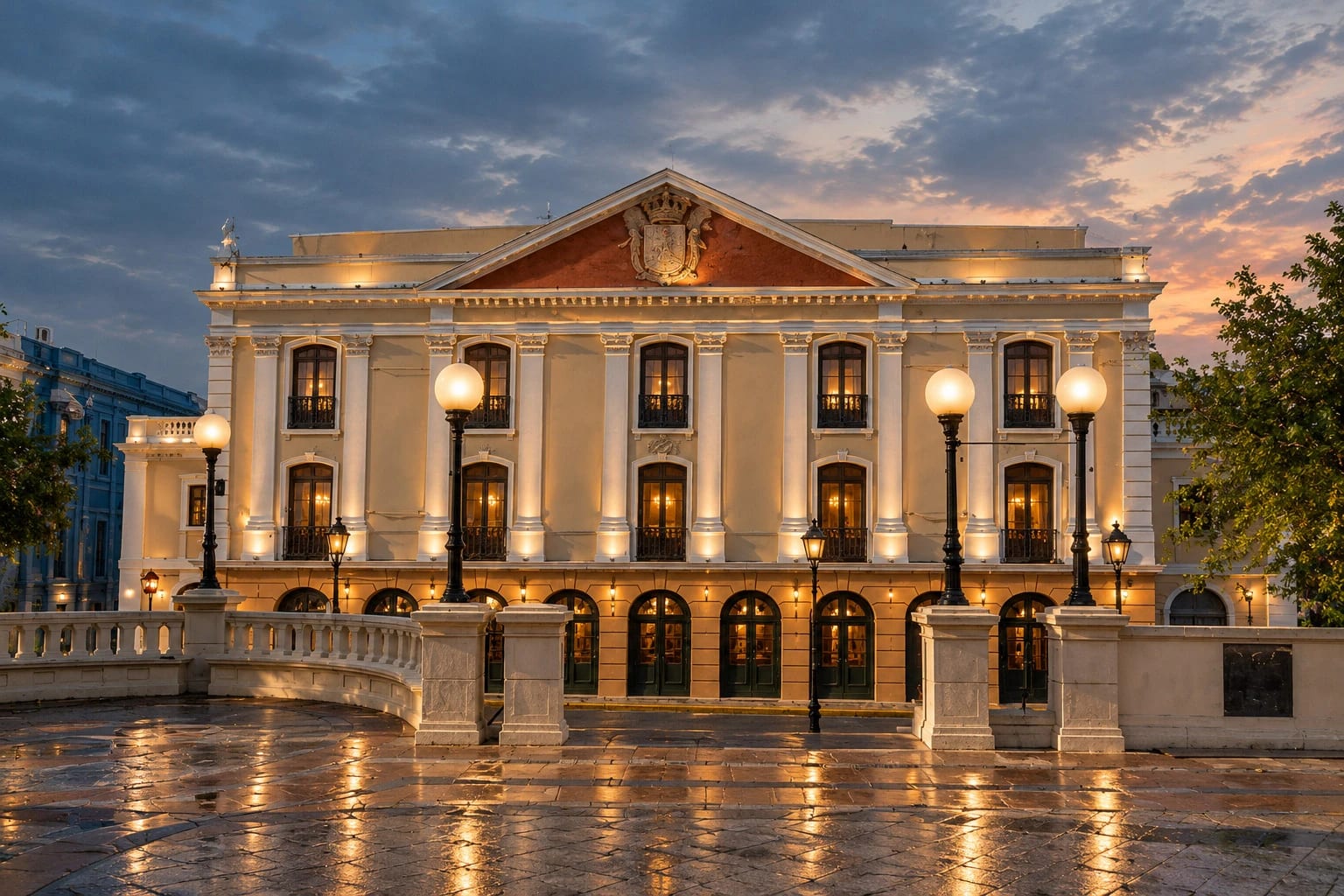
Standing across from Plaza Colón at the eastern entrance to Old San Juan, Teatro Tapia has entertained audiences since 1832. Its neoclassical exterior conceals an elegant auditorium with curved balconies, private boxes, and a stage where generations of Puerto Rican artists have performed.
The building has survived hurricanes, periods of abandonment, extensive reconstruction, and a plan to demolish it altogether. It has hosted operas, dramatic productions, concerts, and theatrical festivals. For nearly two centuries, the lives of its performers and audiences have become part of San Juan's cultural history.
Its supernatural reputation eventually attracted international attention. In February 2011, the television series Ghost Hunters International aired an investigation of Teatro Tapia, bringing its reported apparitions to viewers around the world.
Yet the most interesting part of the theater's haunted history may be the difficulty of separating its ghosts from the stories people have created around them.
The mysterious woman in the balcony has no confirmed identity. The supposedly fatal stage accident remains unverified. Even the building's physical history contains enough changes, forgotten details, and dramatic reversals to rival the stories performed inside it.
At Teatro Tapia, the distinction between history and storytelling has never been particularly simple.
Before Teatro Tapia, San Juan Had No Permanent Theater
During the earliest centuries of Spanish colonial rule, theatrical entertainment in San Juan took place in temporary or improvised spaces.
Religious performances were sometimes staged in church courtyards, while other productions occupied patios, public gathering places, and buildings adapted for entertainment. Traveling performers brought new works to the city, but there was no permanent public theater comparable to those found in major European capitals.
By the early nineteenth century, that absence had become increasingly conspicuous.
San Juan was the administrative and military center of Puerto Rico. Its population included government officials, merchants, soldiers, religious authorities, wealthy families, artisans, free people of color, and enslaved people. Social divisions were pronounced, and opportunities for entertainment varied enormously depending on wealth, status, and race.
For the city's more privileged residents, European theatrical culture offered a fashionable form of recreation. Opera, drama, music, and dance were important features of social life in Spain and elsewhere in Europe, and colonial officials wanted San Juan to possess a suitable venue for performances.
In 1824, Governor Miguel de la Torre proposed constructing a permanent public theater.
The proposal received support from the municipal government and the Catholic Church, which agreed to the project partly because the theater's proceeds were intended to help finance a diocesan seminary.
That arrangement reflected the close relationship between religious and civil authority in colonial Puerto Rico. Even an institution devoted to entertainment could be justified through its anticipated contribution to religious education.
Financing the theater required public money, and the government introduced additional taxes to pay for it. A quarter of a centavo was added to the price of a pound of bread, while alcoholic beverages were also subjected to increased taxation.
The costs ultimately reached approximately 155,000 pesos.
It is an interesting detail in the theater's history. The elegant building that later entertained San Juan's wealthier citizens was financed in part by taxes on everyday purchases made throughout the community.
Construction began in September 1824, under the direction of military engineer José Navarro y Herrero.
The location was significant.
The new theater would stand near the eastern entrance to the fortified city, close to the Puerta de Santiago, one of the gates through which residents and travelers passed into San Juan.
Its placement made the building prominent. Anyone entering the city from the eastern approaches would encounter the theater near the walls that protected the colonial capital.
But military considerations also limited what could be built.
According to historical information preserved at the theater, its original design called for a taller structure. Concerns about maintaining the city's defenses required modifications, reducing the proposed height.
Even San Juan's new cultural institution had to accommodate the priorities of a military city.
The Opening Night That Changed Puerto Rican Theater
Construction took approximately eight years.
By 1830, portions of the building were sufficiently complete to accommodate official dances and other gatherings, although the theater was not yet fully operational.
The formal theatrical opening took place in 1832.
An English tenor named William Pearman and his wife participated in the inaugural concert, introducing audiences to a new cultural venue that would become increasingly important to the island.
The theater was initially known as the Coliseo or Teatro Municipal de San Juan.
Its exterior followed neoclassical architectural traditions, with symmetrical proportions, arched openings, and decorative elements inspired by Greek and Roman architecture. Inside, the auditorium was arranged in a horseshoe shape, with private boxes and seating positioned around the stage.
The horseshoe configuration was particularly popular in European opera houses. It allowed audiences to see the performance while also observing one another, an important consideration in a society where attending the theater was as much a social occasion as an artistic experience.
The original interior decorations were associated with Spanish painter Jenaro Pérez Villaamil, whose work reflected the Romantic movement. Stage machinery and curtains were imported from Europe.
Approximately 600 spectators could attend a performance.
That may seem modest compared with modern concert halls, but it represented an impressive cultural investment for nineteenth-century San Juan.
The first seasons included foreign performers and traveling companies presenting concerts, dramas, and operatic works.
Among the early productions were Blanca y Montcasin in 1833, an Italian work titled Nueva invención that same year, the drama La mancha de sangre in 1844, and the operetta El Olimpo in 1848.
For audiences accustomed to temporary stages and improvised performance spaces, the experience was a substantial departure.
A permanent auditorium made it possible to present more technically elaborate productions, accommodate larger audiences, and establish regular theatrical programming.
It also created the enclosed balconies and darkened passageways that would eventually figure so prominently in the theater's ghost stories.
The Woman in Red Who Watches from Box 105
Of all the apparitions associated with Teatro Tapia, the mysterious woman in the balcony is among the most frequently described.
Modern versions of the legend place her in or near Box 105, one of the theater's seating areas.
She is usually described as a woman wearing a red dress, sometimes accompanied by clothing or accessories associated with an earlier period. Her appearance is fleeting. An audience member might notice her standing behind other spectators, or someone across the auditorium might see her looking toward the stage.
Then, without any obvious movement toward an exit, the figure supposedly disappears.
The identity of the woman has never been established.
Some storytellers imagine that she was once a devoted patron who attended performances so frequently that she remained attached to the theater after death. Others suggest a former actress who continues to return to the place where she spent much of her professional life.
Neither explanation is supported by a documented identity.
There is also disagreement about her appearance. Some modern retellings describe a woman in white rather than red, while others refer only to a female apparition in old-fashioned clothing.
Such inconsistencies are common in stories transmitted through oral accounts and later reproduced in ghost-tour material.
The specificity of Box 105 is intriguing, but a named seating location does not establish that a haunting occurred there. The available accounts do not identify a dated eyewitness report explaining when the story originated or why that particular box became associated with the apparition.
The theater itself provides a powerful setting for the legend.
Its auditorium is divided into several levels, with curved balconies looking toward the stage. During a performance, light falls unevenly across the audience as stage illumination changes. A person seated in one part of the theater may see only fragments of another spectator's face or clothing.
In a crowded room, someone entering or leaving a box might appear briefly before disappearing behind a partition.
Those ordinary circumstances offer possible explanations for unusual sightings, but they also help explain why the legend has endured.
A ghost in an old house might appear at a window or in an empty hallway. Teatro Tapia's mysterious woman is different. She supposedly appears during the very activity for which the building was constructed.
She has come to see a performance.
The Actress Who Died on Stage
Another of Teatro Tapia's most disturbing legends concerns a performer whose career supposedly ended in front of a crowded audience.
According to the story, a female actress was performing during the nineteenth century when she lost her footing and fell from the stage.
Some versions say she broke her neck and died immediately.
The tragedy supposedly became part of the theater's history, and her spirit was later seen performing to an empty auditorium, as though unaware that her final performance had ended.
Unlike the woman in Box 105, this apparition is directly connected with the stage.
Accounts describe a female figure appearing where performers normally stand, sometimes associated with unexplained singing or the impression that a performance is taking place even though no actors are present.
It is a compelling story, but there is an important problem.
No reliable historical record has been identified confirming that an actress died from a fall during a performance at Teatro Tapia.
The circulating versions do not consistently provide the woman's name, the production in which she appeared, or the year in which the supposed accident occurred.
That absence is noteworthy. A fatal incident during a public performance would ordinarily have attracted considerable attention, particularly in a relatively small colonial city where the theater was a prominent social institution.
An event of that magnitude might be expected to appear in newspaper accounts, municipal records, or later theater histories.
The absence of a readily identifiable record does not prove that no such accident occurred. Historical documents can disappear, remain uncataloged, or escape modern research. Nevertheless, it would be misleading to present the legend as an established death at the theater.
A further complication is the tendency for theatrical ghost stories to acquire similar details in different cities.
The actress who dies onstage and returns to complete her performance is a familiar supernatural motif. Old theaters throughout the world have legends involving singers, dancers, actors, and spectators whose devotion to the stage supposedly outlasted their lives.
In San Juan, the story may preserve a forgotten incident, or it may have developed through the same storytelling traditions that produced similar legends elsewhere.
For now, the fatal fall remains a legend rather than a verified historical event.
The theater's long history, however, contains enough genuine drama without needing to invent a tragedy.
Alejandro Tapia y Rivera: The Man Behind the Name
The playwright who eventually gave Teatro Tapia its name was born in San Juan on November 12, 1826, while the theater was still under construction.
His name was Alejandro María Tapia y Rivera.
His father, Alejandro Tapia y Zapata, was a Spanish military officer, while his mother, Catalina de Rivera, came from a prominent Puerto Rican family.
The young Alejandro experienced a complicated childhood marked by family separation and financial insecurity. His father's departure placed considerable pressure on his mother, who struggled to maintain the household and secure the financial support to which she believed the family was entitled.
Despite those difficulties, he received an education and developed a powerful interest in literature, philosophy, and the theater.
He became one of the most important writers of nineteenth-century Puerto Rico.
His literary work included drama, poetry, novels, essays, historical writing, and publications aimed at encouraging intellectual and cultural development on the island.
Tapia also became associated with some of the earliest efforts to establish a distinct Puerto Rican theatrical tradition.
For years, the repertoire presented at San Juan's municipal theater had depended heavily on European works and visiting companies. That began to change during the 1850s.
In 1854, the opera Guarionex, with music by Felipe Gutiérrez y Espinosa and a libretto by Tapia, was performed at the theater.
The work drew on Tapia's novel La palma del cacique, which explored themes involving Puerto Rico's Indigenous past.
In 1857, his play Bernardo de Palissy was presented at the same venue. It is recognized as the first drama by a Puerto Rican author staged at the theater.
This was a significant cultural development.
The building originally constructed to introduce European theatrical entertainment to colonial San Juan was becoming a place where Puerto Rican writers and musicians could present their own work.
Tapia continued writing throughout his life, producing works that included Póstumo el transmigrado, published in 1872, and Póstumo el envirginado, which appeared in 1882.
Those titles are particularly interesting in the context of the theater's supernatural reputation.
The Póstumo works involve fantastical ideas about life, death, identity, and the movement of consciousness between bodies. Tapia's imagination was entirely capable of exploring the supernatural as a literary subject.
That does not mean he believed Teatro Tapia was haunted or that his fictional characters have any connection to its reported apparitions.
It does reveal a wonderful coincidence: a theater associated with stories of spirits and mysterious figures bears the name of a writer who explored life beyond ordinary physical existence in his fiction.
Tapia died in 1882.
The theater was later renamed in his honor, although historical accounts differ on the precise timing. Some place the adoption of his name in the late 1930s, while others associate its formal designation and renewed prominence with the restoration completed at the end of the 1940s.
The name endured, preserving his contribution to Puerto Rican literature long after the colonial society in which he lived had disappeared.
The Ghostly Footsteps and Voices of an Empty Theater
The reported apparitions are only part of Teatro Tapia's supernatural reputation.
Some of the more frequently circulated accounts concern things people hear or feel rather than see.
Visitors and people associated with the theater have reportedly heard footsteps when no one was visible. Other accounts describe voices emerging from empty corridors, unexplained noises backstage, or the sensation of being touched by someone who is not there.
Some stories include singing from an unoccupied stage.
These reports are difficult to evaluate because many are repeated without dates, named witnesses, or detailed descriptions of the circumstances.
The theater's architecture also deserves consideration.
A historic auditorium is a complicated acoustic environment. Sounds can travel through stairwells, service passages, balcony spaces, and backstage areas in unexpected ways. The noise of equipment or people working in a distant part of the building may seem to originate somewhere entirely different.
The building has undergone multiple major restorations. Modern lighting, ventilation, electrical systems, and theatrical machinery operate alongside older structural features.
All can produce sounds unfamiliar to a visitor.
But the legend is not simply that Teatro Tapia makes unusual noises.
It is that the sounds sometimes resemble the activities for which the building was built.
Footsteps cross the stage as though an actor were taking a position. A voice can supposedly be heard in the distance when no rehearsal is scheduled. Singing seems to come from a place where performers have entertained audiences for generations.
In October 2024, the fictional audio series Timestorm published a special episode titled Haunted Puerto Rico: Teatro Tapia, written by Andrew Siañez-De La O.
The story follows Lalo, a Puerto Rican ghost-tour guide, recounting an experience involving his grandfather, who worked on the theater's renovation in 1976.
In the episode, the grandfather hears singing while working alone. He eventually encounters a shimmering figure resembling an opera singer, apparently performing for an audience that is no longer there.
The story is a scripted work of fiction, not an authenticated witness statement. Its significance lies in how it reimagines the theater's existing supernatural traditions for a new generation.
The imagined opera singer is neither dangerous nor particularly interested in frightening anyone. She simply continues to perform.
That interpretation is closely aligned with the older stories associated with the building.
The ghosts of Teatro Tapia, as they are generally described, seem less interested in harming visitors than in continuing the routines of their former lives.
They are still waiting for the curtain to rise.
When Ghost Hunters International Came to San Juan
By 2010, Teatro Tapia's haunted reputation had become sufficiently well known to attract the attention of an international paranormal television production.
The Syfy series Ghost Hunters International traveled to Puerto Rico to investigate two of Old San Juan's most recognizable historic locations.
One was Castillo San Felipe del Morro, the centuries-old Spanish fortress overlooking San Juan Bay.
The other was Teatro Tapia.
The resulting episode, "Soldiers of Misfortune: Puerto Rico," aired on February 16, 2011.
The investigators examined reports of unusual activity at both locations. At the theater, the claims included apparitions, unexplained footsteps, voices, shadowy figures, and the supposed presence of a deceased actress.
The team used equipment commonly associated with televised paranormal investigations, including electromagnetic-field meters, audio recorders, and cameras.
Contemporary summaries of the episode describe investigators Joe Chin and Scott Tepperman examining the theater's upper levels, where they reported unusual activity. One account of the investigation states that Tepperman believed something had pushed him and knocked an electronic meter from his hand.
Such experiences are not independently verified evidence of paranormal activity. An unexpected movement, equipment malfunction, or unusual reading does not establish the presence of a spirit, and the interpretation offered during a television production should not be treated as a scientific conclusion.
The episode nevertheless documented something important about Teatro Tapia's reputation.
Its ghost stories were no longer confined to local retellings or informal conversations among theatergoers. They had become part of an international entertainment program watched by people who may never have visited Puerto Rico.
The investigation also introduced some particularly dark claims about the theater's past, including suggestions that the property had once been used for executions.
That claim should be approached carefully.
The existing historical sources establish that the theater was constructed during the 1820s and early 1830s near the eastern entrance to San Juan. They do not establish that the theater building itself functioned as an execution ground.
The distinction matters because Old San Juan's long military and colonial history contains numerous sites associated with punishment and imprisonment. Historical events can become incorrectly attached to neighboring landmarks as stories are repeated.
Without documentary evidence identifying an execution at the theater's precise location, the claim should not be presented as established fact.
The Ghost Hunters International episode remains part of Teatro Tapia's modern history, regardless of how one interprets the investigators' experiences.
For nearly two centuries, the building had been a place where people came to watch performances.
In 2011, the performance concerned the possibility that some of its former occupants had never left.
The Theater That San Juan Almost Demolished
Perhaps the most remarkable true story about Teatro Tapia concerns its survival.
During the nineteenth century, the building endured repeated periods of deterioration and reconstruction.
Its early wooden architectural elements were vulnerable to Puerto Rico's tropical climate. Hurricanes, heavy rainfall, moisture, and structural wear created continual maintenance challenges.
An important reconstruction during the 1870s changed much of the auditorium, introducing decorative ironwork and architectural features associated with the European Belle Époque.
Engineer Tulio Larrinaga helped transform the interior, incorporating metal columns, railings, and staircases that altered the appearance of the original theater.
Those improvements allowed the building to continue operating, but they could not prevent the gradual aging of the structure.
By the late 1930s, Teatro Tapia faced a serious decline.
The University of Puerto Rico opened its own large theater in 1939, providing a modern venue capable of accommodating the kinds of productions that had historically depended on San Juan's municipal stage.
The older theater subsequently fell out of regular use and was even employed as a storage facility.
Its condition deteriorated so badly that demolition became a genuine possibility.
For a time, one of Puerto Rico's most significant cultural landmarks appeared destined to disappear.
The decision to save it was closely associated with Felisa Rincón de Gautier, the pioneering mayor of San Juan popularly known as Doña Fela.
Her administration supported a major restoration intended to return the theater to public use.
Architect Jorge Juliá Passarell was entrusted with the reconstruction, which involved extensive changes to the interior while preserving as much of the building's historic exterior character as possible.
The work was far more substantial than a cosmetic renovation.
Contemporary newspaper reporting described a new air-conditioning system, modern theatrical equipment, improved seating, updated lighting, and alterations intended to make the building comfortable and useful for performances.
The project also produced a revealing compromise.
Rather than attempt to recreate every original decorative feature, the reconstruction incorporated design influences from the mid-twentieth century. Much of the theater's earlier interior had already disappeared or been altered, and the restoration sought to create a functioning venue rather than an untouched museum.
The renewed theater opened in December 1949.
San Juan had saved a building that might otherwise have survived only in photographs, newspaper accounts, and the memories of former audiences.
That preservation effort made all its later history possible.
Without it, there would have been no continuing performances, no new generations of artists, and perhaps no modern ghost stories attached to the theater's balconies and stage.
The 1976 Restoration and the Theater We See Today
The 1949 reconstruction was not the final chapter in Teatro Tapia's architectural evolution.
By the 1970s, the building again required substantial work.
Modern theatrical productions demanded more sophisticated lighting, sound, stage machinery, and backstage facilities than the older auditorium could comfortably accommodate.
A major restoration began during the middle of the decade, with the goal of preserving the theater's historic character while introducing contemporary technical systems.
The project involved changes to the seating, stairs, balconies, and stage-related infrastructure. Restorers also sought to recover architectural features that had been obscured during previous renovations.
The proscenium boxes, for example, had been altered or closed off to accommodate mechanical systems. Their restoration helped return part of the theater's traditional visual character.
Other work included improvements to backstage service areas, new equipment, and the treatment of architectural details associated with the earlier building.
The renovation cost approximately $2 million.
Teatro Tapia reopened on December 28, 1976.
The timing was significant for the theater's long-term survival. Historic preservation was receiving greater attention in Puerto Rico, and Old San Juan's architecture was increasingly recognized as an irreplaceable part of the island's cultural heritage.
A further renovation began in 2006, and the theater reopened in August 2008.
The building that visitors encounter today therefore contains elements from different periods of its existence.
Its nineteenth-century origins remain visible, but its rooms and auditorium have been substantially modified over generations.
This layered architectural history provides another perspective on the haunting legends.
The theater has changed repeatedly, sometimes almost beyond recognition, yet the stories imagine ghosts still attached to particular seats, passages, or locations within it.
A figure said to belong to the nineteenth century may appear in an auditorium that has been reconstructed several times since her supposed lifetime.
Folklore does not generally concern itself with such architectural complications. Historical research must.
The Tragedies and Mysteries Brought Back to the Stage
In recent years, Teatro Tapia has become more than a theater with a haunted reputation.
It has served as a venue for theatrical productions devoted specifically to the darker history and supernatural legends of Old San Juan.
Beginning in 2021, the Municipality of San Juan presented an immersive experience titled Historias y Misterios del Teatro Tapia.
Rather than stage a traditional play with the audience seated throughout the performance, the production allowed participants to move through portions of the theater while actors recreated stories and mysteries associated with the city.
The inaugural production drew on the tragic story of La Gran Bettina, an acrobatic performer who, according to the account used by the production, fell to her death during a tightrope performance above Plaza de Armas.
It is important not to confuse that incident with the legend of the actress who supposedly died on Teatro Tapia's stage.
La Gran Bettina's story was presented in the theater, but the reported accident took place at Plaza de Armas, elsewhere in Old San Juan. The event's precise historical details warrant separate research.
The second year's production focused on a story involving the mysterious deaths of children associated with a Three Kings Day celebration at Teatro Tapia.
As with the fatal actress legend, that account should not be treated as an established historical tragedy without supporting records identifying the children, the circumstances, and the date.
The third production, presented in October 2023, explored La Charca de las Brujas, or the Witches' Pond.
The story concerned accusations of witchcraft in sixteenth-century San Juan, associated with a marshy area near what later became Puerta de Tierra. The theatrical narrative involved accusations, punishment, and three women supposedly condemned to death.
Contemporary Puerto Rican newspapers documented the production, its actors, and the municipality's effort to combine local history, legend, and immersive entertainment.
The historical claims within the witchcraft story require their own investigation, particularly the asserted executions by the Inquisition.
What is unquestionably significant is the city's decision to use Teatro Tapia as the setting for these performances.
The building had become a place where San Juan's legends were actively interpreted and retold.
Its reputation for mystery was no longer merely something visitors heard about. It had become material for a contemporary theatrical experience.
In a sense, this represents a continuation of the theater's original purpose.
Since 1832, Teatro Tapia has provided a place for stories to be performed before an audience. The more recent productions simply turned their attention toward San Juan's ghosts, tragedies, and folklore.
The supernatural stories that once circulated outside the theater had found their way onto its stage.
Why Are So Many Old Theaters Supposedly Haunted?
Theater ghost stories exist in cities throughout the world.
Some involve performers who died before completing a final production. Others describe former managers, devoted audience members, or employees who supposedly continued their work after death.
The legends often share familiar elements: unexplained footsteps, performers seen on an empty stage, mysterious singing, and figures appearing in balconies or backstage areas.
There are practical reasons for these similarities.
Theaters are designed to create illusions.
Lighting can conceal people or objects, transform familiar spaces, and direct attention toward one part of a room while leaving another in darkness. Sound can travel through elaborate architectural spaces, and theatrical equipment may produce unexpected noises even when no performance is underway.
A historic theater adds another layer of complexity. Old materials, successive renovations, and unusual building layouts can make ordinary sounds or visual effects difficult to interpret.
But these explanations do not entirely account for the cultural appeal of theater hauntings.
Actors spend their professional lives becoming other people. Audiences willingly suspend disbelief, accepting imagined events as real for the duration of a performance.
A theater is therefore a place where the boundary between reality and illusion is deliberately blurred.
Ghost stories extend that experience beyond the end of the performance.
The woman in Teatro Tapia's balcony is imagined as an audience member who never goes home. The actress who supposedly died onstage remains a performer who never takes her final bow.
Even the accounts of disembodied singing and footsteps depend on the idea that some part of an old performance continues when no living person is present.
A traditional theatrical custom offers an appropriate symbol.
Many theaters leave a single light burning on the stage after everyone has departed. Known as a ghost light, it has a practical safety purpose, preventing people from walking into a darkened stage area where equipment, scenery, or open spaces may present hazards.
The practice has also acquired a variety of supernatural explanations. Some theatrical traditions imagine that the light allows ghosts to perform after the living actors have gone home; others suggest it prevents restless spirits from causing trouble.
There is no need to claim that a ghost light proves anything paranormal, or even that Teatro Tapia follows a particular version of the custom.
The tradition illustrates how deeply ghost stories have become embedded in theatrical culture.
At a theater, even the lights left burning after a performance can acquire a legend.
Is Teatro Tapia Really Haunted?
The historical evidence establishes that Teatro Tapia has been an important cultural institution since the nineteenth century. Its construction, performances, financial difficulties, near-demolition, and renovations are documented through historical publications, architectural research, and contemporary reporting.
Its ghosts are another matter.
The Woman in Red has no confirmed identity, and the most detailed versions of her story appear in modern paranormal writing rather than traceable nineteenth-century testimony.
The actress who supposedly died after falling from the stage has not been connected to a verifiable historical death.
Reports of footsteps, singing, and figures moving through the auditorium are part of the theater's paranormal reputation, but the available accounts do not establish that they were caused by supernatural forces.
The 2011 television investigation brought greater attention to these stories without resolving them.
None of this makes the folklore unworthy of attention.
It simply means that the legends and the documented history should be understood as different kinds of evidence.
Teatro Tapia offers an unusual opportunity to explore both.
Its ghosts reflect the building's identity as a place of performance. Unlike the supernatural stories associated with San Juan's military forts, where apparitions are often imagined as soldiers or prisoners, the theater's supposed spirits are performers and spectators.
They remain attached to the activities that once brought them to the building.
Perhaps the most enduring idea behind the stories is that a performance can become so important to someone that even death cannot persuade them to leave.
The Woman in Red continues to watch. The actress continues to perform. The applause may have ended generations ago, but the stories refuse to let the theater fall silent.
Whether any of those figures actually exist is a question no historical source has answered.
The theater itself, however, has survived repeated threats that were entirely real.
Where Is Teatro Tapia, and Can You Visit It?
Teatro Alejandro Tapia y Rivera is located on Calle Fortaleza, opposite Plaza Colón, in Old San Juan, Puerto Rico.
Its recognizable yellow-and-white exterior stands near the eastern entrance to the historic district. The building is one of the architectural landmarks that greet visitors arriving in Old San Juan from the direction of Puerta de Tierra.
It remains an active performance venue, hosting theatrical productions, concerts, and other cultural events.
The auditorium has approximately 640 seats distributed across its three levels, according to Discover Puerto Rico. Its intimate scale and curved seating arrangement make it particularly attractive for performances that benefit from a close connection between artists and audiences.
Visitors can view the historic exterior at any time from the surrounding public streets and Plaza Colón.
Access to the interior is generally associated with ticketed performances or specifically authorized events. Teatro Tapia is not an abandoned theater, and visitors should not expect to explore its backstage areas, dressing rooms, or auditorium without permission.
Those interested in seeing the inside should consult current cultural programming and ticketing information before arriving.
The nearby streets also contain several landmarks associated with Old San Juan's wider history, including the surviving colonial fortifications and buildings connected with the city's military, political, and religious past.
The theater's location makes it a particularly interesting place to appreciate the contrast between daytime and nighttime Old San Juan.
During the day, Plaza Colón is a busy public space where visitors gather beneath the statue of Christopher Columbus. Nearby streets accommodate restaurants, businesses, and people making their way into the historic district.
After dark, the theater's exterior becomes part of a different scene.
Its arched openings, tall windows, and historic façade are illuminated against the night, while the surrounding streets take on the quieter atmosphere for which Old San Juan is famous.
The building continues to serve the purpose for which it was constructed nearly two centuries ago.
People still arrive to hear stories.
Discover More Ghost Stories in Old San Juan
Teatro Tapia is one of several historic San Juan landmarks whose documented past has become intertwined with supernatural folklore.
Elsewhere in the city, the old Spanish fortifications are associated with phantom soldiers, unexplained disappearances, and stories passed down through generations.
At Castillo San Cristóbal, the isolated lookout known as La Garita del Diablo became famous for the legend of a soldier who supposedly vanished during his night watch.
Castillo San Felipe del Morro has its own traditions involving a mysterious Woman in White and apparitions in military clothing.
Historic churches, former convents, colonial residences, and burial grounds preserve additional stories that reflect centuries of life in Puerto Rico's capital.
These locations offer far more than collections of ghost sightings. Their histories reveal how people lived, worked, worshipped, struggled, entertained themselves, and remembered their dead.
At Ghost City Tours, we explore the haunted history and legends of Old San Juan through guided walking tours after dark.
Our family-friendly Night of Souls Ghost Tour introduces visitors to the history and folklore of the old city. Guests who prefer a darker exploration of San Juan's past can join The Dead at the Gate, our adults-only ghost tour.
The stories of Teatro Tapia belong to that larger tradition of Puerto Rican storytelling, where documented history and enduring legend occupy the same streets.
Nearly two centuries have passed since William Pearman and his wife performed at the theater's opening. Thousands of musicians, actors, dancers, and spectators have entered the building since then.
Most left when the performance ended.
According to the ghost stories, a few are still waiting for the next curtain to rise.
Historical References and Sources
1. EnciclopediaPR — History of Teatro Tapia
Teatro Tapia en el Viejo San Juan
By Dr. Ivonne Acosta, reviewed by Dr. Lizette Cabrera Salcedo. Detailed Puerto Rican historical account of the theater's construction, financing, architecture, first performances, early Puerto Rican productions, renovations, and cultural importance. One of the principal historical sources used for this article.
2. Colección Reyes Veray — Architectural History
Architectural documentation concerning the theater's construction, nineteenth-century reconstruction, near-demolition, restoration, and the extensive improvements completed in 1976. Particularly valuable for understanding the building's physical evolution.
3. Discover Puerto Rico — Official Tourism Listing
Puerto Rico's destination-marketing organization provides information on the theater's location, neoclassical architecture, interior configuration, current seating capacity, and continuing use as a performance venue.
4. Instituto Alejandro Tapia y Rivera — Biography
Alejandro Tapia y Rivera: Chronology of His Life and Work
Detailed biographical chronology covering Tapia's upbringing, family circumstances, education, literary career, and theatrical productions.
5. EnciclopediaPR — Alejandro Tapia y Rivera
Historical and literary overview of the playwright whose name the theater bears, including his dramatic productions, fiction, poetry, and contributions to Puerto Rican cultural life.
6. Casa Guarch — Jorge Juliá Passarell and the 1949 Restoration
Jorge Juliá Passarell — Architectural Biography and Historical Newspaper Records
Includes historical newspaper excerpts from El Mundo documenting the reconstruction of Teatro Tapia, modernization of its facilities, and reopening in December 1949.
7. University of Puerto Rico — Theater History
Teatro de la Universidad de Puerto Rico: Historical Overview
Provides historical context for Teatro Tapia's decline around 1939, its temporary conversion to storage use, and the opening of the University's theater as a major cultural venue.
8. Facts-Chology — Teatro Tapia's Ghost Legends
The Haunted Teatro Tapia in San Juan, Puerto Rico
A modern paranormal-history account describing the Woman in Red in Box 105, the alleged actress who died after falling from the stage, and reports of unexplained sounds and apparitions. The author acknowledges the lack of verification for the alleged fatal accident.
9. HauntedPlaces.org — Reports of Unexplained Activity
Documents the theater's reputation for apparitions, unexplained footsteps, and reports of physical sensations. The site identifies its content as unverified paranormal accounts.
10. Ghost Hunters International — Episode Record
Soldiers of Misfortune: Puerto Rico — February 16, 2011
Official television distribution listing confirming that the series investigated both El Morro and Teatro Tapia during its Puerto Rico episode.
11. Rotten Tomatoes — Ghost Hunters International
Ghost Hunters International, Season 2, Episode 26
Independent episode listing confirming the program's title, airdate, participants, and investigation locations.
12. Metro Puerto Rico — Historias y Misterios del Teatro Tapia
Contemporary Puerto Rican reporting on the municipal immersive productions, including the stories presented in 2021, 2022, and 2023.
13. Primera Hora — La Charca de las Brujas
Regresa la experiencia teatral “Historias y Misterios del Teatro Tapia” — October 12, 2023
Additional reporting on the theater's 2023 historical mystery production and its connection with supernatural and tragic stories from Old San Juan.
14. Timestorm — Haunted Puerto Rico: Teatro Tapia
Haunted Puerto Rico: Teatro Tapia — October 18, 2024
An original scripted audio story by Andrew Siañez-De La O in which a fictional former theater renovation worker encounters a ghostly opera singer. Useful as an example of the continued development of Puerto Rican supernatural storytelling, not an eyewitness source.
15. GeoIsla — Historical Photograph of Teatro Tapia
Historic photographic material documenting the building's earlier exterior appearance before the major mid-twentieth-century restoration.
Teatro Tapia on Calle Fortaleza, opposite Plaza Colón in Old San Juan