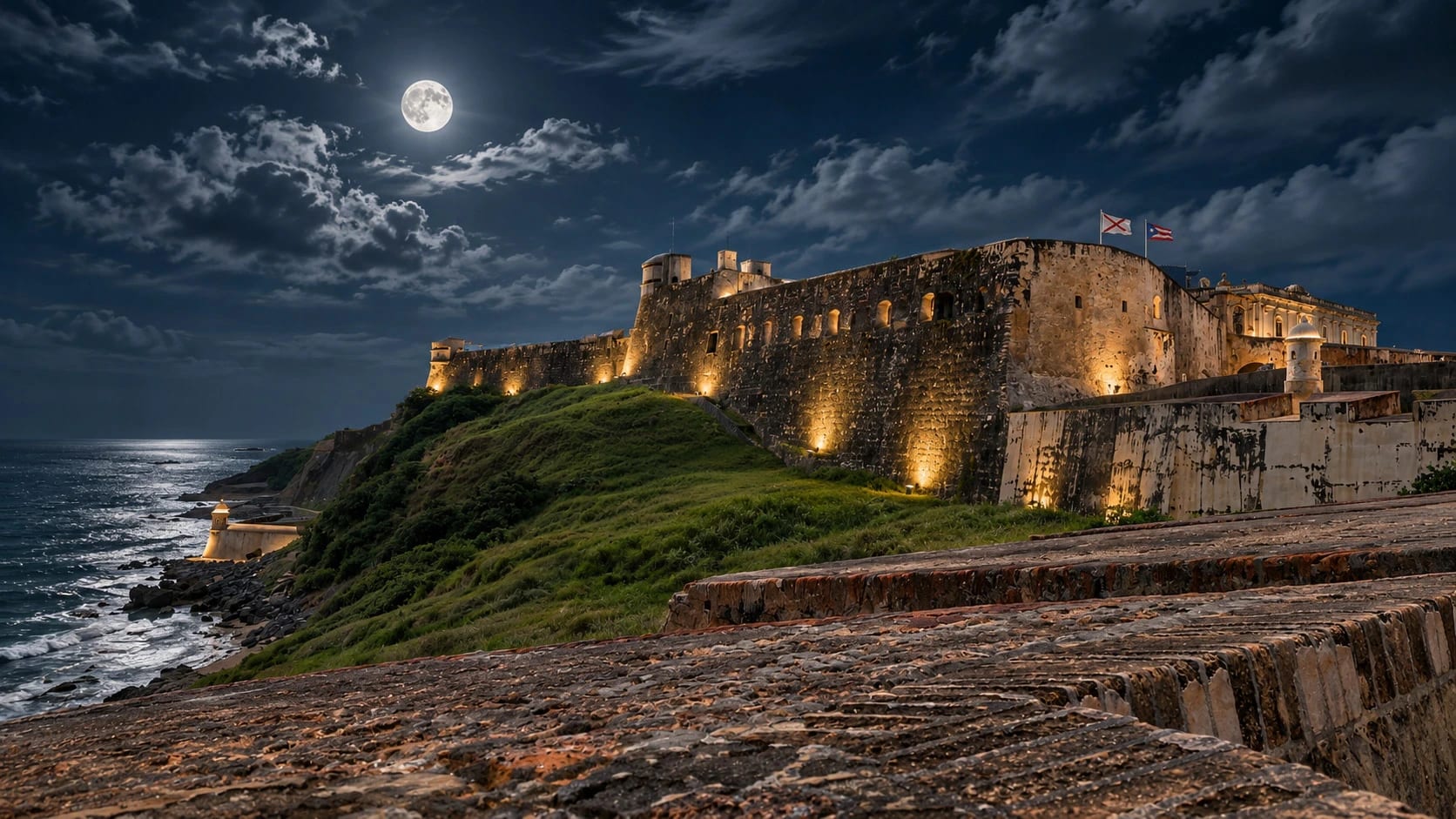
Four men lay dead outside the governor's palace, and the street was littered with shattered glass and spent ammunition.
On October 30, 1950, armed members of the Puerto Rican Nationalist Party had attempted to storm La Fortaleza, the centuries-old executive mansion overlooking San Juan Bay. Their objective was to reach Governor Luis Muñoz Marín during an island-wide uprising against American rule.
They arrived in a green automobile and opened fire. Police officers and palace guards responded from defensive positions around the building. One attacker reached the entrance before he was shot. Others fell beside the vehicle that had carried them into Old San Juan.
By the time the gunfire ended, four Nationalists were dead and several police officers had been wounded.
The violence occurred outside a building whose history already included military invasions, imprisonment, occupation, and the destruction of much of colonial San Juan. Yet La Fortaleza was not abandoned after the attack. The governor continued working there, and the historic palace remained the center of Puerto Rico's executive government.
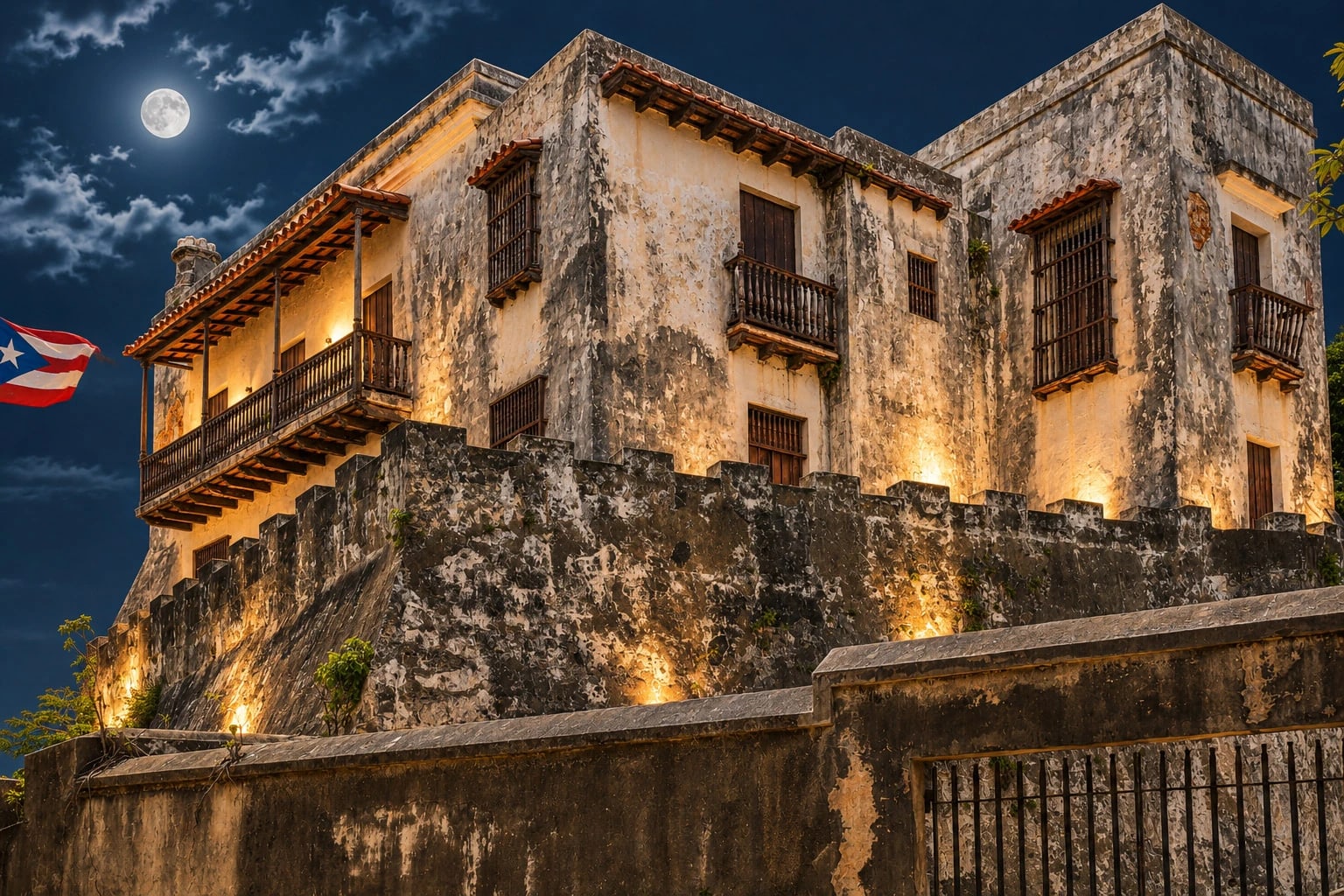
Today, visitors approaching the elegant blue-and-white mansion encounter heavy gates, manicured gardens, and a beautiful nineteenth-century façade. Behind them are some of the oldest surviving military structures in the Americas, including massive stone towers that were standing when San Juan was little more than a developing Spanish colonial settlement.
There are also stories about ghosts.
Some modern accounts describe a mysterious woman in blue appearing on the palace staircase. Others mention a woman dressed in white, unexplained footsteps, and a restless presence associated with the building's former prison rooms.
The stories are intriguing, although their origins are far more difficult to establish than the palace's documented history.
La Fortaleza has another legend, one involving a Spanish general, a sword, and an old mahogany clock supposedly stopped at the exact moment Spain surrendered Puerto Rico to the United States.
The damaged clock really exists. Its hands remain motionless.
But a Puerto Rican historian who examined the object in 2019 uncovered evidence that the famous story about the sword almost certainly did not happen as generations of visitors have been told.
That makes La Fortaleza one of Old San Juan's most fascinating places to explore the relationship between history and folklore.
Its ghosts remain unproven. The dead outside its gates, the fires that consumed its walls, and the curious story of a clock that supposedly stopped history are considerably more tangible.
The Fortress That Couldn't Protect San Juan
Long before La Fortaleza became an elegant governor's residence, it was intended to be Puerto Rico's most important military stronghold.
The Spanish began developing the fortification in 1533, only a little more than a decade after relocating their principal settlement from Caparra to the islet of San Juan.
The new capital occupied a valuable position beside a sheltered harbor. Ships arriving from Europe could enter San Juan Bay, unload supplies, and prepare for voyages to other Spanish territories in the Americas.
But the harbor also attracted enemies.
Spain's growing colonial empire faced threats from competing European powers, maritime raiders, and Indigenous communities resisting Spanish expansion.
The Crown wanted a permanent military structure capable of protecting the settlement and its anchorage.
Construction of La Fortaleza was completed on May 25, 1540, according to the Puerto Rican government's official historical records.
The original building looked nothing like the governor's mansion visitors see today.
It consisted of heavy masonry walls surrounding a courtyard, with a circular defensive tower positioned along the waterfront. The structure was intended to provide shelter for military personnel, government officials, and residents in the event of an attack.
Its walls were approximately seven feet thick in places, while the surrounding defensive works incorporated positions for artillery.
But the design suffered from a serious flaw.
La Fortaleza was built in the wrong place to effectively defend the harbor entrance.
Its elevated position overlooked portions of San Juan Bay, but enemy ships approaching from the Atlantic could pass the harbor mouth before coming within useful range of the fortress's limited artillery.
The Spanish chronicler Gonzalo Fernández de Oviedo criticized the location while the structure was still being developed. His assessment was unusually severe, suggesting that even blind builders could scarcely have chosen a less useful defensive position.
The problem was eventually recognized by the colonial authorities.
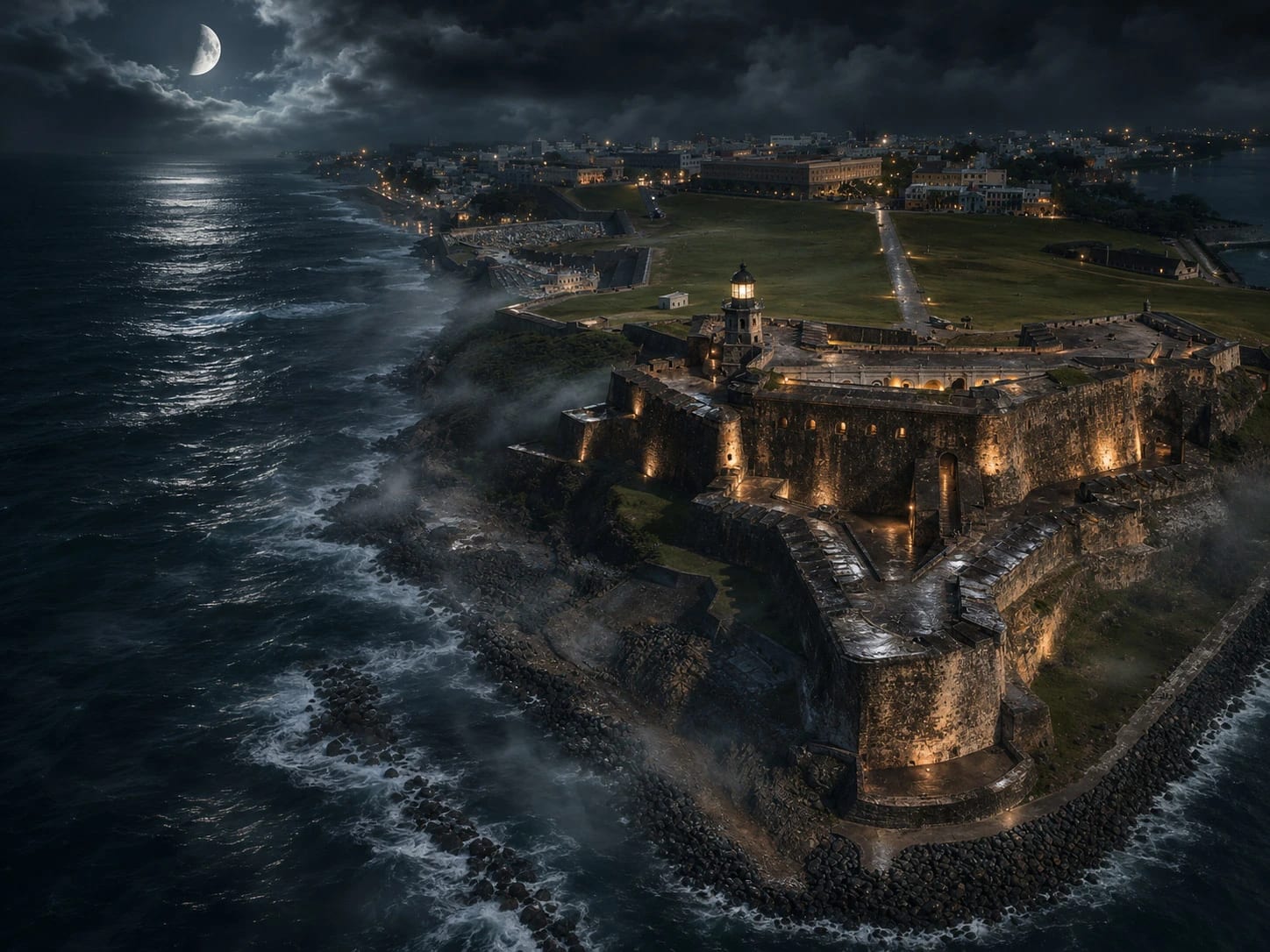
In 1539, construction began on Castillo San Felipe del Morro, positioned on the rocky headland commanding the actual entrance to San Juan Bay.
El Morro would become the city's principal defense against naval attack.
La Fortaleza, meanwhile, gradually acquired a different purpose.
Its defensive walls remained, but its most important occupants would no longer be soldiers preparing for an invasion.
They would be the governors of Puerto Rico.
The Oldest Governor's Mansion in the Americas
La Fortaleza is widely recognized as the oldest continuously used executive mansion in the Western Hemisphere.
The building's official history places its use as a governor's residence in the sixteenth century, with different historical accounts identifying dates in the 1540s for its early occupation.
Over the following centuries, it accommodated Spanish governors, military officials, American-appointed governors, and Puerto Rico's elected chief executives.
Approximately 170 governors have occupied the building, according to the official governor's office and the Institute of Puerto Rican Culture.
The residence is also known as Palacio de Santa Catalina, or Saint Catherine's Palace.
The name reflects its association with Saint Catherine of Alexandria, a Christian martyr traditionally celebrated for her learning, religious convictions, and resistance to Roman persecution.
A chapel dedicated to Saint Catherine existed near the early fortifications, and later alterations incorporated the religious dedication into the governor's residence.
The name has survived even as the building's architecture and political functions changed.
For centuries, decisions affecting Puerto Rico were made within its walls.
Spanish governors administered a colony in which military authority, taxation, commerce, religion, and labor were closely connected. The island's society included wealthy landowners, merchants, soldiers, artisans, free Black residents, enslaved Africans, and Indigenous populations whose lives had been transformed by conquest and colonial policies.
The grand rooms now associated with formal receptions represented only one aspect of that system.
The building also contained offices, military storage areas, service spaces, and rooms associated with confinement.
Over time, its physical arrangement changed to meet the demands of different administrations.
The residence eventually became a place where diplomatic visitors, politicians, military officers, and prominent members of Puerto Rican society gathered for official events.
But in the sixteenth and seventeenth centuries, La Fortaleza remained vulnerable to the same danger facing the rest of San Juan.
Twice, invading forces captured it.
The second occupation nearly destroyed the building altogether.
When the English Captured La Fortaleza in 1598
In June 1598, an English expedition commanded by George Clifford, the third Earl of Cumberland, attacked Puerto Rico.
The English were attempting to undermine Spain's power in the Caribbean and establish control over strategically important colonial ports.
San Juan was an attractive target.
Its harbor offered naval advantages, and the city's defenses had not yet developed into the enormous system visible today.
Clifford avoided the strongest artillery positions at El Morro by approaching from the eastern side of the islet.
His troops advanced into San Juan, forcing Spanish defenders to withdraw toward the fortress at the western end of the city.
Eventually, El Morro surrendered.
The English occupied San Juan, bringing La Fortaleza under their control.
Clifford himself left a description of the governor's residence, referring to it as a substantial stone castle known as the King's Palace.
That account is preserved in the National Historic Landmark documentation prepared for La Fortaleza.
For the Spanish colonial administration, the loss was a humiliation.
The fortifications built to protect San Juan had failed to prevent an invading army from occupying the city.
But the English victory did not last.
Disease spread among Clifford's forces, particularly dysentery. The epidemic weakened the occupying army and contributed to the decision to abandon Puerto Rico after approximately six weeks.
Spain regained its colony.
La Fortaleza returned to Spanish control, and the city's residents began recovering from the disruption.
The event exposed the limitations of San Juan's defenses, but it was not the last invasion.
Twenty-seven years later, an attacking force from the Netherlands would occupy the city and leave La Fortaleza in flames.
The Dutch Invasion That Nearly Destroyed the Palace
In September 1625, a Dutch naval expedition commanded by Boudewijn Hendricksz entered San Juan Bay.
The Netherlands was engaged in a prolonged conflict with Spain, and Dutch commanders viewed Puerto Rico as a potentially valuable target.
Hendricksz successfully occupied much of San Juan.
Spanish defenders withdrew into El Morro, which continued resisting the attackers even after the surrounding city had fallen.
The Dutch commander established himself at La Fortaleza.
For a time, the governor's residence became the headquarters of an invading military force.
The situation was humiliating for the Spanish authorities and terrifying for ordinary residents.
An enemy had entered the capital, occupied government buildings, and attempted to force the surrender of its principal fortress.
But Hendricksz could not capture El Morro.
As the siege continued, the Dutch position became increasingly difficult to maintain. The Spanish defenders refused to surrender, and the attackers eventually decided to withdraw.
Before leaving, the Dutch plundered San Juan and set buildings on fire.
La Fortaleza was among the structures devastated.
The fire caused such serious damage that much of the original building was reduced to its masonry walls.
The residence that had served Spanish officials for generations was left badly damaged.
Reconstruction began around 1640.
By then, the building's defensive importance had diminished relative to El Morro and the newer fortifications developing elsewhere in the city.
The restoration therefore emphasized its use as a residence for the colonial governor.
The transformation would continue through the following two centuries.
La Fortaleza was no longer simply a military stronghold.
It was becoming a palace.
And like many old palaces, it would eventually acquire stories about the people who supposedly remained there after death.
The Lady in Blue on the Palace Staircase
One of the ghost stories attached to La Fortaleza concerns a woman dressed in blue.
According to a modern haunted-place compilation, the mysterious figure is associated with the palace's grand staircase. She supposedly appears in an area connecting the former military structure with the more elaborate residential rooms built during later renovations.
The same compilation mentions a woman in white seen on the grounds, along with unexplained music and footsteps.
The contrast between the two supposed apparitions has become part of the way the palace is described in contemporary paranormal writing.
One ghost belongs to the formal rooms of the governor's residence.
Another is said to move through the gardens or older portions of the property.
There is, however, an important limitation.
The available published accounts do not identify an original eyewitness, provide a verified date for either apparition, or establish that these stories belong to an older Puerto Rican oral tradition.
The Lady in Blue appears in a modern online haunted-location directory, but its description is not accompanied by a contemporaneous witness interview or historical documentation confirming the origin of the story.
The woman in white is similarly uncertain.
Her presence in modern ghost writing does not establish that visitors actually saw her or that she was a former resident of the palace.
It would be particularly misleading to assign either apparition the name of a governor's wife, a murdered servant, or a woman who died under mysterious circumstances without evidence of such an event.
Yet the legends are worth examining as examples of how the building's reputation has developed.
La Fortaleza has been occupied by generations of governors and their households.
The women who lived there were not merely decorative figures in official receptions. Some played important roles in charitable activities, social events, public life, and the domestic organization of the residence.
Others worked behind the scenes, maintaining the rooms, preparing meals, caring for children, and performing the labor required by a large official household.
Their lives are far less prominent in historical summaries than the political careers of the men who governed Puerto Rico.
An unidentified female apparition is therefore an appealing figure in the folklore of a building whose written history has traditionally concentrated on powerful male occupants.
That does not establish her existence.
But it raises an interesting question.
If people imagine the dead returning to La Fortaleza, why should they assume that the ghosts belong exclusively to governors and soldiers?
The Grand Staircase and the Palace of 1846
The staircase associated with the Lady in Blue is one of the most distinctive features of La Fortaleza.
It dates primarily to the major renovation undertaken in 1846, during the governorship of Rafael de Arístegui y Vélez, the Count of Mirasol.
By the middle of the nineteenth century, the building's appearance no longer reflected the status Spanish authorities wished to project.
Its defensive architecture had become antiquated, and the governors of Puerto Rico required a residence suited to formal administration, receptions, and the display of royal authority.
Military engineer Santiago Cortijo directed the reconstruction.
The work replaced the severe seventeenth-century façade with a neoclassical entrance, incorporating architectural details fashionable during the reign of Queen Isabella II.
Inside, the staircase was transformed into a grand ceremonial feature.
Its steps were made from Puerto Rican ausubo wood, while the surrounding decoration included marble, elaborate plasterwork, and colorful tiles.
The National Historic Landmark documentation describes the staircase as combining Gothic, Baroque, neoclassical, and Moorish influences.
Decorative shields represented Puerto Rico, Castile, and León.
For visitors entering the palace, the staircase provided an impressive transition from the ground level to the formal rooms above.
The governor's residence now appeared less like a military stronghold and more like an executive palace.
Other rooms were also transformed.
The Hall of Mirrors acquired elaborate decorative elements, while the reception rooms and state dining room reflected European styles and the wealth of the colonial administration.
The Governor's Office occupied a large formal room once used as a throne or court chamber.
An official celebration held in November 1848 marked the completion of important parts of the reconstruction.
This nineteenth-century renovation explains why the palace has two distinct architectural identities.
Beneath and behind its formal façade remain the remnants of a sixteenth-century fortress.
Above them are rooms associated with royal authority, elegant furnishings, and centuries of official ceremonies.
Modern ghost stories have placed supposed apparitions in both environments.
The Lady in Blue belongs to the staircase.
Another legend concerns a less comfortable part of the original building.
The Prisoner Who Supposedly Remains Beneath La Fortaleza
La Fortaleza was used as more than a military residence.
UNESCO's official history identifies the property as a fortress, arsenal, prison, and executive residence during different periods of its existence.
The structure's original defensive towers contained rooms used for storage and confinement.
EnciclopediaPR, drawing on Puerto Rican architectural scholarship, describes a lower chamber beneath the Tower of Homage that served as a calabozo, or dungeon-like room.
However, that space was also used to store important government documents, ammunition, and the colony's funds.
One historically significant object kept there was the arca de las tres llaves, a chest secured by three keys and associated with the safekeeping of public money.
This varied use complicates modern descriptions of the chamber.
A room called a dungeon was not necessarily used continuously to hold prisoners, and its presence does not establish that torture or executions took place there.
Nevertheless, confinement was among the functions associated with La Fortaleza.
Modern paranormal writing has used that history to suggest the presence of a former prisoner who supposedly haunts the lower parts of the palace.
Some accounts imagine a restless figure remaining within the old cells, while others mention sounds coming from areas associated with the original fortification.
As with the Lady in Blue, the available descriptions lack a traceable historical identity for the supposed ghost.
There is no established account identifying a particular prisoner who died in the chamber and subsequently became the subject of repeated eyewitness reports.
Nor is there reliable documentation establishing that a supernatural presence has been observed there.
The building's history makes the idea understandable, but a historical prison room is not evidence of a haunting.
The actual function of the chamber deserves attention on its own.
For centuries, La Fortaleza was a place where colonial officials exercised authority over Puerto Rico.
It represented the government's ability to issue orders, collect revenue, enforce regulations, and control the movement and freedom of people living under Spanish rule.
The presence of a room used for confinement was one part of that larger system.
The stories of a ghostly prisoner may be difficult to verify.
The power exercised within the palace walls was entirely real.
The Chapel Hidden Inside the Old Tower
One of La Fortaleza's most remarkable surviving rooms occupies the upper level of the original northern tower.
It is the palace chapel.
The circular chamber measures approximately twenty feet in diameter and is covered by a vaulted ceiling.
Its location within a sixteenth-century military structure makes it unusual. A visitor approaching La Fortaleza from Calle Fortaleza sees the formal nineteenth-century mansion, but the chapel belongs to the much older fortified complex concealed behind that façade.
The room was associated with the religious life of the governors and their households.
During the Spanish colonial period, Catholicism played an official role in government, and religious ceremonies were an important part of public and private life.
A chapel within the residence allowed governors and their families to attend religious services without leaving the building.
One architectural feature demonstrates the privileges associated with their position.
The chapel contains an opening through which the governor could attend Mass without being seen by other worshippers.
The arrangement preserved a distinction between the official household and the people participating in the same religious ceremony.
The chapel has undergone numerous alterations.
In 1951, Dutch artist Marcolino Maas contributed to a restoration that included religious artwork and the redecoration of the interior.
The National Historic Landmark documentation describes a mosaic of the Crucifixion and stained-glass images of Saint Catherine of Alexandria and Saint John the Baptist.
The room was dedicated to the Holy Trinity.
Its architecture and decoration provide an important connection between Puerto Rico's colonial government and the religious institutions that shaped the island's history.
Modern haunted-place writing also associates unexplained activity with the old chapel.
Those claims are not supported by identifiable historical witnesses or established supernatural evidence.
The chapel's real history, however, is sufficiently unusual to make it one of the most intriguing places within La Fortaleza.
A religious chamber built into a medieval-style defensive tower has remained part of an occupied executive mansion for centuries.
It is a remarkable survival from San Juan's earliest years.
The Old Kitchen Rediscovered in 1956
Another extraordinary room lies within La Fortaleza's southern tower.
For years, its original function had been obscured by later alterations.
Then, during work in the summer of 1956, the removal of wooden coverings revealed evidence that the chamber had once served as the fortress's kitchen.
The discovery exposed an old cooking stove and chimney.
Preservationists recognized that the circular room belonged to the building's earliest period.
The National Historic Landmark documentation describes it as potentially one of the oldest surviving kitchens in Puerto Rico.
Its masonry walls are approximately six feet thick, and a skylight admits light through the vaulted roof.
The chamber contains historical furnishings and utensils associated with colonial domestic life, including cooking vessels, food-preparation equipment, and traditional Puerto Rican household objects.
Some historical interpretations suggest that the room may also have been used to melt metal or produce ammunition during the building's earliest military period.
The discovery demonstrates how much of La Fortaleza's original history remains concealed beneath later architectural changes.
Even in the twentieth century, people working inside the palace could uncover evidence of rooms whose early functions had been forgotten.
That reality offers a useful perspective on the supernatural stories.
A building does not need secret passageways or invisible occupants to contain mysteries.
Sometimes its most interesting discoveries are hidden beneath ordinary wooden panels.
The Damaged Clock and the End of Spanish Rule
Perhaps the most famous legend associated with La Fortaleza concerns an old mahogany clock.
It stands near the palace's grand staircase.
The clock's hands are stopped, and part of its face is damaged.
According to the traditional story, the damage occurred on October 18, 1898, when Spain formally surrendered control of Puerto Rico to the United States.
The story identifies Spanish general Ricardo de Ortega y Díez as the man responsible.
As he prepared to leave the palace, the general supposedly stopped before the clock, drew his sword, and struck its face.
The blow stopped the mechanism.
For the departing officer, the act symbolized the end of centuries of Spanish rule over Puerto Rico.
The clock would remain motionless, preserving the final moment of Spanish authority over the island.
It is an extraordinary image.
A military officer who had devoted his career to Spain's service stands inside a palace occupied by Spanish governors for centuries.
He knows that another government will soon take possession of the building.
Unable to change the outcome, he attempts to stop time itself.
The story became familiar enough to appear in scholarly and historical publications.
A 1979 bulletin of the Academia Puertorriqueña de la Historia repeated the account, identifying Ortega as the officer who struck the clock and claiming that the hands stopped at approximately 11:40 a.m.
The National Historic Landmark documentation also preserves the sword story.
But there are serious problems with the traditional account.
First, descriptions disagree about the time displayed by the damaged clock.
Some later versions place its hands at approximately 4:27 or 4:28, rather than 11:40.
Other retellings confuse the date of the transfer, placing it in 1899 despite the documented ceremony having occurred on October 18, 1898.
Those inconsistencies might seem minor if the story were otherwise supported by contemporary testimony.
In 2019, however, Puerto Rican historian José G. Rigau Pérez examined the clock and investigated its history.
What he found was far more revealing than a disagreement about the hour.
The Historian Who Challenged the Clock Legend
José G. Rigau Pérez presented his research in a scholarly publication issued by the Academia Puertorriqueña de la Historia in 2020.
He had been familiar with the clock's supposed history since childhood.
During a school visit to La Fortaleza in the early 1960s, he had heard the story of the Spanish officer who stopped the clock with his sword to commemorate the loss of Puerto Rico.
Decades later, he decided to investigate the claim.
On October 22, 2019, he examined and photographed the clock with assistance from officials responsible for the preservation and administration of La Fortaleza.
The object was real.
It was a mahogany pendulum clock with a damaged face and hands stopped at approximately 4:27.
The damage suggested that the clock had suffered a physical blow at some point in its history.
But the evidence did not support the familiar explanation.
Rigau Pérez examined accounts of the transfer of power in October 1898.
Spanish military officers had already begun leaving San Juan before the formal ceremony.
General Ricardo de Ortega had departed La Fortaleza for other military accommodations before the transfer, while the final ceremony occurred around noon on October 18.
Contemporary descriptions of the ceremony did not place him standing beside the clock with a sword.
More importantly, the clock apparently continued working after Spanish rule ended.
Rigau Pérez discovered a newspaper discussion from December 1938 in which Puerto Rican political figure Roberto H. Todd challenged a radio program's claim that the clock had remained stopped since 1898.
Todd remembered seeing and hearing the clock operate.
He contacted former American governors who had lived at La Fortaleza.
William H. Hunt, governor during the early twentieth century, reportedly confirmed that the clock had worked while he occupied the residence.
Another former governor, James R. Beverley, recalled attempting to have the clock repaired after it stopped functioning during his administration.
That testimony was damaging to the legend.
If the clock worked during the years after the American takeover, it could not have remained stopped continuously since the departure of the last Spanish administration.
Rigau Pérez concluded that the famous story developed through later retellings, particularly the interpretation of the broken clock as a symbol of Puerto Rico's changing political circumstances.
The object had acquired a historical meaning that the evidence did not support.
The clock remains fascinating.
Its damaged face is visible in historical photographs, and its connection to La Fortaleza's political history has become part of the building's identity.
But its origin as a commemorative act by the last Spanish governor is doubtful.
The actual circumstances of the damage remain uncertain.
The story has survived because it expresses something powerful about a moment of political transition.
For those who lamented the end of Spanish rule, the stopped clock symbolized a world that had disappeared.
For later generations, it became a reminder that political authority can change while the physical institutions of government endure.
La Fortaleza remained standing.
The clock stopped working.
The legend attempted to make those two facts part of the same moment.
October 30, 1950: The Deadly Attack on the Governor's Palace
The most violent episode in La Fortaleza's modern history occurred on October 30, 1950.
Puerto Rico was then experiencing a period of profound political conflict.
Following the Spanish-American War, the island had passed from Spanish to American control. The United States established a military government and later a civilian administration, while Puerto Ricans debated the island's political future.
Some advocated statehood, others favored varying forms of self-government, and the independence movement sought an end to American sovereignty.
The Puerto Rican Nationalist Party, led by Pedro Albizu Campos, rejected American rule and became increasingly confrontational during the middle decades of the twentieth century.
By 1950, tensions had intensified.
Governor Luis Muñoz Marín was pursuing a political framework that would lead to the establishment of the Commonwealth of Puerto Rico in 1952.
The Nationalist leadership opposed that course and organized an armed uprising.
On October 30, violence erupted in several municipalities across the island.
San Juan was among the locations targeted.
A group of armed Nationalists approached La Fortaleza in a green Plymouth automobile.
Historical accounts identify Raimundo Díaz Pacheco as the group's leader.
Other participants included Domingo Hiraldo Resto, Manuel Torres Medina, and Gregorio Hernández, while contemporary sources provide somewhat differing accounts of the remaining participants and their precise roles.
The attackers opened fire near the executive mansion.
Police officers and palace guards, who had received warnings of a possible attack, responded from the surrounding defensive positions.
The gunfire was intense.
One attacker advanced toward the main entrance before being shot.
Others fell near their vehicle as the authorities returned fire.
When the shooting ended, four Nationalists had been killed.
Puerto Rican newspaper NotiCel, drawing on historical reporting, identifies the dead as Raimundo Díaz Pacheco, Domingo Hiraldo Resto, Carlos Hiraldo Resto, and Manuel Torres Medina.
Gregorio Hernández survived with injuries, while another person associated with the group was later identified as an infiltrator.
Several police officers were also wounded.
The exact duration of the encounter differs between accounts, but the casualties are well established.
The attempted assault formed part of a wider uprising in which violence occurred across Puerto Rico, followed by additional confrontations and arrests.
Two days later, on November 1, Puerto Rican Nationalists attempted to assassinate President Harry S. Truman at Blair House in Washington, D.C.
The confrontation at La Fortaleza was therefore part of a larger political crisis, not an isolated attack by ordinary criminals.
Contemporary photographs show the scene outside the governor's residence following the shooting.
They preserve a disturbing contrast.
The elegant façade and formal entrance remained almost unchanged, but the street in front of them had become the scene of a deadly gun battle.
Four men died there.
The palace continued to serve as the governor's residence.
And the history of the building acquired another chapter of violence that cannot be dismissed as folklore.
Do the Ghosts of the 1950 Attack Remain at La Fortaleza?
Given the documented deaths outside the palace, it would be tempting to connect the 1950 shooting with its modern ghost stories.
But the historical evidence does not support such a connection.
No reliable account reviewed for this article identifies the Lady in Blue, the woman in white, or the supposed prisoner apparition as one of the men killed during the attack.
Nor is there a verified report describing the ghost of a named Nationalist appearing at La Fortaleza.
The shooting is documented through contemporary journalism, historical research, and photographs.
The supernatural claims are not supported by comparable evidence.
That distinction is particularly important because the 1950 uprising remains part of Puerto Rico's contested political history.
The people who died had names, families, political convictions, and personal histories.
Reducing them to convenient characters in an invented ghost story would obscure the actual circumstances of their deaths.
The more interesting historical question concerns how a building associated with centuries of government authority became the scene of a violent attempt to change that authority.
La Fortaleza had originally been designed to resist foreign invaders.
In 1950, its defenders exchanged gunfire with Puerto Ricans fighting over the political future of their own island.
The old fortress had survived another attack.
This time, the enemy was not a foreign army arriving by sea.
Is La Fortaleza Really Haunted?
La Fortaleza has accumulated supernatural claims, but its reputation as a haunted palace is not supported by the same level of documentation available for certain other historic buildings in Old San Juan.
Modern haunted-location directories describe female apparitions, unexplained footsteps, doors opening, and a supposed presence associated with the former confinement rooms.
However, the accounts generally lack identifiable witnesses, original interviews, or reliable information establishing when the stories began.
The supposed Lady in Blue has no documented historical identity.
Neither does the woman in white.
There is no reliable evidence connecting an alleged ghost to a particular governor, servant, prisoner, or person killed during an attack on the building.
The palace's centuries of occupation make supernatural stories unsurprising.
It is one of the oldest continuously occupied government residences in the Americas. Generations of people have lived and worked within its walls, and the structure has survived periods of extraordinary turmoil.
But a long and violent history does not automatically establish that ghosts exist.
Some unusual noises in an old building may have ordinary causes.
Large masonry structures contain rooms with different acoustics, enclosed passages, wooden doors, heavy shutters, and architectural features altered repeatedly over time.
Wind, changes in humidity, maintenance activity, and sound traveling through adjoining spaces can all create unfamiliar experiences.
The palace is also an active government building, making independent paranormal investigations difficult.
Its security requirements restrict access, and many rooms are not open to the general public.
The historical mysteries are more tangible.
La Fortaleza contains early military towers, rooms used for different purposes over centuries, and a clock whose famous story has been challenged by archival evidence.
Its walls witnessed two invasions, a catastrophic fire, the transfer of colonial sovereignty, and a deadly armed attack in the twentieth century.
Those events provide more than enough material for an unsettling history.
The ghost stories may be part of the building's modern folklore.
The most haunting facts are already documented.
Why La Fortaleza Looks Different from the Other Spanish Forts
Visitors often wonder why La Fortaleza resembles a grand colonial residence while El Morro and Castillo San Cristóbal retain the unmistakable appearance of military strongholds.
The explanation lies in how the buildings evolved.
El Morro and San Cristóbal continued serving defensive purposes throughout much of their history.
Their design focused on thick walls, artillery positions, military chambers, and the protection of soldiers and weapons.
La Fortaleza began with a similar military purpose, but its location quickly made it less useful as a principal harbor defense.
Its role as a residence and administrative center became increasingly important.
The structure was therefore altered to accommodate government offices, formal rooms, dining spaces, family apartments, and gardens.
The great renovation of 1846 completed much of that transformation.
Its neoclassical façade concealed older military architecture, while interior rooms were decorated according to nineteenth-century tastes.
The palace also acquired extensive gardens overlooking San Juan Bay.
The National Historic Landmark documentation describes a sunken garden known to have existed by 1845.
Over time, landscaped spaces, terraces, fountains, and other ornamental features became part of the residence's appearance.
The result is a building with two architectural identities.
From Calle Fortaleza, it appears to be a stately executive mansion.
From the waterfront, its massive defensive walls and surviving towers reveal the military structure beneath the later additions.
This contrast is central to understanding La Fortaleza.
The building has never entirely stopped being a fortress.
It simply became a place where the exercise of political authority replaced military defense as its principal purpose.
Visiting La Fortaleza in Old San Juan
La Fortaleza is located at the western end of Calle Fortaleza in Old San Juan, Puerto Rico, overlooking San Juan Bay.
The official visitor address is 54 Calle Fortaleza, San Juan, PR 00901.
It remains an active government building and the official residence and principal workplace of Puerto Rico's governor.
Visitors cannot freely explore the mansion.
However, the Governor's Office operates a program of guided historical tours that provides access to selected areas of the property.
According to the official La Fortaleza website, these tours are available in English and Spanish, generally Monday through Friday between 8:00 a.m. and 5:00 p.m.
The tours are free.
They typically focus on the first level, including portions of the original military fortification, the circular tower, the wall terrace, and the gardens.
The upper residential and formal government spaces are not ordinarily included.
Adults aged eighteen or older must present valid photographic identification or a passport when registering with security. Children must be accompanied by an adult.
Reservations are subject to change, and tours may be canceled or modified because of government operations or security requirements.
For current information and reservations, consult the official La Fortaleza guided-tour page.
The office also provides a telephone number for inquiries: 787-721-7000, extensions 2358, 2211, and 2323.
Visitors should contact the palace before traveling specifically to tour the property.
Can you see La Fortaleza at night?
Although ordinary public tours take place during daytime government hours, the palace can be viewed from surrounding public streets and portions of the waterfront.
The approach along Calle Fortaleza offers a familiar view of the mansion's gates and façade.
From the lower waterfront, visitors can appreciate its original defensive walls and the relationship between the palace and San Juan Bay.
The nearby Paseo de la Princesa and San Juan Gate provide opportunities to explore the historic landscape without entering restricted government property.
Security arrangements can change, and visitors should respect any temporary street closures or access restrictions.
La Fortaleza is not an abandoned mansion or a venue for unrestricted nighttime paranormal investigations.
Its historical significance can be appreciated without entering the building after hours.
The Palace That Outlived Every Empire
La Fortaleza has stood for almost five centuries.
It was constructed when Spain was still establishing its colonial possessions in the Americas, and its original purpose was to protect a small settlement from foreign attack.
The design proved inadequate.
A larger fortress was built at El Morro, and La Fortaleza became increasingly important as the residence of the colonial governor.
It was captured by English forces in 1598 and occupied by the Dutch in 1625.
The Dutch burned it before departing, leaving a ruined building that Spanish authorities reconstructed for continued use.
Generations later, the palace acquired an elegant nineteenth-century façade and ceremonial rooms intended to reflect the power of the Spanish Crown.
In 1898, Spain relinquished Puerto Rico to the United States.
According to the famous legend, a departing Spanish general struck a clock with his sword, attempting to preserve the final moment of Spanish rule.
Historical research suggests that the story developed later, transforming an old damaged timepiece into a symbol of political change.
In 1950, armed Nationalists attacked the palace in an effort to alter Puerto Rico's political future.
Four died outside its gates.
The building survived that confrontation as it had survived earlier invasions.
Today, it continues serving as an executive residence.
Its original towers remain, concealed behind centuries of architectural additions. The chapel and old kitchen preserve traces of life in the earliest colonial period, while formal rooms reflect the administrations that followed.
A building designed to resist enemies has endured long after the military threats it was originally meant to confront disappeared.
Perhaps that is why La Fortaleza attracts stories about ghosts.
It is difficult to stand before such an old building without wondering how many people have passed through its doors, how many decisions were made inside, and how many lives were changed by those decisions.
Most of those people are gone.
Their names survive unevenly in documents, portraits, and official records.
The palace remains.
Discover the Darker History of Old San Juan
La Fortaleza is one of the historic landmarks that reveal the complicated history behind Old San Juan's beautiful streets.
Elsewhere in the city, Spanish fortifications preserve stories of military conflict, confinement, and unexplained events.
At Castillo San Cristóbal, the isolated sentry box known as La Garita del Diablo became associated with soldiers who supposedly disappeared during their night watches.
Castillo San Felipe del Morro has its own traditions involving a mysterious Woman in White and phantom soldiers.
The former La Princesa prison, beside the southern city walls, witnessed executions, political imprisonment, and conditions that eventually prompted a federal court to order its closure.
Historic residences, churches, and former convents contain additional legends shaped by centuries of life in Puerto Rico's capital.
At Ghost City Tours, we explore the city's history and supernatural traditions through guided evening walking tours.
Our family-friendly Night of Souls Ghost Tour introduces visitors to Puerto Rican legends, historic mysteries, and the people who shaped Old San Juan.
Guests seeking a darker exploration of the city's past can join The Dead at the Gate, our adults-only ghost tour focusing on the more unsettling stories associated with San Juan's history.
The history of La Fortaleza reminds us that a place does not need a proven ghost to hold a disturbing story.
The palace has survived fire, invasion, political upheaval, and bloodshed.
Its walls have outlasted every Spanish governor who lived there and every American administration that followed.
According to modern ghost stories, mysterious figures still move through some of its rooms.
Perhaps those apparitions are no more than folklore.
But inside the old palace stands a damaged clock that has become part of Puerto Rico's historical imagination.
Generations were told that a departing general struck it with his sword so time would forever remember the loss of Spanish rule.
The evidence suggests that the clock continued ticking long after the general departed.
History moved forward, whether the clock did or not.
Historical References and Sources
1. EnciclopediaPR — La Fortaleza / Palacio de Santa Catalina
San Juan: La Fortaleza / Palacio de Santa Catalina
A Puerto Rican historical overview, revised in November 2024, drawing on architectural scholarship by María de los Ángeles Castro Arroyo and other researchers. Documents the fortress's original construction, defensive weaknesses, early towers, forced and enslaved labor involved in construction, prison and storage functions, Dutch occupation, and renovations.
2. Government of Puerto Rico — Official History of La Fortaleza
La Fortaleza — Office of the Governor
The official executive mansion website. Provides the construction dates of 1533–1540, the building's continuing use as the governor's residence, the renovation of 1846, and the history of the palace as Puerto Rico's administrative center.
3. National Park Service — La Fortaleza National Historic Landmark Documentation
La Fortaleza — National Register of Historic Places Inventory and Nomination (PDF)
An essential architectural primary source. Describes the 1846 façade, grand staircase, reception rooms, Hall of Mirrors, governor's office, historic kitchen, chapel, gardens, defensive towers, and the famous damaged clock, and documents the English and Dutch occupations and the palace's architectural evolution.
4. Academia Puertorriqueña de la Historia — The Clock Legend Investigated
Conversatorios: La Mudanza de San Juan a la Isleta, 1519–1521 (2020) — PDF
See José G. Rigau Pérez's discussion of the clock at La Fortaleza, printed pages 216–221. Rigau Pérez examined the clock in October 2019, identified the time displayed on its damaged face, and traced the legend to historical retellings. His investigation cites a 1938 article by Roberto H. Todd documenting statements from former governors indicating that the clock continued functioning after 1898, which strongly challenges the traditional account of Ricardo de Ortega stopping the clock with his sword.
5. Academia Puertorriqueña de la Historia — Earlier Version of the Clock Story
Boletín de la Academia Puertorriqueña de la Historia, Volume VI, Number 22 (1979) — PDF
See printed pages 199–200. Contains a historical account by Aurelio Tió repeating the story of General Ricardo Ortega striking the clock with his sword in 1898, with the clock stopped at approximately 11:40 a.m. — a different time from the one identified in the later physical examination. Useful for documenting the development and transmission of the legend.
6. NotiCel — The 1950 Attack on La Fortaleza
Hace 65 años tirotearon La Fortaleza — June 17, 2016
Puerto Rican newspaper reporting drawing on historical articles and photographs of the October 30, 1950, attack. Identifies the four Nationalists killed, discusses the gunfire outside the palace, and describes the involvement of police and government security personnel.
7. EnciclopediaPR — The Nationalist Uprising of 1950
Insurrección Nacionalista de 1950
A detailed Puerto Rican historical account of the political circumstances surrounding the 1950 uprising: the Nationalist movement, government actions, the island-wide confrontations, and the attack on La Fortaleza.
8. Academia Puertorriqueña de Jurisprudencia y Legislación — Historical Research
Revista de la Academia Puertorriqueña de Jurisprudencia y Legislación, Volume VII (PDF)
Includes historical analysis by Carmelo Delgado Cintrón discussing the Nationalist insurrection and the attack on La Fortaleza, identifying participants, political circumstances, contemporary newspaper reporting, and the casualties of the confrontation.
9. TIME Magazine — Contemporary Reporting on the 1950 Attack
Insurrection — November 13, 1950
A contemporary American magazine account of the armed confrontation outside La Fortaleza, describing the attackers' arrival, the gunfire, and the casualties. Its political language reflects the publication's perspective during the period.
10. United States House of Representatives — Puerto Rican Political History
Puerto Rico: Historical Essays
An official U.S. congressional historical overview of Puerto Rico's changing political status, the Nationalist movement, and the events of 1950, including the subsequent confrontation at Blair House in Washington, D.C.
11. Library of Congress — Puerto Rico in 1898
The Changing of the Guard: Puerto Rico in 1898
Historical background on the Spanish-American War, the American landing in Puerto Rico, and the formal transfer of authority on October 18, 1898 — the chronology against which the clock legend must be evaluated.
12. UNESCO World Heritage Centre — La Fortaleza
La Fortaleza and San Juan National Historic Site in Puerto Rico
Official UNESCO documentation identifying La Fortaleza's historic functions as a fortress, arsenal, prison, and governor's residence, its architectural importance, and the 1983 World Heritage designation.
13. National Park Service — Early Fortifications of San Juan
Puerto Rico: San Juan National Historic Site
Official National Park Service overview explaining why La Fortaleza was constructed and why its position proved inadequate for defending the entrance to San Juan Bay, leading to the construction of El Morro.
14. Drugstore Divas — Modern Haunted-Location Accounts
A Comprehensive Guide to Haunted Places in San Juan, Puerto Rico
A modern travel and folklore article describing reported apparitions and unusual noises associated with La Fortaleza. Evidence of contemporary haunting narratives, not independent evidence of paranormal events.
15. HauntHunt — La Fortaleza Paranormal Compilation
La Fortaleza — Haunted Location Dossier
A modern paranormal directory cataloging claims involving a Lady in Blue, a Lady in White, a supposed former prisoner, and unexplained activity. It does not identify authenticated original eyewitness testimony; its material is contemporary folklore, not historical evidence of specific apparitions.
16. Government of Puerto Rico — Official Guided Tours
Official information on guided historical visits: tours are free, generally offered Monday through Friday, and subject to government operations and security requirements. Specifies photographic identification requirements and the areas ordinarily included in visits.
17. Discover Puerto Rico — La Fortaleza Visitor Information
La Fortaleza — Official Tourism Listing
Puerto Rico's official destination-marketing organization provides the address, historic overview, access information, and practical guidance for visitors. Its published tour schedule differs slightly from the governor's official tour page, which should be treated as authoritative.

La Fortaleza, the governor's mansion at the end of Calle Fortaleza