In April 1996, construction workers renovating one of Old San Juan's most famous hotels made an unexpected discovery. Beneath the centuries-old building, in an area being prepared for a new elevator, they uncovered several empty burial crypts.
The discovery alarmed a community of Carmelite nuns whose predecessors had lived in the building for more than 250 years. According to records maintained by the religious order, more than 100 deceased sisters might still be buried beneath the property. The nuns believed that most of the burial chambers remained occupied, and they were deeply troubled by plans to introduce a casino into what had once been their monastery.
Hotel executives disputed the claim that human remains were still buried beneath the building. The disagreement became a public controversy, reaching the pages of The Washington Post in November 1996.
By then, the former convent had already acquired another reputation. Guests and visitors told stories of hearing women's voices in otherwise quiet corridors, seeing shadowy figures in old-fashioned clothing, and encountering a mysterious nun who seemed unwilling to abandon the building.
Some claimed to recognize the apparition as Doña Ana de Lansós y Menéndez de Valdés, the wealthy seventeenth-century widow who had founded the monastery. In the stories, she was not particularly frightening. She moved through the halls in prayer, apparently carrying on the religious duties that had occupied her during her lifetime.
The building is now known as Hotel El Convento, a luxury hotel at 100 Calle del Cristo, directly across from the Cathedral of San Juan Bautista. Its yellow exterior, impressive entrance, and beautiful interior courtyard make it one of Old San Juan's most recognizable landmarks.
But the history behind its walls extends far beyond the experiences of modern hotel guests. For generations, the building was home to women who spent much of their lives in religious seclusion. Its chambers witnessed prayer, illness, death, and the complicated social relationships of colonial Puerto Rico.
The ghost stories are intriguing. The burial controversy, the convent's remarkable founder, and the lives of the women who once occupied the building make them considerably more interesting.
A Widow Who Wanted to Build a Convent
The history of Hotel El Convento begins with a woman named Ana de Lansós, born in San Juan around the beginning of the seventeenth century.
She belonged to one of Puerto Rico's prominent Spanish colonial families. Her grandfather, Diego Menéndez de Valdés, served as governor and captain general of Puerto Rico during the late sixteenth century, while her father, Francisco Lansós de Andrada, was also associated with the island's military establishment.
Her husband was Captain Pedro de Villate Escobedo, a Spanish military officer who participated in the defense of Puerto Rico during the Dutch invasion of 1625. By the time Ana began pursuing her plans for a religious foundation, she was a wealthy widow without children.
The San Juan of her lifetime was a small, heavily fortified colonial settlement. Its military significance was considerable, but everyday life could be difficult. Residents endured shortages, hurricanes, disease, and the constant possibility of attacks by Spain's European enemies. The city had already survived an English occupation in 1598 and the devastating Dutch assault of 1625, during which much of San Juan was burned.
Women faced additional restrictions.
Marriage was the expected path for many women of Ana's social position, but respectable marriages often required substantial dowries. Entering a convent offered another possibility, yet Puerto Rico did not have a local female monastery. A woman wishing to pursue religious life generally needed to travel elsewhere, an expensive undertaking that could separate her permanently from her family.
Ana wanted to change that.
In 1642, she petitioned King Philip IV of Spain for permission to establish a Carmelite convent in San Juan. The proposed institution would accommodate women seeking a religious vocation, particularly those from established families who lacked the resources needed to enter other institutions or marry according to the expectations of their social class.
Her proposal was ambitious. She was offering to use her own property and wealth to establish a religious community that Puerto Rico had never possessed.
On June 25, 1645, Ana executed a formal document specifying the terms of her foundation. She committed 50,000 pesos in property and assets, including the houses where she lived, and outlined the rights and responsibilities that would govern the new convent.
The document reveals something important about the woman whose ghost supposedly wanders Hotel El Convento today.
Ana was deeply religious, but she was also a capable property owner who understood the legal and financial mechanisms of colonial society. She negotiated privileges for herself and her family, established rules concerning admission to the convent, and made provisions for the institution's long-term support.
Among those provisions was the right to reserve places for six women from her own family without requiring them to provide dowries.
The agreement also addressed a matter that would become unexpectedly relevant centuries later: burial.
Ana requested permission to establish a vault within the convent church where the remains of her deceased husband could be placed. She also wanted the chamber to serve as a burial place for herself and members of her family.
The founding document therefore establishes that burial within the monastery was contemplated from its earliest years.
This does not establish that Ana herself was eventually buried beneath the modern hotel, or that her husband's remains were successfully transferred there. Those questions require separate historical evidence. But the provision is important because it shows that religious devotion, family remembrance, and the burial of the dead were part of the convent's original purpose.
The building was never intended to accommodate only the living.
The Founding of Puerto Rico's First Convent for Women
On July 1, 1646, King Philip IV authorized the establishment of the convent. Construction followed on Ana's property, opposite the Cathedral of San Juan Bautista.
The monastery formally opened in July 1651 under the patronage of Our Lady of Mount Carmel and Saint Joseph. It became known as the Monasterio del Señor San José, or Monastery of Saint Joseph.
Today, hotel histories sometimes describe the building as the first Carmelite convent in the Americas. That distinction requires qualification. Carmelite convents had already been established elsewhere in Spanish America. What made the San Juan foundation especially significant was that it was Puerto Rico's first convent for women and an unusual foundation of the Carmelites of the Ancient Observance, rather than the Discalced branch established through the reforms of Saint Teresa of Ávila.
Even organizing the first community presented difficulties.
The original plan called for Carmelite nuns from Spain to help establish the monastery, but the necessary arrangements could not be completed. Instead, three Dominican nuns from Santo Domingo were permitted to assist in organizing the new community and supervising its early religious life.
Ana herself entered the convent as a novice and adopted the religious name Sor Ana de Jesús. Her sister Antonia joined her, becoming Sor Antonia de la Encarnación.
Other women, including relatives and members of established San Juan families, entered the monastery during its early years.
For Ana, the opening represented the culmination of a project that had required years of negotiation with church authorities and the Spanish Crown. Her property had become a permanent religious institution, and she had chosen to spend the remainder of her life within it.
Later accounts identify her as the convent's first mother superior, although the presence of Dominican nuns acting as early superiors makes the precise sequence of leadership more complicated than the simplified histories generally suggest.
What is certain is that Ana was the founder and one of the monastery's first religious residents.
Her name would remain inseparable from the building long after the convent ceased to exist.
What Life Was Like Inside the Carmelite Monastery
The women living at the Monastery of Saint Joseph followed a routine organized around prayer, religious observance, and communal responsibilities.
Their days were shaped by the Catholic liturgical calendar and the obligations of convent life. Worship, private devotion, religious instruction, and the maintenance of the community formed the structure of daily existence.
Seclusion did not mean that the nuns were entirely disconnected from San Juan.
The monastery depended on property, donations, supplies, correspondence, religious authorities, and relationships with families outside its walls. Women entering the convent brought their personal histories and social connections with them, while financial decisions made by the community could affect people far beyond the building.
Over time, the institution developed its own traditions, possessions, and religious art.
Among the artists connected with its history was José Campeche, one of colonial Puerto Rico's most important painters. His association with the Carmelite community included religious works such as a painting of the Holy Family and an image of Saint Teresa of Jesus.
The monastery also maintained a relationship with San Juan's cathedral, located immediately across the street.
For the women inside, however, the building remained a place of relative separation from ordinary city life. Its thick walls and enclosed interior spaces served a purpose very different from the fortifications guarding San Juan's coast. Rather than protecting soldiers from an invading army, they helped maintain the privacy and discipline of a religious community.
The convent's history was not exclusively peaceful.
A historical study by Kevin Rupizá Rodríguez, drawing on earlier scholarship and archival materials, notes that the community had reached approximately twenty-two nuns before an epidemic in 1691. The institution also experienced the ordinary difficulties of maintaining an aging building in a tropical climate, where heat, storms, moisture, and financial limitations could complicate repairs.
The same research reveals a less comfortable aspect of convent life.
The Carmelite community and some individual nuns owned enslaved people. Baptismal records from San Juan Cathedral identify children born to people enslaved by the monastery or by members of its religious community. A painting by Campeche also depicts enslaved Black women in association with a Carmelite religious figure.
Ana's financial provisions had included a sugar estate at Canóvanas, which eventually became part of the convent's holdings. The institution's connections to plantation property and enslaved labor place it within the larger economic structure of colonial Puerto Rico.
These facts complicate the familiar image of a peaceful convent inhabited solely by women devoted to prayer.
The monastery was a religious community, but it was also part of a society in which wealth, family privilege, race, and forced labor shaped opportunities and responsibilities.
For more than two centuries, the building contained lives and experiences that extended beyond those of the nuns themselves.
The ghost stories usually remember the women in religious habits. The historical record reminds us that many other people contributed to the institution's existence.
The Ghost of Doña Ana de Lansós
Among the supernatural stories associated with Hotel El Convento, the most persistent concerns its founder.
Doña Ana is said to appear in the hotel's corridors, dressed in the religious clothing she wore during her lifetime. Witnesses reportedly see her moving through the building as though carrying out some familiar obligation, sometimes with her head lowered in prayer.
The apparition is not generally portrayed as malicious. Rather than confronting guests or attempting to frighten them, she seems unaware of the centuries that have passed since the monastery's earliest days.
A 2015 article published by Puerto Rican news outlet NotiCel, examining several of the island's reportedly haunted locations, specifically identified Ana as the spirit believed to wander Hotel El Convento. The publication described stories in which the original mother superior walks through the corridors praying.
Other retellings describe the sound of a nun's clothing brushing against the floor. Guests supposedly hear the movement of fabric in an otherwise empty hallway, followed by silence when they attempt to find its source.
Some stories add the sound of whispered prayers or religious chanting, suggesting that the women who once lived there continue their devotional routines.
Such accounts were circulating well before the recent popularity of online ghost-tour articles. A travel feature published by Uncommon Caribbean in 2010 described reports of robes rustling through the corridors and even alleged incidents in which Ana awakened hotel guests who had slept later than she apparently considered acceptable.
That last detail gives the legend an unexpectedly human quality.
The supposed ghost is not searching for revenge or attempting to terrify strangers. She is imagined as a stern religious superior who continues to enforce the discipline of convent life, even though her former monastery has become a luxury hotel.
Of course, there is no verified evidence that Ana's spirit appears in the building. The published accounts document a surviving ghost story, not an independently established supernatural phenomenon.
Her historical existence, however, is beyond doubt. Unlike many haunted hotels where an anonymous apparition is eventually assigned a convenient identity, Hotel El Convento has a specific individual whose connection to the property can be traced through seventeenth-century documents.
Ana founded the monastery, provided its financial support, and lived within its walls.
Whether she ever returned after death remains a question belonging to folklore.
The Mysterious Sounds of the Former Convent
Not every haunting associated with Hotel El Convento involves a visible apparition.
Some of the stories concern sounds.
Guests have reported footsteps in corridors where no one appears to be walking, unusual movement near their rooms, and noises that seem to come from spaces that should be unoccupied.
Modern hotels can produce unexpected sounds for perfectly ordinary reasons. Plumbing, air-conditioning equipment, adjoining rooms, and people moving through shared spaces can create noises that are difficult to identify, especially at night.
Hotel El Convento presents an additional complication. It occupies an old building that has been repeatedly altered, expanded, and renovated. Its original architecture shares space with later construction, and sounds may travel differently through its corridors and chambers than they would in a modern hotel designed from the beginning for guest accommodations.
Still, some visitors believe their experiences are not adequately explained by the building's age.
In June 2017, a guest using the name Kenny posted an account on the website HauntedPlaces.org describing a stay at El Convento several years earlier.
According to the account, the guest and his grandmother occupied a room they had been told was once associated with the mother superior.
Late that night, he heard what sounded like trumpets playing in the hallway. When he looked through the door's peephole, he could see no one. The music stopped, and he eventually went to sleep.
Around three in the morning, another sound awakened him. This time it seemed to come from the room's living area, where a closed door separated the space from the bedroom. He described hearing something resembling a drawer opening or closing.
He also noticed that the television, which he believed he had left on, was now off.
The following morning, his grandmother asked whether he had turned off the television during the night. Later, another family member confirmed that she had also heard the trumpet sounds.
The guest only became aware of the hotel's haunted reputation after returning home.
The account cannot be independently verified, and there may be ordinary explanations for the sounds and the television. It is nevertheless more useful than an anonymous claim that people sometimes hear strange noises. It provides a particular experience, a published date, and enough detail to understand why the witness considered the events unusual.
The story also illustrates how modern encounters become absorbed into older legends.
A noise that might seem unremarkable in another hotel takes on a different significance when a guest discovers that the building once housed a religious community whose founder is rumored to remain there.
The Shadowy Woman Seen Inside a Guest Room
Another account published on HauntedPlaces.org in June 2019 describes a more unsettling experience.
A guest named Erika reported staying in an upgraded room with her family. During the visit, she repeatedly noticed shadows that she initially assumed were being cast by people or trees outside.
As the experience continued, she began questioning that explanation.
While preparing to enter the bathroom, she believed she saw the shadowy form of a woman sitting on the room's couch. The figure appeared to be wearing a shawl.
When she looked again, nothing was there.
According to her account, she later emerged from the bathroom to find her son frightened. He told her that he had also seen a woman sitting on the couch and described a figure resembling the one she believed she had observed.
The family left the room and went downstairs.
What makes the report interesting is the guest's description of the experience. She did not portray the apparition as aggressive or threatening. The frightening element was the possibility that two people had seen someone who was not physically present.
There are obvious limits to what can be concluded. The account is a user-submitted story, and there is no independent investigation establishing what the witnesses saw. Shadows, reflections, lighting conditions, and memory can all influence the interpretation of an unusual experience.
Nor is there evidence identifying the reported figure as Doña Ana.
The story nevertheless resembles the broader folklore of El Convento, in which female apparitions appear unexpectedly before disappearing without explanation.
The original mother superior may be the hotel's most famous supposed ghost, but the stories do not always describe a woman wearing a recognizable Carmelite habit.
Some witnesses simply report a female figure.
Considering the number of women who lived and worked in the building over the centuries, the distinction matters. The monastery's history was never limited to one person, however prominent she became in later accounts.
The 1996 Discovery of Burial Crypts Beneath the Hotel
The most disturbing chapter in the modern history of El Convento does not depend on a reported ghost sighting.
It begins with construction work.
During renovations in April 1996, workers preparing part of the building for a glass elevator discovered several empty burial crypts. The discovery drew attention from Puerto Rico's Carmelite religious community, whose historical records suggested that numerous deceased sisters had been interred within the old convent.
The renovation was part of an ambitious effort to transform El Convento into a luxury hotel capable of attracting more visitors to Old San Juan.
The new owners planned significant improvements to the property, including changes to its accommodations and commercial areas. Among the proposals was the introduction of a casino.
For the Carmelite nuns, this raised serious concerns.
The property had been their order's home for centuries. Although the community had left the building in 1903, its history remained closely connected with the religious lives and deaths of earlier generations.
According to a report by William Santiago published in The Washington Post on November 8, 1996, the order believed that more than 100 deceased nuns might remain buried beneath the hotel.
The article explained that the discovery of empty crypts had prompted further examination of records maintained by the Carmelite community. Those records, according to the nuns, indicated that many burial chambers beneath the property still contained human remains.
The order protested the proposed casino.
Mother Superior Rosa María Estremera and Sister Blanca María Ocasio appeared at a government hearing seeking protection for the building as a historic monument. Their concerns were supported by Ricardo Alegría, the influential Puerto Rican historian and cultural preservationist who founded the Institute of Puerto Rican Culture.
The dispute involved far more than the question of whether gambling should take place in a former religious building.
It touched on the treatment of historic remains, the protection of colonial architecture, and the growing commercialization of Old San Juan.
Hotel president Alberto Velásquez rejected the assertion that the remains of Carmelite nuns were still buried beneath the property. He also defended the proposed casino as an important commercial component of the hotel's future.
The disagreement therefore contained two separate historical claims.
The discovery of several empty crypts during renovation work was reported as an actual event. The belief that more than 100 nuns remained buried beneath the building was a claim advanced by the Carmelite order and disputed by hotel management.
The reporting does not establish that all of the alleged occupied crypts were subsequently excavated or independently verified.
That distinction is essential.
It would be inaccurate to state as settled fact that the modern hotel contains the bodies of more than 100 nuns. It would be equally inaccurate to dismiss the controversy as merely another ghost story.
The discovery, the archival claims, and the public disagreement were documented.
For anyone interested in the haunted history of Old San Juan, the episode is extraordinary. Decades after the convent had become a hotel, the possibility that its deceased residents still occupied the ground beneath it became a matter of public debate.
The women who had lived there were once again at the center of the building's future.
Why Were Nuns Buried Inside Convents?
The possibility of burials beneath El Convento is less unusual than it might initially appear.
In Catholic Europe and its colonial territories, churches and religious institutions historically served as places of burial. Before the development of modern municipal cemeteries, individuals were often interred inside churches, beneath chapels, or in adjoining burial grounds.
Religious communities frequently maintained their own burial traditions.
For women who devoted their lives to a monastery, burial within its grounds could preserve their connection to the community in death. The deceased remained physically close to the institution where they had spent their religious lives, while prayers and memorial observances continued among the surviving members.
Burial arrangements also reflected social position and family relationships.
Prominent families might reserve places in church vaults, and benefactors sometimes secured burial rights through the donations that supported religious institutions.
Ana de Lansós made precisely such a request in the convent's founding agreement.
She wanted a vault where her husband's remains could be placed and where she and her relatives could eventually be buried.
The provision demonstrates that burial was contemplated as part of the monastery's function from the beginning. It does not identify every subsequent burial or prove which remains survived later construction work.
The broader tradition, however, makes the 1996 controversy historically understandable.
A building occupied by a female religious community for nearly 250 years could have contained multiple generations of burials. Changes in architecture, ownership, and land use might eventually obscure the location or condition of those burial spaces.
By the time twentieth-century developers began converting the property into a modern hotel, some of the building's earlier functions had become difficult to recognize.
A room that once served a religious purpose might become a restaurant. A corridor used by nuns could become part of a guest accommodation. An area associated with burials might be concealed beneath later flooring or construction.
The history was not necessarily destroyed by those changes, but it became harder to see.
The Carmelite order's 1996 protest was an attempt to ensure that this history was not disregarded.
The End of the Convent in 1903
For more than two centuries, the Monastery of Saint Joseph remained part of the religious life of San Juan.
Its buildings were maintained, altered, and expanded as circumstances required. Significant construction during the nineteenth century changed parts of the complex, meaning that visitors today are not looking at an entirely untouched seventeenth-century structure.
The monastery survived the long period of Spanish colonial rule and the transfer of Puerto Rico to the United States after the Spanish-American War.
But by the beginning of the twentieth century, maintaining the aging complex had become increasingly difficult.
On December 9, 1903, church authorities closed the convent.
The Carmelite community left the historic property, bringing an end to approximately 252 years of religious occupation at the original site. The community itself did not disappear. Its religious life continued elsewhere in Puerto Rico, eventually becoming associated with other monastic locations outside the old city.
The building, however, entered an uncertain period.
Without the nuns, the former monastery gradually lost much of its original purpose. Over the following decades, parts of the property were used for commercial and temporary accommodation purposes. Accounts of its twentieth-century history describe retail activity, a dance hall, inexpensive lodging, and periods of serious neglect.
The contrast with its earlier existence was enormous.
The monastery founded by a wealthy colonial widow had once been governed by religious rules and maintained through donations, inherited property, and community labor. Now its rooms accommodated entirely different activities.
The building's physical condition deteriorated.
By the middle of the twentieth century, the former convent faced an uncertain future, and preservationists worried that another important piece of Old San Juan's architectural history might be lost.
Its eventual rescue came from an unexpected source.
From Abandoned Monastery to Luxury Hotel
In 1959, Robert Frederic Woolworth, an heir to the Woolworth retail fortune, acquired the deteriorating property and began converting it into a hotel.
The project was ambitious.
Rather than demolish the former convent, Woolworth sought to preserve its historic atmosphere while introducing the accommodations and services expected by modern travelers. The renovation retained elements of the building's Spanish colonial character while substantially altering its interior.
Two floors were added, and the restored complex was developed into a hotel with approximately 100 rooms.
The new El Convento opened on January 27, 1962.
Its unusual architecture, central location, and combination of historic surroundings with luxury accommodations attracted considerable attention. Celebrities and international visitors stayed at the property, and the hotel became part of Puerto Rico's effort to develop its tourism industry.
Among the famous guests associated with its early years was actress Rita Hayworth.
The hotel's fortunes changed over the following decades. Financial difficulties, changes in management, and the costs of maintaining an old building complicated its operation.
Eventually, the property passed into government ownership.
In 1995, a group of Puerto Rican business leaders acquired El Convento and began another major restoration. The project was intended to return the hotel to prominence while preserving the architectural character that made it distinctive.
The renovation retained features associated with the former monastery, including its central courtyard, arched corridors, heavy wooden doors, and traditional materials.
Its reopening in January 1997 marked another transformation.
The neglected convent of the 1950s had become a refined boutique hotel, now recognized as a significant example of the preservation and adaptive reuse of historic architecture.
The building's courtyard remains among its most striking features. Balconies overlook an interior space filled with plants, and the architecture combines thick walls, arches, and shaded walkways with the comforts of a modern hotel.
One celebrated feature is an old níspero tree, whose presence has become part of the property's identity.
Visitors entering the building today encounter restaurants, hotel rooms, and carefully restored architectural details rather than the quiet religious community established in 1651.
Yet the original purpose of the structure remains visible.
The appearance of the corridors, the enclosed courtyard, and the relationship between the building and the cathedral across the street all preserve elements of its former life.
For believers in the hotel's ghost stories, the restoration did not erase its past.
It merely changed the people who occupied the rooms.
A Modern Guest Encounters the Hotel's Haunted Reputation
The reputation of El Convento as a haunted hotel has continued into the twenty-first century.
In March 2025, journalist Dan Webster published a travel account in The Spokesman-Review describing a stay at the historic property.
Webster acknowledged hearing the story that the hotel's first mother superior supposedly haunted parts of the building, particularly rooms on its lower floors.
He did not initially take the story seriously.
Then, during the night, he awoke and noticed an unusual blue light flashing across the ceiling. Investigating the source, he discovered that the room's espresso machine had apparently switched itself on and was indicating that it was ready to prepare coffee.
His solution was practical: he unplugged the machine.
The account was written with humor, and Webster did not claim that he had proved the presence of a ghost. Nevertheless, the episode demonstrates how the hotel's reputation can influence the interpretation of otherwise ordinary events.
A malfunctioning appliance in a modern hotel would generally be considered an inconvenience. At El Convento, it becomes part of a much older conversation about whether the building's former inhabitants are still present.
The anecdote also illustrates why stories about the mother superior have survived.
Unlike the ghost of a murdered guest or a soldier killed during battle, Ana is imagined as a figure whose attachment to the building came from devotion and responsibility.
She helped create the convent. She organized its future. She chose to spend her life within it.
The legend suggests that she never entirely relinquished those responsibilities.
Is Hotel El Convento Really Haunted?
There is no independently verified evidence that Hotel El Convento is inhabited by ghosts.
The accounts of Doña Ana wandering the corridors, the reported sounds of religious clothing, and the shadowy female figures described by guests belong to a tradition of supernatural storytelling that has developed around the property.
Some reports are specific enough to be examined as personal testimony. Others are stories repeated through travel articles and ghost-tour accounts without a traceable original witness.
They should not be treated as equally reliable.
The history of the building, on the other hand, is unusually well documented.
Ana de Lansós was a real person whose founding agreement survives in historical transcriptions. The monastery opened in 1651, and Carmelite women occupied the property until 1903. The institution accumulated property, possessed religious artworks, maintained connections with important colonial families, and participated in an economy that included enslaved labor.
The modern hotel emerged from a series of renovations beginning in the late 1950s, and its reopening in the 1990s prompted a documented dispute about the location and preservation of religious burials.
Those facts are compelling without the addition of invented tragedies.
There is no need to claim that Ana was murdered, died under mysterious circumstances, or was punished for violating her religious vows. No such episode has been established, and attaching an unsupported death story to a named historical woman would diminish the credibility of the article.
Similarly, the possibility that nuns remained buried beneath the property does not prove that their spirits were responsible for unexplained activity upstairs.
The two subjects are connected by history and public memory, not by demonstrable paranormal evidence.
What makes Hotel El Convento especially interesting is the way its ghost story preserves the identity of its founder.
In many haunted buildings, the supposed apparition is anonymous. At El Convento, generations of storytellers have assigned the haunting to a woman whose life can be examined through documents dating to the seventeenth century.
She is remembered not as a victim, but as the person who created the institution.
The ghost story allows her to remain the building's guardian.
Whether that presence exists outside the imagination is something no historical document can establish.
Can You Visit Haunted Hotel El Convento?
Hotel El Convento is located at 100 Calle del Cristo in Old San Juan, Puerto Rico, immediately opposite the Cathedral Basílica Menor de San Juan Bautista.
The building is an operating luxury hotel, not an abandoned convent or a public paranormal attraction.
Visitors can appreciate its historic exterior from the surrounding streets and plaza. The property's restaurants and other hospitality facilities may be accessible to nonregistered guests according to current hotel policies, but guest rooms and private areas are not open to casual exploration.
The hotel also offers a history-focused guided experience for registered guests on selected dates. According to its official website, a complimentary Old San Juan and El Convento historical tour is scheduled on Saturdays at 10:00 a.m., subject to availability and any changes made by the property.
For current accommodation information, dining arrangements, and visitor policies, consult the official Hotel El Convento website.
The surrounding neighborhood offers an opportunity to explore several important chapters of San Juan's history within a relatively small area.
The cathedral across the street contains the remains of Juan Ponce de León, one of the figures most closely associated with the island's early Spanish colonial period. Nearby historic streets lead toward Casa Blanca, once home to members of Ponce de León's family, and eventually to the fortifications of Castillo San Felipe del Morro.
Hotel El Convento belongs to that larger historic landscape.
Its former religious residents lived within the same fortified colonial city as soldiers, merchants, enslaved laborers, sailors, and families whose stories are preserved in churches, government records, and local traditions.
Walking through Old San Juan today, it is easy to admire the beautifully restored buildings without realizing how many different lives they once contained.
El Convento is a particularly striking example.
Its walls have surrounded a monastery, an aging commercial property, and a succession of hotels. The rooms have changed, but the history of the women who lived there has not disappeared.
For more of the city's haunted history, read about El Morro and La Garita del Diablo, or explore our guide to haunted San Juan.
Discover the Ghost Stories of Old San Juan
The story of Hotel El Convento is only one chapter in the haunted history of Puerto Rico's capital.
For more than five centuries, Old San Juan has witnessed conflict, religious devotion, political upheaval, and extraordinary changes in daily life. Its narrow streets connect former military installations, churches, historic residences, and public squares where generations of residents created the traditions that visitors encounter today.
Some of those stories concern people whose lives are documented in remarkable detail. Others survive as legends, passed down through families and retold by storytellers who found meaning in the city's mysterious past.
Hotel El Convento brings both kinds of history together.
Doña Ana de Lansós created a religious institution that survived for centuries. The women who followed her lived and died within its community, and their experiences became part of the history of San Juan. Long after the convent closed, stories began circulating that its founder continued to walk the corridors.
At Ghost City Tours, we bring the legends and darker history of Old San Juan to life through guided evening walking tours.
Families interested in Puerto Rican folklore and the mysterious side of the old city can explore The Night of Souls Ghost Tour. Guests who prefer a darker approach to San Juan's colonial history can discover The Dead at the Gate, our adults-only ghost tour.
Our tours introduce visitors to the history and supernatural traditions of Old San Juan without requiring them to believe that every unusual story has a paranormal explanation.
The former convent on Calle del Cristo offers an enduring example of why those stories matter.
When Ana de Lansós founded her monastery, she made provisions for the living, the dead, and the generations that would follow her. She could hardly have imagined that centuries later, travelers would sleep in its rooms, dine in its courtyard, and tell stories about a mysterious nun wandering the hallways.
The religious community departed more than a century ago.
According to the legend, its founder never did.
Historical References and Sources
1. The Washington Post — The 1996 Burial Crypt Controversy
Controversy Over Nuns' Remains Rattles City's Revitalization Effort — November 8, 1996
By William Santiago. Contemporary reporting on the discovery of burial crypts during the hotel's renovation, the Carmelite community's claims concerning more than 100 deceased nuns, the proposed casino, and objections from religious and cultural preservation representatives.
2. Hotel El Convento — Official History
The hotel's own historical timeline, including the 1646 authorization, founding in 1651, closure in 1903, acquisition by Robert Frederic Woolworth, opening in 1962, and restoration during the 1990s.
3. Kevin Rupizá Rodríguez — Historical Research on the Carmelite Monastery
Historical study published in 2019, drawing on archival documents and scholarship concerning the founding of the convent, Doña Ana's family, its religious community, property holdings, burial provisions, artistic connections, and ownership of enslaved people.
4. Tercera Orden del Carmen en Puerto Rico — Carmelite History
Historia de la Orden del Carmen en Puerto Rico
Official Carmelite historical information identifying the Monastery of Saint Joseph as Puerto Rico's first Carmelite community, founded in July 1651, and documenting its relationship to the island's subsequent Carmelite institutions.
5. NotiCel — The Ghost of Doña Ana
Los seis lugares más embrujados de Puerto Rico — October 7, 2015
Puerto Rican news report identifying Hotel El Convento as a location associated with the apparition of Doña Ana de Lansós, described in folklore as walking the halls in prayer.
6. Uncommon Caribbean — The Haunted-Hotel Legend
Scary-Good Savings at San Juan's Most Haunted Hotel — 2010
An earlier published account of the hotel's haunted reputation, including the supposed sounds of religious robes moving through the halls, stories of the original mother superior, and claims of guests awakened by an unseen presence.
7. HauntedPlaces.org — Guest Experiences
Hotel El Convento: Ghost Stories and Visitor Reports
Contains user-submitted reports from June 2017 and June 2019 describing unusual sounds, shadowy figures, and experiences in guest rooms. These accounts are anecdotal and have not been independently verified.
8. The Spokesman-Review — A 2025 Guest Experience
Confronting the Ghosts of Old San Juan — March 31, 2025
By Dan Webster. A personal travel account discussing the hotel's reputation for being haunted by its first mother superior and an unusual nighttime incident involving the guest-room espresso machine.
9. National Trust for Historic Preservation — Adaptive Reuse
Explore Eight Adaptive Reuse Sites from Historic Hotels of America
Information about the former Carmelite convent, the importance of preserving the historic property, and its transformation into a modern hotel.
10. Travel Weekly — The 1997 Restoration
Former Carmelite Cloister Reborn as Luxurious El Convento — August 13, 1997
Contemporary reporting describing the hotel's reopening after the major renovation, the preservation of historic architectural features, and changes to rooms, corridors, and the central courtyard.
11. Discover Puerto Rico — Historic Hotels
Historic Hotels and Resorts in Puerto Rico
Puerto Rico's official destination-marketing organization provides a concise history of El Convento, including its Carmelite origins, original occupation, acquisition by Woolworth, and subsequent redevelopment.
12. Puerto Rico Historic Buildings Drawings Society
Hotel El Convento — Architectural and Historical Overview
Historical overview of the building's construction, relationship to San Juan Cathedral, changing uses, and restoration as a hotel.
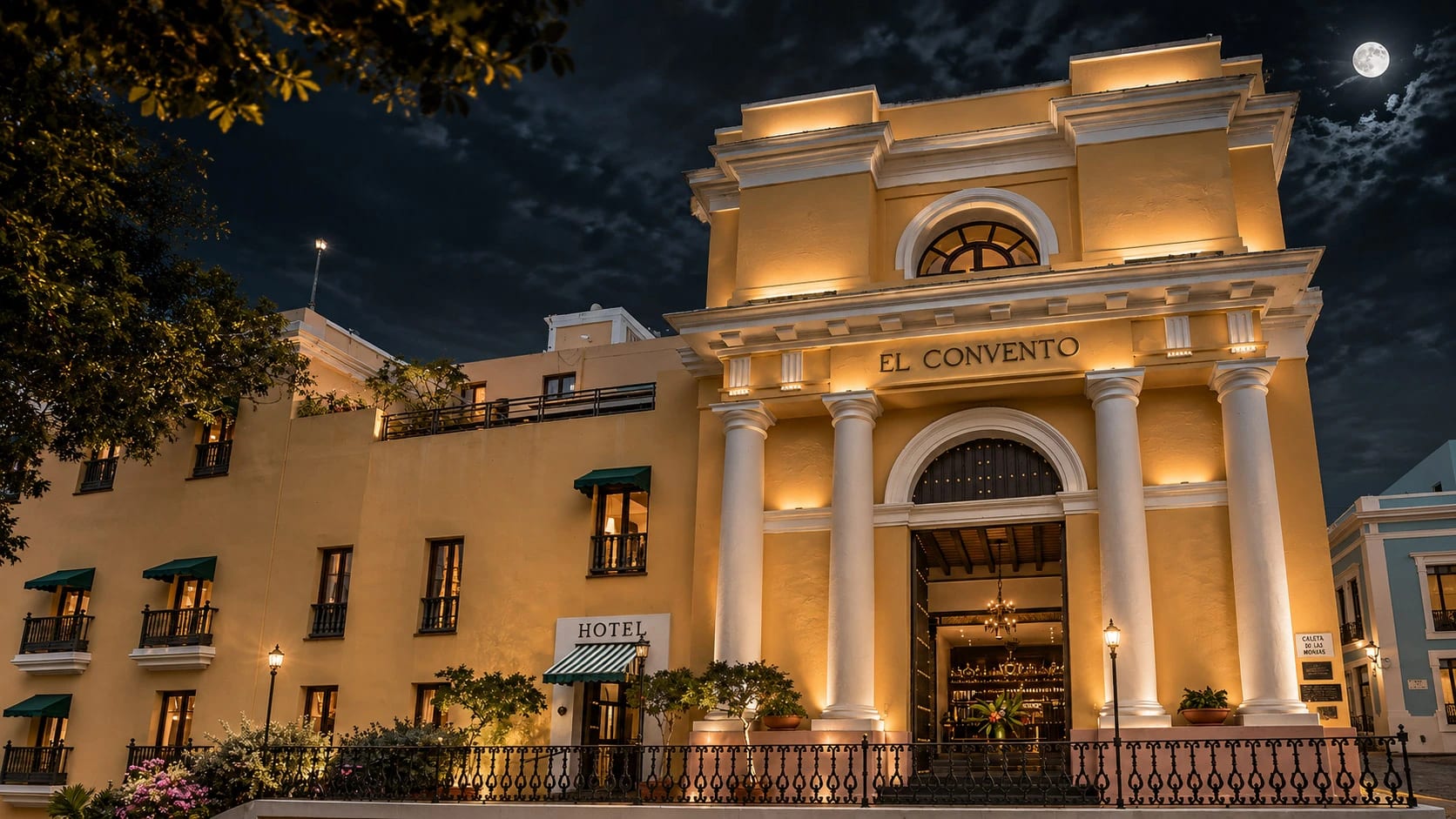
Hotel El Convento on Calle del Cristo, across from the Cathedral of San Juan Bautista