In December 1893, two men allegedly attempted to assassinate one of the most important figures in Cuba's struggle for independence. Their target was José Martí, a Cuban revolutionary, journalist, and poet who had been traveling between American cities raising money and organizing support for a war against Spanish rule. Martí was visiting Tampa when the men reportedly approached him and offered him wine that had been poisoned.
The attempt failed, but Martí became seriously ill. A physician was summoned, and arrangements were made to move him somewhere safer than the hotel where he had been staying. His supporters feared that the men responsible might return, and there was no reason to assume the danger had passed simply because their first attempt had been unsuccessful.
Martí was taken to a small wooden house near the corner of Eighth Avenue and Thirteenth Street in Ybor City. The property belonged to Paulina and Ruperto Pedroso, an Afro-Cuban couple who had become deeply involved in the independence movement. Paulina helped nurse Martí back to health while her husband kept watch over the property, ensuring that nobody approached without their knowledge.
According to accounts preserved by Cuban historians, Martí spent the following days recovering in the Pedroso home. He was already acquainted with the couple, having stayed with them during previous visits to Tampa, but the assassination attempt made their house particularly important. During subsequent trips, he reportedly preferred to stay with the Pedrosos rather than expose himself to the risks associated with public accommodations.
The house became one of the most significant locations associated with Cuban independence outside Cuba itself. Martí wrote speeches and correspondence there, met with supporters, and continued organizing the revolution that would eventually challenge Spain's control of the island.
Today, the house is gone.
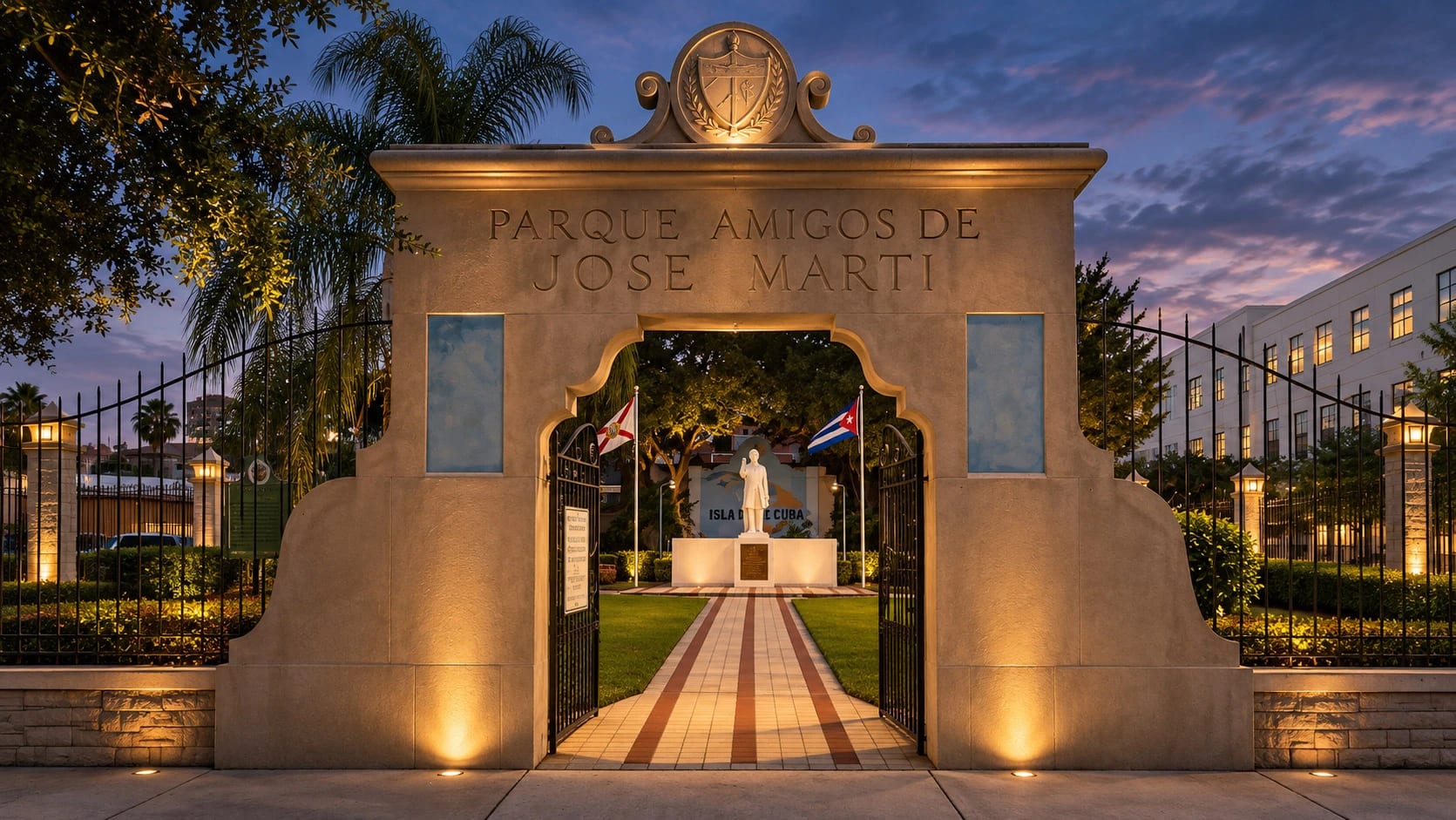
In its place stands José Martí Park, a small memorial enclosed by an ornamental wall and wrought-iron gates. A white statue of Martí stands inside, surrounded by tropical vegetation, Cuban historical markers, and soil brought from the island he spent much of his life trying to liberate.
The park has another distinction that surprises many visitors. Although it is located in Tampa, the land is owned by the Republic of Cuba. The property was transferred to the Cuban government in 1956, three years before Fidel Castro came to power, and ownership has remained with the Cuban state ever since.
There is also a darker side to the park's history. The assassination attempt, the mysterious circumstances surrounding the poisoning, and the disappearance of the original house have attracted interest from people exploring Ybor City's haunted locations. Some paranormal tours include the park among their stops, although a well-documented ghost story associated specifically with the property has proven difficult to establish.
What happened there in 1893, however, was extraordinary enough without adding ghosts to the account. Had the assassination attempt succeeded, the history of Cuba might have unfolded very differently.
José Martí and the Cuban Revolution
Why a Cuban Revolutionary Came to Tampa
José Julián Martí Pérez was born in Havana on January 28, 1853, when Cuba was still a Spanish colony. His involvement in the independence movement began while he was young, and he was arrested by Spanish authorities in 1869 for his political activities.
Martí was only sixteen when he was imprisoned and sentenced to forced labor. The experience affected him physically and strengthened his opposition to Spanish rule, eventually leading to his exile from Cuba.
Over the following decades, Martí lived and traveled throughout Latin America, Europe, and the United States. He became known as a gifted writer and public speaker, using journalism, poetry, and political organizing to advance the cause of Cuban independence.
By the early 1890s, he had settled into an increasingly demanding schedule of meetings, fundraising appearances, and speeches intended to unite Cuban communities living outside their homeland.
One of the most important communities was in Tampa.
Ybor City had developed rapidly since the arrival of cigar manufacturers in the 1880s. Its factories employed thousands of Cuban immigrants, many of whom had left the island during earlier periods of political unrest. These workers maintained close relationships with relatives in Cuba and followed developments in the independence movement with considerable interest.
The cigar factories were especially useful places for spreading political ideas. Workers spent long hours together, and many factories employed lectors who read newspapers, novels, and political publications aloud while employees rolled cigars.
Martí understood the importance of these workers. Their wages might not have been substantial individually, but thousands of small contributions could provide money for revolutionary activities, including the purchase of weapons and supplies.
He also recognized that workers who had already experienced Spanish colonial rule could become some of the movement's strongest supporters.
During his first important visit to Tampa in November 1891, Martí delivered speeches that helped establish the city's reputation as a center of Cuban revolutionary activity.
His address known as Con todos y para el bien de todos, or "With All and for the Good of All," called for unity among Cubans and emphasized the importance of building a republic that would not reproduce the inequalities of the colonial system.
He also delivered a speech commemorating eight medical students executed in Havana in 1871, an event that had become a powerful symbol of Spanish colonial repression.
The audiences were enthusiastic, and Martí returned to Tampa repeatedly over the following years.
According to research referenced by the University of Tampa, twenty visits between 1891 and 1894 have been documented.
His relationship with Ybor City became so important that the neighborhood earned a place in the history of Cuba's independence movement far greater than its size might suggest.
The People Who Helped Finance the Revolution
The Cuban workers supporting Martí were not wealthy people.
Many lived in modest houses near the factories, supporting families on wages earned through demanding manual labor. Some had only recently arrived in the United States, and others were sending money to relatives still living in Cuba.
Nevertheless, they contributed what they could.
Revolutionary organizations collected donations, arranged meetings, distributed political publications, and helped recruit supporters. Social clubs and neighborhood businesses became places where discussions about Cuba's future occurred almost daily.
Martí's supporters included men and women from different economic backgrounds, and the movement depended on their willingness to make sacrifices.
The political atmosphere was complicated by the fact that Ybor City also had a substantial Spanish population.
Some Spanish immigrants supported Cuban independence, while others maintained loyalty to Spain or opposed the revolutionary movement for different reasons. The disagreements could become intensely personal, particularly when families had connections to both communities.
Martí therefore operated in a neighborhood where he was admired by many people but not universally welcomed.
His activities were well known, and Spanish authorities had every reason to be interested in what he was doing.
That made his visits to Tampa potentially dangerous.
The Assassination Attempt Against José Martí
Accounts of the attempt on Martí's life generally place the incident during one of his Tampa visits in December 1893, although some historical sources identify December 1892.
The version discussed in the University of Tampa's Fall 2024 Boletín Martiano places the attempted poisoning on December 16, 1893. Other accounts of Paulina Pedroso's life describe an incident occurring the previous year. The discrepancy is worth acknowledging because the story has been repeated extensively, and not every retelling agrees about the circumstances.
The essential details are similar.
Martí was staying in Tampa when two men allegedly approached him and attempted to poison his wine. According to the traditional account, he noticed that something was wrong after taking a small amount of the drink.
He became ill, and a physician named Miguel Barbarrosa was called to assist him.
Some versions describe Barbarrosa inducing vomiting and performing a stomach treatment intended to remove whatever Martí had swallowed.
The physician's intervention was followed by a decision to move Martí to the Pedroso house, where he could recover under the protection of trusted supporters.
The identity of the would-be assassins remains uncertain.
Some historical accounts describe them as Spanish agents, while other versions identify them as Cubans working on behalf of Spanish authorities. The poison itself has not been reliably identified, and the surviving accounts do not establish that a forensic examination confirmed its presence.
The story is supported by longstanding historical traditions, later biographical research, and references to Martí's own illness, but some of its more dramatic details are difficult to verify independently.
That uncertainty hasn't prevented the incident from becoming an important part of Cuban revolutionary history.
Martí was the movement's principal organizer and one of its most recognizable public figures. Had he died in Tampa, the political consequences could have been significant.
Instead, he survived, and the couple who sheltered him became closely associated with his legacy.
The House Where Martí Recovered
Paulina and Ruperto Pedroso operated a boardinghouse near Eighth Avenue and Thirteenth Street, close to the cigar factories that employed many of Ybor City's Cuban residents.
The house was relatively modest, but its location made it convenient for people involved in the independence movement.
Visitors could reach it on foot from nearby businesses and meeting places, and its owners were personally committed to the revolutionary cause.
After the poisoning attempt, the Pedrosos took responsibility for Martí's safety.
Paulina cared for him while he recovered, following the instructions of Dr. Barbarrosa and ensuring that he received food, medicine, and rest.
Ruperto reportedly guarded the property, watching for strangers who might pose another threat.
According to the historical account published by the University of Tampa, Martí remained under their care for approximately three days.
He eventually recovered sufficiently to continue his revolutionary activities.
His relationship with the couple became even stronger afterward.
Rather than relying on hotels during subsequent visits, Martí reportedly stayed at the Pedroso house and trusted Paulina to prepare his meals.
The house became a familiar gathering place for members of the independence movement.
It was also where one of the stranger stories associated with the attempted assassination supposedly unfolded.
The Assassins Who Returned to the Pedroso House
According to a story preserved in Cuban historical writing, Martí eventually came face-to-face with the men who had attempted to poison him.
The encounter reportedly occurred at the Pedroso house.
One of the men approached the property, where Ruperto Pedroso recognized him and reacted angrily. Understandably, he had little interest in allowing someone who had allegedly tried to murder Martí to enter the house.
Martí intervened.
Rather than have the man thrown out or attacked, he invited him inside for a private conversation.
Accounts suggest that they spoke for an extended period, discussing what had happened and the reasons behind the assassination attempt.
A second man was reportedly received in similar circumstances.
When the conversations ended, the men left visibly emotional.
The story continues with Martí suggesting that the would-be assassins might eventually become supporters of the very revolution they had attempted to undermine.
Some accounts claim the men subsequently joined revolutionary expeditions to Cuba.
It's a remarkable story, although the identities of the men and the details of their supposed involvement in the independence struggle have not been established sufficiently to treat every element as verified fact.
The encounter appears in Cuban biographical traditions and has been discussed by writers examining Martí's relationship with Paulina Pedroso.
Its significance is tied to Martí's political philosophy.
He wanted to create a movement capable of uniting Cubans from different racial, social, and political backgrounds. Forgiveness and reconciliation, at least in principle, were consistent with his efforts to build a republic based on shared national identity.
If the encounter occurred as described, it would have represented an extraordinary moment.
A man who had recently survived an assassination attempt was sitting inside a small boardinghouse in Tampa, speaking privately with the people believed responsible.
And according to the story, he allowed them to leave unharmed.
There aren't many locations in Florida associated with an event quite like that.
Paulina Pedroso: The Woman Who Protected Martí
Although the park bears José Martí's name, its history is inseparable from Paulina Pedroso.
Born Paulina Hernández in Cuba, she was an Afro-Cuban woman who became involved in the independence movement long before Martí's assassination attempt in Tampa.
Her life was shaped by the political and social circumstances of nineteenth-century Cuba, where slavery continued until 1886 and racial discrimination remained deeply embedded in society.
Paulina and Ruperto eventually settled in Florida, spending time in Key West before establishing themselves in Tampa.
They worked in industries connected to cigar manufacturing and accumulated enough money to acquire property in Ybor City.
Owning a boardinghouse was particularly significant for Paulina.
Women had limited economic opportunities in much of American society during the late nineteenth century, and Black women faced additional barriers. An Afro-Cuban woman owning property and managing a business was an important accomplishment, particularly in the segregated South.
Ybor City offered some opportunities that were less accessible elsewhere.
Its immigrant communities were not free from racial prejudice, but the combination of Cuban political traditions, labor organizing, and a large foreign-born population created circumstances that differed from those in many surrounding communities.
Paulina took advantage of those opportunities.
Her boardinghouse provided accommodations for workers and visitors, while also serving as a place where supporters of Cuban independence could gather.
She became an important organizer and fundraiser.
Historians interviewed by Tampa Bay 28 have described how Paulina encouraged workers to contribute money to the revolution, emphasizing that even modest donations could help finance the struggle.
She wasn't simply providing a room for Martí when he visited.
She was actively involved in the movement he was organizing.
Martí's Relationship With Paulina
The relationship between Martí and Paulina has received considerable attention from historians because it illustrates his views about racial equality.
Martí was a white Cuban intellectual whose political career brought him into contact with influential businessmen, journalists, and revolutionary leaders.
Paulina was a Black Cuban woman who had built her life through work and community organizing.
In the racial climate of the nineteenth century, their public friendship was unusual.
Historical accounts describe Martí walking arm-in-arm with Paulina through the streets of Ybor City, deliberately demonstrating his belief that Black and white Cubans should be united in the struggle for independence.
Kenya Carmen Dworkin y Méndez of Carnegie Mellon University and Susan Greenbaum, professor emerita at the University of South Florida, discussed this relationship in a 2021 Tampa Bay 28 report.
They explained that Martí's behavior challenged expectations about racial separation and reflected the movement's broader effort to bring Cubans together.
Paulina eventually became known as Martí's Black mother, a description reflecting their unusually close relationship.
In a letter dated May 29, 1894, Martí expressed his gratitude for the care he had received from Paulina and Dr. Barbarrosa during his illness.
The letter is particularly valuable because it provides a connection to Martí's own words rather than relying exclusively on stories repeated after his death.
Paulina's influence also extended beyond her friendship with Martí.
She participated in organizing Afro-Cuban political and social groups, helping develop institutions that would eventually support the creation of La Unión Martí-Maceo.
That organization provided education, social activities, and mutual assistance to Black Cubans who sometimes faced exclusion from other institutions.
Her accomplishments were substantial enough that she was inducted into the Florida Women's Hall of Fame in 1993.
Yet for many years, her role received far less attention than that of the famous men associated with Cuba's independence movement.
José Martí Park helps preserve her story, although visitors who focus only on the large statue may overlook the woman whose house once occupied the property.
The Nights Martí Spent Writing in the Pedroso House
One of the most interesting descriptions of the old Pedroso home appears on the historical marker commemorating the house.
According to the inscription, Martí's presence was announced by the Cuban flag displayed outside the building.
Supporters sometimes gathered in the street during the evening, hoping to see the revolutionary leader through the windows.
His room remained illuminated late into the night.
The marker also preserves a memorable detail: people standing outside could sometimes hear the scratching of Martí's pen as he worked.
The account describes a quieter side of the independence movement, far removed from the speeches and public demonstrations for which Martí became famous.
He spent enormous amounts of time writing.
His correspondence, newspaper articles, political statements, and speeches were essential to organizing support for Cuban independence. He maintained relationships with people in different American cities and worked to coordinate organizations whose members did not always agree with one another.
The work continued when he was in Tampa.
From the Pedroso house, Martí could communicate with supporters, prepare speeches, and develop plans for the revolution.
Ruperto's reported habit of guarding the property reflects the danger associated with those activities.
Martí was not an ordinary visitor conducting harmless political discussions. He was actively organizing resistance against a colonial government that had imprisoned him in his youth and remained determined to retain control of Cuba.
His safety was a genuine concern.
The image of the illuminated room and the sound of his pen eventually became part of the historical memory surrounding the property.
It is easy to see how a story like that might acquire supernatural associations after the original house disappeared.
A room that remained illuminated late at night, a man working while others slept, and a property watched over by armed or vigilant supporters could provide the foundation for a compelling ghost story.
But the historical marker is describing events believed to have occurred while Martí was alive.
It does not claim that his ghost continues writing at the site.
That distinction matters because the modern park no longer contains the room described in the account.
The house was deliberately removed during the construction of the memorial.
José Martí's Death in Cuba
Martí survived the assassination attempt in Tampa, but he did not live to see Cuba achieve independence.
In February 1895, the long-planned uprising against Spanish rule began.
Martí traveled to the Caribbean to participate more directly in the revolution and eventually returned to Cuba in April.
Although he had been a political organizer rather than a professional soldier, he joined the revolutionary forces fighting against Spain.
On May 19, 1895, Martí was killed during an encounter with Spanish troops near Dos Ríos in eastern Cuba.
He was forty-two years old.
His death was a serious loss for the independence movement, particularly because he had been one of the principal figures responsible for organizing support among Cubans living abroad.
The revolution continued without him.
Spain eventually lost control of Cuba following the Spanish-American War in 1898, although the island remained under American military occupation until the establishment of the Republic of Cuba in 1902.
Martí became one of the country's most important national heroes.
His writings and speeches continued influencing Cuban political thought, and his image became closely associated with the idea of an independent Cuba.
For the Cuban immigrants who had supported him in Tampa, his death carried particular significance.
Many had attended his speeches, contributed money to his movement, or helped organize the revolutionary clubs that he encouraged.
Some had known him personally.
Paulina and Ruperto Pedroso belonged to that smaller group.
They had not simply listened to Martí speak. They had provided him with a place to recover when his life was in danger and welcomed him into their home during subsequent visits.
The house on Eighth Avenue therefore became an important historical location, even though Martí himself never returned.
What Happened to Paulina Pedroso?
Paulina and Ruperto remained involved in Tampa's Cuban community for years after Martí's death.
In 1910, they returned to Cuba, ending their long association with Ybor City.
Historical accounts describe Paulina's health deteriorating during her later years. She eventually died in Cuba, although published sources disagree about the exact year.
Florida's official historical records identify 1913, while several later biographical accounts place her death in 1925.
The discrepancy remains unresolved in the sources consulted for this article.
One tradition associated with Paulina's death is particularly moving.
According to historical accounts, she requested that a photograph of Martí be buried with her. The photograph reportedly contained a personal dedication referring to her as his Black mother.
That detail has become part of the story of their friendship.
It also establishes an important fact when considering the park's supposed hauntings: Paulina died in Cuba, and no reliable source indicates that she was buried at the site of her former Tampa home.
Her house, however, remained standing for decades after she left.
Its eventual disappearance would create a controversy of its own.
The Destruction of the Pedroso House
By the middle of the twentieth century, the small wooden house at Eighth Avenue and Thirteenth Street had deteriorated badly.
The surrounding neighborhood had changed. The cigar industry was declining, families were moving away, and many older buildings had fallen into disrepair.
The Pedroso house remained historically significant because of its connection to Martí, but preserving it would require substantial investment.
During the 1940s and 1950s, community leaders began discussing ways to create a permanent memorial to the Cuban revolutionary.
One proposal involved preserving and restoring the original house.
Another approach called for replacing the deteriorating building with a landscaped park and monument.
The latter eventually prevailed.
In 1951, the property was purchased by Mercedes Carillo la Guardia and Manuel Quevedo Jaureguizar, Cuban citizens living in Havana.
The couple intended to transfer the site to the Cuban government for the creation of a memorial honoring Martí.
They completed that transfer in 1956.
The deed included language recognizing the historical importance of the house that had sheltered Martí.
Yet the original building was not preserved.
The Mayor Who Took an Ax to Martí's House
On October 27, 1956, Tampa Mayor Nick Nuccio participated in a ceremony marking the demolition of the Pedroso house.
Rather than simply hiring a contractor and allowing the building to disappear quietly, the event was treated as an important moment in the development of the memorial park.
Nuccio took an ax and struck the building's front door, symbolically beginning the demolition.
Contemporary reporting, examined in a 2024 University of Tampa historical study, described the house as badly deteriorated, with serious problems involving termites, rot, and structural instability.
The demolition continued shortly afterward.
The ax used during the ceremony was reportedly sent to Cuba as a gift to President Fulgencio Batista, whose government had supported the memorial project.
There is something strange about the symbolism of that event.
A house where one of Cuba's most important revolutionary leaders had been protected from assassination was deliberately destroyed to make room for a monument honoring him.
The decision reflected the preservation priorities of the period. Restoring a deteriorating nineteenth-century wooden structure could be expensive, while constructing a permanent park offered a more visible public tribute.
The result, however, was the loss of the actual building where much of the property's historical significance originated.
Visitors today can stand on the same land, but they cannot enter the room where Martí recovered or see the doorway through which his supporters passed.
Those physical connections disappeared in 1956.
The park would preserve the memory of the house, but the house itself was gone.
How José Martí Park Became Cuban Property
The ownership of José Martí Park is one of its most unusual features.
When Manuel Quevedo and Mercedes Carillo transferred the land in 1956, the recipient was the Cuban state.
The transaction was approved while Fulgencio Batista was still president of Cuba.
Three years later, Batista's government fell during the Cuban Revolution, and Fidel Castro became the country's dominant political leader.
Despite the change in government, the property remained registered under Cuban ownership.
Records maintained in Hillsborough County identify the owner as Estado Cubano, meaning the Cuban State.
That arrangement has created considerable confusion.
The park is often described as a little piece of Cuba inside Tampa, and visitors frequently hear that stepping through its gates means entering Cuban territory.
The description is understandable, but there is an important legal distinction.
Cuban ownership does not make the park independent sovereign territory outside United States jurisdiction. Florida and American laws still apply. The property is owned by a foreign state, much as a foreign government can own other real estate in the United States, subject to applicable laws and restrictions.
The soil brought from Cuba adds to the symbolism, but it does not change the park's legal status.
The distinction became particularly interesting after relations between the United States and Cuba deteriorated during the Cold War.
Ownership was maintained by a government with which the United States had a deeply adversarial relationship.
Tampa continued providing maintenance for property it did not own.
And the Cuban-American community developed competing interpretations of what the memorial represented.
For some, it was a tribute to Cuban independence and the ideals associated with Martí.
For others, it became a symbol of the Cuba they had left behind and hoped one day to see changed.
Those disagreements would produce some of the most unusual incidents in the park's history.
The Political Battles Over José Martí Park
The creation of the memorial park occurred during a period of extraordinary political change.
In November 1955, Fidel Castro visited Tampa while seeking support for his movement against Batista.
According to research published by the University of Tampa, Castro visited the old Pedroso house during his trip, accompanied by members of Tampa's Cuban community.
The irony is difficult to miss.
Martí had used Ybor City as a center for organizing a revolution against Spanish rule.
More than sixty years later, Castro was visiting the same neighborhood while organizing a revolution against the Cuban government.
The Batista administration subsequently helped finance the exterior features of the memorial park, including its walls and fencing.
After Castro came to power, supporters of his 26th of July Movement became involved in completing the monument.
The park's principal statue was unveiled in February 1960.
By then, the political alliances surrounding the project had become increasingly complicated.
The Locked Gates of 1960
The unveiling of the José Martí statue became the subject of a dispute between different groups claiming responsibility for the memorial.
According to the University of Tampa's historical research, representatives associated with Castro's revolutionary movement planned to participate in a ceremony on February 24, 1960.
The Cuban consul in Tampa changed the date and demanded control of the park's keys.
When members of the revolutionary organization arrived for their preferred ceremony, they found the gates locked.
They placed white roses outside the entrance and displayed a message criticizing the decision to exclude them.
Several days later, they returned and again found themselves unable to enter.
The dispute escalated, with accusations exchanged over who had contributed to constructing the monument and who had the right to control the property.
The Cuban consul was eventually removed from his position, and the keys were returned.
The episode demonstrated how the park had become something more complicated than a memorial to a historical figure.
Control of the property was becoming a question of political identity.
Both sides could claim admiration for José Martí while disagreeing about what his legacy meant for Cuba's future.
The War of the Roses
As opposition to Castro grew among Cuban exiles, José Martí Park became a frequent location for demonstrations.
Different groups placed wreaths at the statue, organized rallies, and used the park to communicate political messages.
The flowers became particularly symbolic.
Red roses were associated with some supporters of Castro's movement, while white roses were frequently used by anti-Castro groups.
The disagreements became known locally as the War of the Roses.
One confrontation occurred in November 1960, when approximately 1,500 Cuban refugees traveled from Miami to Tampa for an anti-Castro demonstration.
Before they arrived, supporters of the revolutionary government reportedly placed red roses at the statue and locked the park gates.
The demonstrators forced their way through the barrier and placed their own floral arrangement near the monument.
Police were called, but the unusual ownership situation complicated the question of who had authority over access.
The incident was one of several confrontations associated with the property during the following decades.
In 1986, another dispute developed when participants in a historical celebration found the park gates locked shortly before a scheduled ceremony.
Police reportedly used bolt cutters to open the entrance.
The park continued serving as a location for political protests, commemorations, and demonstrations concerning Cuba's future.
In 1988, Cuban exiles organized a three-day hunger strike there. The event concluded with a candlelight vigil attended by hundreds of supporters.
The property was also subjected to vandalism.
In 1998, shortly after restoration work, someone damaged a flagpole and removed the American flag from the park.
The following year, the outstretched arm of Martí's statue was broken by vandals.
These incidents illustrate just how contentious the small memorial had become.
Its original purpose was to honor the man who helped organize Cuba's independence movement. Over time, it also became a place where different generations of Cubans fought over the meaning of that independence.
The Ghost Stories of José Martí Park
Given the history associated with the park, it isn't especially surprising that paranormal tours have incorporated the property into their itineraries.
The location has connections to an attempted assassination, political conflict, and a house that disappeared after decades of historical significance.
Its gates, monument, and unusual ownership also create an atmosphere unlike that of an ordinary neighborhood park.
Some Ybor City ghost-tour operators include José Martí Park among the places they visit while discussing the neighborhood's darker history.
One advertised investigation tour has offered after-hours access to the property and described the location as sacred ground connected to Cuba's revolutionary struggle.
Another paranormal experience includes the park among several outdoor investigation stops.
These tours demonstrate that José Martí Park has become part of the neighborhood's modern paranormal tourism circuit.
However, the available accounts don't establish a specific, identifiable ghost associated with the property.
There is no well-documented report of Martí's apparition appearing beside his statue, nor have reliable sources identified witnesses who claim to have encountered Paulina or Ruperto Pedroso there.
The park's reputation seems to rest primarily on its historical importance, the circumstances surrounding the poisoning attempt, and the atmosphere created by its memorial setting.
That's worth distinguishing from locations such as the Cuban Club or Italian Club, where published accounts describe identifiable witnesses reporting specific apparitions.
José Martí Park has an extraordinary history, but its ghost stories remain much less developed.
Are There Bodies Buried in José Martí Park?
One detail appearing in promotional descriptions for paranormal tours is particularly questionable.
A tour itinerary has claimed that the bodies or ashes of Cubans rest within the park.
That would be significant if true, especially considering the location's connection to revolutionary history.
But reliable historical documentation confirming human burials or cremated remains at José Martí Park has not been identified.
The land was previously occupied by the Pedroso house and later converted into a memorial.
Historical descriptions of the park identify statues, monuments, imported Cuban soil, landscaping, and commemorative plaques. They do not establish the existence of graves or a burial chamber beneath the property.
The association may reflect confusion with other sites connected to Tampa's Cuban community, including historic cemeteries established by immigrant mutual-aid societies.
But that is only a possibility.
There is no reason to describe the park as a burial ground without evidence.
The same caution applies to any suggestion that Martí himself is buried there.
He died in Cuba in 1895, and his remains are interred in Santiago de Cuba, at Santa Ifigenia Cemetery.
The statue in Ybor City is a memorial, not a tomb.
The House That No Longer Exists
Of all the stories connected to José Martí Park, the disappearance of the Pedroso house is probably the most compelling subject for visitors interested in historical mysteries.
The building was where Martí recovered after an alleged attempt to kill him, and it served as a center for revolutionary organizing.
Generations later, people decided that the best way to preserve its importance was to remove the structure and replace it with a memorial.
The original rooms are gone, along with the doorway where Ruperto supposedly watched for suspicious visitors and the window through which supporters could see Martí working late into the night.
The historical markers preserve those details, but visitors have to imagine the house that once occupied the site.
It is easy to understand why a property with that history might develop supernatural associations.
People often connect ghost stories to places where significant events occurred, particularly when the original structures have disappeared.
But historical significance and paranormal activity aren't the same thing.
The park has no verified haunting that can be traced to Martí's time in Tampa.
What remains is a place where an important episode in Cuban history occurred, surrounded by the stories and commemorations that developed afterward.
For a visitor standing beside the statue, that history can be compelling enough without imagining a ghost standing nearby.
What Remains at José Martí Park Today?
The modern park is small, occupying approximately 0.14 acres near Eighth Avenue and Thirteenth Street.
Its formal name is Parque Amigos de José Martí, or Park of the Friends of José Martí.
Visitors enter through an ornamental stone arch and wrought-iron gates. A tiled walkway leads toward the principal statue, which depicts Martí standing with one arm extended.
The park also contains a bust of Antonio Maceo Grajales, one of the most important military leaders of Cuba's independence movement.
Known as the Bronze Titan, Maceo was an Afro-Cuban general whose military accomplishments and opposition to racial discrimination made him an important figure in Cuban history.
His inclusion is particularly meaningful considering Paulina Pedroso's identity and the role Afro-Cubans played in the independence struggle.
Other markers commemorate the Pedroso house and the history of the surrounding neighborhood.
A decorative wall includes a map of Cuba, while the landscaping contains vegetation intended to reinforce the connection with the island.
The park also contains soil imported from Cuba's provinces, giving visitors a tangible reminder of the country's connection to the memorial.
Over the years, local organizations and volunteers have helped maintain the property.
The city of Tampa has also provided landscaping and maintenance services despite not owning the land.
During an October 2021 Tampa City Council meeting, city officials publicly confirmed that the property belonged to the Republic of Cuba and explained that Tampa continued maintaining it because of its location within city limits and its historical importance.
The discussion illustrated how the park had become part of Tampa's civic identity even though ownership remained with another country.
For many Cuban Americans, the property represents something considerably more important than its size would suggest.
It provides a physical connection to a history that spans Cuba, Florida, and generations of families who left their homeland.
Is José Martí Park Really Haunted?
José Martí Park belongs in a discussion of Ybor City's darker historical locations, but its reputation should be understood differently from that of the neighborhood's better-documented haunted buildings.
The assassination attempt against Martí is part of established Cuban historical tradition, supported by biographical research and accounts of the illness that brought him into the care of Paulina and Ruperto Pedroso.
The exact circumstances of the poisoning remain uncertain, including the date and identity of the alleged attackers.
The Pedroso house was real, and its importance to the independence movement is well established.
The original building was demolished in 1956, and the memorial park developed during the following years.
Its unusual ownership is also documented, along with decades of political confrontations and disagreements about access to the property.
The paranormal claims are considerably weaker.
Although ghost tours have incorporated the park into their itineraries, no independently verified apparition or consistently documented ghostly encounter has been established through the sources reviewed for this article.
Likewise, claims that human remains are buried beneath the memorial require evidence that has not been identified.
That doesn't mean people visiting the property haven't experienced something they considered unusual. It means those experiences haven't been documented well enough to identify a particular haunting.
The distinction is important because José Martí Park doesn't need an invented ghost to be historically fascinating.
A Cuban revolutionary survived an assassination attempt nearby and recovered inside a house that once stood on the property. The couple who protected him helped organize the movement that would eventually free their homeland from Spanish rule.
Decades later, their house was destroyed to create a memorial.
The memorial itself became the subject of another generation's political struggles, with people literally fighting over who had the right to enter and place flowers at the statue.
Even today, the land belongs to Cuba while remaining part of Tampa's historic district.
For a park that occupies less than a fifth of an acre, that is an extraordinary amount of history.
Whether it is haunted remains an open question, but the events that occurred there are worth remembering.
Visiting José Martí Park in Ybor City
José Martí Park is located at 1303 East Eighth Avenue, Tampa, Florida, near the intersection with Thirteenth Street.
The park is a short walk from Seventh Avenue and several other historical landmarks associated with Cuba's independence movement.
Unlike most public parks in Tampa, it is enclosed by gates and has limited visiting hours.
The University of Tampa's historical walking-tour guide lists public access from 8:00 a.m. to 1:30 p.m., Monday through Friday. These are published hours rather than a guarantee of current access, and visitors should confirm arrangements before making a special trip.
The park contains memorials to José Martí, Antonio Maceo, and Paulina Pedroso, along with historical plaques explaining the significance of the property.
Visitors should remember that the site is a memorial rather than a recreational park. It remains an important place of remembrance for Tampa's Cuban-American community.
For people interested in Cuban independence history, the surrounding neighborhood is equally important.
Nearby landmarks include locations associated with Martí's speeches, the early cigar factories, and organizations established by Cuban immigrants.
The University of Tampa has developed a self-guided historical walking tour identifying several of these sites, providing an opportunity to explore the neighborhood's revolutionary history in greater detail.
Explore the Darker History of Ybor City With Ghost City Tours
José Martí Park offers a different kind of historical mystery from the murder legends and paranormal encounters associated with many of Ybor City's other landmarks.
Its story involves an attempted assassination, political intrigue, a vanished house, and a piece of Tampa that remains tied to the Cuban government.
Elsewhere in the neighborhood, the stories become more explicitly supernatural.
The Cuban Club is associated with several reported ghosts and a documented fatal shooting. The Italian Club has accounts involving a former president whose apparition supposedly remains in the building, while the old Don Vicente Inn became famous for stories involving its former medical clinic.
Ybor City's history also includes organized crime, illegal gambling, violent rivalries, and other events that have become part of the neighborhood's haunted reputation.
Ghost City Tours explores the history and supernatural folklore of Ybor City through guided nighttime walking tours.
Our Ghosts of Ybor City Tour introduces guests of all ages to the people, buildings, and stories that helped shape Tampa's historic cigar district.
For visitors interested in the more disturbing side of the neighborhood, The Darkness Between Us Ghost Tour explores organized crime, violence, and Ybor City's darker legends. This experience is designed for guests sixteen and older.
Both tours provide an opportunity to discover a neighborhood whose past is considerably more complicated than its modern restaurants and nightlife might suggest.
Explore our Ybor City Ghost Tours and learn more about the history that continues to make this part of Tampa so fascinating.
Frequently Asked Questions About José Martí Park
Is José Martí Park in Ybor City haunted?
José Martí Park appears on some Ybor City paranormal-tour itineraries, but there are no well-documented ghost sightings reliably connected to the location. Its reputation for mystery is primarily associated with the attempted assassination of José Martí, the disappearance of the original Pedroso house, and the park's unusual history.
Is José Martí Park really owned by Cuba?
Yes. The property was transferred to the Cuban government in 1956, and official records continue identifying the owner as the Cuban state. However, ownership does not make the park sovereign territory outside American jurisdiction. United States and Florida laws still apply.
Was José Martí poisoned in Tampa?
Historical accounts describe an attempted poisoning during Martí's visit to Tampa in the early 1890s. The commonly reported date is December 1893, although some sources identify December 1892. Martí became ill and received medical care before recovering at the home of Paulina and Ruperto Pedroso.
Who was Paulina Pedroso?
Paulina Pedroso was an Afro-Cuban independence activist and property owner in Ybor City. She operated a boardinghouse with her husband, Ruperto, and helped José Martí recover from an alleged assassination attempt. She also raised money and organized support for Cuban independence.
What happened to the original Pedroso house?
The house was demolished in October 1956 after becoming severely deteriorated. Tampa Mayor Nick Nuccio participated in a ceremony marking the beginning of its demolition. José Martí Park was constructed on the property afterward.
Are people buried beneath José Martí Park?
There is no reliable historical evidence establishing that human remains are buried beneath José Martí Park. Although some paranormal-tour descriptions make that claim, the available historical documentation identifies the site as the location of the former Pedroso house and a later memorial park.
Why is there Cuban soil in José Martí Park?
Soil from Cuba's provinces was brought to the park as part of its memorial design. The imported soil represents the connection between Tampa's Cuban community and the island's independence movement.
When was José Martí Park built?
The property was transferred to the Cuban state in 1956. Work on the park continued through the late 1950s, and the principal statue of José Martí was unveiled in February 1960.
Can you visit José Martí Park?
Yes, although access is limited. The University of Tampa lists public visiting hours as 8:00 a.m. to 1:30 p.m. on weekdays. Visitors should verify current access arrangements, particularly if planning to visit outside ordinary weekday hours.
Historical References and Sources
1. University of Tampa — Boletín Martiano, Volume 4, Issue 2 (Fall 2024)
University of Tampa — Boletín Martiano, Volume 4, Issue 2 (Fall 2024)
Particularly important research by Adolfo Lagomasino, Ph.D., titled The Parque Amigos de José Martí — A Brief History of Patria in Exile, beginning on page 37. Documents the assassination account, the Pedrosos, transfer of the property, demolition of the house, construction of the memorial, and decades of political conflict surrounding the park.
2. University of Tampa — José Martí and Cuban Independence in Ybor: A Walking Tour
University of Tampa — José Martí and Cuban Independence in Ybor: A Walking Tour
University research guide identifying ten historical locations associated with Martí and the Cuban independence movement. Includes the park, the Pedroso house, the attempted assassination site, revolutionary meeting locations, and published park visiting hours.
3. Tampa Bay 28 — The Afro Cubana Who Helped Revolutionary Leader José Martí
Tampa Bay 28 — The Afro Cubana Who Helped Revolutionary Leader José Martí
Anthony Hill's reporting with historians Kenya Carmen Dworkin y Méndez and Susan Greenbaum about Paulina Pedroso, her business activities, the attempted assassination, and her role in organizing support for Cuban independence.
4. Tampa Bay 28 — The Story of the Black Mother of Cuban Liberator José Martí
Tampa Bay 28 — The Story of the Black Mother of Cuban Liberator José Martí
Interview with Tampa Bay History Center historian Rodney Kite-Powell explaining Paulina Pedroso's importance, her ownership of the boardinghouse, and the historical events associated with the present park.
5. Florida Memory — The Paulina Pedroso Home
Florida Memory — The Paulina Pedroso Home
State Archives of Florida photograph and historical description of the original Pedroso house at Eighth Avenue and Thirteenth Street, documenting the building that occupied the property before the creation of José Martí Park.
6. Florida Women's Hall of Fame — Paulina Pedroso
Florida Women's Hall of Fame — Paulina Pedroso
Official biographical information on Pedroso's involvement in Cuban independence, her work with Ruperto, her importance to Martí, and her recognition by the state of Florida.
7. Hillsborough County — Four Women Who Made Local History
Hillsborough County — Four Women Who Made Local History
County historical material discussing Pedroso's accomplishments, property ownership, and role in establishing support for Cuban independence. Published accounts disagree on some biographical dates.
8. OnCubaNews — José Martí's Black Mother in Ybor City
OnCubaNews — José Martí's Black Mother in Ybor City
Alfredo Prieto, February 14, 2022. Detailed account of Paulina's relationship with Martí, including historical correspondence, the assassination attempt, his recovery, and the story of his subsequent meeting with the alleged poisoners.
9. OnCubaNews — The Man From Ybor City
OnCubaNews — The Man From Ybor City
Historical account examining Martí's relationship with Tampa, the poisoning attempt, treatment by Dr. Miguel Barbarrosa, and the story of the alleged assassins returning to the Pedroso house.
10. Centro de Estudios Convivencia — Paulina Hernández: La Consolareña Que Cuidó a Martí
Centro de Estudios Convivencia — Paulina Hernández: La Consolareña Que Cuidó a Martí
Spanish-language historical research on Paulina Pedroso, the assassination attempt, Martí's recovery, and his correspondence expressing gratitude for her care. Useful for comparing differing dates and versions of the poisoning story.
11. Historical Marker Database — La Casa de Pedroso
Historical Marker Database — La Casa de Pedroso
Transcription of the historical marker describing the original Pedroso house, Martí's use of the property, the Cuban flag displayed during his visits, and the late-night writing that became part of the property's historical memory.
12. National Park Service — Ybor City Historic District Registration
National Park Service — Ybor City Historic District Registration
Federal historical documentation identifying José Martí Park as the former location of the Pedroso home and explaining the property's significance to Ybor City's history.
13. Tampa City Council — October 7, 2021 Meeting Transcript
Tampa City Council — October 7, 2021 Meeting Transcript
Official discussion confirming that the park remains owned by the Republic of Cuba and that the city of Tampa continues providing maintenance. Includes comments from officials about the historical and cultural importance of the site.
14. Spectrum Bay News 9 — Hispanic Heritage Month: José Martí Park
Spectrum Bay News 9 — Hispanic Heritage Month: José Martí Park
September 30, 2019. Reporting on Cuban ownership, the 1956 property transfer, the Cuban Historical and Cultural Center's role in caring for the park, and its significance to Tampa's Cuban-American community.
15. Old Tampa Photos — José Martí Park
Old Tampa Photos — José Martí Park
Historical photographs of the park, including images from the late 1960s, along with more recent photographs documenting the monuments, memorial plaques, and changes to the surrounding neighborhood.
16. Historical Marker Database — José Martí Monument
Historical Marker Database — José Martí Monument
Documentation of the park's memorials, the February 1960 dedication plaque, Cuban soil, and the historical significance of the site's ownership.
17. Smithsonian Institution / Google Arts & Culture — José Martí in the United States
Smithsonian Institution / Google Arts & Culture — José Martí in the United States
Historical exhibit examining Martí's activities in the United States, the cigar workers who supported him, and the significance of the Pedroso home.
18. The Official Ybor City Ghost Tour — Published Tour Itinerary
The Official Ybor City Ghost Tour — Published Tour Itinerary
Documents José Martí Park's inclusion in local paranormal tourism and the unverified claim concerning human remains at the property. The itinerary is evidence of how the site is presented by a tour operator, not confirmation of the burial claim.
José Martí Park, on the site of the Pedroso house at Eighth Avenue and Thirteenth Street