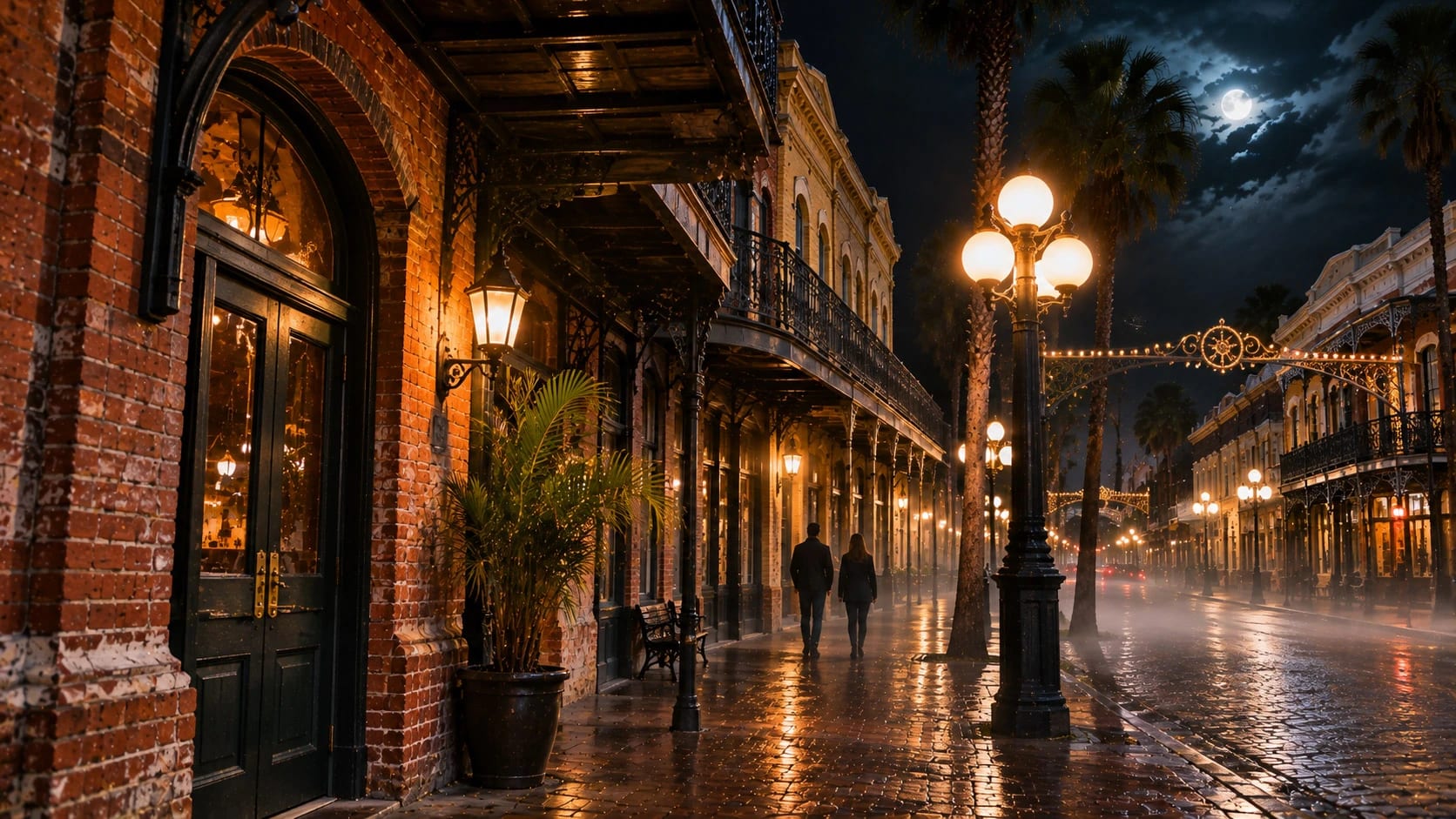
Explore Ybor City's Paranormal History
Haunted Ybor City
Discover why Ybor City is considered haunted: a cigar boomtown built by immigrants, scarred by fire and gangland violence, and full of social clubs with long memories.
Ybor City was built in a hurry by people chasing a better life, and it packed a century of ambition, labor, vice and loss into a few square blocks of brick. Cigar factories, immigrant social clubs and the bolita rackets all left their mark here. This is the history behind Tampa's most haunted neighborhood, and the stories people still tell about who never left.
Ghost Tours in Ybor City
The haunted places below are stops on Ghost City Tours' Ybor City ghost tours — guided walks where our local storytellers bring this history to life after dark.
Why Is Ybor City So Haunted?
Discover the dark history and supernatural forces that make Ybor City one of America's most haunted cities
Ybor City did not grow slowly. In 1885 cigar manufacturer Vicente Martinez-Ybor, working with fellow manufacturers and the Tampa Board of Trade, began laying out a company town on the edge of Tampa, which at the time had fewer than 1,000 residents. On April 13, 1886, the first Ybor City cigar came off the tables at Ignacio Haya's factory, and that same spring a great fire in Key West sent Cuban and Spanish cigar workers north looking for work. Tampa annexed the new town in 1887, and by 1888 Martinez-Ybor's three-story brick factory was the largest cigar factory in the world.
The town rose almost overnight. Construction of the first 176 worker cottages began in 1886, the same year the Ybor-Manrara factory opened as the district's first, and according to the National Park Service about 3,000 people were already rolling cigars by hand in the new factories that year. Gavino Gutierrez laid out the street grid, and by 1890 some 6,000 people lived in Ybor City, crowded into small wooden houses alongside factories that worked long hours in the Florida heat. Disease, accidents and fire were constant companions in a town built that fast.
The people who filled those factories came from Cuba, Spain and Italy, many of the Italians from a handful of villages in southwestern Sicily. They built their lives around mutual aid societies that served as clinic, theater, ballroom and safety net all at once, beginning with the Centro Español in 1891 and followed by Cuban, Italian and Afro-Cuban clubs. Members paid dues from every paycheck, and in return the clubs cared for them when they were sick and helped bury them when they died.
Ybor City was also the heart of the Cuban independence movement in exile. In 1893 José Martí delivered a widely reprinted speech from the steps of Martinez-Ybor's factory, and when he was killed in battle in Cuba in 1895, several volunteers from Tampa died in the same fighting. In 1898 Tampa became the main port of embarkation for American troops bound for the Spanish-American War, and the streets of Ybor filled with soldiers waiting to ship out.
Fire shaped the district as much as tobacco did. On March 1, 1908, a blaze broke out in a boarding house at 12th Avenue and 20th Street and, driven by a strong wind, swept across the neighborhood. Contemporary accounts collected by local historians describe some 18 blocks leveled, with 171 homes, 42 businesses and five cigar factories lost. The Cuban Club's own first building burned in 1916, and the members rebuilt on the same corner, completing the grand yellow-brick Círculo Cubano in 1917.
Between 1902 and 1929 Ybor City lived its golden age, and in 1929 Tampa's factories rolled roughly 500 million cigars. But underneath the success ran a second economy. Bolita, an illegal numbers game, spread through the saloons, and by 1927 there were more than 300 bolita houses in Ybor City. Charlie Wall turned the game into a major business in the late 1920s, and the rivalries that followed became a period of killings locals still call the "Era of Blood." Wall's rival Ignacio Antinori was gunned down in 1940, Santo Trafficante Sr. rose to lead the rackets, and Wall himself was murdered in Tampa in 1955.
Then the neighborhood emptied. The Depression collapsed demand for hand-rolled cigars, machines replaced workers, and the 1931 strike ended with the lectors, the readers employed on the rolling floors, removed from every factory. The 1962 embargo on Cuban tobacco hit hard, and in the 1960s urban renewal and Interstate 4 cut through the district, demolishing whole blocks and, in 1965, the Martí-Maceo club. By the late 1970s perhaps 1,000 people still lived in Ybor City. Empty factories and shuttered clubhouses are exactly the kind of places ghost stories take root.
No building in Ybor City carries more of those stories than the Cuban Club, which the Travel Channel once ranked among the most haunted buildings in the country. Guides and staff tell of an eight-year-old boy, usually called Jimmy, who is said to have wandered into the basement looking for his father and drowned in the old pool, where the cantina is now. They tell of an actor who took his own life on the theater stage in the 1920s, of a board member shot by another after an argument, and of a woman in white said to have been pushed from a balcony. In 2009 the television series Ghost Hunters investigated the building and tried to reach Jimmy with a flashlight.
The Cuban Club is far from alone. Locals and visitors talk about the Italian Club, the old cigar factories that now house offices and restaurants, and the bars along 7th Avenue, each with its own reputation for footsteps, voices and figures in rooms that should be empty. Some of these stories rest on documented history; others are local lore and firsthand accounts passed from staff to staff and guide to guide. On our walks past the factories and social clubs, our guides tell you which is which.
That is why Ybor City feels haunted. In barely a century it went from palmetto scrub to one of the great cigar-making centers in the world, through fire, revolution, gang war and near abandonment, and back to life as a National Historic Landmark District. The people who built it poured everything into these few blocks of brick, and when the weekend crowds thin out and the old streetlights come on, many visitors leave convinced that some of them are still here.
1885
Year Ybor City was founded
500M
Cigars rolled in Tampa at the 1929 peak
1917
Year the Cuban Club building was completed
Ybor City's Haunted Places: Coming Soon
We're writing up the story of each of Ybor City's haunted places. Until then, the best way to meet them is on one of our ghost tours.
Ready to Explore Ybor City's Dark Side?
Don't miss out on the #1 rated ghost tour experience in Ybor City. Book your adventure today!
Why Book With Ghost City Tours?
Multiple Tour Options
Choose from family-friendly, adults-only, or pub crawl experiences.
Top-Rated Experience
From the world's #1 ghost tour company.
Tours 7 Days a Week
Rain or shine, we run tours every single night of the year.
Money-Back Guarantee
Love your tour or get a full refund - that's our promise!
Tours Sell Out Daily
Ybor City is a popular destination. Book now to guarantee your spot!
Book Your Ghost Tour Today
Book Online Now
SAVE TIME- Choose from all available tour times
- Instant email confirmation
- Secure, encrypted checkout
- 100% Money Back Guarantee
Prefer to Call?
Our Guest Services team is available 7 days a week to help you book the perfect tour.
CALL 855-999-04917am - 11:30pm Daily