On the evening of April 12, 1934, a meeting inside Ybor City's Cuban Club descended into violence. Hundreds of people had gathered to discuss the dismissal of a club physician, a contentious issue in an organization where medical care was one of the most important benefits of membership. Arguments turned into a physical confrontation near the theater stage. Moments later, gunshots rang out.
A Cuban-born cigar maker named Belarmino Vallejo suffered a fatal wound. He died the following night. Although the shooting was investigated, authorities could not establish who had fired the weapon, and no murder charges resulted.
The death became part of the history of El Círculo Cubano, a magnificent yellow-brick clubhouse that had been the center of Cuban immigrant life in Tampa for decades. It also became entangled with the building's supernatural reputation. Today, stories of a murdered club official are told alongside those of a drowned child, a tragic young actor, and a woman who supposedly fell to her death from an upper-floor balcony.
Visitors have reported hearing voices in empty rooms, seeing figures in the theater, and encountering strange activity in the basement. Some people who have worked in the building believe that its former occupants have never entirely departed.
The Cuban Club has become one of the best-known haunted locations in Tampa, attracting paranormal investigators, television crews, and curious visitors from across the country. Yet its history is considerably more interesting than the supernatural stories alone. To understand why so many people believe the building is haunted, it helps to understand what the Cuban Club once meant to the people of Ybor City.
The History of El Círculo Cubano
A New Home for Tampa's Cuban Immigrants
In the late nineteenth century, Tampa was transformed by the cigar industry. When Vicente Martínez-Ybor established his cigar manufacturing operations in the area in the 1880s, workers arrived from Cuba, Spain, Italy, and other countries. Within a generation, Ybor City had become one of the most important cigar-manufacturing communities in the world.
Cuban immigrants were central to that transformation. Many had left their homeland during the political upheavals surrounding Cuba's struggle for independence from Spain. They brought their language, traditions, political convictions, and extraordinary skill in cigar making to Tampa. Factories provided employment, but building a new life in an unfamiliar country required more than a steady paycheck.
Illness could leave a family without income. Medical treatment was expensive, and workers had little protection against unemployment or disability. There were also practical difficulties associated with living in a community where English was not everyone's first language.
The immigrant mutual-aid societies that emerged in Ybor City attempted to address these problems.
In 1899, Cuban residents established a recreational organization known as El Club Nacional Cubano. By 1902, it had evolved into El Círculo Cubano, the Cuban Circle, a mutual-aid society dedicated to supporting the community.
Members paid dues that helped provide medical treatment, prescription medicine, recreational opportunities, and financial assistance. The organization eventually offered services ranging from English classes and library access to health care and death benefits.
Membership meant more than access to a social club. For many families, El Círculo Cubano offered a measure of security that would otherwise have been unavailable.
The society grew as Ybor City's cigar industry expanded. According to the University of South Florida's historical collections, membership eventually approached 8,000 people.
The Fire of 1916 and the Rebuilding of the Cuban Club
The Cuban Circle opened its first substantial clubhouse in 1907, at the corner of Fourteenth Street and Tenth Avenue. It included a large theater and became a gathering place for the city's Cuban population.
Then, in 1916, fire destroyed the building.
The loss was significant, but the membership quickly organized to replace it. Cuban workers contributed money to the rebuilding effort, and the project received support from prominent community figures, including a donation from Cuban president Mario García Menocal.
Construction began in 1917, and the replacement building was completed around 1917–1918. Designed by architects M. Leo Elliott and Bayar C. Bonfoey, the new Cuban Club was an imposing four-story structure built primarily of yellow brick in the Neoclassical style.
Its facade featured towering columns, decorative railings, and stained glass. Inside were elaborate tile floors, sweeping staircases, a theater, a grand ballroom, a library, a pharmacy, and a cantina.
The basement contained recreational facilities, including a gymnasium, bowling lanes, and a deep plunge pool made with Cuban marble. The building also had spaces for boxing, an enormously popular sport among the working-class residents of Ybor City.
For a community built around demanding factory work, the Cuban Club offered an unusual amount of recreation and cultural enrichment. Members attended dances, theatrical productions, concerts, meetings, and sporting events. The club welcomed performers who would become famous far beyond Tampa, including Cuban singers Benny Moré and Celia Cruz.
The grand ballroom, with its ornate ceiling and generous dancing space, became one of the most impressive gathering places in the neighborhood.
It was a building constructed through the collective efforts of people who wanted their families to have a better life.
A Hospital During the Influenza Pandemic
The Cuban Club also played an important role during one of the deadliest public-health emergencies of the twentieth century.
When the influenza pandemic reached Tampa in 1918, the clubhouse was temporarily converted into a hospital. Medical personnel cared for sick residents, including people who were not members of the society.
The arrangement was consistent with the club's original purpose. El Círculo Cubano had been established to help Cuban workers and their families survive hardship, and the influenza outbreak created an extraordinary demand for medical assistance.
Hillsborough County's historical records confirm the building's use as a temporary hospital during the pandemic. The records do not establish exactly how many patients were treated there or how many, if any, died inside the clubhouse.
Nevertheless, the episode became part of a long institutional history that connected the building with illness, recovery, and loss.
Years later, when the Cuban Club acquired its reputation for paranormal activity, some observers would point to its medical history as one possible reason for the large number of spirits supposedly associated with the property.
That explanation belongs to the building's supernatural folklore rather than its documented history. Its role during the influenza pandemic, however, is an established part of Ybor City's past.
The Ghosts of the Cuban Club
Stories of supernatural activity are associated with nearly every floor of the Cuban Club. Some concern identifiable areas of the building, while others describe former members whose lives allegedly ended in tragedy.
Over the years, these accounts have changed as different tour guides, employees, and paranormal investigators repeated them. Details such as names, dates, and causes of death are not always consistent.
The most frequently described spirits are those of a child called Jimmy, an actor named Victorio, a murdered club official, and a woman usually identified as Rosalita.
Little Jimmy: The Boy Who Haunts the Basement
One of the Cuban Club's most persistent ghost stories concerns a young boy named Jimmy.
According to local legend, Jimmy was approximately eight years old when he drowned in the clubhouse's basement swimming pool. Some retellings describe him as nine. The accident supposedly happened while the boy was swimming without supervision, although the exact year and circumstances remain unclear.
The swimming pool itself was real. Historical accounts of the clubhouse describe a deep marble plunge pool in the lower-level recreation facilities.
The pool is gone, but the area where it once stood has become closely associated with stories of a child's ghost.
Employees and visitors have reported hearing unexplained noises in the basement. Some accounts describe a child's voice or laughter, while others involve a small figure appearing briefly near the former pool area.
Anitra Turner, who worked as the Cuban Club's operations manager, described hearing whistling sounds while alone in the lower portion of the building. In a 2014 account of the clubhouse's hauntings, she also recalled greeting the supposed spirit of Jimmy when entering the cantina.
The story attracted national attention when investigators from the television series Ghost Hunters visited the building.
During the investigation, members of the team attempted to communicate with Jimmy using a flashlight. According to Turner's account, the light appeared to respond to questions by switching on and off. She believed the timing of those responses suggested that something unusual was happening.
The flashlight experiment did not establish the presence of a ghost. Such demonstrations are particularly susceptible to ordinary electrical and mechanical explanations. For Turner, however, the experience reinforced her belief that the building was home to something she could not readily explain.
Other paranormal investigators have reported photographs that appear to show a child's face in an upstairs window. The images have been interpreted by some as possible evidence of Jimmy's presence, although reflections and photographic artifacts offer alternative explanations.
Whether the drowning occurred as described remains uncertain. The Tampa Bay Times was unable to verify the child's death through the historical records it examined.
Even so, Jimmy remains one of the Cuban Club's most frequently discussed spirits, and stories about him continue to circulate among people familiar with the building.
Victorio: The Actor Who Never Left the Stage
The Cuban Club's theater is another location associated with unexplained activity.
With its large auditorium, decorative architecture, and long history of performances, the theater was once an important part of Ybor City's cultural life. Plays and musical productions brought audiences together, and the building's members took considerable pride in their entertainment facilities.
According to one of the club's most disturbing legends, a young actor named Victorio died by suicide inside the theater.
The most widely repeated version places the incident in 1919. Victorio, described as an aspiring playwright and performer, supposedly became overwhelmed with humiliation after forgetting his lines during a production.
Unable to recover from the experience, he allegedly took his own life on the stage where he had hoped to establish his reputation.
Another version tells a different story. In that account, an ambitious young actor became distraught after auditioning for an important production and receiving a minor role. The disappointment supposedly led to his death.
The circumstances of the alleged suicide differ substantially between tellings, and the event has not been independently established through contemporary newspaper reports or official records.
The haunting associated with Victorio, however, has developed a life of its own.
People working inside the theater have reported the sensation of being watched when the auditorium is empty. Others claim to have heard voices coming from the stage or unexplained sounds among the rows of seats.
A former Cuban Club president, Rolando Perez-Pedrero, spoke about the unsettling experience of closing the darkened theater. Although he did not claim to have witnessed a ghost himself, he acknowledged that the building could create the unmistakable impression that someone else was present.
In another account, a longtime maintenance worker reportedly saw an elderly man rise from a theater seat and walk through a wall. The experience was said to have frightened him enough that he left his position.
The theater's reputation became an important part of the Cuban Club's appearance on paranormal television. In Ghost Hunters, investigators explored the story of the deceased actor and attempted to determine whether the building's unusual activity had a supernatural explanation.
Whether Victorio was a real person whose death became distorted through retelling, or a fictional character who emerged from decades of local storytelling, remains unresolved.
His story has nevertheless become inseparable from the Cuban Club's haunted identity.
The Murdered Club Official: A Ghost Story With a Documented Death
Perhaps the most historically significant of the Cuban Club's supernatural stories concerns a violent dispute between members of the organization's leadership.
In the popular version, two members of the board of directors argued inside the clubhouse. One allegedly produced a gun and shot the other in the face, killing him.
The murdered man's spirit is said to wander the upper floors. Some visitors report seeing a figure near the former boardroom, while others have described an apparition with a badly damaged face.
Unlike several other Cuban Club ghost legends, this story appears to have originated from an actual fatal shooting.
On April 12, 1934, members gathered at the clubhouse to discuss the dismissal of a physician employed by the organization. The dispute became increasingly heated, and a confrontation developed involving club president Edward Valdez and another member, Belarmino Vallejo.
Contemporary reporting in The Tampa Tribune described a chaotic scene involving fighting near the theater stage. Vallejo was shot during the disturbance and later died at El Bien Público Clinic on April 13.
The circumstances were sufficiently confused that investigators had difficulty establishing exactly who was responsible.
Valdez was questioned, but authorities reported that they could not directly connect him with the gunfire. No charges were brought against him. The investigation did not identify a shooter whom prosecutors could hold responsible for Vallejo's death.
There is also an important difference between the historical event and the familiar ghost story.
Vallejo was not documented as having been shot in the face. Contemporary newspaper accounts described a wound to his torso.
That distinction matters because the image of a faceless or disfigured apparition has become one of the more sensational details repeated in stories about the clubhouse.
The historical record establishes that a man died following a violent confrontation in the building. It does not establish that his ghost has appeared there, nor does it support every detail subsequently incorporated into the legend.
Belarmino Vallejo was more than a figure in a ghost story. Born in Cuba in 1880, he came to Tampa and worked in the cigar industry. He married Lydia Martinez and became a member of the Cuban Club, the same organization intended to provide assistance and security to families like his.
His death during an internal dispute was a tragic event in the history of an institution founded on mutual support.
Nearly a century later, it remains one of the most unsettling documented episodes in the building's past.
Rosalita: The Woman in White and Red Shoes
The Cuban Club's grand ballroom has its own tragic legend.
According to the story, a young woman named Rosalita attended a dance at the clubhouse. She was an attractive and accomplished dancer who attracted the attention of a man attending the event.
The man repeatedly attempted to dance with her, but she refused his advances.
As the evening progressed, the encounter allegedly became increasingly threatening. Rosalita eventually went outside onto an upper-floor balcony, where the rejected man confronted her.
The confrontation ended, according to the legend, when he pushed her over the railing.
Rosalita fell to her death.
Her spirit is now said to appear throughout the upper floors of the Cuban Club, sometimes wearing a white dress and distinctive red high-heeled shoes.
Visitors have reported seeing a pale woman near the main staircase, while others claim to have encountered her near the ballroom or the building's balconies.
One paranormal investigation reportedly produced a recording in which a female voice seemed to claim ownership of a balcony. Investigators interpreted the voice as Rosalita, although such recordings cannot independently establish the identity or existence of a spirit.
The story has several inconsistencies.
Different accounts identify different balconies as the location of Rosalita's supposed death. The precise date of the incident is generally absent, and the Tampa Bay Times could not confirm a matching death through the historical records it reviewed.
Rosalita may be a ghost-story character whose identity developed over time, or her legend may preserve a distorted memory of an incident that has not yet been documented.
Either way, the image of a woman in white and red shoes has become one of the most recognizable elements of the Cuban Club's supernatural reputation.
Other Unexplained Activity at the Cuban Club
Not every reported haunting at the Cuban Club is connected to a particular tragedy.
People familiar with the building have described a variety of experiences that do not involve identifiable apparitions. Elevators have reportedly moved without anyone operating them, and doors have behaved unexpectedly. Other accounts involve footsteps, unexplained voices, and music coming from empty rooms.
In a 2017 interview with FOX 13 Tampa Bay, Jeff Hartzog, who was associated with the club's operation, described hearing elevators run by themselves and encountering doors that seemed to push back as he attempted to close them.
Patrick Manteiga, president of the Cuban Club Foundation, offered a similarly interesting perspective in an interview with journalist Paul Guzzo. Although Manteiga had not personally encountered a ghost, he said he knew people he considered credible who had reported being touched, hearing singing, or experiencing unexplained piano music inside the building.
These accounts differ from the dramatic stories of the drowned child or the murdered official. They concern smaller disturbances witnessed by people going about ordinary activities.
Old buildings can produce unexpected sounds, and electrical or mechanical systems may behave unpredictably. Nothing about an unexplained noise proves that a supernatural presence caused it.
Still, the Cuban Club's unusual reputation cannot be attributed solely to ghost-tour storytelling. The accounts include people who worked there, cared for the property, and spent considerable time inside its rooms.
Some remain convinced that they encountered something beyond an ordinary explanation.
The Cuban Club on Ghost Hunters
The Cuban Club's supernatural reputation eventually attracted the attention of national television producers.
In 2009, investigators from Ghost Hunters, the Syfy paranormal investigation series featuring The Atlantic Paranormal Society, examined the building's reported activity. The episode, titled "Club Dead," explored several of the clubhouse's best-known ghost stories.
The investigators focused on areas associated with the alleged deaths, including the theater and the former swimming-pool area.
The investigation helped introduce the Cuban Club to a much larger audience. By the following decade, the building was regularly mentioned in discussions of Tampa's most haunted locations and had become a recognized destination for paranormal enthusiasts.
The Cuban Club has also been associated with Travel Channel rankings of supposedly haunted American locations.
Such television appearances reflect the building's established reputation, although they do not constitute independent proof that the reported spirits exist.
The most meaningful distinction is between the documented history of the clubhouse, the personal experiences reported by witnesses, and the supernatural explanations offered for those experiences.
Each contributes to the Cuban Club's identity, but they are not interchangeable.
Is the Cuban Club Really Haunted?
The Cuban Club's own website acknowledges the building's haunted reputation while leaving visitors to form their own conclusions.
That position is understandable. Over more than a century, the building has been a social center, theater, athletic facility, medical center, and place of celebration. Its rooms have witnessed an extraordinary range of human experiences.
Some of the deaths frequently associated with the clubhouse remain unverified. The shooting of Belarmino Vallejo, on the other hand, is documented in contemporary newspaper reporting.
The building itself is undoubtedly historic. Added to the National Register of Historic Places in 1972, it remains one of the most important surviving landmarks from Ybor City's immigrant era.
After decades of declining membership and mounting maintenance needs, the Cuban Club Foundation took ownership of the building in 1991 and began the long process of preserving it. Restoration work has helped keep the structure in use as a venue for performances, weddings, and community events.
There are no longer cigar workers gathering for the same reasons their grandparents did. The mutual-aid system that helped support thousands of families has largely passed into history.
But the staircases, theater, ballroom, and decorated halls remain. So do the stories associated with them.
The question of whether the Cuban Club is haunted may never be resolved to everyone's satisfaction. What can be established is that this remarkable building has become a place where generations of Ybor City history continue to be remembered, debated, and retold.
And for some visitors, the experience of standing outside the old clubhouse after dark is enough to make those stories seem a little less distant.
Visit the Haunted Cuban Club in Ybor City
The Cuban Club is located at 2010 Avenida República de Cuba in Tampa's historic Ybor City neighborhood, a short distance from the restaurants, bars, and entertainment venues of Seventh Avenue.
The building continues to operate as an event and performing-arts venue. Public access to its interior is limited, and visitors should not assume that they can enter without attending an authorized event or arranging access.
Its exterior, however, remains one of Ybor City's most recognizable architectural landmarks.
For anyone interested in the darker stories of Tampa's historic cigar district, the Cuban Club is an essential part of the neighborhood's haunted history.
Ghost City Tours explores Ybor City's history through guided walking experiences, including The Ghosts of Ybor City Tour, an all-ages introduction to the neighborhood's immigrant history and supernatural legends, and The Darkness Between Us Ghost Tour, an adults-only exploration of the city's more disturbing past.
Our guides bring the streets, historic buildings, and people of Ybor City into focus through stories rooted in the neighborhood's extraordinary history.
You can explore these tales and more on one of our Ybor City Ghost Tours.
Whether the Cuban Club's ghosts are real or simply part of the folklore passed from one generation to the next, the building remains a compelling reminder that Ybor City's past is never very far away.
Historical References and Sources
1. Hillsborough County — Historical Markers: El Círculo Cubano
Hillsborough County — Historical Markers: El Círculo Cubano
Official historical account of the clubhouse, architecture, medical services, influenza pandemic, and preservation.
2. The Cuban Club — Official History
The Cuban Club — Official History
Club history, facilities, cultural activities, performers, and the reconstruction following the 1916 fire.
3. University of South Florida — El Círculo Cubano Archives
University of South Florida — El Círculo Cubano Archives
Historical collection documenting the development and significance of the Cuban mutual-aid society.
4. Ybor City Chamber of Commerce — Historic Social Clubs
Ybor City Chamber of Commerce — Historic Social Clubs
Historical overview of immigrant mutual-aid organizations, early clubhouse development, membership, and community activities.
5. The Tampa Tribune, April 14, 1934 — Belarmino Vallejo Shooting, reproduced by The Good Cemeterian
The Tampa Tribune, April 14, 1934 — Belarmino Vallejo Shooting, reproduced by The Good Cemeterian
Contemporary reporting on the fatal shooting, the dispute involving club leadership, and the subsequent investigation.
6. Tampa Bay Times / Tribune News Service — I Tried to Spend the Night in a Haunted Building
Tampa Bay Times / Tribune News Service — I Tried to Spend the Night in a Haunted Building
Reporting by Paul Guzzo on the club's supernatural reputation, eyewitness accounts, and discrepancies between its legends and verifiable deaths.
7. WUSF — A Tour of the Haunted Cuban Club
WUSF — A Tour of the Haunted Cuban Club
Public-radio reporting on the club's history and paranormal traditions.
8. FOX 13 Tampa Bay — The Haunts of the Cuban Club in Ybor City
FOX 13 Tampa Bay — The Haunts of the Cuban Club in Ybor City
Interviews and accounts concerning Little Jimmy, the theater, reported apparitions, and paranormal investigations.
9. FOX 13 Tampa Bay — The Cuban Club Is One of the Oldest Ybor Buildings and One of the Most Haunted
FOX 13 Tampa Bay — The Cuban Club Is One of the Oldest Ybor Buildings and One of the Most Haunted
Local accounts concerning Victorio, Rosalita, and the club's supernatural reputation.
10. Syfy — Ghost Hunters: Club Dead
Syfy — Ghost Hunters: Club Dead
Television investigation describing the reported hauntings of the theater, staircases, and former swimming-pool area.
11. Ybor City — Cuban Club Hosts Ghosts
Ybor City — Cuban Club Hosts Ghosts
Detailed interviews with people associated with the Cuban Club, including former staff members and leadership, concerning reported paranormal experiences.
12. The Cuban Club — Frequently Asked Questions
The Cuban Club — Frequently Asked Questions
Official visitor information, public-access guidance, and acknowledgment of the building's reputed hauntings.
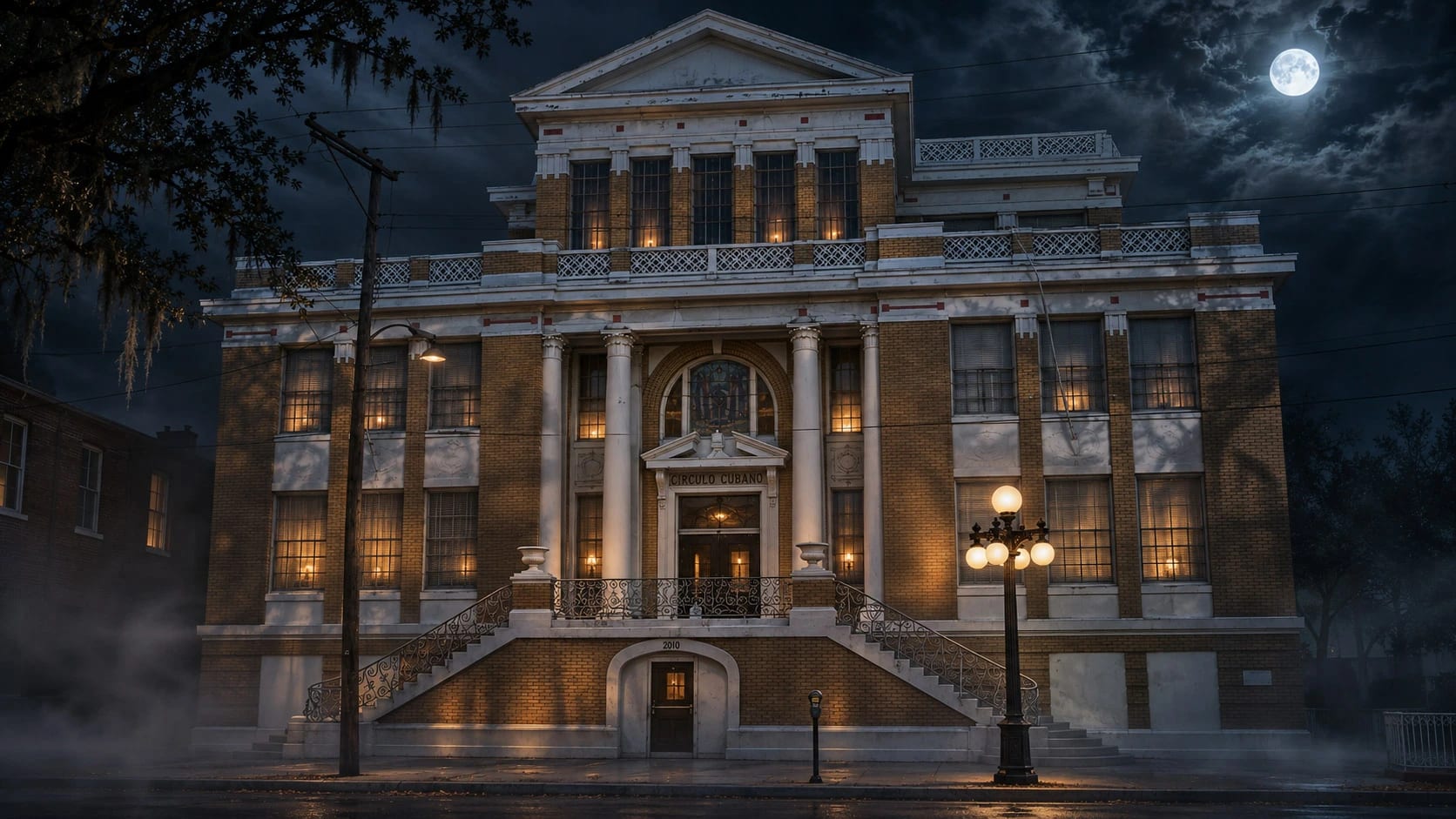
El Círculo Cubano, the Cuban Club, on Avenida República de Cuba in Ybor City


