There is an old story about the Florida Brewing Company in Ybor City that begins with a celebration and ends with a man being killed.
The brewery had just opened, and people were eager to see what was being advertised as one of the finest beer-making operations in the country. Beer was flowing, the crowd was enjoying itself, and somewhere during the festivities, two men got into an argument. One was Spanish, the other Cuban. The disagreement escalated into a fight, and by the time it was over, the Cuban man had suffered injuries that reportedly killed him.
His name has been lost to history, assuming the story happened as it has been told. There is no readily identifiable newspaper account confirming his death, and nobody seems to agree on precisely where inside the brewery the fight occurred.
What people do agree on is that something strange has been happening in the building ever since.
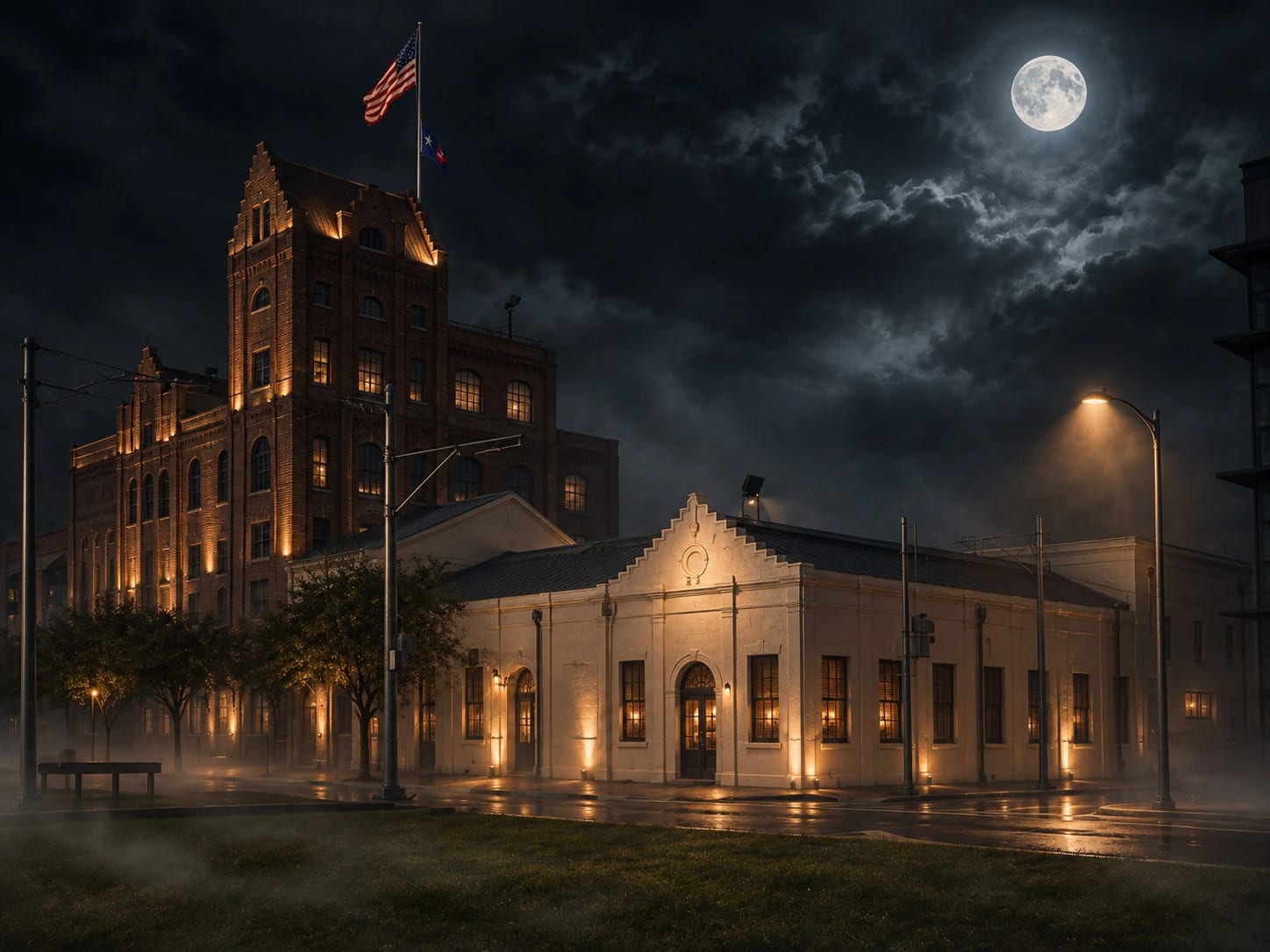
The old Florida Brewing Company building stands at 1234 East Fifth Avenue, near the western edge of Ybor City's historic district. It hasn't produced beer since 1961. Today, its thick brick walls enclose law offices, and the former manufacturing areas have been converted into working spaces. Most of the people who enter the building probably have no idea that it once housed Florida's first commercial brewery.
They probably don't know about the ghost, either.
Dale Swope, the Tampa attorney who purchased and restored the building, has spoken publicly about hearing an unexplained voice inside. On more than one occasion, he thought he could hear someone speaking Spanish from another room. He suspected a homeless person might have gotten inside, something that wouldn't have been especially surprising during the years the building stood abandoned.
But the source of the voice was never found. Wherever Swope went, it seemed to be coming from somewhere just beyond the wall.
In a 2019 interview with 83 Degrees Media, Swope admitted he wasn't particularly interested in ghosts. Still, he couldn't explain what he'd heard, and he was familiar with the story of the man supposedly killed during the brewery's opening celebration.
For a building that has survived Prohibition, a federal raid, the collapse of Tampa's brewing industry, and decades of abandonment, a ghost might seem like a relatively minor addition to its history.
Then again, there's something particularly unsettling about a voice that keeps speaking long after the person it supposedly belongs to has died.
The Florida Brewing Company Before It Was a Brewery
Government Spring and the Earliest Days of Tampa
Long before anyone thought of building a brewery on Fifth Avenue, the property was valuable for an entirely different reason.
There was fresh water beneath it.
A natural spring emerged near the present-day intersection of Fifth Avenue and Nuccio Parkway. The water had been used by Indigenous people before the arrival of American settlers, and by the early nineteenth century, it had become one of the most important sources of drinking water in the Tampa area.
When the United States Army established Fort Brooke in 1824, soldiers needed a dependable supply of fresh water. Tampa Bay's coastal environment offered plenty of water, but little of it was suitable for drinking.
The spring, which became known as Government Spring, solved that problem.
Military wagons traveled between the spring and Fort Brooke twice each day, transporting water back to the garrison. The route between the two locations became an important early road, connecting what would eventually become downtown Tampa with the land where Ybor City developed.
The water reportedly had a strong taste of iron and sulfur. It wasn't particularly pleasant, but it was plentiful, and that mattered more.
For decades, Government Spring supplied water to soldiers, settlers, and businesses in the growing community. Ownership of the surrounding property changed several times as Tampa expanded.
In 1882, the federal government transferred the spring property to Martha Brown, who subsequently sold it to her son-in-law, Captain John T. Lesley. Four years later, Cyrus Snodgrass acquired the site and established the Ybor City Ice Works.
The ice business was a natural fit. Tampa's heat made refrigeration valuable, and the spring supplied an important ingredient for manufacturing ice.
During the 1890s, the property also became home to the Ybor City Natatorium, a swimming and health resort. Historical accounts describe pools supplied by spring water, including a separate facility for African Americans, reflecting the segregation of the period.
The swimming facilities didn't last. By 1896, a group of businessmen had decided the property could be put to a considerably more profitable use.
Instead of using the water to cool people off, they were going to use it to make beer.
Vicente Martínez-Ybor Gets Into the Brewing Business
By the middle of the 1890s, Vicente Martínez-Ybor had already accomplished something extraordinary.
In less than a decade, he had helped transform an undeveloped area northeast of Tampa into one of the country's most important centers of cigar manufacturing.
Martínez-Ybor was born in Valencia, Spain, in 1818. His career in the cigar business had taken him to Cuba and later to Key West, where he operated a successful manufacturing enterprise. Labor difficulties, political unrest, and transportation limitations eventually convinced him to relocate.
He chose Tampa in 1885.
The decision changed the city's future. Martínez-Ybor built a massive cigar factory, encouraged other manufacturers to establish operations nearby, and helped develop housing and commercial properties for the workers who followed.
Thousands of immigrants arrived from Cuba, Spain, Italy, and other countries. Within a few years, Ybor City had its own stores, restaurants, saloons, boardinghouses, factories, and social organizations.
The neighborhood was growing quickly, and its residents were spending money.
Martínez-Ybor recognized that the cigar industry created opportunities for other businesses. He was involved in several ventures beyond manufacturing tobacco, including transportation, property development, and commercial services.
Beer was another opportunity.
The many saloons operating throughout Ybor City needed a reliable supply. Tampa's population was increasing, and the railroad and port offered access to markets well beyond Florida.
Yet there was no large commercial brewery in the area.
Martínez-Ybor and his business associate Eduardo Manrara joined other investors in organizing the Ybor City Brewing Company. They selected the Government Spring property, where a dependable supply of water and proximity to the railroad made the site attractive.
Construction began in 1896.
The brewery was an expensive undertaking, reportedly costing approximately $200,000. Its investors wanted a modern facility capable of competing with breweries in larger American cities.
They weren't interested in building a small neighborhood operation. They wanted to produce beer on an industrial scale and ship it throughout Florida and the Caribbean.
The timing was good. Ybor City was growing, Tampa's transportation connections were improving, and the market for beer was substantial.
The company would soon become known as the Florida Brewing Company.
Building Florida's First Commercial Brewery
The Florida Brewing Company was a remarkable building when it was completed.
Six stories tall, constructed of heavy brick masonry, and rising approximately seventy-five feet above the surrounding neighborhood, it dominated the area's industrial landscape.
At the time of its construction, it was described as the tallest building in Florida. It remains the tallest historic building in Ybor City.
Its appearance was unusual for Tampa.
The design was reportedly influenced by the Castle Brewery in Johannesburg, South Africa, a substantial industrial facility that represented modern brewing technology in the late nineteenth century.
The Florida brewery was built with thick interior walls, large manufacturing areas, and specialized equipment for processing, cooling, fermenting, and storing beer.
Unlike a modern brewery where much of the production process can be observed from a single room, the original facility was organized vertically. The building's height allowed various manufacturing activities to occupy different floors, taking advantage of gravity and the arrangement of industrial machinery.
Refrigeration was especially important.
Producing lager in Florida required controlling temperatures during fermentation and storage. The brewery incorporated an elaborate refrigeration system, and contemporary accounts described its technology as unusually advanced for American brewing.
The thick masonry walls helped separate areas requiring different temperatures.
These details would become important decades later, when the building's interior was converted into offices. Even after extensive restoration, parts of the old manufacturing arrangement remained recognizable.
The company also benefited from a workforce that understood beer production.
Although Ybor City is most closely associated with Cuban, Spanish, and Italian immigrants, the brewery employed a substantial number of German workers. Many had experience with the techniques used to produce traditional European-style beer.
Dale Swope later estimated that the business employed roughly eighty to ninety people during its early years.
The result was an industrial operation that looked somewhat out of place among Ybor City's cigar factories, but fit comfortably into the larger ambitions of the neighborhood.
The Grand Opening of 1897
Construction of the brewery began in 1896, and the company held its formal opening the following year.
Tampa historian Rodney Kite-Powell identifies February 15, 1897, as the date Florida's first commercial brewery opened. Other historical accounts refer to activities beginning in 1896, apparently reflecting the building's completion and the company's early operations.
The opening was an important occasion for Tampa.
A local brewery meant that saloons and restaurants could purchase beer manufactured close to home. The facility also gave the city another export industry at a time when businessmen were eager to diversify beyond cigar production.
The celebration reportedly attracted large crowds.
Beer was available, people were drinking, and the investors had reason to be pleased. They had completed a substantial industrial project and introduced a product that they hoped would become popular across the region.
According to one story, some people believed the brewery's water was so pure that the resulting beer wouldn't make them drunk.
That claim was nonsense, of course. But it became part of the folklore surrounding the opening celebration.
The party supposedly became rowdy, with some guests consuming considerably more beer than they should have.
And somewhere among the festivities, according to the legend, a confrontation turned deadly.
The Murder at the Florida Brewing Company
The story of the brewery's ghost is closely tied to that opening celebration.
Two men, one Spanish and the other Cuban, allegedly became involved in an argument after drinking. Different versions suggest the disagreement concerned beer, although no reliable account establishes what started the confrontation.
At some point, the argument became physical.
The Cuban man reportedly suffered a serious head injury during the fight. He either died at the brewery or succumbed to his injuries shortly afterward, depending on the version being told.
The story has circulated for years and was repeated by Dale Swope during his 2019 interview with 83 Degrees Media.
What makes the account frustrating from a historical perspective is the absence of a name.
The deceased man is usually identified only as Cuban. The other participant is described as Spanish. Neither man's identity is established, and there is no consistently reported date beyond the brewery's opening celebration.
If the incident occurred in February 1897, contemporary Tampa newspapers might contain an account of the death, but no matching report has been identified in the published sources examined here.
That leaves an important question unanswered: Was there an actual fatal confrontation at the brewery, or did the story develop later as an explanation for the strange experiences people reported inside the building?
It's entirely possible that the account preserves a genuine incident whose details have been distorted over time. It's also possible that the supposed murder became attached to the brewery long after it stopped producing beer.
Without stronger documentation, neither explanation can be established.
The ghost story, however, has remained remarkably consistent in one respect.
The spirit is said to be the Cuban man who died in the fight, and he has supposedly spent more than a century making his presence known inside the building.
The Drunken Ghost of the Old Brewery
According to local paranormal accounts, the murdered man has never stopped wandering the brewery.
Witnesses have described objects moving unexpectedly, brief disturbances in otherwise empty rooms, and the sensation of someone passing close by when no one is visible.
The most distinctive reports involve a man speaking Spanish.
Some versions of the legend describe the voice as agitated, as though the speaker is still arguing with someone. Others suggest the man sounds intoxicated and confused.
There are also stories of sudden movements of air, which witnesses interpret as the ghost walking past them.
The details are difficult to verify because many accounts have been repeated through ghost tours, paranormal websites, and local storytelling rather than documented in firsthand interviews.
But one account comes from someone who spent years inside the building and had little interest in presenting himself as a paranormal investigator.
That person was Dale Swope.
Dale Swope and the Spanish-Speaking Voice
When Dale Swope purchased the former brewery in the late 1990s, the building was in terrible condition.
The roof had partially collapsed. Windows had been broken or sealed, entire sections were filled with debris, and decades of neglect had left the structure barely recognizable as the impressive industrial facility it once was.
Restoring the building required extensive work.
Swope spent long hours at the property, sometimes remaining well into the evening while construction and restoration activities continued.
During those visits, he began hearing something he couldn't explain.
Someone appeared to be speaking Spanish.
The sound seemed to come from another room or from behind a wall. Swope initially assumed that a homeless person had entered the property, a reasonable explanation given the building's condition and history of unauthorized occupation.
He looked for the source.
But he never located anyone.
What bothered him was the way the voice seemed to remain just beyond his reach. It wasn't a distant sound coming from the street. He thought he was hearing someone nearby, inside the building itself.
In the 2019 83 Degrees Media interview, Swope described his experience and acknowledged that the brewery had a reputation for hauntings.
He didn't claim to have seen the ghost. He didn't suggest that he knew who was speaking or what the voice was saying.
He simply reported hearing a Spanish-speaking man when he couldn't find anyone who might have been responsible.
There are ordinary possibilities worth considering. The brewery is a large structure with thick walls and unusual interior spaces. Sound can travel through old buildings in unexpected ways, particularly where stairwells, ventilation openings, and adjoining rooms create complicated acoustics.
A voice originating outside might be audible inside without its location being obvious.
But Swope knew the building well, and the experience remained memorable enough that he discussed it publicly years later.
Whether he heard an ordinary sound or something less easily explained, his account gave the brewery's ghost story something most local legends lack: a named witness who could describe what happened.
Does the Ghost Still Haunt the Building?
There is no documented paranormal investigation establishing that the voice Swope heard belonged to a deceased brewery patron.
Nor is there sufficient evidence to connect other reported disturbances to the alleged opening-day death.
Still, the account has several unusual features.
The ghost is associated with a specific event in the building's early history. The supposed victim was Cuban, which gives the reports of Spanish speech an apparent connection to the legend.
The experiences also occurred decades after the brewery ceased operating, when the property was being restored for an entirely different purpose.
Whatever caused the sounds, they weren't part of ordinary brewing operations.
For people who believe in ghosts, the explanation is straightforward: a man killed during the brewery's first celebration never left.
The less supernatural explanation is that an old industrial building produced confusing sounds, which became associated with an existing legend.
Both interpretations have their supporters.
What is certain is that the ghost story has survived alongside the building itself, even as almost everything about its original purpose has changed.
La Tropical Beer and the Brewery's Rise to Success
The Florida Brewing Company wasn't simply a local novelty. It developed into one of the most successful beer producers in the region.
Its best-known product was La Tropical, a beer with deep connections to Cuba.
The original La Tropical brand had been established in Havana in the 1880s. When Cuban immigrants arrived in Tampa, they brought their tastes and familiar brands with them.
The families associated with Ybor City's development arranged to produce La Tropical under license at the Florida Brewing Company in 1897.
It proved to be a smart decision.
Ybor City had a large Cuban population, and La Tropical was already recognizable to many residents. Producing it locally allowed the brewery to serve the Tampa market while developing substantial exports to Cuba.
The company eventually became one of the most important beer exporters from the United States to the island.
According to historian Rodney Kite-Powell, the original brewery had the capacity to produce approximately 50,000 barrels annually and initially manufactured around 30,000. Later accounts place production during the company's most successful years as high as 80,000 barrels.
La Tropical became familiar throughout Florida and Cuba.
A photograph taken in 1936 shows the brewery with a large rooftop advertisement for the brand, a reminder of just how prominent the company had become.
The brewery's relationship with Ybor City's other businesses was particularly close.
The Columbia Restaurant, founded in 1905, began as a café and saloon associated with the neighborhood's cigar workers. Its early operations were closely connected to the beer trade, and local brewing history links the Columbia to the Florida Brewing Company.
This was a neighborhood where the cigar factories, restaurants, saloons, and breweries depended on one another.
Workers finished their shifts and gathered to eat, drink, discuss politics, and socialize. Beer was part of daily life, especially among immigrants familiar with European and Cuban drinking traditions.
The Florida Brewing Company helped supply that demand.
It also became part of a larger international trade network connecting Tampa with Havana and other Caribbean markets.
The Spanish-American War Brings Thousands of Soldiers to Tampa
In 1898, only a year after the brewery's formal opening, Tampa became a major staging area for American forces preparing to fight in the Spanish-American War.
Thousands of soldiers arrived in the city.
Among them was Theodore Roosevelt, who had resigned his position as Assistant Secretary of the Navy and helped organize the volunteer cavalry regiment that became famous as the Rough Riders.
Tampa's railroad facilities and proximity to Cuba made it an important departure point for American troops.
The sudden arrival of military personnel transformed the city.
Hotels filled, restaurants became busy, and local merchants found themselves serving a population far larger than usual.
The brewery benefited from the influx.
Historical accounts describe increased production during the military buildup, when thousands of soldiers stationed in and around Tampa created additional demand for beer.
There is an irony in that situation.
A brewery founded partly by Cuban and Spanish businessmen was supplying beer to soldiers preparing to fight Spain in Cuba, while many of Ybor City's Cuban residents had spent years supporting the island's struggle for independence.
Ybor City had been an important center of Cuban revolutionary activity. José Martí visited the neighborhood several times during the early 1890s, organizing support and raising money for the independence movement.
The brewing business existed within the same complicated political environment.
The war eventually ended with Spain losing control of Cuba, but the economic relationship between Tampa and the island continued.
For the Florida Brewing Company, Cuba remained one of its most valuable markets for decades.
Prohibition and the Brewery's Criminal Connections
The brewery's greatest challenge arrived in the early twentieth century.
Florida adopted statewide Prohibition in 1918, two years before the federal prohibition of alcoholic beverages took effect in January 1920.
For businesses that manufactured beer, the new laws threatened their entire economic model.
Breweries across the country closed or attempted to survive by producing alternative beverages. Some manufactured soft drinks, malt products, or other goods that could legally be sold.
The Florida Brewing Company also adapted, although accounts of its activities during Prohibition are complicated by allegations that beer production continued illegally.
Local historical sources describe the business manufacturing soft drinks while maintaining at least some production associated with alcohol.
Other accounts suggest that the brewery continued supplying beer to customers despite the legal restrictions.
In 1928, Salvador Martínez-Ybor, a member of the family associated with the brewery, was reportedly sentenced to six months in jail for illegally distributing alcoholic beverages.
That case provides a documented connection between the brewery's business interests and Prohibition-era violations.
But another story is considerably harder to prove.
It involves one of Ybor City's most notorious organized-crime figures and a secret tunnel supposedly constructed beneath the brewery.
Charlie Wall and the Underground Beer Tunnel
Charlie Wall was one of the most influential figures in Tampa's criminal underworld during the early twentieth century.
His power came largely from gambling, especially bolita, an illegal lottery that became enormously popular in Tampa's immigrant neighborhoods.
Wall's organization operated in a city where corruption, political influence, and criminal enterprise frequently overlapped.
He was wealthy, connected, and feared.
According to a story associated with the Florida Brewing Company, Wall helped construct or use a tunnel that connected the brewery to a nearby hotel.
The passage supposedly allowed beer to be moved underground during Prohibition, avoiding attention from law enforcement.
It's a fascinating story, particularly because Ybor City really does have underground tunnels.
The problem is that the existence of those tunnels doesn't establish the involvement of Charlie Wall, or prove they were used to smuggle beer from the brewery.
The account has been repeated in historical reporting, but remains a theory rather than an established fact.
Still, the idea isn't entirely unreasonable given Tampa's Prohibition-era criminal activity.
The city had a reputation for illegal gambling, bootlegging, and widespread political corruption. Criminal organizations operated openly enough that historians have questioned whether elaborate underground smuggling routes would even have been necessary.
In other words, beer could often be distributed illegally without anybody bothering to dig a tunnel.
That hasn't stopped people from connecting the brewery to the underground passages.
The Tunnels Beneath Ybor City Are Real
In November 2018, construction crews working near East Sixth Avenue and Twelfth Street discovered an underground tunnel.
The discovery attracted immediate attention because stories about tunnels beneath Ybor City had circulated for decades.
Architect Gerry Curts, whose firm occupied a nearby building, confirmed that his property contained access to another tunnel. Researchers and historians began examining the passages and attempting to determine their original purpose.
Some were substantial enough for a person to walk through while bent over.
The University of South Florida's Center for Digital Heritage later documented portions of the system using laser-scanning technology, creating three-dimensional records of the underground structures.
Researchers also located a spring associated with the old system, adding another connection to Ybor City's early industrial development.
The discoveries confirmed that at least some of the underground passages described in local stories actually existed.
Their purpose was another matter.
Historian Rodney Kite-Powell has suggested that certain tunnels were probably built as part of an early sewer or drainage system. Others may have served commercial or utility purposes.
Some people continue to believe the passages were used for smuggling alcohol or moving money between businesses.
The evidence remains incomplete, and not every tunnel necessarily served the same purpose.
The old brewery's location near Government Spring, former bottling facilities, and historic industrial properties makes the surrounding area especially interesting.
It does not, however, prove that Charlie Wall constructed a secret passage beneath the Florida Brewing Company.
The story remains one of Ybor City's more compelling Prohibition legends.
And when it comes to the city's reputation for haunted locations, an old brewery with a murdered man's ghost and suspected bootlegging tunnels is about as good a combination as a ghost storyteller could hope for.
The Brewery Reopens After Prohibition
When national Prohibition ended in 1933, the building returned to its original industry.
Operating as the Tampa Florida Brewery, it resumed the production of beer for a market that had changed considerably since the company's founding.
La Tropical remained its best-known product.
The beer was available in several varieties, including lager, ale, and bock. It continued to be sold throughout Florida and exported to Cuba.
The brewery also faced competition from Southern Brewing Company, another Tampa producer whose brands included Silver Bar.
For several decades, the two businesses represented a substantial portion of the area's beer-manufacturing industry.
The Tampa Florida Brewery survived the Great Depression, World War II, and the difficult economic conditions that followed.
But the company was operating in an increasingly competitive market.
Large national breweries had advantages that smaller regional producers struggled to match. Their production methods were more efficient, their advertising budgets were substantially larger, and their distribution networks reached across the country.
During the 1950s, those companies began moving into Tampa.
Schlitz established a major brewing operation in the area, followed by Anheuser-Busch, whose enormous Tampa facility was capable of manufacturing beer on a scale the old Ybor City brewery could never equal.
The difference was dramatic.
A comparison published by historian Rodney Kite-Powell illustrates the problem. Anheuser-Busch's Tampa operation could produce approximately 1,000 cans of beer per minute with a single employee operating the machinery, while La Tropical's operation required three workers to produce roughly 250 cans in the same period.
The old brewery's equipment simply couldn't compete.
Then the company lost a market that had been central to its success for generations.
The Cuban Revolution and the End of the Brewery
Fidel Castro's revolution in Cuba in 1959 transformed the political and economic relationship between the island and the United States.
Trade restrictions imposed by the American government soon disrupted commercial relationships that had existed for decades.
For the Tampa Florida Brewery, Cuba wasn't merely another export destination. It had been one of the company's most important markets since the nineteenth century.
Losing access to Cuban customers created a serious problem at the worst possible time.
The brewery was already struggling against larger competitors with newer equipment and lower manufacturing costs.
Its historic building, which had once represented the height of brewing technology, had become increasingly expensive to operate.
In 1961, the company stopped producing beer.
The closure ended approximately sixty-five years of brewing at the site.
A business that had survived two world wars, Prohibition, the Great Depression, and generations of economic change could no longer compete.
The machinery went silent.
For the first time since the 1890s, the enormous brick building on Fifth Avenue had no beer to produce.
Its future was uncertain.
The Brewery Becomes a Tobacco Warehouse and Fallout Shelter
The old factory didn't immediately disappear after brewing operations ended.
Corral-Wodiska & Company, a cigar manufacturer, took over portions of the building and used them to store tobacco.
The property was well suited for storage because of its thick masonry walls and substantial interior spaces.
Some windows were sealed with brick to help control conditions inside.
The alterations gave the building a much more forbidding appearance. Sections that had once received natural light became enclosed industrial rooms.
During the Cold War, the property also became associated with plans for a fallout shelter.
The Cuban Missile Crisis of 1962 had brought the possibility of nuclear conflict frighteningly close to Florida. Tampa's location and military importance made civil-defense planning a serious concern.
The brewery's heavy construction and enclosed interior spaces made it a candidate for shelter use.
Supplies from that period were later discovered during the building's restoration.
Eventually, however, even these secondary uses ended.
The property fell into disrepair.
Broken windows, deteriorating masonry, and roof damage gradually transformed the once-proud brewery into one of Ybor City's most visible abandoned landmarks.
For years, it stood as a reminder of how much the neighborhood had lost.
The cigar industry had declined. Interstate construction and urban renewal had destroyed portions of the historic district. Businesses closed, residents moved away, and many of the buildings that survived were left empty.
The Florida Brewing Company was one of them.
Its enormous size made the problem worse.
Restoring a six-story nineteenth-century industrial building would require substantial money and expertise. Demolition would have been easier.
As the decades passed, the structure became increasingly dangerous.
People entered without permission, windows were broken, and piles of debris accumulated inside. Large portions of the roof deteriorated, exposing the interior to rain and further damage.
By the 1990s, the building had become an eyesore.
It was also one of the most historically significant structures remaining in Ybor City.
Saving the Old Florida Brewing Company
Dale Swope remembered the brewery from his childhood.
Growing up in Tampa, he had seen the enormous building towering over the surrounding neighborhood. Even in its declining condition, it was difficult to ignore.
In 1999, Swope and contractor Joseph Kokolakis purchased the property with the intention of restoring it.
The project was ambitious.
The building had been neglected for decades, and the damage extended throughout the structure. Windows were missing, parts of the roof had collapsed, and entire rooms were filled with trash.
Architect Stephanie Gaines oversaw the restoration design, while the new owners worked to preserve as much of the building's original character as possible.
The renovation took approximately two and a half years.
Workers removed enormous quantities of debris, reconstructed damaged areas, and repaired the brick exterior.
The building's distinctive tower was restored.
Its interior was adapted for modern offices, but the restoration retained important features from its industrial past.
Old iron rails, exposed structural elements, and portions of the brewery's original construction remained visible.
In some areas, the concrete contained fragments of glass bottles that had been incorporated into the building's materials decades earlier.
The workers also found objects left behind by previous occupants.
There were old beer bottles, cigar boxes, wrappers, advertisements, and supplies associated with the Cold War shelter.
Each discovery provided another small piece of the building's history.
The former brewery wasn't simply being renovated. Much of its past was being recovered as the work progressed.
A Remarkable Date in the Building's History
On September 10, 2001, Swope's law firm moved into the restored brewery.
The date was significant for an entirely unexpected reason.
The following morning, the September 11 terrorist attacks changed the country.
After decades as an abandoned industrial building, the old brewery had reopened just one day before one of the defining events of modern American history.
The coincidence is one of the more unusual details in the building's long story.
The restoration was eventually recognized for its successful adaptation of a historic industrial property. It helped demonstrate that Ybor City's deteriorating buildings could be preserved and returned to productive use.
Today, the former brewery remains a prominent feature of the historic district.
Its offices are occupied by legal professionals rather than brewers, and the building no longer serves the same purpose it did when Martínez-Ybor and Manrara financed its construction.
Much of the original structure, however, remains.
The thick walls, unusual arrangement of rooms, and imposing exterior still reflect the building's nineteenth-century origins.
And somewhere inside those walls, according to the local legend, a Cuban man may still be arguing about beer.
Is the Florida Brewing Company Really Haunted?
The Florida Brewing Company has a better-documented history than many of the supposedly haunted buildings in Ybor City.
Its construction, business operations, association with Government Spring, role in Tampa's brewing industry, closure, and eventual restoration are all supported by historical records.
The underground tunnels in the surrounding neighborhood are real, too, although their original purposes remain the subject of debate.
The ghost story is considerably less certain.
There is no verified identification of the Cuban man supposedly killed at the brewery's opening celebration.
His name, age, occupation, and burial location are unknown. No independently confirmed death record has been connected to the incident.
The strongest firsthand paranormal account comes from Dale Swope, who described hearing a Spanish-speaking voice while spending time inside the building.
Other reported disturbances include moving objects, strange sensations, and sounds that witnesses have associated with the alleged ghost.
But those reports are not evidence that a murder occurred or that the victim remains in the building.
That distinction matters, especially in a neighborhood where historical events and supernatural stories have been repeated together for generations.
Ybor City has plenty of genuine violence in its history. Its criminal organizations, labor disputes, political confrontations, and gangland killings are documented. There is no need to invent deaths to make the neighborhood interesting.
In the case of the old brewery, the alleged murder may eventually be verified through historical newspaper research. Until then, it belongs to local folklore.
Swope's experience is a different matter. We know who reported hearing the voice, where it happened, and what he believed he heard.
We don't know what caused it.
Perhaps someone really had entered the property without his knowledge. Maybe the sound traveled through the building in an unexpected way.
Or perhaps the old story about the Cuban man has persisted for more than a century because people continue to encounter something they can't explain.
There isn't enough evidence to settle the question.
And that uncertainty is part of what makes the brewery worth discussing.
Visiting the Haunted Florida Brewing Company in Ybor City
The historic Florida Brewing Company building is located at 1234 East Fifth Avenue, Tampa, Florida, near Nuccio Parkway and the western edge of Ybor City's historic district.
The six-story brick structure is one of the most recognizable historic buildings in the neighborhood.
Although the brewery closed in 1961, its exterior has been preserved, and the property continues to serve as professional office space.
It is not a working brewery, public bar, or open paranormal attraction. Visitors can see the building from public streets and sidewalks, but should not enter private areas without permission.
The old Government Spring site is nearby, and the surrounding streets contain numerous reminders of Tampa's industrial and immigrant history.
The location also sits within a short distance of several other historic Ybor City landmarks, including former cigar factories, commercial buildings, and properties associated with the neighborhood's organized-crime era.
For anyone interested in Tampa's haunted history, the Florida Brewing Company is an especially interesting place because its stories extend well beyond the alleged ghost.
The building witnessed the rise of Ybor City, the growth of Florida's brewing industry, the consequences of Prohibition, and the neighborhood's long economic decline.
It nearly disappeared before being restored.
And its reputed haunting has survived every change.
Explore the Haunted History of Ybor City
The old Florida Brewing Company is only one of the buildings in Ybor City with an unusual past.
The neighborhood is filled with places where documented history and ghost stories have become closely connected. Former immigrant social clubs, historic theaters, cigar factories, and bars all have stories worth hearing.
Ghost City Tours explores those stories through guided nighttime walking tours of the historic district.
Our Ghosts of Ybor City Tour introduces guests of all ages to the immigrants, businesses, and historic buildings that created the neighborhood, along with the ghost stories that have developed around them.
For visitors interested in a darker experience, The Darkness Between Us Ghost Tour explores Ybor City's organized-crime history, illegal gambling, violence, and more disturbing supernatural legends.
Both tours focus on the people and events behind the stories. After all, even the strangest haunting usually begins with something that happened to someone.
Learn more about our Ybor City Ghost Tours and discover the history that still occupies Tampa's old cigar district.
Frequently Asked Questions About the Haunted Florida Brewing Company
Where is the haunted Florida Brewing Company?
The former Florida Brewing Company is located at 1234 East Fifth Avenue in Ybor City, Tampa, Florida. The restored building is occupied by professional offices and is visible from surrounding public streets.
Who is the ghost of the Florida Brewing Company?
According to local legend, the ghost is a Cuban man who died after fighting with a Spanish man during the brewery's opening celebration in the 1890s. His identity has not been verified, and reliable documentation confirming the alleged death has not been established.
What paranormal activity has been reported at the brewery?
The most notable firsthand account comes from attorney Dale Swope, who reported hearing an unexplained Spanish-speaking voice while working inside the building. Other local stories describe objects moving, unusual sounds, and the sensation of someone passing nearby.
When did the Florida Brewing Company open?
Construction began in 1896, and historian Rodney Kite-Powell identifies February 15, 1897, as the company's formal opening date. It became Florida's first commercial brewery.
Is the Florida Brewing Company still operating?
No. The brewery ceased producing beer in 1961 after facing competition from national brewing companies and losing important export business with Cuba. The historic building was restored in 2001 and now serves as professional office space.
Are there tunnels beneath the Florida Brewing Company?
Underground tunnels have been documented in the area surrounding the former brewery. Local legends connect them with Prohibition-era bootlegging and organized crime, although historians have suggested that some passages were originally constructed for sewage, drainage, or other commercial purposes. Their precise history remains uncertain.
Historical References and Sources
1. 83 Degrees Media — Former Ybor City Brewery Mixes Past With Future in Tampa
83 Degrees Media — Former Ybor City Brewery Mixes Past With Future in Tampa
Joshua McMorrow-Hernandez, February 19, 2019. The most important source for the brewery's ghost stories, including an interview with Dale Swope about the alleged opening-day death, the Spanish-speaking voice, and the history of the restoration. Also covers the brewery's architecture, workforce, brewing technology, and connections to Prohibition.
2. Swope Rodante — Our History
Official account from the law firm occupying the former brewery. Documents the founding of the company, the Government Spring, the brewery's industrial history, its closure in 1961, and the restoration completed in 2001.
3. Tampa Magazine — Tampa Bay's Craft Brewing Industry
Tampa Magazine — Tampa Bay's Craft Brewing Industry
Rodney Kite-Powell, June 25, 2024. Detailed historical research on the founding of the Florida Brewing Company, the February 15, 1897 opening date, production capacity, Prohibition, La Tropical, and competition from national breweries.
4. AIA Tampa Bay — Architecture of Tampa Bay: Swope Rodante
AIA Tampa Bay — Architecture of Tampa Bay: Swope Rodante
Architectural history of the former brewery, including its 1896 construction, industrial design, role in early Tampa commerce, later use as a tobacco warehouse, and restoration.
5. Old Tampa Photos — Florida Brewing Company, 1234 East Fifth Avenue
Old Tampa Photos — Florida Brewing Company, 1234 East Fifth Avenue
Historical photographs from the Burgert Brothers collection and research describing the brewery, its La Tropical brand, connections to Government Spring, Prohibition, and later uses.
6. Historical Marker Database — Old Government Spring
Historical Marker Database — Old Government Spring
Transcription and photographs of the historical marker documenting the spring's use by Indigenous people, Fort Brooke, the Ybor City Ice Works, the natatorium, and the Florida Brewing Company.
7. Library of Congress — Birth of Ybor City, the Cigar Capital of the World
Library of Congress — Birth of Ybor City, the Cigar Capital of the World
Historical background concerning Vicente Martínez-Ybor, the creation of Ybor City, the cigar industry, immigrant settlement, and commercial development.
8. Florida State Parks — Ybor City Museum State Park History
Florida State Parks — Ybor City Museum State Park History
Historical overview of Ybor City's founding, immigrant communities, cigar factories, and economic decline.
9. WUSF — Craft Beer and Its Ties to Tampa's Rich History
WUSF — Craft Beer and Its Ties to Tampa's Rich History
October 31, 2025. Interview with Jeff Houck about the Florida Brewing Company, its relationship with the Columbia Restaurant, La Tropical beer, and Tampa's brewing traditions.
10. FOX 13 Tampa Bay — Famous Beer Brewed in Tampa More Than a Century Ago Makes Comeback
FOX 13 Tampa Bay — Famous Beer Brewed in Tampa More Than a Century Ago Makes Comeback
October 18, 2022. Reporting on the origins of La Tropical in Cuba, its licensed production in Ybor City beginning in 1897, and the brand's modern revival.
11. Creative Loafing Tampa — Tampa Bay Brewers and Bartenders Share Their Secrets
Creative Loafing Tampa — Tampa Bay Brewers and Bartenders Share Their Secrets
Historical background on the Florida Brewing Company, including its founding and a reference to Salvador Martínez-Ybor's 1928 conviction for illegally distributing alcoholic beverages.
12. FOX 13 Tampa Bay — Tunnels Under Ybor City Streets Lead to Historical Mystery
FOX 13 Tampa Bay — Tunnels Under Ybor City Streets Lead to Historical Mystery
November 22, 2018. Reporting on the discovery of underground tunnels near the old brewery, including commentary from historian Gary Mormino and architect Gerry Curts.
13. Spectrum Bay News 9 — Underground Tunnel Discovered in Ybor City
Spectrum Bay News 9 — Underground Tunnel Discovered in Ybor City
November 24, 2018. Documentation of the tunnel discovered near East Sixth Avenue and Twelfth Street and the ongoing debate about the underground system's purpose.
14. WKMG News 6 — Secret Tunnels Exist Below This Florida City
WKMG News 6 — Secret Tunnels Exist Below This Florida City
June 5, 2024. Interviews with University of South Florida researchers and historian Rodney Kite-Powell concerning the mapping of Ybor City's tunnels, their possible use as sewers, and disputed connections to organized crime.
15. City of Tampa — Ybor City History
City of Tampa — Ybor City History
Official historical background on the district's founding, immigrant population, cigar manufacturing, urban decline, and revitalization.
The former Florida Brewing Company at 1234 East Fifth Avenue, Florida's first commercial brewery