There's an old safe inside the Centro Español building in Ybor City, and according to local ghost stories, at least one man died because of it.
The most commonly repeated version takes place in 1908. A man was attempting to break into the safe when something went wrong, leaving him dead inside the Spanish social club. His spirit supposedly remains near the heavy iron safe, unwilling or unable to leave the place where his life ended.
Another version is considerably more disturbing.
In that account, eighteen men were meeting behind closed doors when a fire broke out. Among them were influential city officials and men connected with Tampa's criminal underworld. They had moved a large safe in front of the door to prevent anyone from entering, but when the fire spread, they discovered they couldn't move it out of the way.
Trapped inside, the men desperately attempted to escape. One reportedly fired a gun at the safe, leaving a bullet hole in its metal casing. None survived.
The safe is said to remain inside the building, and people working nearby have reported hearing screams coming from rooms where nobody should be.
It's a frightening story. There's also a serious problem with it.
The Centro Español building standing on Seventh Avenue today wasn't constructed until 1912, four years after the alleged incident. The organization did have an earlier clubhouse on the same property, so the date alone doesn't make the entire story impossible. But the accounts of a single dead burglar and eighteen men killed in a fire are difficult to reconcile, and no reliable contemporary documentation has been identified to establish either version.
That hasn't stopped the story from spreading.
In October 2023, FOX 13 Tampa Bay featured the haunted safe during a report about paranormal tours of Ybor City. The reporter visited the building with a local ghost-tour operator who described the spirit of a man killed while attempting to break into it.
Other accounts go beyond the safe.
Former restaurant employees have described being shoved by something they couldn't see. A woman wearing a long white dress has reportedly appeared in an upstairs dining area, only to disappear moments later. Doors have supposedly opened by themselves, and one restaurant owner claimed she was struck hard enough to leave bruises.
For a building originally intended to provide a safe gathering place for Tampa's Spanish immigrants, it has developed a surprisingly unsettling reputation.
The stories are intriguing on their own. But the history of El Centro Español de Tampa is worth exploring in considerably more detail, because the organization that occupied this building helped shape nearly every aspect of Ybor City's early development.
Its members established hospitals, built theaters, organized political discussions, provided medical care, and created a support system for families who had arrived in Florida with little more than the hope of finding work.
And when the Spanish Club's original purpose began disappearing, the building nearly disappeared with it.
The Founding of El Centro Español de Tampa
Spanish Immigrants Arrive in Ybor City
During the 1880s, Tampa was undergoing a transformation that few people could have predicted.
For much of the nineteenth century, the city had been a relatively small settlement along Florida's Gulf Coast. Its economic opportunities were limited, and its population was modest compared with established cities farther north.
Then Vicente Martínez-Ybor arrived.
Martínez-Ybor was a Spanish-born cigar manufacturer who had operated businesses in Cuba and Key West. Problems involving labor, transportation, and political instability convinced him to relocate his manufacturing operations.
In 1885, he selected land northeast of Tampa for a new cigar-making community.
The following year, the first major factory began operating, and workers started arriving.
Many were Cubans with experience rolling cigars by hand. Others came from Spain, Italy, and various parts of the Caribbean. Within a few years, the neighborhood had become one of the most important centers of cigar production in the country.
Employment was available, but life wasn't necessarily easy.
Workers who left their home countries encountered a community where the language, laws, and customs could be unfamiliar. Medical care was expensive, and a serious illness could eliminate an entire family's income.
There were few institutions prepared to help immigrant families adapt.
Some residents struggled with English. Others had difficulty navigating American business practices or obtaining assistance when they were injured.
Tampa's Spanish immigrants quickly realized they would have to create their own support systems.
They did exactly that.
September 7, 1891: The Spanish Club Is Born
On September 7, 1891, a group of Spanish immigrants chartered El Centro Español de Tampa.
The organization became Ybor City's first Latin social club, predating the Cuban Club, Italian Club, and Centro Asturiano.
Its original membership included 186 charter members who helped finance the organization by pledging $10 each.
That might not sound like much today, but ten dollars represented a meaningful contribution for a working-class immigrant during the late nineteenth century.
The purpose of the organization was straightforward.
Spanish immigrants wanted a place where they could gather, socialize, preserve their cultural traditions, and help one another during difficult times.
The club also provided something less tangible but equally important: a connection to home.
A worker who had spent the day rolling cigars could visit the Centro Español, speak Spanish, play cards, enjoy familiar food, and spend time with people who understood the circumstances that had brought him to Tampa.
The organization developed educational programs, recreational activities, and eventually substantial health-care benefits.
Over time, membership provided access to medical treatment, entertainment, educational opportunities, and burial assistance.
The Spanish Club became part social institution, part insurance organization, and part extended family.
For thousands of people, it provided services that modern Americans generally expect from employers, insurance companies, hospitals, or government programs.
Its importance was difficult to overstate.
The First Clubhouse Opens in 1892
The society needed somewhere to meet.
Ignacio Haya, another prominent figure in Tampa's early cigar industry, helped make that possible by purchasing land near the intersection of Seventh Avenue and Sixteenth Street.
A clubhouse was constructed on the property, opening in June 1892.
The first building was considerably smaller than the elaborate brick structure visitors see today, but it offered many of the same amenities that would eventually make the Spanish Club famous.
Members could attend dances, watch theatrical performances, gather in recreational areas, and participate in educational programs.
The clubhouse included spaces for socializing and entertainment, which quickly became important to Ybor City's growing Spanish community.
Families gathered for celebrations, workers discussed events in Spain and Cuba, and the organization gradually became an important part of neighborhood life.
This original building is also important to understanding the club's ghost stories.
It was standing in 1908, when the alleged safe incident supposedly occurred.
Whether the safe now associated with the haunting originated in the earlier clubhouse is another question. Historical records have not established its provenance.
But the organization itself was already seventeen years old by the time the ghost story supposedly took place.
The Spanish Club and Cuba's Fight for Independence
The history of El Centro Español becomes especially interesting when the political situation in Cuba is taken into account.
Ybor City was home to thousands of Cuban immigrants during the years leading up to the Spanish-American War.
Many supported Cuban independence from Spain.
Others had strong connections to Spain and opposed the independence movement, particularly when it threatened their national identity or business interests.
Those disagreements weren't limited to political meetings. They affected friendships, social organizations, workplaces, and relationships between families.
The Cuban revolutionary leader José Martí visited Ybor City several times during the early 1890s, raising money and organizing support for Cuban independence.
His speeches attracted enthusiastic audiences, and the neighborhood became one of the most important centers of Cuban revolutionary activity outside the island.
For Spanish immigrants who remained loyal to Spain, the situation was considerably more complicated.
They were living in an American community where many of their Cuban neighbors openly supported a war against their homeland.
The Centro Español offered a place where Spanish identity could be maintained during this increasingly tense period.
Its own historical materials acknowledge the political divisions that existed between Spanish and Cuban residents.
Membership rules reflected the organization's original cultural purpose. Members were expected to have a connection to Spain, either through birth or loyalty to the country and its interests.
This wasn't an insignificant distinction in the 1890s.
Political arguments about Cuban independence could become deeply personal, especially among people who had left family members and property behind.
Ybor City's cigar factories employed workers with competing political loyalties, and the Spanish Club provided a separate institutional home for immigrants who identified strongly with Spain.
When the Spanish-American War began in 1898, the divisions became even more complicated.
Tampa served as a major staging area for American troops preparing to travel to Cuba. Thousands of soldiers arrived in the city, including Theodore Roosevelt and the men who would become famous as the Rough Riders.
The Centro Español's own historical timeline notes that the United States Army briefly occupied the original clubhouse during the military buildup.
It's a remarkable detail.
A social club established by immigrants who maintained strong ties to Spain was temporarily occupied by American soldiers preparing to fight against Spain.
The experience illustrates just how unusual the political environment had become.
After the war ended, the tensions gradually changed. Spain lost control of Cuba, and the relationship between the immigrant communities evolved.
The Spanish Club continued serving its members, but the political divisions that had influenced its creation remained part of the neighborhood's history.
The Fight Over Medical Care
One of the most consequential arguments in the Spanish Club's history had nothing to do with Cuba's independence.
It involved health insurance.
By the beginning of the twentieth century, members were debating whether the organization should expand beyond entertainment and social activities to provide comprehensive medical services.
Some believed the club had a responsibility to help members obtain treatment when they became sick or injured.
Others were concerned about the costs and administrative responsibilities involved.
The disagreement grew increasingly contentious.
In 1898, a member named Adalberto Ramirez advocated the expansion of medical benefits. The proposal encountered resistance, and the issue remained unresolved.
Three years later, Antonio Prado suggested that the club establish an affiliation with the Centro Asturiano in Havana, which already operated a cooperative medical system.
The proposal revived the disagreement.
For workers whose families depended on their wages, medical coverage wasn't an abstract political issue. A serious illness could mean losing employment, accumulating medical bills, or being unable to support children.
Some members had become frustrated by the organization's reluctance to act.
In 1902, hundreds of members left El Centro Español and established a separate organization: the Centro Asturiano de Tampa.
The split was significant.
According to historical accounts of the clubs, approximately 542 men were involved in the departure.
Their new organization made medical care one of its principal priorities, and within a few years, it had established its own hospital.
The Spanish Club eventually responded.
In October 1903, El Centro Español decided to provide expanded medical services and purchased property for a hospital.
By 1906, the organization had opened a substantial medical facility of its own.
Two competing Spanish mutual-aid societies now provided services to thousands of immigrant families.
What began as an internal disagreement had helped create one of the most sophisticated cooperative health-care systems in the American South.
El Sanatorio del Centro Español
The Centro Español hospital opened on Bayshore Boulevard in 1906.
Known as El Sanatorio del Centro Español, it offered medical treatment to members of the society through a cooperative arrangement financed by membership dues.
Patients received access to physicians and hospital services that would otherwise have been expensive or difficult to obtain.
The facility became known for its modern medical equipment and professional care.
A photograph preserved by the University of South Florida, dating to approximately 1911, shows a physician standing in a hospital room beside a metal-framed bed and medical equipment.
The image provides a glimpse into the system that Spanish immigrants had built for themselves.
Workers who spent their days in cigar factories were financing a medical institution capable of providing professional care.
The hospital continued operating for decades, eventually relocating in 1970. Its original Bayshore Boulevard building was demolished in 1973.
The Spanish Club also maintained medical facilities and burial benefits.
Its own historical materials describe a system that ultimately included two clubhouses, a hospital, a medical clinic, and two cemeteries.
The organization even faced opposition from established medical interests.
According to the club's historical records, the Hillsborough County Medical Association once sued El Centro Español over its comprehensive medical-care arrangements.
That dispute says a great deal about how unusual the system was.
At a time when many Americans received medical care through individual payments to private physicians, Ybor City's immigrants had developed a cooperative arrangement that could provide care to large numbers of working families.
And they were doing it with money collected from their own members.
The New Centro Español Building of 1912
By the first decade of the twentieth century, the Spanish Club had outgrown its original headquarters.
Membership continued increasing, and the organization needed more room for recreation, administration, and cultural activities.
There was another consideration.
Not all members lived in Ybor City anymore.
West Tampa had developed into a major cigar-manufacturing community, and many Spanish immigrants worked and lived there.
Rather than construct one enormous replacement clubhouse, the society decided to build two.
One would stand on the site of its original Seventh Avenue building in Ybor City. The second would serve members in West Tampa.
Both were completed in 1912.
One of Ybor City's Most Impressive Buildings
The new Ybor City clubhouse was designed by Tampa architect Francis J. Kennard.
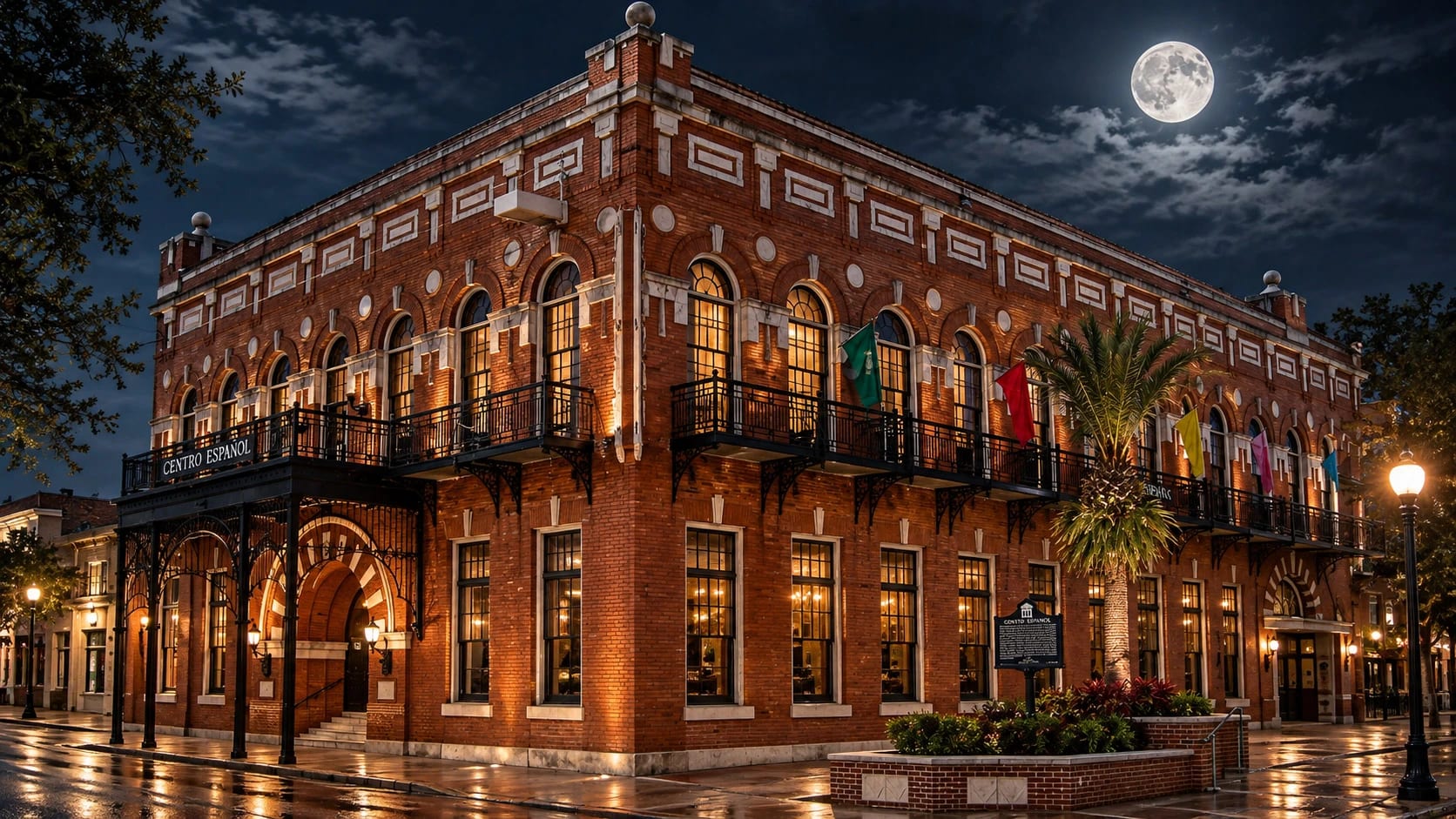
Its exterior was constructed primarily of dark red brick with elaborate decorative elements influenced by French Renaissance Revival architecture, along with Spanish and Moorish design.
The building occupied a prominent location at the intersection of Seventh Avenue and Sixteenth Street.
It was substantially larger and more elaborate than the original clubhouse.
A row of tall arched windows gave the building an imposing appearance, while ornamental balconies, decorative masonry, and elaborate entrance details provided a sense of refinement.
The structure was designed around two major gathering spaces.
At one end was a large theater where audiences could attend plays, concerts, and other performances. At the other were social and recreational spaces, including a ballroom and cantina.
A central foyer and staircase connected the principal areas.
The clubhouse also contained a library, gymnasium, and spaces used for educational programs.
This was not an ordinary neighborhood meeting hall.
It was a building intended to demonstrate the economic success and cultural ambitions of Tampa's Spanish community.
Members who had arrived in Florida to work in cigar factories had helped finance a landmark that would have looked impressive in a much larger city.
Life Inside the Spanish Club
During the club's most successful years, the building was busy with activity.
Members gathered to play dominoes and cards, read newspapers, attend meetings, or simply spend time together after work.
The cantina served as an important social space, while the ballroom hosted dances, receptions, and celebrations.
The theater was especially significant.
Ybor City had a thriving entertainment culture, with Spanish-language plays, musical performances, and theatrical productions attracting audiences from throughout the neighborhood.
For immigrants who had left Europe and Cuba, the theater offered a connection to familiar cultural traditions.
Performances allowed members to hear their own language spoken onstage and enjoy forms of entertainment that might otherwise have been unavailable in an American industrial city.
The club also provided educational opportunities.
English classes helped immigrants adjust to life in the United States, while the library offered access to books, newspapers, and other materials.
The building's purpose extended well beyond recreation.
It helped people build a life in a new country without abandoning their cultural identity.
Membership eventually reached several thousand people.
By 1908, just before the construction of the new clubhouse, historical accounts place membership at approximately 2,687.
The growing society had become one of the most influential institutions in Tampa's immigrant community.
Its members had good reason to be proud of what they had created.
But the building also became the setting for stories that had very little to do with its intended purpose.
The Haunted Safe of Centro Español
The most famous haunting associated with the Centro Español concerns an old safe.
According to the version reported by FOX 13 Tampa Bay in October 2023, a man died while attempting to break into the safe in 1908.
His ghost allegedly remains inside the building, still associated with the object he was trying to open when he died.
The report described the safe as one of the features shown to guests during paranormal tours.
The story has also appeared in other articles about haunted Ybor City, including a 2026 Bradenton Magazine feature that repeats the account of a man killed while attempting to open the safe.
Unfortunately, those versions provide few historical details.
The alleged burglar isn't named, and the specific cause of death is unclear.
There is also no confirmed explanation for why he would have died while trying to open a safe.
Was he injured by the mechanism? Was he confronted by someone inside the building? Did some other incident occur during the attempted robbery?
The available accounts don't establish what happened.
That uncertainty becomes even more interesting when another version of the story is considered.
The Eighteen Men Trapped Behind the Safe
A more elaborate account appeared in an October 2021 travel article published by American Roads and Global Highways.
The writer had participated in a Ybor City ghost tour led by Max Herman and visited the Centro Español building.
During the tour, Herman reportedly described a deadly incident that occurred in 1908.
According to the story, eighteen men were meeting inside the Spanish Club. The group supposedly included a mayoral assistant, a senior police official, and individuals associated with organized crime.
The men wanted privacy, so they positioned a large safe in front of the door.
Then a fire broke out.
As flames spread through the building, the men attempted to escape, but the safe blocked their exit. Despite their efforts, they couldn't move the heavy object out of the way.
One man allegedly fired a gun into the safe in desperation.
The shot left a bullet hole, which the story claims can still be seen.
All eighteen men reportedly died in the fire.
Their ghosts are said to remain inside the former clubhouse, and employees working in the building have allegedly heard screams coming from the area where the tragedy occurred.
It's the kind of story that makes a memorable stop on a ghost tour.
A locked room. A secret meeting. Powerful men with criminal connections. A fire that traps everyone inside.
The trouble is that the available historical evidence doesn't support it.
Did Eighteen People Really Die in 1908?
There was a devastating fire in Ybor City in 1908.
On March 1 of that year, a fire began in a boardinghouse near Twelfth Avenue and spread through a large section of the neighborhood.
The fire destroyed homes, businesses, and cigar factories, leaving approximately 2,000 people homeless.
Firefighters struggled with inadequate water pressure and wooden water mains, while wind carried the flames between tightly packed structures.
The destruction was extensive.
But according to a historical account published in Firehouse magazine, there were no deaths or serious injuries associated with the Great Ybor City Fire.
That creates a problem for the ghost story.
If the eighteen men supposedly died during the neighborhood's famous 1908 fire, the account conflicts directly with the documented casualty information.
It's possible that the legend refers to an entirely different fire, but no corresponding incident involving eighteen deaths at the Spanish Club has been established.
There's another complication.
The present Centro Español building was completed in 1912.
In 1908, the property was occupied by the original clubhouse, constructed in 1892.
That earlier structure could theoretically have been the location of an incident, but the story would still require an explanation of how the safe survived and eventually became part of the replacement building.
The safe's age and history have not been independently established.
Nor has a contemporary newspaper report been identified describing eighteen prominent men dying in a fire inside the clubhouse.
An event involving that many deaths, particularly if local officials were among the victims, would ordinarily have attracted considerable attention.
Without documentation, the account remains a ghost story rather than a verified episode in Tampa's history.
What About the Bullet Hole?
The story of the bullet hole is one of its most compelling details.
According to the 2021 travel account, the safe displayed during the ghost tour had a visible hole that the guide associated with the alleged shooting.
A physical mark on an old safe, however, doesn't establish when or why the damage occurred.
It could be connected to a historical incident, an attempted burglary, accidental damage, or something else entirely.
To establish the story, researchers would need to identify the safe's manufacturer, age, ownership history, and any relevant contemporary police or newspaper reports.
The club's surviving records might help.
The University of South Florida maintains an extensive Centro Español collection that includes account books, financial records, minutes of meetings, correspondence, and membership registers.
Those materials offer a potential starting point for determining whether the organization documented a robbery, fire, or other incident involving the safe.
Until such evidence is discovered, the reported bullet hole is an interesting physical detail associated with an unverified legend.
The safe may be old. It may have been damaged. It may even have been involved in a crime.
But the story of eighteen men dying behind it has not been established.
The Ghost That Guards the Safe
Regardless of the circumstances surrounding the alleged death, the safe has become one of the building's most recognizable paranormal attractions.
The ghost is generally described as a man who remains attached to the location where he died.
In the shorter version of the story, he was a burglar attempting to steal money.
In the longer version, the supernatural activity is associated with the men trapped during the fire.
These conflicting explanations are worth considering because they demonstrate how ghost stories can change as they're passed from one person to another.
A single object can acquire different histories, particularly when the original circumstances are poorly documented.
What remains consistent is the idea that something about the safe prevents the dead from leaving.
Witnesses have reportedly heard unexplained sounds in nearby rooms, while local guides have described the area as a center of paranormal activity.
The most disturbing accounts involve screams.
According to the 2021 account, workers in the building and nearby entertainment spaces have heard voices that seemed to come from an area associated with the supposed deaths.
No independently documented investigation establishes the source of those sounds.
Old buildings can produce unusual noises, particularly when spaces have been renovated, divided, and adapted to different uses over many decades.
A sound originating in one room may travel through ceilings, ventilation openings, or structural cavities and seem to come from somewhere else.
But the reputation of the safe has persisted.
Visitors who know the story may find themselves studying an ordinary-looking piece of equipment and wondering whether it really witnessed something terrible more than a century ago.
That uncertainty is part of what has made the legend so durable.
The Woman in White at Centro Español
The haunted safe isn't the only ghost story connected to the building.
Another account involves a woman who has reportedly appeared in the upstairs restaurant spaces.
Unlike the 1908 safe legend, these reports emerged from people who worked in the building during its more recent commercial history.
An article published by MCFilm in October 2016, drawing from earlier local reporting, described unusual experiences at Teatro on Seventh, a former restaurant located within the Centro Ybor complex.
The restaurant occupied space associated with the old Centro Español building.
According to the account, customers and employees reported seeing an attractive Hispanic woman wearing a long white dress and high heels.
Her clothing appeared to belong to an earlier period, rather than the contemporary restaurant setting.
Witnesses claimed she would appear briefly before disappearing.
The reports didn't identify her as a particular former club member, performer, or employee.
There was no established story explaining when she supposedly died or why she might remain in the building.
She was simply a woman who appeared where nobody expected her to be.
The lack of an elaborate backstory makes this haunting somewhat different from the legend of the safe.
Instead of a named victim attached to a dramatic historical event, the account describes an apparition that witnesses supposedly encountered during ordinary business operations.
Of course, the experiences remain unverified.
But they form a separate part of the building's paranormal reputation.
Was She a Former Club Member?
It's tempting to connect the woman in white to the building's years as a Spanish social club.
For decades, the Centro Español ballroom hosted dances, celebrations, and other events. Women attended functions in formal clothing, and the building was an important part of the neighborhood's social life.
A woman dressed in clothing associated with an earlier era would fit naturally into that history.
But there is no reliable evidence identifying the reported apparition.
She could be a former club member, at least within the framework of the legend.
She could also be connected to the building's later use as a restaurant or entertainment venue.
Or the witnesses may simply have misinterpreted something they saw.
The reports provide too little information to determine which explanation is correct.
The original accounts are still interesting because they describe multiple people allegedly seeing a similar figure.
Whether those witnesses experienced the same phenomenon, influenced one another, or encountered separate events is unknown.
What they believed they saw was memorable enough to become part of Ybor City's collection of ghost stories.
The Mischievous Ghost of Teatro on Seventh
Some of the most unusual paranormal claims associated with the Centro Español involve physical contact.
Former employees of Teatro on Seventh reportedly complained about an unseen presence interfering with their work.
According to the MCFilm account, servers walking between the kitchen and dining areas sometimes felt as though someone had tripped them.
Others reported being pushed on the shoulders while carrying trays of food.
These weren't accounts of distant footsteps or vague shadows.
The employees believed something was physically interfering with them.
One of the restaurant's owners, identified as Jill, reportedly experienced a particularly disturbing incident near the front of the bar.
She claimed she was pushed from behind hard enough to leave bruises on her back.
No one was visible behind her.
The article described the experience as part of a pattern of unusual activity at the establishment, although it did not provide medical records, surveillance footage, or other independent evidence confirming the cause of the injuries.
Other employees reportedly described doors opening and closing unexpectedly.
Those incidents were often attributed to the same mischievous presence.
A restaurant is naturally a busy environment. Employees move quickly, carrying heavy objects through confined spaces. Doors swing, equipment shifts, and accidents happen.
But according to the people involved, the incidents at Teatro felt different.
They believed the activity was deliberate.
The Unexplained Candle Wax
One of the stranger stories from Teatro involved a cleaning crew working late at night.
According to the published account, employees had been stripping and sealing the restaurant's wooden floors.
When they finished, they closed the establishment and left.
The following morning, workers reportedly discovered candle wax pooled on the floor near large windows.
The candles available in the restaurant were said to be new and unlit.
Nobody could explain where the wax came from.
Compared with a ghostly woman appearing in a dining room or an employee being pushed by an invisible force, candle wax on a floor might seem like a minor mystery.
But it was the apparent absence of an ordinary explanation that made the incident memorable.
Who had lit the candles?
Had someone entered the restaurant overnight?
Could the material have come from a source the employees hadn't considered?
The published account doesn't answer those questions.
It simply records the experience as another example of the strange activity employees associated with the property.
The restaurant eventually closed, and the building's commercial spaces continued changing.
The stories remained.
Are the Centro Español Ghosts Connected to the Old Theater?
The theater is one of the most historically significant parts of the Centro Español building.
Completed in 1912, it was designed to accommodate performances attended by the club's members and their families.
For generations, Spanish-language theater was an important part of Ybor City's cultural life.
Actors, musicians, singers, and other performers provided entertainment to audiences who had grown up with theatrical traditions in Spain and Cuba.
The theater helped preserve those traditions in a community far from the countries where many residents had been born.
It also provided an opportunity for social gatherings and cultural events that extended beyond ordinary club meetings.
A building that hosted performances for decades naturally invites speculation about whether former performers might remain attached to it.
That is a common theme in stories about haunted theaters.
But in the case of Centro Español, the available evidence doesn't establish a specific theatrical death or a consistently identified ghost associated with the original stage.
This distinction is important because Ybor City has several historic clubs with theaters, and their paranormal traditions can become confused.
The Cuban Club, for example, has its own widely repeated story about an actor who supposedly died by suicide after a disappointing performance.
That legend belongs to the Cuban Club and should not be transferred to Centro Español simply because both buildings contain theaters.
The Centro Español's better-documented paranormal reports involve the safe and the commercial spaces occupied by later restaurants.
There may be additional firsthand accounts concerning the original theater, but they require stronger sourcing before being treated as established local traditions.
Even without a verified theater haunting, the space remains an important part of the building's history.
For thousands of immigrants, it offered a connection to the cultural life they had left behind.
The Decline of the Spanish Club
By the middle of the twentieth century, the circumstances that had made El Centro Español so important were changing.
Ybor City's cigar industry had begun declining.
Automated production methods reduced demand for skilled hand-rollers, while cigarettes became increasingly popular among American consumers.
Factories closed, and many workers moved away.
The neighborhood's population changed as younger generations sought opportunities elsewhere.
Children and grandchildren of the original immigrants were generally more familiar with American institutions than their parents had been.
They no longer depended on ethnic social clubs to the same degree for education, medical care, or recreation.
The Spanish Club's membership began declining.
Maintaining an enormous historic clubhouse became increasingly difficult, particularly as the organization continued supporting medical and cemetery obligations.
The building itself required repairs.
Large theaters, ballrooms, and other elaborate interior spaces were expensive to maintain, especially when fewer members were using them.
The society gradually consolidated its operations.
In 1983, the Ybor City clubhouse was sold, ending its long period as the principal gathering place of the Spanish community.
The organization itself survived, but its connection to the building changed permanently.
For a time, the property stood vacant.
A National Historic Landmark in Danger
The significance of the building was recognized in 1988 when the United States Department of the Interior designated El Centro Español de Tampa a National Historic Landmark.
The designation acknowledged the society's role in the development of Ybor City and the building's architectural importance.
Only a relatively small number of historic properties receive this recognition.
But landmark status doesn't automatically provide the money necessary to preserve a deteriorating building.
The former Spanish Club still required substantial investment.
By the late twentieth century, much of Ybor City had suffered from decades of neglect, economic decline, and redevelopment projects that destroyed historic structures.
The Spanish Club's enormous brick building was one of the neighborhood's most prominent surviving landmarks.
Losing it would have meant losing an important part of Tampa's immigrant history.
Preservation efforts eventually became part of a much larger project intended to revitalize Seventh Avenue.
The building would survive, but its next purpose would be very different from the one envisioned by its founders.
Centro Ybor and the Restoration of the Spanish Club
During the 1990s, Tampa began investing heavily in the restoration and redevelopment of Ybor City's historic commercial district.
The former Centro Español building became a centerpiece of those efforts.
After the state acquired the property in 1990, stabilization work began. A larger redevelopment project followed in the late 1990s, incorporating the historic clubhouse into a commercial and entertainment complex.
The surrounding project became known as Centro Ybor.
According to an architectural history published by AIA Tampa Bay, stabilization and redevelopment costs associated with the larger project totaled approximately $52 million.
The work included preserving the former Spanish Club's historic appearance while adapting interior spaces for contemporary uses.
Centro Ybor officially opened in 2000.
Restaurants, shops, entertainment venues, and other commercial businesses occupied the complex.
The old clubhouse, once reserved for the social and cultural activities of Spanish immigrants, became part of a public destination attracting visitors from throughout Tampa.
The building's red-brick facade, arched windows, and decorative balconies remained.
Inside, historic features were preserved alongside modern improvements.
Visitors could still appreciate portions of the original architecture, even though the activities taking place inside were very different from those of the early twentieth century.
The restoration also meant that people working in the building were spending time in rooms with a century of history.
And according to the ghost stories, some of those workers began encountering things they couldn't explain.
Restaurants Come and Go, but the Building Remains
Over the years, different restaurants and businesses have occupied portions of the former clubhouse.
Big City Tavern and Teatro on Seventh were among the establishments associated with the building's later commercial history.
It was during this period that stories about the woman in white and the mischievous presence interfering with restaurant employees circulated.
More recently, a hospitality concept called Ten Rooms opened in the historic building in April 2024.
The development included a restaurant, cocktail bar, café, and retail spaces, with operators hoping to create a destination that would appeal to visitors interested in Ybor City's history and architecture.
The project attracted attention because of the building's significance.
But the business lasted only a few months.
Ten Rooms closed in July 2024, according to reporting by Creative Loafing Tampa and the Tampa Bay Times.
Its closure was a commercial event, not evidence of a haunting, and no reliable reporting connects the decision to paranormal activity.
The larger Centro Ybor complex remains active, and the historic Spanish Club continues to occupy its prominent position on Seventh Avenue.
More than a century after it was completed, the building is still being adapted to changing circumstances.
That adaptability is probably the biggest reason it has survived.
The Spanish Club's Cemeteries and the Families Who Never Left Tampa
The Centro Español's history isn't confined to its former clubhouse.
The organization also established cemeteries where members and their families could be buried.
Death benefits were an important part of the mutual-aid system.
For immigrant workers, the cost of a funeral and burial could create substantial financial hardship, particularly when the deceased had been the primary source of income for a household.
By providing cemetery arrangements and burial assistance, the society offered security beyond the lifetime of an individual member.
That responsibility became one of the organization's most enduring obligations.
The Centro Español continues to maintain its historical cemetery interests, including El Cementerio Viejo and Memorial Park.
In its long-term planning materials, the organization identifies cemetery preservation as a central reason for maintaining the society's existence.
There is something meaningful about that continuity.
The original members organized the club because they wanted their families to have a better life in Tampa.
More than a century later, the organization continues caring for the final resting places of people who helped establish the community.
The clubhouses, hospital, and medical facilities have changed ownership or purpose, but the responsibility to preserve the memory of those families remains.
The cemeteries are also important historical resources.
Names, burial dates, and family relationships recorded there offer opportunities to understand the people who belonged to the organization and the lives they built in Tampa.
If future research identifies a name associated with the alleged safe incident, cemetery records could be one place to investigate.
At present, however, there is no established connection between a particular burial and the Centro Español's famous ghost.
Is the Centro Español de Tampa Really Haunted?
The Spanish Club has several distinct paranormal stories, and they shouldn't all be treated as though they have the same historical foundation.
The most famous involves the safe and the man supposedly killed while attempting to open it.
That account is well established in modern ghost-tour folklore, but the victim's identity and circumstances of death remain unverified.
The more sensational story of eighteen men dying behind the safe during a 1908 fire is even more questionable.
The present building wasn't constructed until 1912, and the documented Great Ybor City Fire of 1908 did not produce the fatalities described in the legend.
The reported bullet hole in the safe is an interesting detail, but it doesn't establish the story by itself.
Other hauntings have a different kind of evidence.
The woman in white, the alleged pushing incidents, and the unexplained candle wax were described in reporting that drew on accounts from people associated with businesses operating inside the building.
Those reports are not proof that ghosts exist, but they are accounts attributed to people who spent time working in the property rather than stories connected only to the distant past.
There's also an important difference between believing someone had an unusual experience and knowing what caused it.
A server who feels something strike a shoulder may genuinely believe another person pushed them.
A customer who sees a woman in a white dress may be convinced she disappeared.
Neither experience necessarily establishes that a deceased person was responsible.
Buildings as old as Centro Español also have unusual physical characteristics.
The property has been substantially renovated, and spaces that once served as theaters, ballrooms, or social rooms have been adapted for commercial uses.
Sounds can travel in unexpected ways, and changes in lighting, air movement, or mechanical equipment can produce experiences that seem strange.
But not every account offers an obvious explanation.
The interesting question is why certain stories persist while others disappear.
The haunted safe has remained part of local folklore for years, despite the inconsistencies in its history.
The woman in white has been described by multiple people associated with former businesses.
The building itself continues attracting people who are fascinated by the possibility that something from its earlier life remains.
Whether any of those experiences involve actual ghosts is impossible to establish from the available evidence.
What we do know is that El Centro Español de Tampa has been part of Ybor City's history for more than 130 years.
Its organization has watched generations of members arrive, build families, struggle through illness, celebrate milestones, and eventually die.
The building standing on Seventh Avenue has witnessed much of that history since 1912.
Whatever the explanation for its hauntings, there's no shortage of stories associated with the place.
Visiting the Haunted Centro Español in Ybor City
The historic Centro Español de Tampa building stands at the corner of Seventh Avenue and Sixteenth Street in Ybor City, Tampa.
Its historic street frontage includes addresses in the 1500 block of East Seventh Avenue, with the main entrance commonly identified near 1536 East Seventh Avenue.
The building is part of the Centro Ybor shopping and entertainment complex.
Visitors can appreciate the exterior from public sidewalks, including the red-brick facade, arched windows, and decorative iron balconies.
Interior access depends on the businesses and spaces currently open to the public. The original clubhouse is no longer operated as a traditional members-only social club, and visitors should not assume that historic rooms or the reported haunted safe are accessible without permission.
The location is surrounded by other important landmarks associated with the neighborhood's immigrant history.
The nearby Cuban Club, Italian Club, historic theaters, and former cigar-industry buildings provide a sense of how important these organizations were to the people who built Ybor City.
The Centro Español is especially significant because it was the first of the neighborhood's major Latin social clubs.
Its establishment in 1891 helped create a model that other immigrant organizations would follow.
And today, its reputation as a haunted building adds another dimension to a history that already includes political divisions, medical innovation, and remarkable cultural achievements.
Discover Haunted Ybor City With Ghost City Tours
The Centro Español is only one of the historic buildings in Ybor City with stories that extend well beyond what visitors see from the street.
Throughout the neighborhood, former cigar factories, social clubs, theaters, and commercial buildings have accumulated legends about the people who once occupied them.
Some stories involve documented crimes and historical tragedies. Others come from people who report unusual experiences inside buildings that have stood for generations.
Ghost City Tours explores the history and supernatural folklore of Tampa's old cigar district through guided nighttime walking tours.
Our Ghosts of Ybor City Tour is an all-ages experience focused on the history and ghost stories of the neighborhood.
For guests interested in Ybor City's more disturbing past, The Darkness Between Us Ghost Tour explores the darker side of the historic district, including organized crime, violence, and unsettling local legends.
Both experiences offer an opportunity to discover the people, places, and events that made Ybor City one of Florida's most unusual historic neighborhoods.
Explore our Ybor City Ghost Tours and find out why so many stories continue to circulate through the old streets after dark.
Frequently Asked Questions About the Haunted Centro Español
Is Centro Español in Ybor City haunted?
Centro Español has a longstanding reputation for paranormal activity. Its best-known ghost story concerns an old safe supposedly haunted by a man who died while attempting to open it in 1908. Other reports describe a woman in a white dress, unexplained sounds, and restaurant employees who believed they were pushed by an unseen presence.
What happened at the haunted safe in Centro Español?
According to one local legend, a man died while attempting to break into the safe in 1908. Another version describes eighteen men who were trapped behind the safe during a fire. Neither account has been established through reliable contemporary historical records.
Did eighteen men die in a fire at the Spanish Club?
The story has been repeated on ghost tours, but historical documentation does not confirm it. The present Centro Español building was constructed in 1912, and the famous Great Ybor City Fire of 1908 had no reported fatalities. It remains an unverified local legend.
Who is the woman in white at Centro Español?
Former restaurant employees and customers have reportedly seen a woman wearing a long white dress and high heels in upstairs commercial spaces associated with the historic building. Her identity is unknown, and no documented death has been reliably connected to the apparition.
When was Centro Español de Tampa built?
The organization was chartered in 1891 and opened its first clubhouse in June 1892. The present red-brick building on Seventh Avenue was completed in 1912 and designed by architect Francis J. Kennard.
What was the Spanish Club in Ybor City?
El Centro Español was a social and mutual-aid organization established by Spanish immigrants working in Tampa's cigar industry. It provided recreational activities, education, medical benefits, and burial assistance to members and their families.
Is Centro Español still open?
The organization still exists, although the historic Ybor City clubhouse no longer serves as its primary members-only facility. The building is part of Centro Ybor, a shopping and entertainment complex containing commercial spaces.
Historical References and Sources
1. Florida Division of Historical Resources — Centro Español de Tampa Historical Marker
Florida Division of Historical Resources — Centro Español de Tampa Historical Marker
Official state historical marker documenting the organization's founding in 1891, its 186 charter members, the first clubhouse in 1892, and construction of the current building in 1912. Also details the architecture and National Historic Landmark designation.
2. Centro Español de Tampa — Official History and Heritage
Centro Español de Tampa — Official History and Heritage
The organization's own historical account of its establishment, Spanish immigrant community, social services, and continuing cultural mission.
3. Centro Español de Tampa — El Segundo Siglo
Centro Español de Tampa — El Segundo Siglo
Detailed organizational history explaining the political and cultural circumstances surrounding the club's creation, Spanish-Cuban tensions, mutual-aid benefits, membership decline, and preservation of its cemeteries.
4. Centro Español de Tampa — Did You Know?
Centro Español de Tampa — Did You Know?
The organization's historical timeline, including the 1898 military occupation of its original clubhouse, the debate over medical benefits, and the decision to construct a hospital.
5. University of South Florida — Centro Español de Tampa Records
University of South Florida — Centro Español de Tampa Records
Primary historical collection containing membership registers, financial records, correspondence, account books, meeting minutes, and photographs. Particularly valuable for future research into the alleged safe incident.
6. University of South Florida — Ybor City and West Tampa Collections
University of South Florida — Ybor City and West Tampa Collections
Overview of the university's original records from Centro Español and other historic immigrant organizations, including the extensive collection of club documents dating from the 1890s through the 1950s.
7. University of South Florida — Room in Sanatorio del Centro Español, circa 1911
University of South Florida — Room in Sanatorio del Centro Español, circa 1911
Historical photograph and archival description of the Spanish Club's hospital on Bayshore Boulevard, including the opening date, relocation, and demolition.
8. AIA Tampa Bay — Architecture of Tampa Bay: El Centro Español
AIA Tampa Bay — Architecture of Tampa Bay: El Centro Español
Architectural history detailing Francis J. Kennard's 1912 building, its original facilities, declining membership, historic preservation, and incorporation into the Centro Ybor complex.
9. FOX 13 Tampa Bay — Tampa Bay Tour Company Goes to Most Haunted Places in Ybor City
FOX 13 Tampa Bay — Tampa Bay Tour Company Goes to Most Haunted Places in Ybor City
Josh Cascio, October 18, 2023. Local television reporting describing the supposedly haunted safe and the legend of a man who died attempting to break into it in 1908.
10. American Roads and Global Highways — Ybor City Ghost Tour
American Roads and Global Highways — Ybor City Ghost Tour
October 22, 2021. First-person account of a guided visit to Centro Español, including the version of the safe legend involving eighteen men trapped during a fire, an alleged bullet hole, and reported screams.
11. MCFilm — Ybor Ghost Stories
October 26, 2016. Local reporting concerning paranormal experiences attributed to former restaurant employees, including the woman in white, unexplained pushing incidents, doors operating unexpectedly, and the mysterious appearance of candle wax.
12. Bradenton Magazine — Spirits of Ybor City
Bradenton Magazine — Spirits of Ybor City
A modern collection of local ghost stories that includes the Centro Español safe legend and reports from other supposedly haunted properties in Ybor City.
13. Firehouse — On the Job: Tampa, Ybor City Inferno
Firehouse — On the Job: Tampa, Ybor City Inferno
Historical account of the March 1, 1908, Great Ybor City Fire, including the destruction of approximately 55 acres and confirmation that there were no deaths or serious injuries. Important when evaluating the alleged eighteen fatalities at Centro Español.
14. Centro Ybor — History and Future
Centro Ybor — History and Future
Official history of the Centro Ybor redevelopment project, which opened in 2000 and incorporated the restored Centro Español clubhouse into a commercial and entertainment complex.
15. Creative Loafing Tampa — After Just Three Months, Ybor's Ten Rooms Abruptly Closes
Creative Loafing Tampa — After Just Three Months, Ybor's Ten Rooms Abruptly Closes
July 9, 2024. Reporting on the closure of Ten Rooms, a restaurant and hospitality development that had briefly occupied the historic Centro Español building.
16. National Park Service — Ybor City Historic District
National Park Service — Ybor City Historic District
Federal historical overview explaining Ybor City's cigar industry, immigrant social clubs, mutual-aid societies, political history, and architectural significance.
17. Florida Memory — Fifty Years of Group Medicine in Tampa, Florida
Florida Memory — Fifty Years of Group Medicine in Tampa, Florida
A Works Progress Administration historical study published in 1941, documenting cooperative medical care in Tampa and the role played by the Centro Español in establishing affordable health services.
18. Duke University — Centro Español de Tampa Migration Memorial
Duke University — Centro Español de Tampa Migration Memorial
A historical record detailing the club's founding, early membership, clubhouse construction, mutual-aid services, and architectural importance.
El Centro Español de Tampa at Seventh Avenue and Sixteenth Street, completed in 1912