John Clifford was working security at the J.C. Newman Cigar Factory when he noticed something unusual following one of his coworkers. A bright, glowing object appeared to be moving behind the man, keeping close enough that Clifford could watch it approach the back of his head. As it drew nearer, the light grew intense enough to illuminate the man's shirt and the back of his head.
Clifford had worked at the factory long enough to become accustomed to things happening that he couldn't readily explain. Sometimes he would walk through an apparently empty room and encounter what seemed to be a fresh puff of cigar smoke, even though nobody was standing nearby. On other occasions, he had the unmistakable feeling that someone was watching him while he made his rounds.
In an October 2021 interview with FOX 13 Tampa Bay, Clifford described his belief that whatever occupied the building seemed to be watching over it. He had developed the impression that the activity diminished once the unseen occupants became comfortable with his presence. He didn't feel threatened by them, and he wasn't particularly interested in getting rid of whatever might be there.
That attitude appears to be fairly common among people who have worked at the old factory.
Kara Guagliardo, who worked in marketing for J.C. Newman, told the same television station that she had experienced things inside the building that convinced her it was haunted. She admitted that sensing another person in a room without being able to see anyone could be uncomfortable, although she didn't associate the experiences with anything particularly threatening.
The Newman family has been unusually open about the factory's supernatural reputation. Rather than dismissing employee accounts, fourth-generation owner Drew Newman helped produce an eight-part video series featuring workers discussing their encounters. The company also invited paranormal investigators into the building and eventually began hosting Halloween events inspired by its ghosts.
The factory at 2701 North Sixteenth Street is the last traditional cigar factory still operating in Tampa, a city that once had more than 150 of them. It has survived the loss of Cuban tobacco imports, changing consumer tastes, and economic conditions that forced nearly every other manufacturer to close.
The building itself dates to 1910, when the E. Regensburg & Sons Cigar Company constructed what was regarded as one of the finest cigar factories in the world. More than a thousand workers once filled its production floors, rolling cigars beneath enormous windows while the clock tower above them helped regulate daily life throughout the surrounding neighborhood.
After all those years, some people believe the factory's former workers are still showing up for their shifts.
The History of El Reloj
Building One of the World's Largest Cigar Factories
By 1910, Ybor City had become one of the world's most important centers of cigar manufacturing. The neighborhood had grown rapidly since Vicente Martínez-Ybor established his first major factory in 1886, attracting thousands of skilled workers from Cuba, Spain, Italy, and other countries.
Tampa's cigar industry had created an enormous demand for factory space, and manufacturers competed to attract experienced workers capable of producing premium cigars. One of those companies was E. Regensburg & Sons, a New York cigar manufacturer best known for its American cigar brand.
The Regensburg family recognized the advantages of manufacturing in Tampa. The city had an established workforce, access to Cuban tobacco, and transportation connections capable of moving finished cigars throughout the country.
Rather than building a modest factory, the company commissioned an enormous structure designed for large-scale production.
Completed in 1910, the building stretched more than 300 feet in length and contained three principal production floors above a basement. Its red-brick exterior, tall windows, heavy timber construction, and prominent clock tower made it immediately recognizable.
The factory was designed by New York architect S. S. Schwartz, according to historical research on Tampa's surviving cigar factories.
Its layout reflected the practical demands of manufacturing cigars before modern electric lighting became universally available. Long rows of windows allowed daylight to illuminate the worktables, while the building's orientation helped provide consistent natural light throughout the day.
That was particularly important when sorting tobacco leaves. Experienced workers distinguished between subtle variations in color and texture, and inadequate lighting could interfere with selecting wrappers that needed to match one another.
At its peak, more than 1,200 people worked inside the building. Other employees performed certain tasks from homes in the surrounding neighborhood.
J.C. Newman's historical records identify the original construction cost as approximately $75,000, a substantial investment at the time. Contemporary accounts described the finished structure as one of the largest and finest cigar factories in the world.
But the feature that made it famous throughout Tampa wasn't its size.
It was the clock.
El Reloj: The Clock That Controlled a Neighborhood
The name El Reloj means "the clock" in Spanish, a reference to the enormous clock tower rising above the factory's entrance.
The tower reaches nearly 115 feet above the surrounding neighborhood and contains a massive bell weighing approximately 1,500 pounds. For much of the twentieth century, that bell was an essential part of daily life in Ybor City.
Workers relied on its chimes to know when to prepare for work, when to leave their homes, and when the day was coming to an end. Before clocks and watches were affordable for everyone, the tower provided a dependable way for residents to keep track of time.
The Newman family has preserved accounts of the bell's importance to the community. At six in the morning, its sound helped wake cigar workers preparing for their shifts. Throughout the day, families used the clock to organize meals and other activities, while nearby businesses followed the same familiar schedule.
For generations, El Reloj was as much a neighborhood institution as it was an industrial building.
The clock also developed a reputation for being temperamental, particularly after the Newman family acquired the factory in the 1950s.
Stanford Newman later recalled receiving a complaint from a mother whose newborn child was being disturbed by the bell. He agreed to silence it, only to encounter complaints from other residents who depended on the familiar sound.
In 1956, an electrician named Wallace Jaka modified the mechanism to operate electrically. The change created problems because Tampa's frequent lightning storms could damage the system, and eventually the clock stopped working reliably.
For years, it frequently remained frozen at 9:15.
That malfunction became the source of one of Ybor City's more unusual traditions.
According to the history preserved by J.C. Newman, cigar workers began making wishes whenever the clock displayed 9:15. The practice became known as the Wishing Hour, with people hoping that making a wish at the appropriate moment might bring good fortune.
Even after the clock was repaired, the custom continued. The Newman family still recognizes September 15 at 9:15 a.m. as an occasion to celebrate the Wishing Hour.
Ybor City's immigrant communities had plenty of similar traditions. Workers believed certain numbers, objects, or daily rituals could bring good luck or prevent misfortune. Dreams were sometimes interpreted through La Charada, a system used to select numbers for bolita, Tampa's illegal lottery.
The factory's Wishing Hour fit comfortably into that culture of superstition and folk beliefs, although it developed from an ordinary mechanical problem rather than anything supernatural.
Life Inside the Old Cigar Factory
During the Regensburg years, the interior of El Reloj would have looked considerably different from the restored factory visitors see today.
Long rows of workers occupied the manufacturing floors, seated at individual tables where they handled tobacco leaves and rolled cigars by hand. The work required patience and concentration, with experienced employees carefully arranging filler tobacco, shaping cigars, and applying wrappers.
Other workers sorted leaves, removed stems, prepared materials, packed finished products, and maintained equipment. Supervisors monitored production, while office employees handled financial records, shipping arrangements, and administrative responsibilities.
Working conditions varied according to the period and the tasks being performed. Although cigar making was considered skilled employment, labor disputes were common throughout Tampa's manufacturing industry. Workers organized unions, went on strike, and negotiated over wages and conditions.
The factories also had a distinctive educational tradition.
The Lectors Who Read to Cigar Workers
One of the most recognizable features of Tampa's early cigar factories was the lector, a person employed to read aloud while workers rolled cigars.
Employees contributed money to pay the reader, who sat on an elevated platform where his voice could carry across the production floor. The material wasn't limited to newspapers. Lectors read novels, political essays, labor publications, and other works selected by the workers themselves.
A cigar maker might spend the morning listening to current events and the afternoon following a novel by Alexandre Dumas or Victor Hugo. Even workers with limited formal education could become familiar with world literature and political ideas through the daily readings.
The practice helped establish Ybor City's unusually active intellectual and political culture. It also concerned some factory owners, who regarded the lectors as a possible source of labor agitation.
In 1931, Tampa's cigar manufacturers ended the lector tradition following labor disputes and mounting tensions between workers and employers.
Ninety years later, in March 2021, the Newman family invited guest lectors into El Reloj to commemorate the building's 111th anniversary. The event recreated an important part of the factory's original atmosphere, with readings taking place while employees continued manufacturing cigars.
For people interested in the ghosts of former factory workers, the lector tradition offers an interesting detail about what everyday life inside the building once sounded like. Thousands of people spent their working lives listening to stories, discussing politics, and sharing the same enormous production rooms.
The machinery, furniture, and people have changed over the decades, but some of those original spaces remain recognizable.
How J.C. Newman Came to Own El Reloj
The company that operates El Reloj today began in Cleveland, Ohio.
Julius Caesar Newman was born in Austria-Hungary in 1875 and immigrated to the United States with his family in 1888. As a teenager, he began learning the cigar-making trade, with his mother paying three dollars per month for his apprenticeship.
After several years of working for established manufacturers, Newman lost his job during an economic recession. Rather than continue searching for employment, he decided to start his own business.
In 1895, he constructed a cigar-making table from discarded wooden boards, borrowed fifty dollars to purchase tobacco, and began producing cigars in a barn behind his family's home. His first order came from a neighborhood grocer who agreed to purchase 500 cigars.
The business grew steadily, and by 1916 Newman operated multiple factories in Ohio.
His sons, Stanford and Millard, eventually joined the company. During the following decades, the family developed a successful cigar-manufacturing operation, but the industry was changing.
By the early 1950s, Julius believed the company's future depended on producing premium cigars associated with Tampa's reputation for quality and Cuban tobacco.
In 1953, he visited Tampa and became interested in the former Regensburg factory, which had ceased operations in 1951.
Stanford was less enthusiastic about relocating the entire business immediately. According to his memoir, Cigar Family: A 100 Year Journey in the Cigar Industry, he proposed leasing one floor of the building and installing approximately ten cigar-making machines.
If the experiment worked, the company could move its operations to Tampa. If it failed, the equipment could be returned to Ohio.
The experiment succeeded.
In 1954, J.C. Newman relocated its business to El Reloj, beginning an association with the building that continues today.
Julius died in 1958, leaving the company to the next generation. Stanford guided the business through the disruption of Cuban tobacco imports, growing competition from overseas manufacturers, and the gradual disappearance of Tampa's cigar industry.
The family eventually developed a major partnership with the Arturo Fuente family and expanded production outside the United States while preserving the Tampa factory.
Today, Eric Newman serves as president, Bobby Newman as executive vice president, and Drew Newman represents the fourth generation of the family business.
Their decision to continue operating El Reloj has preserved an unusual piece of Tampa's industrial history. The factory still manufactures cigars, including products made with antique hand-operated machines that remain part of its working equipment.
But the employees haven't always been alone, at least according to the people who have reported unusual experiences inside.
The Ghosts of El Reloj
The paranormal reputation of the J.C. Newman factory is different from that of many historic buildings in Tampa.
There isn't a famous murder that supposedly explains everything. No identified victim is said to wander the halls seeking revenge, and the accounts aren't centered on a particular tragedy.
Instead, the stories come primarily from people who work in the building.
Security guards, office employees, and other staff members have reported unusual lights, unexplained sensations, and the impression that someone is nearby when nobody can be seen.
Several of these experiences have been described publicly by identifiable witnesses, giving them a firmer basis for discussion than the anonymous legends repeated about some of Ybor City's other haunted locations.
John Clifford and the Glowing Orb
John Clifford had spent years patrolling the factory when he experienced something he couldn't explain.
During one of his rounds, he noticed a bright object moving behind a coworker. The light appeared to follow the man rather than remain stationary, eventually approaching the back of his head and growing bright enough to illuminate his clothing.
Clifford described the incident during an October 15, 2021 interview with FOX 13 Tampa Bay.
He believed he had witnessed something unusual, although the published account doesn't establish where the light originated, whether the coworker noticed it, or whether surveillance equipment captured the event.
Those details would be valuable in determining what happened.
A bright light observed inside a large industrial building could have several ordinary explanations, including reflections, electrical equipment, or a moving light source positioned outside the observer's direct view.
But Clifford associated the experience with other unusual activity he had encountered during his years working there.
He also didn't consider the presence threatening.
In fact, he had developed an interpretation of the experiences that was almost reassuring. Rather than assuming something dangerous was following workers through the building, Clifford believed the supposed spirits were watching over the property.
He described sensing their presence more frequently when he first began working there, with the activity seeming to diminish over time. His explanation was that the spirits had gradually become comfortable with him.
There is no evidence establishing that any spirit was actually present, but his account provides some insight into how employees perceived the building's reputation.
For Clifford, the unusual activity wasn't necessarily something to fear. It was simply part of working at El Reloj.
The Cigar Smoke With No Smoker
Another experience Clifford described involved walking through what felt like a fresh puff of cigar smoke while patrolling an area where nobody else appeared to be present.
That might not sound particularly unusual in a cigar factory, but Clifford wasn't simply describing the smell of tobacco. He believed he had encountered a localized cloud of smoke, as though someone had just been smoking a cigar in the space he was passing through.
The apparent absence of a smoker made the experience memorable.
There are several ordinary possibilities worth considering. Tobacco has been stored, processed, and manufactured in the building for more than a century, and the air naturally contains odors associated with those activities. Air circulation might also move smoke or other airborne particles between rooms in unexpected ways.
The published account doesn't provide enough information to determine precisely what Clifford encountered.
What makes the story interesting is how closely the experience matches the building's original purpose.
For generations, workers spent their days handling tobacco beneath El Reloj's enormous windows. The factory was filled with the smell of tobacco, and smoking was once a common part of everyday life throughout Ybor City.
If someone were going to associate a ghost with a former cigar factory, an unexplained puff of smoke would be a particularly appropriate detail.
Clifford believed the incident was another indication that unseen occupants remained inside the building.
Whether the explanation was supernatural or something much more ordinary remains unknown.
The Feeling of Someone Watching
Clifford wasn't the only employee interviewed by FOX 13 about the factory's paranormal activity.
Kara Guagliardo, who worked in marketing for J.C. Newman, also described experiences that convinced her the building was haunted.
Her account was less dramatic than Clifford's glowing light, but it involved something that many people who believe they've encountered a ghost describe: the sensation that another person is standing nearby when nobody can be seen.
Guagliardo acknowledged that the feeling could be uncomfortable, particularly when she was alone in a room. She didn't describe the presence as threatening, however, and appeared to regard the experiences as part of the building's unusual character.
That type of encounter is difficult to evaluate objectively.
People sometimes experience the sensation of being watched in ordinary circumstances, especially in unfamiliar environments or places where they expect someone might be present.
El Reloj contains large production rooms, staircases, storage areas, and spaces that may remain unoccupied for long periods. Sounds traveling through the building or movement glimpsed from a distance could contribute to the impression that someone else is nearby.
Nevertheless, Guagliardo's account demonstrates that the factory's paranormal reputation wasn't limited to one security guard.
By 2021, several employees were discussing their experiences openly enough that the Newman family decided to create a project devoted to the building's supposed ghosts.
The Eight-Part Haunting of J.C. Newman
Around the time of the company's 125th anniversary, the Newman family began collecting stories from employees who believed they had encountered paranormal activity.
The resulting project was an eight-part video series featuring workers discussing their experiences inside El Reloj.
Eight employees participated, describing encounters they couldn't readily explain. The videos were distributed through the company's YouTube channel and promoted in cigar-industry publications.
Drew Newman spoke publicly about the project, noting that enormous numbers of people had entered the factory since its construction in 1910. Some, he suggested, might never have left.
The company also discussed several unusual architectural features, including hidden rooms, old staircases, trapdoors, and a basement whose layout reflects the building's original industrial design.
These features became particularly interesting during a major restoration project, when workers uncovered spaces that had been concealed or forgotten for decades.
The possibility that renovations had disturbed the building's supposed spirits became part of the paranormal discussion.
That idea is common in haunted-building folklore, where construction and remodeling are sometimes followed by reports of increased activity. There is no reliable evidence that renovations can disturb ghosts, but the theory is frequently offered when people begin noticing unusual events in historic properties.
For the Newman family, the employee accounts offered an opportunity to explore another side of the factory's identity.
And unlike many businesses that discourage paranormal investigations, they allowed outside investigators to examine parts of the property.
Paranormal Investigations in the Basement
A Ybor City paranormal tour company conducted investigations inside El Reloj, including areas that weren't normally accessible to visitors.
According to reporting published in cigar-industry media, investigators reported elevated readings from electronic equipment in two locations: a former basement laboratory and an office once used by the factory's general manager.
The investigators interpreted those readings as possible evidence of paranormal activity.
The reports attracted attention partly because both locations were associated with specific functions during the building's industrial history.
The basement had been used for activities connected with tobacco processing and manufacturing, while the manager's office belonged to the administrative operation.
Neither area had originally been designed as a supernatural attraction.
However, elevated electromagnetic readings don't establish that ghosts are present.
Factories contain electrical wiring, machinery, lighting systems, and other equipment capable of generating electromagnetic fields. Even when a detector registers an unexpected change, additional investigation is necessary to determine the source.
The published reports don't provide enough independently verifiable information to establish that the measurements resulted from anything supernatural.
Still, the investigation demonstrated that the Newman family was willing to allow the stories to be examined rather than simply using them for publicity.
The former manager's office also had another distinction.
During the restoration, workers discovered a concealed staircase and a hidden steel vault nearby.
And that discovery had nothing to do with ghosts.
The Secret Staircase and Hidden Vault
In November 2019, FOX 13 Tampa Bay reported that workers renovating El Reloj had uncovered a staircase concealed beneath a floor.
The stairs led toward a storage area containing a steel door that had been hidden behind boxes of records for years.
The discovery surprised the Newman family.
Eric Newman explained that the concealed passage appeared to have been associated with the factory's administrative operations, particularly the handling of money.
During the early twentieth century, Tampa had developed a reputation for organized crime, illegal gambling, and political corruption. Charlie Wall and other influential figures controlled gambling organizations that generated substantial amounts of money, while rival criminal groups competed for territory and influence.
Robberies were also a concern for legitimate businesses. Cigar factories handled substantial payrolls, and the money required to pay hundreds of workers could make them attractive targets.
According to the explanation offered by Eric Newman, the hidden staircase may have allowed a factory manager to move money to a safer location during a robbery.
The steel door led to a concealed room that might have served as a vault.
The theory is reasonable, although the available reporting doesn't establish precisely when the room was constructed or document any particular robbery associated with it.
What makes the discovery especially interesting is that even the Newman family, after decades of occupying the building, had been unaware of some of its original features.
A hidden staircase beneath a floor is exactly the sort of discovery that encourages speculation about secret meetings, underground passages, and mysterious activity.
But the building's concealed rooms don't provide evidence of a murder or establish that a deceased gangster haunts the property.
The historical discovery is interesting enough without attaching an imaginary tragedy to it.
The Restoration of El Reloj
The Newman family's preservation work reached an important milestone around the company's 125th anniversary in 2020.
El Reloj required substantial repairs and modernization, but the family wanted to preserve as much of the original building as possible.
The renovation involved restoring windows, exposing historic brickwork, repairing architectural elements, and reconfiguring portions of the interior to create new visitor spaces.
Workers also uncovered features that had been hidden during earlier renovations.
Some were practical, like the staircase and vault. Others revealed details about the building's original construction and the way its manufacturing areas had been organized.
The restoration allowed the company to create a museum and visitor experience while continuing to manufacture cigars.
Visitors can now learn about Tampa's cigar industry, examine historical artifacts, and watch employees producing cigars using both traditional hand-rolling techniques and antique machinery.
In an August 2021 article for Smithsonian Magazine, journalist Jennifer Simonson described El Reloj's transformation into a working museum.
That distinction is important.
Many historic factories preserve machinery that hasn't operated for decades. At El Reloj, some of the equipment is still being used for its original purpose.
The factory also provides a connection between Tampa's early industrial history and the generations of workers who developed the city's reputation for premium cigars.
For the Newman family, the preservation project was about maintaining a business and protecting an important part of the community's heritage.
The building's haunted reputation became an unexpected addition to that effort.
A Haunted Factory Becomes a Halloween Attraction
The stories told by employees eventually inspired the Newman family to create seasonal Halloween experiences.
In October 2025, J.C. Newman hosted a Haunted Factory event that transformed portions of the building's basement into an immersive attraction.
Visitors moved through darkened spaces filled with theatrical effects and a fictional story inspired by the factory's history.
The event attracted hundreds of people, according to the company, and its popularity encouraged another production the following year.
From October 15 through October 17, 2026, El Reloj hosted Haunted Factory: Mama Guava — The Curse of El Reloj.
The experience involved an elaborate supernatural storyline, frightening characters, mysterious rituals, and themed rooms designed to unsettle guests.
Afterward, participants could attend an after-party and explore portions of the factory's visitor facilities.
It's important to distinguish these Halloween productions from the historical ghost reports.
Mama Guava and the other characters featured in the attraction are fictional creations. They shouldn't be presented as documented spirits or actual historical figures associated with the property.
The reported paranormal experiences existed before the Halloween events were developed. The attractions drew inspiration from the factory's reputation while introducing additional elements intended purely for entertainment.
The difference is fairly straightforward: John Clifford's account of an unexplained glowing light is a reported personal experience. Mama Guava is part of a staged Halloween production.
Both have contributed to El Reloj's modern reputation, but they aren't the same type of story.
The El Reloj District
The Newman family's preservation efforts have also expanded to the surrounding neighborhood.
Across Columbus Drive stands the former Sanchez y Haya building, constructed in 1910 and historically associated with businesses serving the nearby cigar factories.
The structure contained commercial spaces on the ground floor and accommodations above. Like many older Ybor City properties, it eventually deteriorated as the neighborhood's industrial economy declined.
The Newman family acquired the building and began restoring it as part of a larger project known as the El Reloj District.
Plans have included Elaine's Restaurant, Stanford's Cigar Club, and an eleven-room boutique hotel called the Inn at El Reloj.
The company has also supported the development of Cigar Workers Park, a public space honoring the people whose labor made Tampa famous.
The project is intended to attract visitors to a part of Ybor City that has historically received less attention than the entertainment district along Seventh Avenue.
It also helps preserve a neighborhood where the factories, homes, and businesses were once closely connected.
El Reloj remains the centerpiece.
Its clock tower still rises above North Sixteenth Street, and cigar manufacturing continues inside the same building that opened in 1910.
The company's commitment to preserving the property has allowed it to survive long after most of Tampa's other traditional cigar factories disappeared.
And according to some of the employees who spend their days and nights inside, the building may have a few occupants who have been there considerably longer than anyone realizes.
Is the J.C. Newman Cigar Factory Really Haunted?
El Reloj has several characteristics that make its paranormal reputation worth examining.
The building has been occupied continuously for more than a century, and its owners have preserved an unusually large amount of information about its history.
We know when it was constructed, who originally operated it, and how its different rooms were used. We also have identifiable employees who have publicly described experiences they believe were paranormal.
John Clifford's account of a glowing orb following a coworker is particularly interesting because he described a specific event rather than a vague feeling.
His reports of unexplained cigar smoke provide another unusual detail, while Kara Guagliardo's experiences suggest that the factory's reputation extended beyond a single employee.
The eight-part video series adds further accounts from workers who spent substantial time inside the building.
There are, however, significant limitations to the available evidence.
The light Clifford observed hasn't been conclusively identified, and the published account doesn't establish whether a video recording exists. His experiences involving smoke could have originated from ordinary activity, while the sensation of being watched is difficult to evaluate objectively.
Electrical equipment may explain some of the readings obtained during paranormal investigations.
The building's size and complicated layout also create opportunities for sounds and lighting effects that people might misinterpret.
There is no established historical evidence connecting a particular deceased cigar worker to the reported activity, nor is there a documented death that explains the factory's ghost stories.
The theory that former employees continue watching over El Reloj remains an interpretation offered by people who have encountered things they couldn't explain.
What distinguishes this location from many other reputedly haunted buildings is the attitude of its witnesses.
The employees don't generally describe the activity as hostile. They seem to regard the supposed spirits as familiar presences that have become part of working in an old factory.
Clifford's belief that the building's unseen occupants eventually accepted him is particularly interesting. He didn't describe a terrifying encounter that made him want to leave. He described a relationship that, in his interpretation, became more comfortable over time.
Whether that relationship existed outside his own perception is impossible to establish.
But the experiences are part of the factory's modern history, just as the stories about the clock, former workers, and hidden rooms have become part of the way people understand the building.
After more than a century, El Reloj has accumulated an extraordinary number of stories.
Some are documented history. Others are traditions passed down by the people who worked there, and a few remain difficult to explain.
The ghosts, if there are any, have yet to identify themselves.
Visiting the Haunted J.C. Newman Cigar Factory
The J.C. Newman Cigar Factory is located at 2701 North Sixteenth Street in Ybor City, Tampa, Florida, near the intersection of Sixteenth Street and Columbus Drive.
Its enormous red-brick clock tower makes the property easy to recognize.
Unlike many supposedly haunted buildings in Tampa, El Reloj is a working historic attraction that welcomes visitors.
The factory includes a museum, manufacturing areas, and spaces dedicated to preserving the history of the American cigar industry. Visitors can watch cigars being made, examine historical artifacts, and learn about the workers who helped establish Tampa's reputation as the Cigar Capital of the World.
Guided factory tours and cigar-rolling experiences are available through the company, subject to its operating schedule.
Special events, including Halloween attractions and occasional paranormal investigations, may also be offered.
The building is not an abandoned property, and access to production areas, the basement, or other restricted spaces requires authorization.
Visitors should consult the J.C. Newman Cigar Company's official website for current tour information, admission details, and event schedules.
Explore Haunted Ybor City With Ghost City Tours
El Reloj is one of several historic Ybor City buildings associated with unexplained activity.
Elsewhere in the neighborhood, the Cuban Club has stories about several apparitions and a documented fatal shooting in 1934. The Italian Club is reportedly haunted by a former president, while the old Florida Brewing Company has its own story involving a mysterious Spanish-speaking voice.
Ybor City's history also includes organized crime, illegal gambling, labor disputes, and violence that shaped the neighborhood during its industrial years.
Ghost City Tours explores that history through guided nighttime walking tours led by local guides.
Our Ghosts of Ybor City Tour introduces guests of all ages to the immigrants, factories, social clubs, and supernatural stories that have made the neighborhood famous.
For visitors interested in the darker side of Tampa's history, The Darkness Between Us Ghost Tour explores the organized crime, violence, illegal gambling, and more disturbing legends associated with the historic district. This experience is intended for guests sixteen and older.
Both tours explore Ybor City's historic streets, where many of the original buildings remain.
Learn more about our Ybor City Ghost Tours and discover the history and hauntings of Tampa's old cigar district. You can also explore more haunted places in Ybor City.
Frequently Asked Questions About the Haunted J.C. Newman Cigar Factory
Is the J.C. Newman Cigar Factory haunted?
The J.C. Newman factory has a reputation for paranormal activity, with employees reporting unusual lights, unexplained sensations, and apparent cigar smoke in empty areas. Security guard John Clifford described several experiences during a 2021 FOX 13 interview, and the Newman family produced a video series featuring employees discussing the factory's reported ghosts. The experiences have not been independently verified as supernatural.
What is the ghost at El Reloj?
The factory's reported hauntings are often associated with former cigar workers, although no particular deceased employee has been reliably identified as a spirit. Some current and former workers believe the unusual activity represents people who remain attached to the building.
What did security guard John Clifford see?
Clifford reported observing a bright, orb-like light following a coworker through the factory. He said the light approached the man's head and became bright enough to illuminate his clothing. Clifford also described encountering unexplained puffs of cigar smoke while patrolling areas where nobody appeared to be present.
When was the J.C. Newman Cigar Factory built?
The El Reloj factory was completed in 1910 for E. Regensburg & Sons, a New York cigar manufacturer. The Newman family began operating in the building in 1953 and relocated its business from Cleveland to Tampa in 1954.
What does El Reloj mean?
El Reloj means "the clock" in Spanish. The name refers to the factory's distinctive clock tower and its 1,500-pound bell, which helped residents of Ybor City keep track of time during the early twentieth century.
What is the Wishing Hour at El Reloj?
The Wishing Hour is a local tradition associated with the factory's clock repeatedly stopping at 9:15. Cigar workers began making wishes when they saw the clock displaying that time. The Newman family continues recognizing the tradition each September 15 at 9:15 a.m.
Is there a secret room inside the J.C. Newman factory?
Yes. During a major renovation in 2019, workers discovered a concealed staircase leading toward a steel vault. The Newman family believes the space may have been used to protect money during the period when Tampa's cigar factories faced robberies.
Can you visit the haunted J.C. Newman factory?
Yes. El Reloj operates as a working cigar factory and museum. Guided tours and special events are available, although not every part of the building is accessible to ordinary visitors. The company has also offered seasonal Halloween attractions inspired by its haunted reputation.
Does the J.C. Newman factory still make cigars?
Yes. El Reloj is the last traditional cigar factory still operating in Tampa. Employees continue producing cigars by hand and with hand-operated antique machines.
Historical References and Sources
1. FOX 13 Tampa Bay — Ghost Stories Intertwine With Cigar-Rolling History at Ybor Cigar Factory
FOX 13 Tampa Bay — Ghost Stories Intertwine With Cigar-Rolling History at Ybor Cigar Factory
Josh Cascio, October 15, 2021. Firsthand interviews with security guard John Clifford and marketing employee Kara Guagliardo, including accounts of the glowing orb, unexplained cigar smoke, and sensations of an unseen presence.
2. Cigar Inspector — The Haunting of J.C. Newman
Cigar Inspector — The Haunting of J.C. Newman
April 28, 2022. Documents the company's eight-part employee ghost-story series, Drew Newman's comments about paranormal activity, and investigations conducted in the former basement laboratory and manager's office.
3. J.C. Newman Cigar Company — What Is the Wishing Hour?
J.C. Newman Cigar Company — What Is the Wishing Hour?
Holden Rasmussen, October 25, 2023. Historical account of the clock tower, its bell, the development of the 9:15 Wishing Hour tradition, and superstitions associated with Tampa's early cigar workers.
4. J.C. Newman Cigar Company — The Newman Family
J.C. Newman Cigar Company — The Newman Family
Official history of Julius Caesar Newman, the company's establishment in Cleveland in 1895, its relocation to Tampa in 1954, and subsequent generations of family leadership.
5. J.C. Newman Cigar Company — The American Cigar History
J.C. Newman Cigar Company — The American Cigar History
Historical information about E. Regensburg & Sons, construction of El Reloj in 1910, architectural design, manufacturing operations, and continued production under J.C. Newman.
6. Smithsonian Magazine — The Last Cigar Factory in Tampa
Smithsonian Magazine — The Last Cigar Factory in Tampa
Jennifer Simonson, August 5, 2021. Reporting on the factory's restoration, clock tower, workers, traditional manufacturing methods, museum, and significance to Tampa's cigar industry.
7. FOX 13 Tampa Bay — Renovation of Historic Ybor Factory Uncovers Cigar City Mafia Secret
FOX 13 Tampa Bay — Renovation of Historic Ybor Factory Uncovers Cigar City Mafia Secret
Lloyd Sowers, November 6, 2019. Reporting on the discovery of the hidden staircase and steel vault, including an interview with Eric Newman about the possible purpose of the concealed space.
8. FOX 13 Tampa Bay — Watch Living History at Ybor City's Red-Brick Cigar Factory and Museum
FOX 13 Tampa Bay — Watch Living History at Ybor City's Red-Brick Cigar Factory and Museum
Lloyd Sowers, December 14, 2020. Documents restoration work, the creation of the factory museum, and continued cigar manufacturing.
9. FOX 13 Tampa Bay — After 90 Years, Lectors Return to Ybor Cigar Factory
FOX 13 Tampa Bay — After 90 Years, Lectors Return to Ybor Cigar Factory
March 31, 2021. Reporting on the revival of the lector tradition during El Reloj's 111th anniversary and the role readers played in the intellectual life of Ybor City's cigar workers.
10. Stanford J. Newman — Cigar Family: A 100 Year Journey in the Cigar Industry
Stanford J. Newman — Cigar Family: A 100 Year Journey in the Cigar Industry
Stanford Newman's memoir, explaining the family's relocation from Cleveland, acquisition of El Reloj, and initial trial production in Tampa.
11. J.C. Newman Cigar Company — The El Reloj District
J.C. Newman Cigar Company — The El Reloj District
Official information about the restoration of the Sanchez y Haya building, planned businesses, and Cigar Workers Park.
12. J.C. Newman Cigar Company — Tours & Experiences
J.C. Newman Cigar Company — Tours & Experiences
The company's tours and experiences page, where the October 15–17, 2026 Haunted Factory attraction, with its fictional Mama Guava storyline, was announced.
13. Cigar Journal — Haunted Factory Experience at J.C. Newman Cigar Company
Cigar Journal — Haunted Factory Experience at J.C. Newman Cigar Company
November 3, 2025. Documents the factory's seasonal Halloween attraction and includes Drew Newman's comments about the property's reported hauntings.
14. J.C. Newman Cigar Company — Visit El Reloj
J.C. Newman Cigar Company — Visit El Reloj
Official visitor information covering the working factory, museum, tours, cigar-rolling experiences, and special attractions.
15. National Park Service — Ybor City Historic District
National Park Service — Ybor City Historic District
Federal historical overview of Ybor City's cigar industry, immigrant population, and surviving historic buildings.
16. Library of Congress — Birth of Ybor City, the Cigar Capital of the World
Library of Congress — Birth of Ybor City, the Cigar Capital of the World
Historical background concerning the establishment of Tampa's cigar district and the industrial expansion that made factories like El Reloj possible.
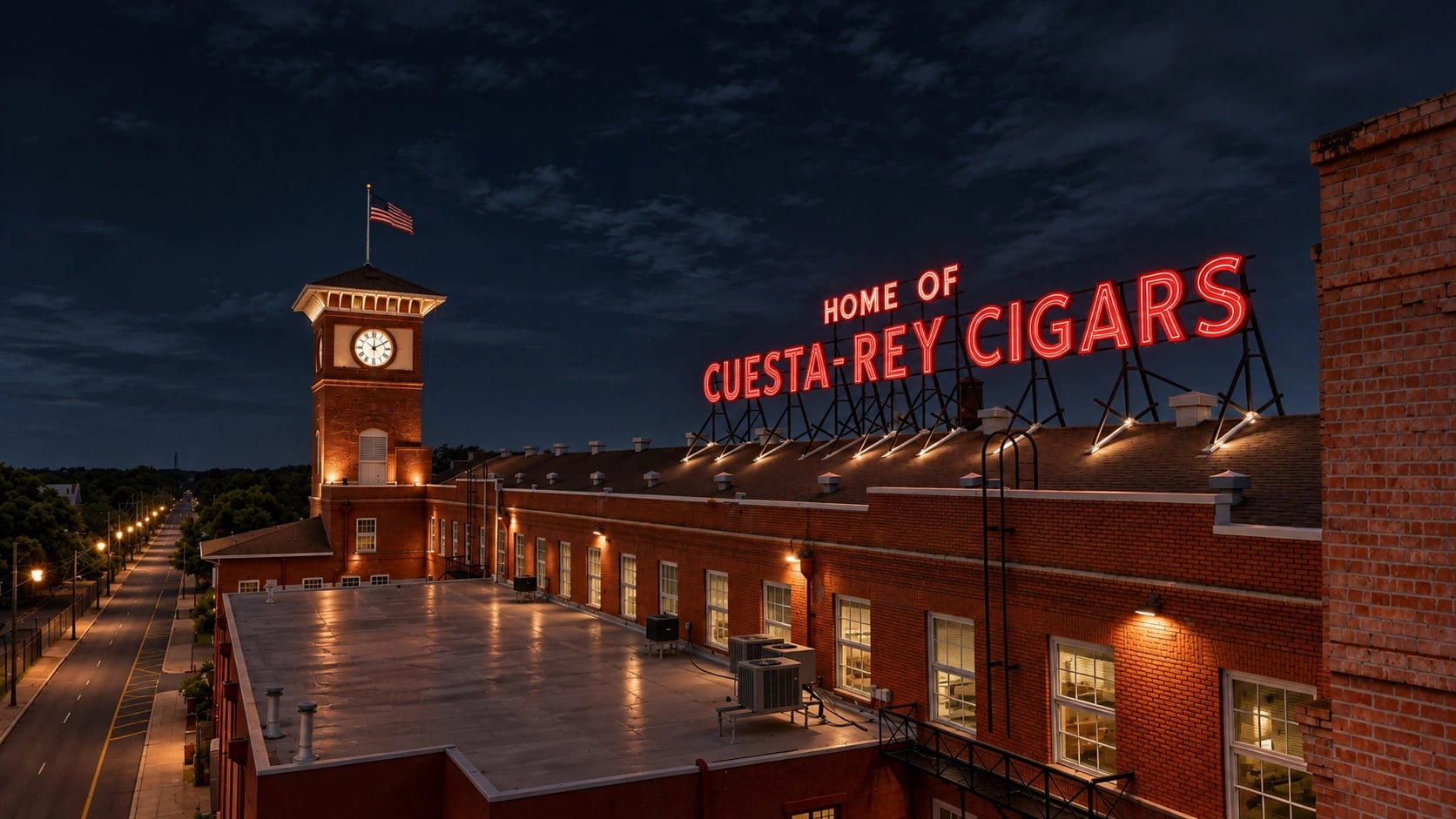
El Reloj, the J.C. Newman Cigar Factory, 2701 North Sixteenth Street