There are a couple of photographs associated with Gaspar's Grotto in Ybor City that have been attracting attention for years. At first glance, they might not look particularly unusual. One shows a young boy at the popular pirate-themed restaurant on Seventh Avenue. It's what appears around him that has people wondering whether someone else was present when the picture was taken.
According to the restaurant's former owner, Shere Schiller, the developed photograph appeared to show a pair of unusually long, ghostly hands surrounding the child. Nobody had noticed anything strange when the picture was taken, and the hands weren't immediately apparent until the image was examined afterward. The photograph became one of the establishment's most recognizable ghost stories, eventually earning a place among the pictures displayed inside the bar.
Schiller discussed the photograph with a local writer researching Ybor City's hauntings in 2011. During the same conversation, she described another recurring problem: patrons and employees occasionally heard noises coming from the rear of the bar when nobody was supposed to be there. The sounds were unsettling enough that people had apparently begun associating them with whatever might have appeared in the photographs.
Gaspar's Grotto doesn't have the same type of haunting associated with the Cuban Club or the former Don Vicente Inn. There isn't a widely documented murder connected to the business, and nobody has identified a particular former employee or customer whose spirit supposedly remains inside. The reported activity is less specific, which makes determining what might be happening considerably more difficult.
Still, there is something interesting about a busy bar in the middle of Ybor City's entertainment district developing a reputation for ghosts. Most visitors come for the food, drinks, live music, and pirate atmosphere. They probably aren't expecting to encounter anything supernatural, although some people have reported experiences that left them wondering.
The bar takes its name from José Gaspar, the legendary pirate whose supposed exploits along Florida's Gulf Coast inspired Tampa's annual Gasparilla celebration. As it turns out, the history of that pirate is almost as questionable as the photographs hanging inside the restaurant.
And while Gaspar's Grotto itself is relatively modern, the neighborhood surrounding it has a much longer history involving cigar workers, immigrants, gambling establishments, organized crime, and more than a few people who met violent ends.
The History of Gaspar's Grotto
Seventh Avenue Before the Pirates Arrived
To understand Gaspar's Grotto, it helps to understand how Ybor City's Seventh Avenue developed into one of Tampa's busiest entertainment districts.
The neighborhood was established in 1885 when Vicente Martínez-Ybor, a Spanish-born cigar manufacturer, decided to relocate his business from Key West to Tampa. Martínez-Ybor had operated factories in Cuba before moving to Florida, and he believed the Tampa area offered better transportation connections and more room to expand.
His decision proved successful. Within a few years, thousands of immigrants had arrived to work in the cigar factories that were being constructed throughout the neighborhood. Most came from Cuba, Spain, and Italy, although Ybor City also attracted Jewish immigrants from Eastern Europe, Chinese merchants, and people from other backgrounds.
By the beginning of the twentieth century, Ybor City had become one of the world's most important centers of cigar production. More than two hundred factories eventually operated throughout the Tampa area, producing hundreds of millions of cigars annually.
Seventh Avenue developed into the neighborhood's principal commercial street. While the factories provided employment, the businesses along Seventh Avenue supplied nearly everything workers and their families needed.
There were grocery stores, clothing shops, restaurants, bakeries, pharmacies, theaters, and saloons. Some catered to particular immigrant communities, while others attracted customers from throughout the neighborhood. Spanish, Italian, and Cuban establishments operated within a few blocks of one another, creating a commercial district unlike anything else in the American South at the time.
Saloons were particularly important gathering places.
For many cigar workers, finishing a shift meant stopping somewhere to have a drink, talk with friends, or discuss politics. Conversations about Cuba's struggle for independence, labor conditions, and events in Europe were common. Gambling also became an important part of the neighborhood's social life, sometimes operating openly despite laws prohibiting certain games.
The area's bars were more than places to purchase alcohol. They were part of a much larger social network connecting workers, business owners, political organizations, and families.
That atmosphere continued for decades, although the businesses themselves changed as Ybor City's population grew and eventually declined.
The Decline and Rebirth of Seventh Avenue
Ybor City began experiencing serious economic problems during the twentieth century as the cigar industry declined.
Mechanization reduced the demand for skilled hand-rollers, and changing consumer preferences made traditional cigars less profitable. Factories closed, workers lost their jobs, and many families relocated to other parts of Tampa.
The Great Depression accelerated the decline. Urban renewal and highway construction during the following decades destroyed portions of the historic neighborhood, including buildings that had stood since the early years of the cigar industry.
By the 1960s and 1970s, many of Seventh Avenue's former businesses had disappeared.
Some buildings remained occupied, but others were abandoned or deteriorating. The neighborhood that had once supported thousands of cigar workers was struggling to find a new economic purpose.
Preservation efforts eventually helped change its direction.
During the 1980s, artists, entrepreneurs, and developers began recognizing the potential of Ybor City's surviving historic buildings. The neighborhood's distinctive architecture, relatively inexpensive commercial spaces, and proximity to downtown Tampa made it attractive for new businesses.
The transformation accelerated during the 1990s.
Restaurants, bars, nightclubs, and entertainment venues moved into former commercial buildings. Seventh Avenue developed a nightlife reputation that attracted people from throughout the Tampa Bay area.
Some longtime residents welcomed the investment, while others worried that the new entertainment district was becoming disconnected from the immigrant culture that had made the neighborhood historically important.
The debate was understandable. A district built around cigar manufacturing was being transformed into a destination for drinking, dining, music, and tourism.
Gaspar's Grotto emerged during this period of redevelopment, combining the neighborhood's longstanding association with bars and restaurants with a very different Tampa tradition: pirates.
The Opening of Gaspar's Grotto
Gaspar's Grotto began operating under its familiar name in the early 2000s, with contemporary reporting placing Eric and Shere Schiller's involvement at approximately 2003.
The couple brought an unusual background to the restaurant business.
Eric Schiller had spent more than twenty years working as a captain aboard an oil tanker before retiring from that career in 1996. His maritime experience made the pirate theme particularly appropriate, although his professional life at sea involved considerably more legitimate activities than those attributed to José Gaspar.
The Schillers developed Gaspar's Grotto into a restaurant and bar built around Tampa's pirate traditions. Rather than limiting the theme to a few decorations, they filled the establishment with maritime memorabilia, pirate imagery, and references to the Gasparilla festival.
The business became known for live entertainment, rum tastings, themed parties, and an atmosphere that didn't take itself especially seriously.
In May 2007, Creative Loafing Tampa published a profile of the couple, describing their involvement in Ybor City and the numerous charitable events they had organized through the restaurant.
According to the article, the Schillers estimated that they had hosted at least two hundred fundraisers for local nonprofit organizations. Their efforts supported groups including the Cystic Fibrosis Foundation and the Center for Autism Related Disorders.
Shere was named Woman of the Year by the Leukemia & Lymphoma Society in 2006.
The restaurant was also home to an unusual mascot named Tanker Ray, a gray tabby cat the couple had rescued from the streets of Ybor City. The cat became a recognizable part of the establishment's personality, apparently developing a reputation for climbing trees and bothering dogs.
These details are worth remembering because Gaspar's Grotto was never intended to be a solemn historic attraction.
It was designed to be entertaining, sometimes outrageous, and unmistakably associated with Tampa's pirate culture.
Somewhere along the way, however, the bar acquired another reputation.
People began saying it was haunted.
What Was at Gaspar's Grotto Before It Opened?
One interesting piece of the property's history appears in an official Tampa City Council transcript from January 20, 2005.
During a discussion concerning permission for a sidewalk café, city officials reviewed the restaurant's existing operations and the surrounding businesses.
The testimony established that the property at 1805 East Seventh Avenue had previously operated as a bar called Harpo's.
One council member specifically recalled the transformation from Harpo's into Gaspar's Grotto, noting the addition of the pirate theme, live entertainment, and outdoor bar areas.
The public hearing also referenced an earlier operation called Coco's in connection with one of the property's patios.
This gives us a more accurate picture of the location's commercial history. Gaspar's Grotto didn't simply move into a building that had remained untouched since the cigar industry's earliest years. The property had already been adapted for entertainment and restaurant uses.
Public real estate records identify the present building as dating to approximately 1946, although additional architectural research would be required to determine whether portions of an earlier structure were incorporated into it.
That distinction matters because many haunted-building articles casually describe every business in Ybor City as occupying a nineteenth-century property.
Some do. Others don't.
The Cuban Club and Italian Club occupy historically documented buildings constructed during the early twentieth century. Gaspar's Grotto is located within the same historic district, but its individual building history is not nearly as well documented.
There is no reliable evidence connecting the property to an early cigar factory, a notorious nineteenth-century murder, or the death of an identifiable pirate.
None of that prevents people from reporting strange experiences there. It simply means the building's reported hauntings need to be considered on their own terms.
The Ghostly Hands in the Photographs
The best-known paranormal story associated with Gaspar's Grotto involves photographs that allegedly contain images of someone who wasn't present when the pictures were taken.
The earliest detailed account I could identify appeared on October 25, 2011, in a collection of Ybor City ghost stories published by MCFilm.
The writer had been speaking with local business owners and residents about strange experiences in the historic district. During that research, he interviewed Shere Schiller about paranormal activity at Gaspar's Grotto.
Schiller described photographs that appeared to show unusually long hands surrounding a young boy.
The writer characterized the images as unexplained and considered the apparent hands easy to identify once someone pointed them out.
The account doesn't provide enough information to reconstruct exactly when the photographs were taken, who took them, or the circumstances surrounding the picture.
It also doesn't identify the child.
Those details would be valuable because the photograph has become one of the principal reasons people consider the bar haunted.
Without them, we're left with the reported appearance of the image and the interpretation offered by people who examined it.
Who Was Standing Behind the Boy?
The implication of the photograph is straightforward.
If a pair of hands appears around a child, but nobody remembers a person standing behind him, someone or something may have been present without being noticed.
That's the interpretation that turned the picture into a ghost story.
Some accounts describe the hands as unusually elongated, giving them a distorted appearance that doesn't seem consistent with an ordinary person.
Others refer more generally to a ghostly figure or apparition appearing in photographs taken at the bar.
The exact appearance of the images is important, but the surviving published descriptions are inconsistent.
The paranormal directory Haunted Places reports that Gaspar's Grotto displayed two photographs believed by some visitors to contain evidence of ghosts. The site acknowledges that the images are open to interpretation and that ordinary photographic problems might explain them.
In a 2018 list of Tampa Bay's haunted locations, Creative Loafing also mentioned the bar's photographic evidence, describing an apparent apparition captured inside the establishment.
A later feature listing twenty-four haunted places in the Tampa Bay area repeated the story about ghostly hands appearing in pictures.
The photographs have therefore been associated with the bar for more than a decade.
But the reports raise several questions that haven't been adequately answered.
Were the images captured with a digital camera or traditional film? Was anyone standing close to the child when they were taken? Could the apparent hands belong to someone partially outside the camera's frame?
And what exactly does the photograph show?
Without the original image files or negatives, it's difficult to examine the evidence in a meaningful way.
A reproduction hanging on a wall might be interesting, but it isn't necessarily suitable for determining whether an unexplained figure appeared during the exposure.
Could the Photographs Have an Ordinary Explanation?
There are several reasons an ordinary photograph might contain something that appears supernatural.
Movement during a long exposure can produce blurred or distorted figures. A person shifting position while the camera's shutter remains open may appear unusually elongated, particularly when portions of the body are moving at different speeds.
Reflections are another possibility.
Gaspar's Grotto contains decorative surfaces, windows, mirrors, and various objects that can create confusing images when photographed under difficult lighting conditions.
A reflection might appear to occupy a position that doesn't correspond with the actual location of the person or object being reflected.
Digital cameras can also produce unusual artifacts when processing images taken in low light.
None of these possibilities establishes what happened in the Gaspar's Grotto photographs.
The point is that an apparently unexplained image isn't automatically evidence of a ghost.
The strongest way to evaluate the photographs would be to obtain the original files, identify the camera and exposure conditions, and interview whoever took them.
At present, the available public accounts don't provide that level of detail.
There is also disagreement among people who have examined the images.
A commenter on the Haunted Places listing in October 2016 argued that the photographs displayed inside the bar were fake and referred readers to a video discussing them.
The site's comments don't establish that the images were fabricated, but they demonstrate that not everyone who has examined the photographs considers them convincing.
The images remain an interesting part of the bar's history precisely because people disagree about what they're seeing.
The Strange Noises in the Back of Gaspar's Grotto
The photographs aren't the only reason Gaspar's Grotto appears on lists of supposedly haunted locations.
During the same 2011 interview, Shere Schiller described noises that customers and employees reportedly heard coming from the rear of the establishment.
The unusual part wasn't necessarily the sounds themselves. A restaurant and bar is filled with equipment, people, music, and activity that can produce unexpected noises.
What made the incidents memorable was that the sounds supposedly continued when the area was empty.
Employees would hear something coming from the back of the business, apparently indicating that someone was moving around or handling objects. When they investigated, nobody was there.
The reports were not limited to one person.
According to the published account, both patrons and employees had experienced the disturbances.
That doesn't establish that everyone heard the same thing or that the noises had a supernatural cause. The account doesn't include individual witness names, exact dates, or descriptions detailed enough to identify what produced the sounds.
But it does suggest that the story wasn't based exclusively on a single unexplained photograph.
People working inside the business believed something unusual was happening in an area where they wouldn't have expected anyone to be.
Why the Back of a Bar Can Sound Haunted
Gaspar's Grotto is located on Seventh Avenue, where restaurants and entertainment establishments operate in close proximity.
Noise from adjoining businesses, outdoor patios, live entertainment, deliveries, and ordinary street activity can carry through commercial buildings in ways that are difficult to identify.
The restaurant itself contains multiple indoor and outdoor areas, with different spaces operating simultaneously.
Mechanical systems, refrigeration equipment, ventilation, doors, and kitchen operations can also produce sounds that seem to originate somewhere other than their actual source.
An employee hearing an unexpected noise after closing might reasonably investigate and discover that nobody is present. That doesn't necessarily mean the sound was imaginary or supernatural.
It may simply mean the source wasn't obvious.
What's missing from the published reports is a sufficiently detailed description of the noises.
Were they footsteps? Knocking? Objects moving? Voices?
Without that information, there isn't enough evidence to connect the disturbances to a particular type of activity, much less to a deceased person.
The story has nevertheless persisted because it offers something the photographs don't: repeated experiences reported by people who spent time inside the business.
For employees who have to walk into an empty rear room after hearing something unexpected, the absence of an explanation may be more unsettling than any photograph hanging on the wall.
Another Unusual Encounter at Gaspar's Grotto
A separate account appeared on the Haunted Places website on September 5, 2016.
A visitor named Kathy Hartzell described having lunch at Gaspar's Grotto with a small Chihuahua.
The group was sitting in an alcove near the front of the restaurant when the dog began behaving strangely. Hartzell reported that the animal was trembling, with its eyes rolling upward.
The dog had apparently experienced seizures before, and the people accompanying it initially suspected that another medical episode might be occurring.
They decided to move outside to the patio.
According to Hartzell, the dog's behavior improved once it was away from the interior of the building, although it continued looking toward the restaurant.
Hartzell returned to take a photograph and later noticed something unusual in the image. She examined the area for an apparent light source but said she couldn't identify one that explained what she saw.
The account is unusual because the witness didn't immediately interpret the dog's behavior as paranormal.
The animal's medical history suggested a much more ordinary explanation, which Hartzell acknowledged in her description.
Only after leaving the interior and examining the photograph did the experience acquire a possible supernatural interpretation.
There is no evidence that the dog's behavior was caused by a ghost, and the reported symptoms could be consistent with an ordinary medical problem.
Animals may react to unfamiliar sounds, smells, people, or environments that their owners don't notice.
Still, the experience was memorable enough that Hartzell submitted it to a paranormal directory five years after the earlier account involving Schiller.
It's another example of how Gaspar's Grotto acquired its haunted reputation through individual experiences rather than one widely recognized historical tragedy.
Who Is Haunting Gaspar's Grotto?
This is probably the most difficult question to answer about the bar.
Unlike some haunted locations in Ybor City, Gaspar's Grotto doesn't have an identifiable ghost associated with a documented former occupant.
The Cuban Club has a story about a murdered man that can be connected to an actual fatal shooting in 1934.
The Italian Club's most recognizable apparition is reportedly Paolo Longo, a former president whose life and contributions to the organization are well documented.
The former Don Vicente Inn has several named spirits associated with its years as a medical clinic, although many details of those stories remain unverified.
Gaspar's Grotto is different.
The photographs don't establish the identity of the apparent hands. The noises heard in the rear of the bar haven't been connected to a particular individual, and the account involving the Chihuahua provides no identifiable spirit.
There is no established historical record of a murder, fatal accident, or other death at the restaurant that would explain the reported activity.
Of course, that doesn't mean people couldn't have experienced something unusual.
It means the haunting remains unidentified.
One possibility is that the reputation developed through a combination of ambiguous photographs, strange sounds, and Ybor City's existing association with paranormal activity.
The neighborhood already had several famous haunted locations by the time Gaspar's Grotto opened.
Ghost tours were discussing the Cuban Club, the old hospitals, theaters, and other buildings along Seventh Avenue. Visitors were familiar with the idea that the historic district might contain spirits.
When unexplained photographs appeared at Gaspar's Grotto, they naturally became part of that larger collection of stories.
Another possibility is that the reported experiences are connected to people who occupied the property before the pirate bar opened.
The location had previous commercial uses, and the surrounding neighborhood has been occupied for generations.
However, there is no reliable evidence identifying a former occupant as the source of the haunting.
Rather than inventing a connection, the most accurate conclusion is that the identity of the supposed ghost remains unknown.
The bar has a reputation for paranormal activity. It does not have a confirmed ghost with a documented biography.
José Gaspar: The Pirate Behind the Name
Gaspar's Grotto is named after José Gaspar, also known as Gasparilla, the legendary pirate who supposedly terrorized ships along Florida's Gulf Coast during the late eighteenth and early nineteenth centuries.
According to the traditional story, Gaspar was born in Spain and served in the Spanish Navy before becoming an outlaw.
His transformation into a pirate is explained differently depending on which account is being told.
Some versions claim he was involved in a romantic scandal at the Spanish royal court. Others suggest that he committed a serious offense while serving in the navy and fled to escape punishment.
Whatever caused his departure, the legend places him aboard a pirate ship operating in the waters surrounding Florida.
Gaspar supposedly established a base on an island near Charlotte Harbor, where he and his crew could attack passing vessels, conceal stolen goods, and hold prisoners.
The island became associated with his name, eventually inspiring the familiar place names Gasparilla Island and Gasparilla Pass.
Over the years, the stories became increasingly elaborate.
Gaspar was said to have accumulated enormous treasures by attacking merchant vessels. Some accounts describe him capturing wealthy passengers and demanding ransom, while others allege that women were held captive on the island.
According to the legend, he commanded a pirate ship known as the Floridablanca and operated for decades before meeting his end in 1821.
His final encounter supposedly occurred when the United States Navy approached his ship near Charlotte Harbor.
Gaspar attacked what he believed was an ordinary merchant vessel, only to discover that it was the American warship USS Enterprise.
Facing defeat, he reportedly refused to surrender. Instead, he wrapped himself in an anchor chain and threw himself into the water, drowning rather than allowing the Americans to capture him.
It's an excellent pirate story, and it has been told in Tampa for generations.
There's just one problem.
Historians have been unable to establish that José Gaspar ever existed.
Was José Gaspar a Real Pirate?
Researchers have examined Spanish naval records, American military documents, contemporary newspapers, and other historical materials in an attempt to find evidence of Gaspar's activities.
They haven't found convincing documentation.
There is no established record of a Spanish naval officer named José Gaspar commanding a pirate ship along Florida's Gulf Coast during the period described in the legend.
There are also problems with the account of his final battle.
The USS Enterprise was a real American naval vessel, and the United States Navy did conduct operations against pirates in the Caribbean during the early nineteenth century.
But the ship's documented movements don't support the story of its supposed battle with Gaspar near Charlotte Harbor in 1821.
Historical research discussed by Spectrum Bay News 9 indicates that the Enterprise was operating near Cuba during the period when the legendary encounter supposedly occurred.
Even the origin of Gaspar's name is uncertain.
A frequently repeated explanation involves Juan Gomez, a man who lived in southwest Florida and claimed to have been a member of Gaspar's crew.
Gomez reportedly told stories about his experiences with the pirate when he was more than a hundred years old.
His extraordinary age and the absence of supporting historical records make his testimony difficult to evaluate.
Another important source was promotional material associated with the Gasparilla Inn on Gasparilla Island during the early twentieth century.
The pirate story appeared in material intended to attract visitors to the area, and the account helped popularize the idea that the island had once served as a pirate headquarters.
Historians have since suggested that much of the legend was developed or embellished for tourism.
Brad Massey, a curator at the Tampa Bay History Center, discussed these problems in a 2021 Smithsonian Magazine article examining the origins of the pirate tradition.
The conclusion is that Gaspar may have been entirely fictional.
Real pirates certainly operated in the Caribbean and Gulf of Mexico. Florida's coastal waters were not immune to piracy, particularly during periods when European colonial governments struggled to maintain control.
But the existence of actual pirates doesn't establish that José Gaspar was one of them.
His story has survived because people enjoy it, not because historians have verified his career.
How a Fictional Pirate Became Tampa's Most Famous Outlaw
By the beginning of the twentieth century, Tampa's civic leaders were searching for ways to make the city's annual May Day celebration more interesting.
One person involved was Louise Frances Dodge, the society editor of The Tampa Tribune.
Dodge worked with George Hardee, a New Orleans native employed by the United States Customs Service, to develop a new attraction inspired partly by Mardi Gras.
Their idea was to stage a pirate invasion.
The organizers selected Gasparilla as the central character and recruited local businessmen to participate in the festivities.
The group eventually became known as Ye Mystic Krewe of Gasparilla.
In May 1904, approximately fifty members dressed as pirates and joined Tampa's May Festival parade.
The first invasion was theatrical rather than violent, with participants riding horses through the city before attending a formal celebration.
The public enjoyed it.
The event grew in popularity, eventually becoming one of Florida's largest annual festivals.
The modern Gasparilla Pirate Festival includes an elaborate invasion by water, with a replica pirate ship leading a fleet into Tampa.
Thousands of people participate in the celebration, and the pirate theme appears throughout the city's businesses, sports teams, festivals, and commercial attractions.
Gaspar's Grotto is part of that tradition.
Its pirate-themed decorations and name celebrate a character who has become deeply embedded in Tampa's identity, regardless of whether he was ever a real person.
The restaurant isn't claiming to occupy one of Gaspar's actual hideouts, and there is no evidence connecting the legendary pirate to the property on Seventh Avenue.
But the name gives the establishment a recognizable connection to Tampa's best-known folklore.
For a business that also happens to have its own ghost stories, the connection is appropriate.
Both the pirate legend and the haunting rely on accounts that people continue discussing despite uncertainty about the underlying events.
From Gasparilla Parties to a Haunted Local Landmark
Gaspar's Grotto has been part of Ybor City's entertainment scene for more than two decades.
During that time, it has developed a reputation as a destination for live music, themed celebrations, food, drinks, and events associated with Tampa's annual pirate festival.
The establishment's interior reflects that identity. Nautical decorations, model ships, bells, and other maritime memorabilia give the rooms an appearance inspired by traditional seafaring taverns.
A June 2025 feature published by That's So Tampa described the extensive collection of ship bells displayed inside the restaurant, along with the opportunity for visitors to ring them.
The venue also offers outdoor dining and entertainment areas, making it a popular gathering place during warm Florida evenings.
That lively atmosphere makes the haunting reports somewhat unusual.
Many supposedly haunted buildings are abandoned structures, empty hospitals, or historic homes where visitors expect an unsettling atmosphere.
Gaspar's Grotto is an active restaurant and bar.
People gather there to eat, drink, listen to music, and spend time with friends. The building is rarely associated with the sort of isolation that makes abandoned properties seem frightening.
Yet the stories of ghostly hands and unexplained noises have continued circulating.
The bar has appeared in multiple lists of Tampa Bay's haunted locations, including articles published by Creative Loafing in 2018 and more recently.
That attention has made it recognizable to people interested in paranormal attractions, even though the business doesn't operate primarily as a haunted destination.
Its reputation developed alongside the broader interest in Ybor City's supernatural history.
And while the restaurant's pirate theme is deliberately theatrical, its ghost stories appear to have originated from people describing experiences they considered unusual rather than from an elaborate fictional backstory created for the business.
The distinction is worth making.
A restaurant can embrace its reputation for being haunted without inventing an entire history of murders, accidents, and deceased former patrons.
In Gaspar's Grotto's case, the photographs and the accounts from employees provide the foundation for the story.
Whether they indicate anything supernatural remains unresolved.
Is Gaspar's Grotto Really Haunted?
The available evidence for Gaspar's Grotto's haunting is limited, but it isn't entirely anonymous.
Shere Schiller was identified by name in a 2011 account describing the photographs and the unexplained noises reported at the restaurant.
Those statements establish that the stories were circulating while the business was operating under the Schillers' ownership.
The photographs also attracted attention from later writers and paranormal websites, making them a recognizable part of the establishment's reputation.
Additional visitor accounts, including the 2016 report involving a Chihuahua behaving strangely inside the restaurant, suggest that some patrons have interpreted their own experiences as potentially supernatural.
None of these reports establishes that a ghost is present.
The photographs haven't been independently authenticated as evidence of paranormal activity, and the sounds reported in the back of the bar haven't been connected to an identifiable source.
There is also no established historical death that provides an explanation for the alleged haunting.
That last point distinguishes Gaspar's Grotto from some other haunted locations in Ybor City.
In the case of the Cuban Club, there is a documented fatal shooting that can be compared with one of its most famous legends.
For Gaspar's Grotto, there isn't a comparable historical incident.
The bar's reputation rests primarily on reported experiences.
That doesn't necessarily make the stories uninteresting. It simply means we have less information to work with when trying to understand what might have happened.
The photographs are probably the most useful starting point for anyone interested in investigating the location.
If the original images could be examined, it might be possible to identify an ordinary photographic explanation for the supposed hands.
The noises would be more difficult to investigate without knowing exactly when they occurred, what they sounded like, and whether employees noticed any patterns.
An investigation would also need to account for the considerable amount of sound produced by neighboring businesses and the restaurant's own equipment.
There may be perfectly ordinary explanations for everything people have reported.
But the experiences were apparently unusual enough that they continued to be discussed years after they occurred.
For now, Gaspar's Grotto belongs among Ybor City's reputedly haunted establishments, although the identity of its supposed spirit and the cause of the reported activity remain unknown.
Visiting Gaspar's Grotto in Ybor City
Gaspar's Grotto is located at 1805 East Seventh Avenue in Tampa's historic Ybor City neighborhood, between Eighteenth and Nineteenth Streets.
Unlike many of the historic buildings associated with Ybor City's ghost stories, Gaspar's Grotto is an operating restaurant and bar that welcomes customers.
The establishment offers indoor dining, outdoor patio spaces, live entertainment, and a menu influenced by the neighborhood's Cuban and Latin culinary traditions.
Its pirate decorations are part of the experience, including nautical memorabilia and references to Tampa's Gasparilla celebration.
Visitors interested in the bar's reputed hauntings may want to ask about the photographs that have been associated with its paranormal reputation. Historical accounts indicate that the images were displayed inside the restaurant, although their current location and availability have not been independently confirmed.
The business can be contacted through its official website, which also provides information about current hours, events, and dining options.
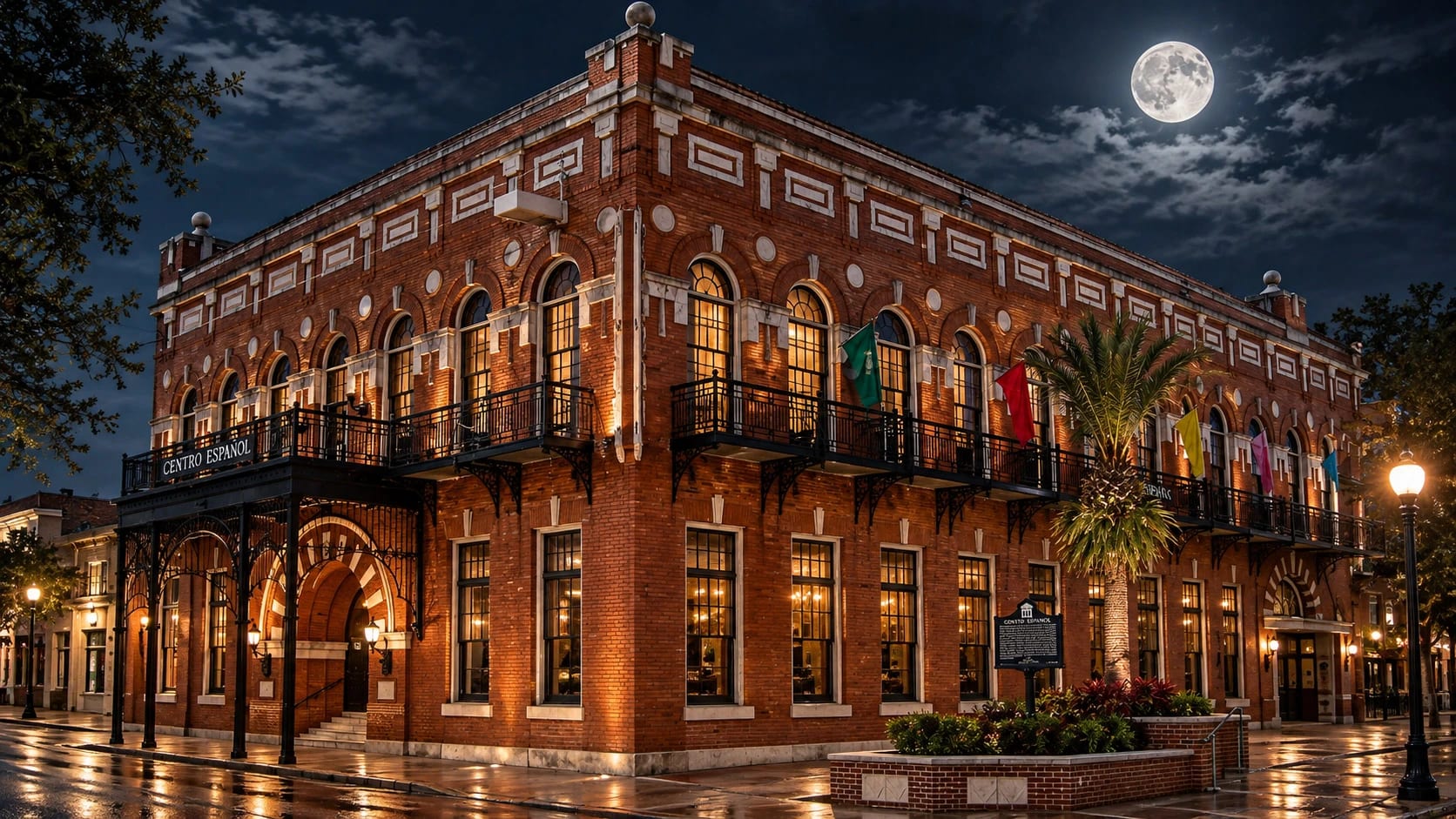
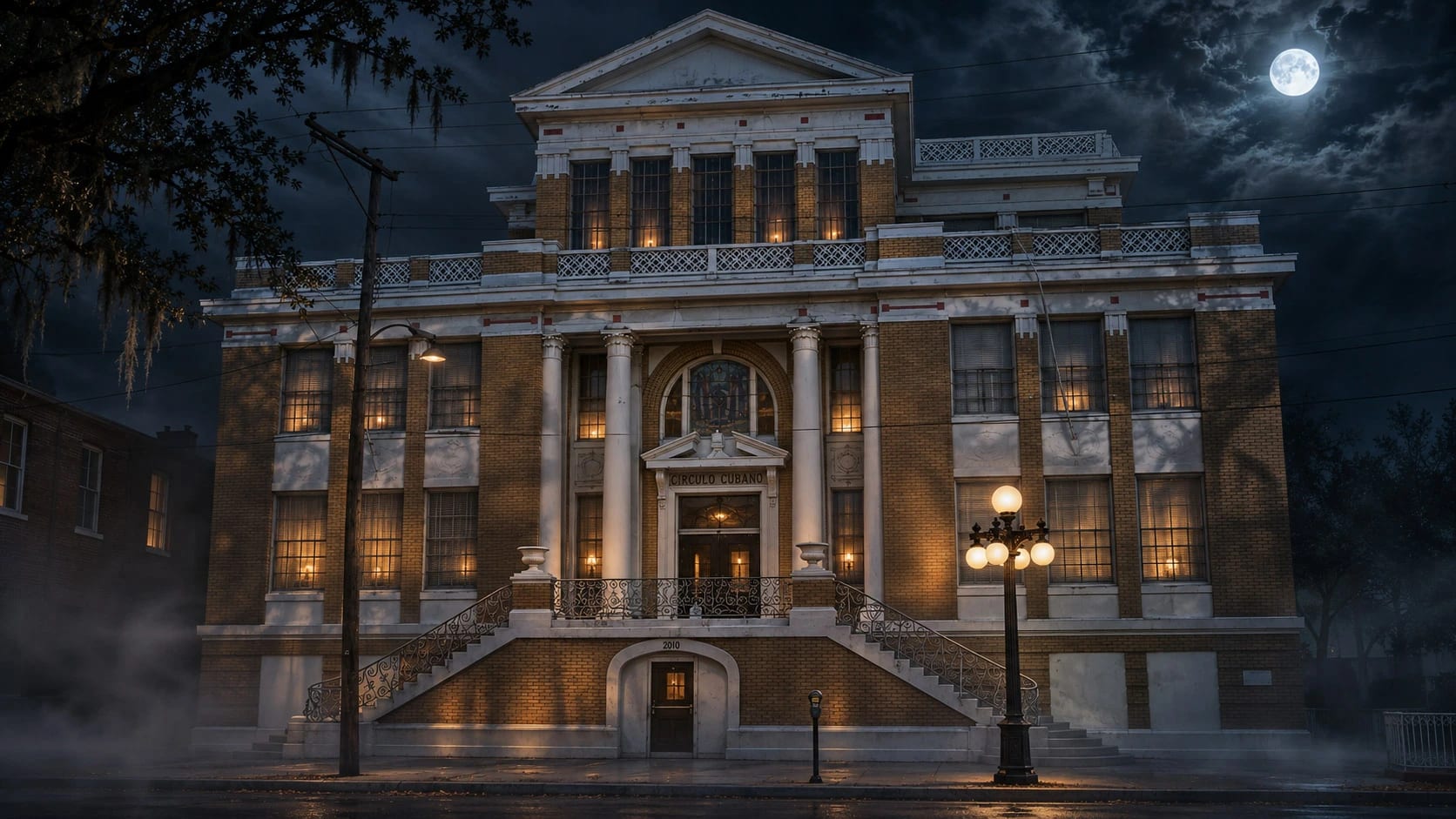
Gaspar's Grotto is located within walking distance of several other historically significant Ybor City buildings, including the Italian Club, Cuban Club, and Centro Español.
Together, these properties illustrate different periods in the neighborhood's development.
The older social clubs represent the immigrant organizations that helped establish Ybor City, while Gaspar's Grotto is part of the entertainment economy that emerged during the neighborhood's late twentieth-century revival.
They also happen to share something else.
All have developed reputations for being haunted.
Explore the Haunted History of Ybor City With Ghost City Tours
Gaspar's Grotto is one of several establishments along Seventh Avenue associated with unusual photographs, unexplained sounds, or reports of supernatural activity.
Elsewhere in the neighborhood, the stories become considerably darker. The Cuban Club is associated with several supposed apparitions and an actual fatal shooting in 1934. The old Don Vicente Inn became famous for its hospital-related ghost stories, while other buildings have connections to Ybor City's long history of gambling, organized crime, and violence.
Ghost City Tours explores these stories through guided walking experiences that introduce visitors to the people and events responsible for shaping Tampa's historic cigar district.
Our Ghosts of Ybor City Tour is an all-ages experience focused on the neighborhood's immigrant history, historic buildings, and supernatural traditions.
For visitors interested in the city's more disturbing past, The Darkness Between Us Ghost Tour explores Ybor City's criminal underworld, violence, and darker ghost stories. This experience is designed for guests sixteen and older.
Both tours take place along the historic streets of Ybor City, where the original factories, clubs, and commercial buildings provide the setting for stories that have been told for generations.
Explore our Ybor City Ghost Tours and discover the history and hauntings that have made this neighborhood one of Tampa's most interesting places to visit after dark.
Frequently Asked Questions About the Haunted Gaspar's Grotto
Is Gaspar's Grotto in Ybor City haunted?
Gaspar's Grotto has a reputation for paranormal activity, including photographs that allegedly show ghostly hands surrounding a child and unexplained noises heard in the rear of the restaurant. Former owner Shere Schiller discussed these experiences in a published account from 2011. The reports have not been independently verified as supernatural events.
What is the ghost in the Gaspar's Grotto photographs?
The photographs reportedly show unusually long hands near a young boy, even though no unidentified person was noticed when the picture was taken. The identity of the supposed apparition remains unknown, and there is insufficient information available to determine whether the image resulted from an ordinary photographic effect.
Are the ghost photographs still displayed at Gaspar's Grotto?
Published accounts indicate that the restaurant displayed photographs associated with its reported hauntings. However, their current location and whether they remain on display have not been independently confirmed.
Has anyone died at Gaspar's Grotto?
No specific fatal incident has been reliably established as the source of the restaurant's reported hauntings. The available ghost stories do not identify a particular deceased employee, customer, or former occupant whose spirit supposedly remains in the building.
When did Gaspar's Grotto open?
Gaspar's Grotto developed under its familiar pirate-themed identity during the early 2000s. Contemporary reporting places Eric and Shere Schiller's involvement at approximately 2003. The property previously operated as a bar called Harpo's, according to a 2005 Tampa City Council transcript.
Was José Gaspar a real pirate?
Historians have not found convincing evidence that José Gaspar, the pirate associated with Tampa's Gasparilla celebration, actually existed. His story appears to have developed through regional folklore and early twentieth-century promotional accounts.
Is Gaspar's Grotto still open?
Yes. Gaspar's Grotto continues operating as a pirate-themed restaurant and bar at 1805 East Seventh Avenue in Ybor City. Visitors should consult the restaurant's official website for current hours, events, and dining information.
Can you visit Gaspar's Grotto on a ghost tour?
Gaspar's Grotto is located within Ybor City's historic entertainment district, where Ghost City Tours offers guided walking tours exploring the neighborhood's history and hauntings. Tour routes and individual stops may vary, so visitors should not assume that a particular tour includes an interior visit to the restaurant.
Historical References and Sources
1. MCFilm — Ybor Lore & Ghost Stories, 2011
MCFilm — Ybor Lore & Ghost Stories, 2011
October 25, 2011. The most important source for Gaspar's Grotto's reported hauntings. The author describes speaking directly with former owner Shere Schiller about photographs appearing to show long hands around a young boy and unexplained noises heard in the rear of the establishment.
2. Creative Loafing Tampa — The 24 Most Haunted Places in Tampa Bay
Creative Loafing Tampa — The 24 Most Haunted Places in Tampa Bay
A local collection of haunted locations that includes Gaspar's Grotto, its reported ghost photographs, and noises heard by employees and customers. Demonstrates the continued circulation of the haunting stories.
3. Creative Loafing Tampa — Top 7 Haunted Spots in Tampa Bay
Creative Loafing Tampa — Top 7 Haunted Spots in Tampa Bay
October 2018. Identifies Gaspar's Grotto among Tampa Bay's haunted locations and discusses photographic evidence allegedly showing an apparition inside the bar.
4. Haunted Places — Gaspar's Grotto
Haunted Places — Gaspar's Grotto
Paranormal-location directory describing two photographs historically displayed inside the restaurant. Includes visitor comments, a September 2016 report involving a Chihuahua behaving strangely, and skeptical responses to the alleged ghost images.
5. Creative Loafing Tampa — Eric and Shere Schiller
Creative Loafing Tampa — Eric and Shere Schiller
Alex Pickett, May 9, 2007. A profile of the former Gaspar's Grotto owners, including Eric Schiller's maritime career, their charitable fundraising, the restaurant's pirate theme, and its early years of operation.
6. Tampa City Council — January 20, 2005 Meeting Transcript
Tampa City Council — January 20, 2005 Meeting Transcript
Official city government transcript documenting the operation of Gaspar's Grotto at 1805 East Seventh Avenue. The discussion of a sidewalk café includes references to the property's prior use as Harpo's, outdoor entertainment areas, and the transition to a pirate-themed establishment.
7. Gaspar's Grotto — Official Website
Gaspar's Grotto — Official Website
Current information about the restaurant's location, pirate theme, entertainment, indoor and outdoor dining areas, and ongoing operations.
8. That's So Tampa — Gaspar's Grotto Is an Ybor City Treasure
That's So Tampa — Gaspar's Grotto Is an Ybor City Treasure
Aaron Styza, June 3, 2025. A contemporary description of the restaurant's atmosphere, maritime memorabilia, collection of ship bells, and different bar and patio spaces.
9. Tampa Bay Business & Wealth — How Three Tampa Bay Businesses Are Getting Into the Pirate Spirit
Tampa Bay Business & Wealth — How Three Tampa Bay Businesses Are Getting Into the Pirate Spirit
January 25, 2022. Documents the restaurant's longstanding involvement with Tampa's Gasparilla celebrations and includes comments from owner Eric Schiller.
10. Smithsonian Magazine — The True History and Swashbuckling Myth Behind the Tampa Bay Buccaneers' Namesake
Nora McGreevy, February 4, 2021. A detailed examination of the José Gaspar legend, including historical research questioning the pirate's existence and the development of Tampa's modern Gasparilla tradition.
11. Spectrum Bay News 9 — The Man Behind Gasparilla: Who Was José Gaspar?
Spectrum Bay News 9 — The Man Behind Gasparilla: Who Was José Gaspar?
January 12, 2023. Investigates the historical evidence surrounding José Gaspar, including the absence of records documenting his existence and inconsistencies involving the USS Enterprise.
12. WUSF — The History of Gasparilla and Its Mystic Pirates
WUSF — The History of Gasparilla and Its Mystic Pirates
January 22, 2019. Public-radio reporting on the creation of Tampa's first pirate invasion in 1904, the involvement of Louise Frances Dodge and George Hardee, and the origins of Ye Mystic Krewe of Gasparilla.
13. Tampa Magazine — A Treasured History: The Story of Gasparilla
Tampa Magazine — A Treasured History: The Story of Gasparilla
Rodney Kite-Powell, January 24, 2022. Historical research concerning the development of the Gasparilla festival, José Gaspar's legend, the early promotional stories, and the first organized pirate invasion.
14. Hillsborough County — Faces Behind the Places: José Gaspar
Hillsborough County — Faces Behind the Places: José Gaspar
Official county historical material discussing the legendary pirate, uncertainty surrounding his existence, and the development of Tampa's annual Gasparilla festival.
15. National Park Service — Ybor City Historic District
National Park Service — Ybor City Historic District
Federal historical overview describing the development of Ybor City, its immigrant population, the cigar industry, Seventh Avenue's commercial importance, and the neighborhood's decline and subsequent preservation.
16. Library of Congress — Birth of Ybor City, the Cigar Capital of the World
Library of Congress — Birth of Ybor City, the Cigar Capital of the World
Historical research concerning Vicente Martínez-Ybor, the establishment of Tampa's cigar district, immigrant communities, and the neighborhood's transformation during the twentieth century.
17. City of Tampa — Ybor City History
City of Tampa — Ybor City History
Official municipal overview of the historic district's origins, cigar-manufacturing era, economic decline, and revitalization as a commercial and entertainment destination.
18. Compass — 1805 East Seventh Avenue Property Record
Compass — 1805 East Seventh Avenue Property Record
Public real estate information identifying the Gaspar's Grotto property's reported construction year as 1946. Useful for distinguishing the current building from the older nineteenth-century structures elsewhere in Ybor City.
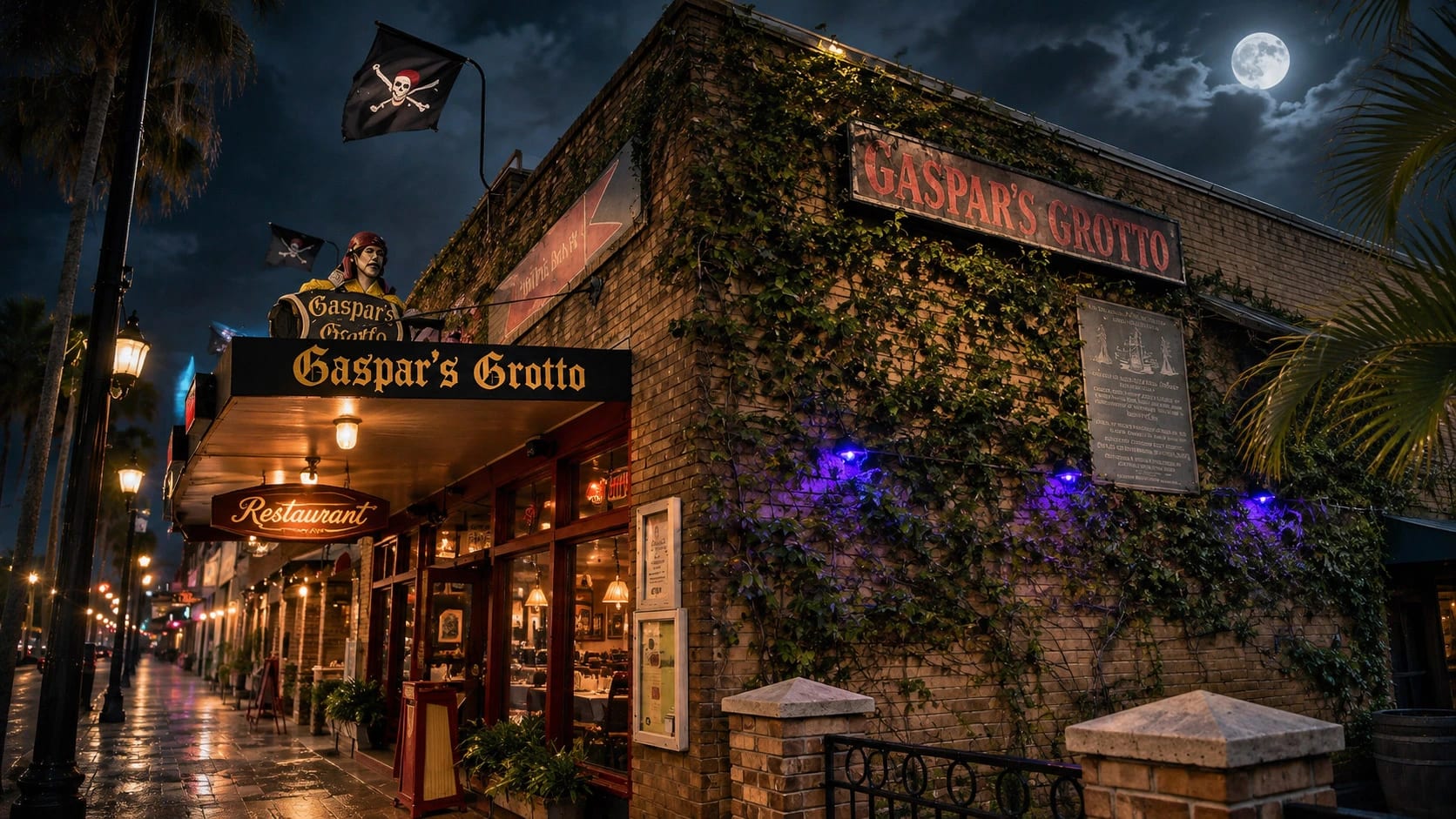
Gaspar's Grotto, the pirate-themed bar at 1805 East Seventh Avenue in Ybor City