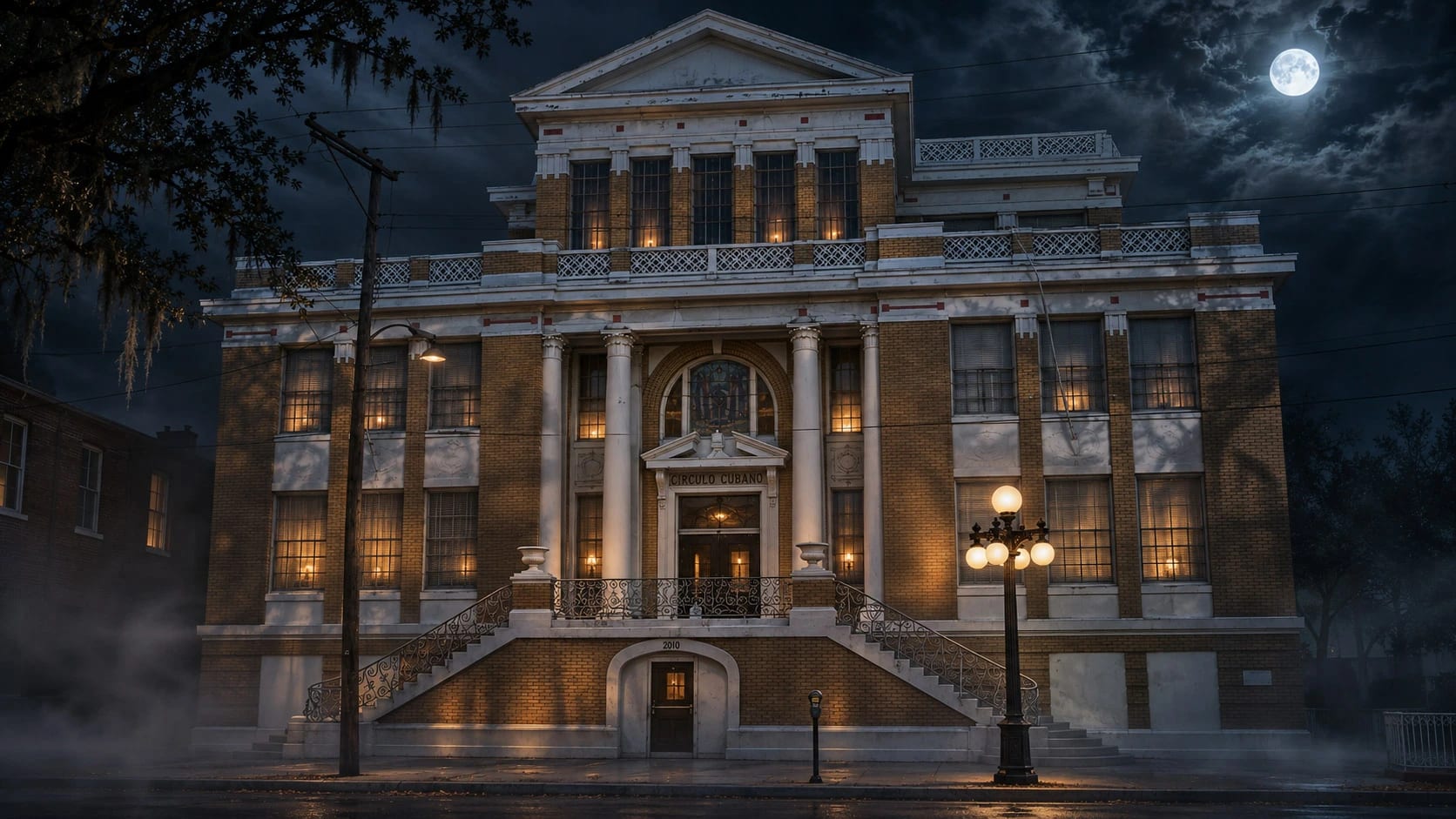
In October 2011, the owners of a sixteen-room hotel in Ybor City invited television viewers to spend an evening exploring one of Tampa's most unsettling ghost stories. The occasion was a screening of The Dead Files, a paranormal investigation series that had recently visited the property. Guests were encouraged to arrive dressed as doctors and nurses, an appropriate choice considering the building's former life as a medical clinic.
The episode had a memorable title: "Hotel Hell."
For years, people who stayed at the Don Vicente de Ybor Historic Inn had reported experiences they could not explain. Faucets allegedly turned on without anyone touching them. Footsteps echoed through empty corridors. Guests described the unnerving sensation of waking to find an unfamiliar figure standing beside their beds.
In the basement, where a stylish lounge had replaced the utilitarian rooms of an old medical facility, stories circulated about a mysterious Spanish nurse who appeared without warning. Some witnesses described an elderly woman; others remembered a stern figure wearing an old-fashioned ornament in her hair. She was said to emerge suddenly from the darkness before disappearing just as quickly.
Then there was the story of a doctor whose son supposedly used the clinic for something considerably more disturbing than treating patients.
According to local legend, the young man secretly impersonated his physician father, lured women into the building, and subjected them to fatal experiments. Their bodies, the story claimed, were destroyed in an incinerator hidden beneath the clinic.
Those allegations have never been substantiated by reliable historical evidence. Nevertheless, they helped transform the Don Vicente from an elegant boutique hotel into one of the most recognizable haunted locations in Tampa.
What makes the property particularly fascinating is that the real history is almost as remarkable as the folklore. The building began as part of the commercial empire responsible for creating Ybor City, became a center of immigrant medical care, survived years of abandonment, and eventually reopened as an opulent hotel.
Its patients, physicians, workers, and guests came from different generations of Tampa history. Some people believe a few of them never left.
The History of the Don Vicente Inn
Vicente Martínez-Ybor and the Birth of Ybor City
The history of the Don Vicente begins long before anyone called it a haunted hotel.
During the 1880s, Tampa was a relatively small Florida community whose economic future was far from certain. Its transformation began when Spanish-born cigar manufacturer Vicente Martínez-Ybor decided to relocate his business from Key West to the Tampa area.
Martínez-Ybor had spent much of his career building a cigar-manufacturing enterprise. Born in Valencia, Spain, in 1818, he moved to Cuba as a young man and eventually established his own factory in Havana. Political instability surrounding Cuba's struggle for independence from Spain prompted his relocation to Key West, where he continued manufacturing cigars.
Key West presented difficulties of its own. Labor disputes, transportation problems, and the limitations of island geography made expansion increasingly challenging.
Tampa offered an appealing alternative. The arrival of railroad service provided a connection to markets farther north, while access to the Gulf of Mexico made the region attractive for receiving tobacco and shipping finished products.
In 1885, Martínez-Ybor purchased land northeast of Tampa and began developing what would become Ybor City.
His ambitions extended beyond building a factory. He envisioned an entire community where employees could live and work. Houses, stores, transportation infrastructure, and recreational facilities developed around the cigar industry.
The first major cigar factory opened in 1886, and other manufacturers soon followed.
Thousands of immigrants arrived from Cuba, Spain, and Italy. They brought distinct languages and traditions, but the cigar industry gave the neighborhood a common economic foundation. Within a relatively short period, Ybor City became one of the most important centers of hand-rolled cigar production in the world.
Martínez-Ybor did not manage the development alone. One of his important business associates was Eduardo, or Edward, Manrara, a businessman and financial adviser who helped oversee the expanding enterprise.
The two men's influence became embedded in the neighborhood's physical landscape. Their names appeared on factories, businesses, and properties developed during Ybor City's earliest decades.
One of those properties would eventually become the Don Vicente Inn.
La Casa Manrara: The Building Before the Hotel
The structure at 1915 Avenida República de Cuba originally belonged to a very different era of Ybor City's history.
For many years, accounts of the Don Vicente claimed that Vicente Martínez-Ybor personally constructed the building in 1895. The date appears in architectural guides, hotel histories, and numerous articles about the property's hauntings.
There is, however, a discrepancy in the historical documentation.
The National Park Service's registration materials for the Ybor City Historic District identify the building as La Casa Manrara, dating its original construction to 1901. The document explains that the property was named for Edward Manrara and housed the offices of the Ybor Land and Improvement Company.
Martínez-Ybor died on December 14, 1896. If the federal historic-register date is correct, the building was completed several years after his death, rather than constructed personally by him.
City of Tampa preservation records use the earlier 1895 date.
Resolving the discrepancy would require examining contemporary construction permits, property records, and early insurance maps. What is clear is that the building was associated with the business interests responsible for Ybor City's original development.
Its position was important. Standing near the intersection of Ninth Avenue and Fourteenth Street, the property faced the enormous Ybor cigar factory complex, a focal point of the community's working life.
Historic Sanborn maps provide further information about the building's early uses. According to records presented by Tampa's historic-preservation staff in 2019, the ground floor contained commercial businesses, including a drugstore and a furniture store, while residential accommodations occupied portions of the upper level.
The building originally had substantial balconies and commercial storefronts. Its appearance changed over time as owners adapted it to different needs.
In 1930, the property underwent extensive remodeling in the Mediterranean Revival style. The alterations helped create the appearance that later hotel guests would associate with the Don Vicente.
Decorative ironwork, balconies, stucco surfaces, and architectural details influenced by Spanish design gave the structure a distinctly Mediterranean character.
By that time, however, the building had already acquired its most historically significant purpose.
It had become a medical facility.
El Bien Público: A Hospital for Ybor City's Workers
Health Care in a City Built Around Cigars
To understand why a medical clinic occupied such an important building, it helps to understand what life was like for the immigrants who worked in Ybor City's cigar factories.
Cigar making was skilled labor. Experienced workers could earn relatively respectable wages compared with workers in many other industries, but their economic circumstances remained precarious.
An illness or injury could eliminate a family's income. Medical treatment was expensive, and the insurance systems familiar to modern Americans did not exist in anything resembling their present form.
Some residents faced additional difficulties because they spoke Spanish or Italian more comfortably than English.
The immigrant communities responded by developing their own institutions.
Ybor City's mutual-aid societies were among the neighborhood's greatest accomplishments. Members contributed relatively small amounts of money to organizations that provided medical care, social activities, education, and assistance during periods of hardship.
The Cuban Club, Centro Español, and Centro Asturiano became especially influential, although other organizations developed around particular needs.
These societies did more than arrange occasional doctor visits. Some maintained clinics, pharmacies, and hospitals. Physicians made house calls, while medical expenses could be covered through membership dues.
The result was a cooperative health-care system that represented a remarkable achievement for an immigrant industrial community at the beginning of the twentieth century.
One of the facilities operating within that system was El Bien Público.
The Opening of El Bien Público in 1903
In 1903, the building formerly associated with the Ybor Land and Improvement Company began operating as a medical facility known as El Bien Público, meaning "The Public Good."
Its purpose was straightforward: provide affordable medical treatment to residents of Ybor City, particularly workers and families who might otherwise struggle to obtain care.
The facility occupied a prominent location near the cigar factories and other institutions serving the immigrant population.
People could receive medical attention through cooperative arrangements rather than relying exclusively on individual payments for every appointment.
That distinction was important in a neighborhood where illness could threaten an entire family's financial stability.
During the early twentieth century, Ybor City faced the same diseases and public-health challenges affecting many growing American cities. Infectious illnesses spread through crowded communities, while industrial work exposed residents to occupational hazards. Sanitation, access to clean water, and adequate medical care were continuing concerns.
The clinic provided a place where patients could seek assistance from physicians familiar with their community.
Unlike the elaborate private hospitals associated with wealthy Americans, El Bien Público emerged from a system organized around collective responsibility.
It was built on the idea that working families deserved access to medical treatment, even when their individual incomes would not have supported expensive private care.
That history would eventually become overshadowed by stories of sinister physicians and hidden experiments.
Yet for much of its existence, the building was remembered by residents as a place where people received medical care, not as a place they feared.
The A. A. Gonzalez Clinic
During the 1930s, the medical facility became associated with Dr. A. A. Gonzalez, whose name eventually replaced El Bien Público in accounts of the building.
The exact date of the transition varies among historical sources. An architectural history of Tampa Bay places the name change in 1935, while the National Park Service identifies 1939 as the beginning of the Gonzalez Clinic period.
The federal documentation states that Dr. Gonzalez provided medical services associated with El Círculo Cubano, the Cuban mutual-aid society.
This connection is particularly significant because the Cuban Club and the former Gonzalez Clinic stood within the same neighborhood and served overlapping communities.
Patients depended on a system of member-funded medical assistance. Small regular payments helped cover treatment, including physician services and access to medication.
The clinic was part of a network of neighborhood institutions that offered working families a degree of security otherwise unavailable to them.
Its operations continued for decades, although historical accounts disagree about the date the medical facility finally closed. Some local histories identify 1968; a 2019 Tampa preservation presentation refers to operations continuing into the 1970s; the National Park Service's historic-register documentation associates the Gonzalez Clinic with the building through 1983.
Despite those differences, the broader history is consistent. For much of the twentieth century, generations of Tampa residents knew the property primarily as a medical institution.
And some of them were born there.
A Future Tampa Mayor Remembers Being Born at the Clinic
One of the most valuable accounts of the building's medical history comes from Charlie Miranda, a longtime Tampa public official who also served as the city's mayor.
During a Tampa City Council meeting on June 6, 2019, preservation staff presented information about restoration work at the former Don Vicente building.
The discussion included historical photographs, architectural drawings, and details about the property's earlier use as a medical facility.
Miranda then revealed something unusual.
He had been born in that very building.
His recollections offered a personal perspective on the cooperative health-care system that once served Ybor City's immigrant families.
According to Miranda, residents paid modest weekly dues that helped cover medical services from birth through old age. Doctors made house calls, and patients could obtain prescriptions at the pharmacy associated with the building.
He remembered aspects of the facility's lower level, including an area where blood samples were collected and analyzed.
Those details are important because the basement would eventually become the center of some of the Don Vicente's most disturbing ghost stories.
Miranda's memories describe a functioning medical institution rather than the place of secret violence portrayed in local legends.
He also spoke warmly about the care provided there.
His testimony offers a reminder that the building's history was not exclusively dark. It was a place of childbirth, treatment, and community support.
For some families, the doctors and nurses who worked there had helped save lives.
For others, the facility was associated with the difficult experiences that inevitably accompany medical care.
Whether any of those experiences resulted in the supernatural activity later attributed to the property is a separate question.
From Medical Clinic to Abandoned Landmark
Ybor City changed dramatically during the middle decades of the twentieth century.
The cigar industry, which had sustained the neighborhood for generations, declined as manufacturing became increasingly mechanized and consumer preferences shifted toward cigarettes.
Factories closed, employment opportunities diminished, and families relocated to other parts of Tampa.
The mutual-aid institutions that had once supported thousands of residents faced their own difficulties. Traditional membership declined as newer forms of insurance and medical care became available.
Buildings that had been central to neighborhood life were increasingly expensive to maintain.
The former Gonzalez Clinic eventually ceased operating as a medical facility. As the years passed, the property deteriorated.
Periods of vacancy exposed it to neglect, weather damage, and vandalism. The elaborate architectural features that had once given the building its character were no longer enough to guarantee its preservation.
By the late twentieth century, much of Ybor City's historic landscape faced the same uncertainty.
Some buildings were demolished. Others were repurposed, restored, or incorporated into redevelopment projects.
The former clinic remained standing, but it required extensive work before it could serve another purpose.
Its next transformation would introduce the building to a new generation of visitors.
And it was during that period that its reputation for hauntings became particularly prominent.
The Birth of the Don Vicente de Ybor Historic Inn
In 1998, businessman Jack Shiver acquired the deteriorating property with the intention of restoring it.
Shiver had previously been involved in Ybor City's redevelopment efforts and recognized the potential of the building's distinctive architecture.
The restoration was extensive.
According to an architectural account of the project, the structure was in such poor condition that Shiver could stand in its basement and see through openings toward the roof.
The renovation required substantial structural and decorative work. Craftspeople reconstructed architectural elements, repaired damaged sections, and transformed the building into an upscale boutique hotel.
The project cost approximately $2.5 million and took about two years.
When the work was complete, the former medical clinic had become the Don Vicente de Ybor Historic Inn.
Its sixteen guest rooms offered an intimate alternative to Tampa's larger hotels. The property featured an impressive staircase, decorative furnishings, paintings, rugs, and public spaces intended to recall the elegance of an earlier period.
A lounge occupied the basement, where visitors could relax in surroundings that bore little resemblance to the medical facility once operating there.
The Don Vicente developed a reputation as a destination for weddings, receptions, and special occasions.
Guests who entered the restored building encountered polished wood, decorative ironwork, and carefully selected furnishings rather than abandoned treatment rooms.
Yet the property's former medical history remained an unavoidable part of its identity.
For some visitors, that history was simply interesting.
For others, it became the explanation for encounters that seemed to have no ordinary cause.
The Ghosts of the Don Vicente Inn
The Don Vicente's haunting traditions center on several recurring stories: a mysterious nurse, an allegedly dangerous physician, apparitions in the guest rooms, and unusual activity in the building's basement.
The accounts vary in detail, and many cannot be connected to verified historical events.
Nevertheless, they were circulating while the hotel was operating and were documented in local reporting before the property appeared on national paranormal television.
The Mysterious Spanish Nurse
Perhaps the best-known apparition associated with the Don Vicente is that of an older Hispanic woman said to appear in the basement.
Descriptions vary, but the woman is frequently identified as a nurse who once worked in the building during its medical-clinic years.
Some witnesses describe her as elderly. Others recall a stern expression or an old-fashioned appearance that seems inconsistent with the hotel's modern occupants.
A particularly distinctive element of the story involves a traditional Spanish hair ornament, sometimes described as a decorative fan.
In a 2010 article for Creative Loafing Tampa, journalist Shannon Bennett accompanied paranormal tour operator Chrissy Koplenik into the Don Vicente's basement.
Koplenik described the lower level as an especially unsettling place. During the visit, she explained the story of a mysterious nurse allegedly connected to the clinic's darkest legends.
According to that account, the woman had supposedly helped conceal the activities of a physician's son who was committing violent crimes inside the building.
Her ghost was said to remain in the basement, appearing suddenly to startled visitors.
The story describes an apparition that does not simply drift through a distant corridor. Instead, she supposedly appears at close range, sometimes confronting witnesses almost face-to-face.
Bennett and Koplenik used equipment during their visit, including a thermometer and recording device, in an attempt to identify unusual activity.
They observed changes in temperature but did not encounter the apparition.
That absence is worth remembering. Although the journalist documented the legend and the experience of investigating the basement, she did not personally witness the nurse.
The woman's supposed identity remains uncertain.
No reliable historical evidence establishes that a particular nurse haunting the property participated in the crimes described by the legend.
Nevertheless, the basement nurse became one of the Don Vicente's most recognizable supernatural figures.
The Sinister Doctor and His Son
The most disturbing story associated with the Don Vicente concerns an alleged series of medical experiments conducted during the building's years as a clinic.
In a version circulated by local ghost tours and reported in Creative Loafing in 2010, a physician named Avellanal worked at the former Gonzalez Clinic.
The doctor was described as a respected medical professional whose son had developed a reputation for unstable and threatening behavior.
According to the legend, the son was eventually excluded from the clinic.
Instead of abandoning his interest in medicine, he supposedly began impersonating his father and persuading women to enter rooms where he could conduct unauthorized experiments.
The victims were allegedly women associated with Ybor City's nightlife and sex trade.
Some retellings connect the young man to El Pasaje, a historic building associated in local folklore with the neighborhood's former red-light district.
The experiments, according to the story, resulted in multiple deaths.
Rather than report what had happened, the son supposedly concealed the bodies by transporting them through underground passages and disposing of them in an incinerator connected to the clinic.
A mysterious nurse was said to have assisted him.
It is a horrific story, and the kind that would naturally become associated with a supposedly haunted former hospital.
But there is an essential problem.
The murders, experiments, and disposal of bodies have not been substantiated by contemporary police records, medical documentation, or reliable newspaper accounts available through this research.
The alleged crimes should therefore be understood as local folklore, not established historical events.
Some versions also attribute the son's actions to a psychiatric diagnosis, a detail that appears in paranormal retellings without adequate documentation and should not be accepted as fact.
The distinction does not make the story irrelevant. Legends can reveal a great deal about the fears and assumptions surrounding a building.
In this case, the Don Vicente's real history as a medical institution provided the foundation for a much darker narrative about the misuse of medical authority.
The existence of doctors, treatment rooms, and basement facilities is historically documented. The alleged murders are not.
That gap between history and legend is central to understanding how the building became known as Hotel Hell.
The Incinerator in the Basement
The alleged incinerator is one of the most frequently repeated details in the Don Vicente's haunting stories.
According to the legend, the device was originally intended for the disposal of medical waste, including materials removed during surgical procedures.
The doctor's son supposedly used it for a much more sinister purpose.
Some accounts claim the incinerator remained intact behind brickwork in the basement even after the building became a hotel.
In 2010, Creative Loafing repeated the story while describing a visit to the building's underground lounge.
The following year, promotional material for the hotel's appearance on The Dead Files included a similar account.
The story gained additional attention because the building genuinely possessed a basement associated with its medical history.
Unlike many Florida properties, the Don Vicente offered visitors an unusual underground space, complete with low ceilings and a cooler environment than the streets outside.
For people already familiar with the rumors, descending into the basement could be an unsettling experience.
But the presence of a basement does not establish the existence of a crematory incinerator or demonstrate that it was ever used to conceal crimes.
Although the incinerator has been described in multiple published accounts, reliable documentation confirming its construction, original purpose, and alleged criminal use is lacking.
The most important distinction is between the existence of the lower level, which is documented, and the sinister events supposedly associated with it, which remain unverified.
Room 305: The Don Vicente's Most Haunted Guest Room
Among the hotel's sixteen guest rooms, Room 305 developed a particularly unsettling reputation.
During the hotel's operating years, guests reportedly experienced unusual activity there, including apparitions appearing beside their beds.
Some accounts describe a man standing at the foot of the bed.
Others associate Room 305 with sightings of a small Hispanic woman, possibly the same figure said to wander the basement.
The descriptions are not entirely consistent, and there is no verified historical identity connecting either apparition to a specific former patient or employee.
The room became prominent in paranormal reporting surrounding the Don Vicente's appearance on The Dead Files.
A 2013 article in the University of Tampa's student newspaper, The Minaret, identified Room 305 as an especially active location and also described faucets turning on and off throughout the former hotel.
The sensation of waking to discover an unfamiliar person in a bedroom is a recurring theme in reports of haunted hotels.
Such experiences can have ordinary explanations, including sleep-related hallucinations or confusion during the transition between sleeping and waking. Those possibilities cannot establish what any particular guest experienced.
Still, repeated accounts made Room 305 an important part of the property's supernatural reputation.
For years, the room's notoriety contributed to the Don Vicente's appeal among visitors who wanted to experience a haunted hotel for themselves.
Today, the building no longer operates as a hotel, and Room 305 is not available for overnight reservations.
Footsteps, Faucets, and Unexplained Noises
The Don Vicente's ghost stories extend beyond identifiable apparitions.
Guests and employees reportedly heard footsteps in areas where no one appeared to be walking. Doors allegedly opened or closed unexpectedly, and lights flickered without an obvious explanation.
Another recurring claim involved plumbing fixtures.
According to local accounts, faucets occasionally turned on or off without anyone touching them.
While plumbing irregularities are hardly unusual in historic buildings, such incidents can become unsettling when they occur alongside reports of apparitions and unexplained sounds.
The Don Vicente had undergone extensive renovation, but it remained an old structure with a complicated architectural history.
During its years as a clinic, the building was adapted for medical use. Later renovations transformed it into a hotel, introducing new plumbing, electrical equipment, and mechanical systems.
Those changes provided ordinary possibilities for some reported disturbances.
But to people who believed the building was haunted, the incidents seemed connected to something more personal.
A faucet operating unexpectedly was not simply a plumbing problem. It became evidence that someone invisible might be moving through the rooms.
A distant footstep was not merely a sound traveling through an old structure. It might be a former nurse returning to work, or a long-deceased patient wandering a familiar hallway.
The building's reputation supplied an explanation for experiences that might otherwise have been forgotten.
The Woman in the Staircase Mirror
One of the more intriguing accounts involving the Don Vicente emerged years after the hotel had closed.
During the June 2019 Tampa City Council meeting about the property's preservation, Councilman Guido Maniscalco unexpectedly discussed its haunted reputation.
He recalled visiting the basement approximately ten years earlier and taking photographs inside the empty space.
According to Maniscalco, several photographs contained unusual orb-like shapes or other visual irregularities that he found difficult to explain.
He also mentioned friends who had stayed at the former hotel and reported strange experiences.
Then he described a photograph he had recently seen on social media.
The image reportedly showed a man standing on the building's staircase. In a nearby mirror, a woman's figure appeared, apparently dressed in clothing reminiscent of the Victorian era.
The account was striking because it emerged during an otherwise routine government discussion about historic preservation.
Maniscalco was not attempting to conduct a paranormal investigation at the meeting. His remarks followed a presentation about the building's architecture and restoration.
Nevertheless, the discussion illustrated how firmly the Don Vicente's haunted reputation had become established in local culture.
The photograph itself was not independently examined during the meeting, and the identity of the reflected figure was not established.
Similarly, orb-like shapes in photographs can result from dust, moisture, lighting conditions, or camera artifacts.
The councilman's comments are evidence that unusual experiences were being reported and discussed. They are not proof of a supernatural presence.
Still, the exchange was a remarkable moment: a local official recounting ghost stories in the middle of an official hearing about a former medical clinic.
The Don Vicente Inn on The Dead Files
The Don Vicente's reputation reached a national audience in 2011.
Travel Channel's paranormal investigation series The Dead Files visited the property for an episode titled "Hotel Hell," which aired on October 28, 2011.
The program followed retired homicide detective Steve DiSchiavi and physical medium Amy Allan as they investigated properties associated with disturbing paranormal activity.
The format combined historical research, witness interviews, and purported psychic impressions.
At the Don Vicente, the investigation focused on the experiences reported by people associated with the hotel, including apparitions and unsettling activity connected to its medical history.
The episode drew particular attention to the building's former use as a clinic and the stories involving a mysterious woman.
Hotel owners Jack Shiver and his family embraced the publicity by organizing a viewing party.
According to a contemporary announcement published by Patch, the event included refreshments, themed costumes, and an opportunity for guests to experience the property on the evening the episode aired.
The owners' willingness to publicize the haunting helped make the Don Vicente especially recognizable among paranormal enthusiasts.
Unlike some haunted properties whose owners prefer to discourage ghost stories, the Don Vicente treated its reputation as part of its unusual identity.
The hotel offered visitors the opportunity to spend the night inside a historic building associated with decades of medical history and unexplained encounters.
For those interested in paranormal investigations, the combination was difficult to resist.
The television program did not establish that the building was haunted. Its findings depended partly on subjective experiences and interpretations of paranormal activity.
Nevertheless, the episode played an important role in preserving and popularizing the hotel's ghost stories.
By then, the Don Vicente had become more than an elegant historic inn.
It had become Hotel Hell.
Were There Really Secret Tunnels Beneath the Don Vicente?
Stories about the Don Vicente frequently mention tunnels beneath Ybor City.
According to the most sensational version of the legend, these passages allowed a doctor's son to transport the bodies of murdered women without being seen.
The suggestion is particularly compelling because underground tunnels are not entirely fictional in Ybor City's history.
There is genuine evidence of subterranean passages beneath parts of the historic district.
In November 2018, FOX 13 Tampa Bay reported on the discovery and documentation of tunnels near the former Florida Brewery area.
Architect Gerry Curts and historian Gary Mormino discussed the passages, which in some places were large enough for people to walk through.
The existence of these structures prompted speculation about their original purpose.
Over the years, local stories had associated Ybor City's underground passages with Prohibition-era smuggling, organized crime, and other clandestine activities.
Yet the historical explanations remain disputed.
Mormino questioned the assumption that bootleggers would have needed an expensive network of underground passages when alcohol was already widely available through illicit channels.
Other possible uses, including drainage, utilities, and commercial transportation, have been discussed.
The tunnels therefore represent a genuine historical mystery, but their existence does not prove every story told about them.
In particular, no reliable evidence establishes that a passage connected the Don Vicente to a network used for disposing of murder victims.
That distinction is important.
The real tunnels deserve investigation on their own merits. Their history is complicated enough without treating unverified crimes as established facts.
For the Don Vicente, the underground passages have become another element of its haunted mythology, linking the building to the wider legends of organized crime and secrecy in Ybor City.
What Happened to the Don Vicente Inn?
Despite its reputation and distinctive architecture, the Don Vicente eventually ceased operating as a hotel.
In May 2015, the property was sold for approximately $2.2 million.
According to FOX 13 Tampa Bay, the new ownership planned to convert the former inn into apartments and office space.
The hotel furnishings were subsequently offered at auction. Items included artwork, furniture, and the baby grand piano that had once stood in the lobby.
For visitors familiar with the Don Vicente's elegant interiors, the auction represented the end of an era.
The building's transformation also meant that paranormal enthusiasts could no longer reserve a room simply to investigate the property's reputation.
The preservation of the structure, however, continued.
During the June 2019 Tampa City Council meeting, historic-preservation staff reviewed restoration work undertaken by the property's subsequent owners.
The presentation included details about the preservation of original architectural elements, the restoration of wood floors, and improvements to the building's exterior.
Decorative columns were cleaned and retained. Work was completed to address water intrusion, while period-appropriate lighting and Cuban-style tile were incorporated into the improvements.
The former hotel rooms were also reconfigured for office use.
The preservation work helped ensure that the building would remain part of Ybor City's architectural landscape, even though its purpose had changed.
By 2019, the property was occupied largely by a security business, according to the city's preservation presentation. It has also been described in later accounts as a mixed office and residential property.
It is no longer operating as the Don Vicente de Ybor Historic Inn.
The closure ended the possibility of booking an overnight stay in its notorious guest rooms, but it did not erase the building's history.
Nor did it end the stories.
Is the Don Vicente Inn Really Haunted?
The Don Vicente presents an interesting problem for anyone attempting to separate historical fact from paranormal folklore.
Some aspects of its history are exceptionally well documented.
The building's connection to Ybor City's original development is established through historic-preservation records. Its use as El Bien Público and the Gonzalez Clinic is confirmed by architectural documentation, historical photographs, and the recollections of people who knew the facility.
Its transformation into a boutique hotel and subsequent closure are equally well documented.
Other claims are much harder to establish.
The story of the physician's son conducting fatal experiments has been repeated in numerous paranormal accounts, but reliable supporting evidence remains elusive.
The alleged crematory incinerator is frequently mentioned without adequate documentation of its existence or use.
Reports of ghosts, unexplained voices, and apparitions in guest rooms are eyewitness claims rather than independently verified supernatural events.
That does not mean every witness was mistaken or dishonest.
People can have genuinely unsettling experiences without being able to identify their cause.
The difficulty lies in determining what produced those experiences, particularly when the events occurred in rooms that have since been renovated or repurposed.
The Don Vicente's long history also creates opportunities for stories to become attached to identifiable periods of the past.
A woman seen in the basement becomes a former nurse. A figure at the foot of a bed becomes a deceased patient. Strange sounds beneath the floor become evidence of hidden tunnels.
Each explanation fits the building's reputation, even when the historical connection cannot be established.
Perhaps the most meaningful aspect of the Don Vicente's story is the contrast between its documented purpose and its darker legends.
For generations, the building was associated with people seeking medical treatment. Families paid small sums to receive care, physicians visited patients in their homes, and children were born within its walls.
It was an institution built around the needs of a working immigrant community.
Decades later, that same building became famous for stories of murder, experiments, and restless spirits.
Both versions of its history now exist side by side.
Whether the ghosts are real remains a matter of personal belief. The building's importance to Tampa history is beyond dispute.
Visiting the Former Don Vicente Inn in Ybor City
The former Don Vicente de Ybor Historic Inn stands at 1915 Avenida República de Cuba, near the intersection with Ninth Avenue in Tampa's historic Ybor City neighborhood.
Its location places it close to several important landmarks, including the former Ybor cigar factory complex and the historic Cuban Club.
Although the hotel is no longer operating, the building remains an important part of the neighborhood's architectural history.
Visitors can appreciate its exterior from public sidewalks, but the property is not an open paranormal attraction. Its interior is used for private purposes, and access should not be assumed.
For visitors interested in its haunted reputation, the surrounding streets offer an opportunity to understand the neighborhood in which these stories developed.
Ybor City's old factories, social clubs, former commercial buildings, and brick streets provide an unusually rich setting for exploring Tampa's past.
The Don Vicente is only one of the many haunted places in Ybor City where history and folklore have become intertwined.
Experience Haunted Ybor City With Ghost City Tours
The former Don Vicente Inn is part of a much larger story about Ybor City's immigrants, entrepreneurs, physicians, criminals, and the people whose lives shaped Tampa's historic cigar district.
Ghost City Tours explores that history through guided walking tours of Ybor City, including two experiences designed for different audiences.
Our Ghosts of Ybor City Tour introduces visitors of all ages to the neighborhood's historic buildings, immigrant communities, and supernatural traditions.
For guests interested in the city's more disturbing history, The Darkness Between Us Ghost Tour explores the violence, organized crime, illegal gambling, and darker legends associated with Ybor City's past.
Both tours bring the history of Tampa's old cigar district to life through the stories of the people who built it.
Whether you're fascinated by the haunted Don Vicente, the ghosts of the Cuban Club, or the mysterious stories surrounding Ybor City's underground passages, there is plenty to discover after dark.
Explore our Ybor City Ghost Tours and discover why the historic district remains one of Tampa's most fascinating places to explore at night.
Frequently Asked Questions About the Haunted Don Vicente Inn
Is the Don Vicente Inn still open?
No. The Don Vicente de Ybor Historic Inn closed in 2015 after the property was sold. The building was subsequently converted for other uses, including offices and residential space. It is no longer possible to reserve a hotel room there.
Where is the haunted Don Vicente Inn located?
The former hotel is located at 1915 Avenida República de Cuba in Ybor City, Tampa, Florida. The historic structure stands near Ninth Avenue, close to the original Ybor cigar factory complex.
Was the Don Vicente really a hospital?
Yes. The building served as El Bien Público, a medical facility that began operating in 1903. It later became associated with Dr. A. A. Gonzalez and provided affordable medical services to Ybor City's immigrant community for decades.
What is the most haunted room at the Don Vicente?
Room 305 was widely identified as a center of reported paranormal activity during the hotel's operating years. Accounts included an apparition appearing beside a guest's bed, unexplained sounds, and other unusual disturbances. The room is no longer available for hotel stays.
Why is the Don Vicente called Hotel Hell?
The nickname became particularly well known after the property appeared on the Travel Channel series The Dead Files in October 2011. The episode, titled "Hotel Hell," examined the building's reported paranormal activity and its history as a medical clinic.
Did a doctor really murder patients at the Don Vicente?
There is a local legend about a doctor's son who supposedly impersonated a physician, conducted fatal experiments, and disposed of bodies beneath the clinic. The story has circulated for years, but reliable historical evidence confirming those crimes has not been established.
Can you investigate the basement of the Don Vicente?
The property is no longer a hotel or public paranormal attraction. The basement became famous during the building's years as an inn, but visitors should not attempt to enter the property without authorization.
Historical References and Sources
1. National Park Service — Ybor City Historic District, National Register Registration
National Park Service — Ybor City Historic District, National Register Registration
The historic-register documentation provides detailed information about La Casa Manrara, its 1901 construction date, Edward Manrara, the Ybor Land and Improvement Company, the 1930 architectural renovations, El Bien Público, and the Gonzalez Clinic. See page 17.
2. City of Tampa — June 6, 2019, City Council Meeting Transcript
City of Tampa — June 6, 2019, City Council Meeting Transcript
An unusually valuable primary source documenting the restoration of the former Don Vicente. Includes architectural details, preservation records, Guido Maniscalco's account of unusual photographs, and Charlie Miranda's firsthand recollections of being born at the clinic and receiving medical care through Ybor City's mutual-aid system.
3. AIA Tampa Bay — Architecture of Tampa Bay: Don Vicente Inn
AIA Tampa Bay — Architecture of Tampa Bay: Don Vicente Inn
Architectural history of the building, including its original commercial purpose, cooperative health-care operations, the Gonzalez Clinic, and Jack Shiver's restoration.
4. Old Tampa Photos — El Bien Público Clinic, 1915 República de Cuba
Old Tampa Photos — El Bien Público Clinic, 1915 República de Cuba
Historical photography and research identifying the former medical clinic, its location, early history, and conversion into the Don Vicente Inn.
5. Florida State Parks — Vicente Martínez-Ybor
Florida State Parks — Vicente Martínez-Ybor
Biographical history of Ybor City's founder and the development of Tampa's cigar industry.
6. Library of Congress — Birth of Ybor City, the Cigar Capital of the World
Library of Congress — Birth of Ybor City, the Cigar Capital of the World
Historical context concerning the founding of Ybor City in 1885, the cigar industry, immigrant settlement, and Martínez-Ybor's commercial development.
7. University of South Florida — El Círculo Cubano: The Clinic
University of South Florida — El Círculo Cubano: The Clinic
Historical narration explaining Ybor City's cooperative medical-care system, house calls, pharmacies, membership dues, and the relationship between neighborhood clinics and mutual-aid societies.
8. Creative Loafing Tampa — Ybor City Through a Newbie's Eyes
Creative Loafing Tampa — Ybor City Through a Newbie's Eyes
Shannon Bennett's March 2010 reporting on local paranormal traditions, including a visit to the Don Vicente's basement, the legend of the physician's son, the mysterious Spanish nurse, and reported temperature changes.
9. University of Tampa's The Minaret — What Are the Most Haunted Places in Tampa?
University of Tampa's The Minaret — What Are the Most Haunted Places in Tampa?
Contemporary reporting on the Don Vicente's haunted reputation, the significance of Room 305, reported plumbing disturbances, and the hotel's appearance on The Dead Files.
10. Patch — Travel Channel's The Dead Files Viewing Party
Patch — Travel Channel's The Dead Files Viewing Party
An October 2011 announcement documenting the show's visit, the hotel's screening party, and the versions of the doctor and nurse legends circulating while the property remained open.
11. TV Guide — The Dead Files, Season 1
TV Guide — The Dead Files, Season 1
Confirms the October 28, 2011, broadcast of "Hotel Hell," the episode devoted to the Don Vicente.
12. FOX 13 Tampa Bay — Don Vicente Inn Items Going Up for Auction
FOX 13 Tampa Bay — Don Vicente Inn Items Going Up for Auction
Reporting from July 2015 confirming the property's sale, conversion plans, historical medical use, restoration costs, and auction of hotel furnishings.
13. Phantom History — The Don Vicente Hotel, Ybor City
Phantom History — The Don Vicente Hotel, Ybor City
A paranormal-history podcast featuring an interview with Tessa, a former owner, along with observations about the hotel's basement and reported experiences.
14. FOX 13 Tampa Bay — Tunnels Under Ybor City Streets Lead to Historical Mystery
FOX 13 Tampa Bay — Tunnels Under Ybor City Streets Lead to Historical Mystery
Reporting on actual underground passages discovered in Ybor City, with commentary from historian Gary Mormino and architect Gerry Curts about their possible origins and disputed purposes.
15. Florida Historical Society — Vicente Ybor Dies, December 14, 1896
Florida Historical Society — Vicente Ybor Dies, December 14, 1896
Confirms the founder's death date, an important consideration when evaluating conflicting claims concerning the construction of La Casa Manrara.
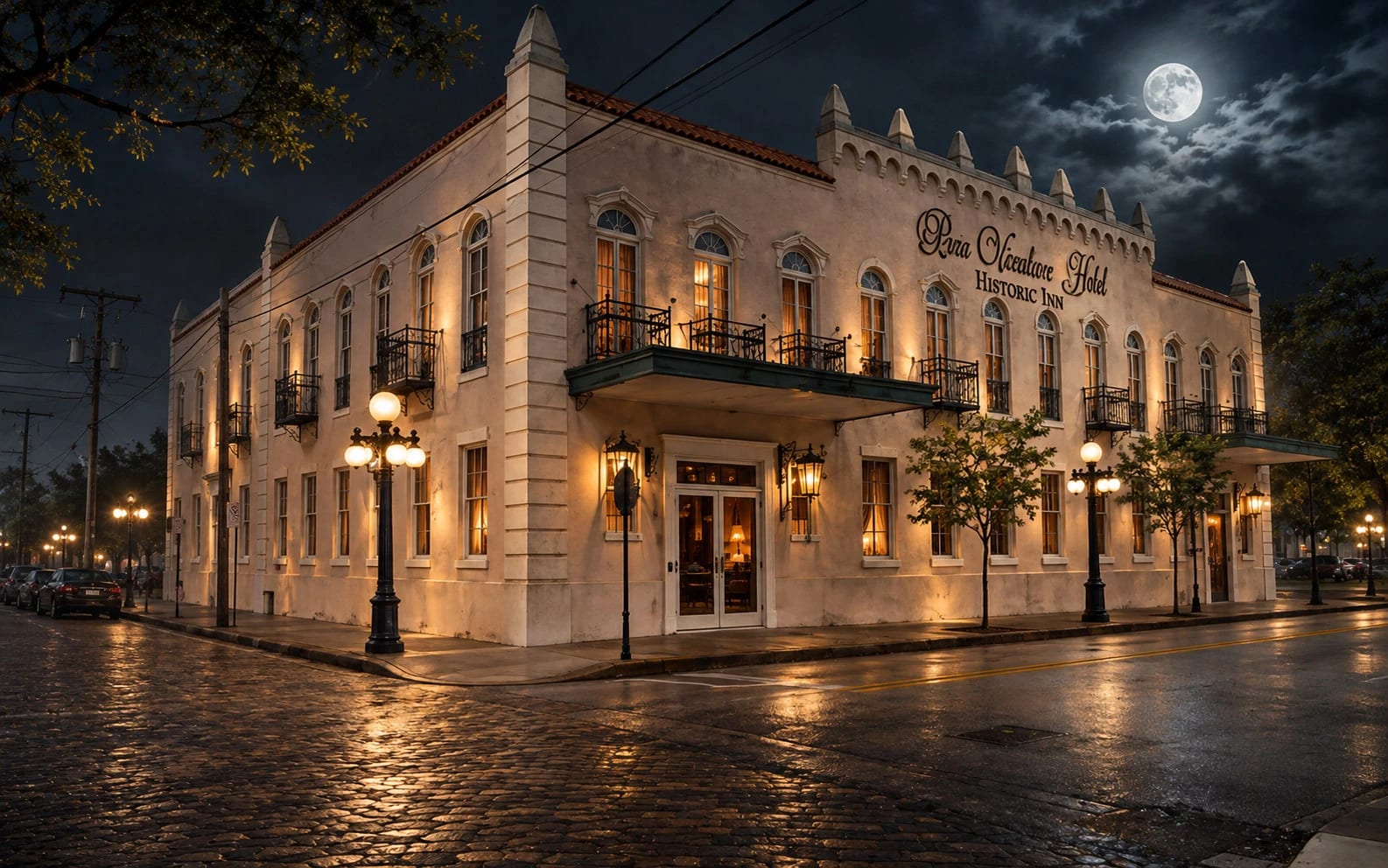
The former Don Vicente Inn at 1915 Avenida República de Cuba, once El Bien Público clinic