In November 2018, a construction crew demolishing an old warehouse in Ybor City uncovered something that local residents had been talking about for generations. Beneath the building, near the intersection of Sixth Avenue and Twelfth Street, workers discovered an entrance to a brick tunnel that disappeared into the darkness beneath the surrounding streets.
The discovery attracted immediate attention because Ybor City had a longstanding reputation for having a network of secret underground passages. According to local stories, these tunnels once connected gambling establishments, cigar factories, breweries, and businesses controlled by Tampa's organized-crime families. During Prohibition, they supposedly allowed bootleggers to move alcohol without attracting attention from the police. Other accounts were considerably darker, describing tunnels used to move women into brothels or provide an escape route for gangsters fleeing a raid.
For decades, nobody seemed entirely certain how much of this was true. Older residents remembered entrances that had been sealed, and some building owners claimed to have discovered passages beneath their properties. The problem was that very little physical evidence remained accessible, making it difficult to separate genuine historical accounts from the stories that developed around them.
That changed when workers opened the ground near Sixth Avenue.
The tunnels were real.
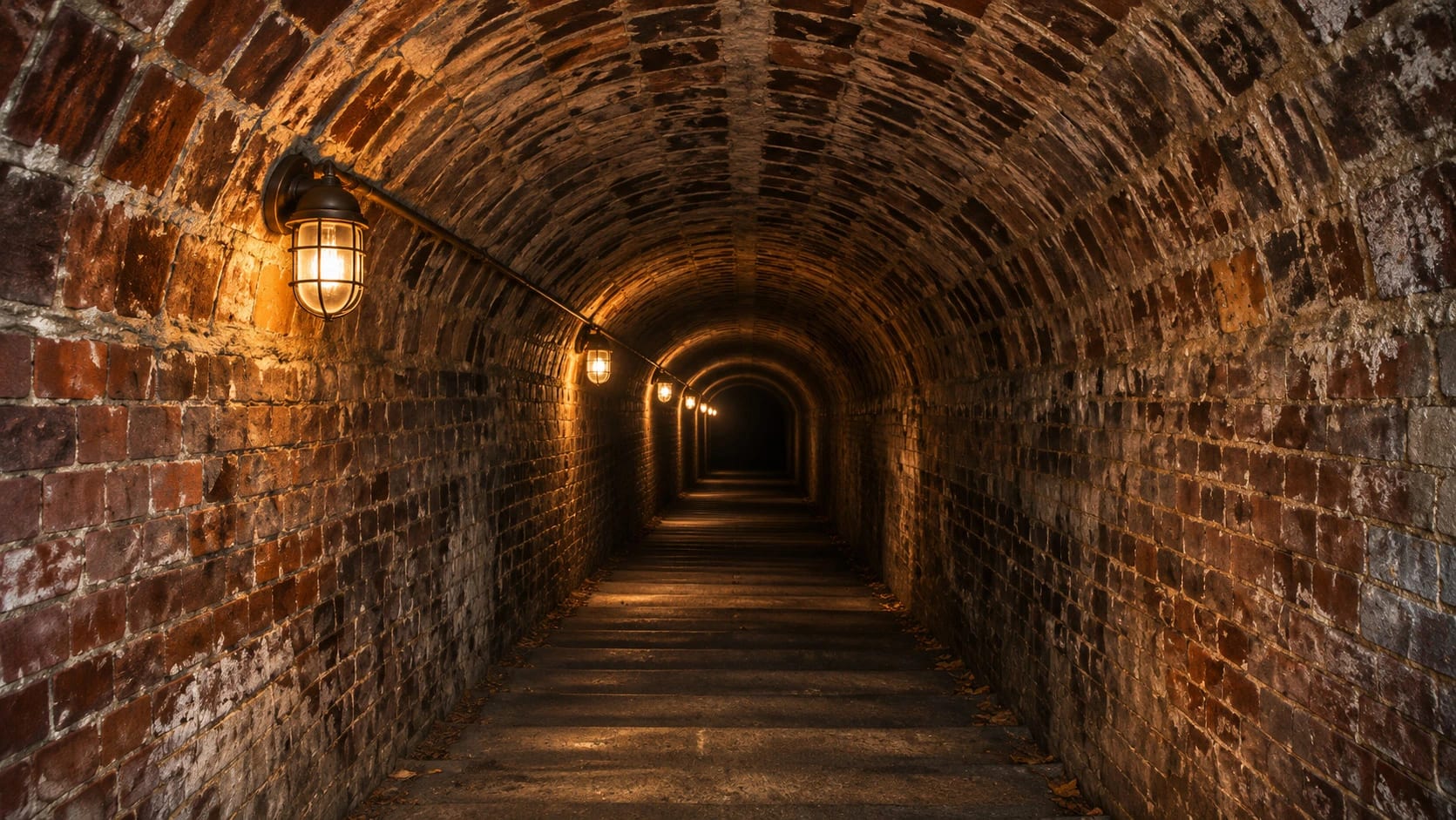
FOX 13 reporter Lloyd Sowers visited the excavation in December 2018, accompanied by construction manager Brad Moore. They entered a brick-lined passage with an arched ceiling, following it away from the construction site until the available light disappeared into the distance. The tunnel was large enough for a person to move through, although some sections required visitors to bend over. Smaller pipes entered the structure from adjoining areas, and old brickwork provided evidence of an underground system that had been constructed long before modern Tampa surrounded it.
The discovery raised more questions than it answered.
Why would someone have built such substantial passages beneath an industrial neighborhood? How far did they extend, and what buildings had once been connected to them? Were they part of an early drainage system, or had someone deliberately created a hidden route for transporting goods and people?
Researchers from the University of South Florida were eventually brought in to document the structures, while historians from the Tampa Bay History Center examined maps and other evidence that might explain their purpose.
What they found complicated the stories considerably.
The tunnels appear to have been associated, at least in part, with Ybor City's early sewer and drainage infrastructure. That doesn't necessarily rule out the possibility that people used them for other purposes, but it makes the familiar tale of a vast underground Mafia transportation network considerably more difficult to substantiate.
There are also stories involving secret chambers, concealed money, and people who supposedly disappeared beneath the neighborhood. Those accounts have become part of Ybor City's darker folklore, although the available historical evidence doesn't establish that people were murdered or buried inside the passages.
The mystery is interesting because there really is something beneath the streets. The question is what people were doing down there, and whether the stories told about the tunnels have any connection to their original purpose.
The Underground History of Ybor City
A Neighborhood Built Faster Than Its Infrastructure
When Vicente Martínez-Ybor began developing Ybor City in 1885, the area northeast of Tampa was largely undeveloped. Within a few years, cigar factories were operating, workers were arriving from Cuba and Europe, and new houses and businesses were being constructed to accommodate the rapidly growing population.
The speed of that development created practical problems that aren't usually mentioned in histories of the cigar industry. Thousands of residents needed drinking water, streets, drainage, and a system for disposing of waste. Those requirements became increasingly difficult to manage as factories expanded and densely populated residential blocks developed around them.
Tampa's climate made drainage especially important. Heavy summer rainstorms could produce large amounts of standing water, while the region's relatively low elevation complicated efforts to move wastewater away from residential and commercial areas.
Ybor City's industrial buildings also required water for manufacturing purposes. Cigar factories needed reliable supplies, and other businesses, including the Florida Brewing Company, depended on water for their operations.
The neighborhood's early infrastructure was developed during a period when American cities were making substantial investments in underground drainage and sewer systems. Brick-lined channels were commonly constructed to carry wastewater, sometimes using arched designs that could withstand the weight of streets and buildings above them.
These weren't necessarily small pipes. Some municipal systems included passages large enough for maintenance workers to enter.
That is an important consideration when examining Ybor City's tunnels, because their size has frequently been cited as evidence that they couldn't have been intended for drainage.
The historical reality is more complicated.
A large brick tunnel with an arched ceiling might have been designed to carry water, even if someone could also walk through it under certain conditions. The presence of an accessible passage doesn't automatically mean it was constructed for transporting people.
Still, there were aspects of the tunnels that puzzled investigators, including their dimensions, unusual connections, and the relationship between the passages and nearby businesses.
Stories of Underground Passages Before 2018
The 2018 discovery wasn't the first time people had found evidence of tunnels beneath Ybor City.
In a November 2018 article for the Tampa Bay Times, journalist Paul Guzzo documented several previously known underground spaces, including passages beneath commercial buildings and an unusual bunker associated with a former organized-crime figure.
Architectural historian Del Acosta recalled entering a tunnel beneath the former Blue Ribbon Grocery Store near the intersection of Seventh Avenue and Fourteenth Street. The passage had already been sealed approximately fifteen feet from its entrance, preventing him from determining where it originally led.
Other people believed the passage might once have connected the grocery property with Las Novedades, a historic restaurant located across Seventh Avenue.
The suggestion was particularly interesting because Las Novedades had been associated with illegal gambling during parts of its history.
A concealed route between the buildings could theoretically have provided an escape during a police raid, although no surviving plans or other reliable records establish that such a connection existed.
The Blue Ribbon Grocery building was destroyed by fire in 2000, eliminating the accessible evidence Acosta had described.
Another account concerned the Ybor Factory Building at 1901 North Thirteenth Street, one of the neighborhood's earliest cigar factories, and the nearby El Pasaje building at 1320 East Ninth Avenue.
According to Tampa organized-crime historian Scott Deitche, stories had circulated about a tunnel connecting the two properties. El Pasaje was also associated with rumors involving prostitution, giving the alleged passage a potentially illicit purpose.
But the existence of a continuous, accessible tunnel between those buildings has not been independently established.
These accounts are important because they demonstrate that people were discussing underground passages long before the 2018 discovery. Some witnesses described physical spaces they had entered, while other stories relied on claims about where sealed entrances might once have led.
Those are different kinds of evidence, and they shouldn't be treated as interchangeable.
There is also another part of the neighborhood where tunnels were reportedly encountered during construction work.
Near Sixth Avenue and Twelfth Street, workers involved in the development of Tampa's modern streetcar system in the early 2000s reportedly encountered an underground passage. Architect Gerry Curts, whose firm occupied a nearby building, later described a tunnel running approximately 250 feet in the direction of the Ybor Channel before branching.
The report added to the belief that the passages beneath Ybor City were more extensive than the isolated underground rooms found in some historic buildings.
By 2018, several people knew that tunnels existed.
What nobody had established was how all of them fit together.
The 2018 Discovery That Brought the Tunnels Back Into the Open
The November 2018 excavation provided researchers with an opportunity that had been unavailable for years.
Developers were preparing a property near Sixth Avenue for new construction when demolition exposed the entrance to a brick-lined tunnel. The work took place in the western portion of historic Ybor City, near the old Florida Brewing Company and buildings associated with its former industrial operations.
The discovery wasn't particularly surprising to Gerry Curts.
Curts, president of Curts Gaines Hall Jones Architects, had previously encountered evidence of underground passages in the area. His firm's building contained basement features that appeared to be sealed tunnel entrances, and he had spent years discussing the possibility of a larger underground system.
When the new passage was uncovered, Curts visited the site and helped explain its significance to local reporters.
He believed that constructing such a substantial tunnel would have required considerable money and labor. The walls were made of brick, the passage had an arched ceiling, and sections appeared large enough for people to walk through without crawling.
In an interview with FOX 13 on November 22, 2018, Curts estimated that some passages were approximately five to seven feet wide and reached heights of roughly seven feet.
Other measurements, taken from different sections, described much smaller dimensions.
That variation matters because the tunnels were not necessarily uniform. Some openings may have led into larger passages, while others were narrower channels or sections affected by later construction.
The development team confirmed that the structures existed, and plans were discussed for preserving at least some indication of the discovery within the new building.
One proposal involved installing a glass floor so visitors could see part of the old tunnel beneath the property.
There is no reliable evidence that this proposed feature was ultimately installed and opened as a permanent public attraction.
At the time, however, the possibility generated excitement among historians and people interested in Tampa's underground past.
The excavation had exposed physical evidence of something residents had been discussing for decades.
What Was Actually Found?
The entrance revealed a brick-lined passage with a curved ceiling, substantial masonry walls, and evidence of smaller pipes connecting with the main structure.
The arched construction was particularly noticeable.
Brick arches were commonly used in nineteenth- and early twentieth-century underground construction because their shape distributed weight effectively. A well-built arch could support considerable pressure from the ground and structures above it.
The passage also contained areas where investigators could see changes in materials and construction techniques.
During the excavation, workers found bottles and other objects associated with the property's commercial and industrial history.
Those discoveries attracted attention because the Florida Brewing Company had operated nearby.
An old bottle in a tunnel might seem like evidence that people were transporting alcohol underground, particularly in a neighborhood with Ybor City's Prohibition history.
But the context of an object matters.
A bottle discarded during construction, deposited by floodwater, or left behind during maintenance doesn't establish that the tunnel was used for bootlegging. Determining its significance would require examining its age, precise location, and relationship to the surrounding materials.
The smaller pipes entering the passage were potentially more informative.
Their arrangement suggested that water or wastewater had been directed into the larger channel.
That detail supported the possibility that the tunnel had been constructed for drainage, even if people later used it for other purposes.
For historians, the next step was determining when the structure had been built and whether it appeared on old maps.
The University of South Florida became involved in answering those questions.
University of South Florida Maps the Tunnels
Dr. Lori Collins and researchers associated with the University of South Florida Libraries' Digital Heritage and Humanities Collections visited the site to record the underground structures.
The project involved laser-scanning technology capable of producing detailed three-dimensional representations of the tunnels.
This was important because the excavation wasn't going to remain open indefinitely.
Construction work was continuing, and there was a strong possibility that the exposed passages would eventually be covered again.
A conventional photographic survey could document what the tunnels looked like, but laser scanning offered considerably more information.
The equipment measured the surrounding surfaces, recording the positions of walls, floors, ceilings, openings, and other features. The resulting data could be assembled into a digital model that preserved the geometry of the structures.
Researchers could then compare the tunnel's position with historic maps and the buildings that once stood above it.
The work was particularly valuable because Ybor City's streets and commercial properties have changed substantially over the past century.
Buildings have been demolished, new structures constructed, and older infrastructure modified or removed.
A tunnel that once connected two buildings might now disappear beneath a parking lot or terminate at a modern foundation.
The digital survey allowed researchers to preserve evidence of the underground structures even if construction made them inaccessible again.
The Spring Found Inside the Tunnel
One of the most interesting discoveries made during the university's investigation involved water.
While exploring a tunnel, the researchers encountered a spring emerging within the underground passage.
Collins discussed the discovery in a June 2024 interview with WKMG News 6.
Historical maps had indicated that an artesian well or spring was located near the tunnel, and the researchers were able to identify water emerging from the area shown in those records.
The finding was significant because it connected the physical structure to historical information about the neighborhood's water sources.
Ybor City's early industrial development depended heavily on reliable supplies of water.
Government Spring, located near the old Florida Brewing Company, had served as a source of fresh water even before the neighborhood existed.
Other natural water sources and wells also appeared on early maps.
The presence of a spring inside a tunnel doesn't establish the entire purpose of the underground system, but it strengthens the argument that at least some passages were connected to the management or movement of water.
It also provides a useful reminder about the limitations of the more sensational stories.
A hidden tunnel isn't necessarily evidence of criminal activity. Sometimes it exists because the people who built a city needed a way to move water from one location to another.
That explanation may be less dramatic than bootleggers carrying barrels beneath the streets, but the discovery of the spring gave researchers a specific physical feature they could compare with historical records.
The 1915 Sanborn Maps
Among the resources examined by historians were Sanborn fire-insurance maps.
The Sanborn Map Company produced detailed plans of American cities for insurance purposes, recording building footprints, construction materials, commercial uses, and other information relevant to assessing fire risks.
For Ybor City, these maps are especially useful because the neighborhood changed so rapidly.
They document factories, businesses, residential blocks, and infrastructure that have long since disappeared.
The Library of Congress preserves Sanborn maps of Tampa and Ybor City dating to 1892, 1895, and 1915, among other years.
University researchers compared their digital recordings of the tunnels with historical maps to understand how the underground passages related to the buildings above them.
A 2019 Tampa Bay History Center publication included a digital rendering that overlaid the tunnel's location onto a 1915 Sanborn map.
That kind of research provides a more reliable approach than attempting to reconstruct a tunnel network from stories about former businesses.
A physical passage can be measured. Its direction can be recorded, and its position can be compared with contemporary buildings, utility infrastructure, and other historical features.
The remaining challenge is finding records that explain why it was built.
Were the Tunnels Originally Sewers?
The possibility that the tunnels were part of Ybor City's sewer system has become the leading explanation for at least some of the documented passages.
Rodney Kite-Powell, a historian at the Tampa Bay History Center, personally explored the exposed tunnel after the 2018 discovery.
His observations were published in the center's Spring 2019 newsletter, Cotanchobee.
After examining the structure, Kite-Powell concluded that the passage had originally been intended to carry sewage.
That's a significant finding because the historian had access to the actual tunnel rather than relying exclusively on descriptions from other people.
His interpretation also differed from some of the theories circulating immediately after the discovery.
Architect Gerry Curts had questioned whether the size and relatively flat floors of certain passages were consistent with sewage infrastructure.
Curts believed some sections appeared more suitable for moving people or goods.
Both observations are worth considering.
Historic sewer systems varied considerably in design, and larger channels were sometimes built to accommodate substantial flows or maintenance access.
At the same time, the presence of passages leading toward commercial properties raises legitimate questions about how they were used.
An important distinction is the difference between a tunnel's original purpose and its later uses.
A passage constructed to carry wastewater could theoretically have been entered or modified by people who wanted to use it for another reason.
The difficulty is establishing that such activity actually occurred.
Could a Sewer Have Been Used for Smuggling?
The idea isn't impossible, but it presents practical problems.
A sewer tunnel may contain wastewater, unpleasant gases, contaminated sediment, and conditions that make moving through it hazardous.
Carrying merchandise through such a passage would be inconvenient, particularly if the goods had to remain dry or sanitary.
There would also be the problem of access.
Smugglers would need entrances and exits that allowed them to move goods without attracting attention. If they were transporting barrels or crates, the route would have to accommodate the weight and dimensions of those objects.
A tunnel might have been useful under certain conditions, especially if it was no longer operating as a sewer.
But the existence of the passage doesn't tell us whether it was abandoned, modified, or used for illicit transportation.
No surviving records examined for this article identify a particular shipment of illegal alcohol transported through the excavated tunnel.
Nor has a documented Mafia operation been conclusively connected to it.
The sewer explanation may account for why the structure was originally built.
What happened there afterward remains less certain.
The Florida Brewing Company and the Bootlegging Legends
The location of the 2018 discovery helped generate interest in the theory that the tunnels were used during Prohibition.
The Florida Brewing Company stood nearby, occupying an enormous six-story brick building that had been constructed in 1896.
The brewery produced La Tropical and other beers, serving Tampa's growing population while exporting substantial quantities to Cuba.
Its operations depended on Government Spring and the surrounding industrial infrastructure.
A nearby building, later occupied by Curts' architectural firm, had served as a bottling facility associated with the brewery.
The relationship between these properties makes the possibility of underground commercial connections interesting.
The brewery needed to move water, bottles, ingredients, and finished products, and it operated in an area where substantial underground infrastructure already existed.
The possibility that tunnels served some commercial function has been discussed by historians and architectural researchers.
But the more famous theory involves illegal alcohol.
Tampa During Prohibition
Florida began restricting alcohol before nationwide Prohibition took effect in January 1920.
By the time the federal government prohibited the manufacture and sale of alcoholic beverages, Tampa already had an established drinking culture and an extensive network of saloons, restaurants, and private establishments.
The new restrictions were not universally popular.
In Ybor City, alcohol had long been part of the neighborhood's social life. Beer was served in restaurants and cantinas, while immigrant communities maintained drinking traditions brought from Europe and Cuba.
Prohibition didn't eliminate that demand.
Instead, it created opportunities for people willing to manufacture, transport, and sell alcohol illegally.
Bootlegging became a profitable business in Tampa, particularly as the city's criminal organizations expanded their influence.
The Florida Brewing Company attempted to survive the restrictions by producing alternative products, although historical accounts also associate the business with illegal alcohol distribution during the period.
In 1928, Salvador Martínez-Ybor, a member of the family connected to the brewery, was reportedly convicted of illegally distributing alcoholic beverages and sentenced to jail.
The case demonstrates that Prohibition violations were not simply an invention of later storytellers.
There was genuine illegal activity associated with Tampa's brewing industry.
The question is whether the tunnels were part of that activity.
The Theory of Underground Beer Shipments
According to one version of the story, barrels of beer were moved through underground passages connecting the brewery to nearby businesses.
Some accounts describe the tunnels extending toward the port, where alcohol could be loaded onto boats or brought ashore without passing through ordinary commercial routes.
Other versions claim the tunnels connected saloons and gambling establishments, allowing customers to obtain illegal alcohol without attracting attention from police officers.
There is a certain logic to the idea.
If a brewery wanted to continue selling beer illegally, a concealed route might have been useful. The building was close to commercial properties, and underground passages would have offered an alternative to transporting merchandise in plain view.
But there is a problem with that explanation.
Tampa's Prohibition enforcement was notoriously inconsistent.
The city had a substantial culture of political corruption, and illegal alcohol was widely available through businesses that operated with varying degrees of official tolerance.
Historian Gary Mormino raised this issue during the original 2018 reporting.
He questioned why bootleggers would undertake the enormous expense of constructing underground passages when illegal alcohol could often be distributed without such elaborate precautions.
The argument doesn't prove that nobody used the tunnels for bootlegging.
It does, however, challenge the assumption that they were constructed specifically for that purpose.
The historical evidence supports the existence of bootlegging in Tampa and the existence of underground tunnels in Ybor City.
It does not establish that the tunnels were built to transport illegal beer.
Those are three separate claims, and only the first two are clearly documented.
Charlie Wall and Tampa's Criminal Underworld
The story of Ybor City's tunnels becomes considerably darker when Charlie Wall enters the picture.
Charles McKay Wall was one of the most influential organized-crime figures in Tampa during the first half of the twentieth century.
Born in 1880, he came from a prominent family whose members had occupied important positions in local government and business.
His father, Dr. John Perry Wall, had served as mayor of Tampa and was a respected physician.
Charlie took a different path.
He became deeply involved in illegal gambling, particularly bolita, an underground lottery that developed an enormous following among Tampa's working-class communities.
Bolita was played using small numbered balls, and the winning number was drawn from a bag or container. Bettors could place small wagers with neighborhood agents, making the game accessible to people who had little money but hoped to win a substantial payout.
The business generated enormous profits for the people who controlled it.
By the 1920s and 1930s, Wall was one of the most powerful figures in Tampa's criminal economy.
His organization was involved in gambling, bootlegging, and other illegal activities. Rival operators competed for control, and the resulting disputes contributed to a period of violence that later became known as Tampa's Era of Blood.
Wall's influence extended into politics and law enforcement, creating an environment where criminal activity often continued despite official efforts to stop it.
It was precisely the sort of world where secret passages might have been useful.
But a reputation for organized crime doesn't prove involvement with a particular tunnel.
Did Charlie Wall Control the Tunnels?
Local accounts have connected Wall and other Tampa crime figures to underground passages beneath Ybor City.
The stories describe hidden routes between gambling establishments, concealed places for storing money, and entrances that could provide an escape if police arrived unexpectedly.
Some versions specifically connect Wall's organization to the tunnels near the old Florida Brewing Company.
Others describe underground movement between saloons, brothels, and gambling rooms.
There is no reliable evidence establishing that Wall personally financed or controlled the documented tunnels near Sixth Avenue.
No construction contract, police report, or contemporary criminal investigation examined for this article confirms his ownership or use of the passages.
That doesn't mean such connections are impossible.
Wall's organization controlled enough criminal activity that hidden storage or escape routes would have been useful, particularly during periods of conflict with rivals.
But historians need more than a plausible motive to establish what happened.
The most compelling evidence of organized crime using underground spaces in Tampa comes from properties where specific physical structures can be connected to identifiable criminals.
One example involved Jimmy Lumia.
Jimmy Lumia and the Underground Bunker
In November 2018, shortly before the Sixth Avenue tunnel discovery attracted widespread attention, the Tampa Bay Times published an article about a house on North Twelfth Street with an unusual feature beneath its backyard.
The property had been associated with Jimmy Lumia, a Tampa criminal figure involved in gambling and bootlegging.
Lumia operated legitimate businesses, including an oil company and gas stations, while also participating in the criminal organizations that controlled portions of Tampa's illegal gambling industry.
Beneath a small structure behind his former residence was a concrete bunker.
The underground chamber measured approximately twenty feet by ten feet and extended as much as twelve feet below ground level.
Its walls were reportedly about a foot thick.
A representative associated with the property's owner explained that the bunker had been discovered after the concrete floor of a backyard structure was opened.
The chamber was substantial enough to serve as a concealed storage location.
Given Lumia's criminal activities, historians considered it plausible that the bunker had been used to conceal money, alcohol, or other materials he didn't want discovered.
There was also a suggestion that a sealed opening in the house's basement might once have led to another property.
That alleged connection was not excavated or verified.
The bunker, however, was real.
This is an important distinction because it provides an example of a physical underground space associated with a documented organized-crime figure.
The Murder of Jimmy Lumia
Lumia's criminal career ended violently.
In 1950, he was sitting in his automobile outside his oil business when a passing vehicle approached.
Someone inside fired a shotgun, striking Lumia in the head.
He died from the attack.
The killing occurred during a period when rival criminal organizations were competing for control of Tampa's gambling operations.
Historian Scott Deitche has associated the murder with the changing balance of power as Santo Trafficante and his organization became increasingly influential.
The precise identity of Lumia's killer was never established.
His death became one of the many unsolved murders associated with Tampa's organized-crime history.
It also demonstrates that Ybor City's reputation for violence was not invented by later ghost tours.
People were actually murdered during disputes over gambling and criminal influence, sometimes in public places where ordinary residents might have witnessed the aftermath.
The underground bunker adds another dimension to Lumia's story.
Here was a man with documented criminal connections who had access to a concealed room beneath a property associated with him.
That doesn't establish that he was connected to the Sixth Avenue tunnels or any other underground passage.
But it explains why stories about hidden rooms and secret routes have persisted in Tampa.
In at least some cases, criminals really did have underground spaces available to them.
The Trafficante Family and Tampa's Era of Blood
Charlie Wall's influence eventually declined as the Trafficante organization consolidated power.
Santo Trafficante Sr. became one of Tampa's dominant crime figures during the 1940s, while his son, Santo Trafficante Jr., later acquired a national reputation through connections to organized crime in Florida, Cuba, and other parts of the United States.
The struggle for control of gambling operations produced a series of shootings, bombings, and other acts of violence.
Some attacks occurred in Ybor City, where gambling establishments and criminal meeting places operated among otherwise legitimate businesses.
The violence wasn't always hidden.
Residents could encounter the aftermath of a bombing near a business they visited regularly, or learn that someone they knew had been shot during a dispute involving the bolita racket.
Those events became part of the neighborhood's history.
Over time, stories about the criminal underworld developed into a larger mythology involving secret chambers, concealed passageways, and men who supposedly controlled the city from beneath its streets.
Scott Deitche, author of Cigar City Mafia and The Silent Don, has researched Tampa's criminal organizations extensively.
His work documents the importance of gambling, corruption, and organized violence to the city's twentieth-century history.
Deitche has also discussed the possibility that underground passages were used for illegal activities.
But the fact that the Trafficante family controlled powerful criminal organizations doesn't establish that they maintained a vast underground transportation network beneath Ybor City.
No documented system of interconnected Mafia tunnels has been mapped to that extent.
There are confirmed underground structures, historical accounts of additional passages, and plausible theories about how criminals might have used them.
Connecting all three into a single organized system requires evidence that has not been established.
The Darker Theory: Human Trafficking Beneath Ybor City
One of the most disturbing explanations for the tunnels concerns the illegal movement of people.
During the 2018 investigation, historian Gary Mormino discussed stories he had heard from longtime Tampa residents about Chinese immigrants being transported through hidden passages.
The theory involved the period following the Chinese Exclusion Act of 1882, when federal restrictions severely limited Chinese immigration to the United States.
Some Chinese immigrants traveled through countries where enforcement conditions differed, including Cuba, before attempting to reach American ports.
Tampa's maritime connections with Cuba provided opportunities for legal trade, immigration, and, potentially, illegal transportation.
According to the stories Mormino had encountered, underground passages might have been used to move Chinese people from the waterfront into Ybor City without attracting attention from immigration authorities.
Some versions went further, alleging that women and girls were trafficked for sexual exploitation.
Those allegations are serious, and they require considerably stronger evidence than the stories currently available.
What the Historical Evidence Establishes
Chinese immigration restrictions existed, and illegal immigration occurred in different parts of the United States during the late nineteenth and early twentieth centuries.
Tampa also had a documented history of prostitution and other illicit businesses.
Those facts make the theory historically possible.
But possibility is not proof.
No reliable documentation reviewed for this article establishes that women or children were trafficked through the particular tunnels discovered near Sixth Avenue.
There are no identified victims, criminal prosecutions, or contemporary investigative reports conclusively connecting those passages to a trafficking operation.
The existence of a large Chinese population in Cuba during the relevant period does not, by itself, establish that people were transported through Tampa's underground infrastructure.
Nor does the presence of prostitution in Ybor City demonstrate that the tunnels were used to move women into brothels.
Mormino himself acknowledged the difficulty of determining whether the stories were true.
His comments should be understood as an exploration of a historical possibility, not confirmation that the alleged trafficking occurred.
This is one of the areas where the distinction between documented history and local folklore is particularly important.
The stories involve potential victims of serious crimes. Presenting those crimes as established fact without identifying supporting evidence would risk turning real historical abuses into sensational entertainment.
The tunnels may eventually provide clues to their original use, but the available research does not support treating the trafficking accounts as proven.
Were the Tunnels Connected to Ybor City's Brothels?
Another recurring story concerns underground passages between historic commercial buildings associated with prostitution.
The El Pasaje building is particularly prominent in these accounts.
Located near Ninth Avenue and Thirteenth Street, the structure has been associated in local folklore with former brothels and establishments where men could meet women away from public view.
One theory suggests that a tunnel connected El Pasaje with a nearby cigar-industry building, allowing visitors to enter or leave discreetly.
The supposed arrangement would have been useful in a neighborhood where prostitution existed but public exposure could create legal or social problems.
However, the alleged connection has not been verified through a complete physical survey of a surviving passage.
There is also a tendency for stories about different buildings to become combined over time.
Ybor City contains numerous historic commercial properties that have changed owners and functions repeatedly.
A building that operated as a hotel during one decade might later become a restaurant, gambling establishment, or office. A passage originally built for storage or utilities could acquire a very different explanation once people began associating the property with vice.
Without reliable historical plans, witness testimony, or contemporary records, it is difficult to establish the purpose of a particular underground opening.
There is a difference between knowing that prostitution existed in Ybor City and proving that a specific tunnel was used to support it.
The first is documented history.
The second remains an unverified claim.
The Ghost Stories of Ybor City's Underground Tunnels
With so much of Ybor City's criminal history connected to the underground passages, it's understandable that the tunnels have become associated with supernatural folklore.
The stories generally involve people who supposedly disappeared beneath the neighborhood, victims of criminal violence, and the possibility that something remains in passages that have been sealed for decades.
Some paranormal accounts suggest that abandoned underground spaces could contain the spirits of people who were murdered or died while being transported through the tunnels.
Others connect the passages with the violent history of the Mafia and Tampa's gambling wars.
These stories fit the atmosphere of Ybor City's darker history, but their factual basis is weak.
The available reporting does not establish a specific murder victim whose body was discovered in one of the tunnels.
Nor have reliable firsthand accounts been identified describing a particular apparition encountered in the documented Sixth Avenue passage.
That distinction separates the tunnels from locations such as the Cuban Club, where specific ghost stories can be traced to identifiable people and, in one case, a documented fatal shooting.
The tunnels are associated more with the possibility of hidden crimes than with an established ghost.
Were Bodies Hidden Beneath Ybor City?
One of the natural assumptions people make about Mafia tunnels is that they might have been used to dispose of bodies.
Tampa's organized-crime history certainly includes murders and disappearances.
Jimmy Lumia was shot to death in 1950. Charlie Wall was murdered in 1955. Other criminal figures were killed during the city's gambling wars, sometimes under circumstances that remain unresolved.
It isn't difficult to imagine that someone involved in those crimes might have wanted a concealed place to dispose of evidence.
But there is no reliable evidence connecting a particular murder victim to human remains discovered in the documented Ybor City tunnels.
The 2018 excavation produced information about the underground structures and objects associated with the surrounding properties, but contemporary reporting did not establish the discovery of bodies.
The theory that victims were buried beneath the streets remains unsupported.
This is worth emphasizing because stories about supposed underground burial chambers can quickly become attached to historic sites.
A sealed entrance becomes a hidden room. The hidden room becomes a place where criminals supposedly killed people, and eventually the story is repeated as though bodies were actually found.
The documented discoveries are interesting enough without adding details that researchers have not established.
Could the Tunnels Be Haunted?
There is no reliable evidence establishing that a deceased person haunts the underground passages.
Paranormal investigators have visited many of Ybor City's historic buildings, and the neighborhood has several well-known locations associated with firsthand accounts of unexplained activity.
The tunnels, however, have generally remained inaccessible to the public.
Their entrances were often sealed, and the 2018 excavation was not intended to create a permanent paranormal attraction.
That has limited opportunities for documented investigations.
An old underground passage would naturally provide an unsettling environment. Darkness, confined spaces, unusual echoes, moisture, and the knowledge that the structure has been hidden for decades could all contribute to the feeling that someone else is present.
But an unsettling atmosphere is not evidence of a haunting.
If future researchers obtain access to additional passages, they may discover more about the structures and how people used them.
For now, the underground tunnels are better understood as a historical mystery that has become part of Ybor City's supernatural folklore.
What Happened to the Tunnels After Their Discovery?
The excavation in 2018 created an opportunity to examine the underground structures, but it did not mean the tunnels would remain accessible indefinitely.
The property was being redeveloped, and construction plans had to account for the stability of the site.
Researchers knew that the exposed passages might soon disappear beneath new construction.
That urgency was one of the reasons USF's digital documentation was so important.
Using laser scanning and historical mapping, the team created a record that could be studied after physical access was lost.
The data preserved the geometry of the tunnel, its relationship to nearby buildings, and the features researchers had observed during their investigation.
The project also contributed to a broader discussion about how Tampa should preserve unexpected archaeological discoveries.
Ybor City is protected as a historic district, but not every underground structure is visible or identified before construction begins.
A redevelopment project can reveal evidence that hasn't been seen for generations.
In some cases, preserving the original structure may be practical.
In others, changes to the site may make permanent access difficult or prohibitively expensive.
The proposal to incorporate a glass viewing floor into the new development attracted attention, but no confirmed public access arrangement has been established through the sources reviewed.
By June 2024, WKMG News 6 was reporting that most people would not be able to visit the known tunnels.
Their entrances had been sealed or covered, and the documented passages were not operating as a public attraction.
The research, however, remains valuable.
Even if nobody can walk through the passages today, their existence has been confirmed through photographs, firsthand exploration, and detailed digital documentation.
That is considerably more evidence than historians had when the stories first began circulating.
Are There More Tunnels Beneath Ybor City?
Almost certainly, there are additional underground structures that have not been fully documented.
Historic neighborhoods commonly contain abandoned utility passages, sealed basements, buried drainage systems, and other features whose original purposes have been forgotten.
Ybor City's rapid development and subsequent redevelopment make that possibility especially likely.
The known tunnels also demonstrate that at least some underground infrastructure survived long after its original use ended.
However, the idea of an enormous, continuous network connecting every major building in the neighborhood is not supported by the available research.
The documented passages represent individual structures and segments whose relationships are not always established.
Some may have been connected to the same drainage system.
Others could have been built for separate purposes, including utility access or private commercial use.
There is no verified map showing a continuous underground route from the port through the entire historic district.
Nor has a tunnel been reliably documented connecting Ybor City to distant Tampa neighborhoods through the extensive routes sometimes described in local folklore.
The underground spaces exist, but the scale of the supposed network remains uncertain.
That's one of the reasons the 2018 discovery was so important.
It provided researchers with physical evidence that could be measured and compared with historical records.
Future construction projects may uncover additional passages, and those discoveries could help determine whether the known sections were once connected.
Until then, there are limits to what can reasonably be concluded.
Can You Visit the Secret Tunnels of Ybor City?
The known underground tunnels are not currently operated as a public tourist attraction.
The entrances documented during the 2018 excavation were associated with private properties and construction sites, and the passages were subsequently covered or made inaccessible.
Visitors should not attempt to enter abandoned buildings, construction areas, drainage structures, or sealed underground openings.
Apart from trespassing concerns, the tunnels may contain unstable masonry, contaminated water, poor air quality, and other hazards associated with old underground infrastructure.
There is also no reliable public map identifying safe, legal entrances to a continuous tunnel system.
However, visitors can explore the historic streets above the places where some of the passages were discovered.
The area around East Sixth Avenue and North Twelfth Street is particularly relevant because it was the location of the documented 2018 excavation.
The former Florida Brewing Company building, located at 1234 East Fifth Avenue, stands nearby and provides an important connection to the neighborhood's industrial and Prohibition history.
Several other buildings associated with Ybor City's gambling and organized-crime past are within walking distance.
The neighborhood's original street layout and surviving architecture help explain why stories about underground passages developed in the first place.
For anyone interested in the darker side of Tampa history, the area offers plenty to investigate without attempting to enter an abandoned tunnel.
Are the Underground Tunnels Ybor City's Greatest Mystery?
There are other mysteries associated with Ybor City, including unsolved murders, missing historical records, and conflicting accounts of events that took place inside the neighborhood's social clubs and businesses.
The underground tunnels stand apart because their existence was questioned for so long, even though some residents had been describing them for decades.
The 2018 discovery resolved that question.
There really are brick-lined passages beneath parts of Ybor City.
What remains uncertain is how all of them were used.
The strongest evidence indicates that at least some were constructed as drainage or sewage infrastructure. Researchers have documented physical connections consistent with that purpose, and historical mapping has provided additional context.
The stories involving bootlegging, organized crime, and prostitution are more speculative.
Those activities were part of Tampa's history, but the presence of criminals and illegal businesses doesn't prove that the tunnels were constructed or extensively used for those purposes.
The most disturbing allegations, including human trafficking and the disposal of murder victims, remain unverified.
One possibility is that the tunnels served different purposes at different times. Infrastructure constructed for water or sewage could theoretically have been repurposed after its original function ended.
Another possibility is that separate underground structures became combined into a single story as people repeated accounts of discoveries made decades apart.
Some passages may have been public works projects, while others were private spaces built for storage, security, or commercial use.
That would help explain why the known underground structures vary so much in size, construction, and location.
The available evidence doesn't establish a definitive answer.
But the research has already changed how historians understand the neighborhood.
Ybor City's history wasn't confined to the buildings and streets visitors can see today. Its development required infrastructure beneath the ground, and some of those structures survived long after their original purpose was forgotten.
The neighborhood also had a genuine underground criminal economy, one that involved gambling, illegal alcohol, corruption, and violence.
Whether those two parts of Ybor City's history ever intersected in the tunnels remains one of Tampa's most interesting unanswered questions.
Explore the Darker History of Ybor City With Ghost City Tours
The tunnels are only one part of Ybor City's complicated past. Above the ground, many of the buildings associated with the neighborhood's most disturbing stories are still standing.
The Cuban Club has a reputation for multiple hauntings and was the scene of a documented fatal shooting in 1934. The former Florida Brewing Company is associated with an unexplained Spanish-speaking voice, while the Italian Club has stories about a former president who supposedly continues walking its rooms.
Other locations are connected to Tampa's gambling wars, the rise of the Trafficante organization, and the violence that accompanied the struggle for control of the city's illegal businesses.
Ghost City Tours explores that history through guided nighttime walks of the historic district.
Our Ghosts of Ybor City Tour is an all-ages experience focused on the immigrants, factories, social clubs, and supernatural traditions that made the neighborhood famous.
For visitors especially interested in organized crime, the bolita gambling racket, gangland violence, and the darker stories associated with Ybor City's history, The Darkness Between Us Ghost Tour is the better fit. The adults-only tour is designed for guests sixteen and older and explores the neighborhood's more disturbing history without avoiding the details.
Both tours take place along Ybor City's historic streets. They do not involve entering the underground tunnels, which are not open to the public.
Learn more about our Ybor City Ghost Tours and discover the history and mysteries beneath one of Tampa's most fascinating neighborhoods. You can also explore more haunted places in Ybor City.
Frequently Asked Questions About the Ybor City Tunnels
Are there really tunnels underneath Ybor City?
Yes. Underground brick tunnels have been documented beneath parts of Ybor City, including a passage discovered during construction near East Sixth Avenue in November 2018. Researchers from the University of South Florida examined the tunnels and created three-dimensional digital records of the structures.
What were the Ybor City tunnels used for?
The strongest historical evidence suggests that at least some of the tunnels were originally constructed for sewage or drainage. Other theories involve commercial transportation, Prohibition-era bootlegging, gambling operations, and organized crime, but these uses have not been conclusively established.
Did the Tampa Mafia use the underground tunnels?
Tampa had powerful organized-crime groups during the early and middle twentieth century, including organizations associated with Charlie Wall and the Trafficante family. There are local stories connecting these criminals to underground passages, but no reliable documentation establishes that they controlled a continuous tunnel network beneath Ybor City.
Where were the secret Ybor City tunnels discovered?
One of the most thoroughly documented discoveries occurred in November 2018 near East Sixth Avenue and North Twelfth Street, close to the former Florida Brewing Company. Other accounts describe tunnels or underground spaces near Seventh Avenue, Fourteenth Street, and historic buildings elsewhere in the neighborhood.
Are the Ybor City tunnels haunted?
The tunnels have become associated with Ybor City's darker folklore, including stories about organized crime and people who supposedly disappeared underground. However, no reliable firsthand evidence establishes a specific ghost or haunting within the documented passages.
Were bodies discovered in the Ybor City tunnels?
No verified discovery of human remains in the documented tunnels has been established through the historical reporting examined for this article. Stories that the Mafia disposed of murder victims beneath the neighborhood remain unsubstantiated.
Did the tunnels connect to the Port of Tampa?
Some accounts describe underground passages running in the direction of the Ybor Channel or port facilities. However, there is no verified map establishing a continuous tunnel route connecting the documented passages to the port.
Can you tour the underground tunnels in Ybor City?
The documented tunnels are not open as a public attraction. Their entrances have generally been sealed or covered following construction and research. Visitors can explore the surrounding historic district, but they should not attempt to enter underground structures without authorization.
Were the tunnels used during Prohibition?
It's possible that some underground passages were used for illegal activities during Prohibition, but there is insufficient evidence to establish that purpose. The existence of bootlegging in Tampa is well documented, as is the existence of the tunnels. A direct connection between the two remains unproven.
Historical References and Sources
1. Tampa Bay History Center — History Center Goes Underground, Cotanchobee, Spring 2019 (PDF, archived copy)
One of the most important sources for understanding the actual tunnel discovery. The History Center's account describes Rodney Kite-Powell exploring the underground passage, the involvement of university researchers, and his conclusion that the structure was originally intended as a sewage line. See page 9.
2. FOX 13 Tampa Bay — Tunnels Under Ybor City Streets Lead to Historical Mystery
FOX 13 Tampa Bay — Tunnels Under Ybor City Streets Lead to Historical Mystery
Lloyd Sowers, November 22, 2018. Contemporary reporting on the discovery of the tunnels, including interviews with historian Gary Mormino and architect Gerry Curts. Discusses the dimensions of the passages, the possibility of Prohibition-era use, and the competing explanations for their original purpose.
3. FOX 13 Tampa Bay — Tunnels of Ybor Explored, Mapped for Clues of Their Purpose
FOX 13 Tampa Bay — Tunnels of Ybor Explored, Mapped for Clues of Their Purpose
Lloyd Sowers, December 5, 2018. Firsthand reporting from inside one of the exposed tunnels. Documents the brick-lined construction, intersecting pipes, objects discovered during excavation, and USF's work to create a detailed digital record of the site.
4. Spectrum Bay News 9 — Underground Tunnel Discovered in Ybor City
Spectrum Bay News 9 — Underground Tunnel Discovered in Ybor City
Dave Jordan, November 24, 2018. Reporting on the tunnel entrance uncovered near Twelfth Street and Sixth Avenue, Gerry Curts' knowledge of nearby passages, and the questions surrounding the underground system.
5. Tampa Bay 28 — USF Digitally Maps Ybor City Tunnel Before It's Filled In
Tampa Bay 28 — USF Digitally Maps Ybor City Tunnel Before It's Filled In
Carson Chambers, December 2018. Describes Dr. Lori Collins and her team's use of laser scanning to document the tunnels, along with Gerry Curts' observations about their physical dimensions and possible purposes.
6. WKMG News 6 — Secret Tunnels Exist Below This Florida City, But You Won't Be Able to Find Them
WKMG News 6 — Secret Tunnels Exist Below This Florida City, But You Won't Be Able to Find Them
Anthony Talcott, June 5, 2024. Later reporting on the research into Ybor City's tunnels, featuring Dr. Lori Collins and the University of South Florida's digital heritage work. Especially useful for the discovery of an artesian spring within a passage and the continuing uncertainty about the tunnels' original uses.
7. Tampa Bay Times — From Bunkers to Tunnels, Mafia History Stirs Underworld Exploration in Ybor City (WRAL Syndication)
Paul Guzzo, November 4, 2018. Extensive reporting on the underground structures known before the major excavation, including the Blue Ribbon Grocery tunnel, the rumored El Pasaje connection, the former bottling facility near the Florida Brewing Company, and Jimmy Lumia's underground bunker. Includes interviews with historians Scott Deitche, Rodney Kite-Powell, and Del Acosta.
8. Abandoned Florida — The History of the Ybor City Tunnels
Abandoned Florida — The History of the Ybor City Tunnels
David Bulit, May 21, 2020. A photographic and historical account of the underground structures, including the 2018 discovery, the surrounding Mafia legends, and examples of misleading photographs circulated online as supposed images of Ybor City's tunnels.
9. Florida Sheriffs Association — The White Shadow: Tampa's Bolita Kingpin
Florida Sheriffs Association — The White Shadow: Tampa's Bolita Kingpin
David Brand, February 29, 2024. Historical overview of Charlie Wall, the bolita lottery, Tampa's organized-crime economy, and the rise of the Trafficante organization. Provides context for the criminal history frequently associated with the tunnels.
10. Creative Loafing Tampa — Repeal Day Recalls Tampa's Noble Experiment
Creative Loafing Tampa — Repeal Day Recalls Tampa's Noble Experiment
Arielle Stevenson, November 27, 2013. Historical reporting on Prohibition in Tampa, the Florida Brewing Company, illegal alcohol distribution, and the relationship between law enforcement and organized crime.
11. Library of Congress — Sanborn Fire Insurance Maps of Tampa, 1915
Library of Congress — Sanborn Fire Insurance Maps of Tampa, 1915
Digitized historical maps documenting the commercial buildings, streets, and infrastructure of Tampa and Ybor City. University researchers compared maps from this period with laser-scanning data from the discovered tunnels.
12. Library of Congress — Sanborn Fire Insurance Maps of Tampa and Ybor City, 1895
Library of Congress — Sanborn Fire Insurance Maps of Tampa and Ybor City, 1895
Earlier survey of Ybor City's commercial and industrial development. Useful for examining the neighborhood's original buildings and infrastructure before the Prohibition era.
13. FOX 13 Tampa Bay — Seminole Heights Home's Hidden Tunnels Reveal Its Storied Past
FOX 13 Tampa Bay — Seminole Heights Home's Hidden Tunnels Reveal Its Storied Past
Lloyd Sowers, December 12, 2018. Reports on additional underground spaces and alleged passageways elsewhere in Tampa, including commentary from Mafia historian Scott Deitche. Helpful for distinguishing documented structures from unverified claims about tunnels connecting distant neighborhoods.
14. Univision Tampa Bay — Túneles Secretos de Ybor City: Esto Se Sabe Sobre Su Origen y la Leyenda del Contrabando
Spanish-language overview of the documented tunnels, research supporting their possible original use as drainage infrastructure, and the lack of evidence establishing an enormous interconnected smuggling network.
15. Tampa Mafia — Scott M. Deitche
Tampa Mafia — Scott M. Deitche
Information about organized-crime historian Scott Deitche and his books Cigar City Mafia and The Silent Don, which examine Tampa's gambling organizations, Mafia figures, bootlegging, and violent criminal history.
16. National Park Service — Ybor City Historic District
National Park Service — Ybor City Historic District
Federal historical overview of Ybor City's development, original factories, immigrant communities, industrial buildings, and architectural preservation.
The brick-lined tunnels beneath Ybor City