The cemetery gates stand at the end of Birch Street, where Asheville's historic Montford neighborhood gives way to a landscape of wooded hills, old stone monuments, and winding roads. Beyond the entrance, the city seems to recede. Towering oaks shade family mausoleums, marble angels overlook the graves below them, and narrow paths follow the contours of a hillside descending toward the French Broad River.
Riverside Cemetery has been part of Asheville since 1885. More than 14,000 people have been buried across its 87 acres, including celebrated writers, Civil War generals, politicians, artists, and ordinary residents whose names have largely disappeared from local memory. Among them are Thomas Wolfe, the novelist who transformed his complicated relationship with Asheville into some of America's most memorable literature, and O. Henry, whose short stories became famous for their unexpected endings.
The cemetery also contains the graves of eighteen German sailors who died while being held in North Carolina during World War I. Elsewhere, a headless mourning statue marks the grave of a young woman who died in 1913. A nearby monument remembers a Black businessman murdered during one of Asheville's deadliest shooting sprees.
These are documented parts of Riverside's history. The ghost stories are another matter.
Visitors have described hearing distant gunfire and cannon blasts, supposedly echoes of the Civil War. Others claim to have seen Confederate soldiers marching between the headstones before disappearing into the trees. There are accounts of children laughing where no children can be found, a woman dressed in white wandering among the graves, and strange lights appearing near an old receiving vault.
Some storytellers even believe that Thomas Wolfe and O. Henry occasionally return to the cemetery where they were buried.
The legends are intriguing, although their historical foundations are not always what they appear. The Battle of Asheville, frequently connected with the cemetery's phantom soldiers, took place twenty years before Riverside opened. The eighteen German men buried together were merchant sailors detained during World War I, not soldiers killed in battle.
Understanding the cemetery's history makes these distinctions especially interesting. Riverside was not established as a battlefield memorial or a neglected burial ground. It was deliberately designed to be one of the most beautiful places in Asheville, where families could bury their dead and the living could enjoy the mountain landscape.
More than 140 years later, the cemetery continues serving both purposes. And somewhere among its thousands of graves, Asheville's history has acquired a collection of stories about those who supposedly never found their rest.
The History of Riverside Cemetery
Asheville's Growing Need for a New Burial Ground
During the middle of the nineteenth century, Asheville was a relatively small mountain community. Families buried their dead in churchyards, private family cemeteries, and burial grounds scattered throughout Buncombe County. Downtown Asheville's principal cemeteries belonged to the Methodist, Presbyterian, and Episcopal congregations along Church Street.
For decades, these facilities were sufficient. That changed as Asheville began growing into a regional commercial and tourism center.
The railroad arrived in 1880, dramatically improving access to Western North Carolina. Visitors who previously faced lengthy journeys over mountain roads could now travel to Asheville by train. The city became increasingly popular with wealthy vacationers, people seeking relief from respiratory illnesses, and families hoping to escape the summer heat of larger Southern cities.
New hotels, boardinghouses, businesses, and residential neighborhoods appeared throughout Asheville. Its population expanded rapidly, creating pressure on an infrastructure that had been designed for a much smaller community.
The existing downtown burial grounds presented a particular problem. By 1885, the three principal church cemeteries occupied little more than an acre of combined land, and available burial space was becoming scarce. The congregations also wanted room to expand their church buildings.
There were public health concerns as well.
Asheville had recently completed a water reservoir on Beaucatcher Mountain, part of a broader effort to modernize its water system. City leaders worried that overcrowded burial grounds might contribute to groundwater contamination, threatening the reputation of a town whose economy increasingly depended on being considered a healthy destination.
A group of prominent businessmen proposed a solution: create a large cemetery outside the crowded downtown area, with enough space to accommodate future generations.
Their plans reflected a growing American movement that treated burial grounds as landscaped public spaces rather than merely places to inter the dead.
The Rural Cemetery Movement
By the 1880s, the idea of a cemetery serving as both a burial ground and a public park was already well established in American cities.
Mount Auburn Cemetery near Boston, founded in 1831, helped popularize the concept. Its founders rejected the crowded churchyard model in favor of rolling hills, winding paths, gardens, and carefully arranged monuments. The cemetery offered families a peaceful setting for remembrance while providing the wider community with access to natural scenery.
Other cities adopted similar designs. Green-Wood Cemetery in Brooklyn and Hollywood Cemetery in Richmond became both burial grounds and popular destinations for visitors.
The movement reflected changing attitudes toward death and remembrance. Nineteenth-century Americans increasingly viewed landscaped cemeteries as places where grief could be expressed through architecture, sculpture, and nature. Families commissioned elaborate memorials, while cemetery companies planted trees and built roads intended for leisurely carriage rides.
Asheville's civic leaders believed their growing city deserved something comparable.
In June 1885, J. Evans Brown and J. P. Sawyer presented plans for a new cemetery to the Asheville City Council. The proposal received support from prominent residents and business leaders who recognized the need for additional burial space.
On August 4, 1885, the Asheville Cemetery Company was formally incorporated.
Investors raised approximately $3,000, and the company began searching for a suitable site. Its directors eventually purchased about thirty-five acres northwest of downtown for $2,576.25.
The property overlooked the French Broad River and possessed the rolling terrain, mature trees, and relative seclusion considered ideal for a landscaped cemetery.
Turning the hillside into a functional burial ground would require considerable work.
C. T. Colyer Designs a Cemetery Among the Mountains
The Asheville Cemetery Company hired English architect C. T. Colyer to design the grounds.
Colyer developed a plan using the site's natural contours rather than attempting to flatten the landscape. Five principal terraces were arranged across the hillside, connected by approximately three miles of winding carriage roads.
The roads followed the slopes and curved around the hills, creating constantly changing views. Visitors moving through the cemetery would discover monuments, groves of trees, and distant mountain scenery gradually rather than seeing the entire property at once.
The design reflected the picturesque landscape traditions popular in Europe and America during the nineteenth century.
Existing oak trees were preserved where possible, while additional ornamental trees, shrubs, and flowering plants were introduced. Over time, poplars, dogwoods, evergreens, rhododendrons, and other vegetation helped establish the cemetery's park-like appearance.
The grounds also offered opportunities for elaborate family monuments.
Wealthier Asheville residents purchased prominent plots and commissioned memorials reflecting their social standing. Some chose substantial granite monuments or carved marble angels. Others constructed private family mausoleums designed to accommodate generations of relatives.
Less affluent residents received simpler markers, and some burials were made without permanent headstones.
The resulting cemetery reflected the community that created it, including the considerable differences in wealth and social position among Asheville's residents.
The First Burial at Riverside Cemetery
The first burial at Riverside occurred on December 12, 1885, before the grounds were fully completed.
The deceased was Charles Hill, a twenty-five-year-old Asheville resident and younger brother of prominent businessman J. J. Hill.
His unexpected death required the cemetery company to begin using its new property ahead of schedule.
By the following year, Riverside was receiving additional burials, and the company's plans for landscaping and improvements were progressing.
The name Riverside was suggested by local real estate agent A. J. Lyman, who believed it captured the setting's relationship to the French Broad River.
The name was adopted, replacing the more utilitarian descriptions used during the cemetery's early development.
In 1886, an Asheville newspaper compared Riverside's potential with celebrated cemeteries in Boston, New York, Richmond, and Savannah.
The comparison was ambitious, but the cemetery soon became an important destination for residents who wanted more than a place to visit family graves.
People walked its roads, enjoyed the trees, and admired the monuments. In an era before Asheville possessed many extensive municipal parks, Riverside provided a landscaped public space close to the growing city.
Its first superintendent played a major role in establishing that identity.
William S. Cornell: The Cemetery's First Superintendent
William S. Cornell was an unlikely choice to become one of Asheville's most influential cemetery caretakers.
A former cheesemaker from Poughkeepsie, New York, Cornell was approximately fifty years old when he became Riverside's first superintendent. He arrived with a reputation for business ability and a dedication to his work that quickly made him a familiar figure in the community.
Cornell helped organize the cemetery into sections identified by letters of the alphabet. He supervised burials, maintained the grounds, and coordinated the workers responsible for landscaping and grave preparation.
His appearance was memorable. Contemporary recollections describe a man with a long white beard who often greeted funeral processions by singing hymns.
The superintendent took considerable pride in the cemetery's appearance. During a period when maintaining landscaped burial grounds required extensive manual labor, he supervised the planting, mowing, road maintenance, and monument care needed to keep Riverside attractive.
Cornell remained employed at the cemetery until shortly before his death in 1917, when he was approximately eighty years old.
His decades of service helped establish a tradition of cemetery management that continued through subsequent generations.
Although Riverside began as a privately operated burial ground, its reputation increasingly depended on the people who maintained its grounds and preserved the histories of those buried there.
Riverside Cemetery and the Growth of Montford
As the cemetery developed, the surrounding Montford neighborhood was becoming one of Asheville's most fashionable residential districts.
During the late nineteenth and early twentieth centuries, wealthy families constructed elaborate homes along Montford Avenue and neighboring streets. Victorian residences, Queen Anne houses, Colonial Revival architecture, and other styles appeared throughout the area.
The neighborhood attracted physicians, attorneys, businessmen, and families connected to Asheville's booming tourism industry.
Riverside occupied a quieter portion of this increasingly prosperous district.
Its location made it convenient for families living in Montford and downtown Asheville, while the wooded grounds offered an attractive setting for memorial services and visits.
The cemetery also expanded.
Additional land acquisitions brought the property to approximately 87 acres. Its grounds eventually incorporated a Jewish burial section associated with Congregation Beth Ha-Tephila, along with areas devoted to veterans and other groups.
Riverside's earliest policies allowed burials of people from different racial backgrounds, an important feature during an era of entrenched segregation. In practice, however, many burial sections remained racially separated.
The cemetery therefore reflected both the opportunities and inequalities of the society around it.
Some residents were buried beneath impressive monuments carved by skilled stoneworkers. Others were placed in modest graves or sections where permanent markers were never erected.
Despite those differences, their burial records preserve an extraordinary amount of information about the people who lived in Asheville.
That historical record includes some of North Carolina's most recognizable figures.
Famous People Buried at Riverside Cemetery
Thomas Wolfe: Asheville's Most Famous Novelist
Perhaps no person buried at Riverside is more closely connected to Asheville than Thomas Wolfe.
Born in the city on October 3, 1900, Wolfe grew up in a family whose complicated relationships became the foundation of his literary career.
His father, William Oliver Wolfe, operated a monument business in downtown Asheville. As a child, Thomas accompanied him to Riverside, where the elder Wolfe worked on graves and memorials.
The cemetery became part of the novelist's earliest experience of death and remembrance. He grew up surrounded by tombstones, funerary sculpture, and the ordinary business of preparing monuments for families who had lost loved ones.
His mother, Julia, operated a boardinghouse known as Old Kentucky Home, which later became the Thomas Wolfe Memorial.
Family conflict, the boardinghouse's constant procession of guests, and the changes taking place in Asheville shaped Wolfe's understanding of the world.
He left the city to attend the University of North Carolina and later studied at Harvard. Eventually, he moved to New York and began pursuing a literary career.
In 1929, he published Look Homeward, Angel.
The novel drew heavily from his childhood, transforming Asheville into the fictional town of Altamont. Many residents recognized themselves or their relatives in its characters, and some were offended by what they regarded as unflattering portrayals.
Wolfe's relationship with his hometown became strained.
He stayed away from Asheville for years before returning in 1937, when he began reconnecting with family and former acquaintances.
His literary success was considerable, but his life ended unexpectedly.
In September 1938, Wolfe died at Johns Hopkins Hospital in Baltimore after developing tuberculous meningitis. He was thirty-seven years old.
His body was returned to Asheville and buried at Riverside Cemetery near members of his family.
Today, his grave is among the cemetery's most frequently visited sites.
Visitors sometimes leave pens or other small tributes, acknowledging the writer whose complicated love for Asheville became the subject of his most famous books.
Wolfe's connection to Riverside was more intimate than that of most famous people buried there. He had known the cemetery as a child, watched his father work among its graves, and incorporated its atmosphere into his writing.
The cemetery was part of his life long before it became his final resting place.
O. Henry: The Writer of Unexpected Endings
William Sydney Porter, better known by his pen name O. Henry, had a very different relationship with Asheville.
Born in Greensboro, North Carolina, in 1862, Porter worked in several occupations before becoming a successful writer. His early career included employment in banking and journalism, and his personal life was marked by financial difficulties and legal trouble.
While working as a bank teller in Austin, Texas, Porter was accused of embezzlement. He fled to Honduras while facing prosecution but eventually returned to the United States, where he was convicted and sentenced to prison.
He served time in a federal penitentiary in Ohio, continuing to write during his incarceration.
Following his release, Porter established a successful literary career in New York.
His short stories became famous for their humor, sympathy for ordinary people, and surprising endings. Works such as The Gift of the Magi and The Ransom of Red Chief remain widely read.
Porter spent time in Asheville and developed an affection for the surrounding mountains.
When he died in New York City on June 5, 1910, at the age of forty-seven, his remains were brought to Riverside Cemetery for burial.
His grave has become another literary destination.
Visitors sometimes leave pennies, referencing the opening of The Gift of the Magi, in which the main character possesses only $1.87.
The tradition has little to do with the paranormal, but it provides an unusual example of how literature can continue shaping the memorial customs surrounding a writer.
O. Henry's stories frequently involved coincidence, irony, and unexpected reversals of fortune.
The fact that a writer who spent much of his career elsewhere came to rest among Asheville's mountains is fittingly unexpected.
Zebulon Baird Vance: The Governor Buried Three Times
Zebulon Baird Vance was one of North Carolina's most prominent nineteenth-century political figures.
Born in Buncombe County in 1830, he served in the United States Congress, became governor during the Civil War, and later represented North Carolina in the United States Senate.
His political career was long and influential.
Vance supported the Confederacy during the war and defended the political order of his time, including slavery. His postwar career included efforts to rebuild North Carolina's economy while maintaining positions that remain controversial in historical assessments of Reconstruction and race.
He died in Washington, D.C., in April 1894.
His burial at Riverside became the subject of an extraordinary family dispute.
Vance had married twice. His first wife, Harriet Espy, had died in 1878, and he later married Florence Steele Martin.
Following his death, Vance was buried in the cemetery's Vance family plot.
His second wife subsequently arranged for his remains to be moved to her family's burial plot, which occupied a prominent location overlooking the grounds.
Vance's children objected.
The disagreement developed into a legal dispute over where the former governor should remain buried.
Eventually, his children succeeded in having his body returned to the original plot.
The result was an unusual distinction.
Vance was buried three times within the same cemetery.
The competing gravesites and the family conflict have become part of Riverside's historical lore. Unlike a supernatural legend, the dispute can be traced through contemporary records and later historical research.
Lillian Exum Clement: A Political Pioneer
Lillian Exum Clement Stafford holds an important place in North Carolina political history.
Born in Black Mountain in 1894, she pursued a legal career during an era when very few women practiced law.
She became the first woman in North Carolina to operate a law practice without male partners.
In 1920, at twenty-six, Clement won election to the North Carolina House of Representatives, becoming the first woman elected to the state's General Assembly.
Her election came during a period of national debate over women's voting rights.
North Carolina had not yet ratified the Nineteenth Amendment, making her victory a particularly significant achievement.
Clement became an active legislator, introducing numerous bills during her time in office.
Her interests included education, public welfare, and legal reforms affecting families and women.
She married and later withdrew from active political life.
In 1925, she died of pneumonia at just thirty years old.
Her grave at Riverside has become a place of remembrance for people interested in women's political history. Visitors have occasionally placed voting stickers near her monument, acknowledging her role in expanding women's participation in government.
Among Riverside's governors, senators, and prominent businessmen, Clement's grave represents a different kind of historical achievement.
Her career was brief, but its significance extended far beyond Asheville.
George Masa: The Photographer Who Helped Save the Smoky Mountains
George Masa was born in Japan and immigrated to the United States in the early twentieth century.
He eventually settled in Asheville, where he worked as a photographer and became fascinated by the surrounding mountains.
Masa developed exceptional skill in landscape photography.
He explored remote trails, documented mountain scenery, and produced photographs that helped Americans understand the beauty of the Great Smoky Mountains.
Working alongside conservation advocates such as Horace Kephart, Masa became an important supporter of efforts to establish Great Smoky Mountains National Park.
His photographs and detailed knowledge of the terrain contributed to the campaign.
He also helped document trails, peaks, and routes that were less familiar to people outside the region.
Masa died in 1933 and was buried at Riverside Cemetery.
His grave commemorates a man whose work helped preserve one of America's most visited national parks, even though he struggled financially during much of his life.
The photographer spent years documenting mountain landscapes for future generations.
His own final resting place lies among the trees of a cemetery overlooking the same region he worked so hard to protect.
Tempie Avery: A Life Beyond Enslavement
Tempie Avery was born into slavery in North Carolina in 1817.
She eventually came to Asheville as an enslaved woman connected with the Woodfin family. Following emancipation, she established herself as a respected nurse and midwife.
Avery's work brought her into homes throughout the community.
She assisted mothers during childbirth, cared for patients, and became a familiar figure in Asheville at a time when medical services were not always readily available to Black residents.
She eventually established a home in the Stumptown neighborhood near Montford.
Avery lived beyond the age of one hundred and was buried at Riverside Cemetery.
Her grave overlooks the area where she once lived.
In 2017, Asheville renamed a community center in her honor, recognizing her contributions to the city's history.
Her story offers a perspective largely absent from traditional accounts of Riverside's famous burials.
The cemetery preserves not only the lives of wealthy businessmen and nationally recognized figures but also people whose work shaped Asheville through everyday service to their neighbors.
Civil War Soldiers Buried at Riverside Cemetery
Riverside contains numerous graves associated with the Civil War.
Among them are Confederate generals, soldiers, and veterans who survived the conflict and lived for years afterward.
Several of North Carolina's prominent wartime leaders eventually made Riverside their final resting place.
Thomas Lanier Clingman, a former United States senator who served as a Confederate general, is buried there. So is Robert Brank Vance, another Confederate general and member of a prominent Western North Carolina family.
The cemetery also contains graves of Union veterans, including a Medal of Honor recipient.
These burials reflect the complicated military and political history of the region.
Western North Carolina was not uniformly Confederate in its sympathies. Families and communities were divided by the war, with some residents supporting the Union and others serving the Confederacy.
The region experienced military violence, raids, political repression, and hardships that continued long after the fighting ended.
For visitors examining the cemetery's military graves, those divisions are an important part of the historical context.
But the cemetery's connection to the Civil War has also produced a persistent misunderstanding.
Some haunted-location websites claim Riverside stands directly on the battlefield where Union and Confederate forces fought in April 1865.
The actual battle took place elsewhere.
The Battle of Asheville, April 6, 1865
On April 6, 1865, Union forces approached Asheville from the north.
Colonel Isaac Kirby commanded a detachment of more than 900 Union soldiers seeking to capture the city as part of the final military operations of the Civil War in Western North Carolina.
Confederate defenders, led by Colonel George Clayton, occupied defensive positions along the Buncombe Turnpike near what is now the University of North Carolina Asheville.
The defenders were heavily outnumbered, with estimates ranging from approximately one hundred to three hundred men.
But they held an important advantage.
Their position included elevated ground and artillery, including two or three cannons that could fire toward the approaching Union soldiers.
The opposing forces exchanged fire for several hours.
Kirby believed the Confederates might have reinforcements available and eventually withdrew, choosing not to risk a costly attack.
The Asheville Museum of History notes that the engagement resulted in no known loss of life.
Three days later, Robert E. Lee surrendered his army at Appomattox Court House in Virginia.
Union troops returned to Asheville later in April, bringing the region more firmly under federal control.
The battlefield was located near the modern UNC Asheville campus, not within Riverside Cemetery.
There is another chronological problem with the ghost story: Riverside did not open until December 1885, more than twenty years after the battle.
Its grounds were not an established cemetery during the Civil War.
The supposed sounds of battle therefore cannot be explained as an event that occurred within an existing burial ground.
The history has nonetheless become attached to the cemetery's reputation.
Visitors who know about the nearby fighting sometimes interpret unexplained sounds as echoes of the conflict.
The soldiers buried at Riverside provide an additional connection between the cemetery and the war.
Together, those facts have helped sustain one of its most famous ghost legends.
The German Sailors Buried at Riverside Cemetery
One of Riverside's most unusual memorials honors eighteen German men who died while being held in North Carolina during World War I.
Their story begins in 1917.
After the United States entered the war against Germany, authorities detained German merchant sailors whose ships were in American waters.
Thousands were transferred to facilities where they could be held for the duration of the conflict.
One of those facilities was established at Hot Springs, approximately forty miles north of Asheville.
The federal government converted the grounds of the former Mountain Park Hotel into an internment camp.
Eventually, more than two thousand German sailors were housed there.
The detainees attempted to make life more bearable while confined far from home. Using locally available materials, they constructed buildings and other facilities resembling a small Bavarian village.
They maintained gardens, organized sports, and formed musical groups.
A German brass band sometimes performed concerts for local residents.
The camp became an unusual part of Madison County's wartime history.
Then disease struck.
A typhoid epidemic spread through the camp, killing eighteen of the detained sailors.
Their remains were transported to Asheville and buried together at Riverside Cemetery.
The men were far from their homes and families, imprisoned in a country that had become an enemy of their homeland.
Their deaths were a consequence of illness rather than combat.
For years, their graves remained a reminder of this little-known chapter of the war.
The 1932 Memorial Ceremony
On November 20, 1932, more than 5,000 people gathered at Riverside Cemetery to dedicate a memorial to the eighteen German sailors.
The ceremony was organized by the Kiffin Rockwell Post of the American Legion.
It attracted extraordinary attention.
The German ambassador to the United States attended, along with other German representatives, American veterans, and local officials.
Flags from both countries were displayed, and the ceremony included music and speeches emphasizing reconciliation.
The monument recognized the men buried far from their homeland while acknowledging the former enemies' shared humanity.
The gathering took place only fourteen years after the end of World War I.
Its significance was considerable.
In a period when memories of wartime hatred remained strong, the memorial represented an effort to recognize the dead without continuing the conflict between their nations.
Today, the monument is one of Riverside's most historically distinctive features.
It has also become associated with ghost stories.
Some visitors have reported unexplained figures or sensations near the German graves, while later accounts suggest the sailors' spirits remain in the cemetery.
The historical identities of the eighteen men are documented.
The claim that they continue haunting their burial place is not.
The Ghost Stories of Riverside Cemetery
Riverside's haunted reputation is made up of several different traditions rather than one well-established apparition.
Some concern the soldiers buried there. Others involve children, mysterious figures, unidentified voices, and unusual activity around the cemetery's older structures.
Regional ghost-story collections have repeated these accounts for years, while local investigations and paranormal enthusiasts have added new interpretations.
Most published reports do not provide the names of witnesses or precise dates of encounters. As a result, it is often difficult to determine whether a story originated from an actual experience, a traditional legend, or a later embellishment.
The setting itself is particularly memorable. Riverside contains old family vaults, elaborate monuments, shaded roads, and wooded areas that change appearance throughout the day.
Its ghost stories have developed around those features, giving different parts of the cemetery their own supernatural reputations.
The Phantom Confederate Soldiers
The most frequently repeated haunting involves Confederate soldiers seen marching through the cemetery.
According to local folklore, visitors have encountered shadowy figures dressed in gray uniforms, sometimes appearing alone and sometimes moving in groups.
The figures supposedly walk between the graves before vanishing.
Some accounts describe soldiers moving in formation as though still following military orders.
Others refer to a single man who appears near a monument and disappears when approached.
The stories are often associated with the Battle of Asheville, although the battle occurred near the present-day UNC Asheville campus rather than on Riverside's grounds.
Several of the cemetery's actual Confederate burials date from decades after the war, when surviving veterans died and were buried among their families.
That history provides a plausible explanation for how the soldiers became part of Riverside's folklore.
Military graves were visible.
The nearby battle was remembered.
Eventually, the two histories became connected through stories of ghostly soldiers.
The published sightings themselves remain poorly documented. Most descriptions lack enough detail to identify a particular uniform, military unit, or historical individual.
No reliable evidence establishes that the figures belong to soldiers who fought in Asheville in April 1865.
Nevertheless, the legend has become one of the defining elements of Riverside's haunted reputation.
The Sounds of Gunfire and Cannon Blasts
Visitors have also reported hearing sounds resembling distant gunshots or artillery fire.
Some accounts describe several sharp cracks breaking the cemetery's quiet.
Others refer to a low boom that resembles cannon fire rolling across the hills.
The sounds are usually interpreted as echoes of the Civil War.
Local ghost-tour material sometimes describes the phenomenon as a repetition of the Battle of Asheville, with the conflict supposedly replaying itself on the cemetery grounds.
But the historical geography does not support that explanation.
The actual battle occurred elsewhere, and the cemetery had not yet been established.
That doesn't explain what someone may have heard, but it removes the supposed direct connection to fighting on the property.
The cemetery overlooks a river valley surrounded by hills, roads, residential neighborhoods, and other sources of sound.
Under certain atmospheric conditions, noise can travel considerable distances or reflect from surrounding terrain.
An unfamiliar sound may be difficult to locate, especially when the listener is standing among trees or enclosed by hillsides.
Without a specific incident report, weather information, or a recording, it is impossible to determine what produced any particular noise.
The stories persist because the connection between a historic cemetery, military graves, and distant gunfire is easy to imagine.
For visitors familiar with Asheville's Civil War history, an unexpected boom can acquire a meaning that ordinary traffic noise would not.
The Ghostly Children of Riverside Cemetery
Another tradition describes the laughter of children heard somewhere among the graves.
The sounds reportedly occur when no children can be seen.
Some accounts place the activity in the early morning, particularly when fog hangs over the cemetery.
Others describe faint voices or the sound of children running through the grass.
In certain retellings, visitors claim to have glimpsed small figures before they disappeared behind monuments or trees.
The stories are sometimes connected to children buried at Riverside.
Like other historic cemeteries, Riverside contains graves of infants and young people who died from illnesses and accidents during periods when medical care was less effective than it is today.
Childhood mortality was substantially higher in the nineteenth and early twentieth centuries.
Diseases that are now preventable or treatable could be fatal, while epidemics affected families throughout the region.
Those historical circumstances make the presence of children's graves unsurprising.
But they do not establish a connection between a particular child and a reported sound.
Some haunted-location websites attribute the activity to children who supposedly died in a yellow fever epidemic. That explanation is not supported by evidence identifying specific victims or demonstrating that the cemetery's child burials resulted from such an outbreak.
Without names, dates, or contemporary records, the story remains a general cemetery legend.
Its emotional appeal comes from the contrast between the setting and the reported sounds.
A place associated with grief and remembrance supposedly contains the laughter of children.
The interpretation is less threatening than the phantom soldiers, but perhaps more unsettling because the voices are attributed to people whose lives ended before adulthood.
The Woman in White Among the Graves
Some Riverside ghost stories include an unidentified woman dressed in white.
She is described as walking among the headstones or standing near a grave, apparently unaware of anyone watching.
One published version portrays her as a grieving woman who appears near a marker bearing only initials.
Other retellings describe a pale figure who disappears when approached.
There is no consistently established identity for the woman.
Her clothing, location, and behavior vary between accounts, and the available descriptions do not identify an original witness or date.
Unlike some of Asheville's other female apparitions, Riverside's Woman in White has not become associated with a single documented tragedy.
Helen's Bridge, for example, has a legend involving a grieving mother who supposedly died after losing her daughter.
The Church of the Redeemer has another story about a woman who walks from a hillside cemetery toward the French Broad River.
Riverside's figure belongs to the same broad tradition of female apparitions appearing near graves and places of mourning.
That similarity makes it difficult to determine whether the story originated independently or developed through the circulation of familiar ghost-story themes.
There is no verified evidence identifying the apparition as a particular Riverside resident.
The image of a woman in white among old monuments remains part of the cemetery's folklore rather than a documented encounter tied to a known grave.
The Old Receiving Vault
One of Riverside's more unusual structures is an old stone receiving vault.
Receiving vaults were built at many nineteenth-century cemeteries to hold remains temporarily before permanent burial. They were particularly useful when weather, frozen ground, or other circumstances prevented a funeral from proceeding immediately.
Riverside's vault is a small masonry structure set into the cemetery's landscape.
Its weathered stone, heavy entrance, and secluded setting have attracted the attention of paranormal enthusiasts.
Some investigators regard the building as one of the cemetery's most active locations.
Reports include unexplained lights, misty shapes, and unusual sensations near the entrance.
A 2026 podcast episode about paranormal investigations in Asheville featured a nighttime visit to the vault using night-vision equipment. Participants described seeing bright points and shimmering effects through the devices.
The episode did not establish that the observations were supernatural.
Night-vision systems can amplify reflections, electronic noise, and small amounts of light that would otherwise be difficult to see. Dust, moisture, insects, and other nearby objects can also produce unusual visual effects.
Nevertheless, the vault has acquired a reputation among people interested in photographing or investigating alleged paranormal activity.
The attraction is understandable.
It is an old structure associated with the temporary keeping of the dead, located within a cemetery whose monuments and landscaping create a distinctive atmosphere.
But no verified historical record identifies a particular person whose spirit supposedly haunts the vault.
Its reputation appears to arise more from modern paranormal investigations than from a documented nineteenth-century ghost story.
Strange Lights and Apparitions Between the Headstones
Visitors have also described indistinct figures, sudden shadows, and unusual lights among Riverside's monuments.
Some accounts involve a person apparently walking along one of the cemetery's roads, only to disappear when the witness looks again.
Others mention pale shapes appearing near family mausoleums or moving between trees.
Photographs have occasionally been interpreted as showing orbs or misty figures.
Such images are common in modern cemetery ghost lore, particularly since digital cameras and smartphones made nighttime photography widely accessible.
The appearance of an unusual shape in a photograph is not, by itself, evidence of paranormal activity.
Small particles close to a camera lens can reflect artificial light. Moisture and fog may create bright patches, while movement during a long exposure can produce blurred or translucent figures.
Shadows from monuments and trees also change rapidly when vehicle headlights or other light sources move across the grounds.
One account from Riverside's former manager, Joshua Darty, illustrates how convincing an ordinary effect can appear.
Darty recalled an employee who repeatedly believed he saw something unusual when arriving at work.
Eventually, the cause became clear: the vehicle's headlights were reflecting from a polished headstone.
The worker's experience was genuine, but the explanation was not supernatural.
Darty also said that although some cemetery employees had reported unexplained experiences, he had never personally encountered a ghost.
His comments offer a useful perspective from someone who spent years working among Riverside's graves.
The cemetery can produce unexpected sights and sounds even for people intimately familiar with its grounds.
The Supposed Spirits of Thomas Wolfe and O. Henry
Riverside's most famous literary residents have also become characters in its ghost stories.
Some accounts describe a tall man in a long coat moving through the cemetery and identify him as Thomas Wolfe.
The figure is sometimes imagined wandering among the graves as though contemplating the city that inspired his novels.
Other stories describe a mysterious person appearing near O. Henry's grave before vanishing.
These accounts are less firmly established than the cemetery's general legends about soldiers and unexplained sounds.
They tend to rely on the idea that the writers' personalities and relationships with Asheville would have given them reasons to return.
The connection is understandable in Wolfe's case.
He knew Riverside during his childhood, worked alongside his father among its monuments, and repeatedly explored memory, loss, and the pull of home in his writing.
O. Henry's reputation for unexpected endings has inspired more playful interpretations of a supposed apparition near his grave.
But there is no well-documented eyewitness account establishing that either writer has been seen at Riverside.
The figures described in the stories have not been reliably identified.
Their association with Wolfe and Porter appears to come primarily from their fame and the fact that their graves attract visitors.
The actual literary histories are compelling without supernatural additions.
Wolfe's childhood experiences at Riverside influenced his writing, while O. Henry's grave remains a destination for readers who continue to enjoy his stories.
Whether either man returns after death is a question the historical record cannot answer.
The German Sailors and Their Restless Spirits
The graves of the eighteen German sailors have developed their own paranormal associations.
Some accounts describe unusual sensations near the memorial.
Others suggest that the men remain restless because they died in confinement, far from their homeland and separated from their families.
Their story lends itself to that interpretation.
The sailors were detained during a war, held at a mountain camp thousands of miles from Germany, and died during an epidemic.
Their burial in Asheville was not something they or their families could reasonably have anticipated when they began their maritime careers.
Yet the circumstances do not establish that the men continue haunting Riverside.
There are no well-documented sightings identifying a particular sailor, and published accounts rarely provide the names or dates of witnesses who reported activity near the memorial.
The strongest historical record concerns the men themselves, their internment at Hot Springs, and the extraordinary ceremony held in 1932 to honor them.
The ghost story adds another interpretation to a tragedy already preserved in stone.
The Darker Stories Behind Riverside's Graves
Not every disturbing story associated with Riverside involves a ghost.
Some of the cemetery's most unusual monuments belong to people whose deaths were violent, unexpected, or surrounded by controversy.
Their graves provide connections to crimes and tragedies that shaped Asheville during the late nineteenth and early twentieth centuries.
Fannie Jackson Reynolds and the Headless Mourning Statue
Among Riverside's more striking monuments is a carved mourning figure associated with the grave of Fannie Jackson Reynolds.
The sculpture depicts a woman in a pose of grief.
But the figure is missing its head.
The damage gives the monument an unsettling appearance, particularly for visitors who encounter it without knowing the story behind the grave.
Fannie Reynolds died in 1913 at the age of twenty-four.
The cause was typhoid fever, a bacterial infection that remained a serious public health threat before the development of modern antibiotics and widespread improvements in sanitation.
Her death was not mysterious.
The loss of the statue's head, however, has attracted curiosity.
The surviving historical record does not conclusively establish when the damage occurred or what caused it.
Weathering, accident, and vandalism are among the possible explanations for damaged funerary sculpture, but none should be assigned to this particular monument without supporting evidence.
There is no verified ghost story identifying Fannie Reynolds as an apparition wandering the cemetery.
The monument's appearance is unusual enough to invite speculation, but the documented tragedy is simply that a young woman died from an illness that is now treatable.
Her memorial has survived for more than a century, even though its original form has not.
Mary Cooper and the 1927 Montford Murder
Another Riverside grave is connected to one of Asheville's controversial murder investigations.
In 1927, Mary Cooper, a wealthy widow living on Montford Avenue, was killed.
Her death became the subject of a criminal investigation that attracted considerable public attention.
The case proceeded to trial, and a conviction was obtained.
But the conviction was later overturned, leaving questions about the evidence and the identity of the person responsible.
Cooper was buried at Riverside Cemetery, not far from the neighborhood where she had lived.
Her grave preserves a connection to a crime that remained the subject of historical investigation long after the original proceedings ended.
The case has been explored in modern reporting and the Southern Mysteries podcast, which examined the circumstances of her death and the legal controversies surrounding the investigation.
There is no established paranormal account identifying Mary Cooper as a ghost at Riverside.
Her story belongs to the cemetery's documented criminal history rather than its supernatural folklore.
Nevertheless, it demonstrates how much of Asheville's darker past can be found by examining the lives of people buried beneath its monuments.
Benjamin Franklin Addison: Killed by a Desperado
One of Riverside's most arresting gravestone inscriptions belongs to Benjamin Franklin Addison.
The marker describes him as having been killed by a desperado.
Addison was a Black businessman who operated a grocery store on Eagle Street, part of Asheville's historic African American commercial district.
On November 13, 1906, a gunman known as Will Harris carried out a series of shootings in downtown Asheville.
Harris killed police officers and civilians as he moved through the city, creating panic and prompting an extensive search.
Addison was shot at his grocery store and died from his injuries.
The violence became one of Asheville's most notorious early twentieth-century crimes.
Police eventually located Harris near Fletcher, North Carolina, where he was killed two days after the shootings.
Addison's grave preserves the circumstances of his death in unusually direct language.
The inscription remains a reminder of a man whose life ended during a violent episode that affected the entire community.
His story has sometimes been overshadowed by accounts focusing on the gunman and the officers who died.
Riverside provides a place where Addison can be remembered as a businessman and Asheville resident, not merely as a victim in someone else's notorious crime.
Mary McDowell and the Fatal Railroad Collision
Another grave at Riverside records a death that occurred far from Asheville.
On October 20, 1887, Mary McDowell was traveling by train near Greer's Station in South Carolina when a passenger train collided with a freight train.
The accident killed and injured several passengers.
McDowell was among those who died.
Her remains were returned to Asheville and buried at Riverside Cemetery.
The inscription on her grave refers to the suddenness of her death.
Railroad disasters were among the most feared transportation accidents of the nineteenth century, particularly as trains began carrying more passengers across increasingly extensive networks.
The same technology that helped transform Asheville into a fashionable destination could also produce devastating accidents.
McDowell's grave connects Riverside to that broader history.
It records a life ended during a journey rather than in the city where she was buried.
The Cemetery's Mausoleums, Angels, and Unmarked Graves
The appearance of Riverside has contributed considerably to its haunted reputation.
Its landscape contains more than 10,000 monuments, ranging from small markers to elaborate memorial sculpture and family mausoleums.
Some represent the prosperity of Asheville's wealthy residents during the late nineteenth and early twentieth centuries.
Others reveal the more modest circumstances of the people buried nearby.
Carved angels, crosses, urns, and symbolic figures appear throughout the grounds.
These designs were part of a larger tradition of Victorian funerary art.
An angel might represent divine protection or the passage from earthly life to eternity. A broken column could symbolize a life cut short, while an urn or draped fabric suggested mourning.
Family mausoleums allowed wealthy residents to construct permanent memorial buildings that reflected their social position and architectural taste.
The von Ruck family mausoleum is among Riverside's distinctive examples.
Other monuments incorporate architectural styles and decorative elements that resemble small chapels or classical buildings.
The cemetery's religious and cultural diversity is also visible in its burial sections.
The Beth Ha-Tephila Jewish section preserves the history of Asheville's Jewish community, while military graves and memorials commemorate service during different wars.
Less visible are the thousands of people buried without substantial monuments.
Former cemetery manager Joshua Darty estimated that roughly 3,000 of Riverside's burials lacked marked graves.
Some lie in areas associated with people who could not afford elaborate funerals or permanent memorials.
These graves are easy to overlook because they lack the impressive sculpture that attracts visitors to other parts of Riverside.
Their historical significance is no less important.
The cemetery's archival records, maps, and modern digital inventory help preserve information about people who might otherwise disappear from the visible landscape.
Riverside Cemetery Becomes a Public Property
By the middle of the twentieth century, Riverside's financial situation had deteriorated.
The Asheville Cemetery Company had operated the property privately since 1885, depending on burial revenue, fees, and investments to maintain the grounds.
As the Depression and subsequent decades changed the city's economy, maintaining the extensive landscaped property became increasingly difficult.
Some families struggled to afford cemetery expenses.
The company faced declining revenue and growing maintenance obligations.
By the late 1940s, the condition of portions of the grounds had deteriorated.
In 1952, company officials approached Asheville's government about transferring the property to municipal ownership.
The proposal generated debate.
Funeral directors, cemetery operators, civic leaders, and residents expressed differing opinions about whether the city should assume responsibility for a private burial ground.
Eventually, City Council agreed.
On October 24, 1952, the Asheville Cemetery Company transferred its property and remaining assets to the City of Asheville for ten dollars.
The city placed the cemetery under municipal management and began substantial improvements.
New sections were developed, roads were paved, utilities were extended, and the grounds received renewed attention.
Superintendent Charles "Chick" Hunter helped modernize cemetery operations, introducing improved recordkeeping and maintenance procedures.
Over the following decades, Riverside became an important part of Asheville's public parks and historical preservation system.
It also continued functioning as an active burial ground.
Families still held funerals there, and cemetery employees maintained thousands of existing graves.
The wooded landscape remained a destination for visitors who wanted to explore Asheville's history.
Riverside Cemetery and Hurricane Helene
Riverside faced a major challenge in September 2024 when Hurricane Helene brought catastrophic flooding and damage to Western North Carolina.
The storm affected much of Asheville, including infrastructure along the French Broad River and historic properties throughout the city.
Riverside sustained damage to roads, retaining walls, drainage systems, fencing, and portions of its landscape.
Fallen trees and displaced soil created additional hazards.
The cemetery's historical significance made the recovery especially delicate.
Workers could not simply remove debris without considering the possibility of damaging old headstones, graves, and burial structures.
Restoration efforts continued through 2025.
In August of that year, the city announced that debris removal had been completed and Riverside would return to regular public visiting hours.
Additional repairs remained necessary.
As of late 2026, the City of Asheville continues identifying the Riverside Cemetery and Montford Park restoration project as an active recovery effort.
The work includes repairing damaged roads, retaining walls, stormwater systems, and other historic infrastructure.
For a cemetery that has survived more than a century of storms, economic downturns, and changing ownership, Helene became another important chapter in its history.
The restoration is intended to preserve Riverside for the people who visit it today and the families whose relatives remain buried there.
Visiting Riverside Cemetery in Asheville
Riverside Cemetery is located at 53 Birch Street, Asheville, North Carolina 28801, in the historic Montford neighborhood northwest of downtown.
The entrance is reached by traveling along Montford Road, turning onto West Chestnut Street, continuing to Pearson Drive, and then turning onto Birch Street.
The road ends at the cemetery gates.
Riverside is managed by the City of Asheville Parks and Recreation Department.
It remains an active cemetery as well as a public historical park.
There is no general admission fee for ordinary visits.
Riverside Cemetery Hours
As of November 2026, the City of Asheville lists public visiting hours as 7 a.m. to 6 p.m., seven days a week.
The schedule can change because of weather, maintenance, funerals, or restoration work.
Visitors should consult the city's official Riverside Cemetery page before arriving, particularly while repairs from Hurricane Helene continue.
Although some older tourism materials describe visiting hours extending to 8 p.m., the city's more recent official listing should be used.
The cemetery is not intended for unrestricted nighttime exploration.
Anyone interested in the ghost stories should visit during permitted hours rather than entering after closing.
Finding the Famous Graves
Riverside's winding roads and multiple burial sections can make locating a particular grave challenging.
The cemetery provides maps and historical information to assist visitors.
Thomas Wolfe's grave is relatively close to the entrance, positioned on a small hill to the left.
O. Henry's grave can be located using the cemetery's historical maps, while the burial places of prominent political figures and military veterans appear in other sections.
The German sailors' memorial is another important destination.
Visitors should also allow time to explore the cemetery's unusual monuments and mausoleums rather than concentrating exclusively on famous names.
Some of Riverside's most interesting historical details are associated with people whose lives are not widely known.
A complete walk through the cemetery can cover approximately three and a half miles of paved roads, although shorter visits are possible.
Are Guided Tours Available?
Riverside offers self-guided historical tours and information through the cemetery office and city resources.
Maps help visitors locate notable burials, monuments, and historic features.
The cemetery has also been the subject of books, local historical tours, and educational programs.
Former manager Joshua Darty wrote Asheville's Riverside Cemetery, a photographic and historical account of the property and its residents.
Visitors interested in a deeper understanding of the cemetery may find the book particularly useful.
Because the grounds remain an active burial place, guided activities should respect funeral services, grieving families, and restrictions on access.
Can You Visit Riverside Cemetery at Night?
The cemetery's haunted reputation has encouraged interest in nighttime visits and paranormal investigations.
However, ordinary public access is limited to posted hours.
Visitors should not enter after closing without proper authorization, and the old receiving vault, mausoleums, and other structures should not be treated as places available for exploration.
Riverside is also home to wildlife.
Deer, turkeys, and black bears have been observed on the grounds, making unauthorized nighttime visits potentially dangerous as well as inappropriate.
The City of Asheville prohibits dogs and other domestic animals within the cemetery, except qualifying service animals.
Daylight provides a much better opportunity to examine the historic monuments, locate graves, and appreciate the landscape.
Anyone interested in photographing the cemetery should avoid disturbing services, entering restricted areas, or moving objects placed at graves.
Is Riverside Cemetery Really Haunted?
Riverside's ghost stories have survived because the cemetery contains so many different connections to Asheville's past.
Civil War generals and veterans are buried there. Eighteen German sailors lie together beneath a memorial created to promote reconciliation after World War I. Writers, politicians, artists, nurses, and business owners occupy the same wooded hillside.
Some of those lives ended peacefully.
Others were marked by violence, disease, accidents, or public controversy.
The range of experiences preserved at Riverside provides ample material for folklore.
The reported paranormal activity, however, is difficult to establish independently.
Stories about marching soldiers, distant gunfire, children's laughter, unidentified women, and mysterious lights have circulated for years, but many lack reliable firsthand documentation.
Some explanations attached to the legends are historically inaccurate.
The Battle of Asheville was not fought on the cemetery grounds, and Riverside did not exist during the Civil War.
The German men buried together were sailors who died from typhoid fever while detained in North Carolina, not battlefield casualties.
The headless statue associated with Fannie Jackson Reynolds is an actual funerary monument, but there is no verified evidence that the young woman haunts the cemetery.
These distinctions do not diminish the historical significance of the place. They help separate the lives of real people from stories that may have developed long after their deaths.
There are also ordinary reasons why Riverside might produce unusual experiences.
Its winding roads, wooded terrain, monuments, and mausoleums create constantly changing patterns of light and shadow. Sounds from neighboring roads and the river valley can carry through the grounds, while wildlife and weather contribute movement and noise that may be difficult to identify immediately.
For someone already familiar with the cemetery's legends, an unfamiliar sound can become much more memorable.
Yet Riverside's appeal has never depended entirely on ghosts.
When the Asheville Cemetery Company established the property in 1885, its founders intended it to serve as a peaceful landscape where families could remember the dead and residents could escape the increasingly crowded city.
That vision remains recognizable today.
The same roads curve around the hills. Old trees stand above rows of memorials, and the graves of people who shaped Asheville's history remain scattered across the terraces.
Thomas Wolfe once walked these grounds as a boy beside his father, learning about the stone monuments that would become such powerful images in his writing.
Decades later, he returned to the same place for his final burial.
Visitors continue arriving to find his grave, leaving the busy streets of Asheville behind as they enter the cemetery.
Some come to remember family members. Others want to see the resting places of famous writers or learn about the city's past.
And a few arrive hoping to encounter one of the mysterious figures said to wander between the headstones.
There is no reliable evidence that Riverside's dead continue walking its roads.
But there is an enormous amount of history here, preserved not only in archives and books but also in the landscape itself.
The cemetery's founders intended Riverside to be a place where the living would continue visiting the dead.
More than a century later, that is exactly what happens.
For more of the city's haunted history, read about Highland Hospital, just up the hill in Montford, the Battery Park Hotel and its 1936 murder, the Jackson Building, built on the site of W. O. Wolfe's monument shop, and the Pink Lady of the Grove Park Inn, explore our guide to haunted Asheville, or join one of our Asheville ghost tours.
Research Sources and Further Reading
-
City of Asheville: Park Views: Riverside Cemetery (October 1, 2025). An extensive historical account by former cemetery manager Joshua Darty. Particularly valuable for the cemetery's founding, design, first burial, early superintendent, land acquisitions, ownership transfer, and notable graves.
-
City of Asheville: Riverside Cemetery Official Information. Official information concerning the cemetery's address, hours, policies, historical tours, current management, and burial records.
-
Asheville Museum of History: April 6, 1865: Battle of Asheville. Detailed historical research establishing the actual location and circumstances of the Battle of Asheville, correcting the claim that the fighting occurred on Riverside Cemetery's grounds.
-
North Carolina Department of Natural and Cultural Resources: Asheville Monument to German Prisoners of War. State historical research on the eighteen German sailors buried at Riverside, their detention at Hot Springs, the typhoid epidemic, and the 1932 monument dedication.
-
NCpedia: Riverside Cemetery. Encyclopedic history of the cemetery, including its prominent graves, military burials, Jewish section, Biltmore stonecutters, and relationship to the Montford Historic District.
-
Asheville's 828 News NOW: Dark Stories from Asheville's Riverside Cemetery: Murder, Mystery and Tragedy (October 31, 2026). Recent historical reporting on Mary Cooper, Fannie Jackson Reynolds, Thomas Wolfe, O. Henry, Benjamin Franklin Addison, and Mary McDowell.
-
98.1 The River: Strangeville: What Haunts Asheville's Riverside Cemetery? (2026). Regional folklore coverage describing the cemetery's reported phantom soldiers, cannon fire, German graves, receiving vault activity, and unexplained sounds.
-
Explore Asheville: Riverside Cemetery Hike. Visitor information, walking routes, prominent graves, historical features, and directions.
-
Rewind 100.3: Darty to Leave Post as Manager at Riverside Cemetery. Interview with former cemetery manager Joshua Darty, including historical research, burial records, cemetery management, and his discussion of reported ghost sightings.
-
City of Asheville: Riverside Cemetery Hurricane Helene Recovery. Official recovery information following the September 2024 storm, including debris removal and ongoing restoration.
-
Big Blend Radio: Ghosts, Orbs, UFOs & Bigfoot? Asheville After Dark with Night Vision (October 2026). A modern paranormal outing to Riverside's receiving vault. Useful for documenting current investigative claims rather than establishing supernatural activity.
-
Joshua Darty: Asheville's Riverside Cemetery. A book containing historical photographs, archival material, and accounts of the cemetery's residents and development, written by its former longtime manager.
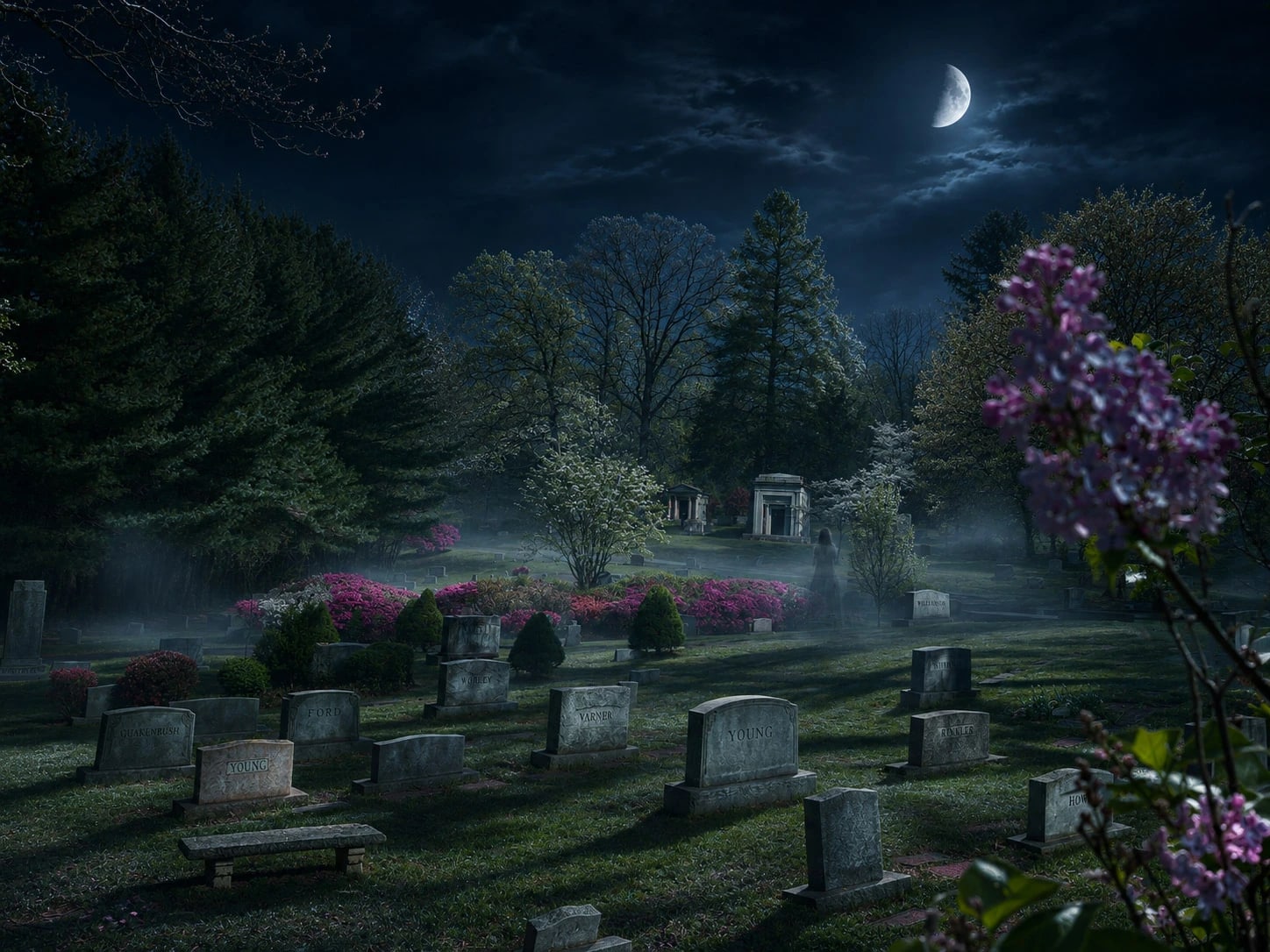
Riverside Cemetery on its hillside in Asheville's Montford neighborhood