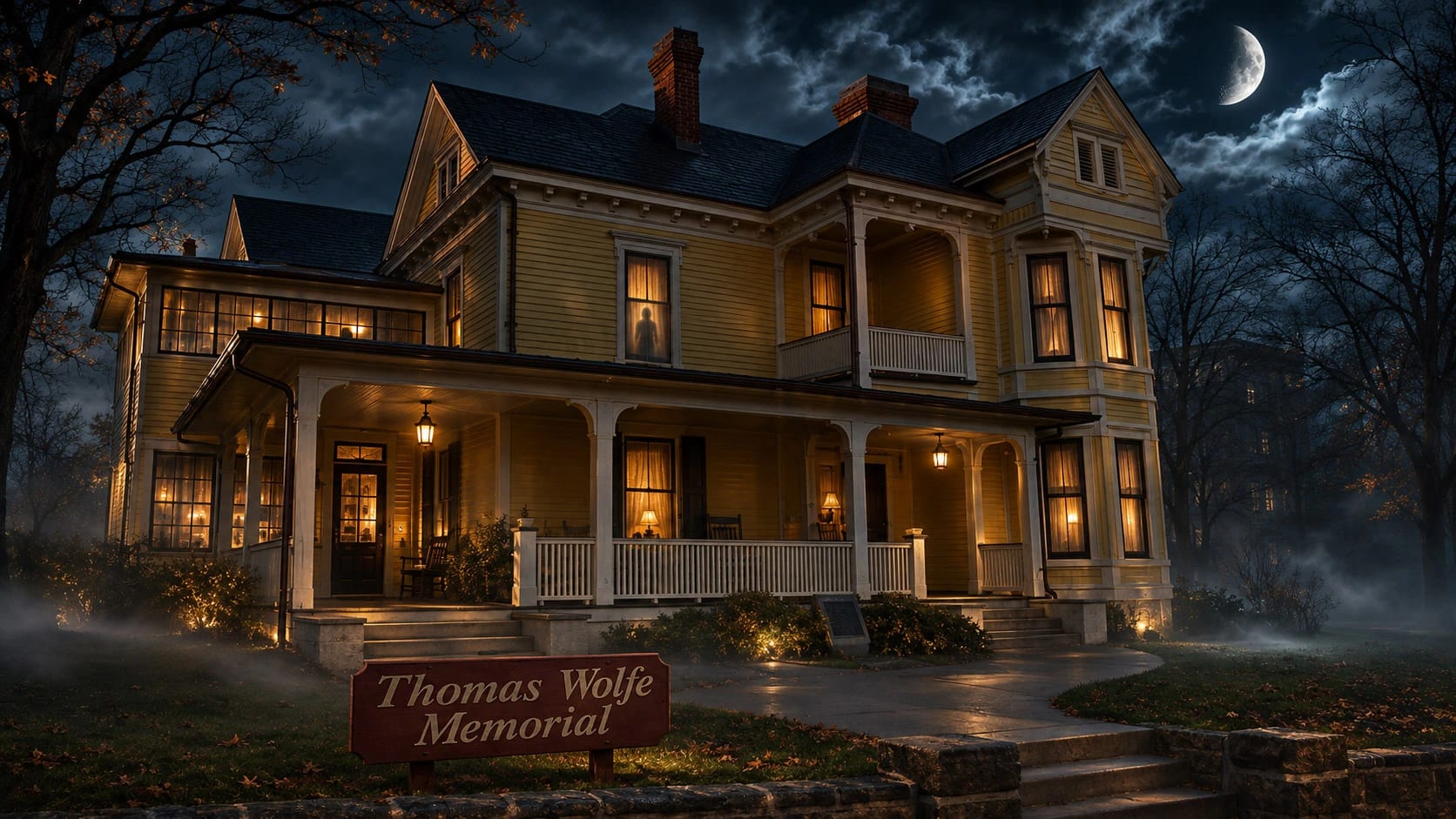
The old yellow boardinghouse stands a short distance from Pack Square in downtown Asheville, its broad porches and Victorian bay windows recalling a time when visitors came to the mountains for fresh air, rest, and the promise of better health. Rocking chairs line the porch, and inside, narrow hallways connect rooms crowded with the furniture and possessions of a family that lived here more than a century ago.
Today, the building is known as the Thomas Wolfe Memorial. It preserves the childhood home of one of America's most celebrated twentieth-century novelists, a man whose complicated relationship with Asheville inspired some of the most memorable passages in American literature.
But the house at the former 48 Spruce Street was never a particularly peaceful home.
For nearly forty years, Julia Wolfe operated the Old Kentucky Home as a boardinghouse. Traveling salesmen, vacationers, teachers, and strangers occupied rooms alongside her children. Guests came and went, meals were prepared for crowded tables, and the constant demands of running a business left little room for privacy. Thomas Wolfe, the youngest of eight children, grew up surrounded by conversations, arguments, laughter, illness, and the everyday difficulties of people whose lives intersected beneath his mother's roof.
The family also experienced extraordinary loss. In October 1918, Thomas's beloved older brother Ben died in an upstairs bedroom during the influenza pandemic. Four years later, their father, William Oliver Wolfe, died in the same boardinghouse. Thomas himself lived only until 1938, leaving behind novels that transformed his childhood memories into fiction.
According to Asheville folklore, some of the Wolfe family never entirely left.
Visitors have described unexplained footsteps in the upstairs hallway, faint knocking sounds, and sudden cold sensations near the room where Ben died. Others claim to have heard a typewriter operating somewhere inside the house when no one was using one. A man dressed in old-fashioned clothing has supposedly appeared at an upper window, while local ghost stories suggest that Julia Wolfe still watches over the property she worked so hard to maintain.
The accounts are difficult to verify individually, and the memorial does not officially identify its rooms as haunted. Yet the house has an unusual connection to the supernatural that predates its modern ghost stories.
Julia Wolfe believed in prophetic dreams, apparitions, and other manifestations of the unseen world. Her son inherited that fascination, incorporating ghosts, visions, and conversations with the dead into his writing. In Look Homeward, Angel, Thomas even imagined an encounter with his deceased brother.
The distinction between literature and folklore becomes particularly important here. Some of the most convincing supernatural scenes associated with the Wolfe family originated in a novel rather than an eyewitness account.
To understand the hauntings attributed to the Old Kentucky Home, it helps to begin with the woman who purchased the boardinghouse and the child who grew up feeling like a stranger inside it.
The History of the Old Kentucky Home
Asheville's Boardinghouse Era
By the late nineteenth century, Asheville was becoming one of the South's most fashionable mountain destinations.
The railroad reached the city in 1880, making Western North Carolina considerably more accessible to travelers. Wealthy vacationers arrived during the summer to escape the heat of larger cities, while patients suffering from tuberculosis and other respiratory illnesses came seeking relief in the mountain climate.
Physicians promoted Asheville as a place where fresh air, moderate temperatures, and outdoor recreation could improve health. Hotels, boardinghouses, private sanatoriums, and other lodging establishments appeared throughout the growing city to accommodate the visitors.
Not everyone could afford a luxury resort.
Boardinghouses offered more economical accommodations, often including meals and a room for a weekly or daily rate. Guests shared dining areas, parlors, porches, and sometimes bathrooms. Their proprietors were frequently women who relied upon the business to support themselves or their families.
Asheville's boardinghouses ranged from modest residences offering a handful of rooms to substantial homes capable of accommodating twenty or more people.
Many operated seasonally, attracting visitors during the most popular travel months. Others housed permanent residents, teachers, clerks, and workers whose employment brought them to the city.
The Old Kentucky Home belonged to this world.
Before it became famous as Thomas Wolfe's childhood residence, it was an ordinary commercial lodging house serving people who came to Asheville for countless different reasons.
The House at 48 Spruce Street
The building that became the Old Kentucky Home was constructed in 1883.
Erwin E. Sluder, a prominent Asheville banker, built the original seven-room residence on a lot measuring approximately ninety-five by 190 feet. The house was intended as a wedding present for his daughter Cordelia and her husband, W. W. Barnard.
The property's ownership changed several times during the following years.
In April 1884, the house was sold to J. H. Herring for $3,600. The Barnards purchased it again in March 1885, then sold it to Alice Johnston Reynolds in July 1889 for $7,500.
Reynolds recognized the property's potential as a boardinghouse.
Under her ownership, the building was enlarged and modernized. Electricity and indoor running water were installed, while additional rooms increased the number of guests it could accommodate.
The business became known as The Reynolds.
Advertisements in local directories and tourist publications promoted its accommodations to visitors coming to Asheville. It operated successfully throughout much of the 1890s.
Following Reynolds's death in July 1900, the property was purchased by Reverend Thomas M. Myers and his wife, Mary, who came from Kentucky.
The Myers family gave the boardinghouse the name that would eventually become famous.
They called it the Old Kentucky Home, honoring Mary's native state.
The house continued operating under several proprietors during their ownership. By 1906, it was a substantial business with an established reputation and a regular clientele.
That year, a determined Asheville woman learned that the property was for sale.
Julia Wolfe Buys the Old Kentucky Home
Julia Elizabeth Westall Wolfe was born on February 16, 1860, near Swannanoa, North Carolina.
She grew up in a large family during the difficult years surrounding the Civil War and Reconstruction. Her childhood experiences left her determined to avoid poverty and establish financial independence.
Julia attended school, became a teacher, and developed an interest in real estate that would shape much of her adult life.
On January 14, 1885, she married William Oliver Wolfe, an Asheville stonecutter and monument dealer.
The couple eventually had eight children.
Unlike many women who entered the boardinghouse business because they had been widowed or were struggling financially, Julia was married to a successful businessman. W. O. Wolfe's monument shop provided a respectable income, but Julia wanted to build wealth through her own efforts.
She studied property values, followed land sales, and invested in real estate whenever an attractive opportunity appeared.
In August 1906, she purchased the Old Kentucky Home for $6,500.
The boardinghouse already had nineteen paying guests, providing immediate income. Its established name was included in the transaction, with the previous owners requesting that it be retained.
Julia saw the property as a business with considerable potential.
Her husband saw it somewhat differently.
W. O. Wolfe disliked the idea of his wife operating a boardinghouse, particularly one that brought strangers into the family's daily life. He believed the arrangement diminished the privacy and standing of a household that was already financially comfortable.
Nevertheless, Julia completed the purchase.
It was a decision that permanently changed the family's relationships.
A Family Divided Between Two Homes
Before Julia purchased the boardinghouse, the Wolfe family lived at 92 Woodfin Street, approximately two blocks away.
W. O. had constructed the residence in 1881, and all eight of the Wolfe children were born there.
The Woodfin Street house represented a conventional family home, although the Wolfe household was rarely free from conflict.
Julia's acquisition of the Old Kentucky Home created a practical problem. She could not effectively operate the boardinghouse while living at Woodfin Street, so she moved into the business.
She took her youngest child, Thomas, with her.
The other Wolfe children divided their time between the two properties, although several remained primarily with their father. Julia's daughters frequently assisted with household work, while her sons moved between the family residence and the boardinghouse.
For Thomas, the arrangement was particularly difficult.
He was only six years old when his mother moved him into the Old Kentucky Home. Unlike most children, he did not have a permanent bedroom that belonged exclusively to him.
When the boardinghouse was crowded, he slept wherever space was available.
His mother's paying guests took priority.
Thomas could visit his father's house during the day, but Julia expected him to return to the boardinghouse at night.
The experience left a lasting impression.
Wolfe later described feeling as though he had grown up with two houses but no true home. He resented the lack of privacy, the constant presence of strangers, and his mother's relentless attention to the business.
Yet the boardinghouse also provided him with an extraordinary education.
Travelers arrived from across the United States, bringing stories, unfamiliar accents, arguments, gossip, and news of places beyond Asheville. Thomas listened to conversations in the parlor, observed the habits of guests, and developed an exceptional ability to remember people and their mannerisms.
Many of those encounters eventually appeared in his fiction.
The house that frustrated him throughout childhood also supplied much of the material that made him famous.
Life Inside Julia Wolfe's Boardinghouse
A Business That Never Really Closed
Running the Old Kentucky Home required enormous effort.
Julia charged guests for accommodations and meals, providing breakfast and supper as part of the boardinghouse's daily routine. During the early years of her ownership, room and board could cost approximately one dollar per day, although rates varied.
The work began early.
Meals had to be prepared, bedrooms cleaned, linens washed, and supplies purchased. Julia managed guests, collected payments, negotiated with merchants, and supervised the people who helped maintain the building.
She could work as many as nineteen hours a day.
Yet the business was only one part of her financial interests.
Julia used the profits to purchase and develop additional property in Asheville and Florida. She followed real estate opportunities closely, sometimes becoming so absorbed in land transactions that her children accused her of caring more about business than family life.
Her determination helped make the household prosperous.
It also contributed to the tensions that Thomas later described in his novels.
The Old Kentucky Home was not uniformly unhappy, however. Family members and boarders gathered around the piano, where Thomas's sister Mabel played and sang. W. O. Wolfe entertained guests with dramatic recitations from Shakespeare and other writers.
The house hosted important celebrations, including the weddings of daughters Effie in 1908 and Mabel in 1916.
For guests, the boardinghouse offered companionship and hospitality. For the children, it provided a succession of new people and experiences, along with the frustration of having very little private space.
The Expansion of 1916
As Asheville's tourism industry expanded, Julia continued enlarging the house.
In 1916, she undertook a substantial renovation, adding bedrooms, bathrooms, sleeping porches, and additional living spaces.
The improvements reflected changing expectations among visitors.
Fresh air remained an important part of Asheville's appeal, and sleeping porches allowed guests to rest outdoors while remaining protected from the weather.
Julia also expanded the dining facilities and created a small family dining area, helping separate some household activities from the commercial operation.
The enlarged building eventually contained twenty-nine rooms.
Its exterior developed the rambling appearance that visitors recognize today, with a broad porch, projecting bays, multiple rooflines, and irregular additions reflecting the practical decisions of successive owners.
Thomas was unimpressed by much of his mother's construction.
In his writing, he criticized the inexpensive materials and the awkward arrangement of rooms. To him, the house represented Julia's determination to maximize income, even when doing so made daily life uncomfortable.
The changes nevertheless helped the Old Kentucky Home accommodate larger numbers of guests during Asheville's busiest tourism seasons.
By then, Thomas was preparing to leave.
In 1916, at fifteen, he enrolled at the University of North Carolina at Chapel Hill.
He had escaped the boardinghouse, at least temporarily.
Two years later, an urgent message from his mother brought him back.
The 1918 Influenza Pandemic and the Death of Ben Wolfe
The Epidemic Reaches Asheville
In the autumn of 1918, the influenza pandemic swept across the United States.
The disease was particularly dangerous for young adults, many of whom developed severe respiratory complications. Pneumonia could progress rapidly, and physicians possessed few effective treatments.
Asheville's reputation as a health resort offered little protection.
People traveled through the city by railroad, stayed in hotels and boardinghouses, and moved between businesses and crowded neighborhoods. The same transportation network that had helped Asheville grow also allowed infectious diseases to spread.
By October, the situation had become desperate.
Local newspapers reported shortages of doctors and nurses. Many medical professionals were serving in military camps because of World War I, leaving civilian communities struggling to care for the sick.
Temporary hospitals opened to accommodate patients.
An emergency facility was established in the former high school, while another hospital opened at the Masonic Temple to care for Black residents who faced segregation in medical services.
By October 20, more than 2,500 cases of influenza had been reported in Asheville.
The epidemic reached the Wolfe family during this period.
Benjamin Harrison Wolfe, Thomas's older brother, became seriously ill.
Benjamin Harrison Wolfe: Thomas's Closest Brother
Ben was born on October 27, 1892, one of the Wolfe family's twin sons.
His twin brother, Grover Cleveland Wolfe, had died of typhoid fever in St. Louis in 1904, when Julia was operating a temporary boardinghouse during the World's Fair.
The twins had been named after the presidential candidates of the 1892 election, reflecting their father's interest in politics.
Ben left school at a relatively young age and began working for the Asheville Citizen. He initially delivered newspapers before moving into the business department.
He later worked for newspapers in Winston-Salem, developing a reputation as a dependable and hardworking young man.
Among the Wolfe siblings, Ben was particularly close to Thomas.
He offered his younger brother attention and understanding that Thomas sometimes felt he lacked from their parents. Ben possessed a dry sense of humor and could be impatient with the family's frequent arguments, but Thomas admired him deeply.
In 1918, Ben returned to Asheville while awaiting news about his military draft status.
He had experienced respiratory problems and had previously been rejected for military service because of his health.
Shortly after returning to the Old Kentucky Home, he contracted influenza.
His condition worsened rapidly.
The Final Days in the Upstairs Bedroom
Ben initially occupied a small upstairs bedroom.
As the illness progressed into pneumonia, the family moved him to an adjoining room that offered better light and ventilation.
Julia and other family members attempted to care for him while Asheville's medical system struggled under the epidemic.
Thomas was at Chapel Hill when he received a telegram announcing that Ben had pneumonia and urging him to return home.
He traveled to Asheville by train.
By the time he arrived, Ben was gravely ill.
The illness had severely affected his breathing, and the family gathered around him as his condition deteriorated.
Thomas watched his brother struggle through the final hours.
On October 19, 1918, Ben died in the upstairs bedroom.
He was twenty-five, just eight days short of his twenty-sixth birthday.
His death devastated Thomas.
The two brothers had shared a close relationship, and the experience became one of the defining memories of the writer's life.
Years later, Wolfe reconstructed Ben's final illness in Look Homeward, Angel, transforming the family's private suffering into one of the novel's most powerful sections.
The room where Ben died became particularly important after the house was preserved as a museum.
Family members arranged its furniture to resemble the room as they remembered it during his final illness. The bed and other personal objects helped visitors understand the circumstances surrounding his death.
Today, Ben's bedroom is the location most closely associated with the Old Kentucky Home's haunting.
But the writer's own treatment of his brother's death adds another dimension to the story.
Ben Wolfe and the Ghost in Look Homeward, Angel
Thomas Wolfe never entirely recovered from the loss of his brother.
His novels returned repeatedly to the themes of death, memory, separation, and the impossibility of recovering the past.
Ben became one of the central figures in Look Homeward, Angel, where the Wolfe family appears in fictional form as the Gants.
Thomas himself became Eugene Gant.
His mother Julia became Eliza, while his father was transformed into W. O. Gant.
Ben retained his name.
The novel's final chapters examine his death and the emotional consequences for Eugene, who feels both love and guilt when remembering his older brother.
Wolfe's treatment of death was not confined to realistic descriptions of illness or mourning.
He also introduced supernatural imagery.
In the novel's closing passages, Eugene encounters what appears to be the spirit of his dead brother. The scene develops into a conversation about life, death, memory, and the impossibility of returning to the people one has lost.
The encounter takes place within the fictional world of the novel.
It is not a documented account of Thomas Wolfe literally seeing Ben's ghost at the boardinghouse.
This distinction becomes important because some modern interpretations of the house's haunting treat the literary appearance of Ben as though it were evidence of an actual supernatural experience.
Wolfe was writing fiction, although his fiction drew heavily upon real events.
The imaginary encounter allowed him to confront feelings that ordinary conversation could not resolve.
His brother was dead.
Thomas had survived.
He could remember Ben, write about him, and imagine hearing his voice, but he could not bring him back.
The scene has remained one of the most memorable expressions of grief in Wolfe's writing.
It also explains why stories of Ben's continued presence seem particularly appropriate to the house where he died.
The Death of William Oliver Wolfe in 1922
The Old Kentucky Home witnessed another major family loss four years after Ben's death.
William Oliver Wolfe had spent much of his adult life operating a monument business in downtown Asheville.
His shop stood near Pack Square, on property eventually occupied by the Jackson Building.
W. O. was an imposing personality, remembered for his drinking, temper, dramatic speech, and skill as a stonecutter.
He frequently carved grave markers and sold funerary monuments, including marble angels that became important images in Thomas Wolfe's writing.
During his later years, W. O.'s health deteriorated.
Julia had sold the original Woodfin Street family home in 1920, and the couple eventually spent more time together at the boardinghouse.
W. O. died there in 1922.
His death provided Thomas with another intimate experience of loss in the building he had long regarded with mixed emotions.
The father's profession added an unusual dimension to the family's history.
For decades, W. O. Wolfe had prepared memorials for other people's dead.
Now his own family had to confront his death.
His monument business also inspired the title of Thomas's first novel. The famous marble angel associated with his father's shop became a central symbol in Look Homeward, Angel, representing longing, beauty, and the human desire to reach beyond the limits of ordinary existence.
W. O. was buried in Riverside Cemetery, where members of the Wolfe family would eventually join him.
There is no well-established ghost story identifying the father's apparition inside the Old Kentucky Home.
Nevertheless, his life and death form an important part of the house's history, particularly when examining how deeply the Wolfe family associated its rooms with grief and remembrance.
Thomas Wolfe Becomes a Famous American Writer
From Asheville to New York
Thomas Wolfe graduated from the University of North Carolina in 1920 and continued his education at Harvard, where he studied drama.
He initially hoped to become a playwright.
After several unsuccessful attempts to establish himself in the theater, he began teaching at New York University while developing his writing.
During the 1920s, Wolfe traveled extensively and became involved with Aline Bernstein, a successful theatrical designer who was considerably older than he was.
Bernstein provided emotional and financial support during important years of his literary development.
Wolfe began transforming his memories of Asheville into an enormous autobiographical manuscript.
His original draft was far longer than a conventional novel.
Working with editor Maxwell Perkins at Charles Scribner's Sons, he revised the manuscript into the book published in 1929 as Look Homeward, Angel.
The novel attracted considerable critical attention.
Its expansive prose, emotional intensity, and detailed portrayal of a Southern family established Wolfe as a significant new American writer.
But the response in Asheville was very different.
The Novel That Angered Asheville
Wolfe had drawn so extensively from his childhood that many Asheville residents recognized themselves in the novel.
The fictional city of Altamont was unmistakably based on Asheville.
Its streets, businesses, families, and local personalities closely resembled those Wolfe had known.
The Old Kentucky Home appeared as Dixieland, while the Wolfe family became the Gants.
Some residents resented the portrayals.
People believed Wolfe had exposed private family conflicts, embarrassing behavior, and personal weaknesses for public entertainment.
The novel was removed from Asheville's public library for years, and Wolfe avoided returning to the city while the controversy continued.
His relationship with his family also suffered.
Julia disliked portions of the book, particularly those describing her business habits and relationships with her children.
Yet the novel brought new attention to the Old Kentucky Home.
Readers began visiting Asheville hoping to see the boardinghouse that had inspired Dixieland.
The building's identity was changing.
What had once been an ordinary commercial lodging house was becoming a literary landmark.
Wolfe Returns to Asheville in 1937
In 1937, Wolfe returned to Asheville after years of absence.
His reception was considerably warmer than he had expected. Many residents had become proud of the nationally recognized writer, and the old anger surrounding his first novel had diminished.
Wolfe visited family members, met old acquaintances, and walked through places he remembered from childhood.
He returned to the Old Kentucky Home.
The experience brought back powerful memories, including the sounds of the staircase, the familiar rooms, and the people who had occupied them.
He also visited the former site of his father's monument shop, where the Gothic Revival Jackson Building now stood.
The changes in Asheville impressed and unsettled him.
His hometown had become a larger, more modern city, while many of the physical landmarks of his childhood had disappeared.
Wolfe returned to New York, continuing to write with extraordinary intensity.
The following summer, he traveled west, visiting national parks and other destinations.
During the trip, he became seriously ill.
Doctors eventually diagnosed tuberculous meningitis.
Wolfe died at Johns Hopkins Hospital in Baltimore on September 15, 1938.
He was thirty-seven years old.
His body was brought back to Asheville and buried in the family plot at Riverside Cemetery.
For a writer whose career had been dominated by the difficulty of returning home, his final journey ended in the city he had spent so many years trying to escape.
Famous Guests: Zelda and F. Scott Fitzgerald
The Old Kentucky Home's literary connections did not end with Thomas Wolfe.
One particularly surprising visitor was Zelda Fitzgerald.
Her stay has been documented through the boardinghouse guest register and her personal correspondence.
Zelda Fitzgerald Checks In During 1943
Zelda had been receiving psychiatric treatment at Highland Hospital in Asheville during the 1930s and 1940s.
Her husband, F. Scott Fitzgerald, had spent time at the Grove Park Inn while she was a patient, but he died in California in December 1940.
Zelda continued returning to Asheville for treatment after his death.
During one such visit in 1943, she needed inexpensive accommodations while receiving outpatient care.
On September 6, 1943, she signed the guest register at the Old Kentucky Home.
The historic site preserves documentation of her visit.
She stayed in a room near the top of the stairs, paying approximately $3.50 per week.
The arrangement was hardly luxurious.
By that point, Julia Wolfe had been operating the boardinghouse for nearly four decades, and the building was showing its age.
Zelda wrote about the house's poor condition and expressed surprise that such an environment had produced a writer of Thomas Wolfe's abilities.
She never met Thomas, who had died five years earlier.
Nevertheless, his family regarded her as a friend, according to recollections attributed to his brother Frank.
The visit creates an extraordinary connection between three of Asheville's literary landmarks.
F. Scott Fitzgerald stayed at the Grove Park Inn. Zelda received treatment at Highland Hospital, where she would die in the devastating 1948 fire. During an earlier period of outpatient treatment, she rented a room inside the boardinghouse that had inspired Look Homeward, Angel.
Her name remains in the guest register.
F. Scott Fitzgerald Visits Julia Wolfe
F. Scott Fitzgerald also reportedly visited the Old Kentucky Home during his time in Asheville.
According to a later account by writer Tony Buttitta, Fitzgerald wanted to see the boardinghouse that had become famous through Wolfe's novel.
He approached Julia without initially revealing his identity, allowing her to believe he might be seeking a room.
The encounter did not go particularly well.
Julia reportedly regarded Fitzgerald as intoxicated and made it clear that she did not want him staying at her property.
The story has been repeated in literary histories of Asheville, including accounts examining the city's connection to both writers.
It survives principally as a recollection rather than an independently documented transaction, but it fits the portrait of Julia that emerges from family correspondence and historical accounts.
She ran a business and expected visitors to meet her standards.
Being a famous writer did not necessarily earn someone special treatment.
The Old Kentucky Home Becomes a Museum
Julia Wolfe's Final Years
Julia continued operating the boardinghouse after Thomas's death.
By the early 1940s, she had become a minor celebrity herself.
Readers of Look Homeward, Angel came to Asheville hoping to meet the woman who had inspired Eliza Gant, and Julia sometimes spoke about her son's childhood and writing.
She remained intensely interested in business, property, and the activities of her surviving children.
The boardinghouse had experienced financial difficulties during the Depression.
It was sold at auction in 1939, but Julia eventually regained ownership with help from family resources and money connected to Thomas's estate.
She continued receiving guests.
Her life ended on December 7, 1945, while she was in New York.
She was eighty-five.
Julia's remains were returned to Asheville and buried in the family plot at Riverside Cemetery.
By then, the Old Kentucky Home had become too important to literary history to remain an ordinary commercial property.
Preserving Thomas Wolfe's Childhood Home
After Julia's death, surviving family members began considering how the building might be preserved.
The Thomas Wolfe Memorial Association acquired the property, and the house opened to the public on July 19, 1949.
Family members contributed furnishings and personal possessions to recreate the boardinghouse as it had appeared during Thomas's childhood.
The rooms were arranged with remarkable attention to historical detail.
Beds, chairs, tables, clothing, photographs, household equipment, and other objects remained in locations associated with the Wolfe family's daily life.
The memorial became a destination for readers, scholars, and visitors interested in Asheville history.
In 1971, the Old Kentucky Home was designated a National Historic Landmark.
The State of North Carolina acquired the property during the 1970s, establishing it as part of the state's historic sites system.
The building was no longer receiving travelers who needed a room and a hot meal.
Instead, visitors arrived to understand the family who had once lived among those travelers.
The transformation fulfilled something Wolfe had imagined in his own writing: that his mother's boardinghouse might one day become a museum.
The Devastating Fire of July 24, 1998
The Old Kentucky Home almost disappeared in the summer of 1998.
In the early morning hours of July 24, a fire broke out inside the historic building.
The flames spread rapidly through the wooden structure, moving from the dining room into upper sections of the house and eventually reaching the attic and roof.
Firefighters battled the blaze, but substantial damage occurred before it could be controlled.
Investigators concluded that the fire had been deliberately set.
The arson caused extensive damage to portions of the building and its irreplaceable furnishings.
Approximately twenty percent of the original structure and fifteen percent of the artifact collection were destroyed, according to the memorial's official history.
Among the areas affected was the upstairs room associated with Ben Wolfe's death.
The fire damaged furnishings that had been preserved for generations, threatening the historical integrity of one of North Carolina's most important literary landmarks.
The preservation effort became an extraordinary project.
Conservators, architects, historians, and craftspeople worked to restore damaged woodwork, reconstruct portions of the building, and repair surviving artifacts.
The work involved careful examination of photographs, historical documentation, and construction details.
Rather than replacing the house with a simplified reconstruction, preservationists sought to retain as much original material as possible.
The restoration continued for nearly six years.
In May 2004, the Old Kentucky Home reopened to visitors.
The fire is one of the most dramatic events in the building's modern history. Although haunted-location stories sometimes emphasize the house's association with death, the 1998 arson is a separate, documented tragedy involving the destruction of historic property.
There is no established evidence connecting the blaze to supernatural activity.
The building survived because people believed the history inside its walls was worth saving.
The Ghost Stories of the Thomas Wolfe Memorial
The Old Kentucky Home's haunted reputation centers on the Wolfe family, particularly Thomas, Julia, and Ben.
Unlike some Asheville ghost stories that revolve around a single mysterious apparition, the accounts associated with the boardinghouse describe several kinds of unexplained activity.
Visitors have reported footsteps, knocking sounds, and unusual sensations in the upstairs rooms. Other stories involve a person appearing briefly at an upper window or the sound of a typewriter operating somewhere inside the building.
Most of these accounts appear in regional ghost-story collections and modern haunted-location articles.
They are not supported by a large collection of independently identified eyewitnesses, and the memorial does not operate as a paranormal investigation site.
Nevertheless, the stories have become part of Asheville folklore, particularly because the building's actual history includes several deaths and a writer who was deeply fascinated by the supernatural.
The Ghost of Ben Wolfe in the Upstairs Bedroom
The most emotionally powerful haunting associated with the Old Kentucky Home concerns the room where Ben Wolfe died in 1918.
Visitors have reportedly experienced sudden cold sensations near the bedroom.
Others describe unexplained footsteps in the adjacent hallway, sometimes seeming to approach the room before fading away.
Some accounts include faint knocking sounds coming from a wall or doorway.
The reports do not consistently describe a visible apparition, although later retellings sometimes suggest that Ben's spirit remains near the place where he died.
His room has a stronger connection to a documented death than many other haunted locations.
Ben's final illness occurred there, and Thomas Wolfe was present during his last hours.
The family subsequently preserved the room as a memorial to the young man whose death had so profoundly affected them.
After the house became a museum, visitors encountered a setting arranged to recall that tragedy.
The bed, furniture, and personal objects helped them imagine the final days of Ben's life.
It is understandable that someone entering the bedroom might experience strong emotions.
For readers of Look Homeward, Angel, the setting also recalls Wolfe's literary description of his brother's death, making the room feel familiar before they ever see it.
But the connection between the reported phenomena and Ben's spirit remains speculative.
No reliable evidence has established that a particular sound or cold sensation originated from a supernatural source.
The historical tragedy is real.
The supposed haunting belongs to the stories that developed around it.
The Footsteps in the Upstairs Hallway
Another frequently repeated account involves footsteps heard on the upper floor when no one appears to be walking there.
The Old Kentucky Home contains a complicated arrangement of rooms and passages developed through decades of expansion.
Its narrow hallways, wooden floors, stairs, and adjoining spaces reflect the practical changes made by successive owners.
These architectural features contribute to its atmosphere.
Visitors moving through the upstairs rooms may hear creaking wood, the movement of other guests, or sounds traveling from distant portions of the house.
According to the ghost stories, however, some footsteps have been heard when the surrounding rooms were supposedly empty.
The sounds are often described as measured and deliberate.
They seem to approach along the hallway, sometimes stopping near the bedrooms associated with the Wolfe family.
The identity of the supposed spirit varies.
Some storytellers attribute the footsteps to Ben, while others suggest that Julia continues making rounds through the building as she did while operating the boardinghouse.
A third interpretation identifies the presence as Thomas Wolfe himself.
The available reports do not establish which, if any, of those explanations is correct.
The footsteps remain one of the house's better-known paranormal traditions, but their association with a particular family member appears to have developed through interpretation rather than documented identification.
Julia Wolfe: The Landlady Who Never Left
Julia Wolfe devoted nearly four decades to the Old Kentucky Home.
She managed its finances, supervised employees, dealt with guests, arranged meals, and expanded the building whenever she believed more rooms would increase its profitability.
Her personality was forceful.
Family members remembered her as frugal, determined, and frequently preoccupied with business.
Thomas's novels exaggerated some of those characteristics, although the historical record confirms that Julia was an unusually ambitious businesswoman for her time.
According to modern ghost stories, she remains attached to the boardinghouse.
Some accounts describe a female apparition moving through the house, particularly near the rooms used for daily operations.
Other versions suggest that an unseen presence watches visitors or that the building occasionally seems occupied even when no one is nearby.
The figure is sometimes identified as Julia because the activity resembles the routines of a busy landlady.
It is an appealing interpretation.
Few people were more closely associated with the Old Kentucky Home than Julia Wolfe.
She purchased the building, enlarged it, operated it through difficult economic periods, and remained involved until the end of her life.
Yet the published accounts do not provide a consistent physical description of her supposed apparition.
Nor do they establish a verified eyewitness who positively identified Julia Wolfe.
The identification appears to be based primarily on her personality and her attachment to the property.
It has nevertheless become one of the memorial's most recognizable ghost stories.
The Sound of a Typewriter in an Empty Room
One of the more unusual accounts involves the supposed sound of a typewriter.
Visitors and local storytellers have described hearing a mechanical clicking or tapping noise that resembles someone typing inside the historic house.
The sound allegedly continues for a short period before stopping.
No person can be found operating a machine.
The phenomenon is frequently associated with Thomas Wolfe.
Given his literary fame, the explanation is almost inevitable.
Wolfe became known for producing enormous manuscripts, often working for long periods and writing with remarkable intensity.
But there is a historical complication.
He did not produce the novels that made him famous while living as a child at the Old Kentucky Home.
His major literary career developed after he left Asheville, particularly during his years in New York and Europe.
The memorial contains furnishings associated with his later life, including writing equipment brought from one of his New York residences.
Those objects were added to help visitors understand his work.
Their presence does not establish that Wolfe spent his childhood typing novels in the boardinghouse.
The sound itself has not been independently documented through a verified recording or detailed eyewitness investigation.
As a ghost story, the phantom typewriter reflects the writer's public identity more than a specific event known to have occurred in the building.
The idea of an author continuing to work after death has a certain appeal.
It is particularly fitting for someone who left behind an enormous quantity of unfinished writing when he died.
But the sound attributed to Thomas Wolfe remains folklore rather than established evidence of his presence.
The Man at the Upstairs Window
A more visual haunting concerns a man reportedly seen standing at an upstairs window after dark.
According to a local account, the figure appeared to be wearing clothing from an earlier period.
He remained visible briefly before disappearing.
The identity of the supposed apparition has never been established.
Some storytellers identify the man as Thomas Wolfe, while others suggest Ben or another member of the family.
There is no detailed, independently verified witness statement establishing the figure's appearance, location, or the circumstances under which it was observed.
The story is nevertheless effective because of the building's design.
The Old Kentucky Home has several projecting windows and upper rooms that are visible from the surrounding grounds.
At night, the combination of window glass, curtains, furnishings, and interior shadows can make it difficult to distinguish objects from people.
Reflections may also produce unexpected shapes when lights are visible inside the building.
Those possibilities do not establish what an individual witness saw.
They simply demonstrate why a brief appearance at a window would be difficult to evaluate without further evidence.
The idea of someone watching the street from an upper room also fits the history of the boardinghouse.
For decades, guests looked through those windows toward a changing Asheville.
In the modern ghost story, someone may still be watching.
Knocking, Voices, and Other Unexplained Sounds
Other accounts describe faint knocks, indistinct voices, or noises coming from apparently unoccupied rooms.
Some visitors have reported unusual sensations while moving through the house, including the feeling that another person is nearby.
These stories generally lack precise dates and consistently identified witnesses.
They also vary considerably in detail, suggesting that the modern haunting has developed through several different accounts rather than one original incident.
The building's age provides possible explanations for some of the reported sounds.
Wood expands and contracts as temperature and humidity change. Older windows and doors may rattle or shift, while vibrations from nearby traffic can travel through the structure.
The house also contains multiple stairways and rooms arranged around narrow corridors.
Sounds from another part of the building may seem closer than they actually are.
No publicly documented investigation has established that the knocking or voices result from paranormal activity.
Still, the stories have remained part of the Old Kentucky Home's haunted reputation, particularly because the house once contained so many people that silence would have been an unfamiliar condition.
Julia Wolfe's Belief in Ghosts and the Supernatural
Perhaps the most interesting supernatural connection to the Old Kentucky Home is not a modern ghost sighting.
It is Julia Wolfe's own interest in folklore.
Julia grew up in the mountain communities of Western North Carolina, where stories involving dreams, omens, apparitions, and supernatural warnings circulated through families.
Her relatives preserved traditions that blended religious belief with the folklore of the surrounding region.
Accounts of Julia's life describe her belief in prophetic dreams and unusual spiritual experiences.
She told stories about relatives who supposedly knew when they would die, people who had appeared in two places at once, and visions involving deceased family members.
According to family recollections, Julia sometimes experienced dreams she interpreted as messages or warnings.
She also possessed a remarkable memory for family histories, local events, and stories passed between generations.
Thomas inherited much of that storytelling ability.
He remembered conversations, gestures, incidents, and personalities with extraordinary detail, later transforming them into scenes in his novels.
The supernatural traditions Julia shared became part of his imaginative world.
Ghosts and visions appear throughout Wolfe's writing, particularly when characters confront death or the memory of people they have lost.
His literary treatment of those experiences is complicated.
He could be skeptical of conventional religious belief while remaining deeply interested in the emotional power of supernatural imagery.
For Wolfe, the dead often remained present through memory, dreams, and the influence they continued exerting on the living.
That perspective helps explain the ghostly encounter with Ben in Look Homeward, Angel.
It also gives the Old Kentucky Home an unusual distinction among Asheville's haunted locations.
The family who lived there already told ghost stories.
Their most famous member later incorporated those traditions into internationally recognized literature.
Long before ghost tours began describing the boardinghouse as haunted, its residents had helped preserve the region's supernatural folklore.
Did Thomas Wolfe Believe in Ghosts?
Wolfe's novels contain frequent references to ghosts, apparitions, angels, and other supernatural imagery.
That does not necessarily mean he believed the dead literally returned to haunt houses.
His writing often treated the supernatural as a way to explore memory and the emotional consequences of loss.
The death of Ben Wolfe is the clearest example.
Thomas had watched his brother die and could not reconcile the permanent reality of that loss with the continuing presence of Ben in his thoughts.
In Look Homeward, Angel, he imagined meeting the dead brother again.
The encounter allowed Eugene Gant to confront questions about mortality and his own future.
It also gave literary form to something many grieving people experience: the feeling that a loved one remains present through memories, habits, and familiar places.
Wolfe's interest in the supernatural was therefore both personal and artistic.
He inherited stories and beliefs from Julia, but he also used them to express emotional experiences that were difficult to describe directly.
The distinction matters when considering the modern haunted reputation of the Old Kentucky Home.
A ghost appearing in Wolfe's fiction cannot be treated as an independently documented paranormal event.
Nor does a character's belief necessarily reveal the author's literal convictions.
What the novels demonstrate is that Wolfe was fascinated by the relationship between the living and the dead.
The Old Kentucky Home provided many of the memories that shaped that fascination.
Did the 1998 Fire Change the Haunting?
The arson fire of July 1998 introduced another tragic episode into the boardinghouse's history.
Because the blaze damaged portions of the upstairs rooms and destroyed irreplaceable family possessions, it is sometimes tempting to interpret the event through the house's ghost stories.
But there is no reliable evidence establishing that the fire caused new paranormal activity.
Nor has a documented investigation shown that unusual experiences became more frequent after the restoration.
The fire's consequences were physical and historical.
Original materials were lost, furnishings were damaged, and conservators spent years reconstructing portions of the building.
Some areas that visitors see today contain restored or reconstructed elements alongside surviving historic fabric.
That distinction is especially relevant to Ben's bedroom.
The family had preserved the room because of its connection to his death. When the fire damaged that portion of the house, preservationists faced the difficult task of repairing a space whose historical significance depended on its physical relationship to the events of 1918.
The restoration succeeded in preserving the building's identity, but some original material could never be recovered.
The work also demonstrates why the house matters beyond its supposed hauntings.
Few historic homes preserve such an intimate record of family life, literary history, and the development of American tourism.
Its survival was the result of extensive human effort.
No supernatural explanation is necessary to appreciate the achievement.
Visiting the Thomas Wolfe Memorial in Asheville
The Thomas Wolfe Memorial is located at 52 North Market Street, Asheville, North Carolina 28801, a short distance north of Pack Square.
The historic house was originally addressed as 48 Spruce Street, and that address appears throughout Wolfe's writing and historical records.
Today, the memorial operates as a North Carolina State Historic Site.
The property includes the Old Kentucky Home boardinghouse, a visitor center, and a historic children's playhouse associated with the Wolfe family.
The museum preserves the appearance and atmosphere of the boardinghouse during the years when Thomas lived there.
More than eighty-five percent of its displayed furnishings and artifacts are original, according to the state historic site.
Visitors can explore rooms associated with Julia's business, the Wolfe family's daily life, and the events that inspired Look Homeward, Angel.
Can You Tour the Old Kentucky Home?
Yes. The Thomas Wolfe Memorial offers guided tours of the historic boardinghouse.
As of November 2026, the site's published operating hours are Tuesday through Saturday, from 9 a.m. until 5 p.m. It is closed on Sundays, Mondays, and state holidays.
Guided house tours begin at half past each hour, with the final tour departing at 4:30 p.m.
The tour typically lasts approximately forty-five minutes.
Visitors can also explore the museum's exhibition hall and watch a twenty-two-minute introductory film about Wolfe's life and writing.
The visitor center provides context for the boardinghouse before guests enter the historic rooms.
Current adult admission is listed at $8 plus tax, with reduced rates for seniors, military visitors, and children. School groups may qualify for free guided tours.
Because schedules and admission policies can change, visitors should check the memorial's official website before arriving.
Can You See the Room Where Ben Wolfe Died?
The upstairs rooms associated with the Wolfe family form an important part of the guided tour.
Ben's bedroom is among the most significant spaces.
The room preserves furnishings and historical details intended to illustrate the circumstances of his final illness in 1918.
Visitors can see the area where the family gathered during his last days and learn how Thomas later transformed the experience into literature.
The room is not presented as an official paranormal attraction.
Its significance comes from the documented death and the role that loss played in shaping Wolfe's writing.
For readers familiar with Look Homeward, Angel, visiting the room can be particularly moving.
Is the Memorial Open for Ghost Hunting?
The Thomas Wolfe Memorial is a working museum and historic preservation site.
It does not offer unrestricted overnight ghost hunts or access to the house outside its authorized programs.
Visitors should not attempt to enter closed rooms, move historic objects, or remain on the property after closing.
The original furnishings and artifacts require careful preservation.
Anyone interested in the ghost stories can appreciate the building during an ordinary guided visit, when staff members provide historical information about the family and the house.
The upstairs hallways and rooms are also easier to understand when viewed within the context of the building's development.
Some areas have restricted accessibility because of the historic structure's stairs and layout.
Visitors with mobility concerns should contact the site in advance to discuss available accommodations.
Other Thomas Wolfe Landmarks in Asheville
The memorial is part of a larger collection of Asheville sites connected with Wolfe's life and writing.
His birthplace at 92 Woodfin Street no longer stands, but a historical marker identifies its former location.
The Jackson Building occupies the site of his father's monument business near Pack Square.
Riverside Cemetery contains the Wolfe family graves, including those of Thomas, Ben, Julia, and William Oliver.
The cemetery was particularly important to Thomas because he visited it as a child while accompanying his father on monument-related work.
These places help reconstruct the Asheville that Wolfe remembered.
The boardinghouse reveals his family life. The monument shop explains his early exposure to funerary sculpture, while Riverside preserves the graves of people whose deaths shaped his writing.
Together, the locations offer a more complete understanding of the writer than any one landmark could provide.
Is the Thomas Wolfe Memorial Really Haunted?
The Old Kentucky Home has acquired a reputation for unusual sounds, mysterious figures, and the apparent presence of people who once lived there.
Some visitors report footsteps near Ben's bedroom. Others describe faint knocks, a typewriter operating in an empty room, or a figure standing briefly at an upstairs window.
Modern ghost stories also suggest that Julia Wolfe and her famous son continue returning to the house.
These accounts are part of Asheville's local folklore, but their supernatural explanations remain unverified.
Most published descriptions lack the names of original witnesses, detailed dates, or evidence that ordinary causes were investigated and excluded.
The historical record is considerably stronger.
Ben Wolfe died in an upstairs bedroom during the influenza pandemic on October 19, 1918.
William Oliver Wolfe died in the boardinghouse four years later.
Julia operated the property for decades, while Thomas spent much of his childhood there before leaving Asheville and beginning the literary career that made the house famous.
The family also maintained a genuine interest in supernatural traditions.
Julia believed in dreams and apparitions, and Thomas incorporated ghosts into his writing.
The imagined appearance of Ben in Look Homeward, Angel is one of the novel's most important scenes, but it belongs to literature rather than documented eyewitness testimony.
These facts provide a more interesting explanation for the memorial's reputation than simply assuming every unexplained sound belongs to a dead family member.
The Old Kentucky Home is a place where history, memory, and storytelling have always been closely connected.
During Julia's lifetime, the house was crowded with travelers and relatives whose conversations supplied material for Thomas's imagination.
After his death, those memories became the foundation of a museum.
Visitors now walk through rooms arranged to recall events that occurred more than a century ago, including the death of a young man whose loss changed his brother's life.
The house has survived its original residents, the transformation of downtown Asheville, and a devastating arson fire.
Its rooms remain filled with the possessions of people who have been dead for generations.
For anyone who has read Wolfe's writing, that experience can be unusually powerful.
The author spent much of his career exploring a question that had troubled him since childhood: what happens to the people and places we love after they are gone?
He never found a simple answer.
Neither have the visitors who come to the Old Kentucky Home hoping to encounter a ghost.
The old boardinghouse remains on North Market Street, no longer receiving travelers who need a room for the night. Its beds are made, its furniture arranged, and its hallways preserved as reminders of another era.
Some people believe that members of the Wolfe family are still there.
There is no reliable evidence that they are.
Yet few houses in Asheville preserve the lives of their former occupants so intimately, or reveal quite so much about the ways people remember their dead.
And in the upstairs bedroom where Ben Wolfe spent his final days, the distinction between a haunting and the memory of someone deeply loved can seem less straightforward than it first appears.
For more of the city's haunted history, read about the Battery Park Hotel, Chicken Alley a few blocks away, and Helen's Bridge, which Wolfe wrote into Look Homeward, Angel, explore our guide to haunted Asheville, or join one of our Asheville ghost tours.
Research Sources and Further Reading
-
Thomas Wolfe Memorial: History of the Old Kentucky Home. Official history documenting the construction of the house, earlier owners, the origin of its name, Julia Wolfe's purchase, the boardinghouse operation, and family events that occurred there.
-
North Carolina Historic Sites: Thomas Wolfe Memorial History. State documentation covering the Wolfe family, the building's development, Thomas's literary career, and the property's establishment as a museum.
-
Thomas Wolfe Memorial: The Wolfe Family. Biographical information about all eight Wolfe children, their relationships, and the ways they were portrayed in Look Homeward, Angel.
-
Thomas Wolfe Memorial: Pandemic: The Spanish Influenza and Benjamin Wolfe. Historical research into the October 1918 influenza epidemic, Ben's death, Thomas's return to Asheville, and the significance of the event in his writing.
-
Thomas Wolfe Memorial: Boardinghouse Guests: Zelda Fitzgerald. Archival research documenting Zelda Fitzgerald's September 1943 stay, including her signature in the guest register and personal correspondence.
-
Swannanoa Valley Museum & History Center: Julia Wolfe. An excellent account of Julia's early life, business interests, real estate investments, and daily operation of the Old Kentucky Home.
-
North Carolina Historic Sites: Biography of Thomas Wolfe. Authoritative biographical research on Wolfe's education, literary development, relationship with Asheville, final illness, and burial.
-
Asheville's 828 News NOW: Strangeville: The Ghost Lore of Asheville's Thomas Wolfe Memorial. Local folklore coverage of the house's reported hauntings, including upstairs footsteps, knocks, unusual sensations, typewriter sounds, and the figure at an upper window.
-
The Museum Doctor: Upstairs at the Old Kentucky Home Interpretation Booklet. Detailed historical interpretation of the upstairs rooms, including Zelda Fitzgerald's bedroom, the sleeping porches, Ben's sickroom, and the room where he died.
-
Thomas Wolfe Memorial: History Overview. The museum's documentation of the 1998 arson fire, restoration efforts, losses to original materials, and reopening in May 2004.
-
Poets & Writers: Mr. Wolfe, You Can Go Home Again. Reporting on the restoration of the boardinghouse after the 1998 fire and the importance of the surviving furnishings.
-
Thomas Wolfe Memorial: Thomas Wolfe: Family, Friends and Folklore. Educational materials developed for the historic site exploring the relationship between Wolfe's family, Appalachian supernatural traditions, and the ghost imagery in his writing.
-
Thomas Wolfe Memorial: Official Visitor Information. Current museum hours, house tours, admission prices, accessibility considerations, and visitor information.
-
Thomas Wolfe: Look Homeward, Angel (1929). The original literary source for the fictional Dixieland boardinghouse, Ben's death, and the supernatural encounter that occurs near the end of the novel.
The Old Kentucky Home, Julia Wolfe's boardinghouse, on North Market Street in downtown Asheville