In downtown Asheville, at the corner of Haywood and Flint streets, stands a remarkable red-brick church that seems to belong to another country and another century. Its twin bell towers rise above the surrounding buildings, while an enormous copper-covered dome stretches across the sanctuary. Inside, thousands of carefully arranged clay tiles form a vaulted ceiling unlike anything else in Western North Carolina.
The Basilica of St. Lawrence is one of America's most extraordinary churches. Completed in 1909, it was designed by Rafael Guastavino, a Spanish architect whose revolutionary construction techniques helped shape some of the country's most celebrated buildings. His work can be found at the Boston Public Library, Grand Central Terminal, Carnegie Hall, and the Biltmore Estate.
Guastavino considered the Asheville church one of his most important achievements. He contributed money, materials, and years of his life to its construction, supervising work on a massive elliptical dome that many contemporary engineers believed would be impossible to build without conventional supports.
He never saw the finished church.
On February 2, 1908, Guastavino died at his home near Black Mountain, leaving the project incomplete. His son continued the construction, and when the church finally opened the following year, the architect's remains were placed inside a specially designed crypt near the Chapel of Our Lady.
More than a century later, Guastavino is still there.
According to Asheville ghost stories, however, his presence may extend beyond the crypt. Visitors and church employees have reportedly encountered a shadowy man near the chapel where he is buried. Others describe footsteps echoing through empty corridors, unexplained voices, and sudden changes in temperature. Some believe the architect remains in the church he devoted his final years to building, unwilling to abandon the extraordinary structure that became his last great work.
Another tradition concerns the sound of music drifting through the supposedly empty sanctuary. The stories are especially intriguing given that Guastavino was an accomplished musician who had been composing music for the church's dedication when he died.
The Basilica of St. Lawrence has never been known for a notorious murder or violent tragedy. Its haunted reputation is considerably quieter than the stories associated with Asheville's old hotels and hospitals. The spirit described in local folklore is generally portrayed as peaceful, even protective, as though the architect continues watching over the building.
Whether anyone has actually encountered Guastavino's ghost remains uncertain. His remarkable life, the complicated history of the church, and the circumstances surrounding his death are much better documented.
And they tell a story almost as unusual as the haunting itself.
The History of the Basilica of St. Lawrence
Catholicism in Asheville Before the Basilica
When Asheville began developing into a mountain resort town during the nineteenth century, its Catholic population was relatively small. Most residents belonged to Protestant denominations, and Catholic institutions were scattered across North Carolina.
The state had comparatively few Catholic churches, particularly outside its larger towns.
In 1868, James Gibbons, then serving as Vicar Apostolic of North Carolina, visited Asheville and became interested in establishing a permanent Catholic congregation. Gibbons would later become one of the most influential Catholic leaders in American history, eventually serving as Archbishop of Baltimore and receiving the title of cardinal.
During his visit, he identified a parcel of land where he hoped a church could be established.
The following year, Gibbons purchased approximately seven and three-quarter acres for $387.50. A modest brick church was subsequently erected on the property, which became known locally as Catholic Hill.
The little congregation faced the challenges typical of Catholic communities in the region. Priests were scarce, parishioners were relatively few, and maintaining regular worship required considerable effort.
For years, St. Lawrence did not have a resident pastor.
That changed in 1887, when Father John B. White was assigned to the parish. White recognized that the existing church was inconveniently located and that Asheville's growing Catholic population would benefit from a more accessible building closer to the town's commercial center.
In March 1889, the church acquired property at the corner of Haywood and Flint streets for $6,000.
A small wooden church was constructed on the new site, and an existing house nearby was adapted for parish use.
The congregation now had a more practical location.
But the building was still modest, and Asheville was changing rapidly.
The arrival of the railroad in 1880 had brought wealthy visitors, new businesses, and substantial investment. Hotels were expanding, elegant residences were appearing in the surrounding mountains, and the construction of George Vanderbilt's Biltmore Estate was introducing architects and craftsmen from across the country.
Among those drawn to Asheville was a Spanish builder whose work would permanently alter the American architectural landscape.
His name was Rafael Guastavino.
Rafael Guastavino: The Man Who Changed American Architecture
From Valencia to the United States
Rafael Guastavino Moreno was born in Valencia, Spain, in 1842.
As a young man, he moved to Barcelona, where he studied architecture and became involved in the city's growing industrial construction industry. His early projects included factories, mills, and large residences commissioned by wealthy manufacturers.
During this period, Guastavino developed a particular interest in an old Mediterranean construction technique involving thin ceramic tiles.
The method had been used for centuries in Spain, especially in Catalonia. Rather than building massive stone arches supported by heavy masonry, skilled craftsmen could construct curved ceilings and vaults from several layers of relatively thin tiles bonded together with mortar.
When properly arranged, the resulting structure was exceptionally strong.
It was also lightweight compared with conventional stone construction.
Guastavino recognized the method's potential. He experimented with tile arrangements, mortar, and engineering techniques, eventually developing a system capable of spanning large interior spaces without the extensive structural supports that traditional construction often required.
His career in Spain became increasingly successful, but his personal life was complicated.
Guastavino married Pilar Expósito when he was still a teenager. Their relationship deteriorated, and he became involved with another woman, Paulina Roig, who worked for the family.
Historical research into Guastavino's correspondence indicates that his youngest son, Rafael Guastavino Jr., was born from that relationship.
In 1881, Guastavino left Spain for the United States, accompanied by his young son and Paulina.
He settled in New York, where his architectural knowledge initially attracted relatively little attention.
He spoke limited English and struggled to establish himself professionally. American builders were unfamiliar with his methods, and many were reluctant to trust unconventional structures made from thin clay tiles.
Guastavino gradually demonstrated that his system was both practical and economical.
In 1889, he established the Guastavino Fireproof Construction Company, which would become one of the country's most important specialized construction firms.
The Guastavino System
The method that made Guastavino famous became known as cohesive construction, or the Guastavino system.
Its basic principle was straightforward, although executing it required extraordinary skill.
Craftsmen laid thin terra-cotta tiles in overlapping layers, bonding them with mortar to form curved surfaces. The arrangement distributed structural forces through the masonry, allowing relatively slender vaults to carry substantial loads.
Unlike many conventional masonry arches, the initial tile layers could often be constructed without extensive wooden formwork.
The method was particularly attractive during a period when American cities were becoming increasingly concerned about fire.
Buildings constructed with wooden beams and floors could burn rapidly, creating an enormous danger in dense urban neighborhoods.
Guastavino's tile vaults offered a more fire-resistant alternative.
Architects soon began using his system in libraries, train stations, churches, museums, and other large public buildings.
The Guastavino company contributed to the Boston Public Library, Carnegie Hall, Grant's Tomb, the Great Hall at Ellis Island, and New York City's Grand Central Terminal.
Over its operating history, the company worked on approximately one thousand buildings throughout the United States.
Many became architectural landmarks.
Yet Guastavino's own name remained relatively unfamiliar outside professional architectural circles. His company often provided specialized vaulting for buildings designed by other architects, meaning the finished projects were more commonly associated with their principal designers.
His unusual combination of architectural knowledge, engineering experimentation, and hands-on construction experience made him exceptionally valuable.
And it was that expertise that brought him to North Carolina.
Guastavino Comes to Asheville and Biltmore
In the early 1890s, Guastavino became involved in the construction of Biltmore House.
George Vanderbilt's enormous mansion required innovative engineering, particularly in areas where the architect wanted large interior spaces without conventional supporting structures.
Guastavino's tile system was used in portions of the estate, including the swimming pool ceiling and other vaulted spaces.
While working on Biltmore, he became attracted to Western North Carolina.
The mountainous landscape offered a welcome contrast to the crowded cities where much of his professional work was located.
He began purchasing land near Black Mountain, eventually acquiring approximately one thousand acres.
There he established an estate he named Rhododendron.
The property included gardens, orchards, grapevines, ponds, workshops, and kilns where Guastavino experimented with producing the ceramic tiles used by his construction company.
He also built a remarkable residence that became known locally as the Spanish Castle.
The large house incorporated unusual architectural features, including a tower with a prominent clock, a private chapel, and spaces for entertaining.
The home was not built entirely using Guastavino's famous tile system. Much of its construction was wooden, an irony given his reputation as a champion of fire-resistant architecture.
By the late 1890s, Guastavino was dividing his time between his Black Mountain estate and projects elsewhere in the country.
He had become prosperous and professionally respected.
He was also a devout Catholic.
Asheville's small St. Lawrence congregation was hoping to replace its wooden church with something more substantial, and Guastavino's involvement would transform that modest ambition into an extraordinary architectural undertaking.
Building the New Church of St. Lawrence
The Marion Brothers and the Dream of a Permanent Church
The project that became the Basilica of St. Lawrence was not conceived by Guastavino alone.
Father Peter G. Marion had become pastor of the congregation in 1895 and recognized the need for a larger church. He hoped to replace the wooden building with a permanent structure that would serve Asheville's growing Catholic population.
The problem was money.
Constructing an elaborate masonry church required resources far beyond those available to the small congregation.
Bishop Leo Haid, who oversaw Catholic affairs in North Carolina, supported the project and eventually appointed Peter's younger brother, Father Patrick Marion, to assist.
Patrick became deeply involved in fundraising and construction management.
Historical records indicate that he studied architectural drawings and building methods so he could help supervise the work.
His role became essential, particularly as the project grew more complicated.
Guastavino had already begun considering designs for a church inspired by the architecture of his native Spain. An early plan from October 1903 shows many of the features that would appear in the completed building, including the oval nave and enormous dome.
The design was far more ambitious than the congregation's original wooden chapel.
Guastavino offered his architectural expertise, supplied materials, and contributed financially to the construction.
He collaborated with Richard Sharp Smith, the English-born architect who had worked on Biltmore House and established a successful practice in Asheville.
Smith helped develop the architectural drawings and supervise portions of the project.
The building would become one of the most important collaborations of their careers.
Construction Begins in 1905
Work on the new St. Lawrence Church began in 1905.
Guastavino selected a design inspired by Spanish Renaissance and Baroque architecture, incorporating massive brick walls, rounded arches, decorative stonework, and twin towers flanking the principal entrance.
The church would rest on substantial granite foundations.
Its walls, floors, ceilings, and stairs would rely heavily on masonry and tile construction rather than conventional wooden framing or steel beams.
But the most demanding feature was the enormous dome above the sanctuary.
Unlike a typical church with a long rectangular nave, St. Lawrence would have a broad elliptical interior.
This design would allow worshippers throughout the church to see the altar without their view being interrupted by rows of supporting columns.
The dome was an extraordinary engineering challenge.
Contemporary builders were skeptical that such a large curved surface could be constructed using thin tiles without extensive support from below.
Guastavino believed his system could accomplish it.
Construction progressed gradually.
Skilled masons laid successive courses of tiles, carefully controlling their position and the bonding mortar. The layers formed a continuous curved surface, transferring weight toward the structure's supporting walls.
According to historical accounts, progress on portions of the vault was measured in inches per day.
Workers had to maintain exacting standards, since even relatively small errors could affect the finished structure.
The church's cornerstone was laid on October 21, 1906.
Guastavino presented a specially engraved silver trowel for the ceremony, honoring Father Peter Marion and Bishop Haid.
By then, the project had become a major undertaking for Asheville's Catholic community.
Parishioners contributed money and labor, while donations from Catholics and Protestants alike helped keep construction moving.
It would take nearly five years to finish the building.
The Dome That Defied Convention
The basilica's extraordinary elliptical dome measures approximately eighty-two feet along its longer axis and fifty-eight feet across its shorter axis.
It is widely described as the largest freestanding elliptical dome in North America.
Its design eliminates the need for interior columns supporting the vast ceiling, creating an unusually open sanctuary.
The structure is composed of multiple layers of thin terra-cotta tiles bonded with mortar. Its surface follows a carefully calculated curvature that distributes loads toward the surrounding masonry.
Near the center, portions of the dome are only a few inches thick.
The result is remarkable when viewed from below.
Visitors see a broad expanse of patterned tilework extending overhead, interrupted by windows and decorative features around its edges.
The dome's construction helped establish the church as one of the finest demonstrations of Guastavino's engineering methods.
It is sometimes described as containing no steel whatsoever. That description requires a qualification: while the church does not rely on conventional steel or wooden structural beams, preservation investigations have documented an iron tension ring associated with the dome.
The achievement lies in the self-supporting masonry vault, not in the complete absence of metal.
Even with that qualification, the structure remains an extraordinary example of early twentieth-century engineering.
For Guastavino, the dome represented the culmination of decades spent refining and promoting his construction system.
It would also become his final major architectural project.
The Death of Rafael Guastavino
February 1908: The Architect Dies Before His Church Is Finished
Rafael Guastavino died on February 2, 1908, at his Rhododendron estate near Black Mountain.
He was sixty-five years old.
At the time of his death, construction of St. Lawrence Church was still underway. The enormous dome and other major portions of the project had been planned and substantially developed, but the building remained incomplete.
Guastavino had not retired from professional life.
He continued directing the affairs of his construction company, developing architectural plans, and overseeing work on the Asheville church.
He had also been working on music intended for the church's dedication.
An accomplished musician, Guastavino played several instruments and maintained a private music room at his Black Mountain residence. His interest in music was a significant part of his life, not merely an occasional pastime.
Historical accounts indicate that he had begun composing portions of the Mass that would be performed when St. Lawrence was dedicated.
Death interrupted that work just as it interrupted construction.
The dedication music was later performed in the form he had left it, and a composition titled Sanctus and Hosanna was published in 1909 with a dedication to the Asheville church.
For someone who had spent decades studying the relationship between architecture, engineering, and artistic expression, it was a fitting final contribution.
His completed church would eventually become known for its remarkable acoustics.
But Guastavino never heard music performed beneath the finished dome.
Francesca Guastavino and the Clock That Stopped
The death of Rafael Guastavino deeply affected his wife, Francesca.
Her response became the subject of one of the most poignant family stories preserved in Western North Carolina history.
According to recollections collected by journalist Maggie Lauterer in 1986, Francesca ordered the clock in the tower of the Spanish Castle stopped at the hour of her husband's death.
The clock remained motionless for decades.
The family's later accounts suggest that Francesca could not bear the idea of time continuing without him.
Rafael Guastavino IV, the architect's grandson, recalled that the stopped clock represented the moment when time had ended for her.
The couple had lived an unusually complicated life.
Francesca, born in Mexico in 1859, had been considerably younger than Rafael. Their relationship began after the collapse of his earlier marriage, and the two eventually established a life together at Rhododendron.
During Rafael's lifetime, the estate had been a place of gatherings, music, and hospitality.
After his death, Francesca became increasingly withdrawn.
People who remembered her described a woman who abandoned much of the social life she had previously enjoyed. She remained at Rhododendron for decades and dressed in dark clothing.
Another family story suggests that Francesca sometimes continued setting a place for Rafael at the dinner table, as though he might return.
The story has been preserved through later recollections rather than contemporary household records, but it illustrates the depth of her grief.
Francesca died in 1946.
By then, the Spanish Castle had fallen into decline. Much of the original estate would eventually disappear, although portions of its foundations and underground structures survived.
The clock story has an especially interesting relationship to the haunted reputation of St. Lawrence.
While Francesca supposedly kept the clock stopped at their home, her husband's remains were placed inside the church he had spent his final years constructing.
The living remembered him at Rhododendron.
According to the ghost stories, his spirit remained in Asheville.
Rafael Guastavino Jr. Finishes His Father's Work
After his father's death, Rafael Guastavino Jr. assumed responsibility for completing St. Lawrence.
The younger Guastavino had worked closely with his father for many years and was already an accomplished builder in his own right.
He understood the family's patented construction methods and had participated in numerous projects throughout the United States.
Finishing St. Lawrence was both a professional responsibility and a personal undertaking.
The design was his father's final major architectural statement, and the church was approaching completion when he died.
Rafael Jr. continued supervising construction, ensuring that the remaining work followed the original plans.
By the autumn of 1909, the building was ready for dedication.
On October 17, Bishop Leo Haid presided over the ceremony.
The event attracted considerable attention in Asheville.
Contemporary newspaper accounts described a large congregation gathered inside the church, with additional spectators standing outside along Haywood Street.
Among those attending were Francesca Guastavino, Rafael Guastavino Jr., his wife, members of the clergy, and parishioners who had supported the construction.
The bishop praised the architect's generosity and acknowledged the contributions of the Marion brothers.
Music composed by the elder Guastavino was performed during the service.
For the congregation, it was the culmination of years of fundraising, planning, and construction.
For the Guastavino family, it was also a memorial to the man who had devoted so much of his life to the project.
The Architect Is Buried Inside the Basilica
Rafael Guastavino had wanted to be buried in the church he helped create.
His wishes were fulfilled.
Historical records indicate that his remains were initially placed in a provisional location associated with the church while the permanent burial arrangement was completed.
On December 17, 1909, his remains were placed in their permanent vault.
The tomb is located near the Chapel of Our Lady, also known as the Marian Chapel, to the left of the main altar.
It is not a conventional grave beneath an outdoor headstone.
The burial chamber is incorporated into the building's architecture.
Its entrance is marked by a rounded doorway decorated with glazed tiles and a bronze-framed design. The distinctive medallion associated with the tomb was created by Rafael Guastavino Jr.
The setting is appropriate for a man whose career had been devoted to architectural ceramics.
Even the entrance to his final resting place reflects the materials and techniques that made him famous.
Visitors sometimes assume that the basilica contains a large underground cemetery or extensive crypt complex. The documented burial associated with Guastavino is a specific architectural tomb near the Marian Chapel.
Some haunted-location websites claim that his wife and daughter are also entombed there. The reliable architectural records consulted for this article establish Rafael Guastavino Sr.'s burial but do not substantiate those additional claims.
His tomb remains one of the church's most unusual historical features.
And it has become the center of the basilica's best-known ghost story.
The Basilica Becomes One of Asheville's Historic Landmarks
The Consecration of 1920
Although the church was dedicated in October 1909, another important religious ceremony occurred eleven years later.
On October 13, 1920, St. Lawrence was formally consecrated.
Cardinal James Gibbons, who had helped establish Asheville's Catholic community more than half a century earlier, returned for the occasion.
The ceremony was a major event in the region's religious history.
Contemporary reporting described large crowds gathering both inside and outside the church, with people filling the surrounding streets.
The consecration was identified as the first such ceremony conducted at a Catholic church in North Carolina.
Father Patrick Marion, whose fundraising and construction work had been so important to the project, received special recognition.
In 1921, Pope Benedict XV honored him with the title of Monsignor, recognizing his contributions to the church.
It was a remarkable achievement for a congregation that had struggled for decades to support a permanent place of worship.
From Parish Church to Minor Basilica
St. Lawrence continued serving Asheville's Catholic population throughout the twentieth century.
The city changed substantially around it.
Hotels and commercial buildings rose nearby, downtown streets became busier, and Asheville developed into a regional center for tourism, education, and the arts.
The church remained recognizable through those changes, its distinctive twin towers and massive dome forming an important part of the downtown skyline.
Its historical significance eventually received national recognition.
On March 24, 1978, St. Lawrence was listed on the National Register of Historic Places.
Preservation specialists recognized its unusual architecture and the importance of Guastavino's construction methods.
The church received another distinction in 1993, when Pope John Paul II elevated it to the status of a minor basilica.
The title recognizes churches of particular religious, historical, or architectural importance.
It does not mean the building became a cathedral or the principal seat of a bishop. St. Lawrence remains a parish church within the Diocese of Charlotte.
The designation acknowledged the exceptional place the building had earned in American Catholic architecture.
Its patron, Saint Lawrence, was a third-century Roman deacon remembered for caring for the poor and for his martyrdom during the persecution of Christians.
The title of basilica also gave the church special ceremonial privileges and strengthened its identity as a destination for Catholic visitors and pilgrims.
Preserving the Basilica in the Twenty-First Century
By the early twenty-first century, the building was facing substantial preservation challenges.
Its unusual masonry construction required specialized maintenance, while water infiltration threatened portions of the roof, interior finishes, and decorative elements.
Engineers discovered deterioration affecting exterior masonry and some ornamental features.
The problems were serious enough that temporary stabilization measures were necessary in certain areas.
Maintaining a building constructed using techniques that are now relatively uncommon required specialists familiar with historic masonry vaults and the Guastavino system.
The church began developing an extensive restoration program.
Architectural investigations examined the condition of the dome, iron tension ring, copper roof, stained-glass windows, decorative tiles, and structural masonry.
Repairing the building would require millions of dollars.
In October 2025, work began on a major phase of restoration, focusing on stopping water intrusion and protecting the historic fabric.
The project included replacing sections of the copper-covered roof, improving drainage, restoring the dome's oculus skylight, and stabilizing deteriorated masonry.
Additional repairs addressed damage associated with Hurricane Helene, which struck Western North Carolina in September 2024.
On October 10, 2026, the basilica celebrated the completion of the first major restoration phase.
The approximately $7.7 million project allowed the church to reopen more fully to visitors after an extended period of restricted access.
Bishop Michael Martin of the Diocese of Charlotte attended the reopening celebration alongside Monsignor Roger Arnsparger, parishioners, donors, and preservation supporters.
Further restoration work remains planned.
More than a century after Rafael Guastavino's death, architects and craftsmen are still working to preserve the building he regarded as one of his greatest accomplishments.
That continuing attention to the church has also become part of its supernatural reputation.
According to the legend, another architect has been watching over the work for a very long time.
The Ghosts of the Basilica of St. Lawrence
The basilica's haunted reputation is different from many of Asheville's better-known ghost stories.
There is no famous murder victim, no tragic suicide, and no documented disaster involving numerous deaths.
Instead, the legends center on a man whose life was closely connected to the building and whose remains are still housed within it.
Rafael Guastavino's dedication to the church provides the explanation most frequently offered by paranormal storytellers.
He devoted years of work to its construction, contributed personal resources, and died before seeing the completed structure. His son finished the project and arranged for him to be buried inside.
For believers in the supernatural, these circumstances suggest that the architect may have been unwilling to leave his masterpiece.
The reported activity generally involves subtle experiences rather than dramatic encounters.
People describe unexplained sounds, footsteps in apparently empty areas, cold sensations, and occasional sightings of a dark figure near the chapel containing Guastavino's tomb.
Most published accounts do not identify the witnesses by name or provide dates for individual incidents. They are part of the basilica's modern folklore rather than a documented series of paranormal investigations.
Even so, several distinct stories have developed around the building.
Rafael Guastavino's Ghost Near the Marian Chapel
The most frequently described apparition is a man seen near the Chapel of Our Lady, the location of Guastavino's tomb.
According to local ghost stories, the figure appears briefly in or near the chapel before disappearing.
Some accounts describe a shadowy man wearing dark clothing. Others suggest the outline of a person moving through the area when no one else appears to be present.
The apparition is generally not described as frightening.
Witnesses supposedly experience the sense that someone is nearby, but the figure rarely approaches them or attempts to communicate.
This has encouraged the belief that Guastavino's spirit is not restless in the traditional sense.
Instead, he is imagined as a guardian of the building.
The idea fits the story of his life.
Few architects become so personally involved in a single project that they contribute their own materials, supervise construction, and arrange to be buried inside it.
Guastavino did all three.
The tomb's location provides the setting for the reported encounters, while his well-documented attachment to the church supplies the identity people associate with the figure.
However, no reliable witness account has established that the apparition resembles Guastavino's known appearance.
There are no verified photographs, measurements, or other evidence connecting a reported sighting to the architect.
The identification appears to come primarily from the knowledge that he is buried nearby.
Nevertheless, the legend has become one of Asheville's more unusual ghost stories: the architect who may still be watching over the church he never saw completed.
Footsteps Echoing Through an Empty Church
Another familiar story concerns footsteps.
Visitors and employees have reportedly heard someone walking through the basilica when the building appeared empty.
Some accounts place the sounds near the sanctuary, while others associate them with the sacristy or corridors connecting the church's service areas.
The footsteps are generally described as deliberate rather than hurried.
They seem to belong to someone moving through the building with a particular destination in mind.
According to a 2025 account published in Asheville's Strangeville series, some people have heard footsteps in areas that were supposedly locked and unoccupied.
Other versions describe the sounds fading away before anyone can identify their source.
The reported activity is frequently attributed to Guastavino.
In the folklore, he continues walking through the church as though inspecting the structure or checking the work that once occupied so much of his attention.
There is an interesting physical dimension to these stories.
St. Lawrence's immense dome and extensive masonry surfaces create unusual acoustic conditions.
Sound can travel along curved surfaces, reflect from hard materials, and reach listeners from directions that do not immediately reveal its source.
The church's own visitor information emphasizes the way its dome carries and amplifies sound.
A person walking in another part of the building may therefore be heard from a considerable distance.
That does not establish the explanation for any particular reported incident, but it makes the basilica an especially interesting place to consider the relationship between architecture and unusual auditory experiences.
Guastavino designed a building in which even ordinary footsteps could sound remarkable.
The Sound of Mysterious Voices
Some reports involve voices rather than footsteps.
Visitors have supposedly heard murmuring or the sound of someone speaking softly inside the church.
The words are rarely described clearly.
In certain versions, the voice resembles someone praying.
The listener turns toward the sound but finds no person nearby.
Accounts of this kind have appeared in local haunted-location publications, although they generally lack the details needed to establish when or where the experiences occurred.
The stories are sometimes associated with Guastavino because he was known to be religious and spent considerable time in prayer.
At Rhododendron, his private residence, he maintained a chapel and reportedly prayed there each morning before breakfast.
It is understandable that later storytellers might imagine him continuing that habit inside the church he helped create.
But there is no established evidence that a particular disembodied voice belongs to Guastavino.
The basilica is also an active place of worship, and its unusual acoustics may allow conversations, prayers, or sounds from neighboring spaces to carry farther than listeners expect.
The reports remain part of its folklore, while the architect's actual religious practices are supported by historical recollections.
The Phantom Organ Music
One of the more intriguing legends concerns music that supposedly plays when no one is using the church's organ.
According to haunted-location accounts, visitors have sometimes heard distant organ notes or music drifting through the sanctuary.
The sound appears to originate from the church itself, although no musician can be found.
Some versions attribute the phenomenon to a deceased priest.
Others suggest that Rafael Guastavino may be responsible.
The latter interpretation becomes particularly interesting when compared with the historical record.
Guastavino was an accomplished musician.
His home contained a music room filled with instruments, and people who remembered him described his musical abilities with admiration.
He was also composing music for the dedication of St. Lawrence when he died.
The fact that the architect wrote music intended for the very church where his ghost is supposedly heard gives the story an unusual historical connection.
However, the phantom organ accounts remain difficult to substantiate.
No identified witness, dated recording, or contemporary investigation establishes that an organ played without human involvement.
Nor is there evidence that the music reportedly heard resembles Guastavino's own compositions.
The coincidence between the legend and his musical interests is compelling, but it is not proof of a supernatural event.
What can be established is that Guastavino contributed to the basilica's musical history as well as its architecture.
His dedication music was performed after his death, beneath a dome whose acoustics he had helped create.
Cold Spots and Unexplained Sensations
Other accounts describe sudden temperature changes or unusual physical sensations inside the basilica.
Some visitors claim to experience cold spots in otherwise comfortable areas of the sanctuary.
Others report an unexpected feeling of being watched or the sensation that someone is standing nearby.
The experiences are frequently associated with the chapel containing Guastavino's tomb, although reports also place them elsewhere in the church.
In paranormal folklore, unexplained changes in temperature are often interpreted as evidence of a spirit's presence.
There is no scientific basis for assuming that a cold sensation is caused by a ghost.
Historic buildings can have complicated patterns of airflow and temperature, particularly when their interior spaces vary dramatically in size.
St. Lawrence combines an enormous open sanctuary with smaller chapels, stairways, vestibules, and service areas.
Its masonry walls and vaulted ceilings can retain heat and respond to temperature changes differently from modern construction.
These conditions offer ordinary explanations for some of the sensations people report.
They do not necessarily account for every individual experience, especially when the available descriptions are brief.
The stories nevertheless contribute to the basilica's reputation as a place where visitors occasionally feel that someone is present even when no one can be seen.
Flickering Lights and Doors That Move on Their Own
Local ghost-story directories have also attributed unusual electrical activity and unexplained movement to the basilica.
Reports include lights that flicker unexpectedly and doors that supposedly open or close without anyone touching them.
Some accounts mention glowing orbs appearing in photographs.
These stories are less developed than the legends surrounding Guastavino's tomb.
They generally lack named witnesses, dates, or evidence establishing that an incident occurred under circumstances that ruled out ordinary explanations.
Electrical systems in historic buildings can be affected by aging fixtures, changing loads, and maintenance issues. Air pressure and mechanical hardware can also cause doors to move unexpectedly.
Photographic orbs are frequently produced by dust, moisture, or small particles reflecting light close to a camera lens.
No publicly documented investigation has established that the events reported at St. Lawrence were paranormal.
For most visitors, the more interesting questions concern the mysterious figure near the tomb and the architect whose remains are actually present in the building.
The Legend of the Priest Who Never Left
Some versions of the basilica's ghost stories refer to a second spirit: a Catholic priest who supposedly died at the church.
According to these accounts, the priest remains attached to the sanctuary, occasionally making his presence known through footsteps, voices, or unusual activity near the organ.
The story has appeared in regional haunted-place directories and online ghost-tour material.
But the priest's identity has not been established.
The published accounts generally do not provide a name, a date of death, or a historical record demonstrating that a priest died inside the building.
St. Lawrence has been served by numerous priests since its establishment in the nineteenth century. Some spent substantial portions of their careers there, including Fathers Peter and Patrick Marion, whose work made the present church possible.
Their association with the building is historically documented.
That does not establish that either man is the unidentified spirit described in the folklore.
Similarly, the presence of Guastavino's actual tomb does not confirm that the church contains other burials associated with its ghost stories.
A more reliable account would require identifying a specific clergyman, establishing the circumstances of his death, and tracing the paranormal reports to a source that could be independently examined.
Until then, the ghostly priest remains one of the basilica's lesser-known and least-documented legends.
Why the Basilica's Haunting Is Different from Other Asheville Ghost Stories
Many famous Asheville hauntings are connected to tragedies.
The Pink Lady of the Grove Park Inn supposedly died after falling from an upper floor. The Battery Park Hotel is associated with the documented murder of Helen Clevenger and the disputed execution of Martin Moore. Highland Hospital became the site of a devastating fire in 1948 that killed nine women, including Zelda Fitzgerald.
The Basilica of St. Lawrence has a different kind of history.
Its most famous supposed spirit is not remembered as a victim of violence.
Rafael Guastavino was a successful architect who spent his life developing a construction method that changed American architecture.
He lived to see his company become successful, worked on buildings that remain internationally recognized, and established a substantial estate near Black Mountain.
His death was unfortunate because it came before his final project was completed, but the circumstances do not resemble the sudden tragedies commonly used to explain hauntings.
Instead, the legend is based on attachment.
Guastavino devoted himself to constructing something he believed would endure. His remains were placed inside the building, and his son completed the work according to his plans.
It is easy to understand how a story about the architect's continued presence could develop around such circumstances.
The supposed encounters are also generally peaceful.
Rather than frightening visitors or attempting to communicate an urgent message, Guastavino's spirit is imagined as a silent observer.
The figure near the chapel does not usually threaten anyone. The footsteps suggest someone moving through familiar rooms, and the voices are sometimes interpreted as prayers.
The legend portrays a man who has remained because he loves the place.
Whether that explanation has any supernatural foundation is uncertain, but it reflects the respect many people feel for Guastavino's achievement.
The church has become both his monument and his resting place.
The ghost story makes that connection permanent in another way.
Does the Basilica's Architecture Explain Some of the Hauntings?
The Basilica of St. Lawrence is an especially interesting location for reports involving sound.
Its elliptical dome creates an acoustic environment that differs from most conventional rectangular interiors.
Curved masonry surfaces can reflect sound in complex ways, sometimes causing it to travel farther than expected or appear to originate from an unexpected direction.
The church's interior includes hard tile, brick, and stone surfaces that absorb relatively little sound.
Voices, footsteps, and music may therefore produce noticeable echoes.
The effect is not necessarily uniform throughout the building.
Someone standing in one part of the sanctuary may hear a sound differently from a person positioned only a short distance away.
That possibility becomes particularly relevant to reports of voices heard in empty spaces or footsteps apparently approaching from an unoccupied area.
The basilica's construction also creates a complicated thermal environment.
Its large masonry surfaces, thick walls, and varying interior volumes can produce differences in temperature and airflow.
Changes in heating or exterior weather conditions may be felt more strongly in some areas than others.
These observations do not mean that every witness has misinterpreted an ordinary event.
They provide context for evaluating experiences that have generally been described without the detail necessary for a thorough investigation.
The building's architecture is remarkable enough that its ordinary physical behavior may surprise visitors.
Guastavino spent his career studying how materials, forces, and shapes interact.
It is rather fitting that some of the phenomena associated with his supposed ghost may be influenced by the unusual properties of his own construction.
Visiting the Basilica of St. Lawrence in Asheville
The Basilica of St. Lawrence is located at 97 Haywood Street, Asheville, North Carolina 28801, near the Harrah's Cherokee Center and the Grove Arcade.
Its twin bell towers and enormous dome make it one of the most recognizable religious buildings in downtown Asheville.
The basilica remains an active Catholic parish within the Diocese of Charlotte.
Visitors interested in its history and architecture are welcome during designated visiting hours, although access may be restricted during religious services, special events, or ongoing restoration work.
Can You Tour the Basilica?
The church offers self-guided architectural tours.
Printed brochures explain the building's history, decorative features, and Guastavino's construction techniques.
Admission to the self-guided tours is free, although donations are appreciated.
Following the completion of the first major restoration phase in October 2026, the basilica resumed expanded visiting hours.
At the time of this article's preparation, its official website lists weekday visiting periods on Monday, Wednesday, Thursday, and Friday, generally from 10 a.m. to 2 p.m., along with Saturday access from 10 a.m. until noon.
Visitors should confirm the current schedule before arriving, as worship services and special events can affect access.
The basilica's website also provides a virtual tour for people interested in examining the building remotely.
Can You See Rafael Guastavino's Tomb?
The burial place of Rafael Guastavino is associated with the Chapel of Our Lady, located to the left of the main altar.
The tomb entrance is an architectural feature incorporated into the chapel rather than an ordinary freestanding monument.
Visitors may be able to view the surrounding area during normal public access, depending on current restrictions.
The crypt itself should not be treated as an open chamber available for exploration.
It is a burial place within an active Catholic church.
Visitors should remain in designated areas and avoid touching historic surfaces, decorative tilework, or religious furnishings.
The most worthwhile way to appreciate the tomb is to understand its connection to the man responsible for the building's remarkable construction.
Guastavino's final resting place is surrounded by the same tilework and architectural methods that defined his career.
What Should Visitors Look for Inside?
The enormous dome is the basilica's principal architectural feature.
From the main aisle, visitors can appreciate the open elliptical space and the intricate arrangement of tiles extending overhead.
The sanctuary also contains colorful stained-glass windows produced by the Meyer studios of Munich, Germany.
Their biblical scenes introduce vivid color into an interior otherwise dominated by masonry and tile.
The main altar is decorated with an elaborate reredos, including a carved wooden Crucifixion scene.
Side chapels dedicated to the Virgin Mary and St. Joseph provide additional examples of religious art and architectural decoration.
The Marian Chapel is especially notable for its blue tiles, ornamental details, and association with Guastavino's tomb.
Visitors interested in engineering should also look at the smaller vaulted spaces and stairways.
The same construction principles used to create the enormous dome appear throughout the building.
In many ways, the smaller architectural details reveal just as much about Guastavino's skill as the extraordinary ceiling above the sanctuary.
Can You Investigate the Basilica for Ghosts?
St. Lawrence is not operated as a paranormal investigation site.
There are no established public ghost-hunting sessions or overnight investigations inside the church.
Access to the sacristy, upper levels, service areas, and other restricted spaces is controlled by the parish.
Visitors should not attempt to enter locked rooms or remain inside after closing.
Anyone interested in the basilica's haunted reputation can appreciate the setting during ordinary visiting hours without interfering with religious activities.
The church is a living place of worship, and the tomb associated with its most famous legend deserves particular respect.
For those exploring haunted Asheville, the basilica can be included as part of a broader visit to downtown's historic landmarks.
The former Battery Park Hotel, Jackson Building, and Thomas Wolfe Memorial are all nearby, each preserving a different chapter of Asheville's history and folklore.
Is the Basilica of St. Lawrence Really Haunted?
There is no verified evidence that Rafael Guastavino's spirit remains inside the church he designed.
The reported apparitions, footsteps, voices, cold sensations, and phantom music come primarily from local folklore and accounts repeated in haunted-location publications.
Most lack identifiable witnesses or the detailed documentation necessary to investigate them independently.
The historical circumstances surrounding the supposed haunting are much more certain.
Guastavino came to Asheville while working on Biltmore, established an estate near Black Mountain, and became deeply involved with the city's Catholic community.
He contributed years of labor, expertise, materials, and money to the construction of a church unlike anything else in Western North Carolina.
He died in 1908 before the project was completed.
His son finished the building, and his remains were eventually placed inside a specially designed tomb near the Marian Chapel.
Those events explain why Guastavino became the central figure in the basilica's ghost stories.
They do not establish that the apparitions are real.
The building itself presents an unusual combination of history, architecture, and personal attachment. It was one of Guastavino's final achievements, and it survives as a monument to the construction methods he spent his career developing.
Even today, the basilica requires specialized care to preserve its remarkable structure.
The recent restoration involved modern architects, engineers, and craftspeople working to protect the same dome that Guastavino began constructing more than a century ago.
The circumstances invite an appealing interpretation of the haunting.
Perhaps the architect is imagined as a guardian because the building remains so closely associated with his identity.
Or perhaps the ghost story developed simply because visitors discovered that the man who built the church was buried inside it.
Whatever its origin, the legend has become part of Asheville's haunted folklore.
Visitors enter the basilica and look upward toward the enormous tiled dome. They admire the stained glass, the intricate masonry, and the chapel where Guastavino's remains rest.
The architect has been dead for more than a century, but his work continues to inspire admiration.
According to the ghost stories, he may still be admiring it himself.
And when footsteps echo through the quiet sanctuary, some visitors cannot help wondering whether the man who built the church is taking another walk beneath his unfinished masterpiece.
For more of the city's haunted history, read about the Church of the Redeemer and its Woman in White, the Biltmore Estate, where Guastavino worked before St. Lawrence, and Chicken Alley, explore our guide to haunted Asheville, or join one of our Asheville ghost tours.
Research Sources and Further Reading
-
National Register of Historic Places: Church of Saint Lawrence, Additional Documentation (2010). The most important primary historical resource for this article. Extensive research into Guastavino's design, construction chronology, the roles of the Marion brothers, the architect's death, dedication music, and the placement of his remains in December 1909.
-
North Carolina Architects & Builders: Rafael Guastavino, Sr. Biographical research on Guastavino's career, immigration, tile construction system, work at Biltmore, Rhododendron estate, and final project at St. Lawrence.
-
North Carolina Architects & Builders: Basilica of St. Lawrence. Architectural documentation identifying the building's designers, construction period, major craftsmen, and historical significance.
-
Basilica of Saint Lawrence: Official History. The parish's own explanation of its history, architecture, Guastavino's contributions, and the location of his tomb.
-
Asheville Museum of History: Infidelity May Have Led to Guastavino's Move Here. Historical research by Anne Chesky concerning Guastavino's family, immigration, second marriage, Francesca's grief, and the Black Mountain estate.
-
Swannanoa Valley Museum & History Center: Rafael Guastavino. Historical exhibition covering Guastavino's building methods, Rhododendron, the Spanish Castle, his family, and recollections from people who knew Francesca.
-
Preservation Society of Asheville & Buncombe County: St. Lawrence Basilica: Spanish Baroque in Asheville. Research into the building's architecture, Spanish influences, Guastavino's construction techniques, and the dome.
-
Asheville's 828 News NOW: Strangeville: The Haunted Legend Behind Asheville's Historic Catholic Basilica (November 9, 2025). Regional reporting documenting the basilica's modern ghost folklore, including stories of a shadowy figure near Guastavino's tomb, footsteps, voices, and cold spots.
-
Catholic News Herald: Historic Asheville Basilica Celebrates Reopening After Renovations (October 10, 2026). Diocesan reporting on the 2026 restoration, reopening ceremony, funding, and preservation efforts.
-
Basilica of Saint Lawrence: Official Visitor Information and Tours. Official information regarding self-guided tours, architectural brochures, public access, and visitor policies.
-
Joseph K. Oppermann Architect: Basilica of St. Lawrence. Professional architectural documentation describing the church's preservation assessment, historic structure report, dome construction, iron tension ring, and masonry repairs.
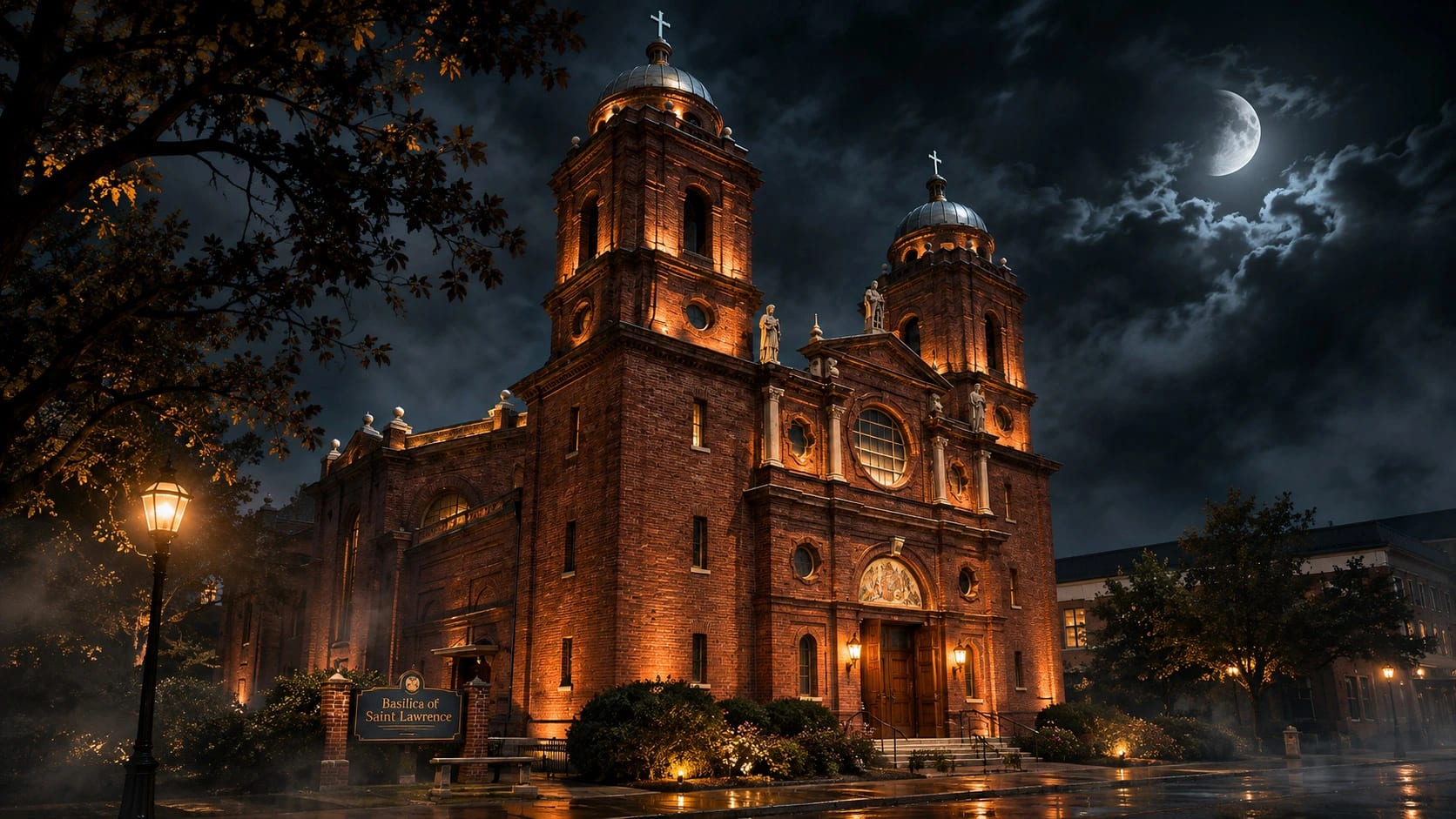
The Basilica of St. Lawrence at Haywood and Flint streets in downtown Asheville