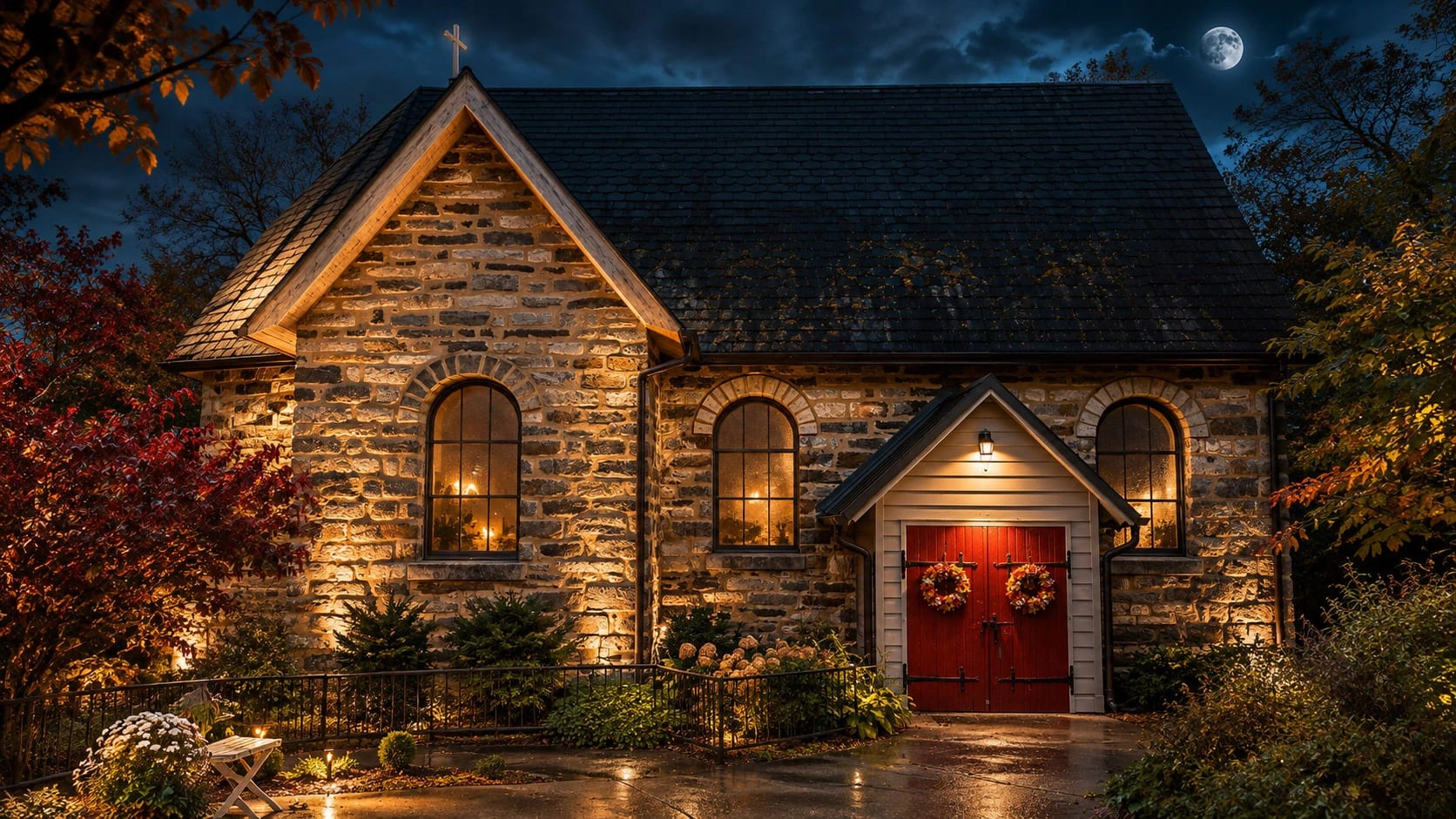
On a wooded hillside overlooking the French Broad River, a small stone church stands above one of the oldest roads connecting Asheville with the communities to its north. Its rough-hewn walls, steep slate roof, and arched windows look more at home in the English countryside than in the mountains of Western North Carolina. A narrow stairway climbs the slope toward the churchyard, where weathered gravestones mark the resting places of people who worshipped here more than a century ago.
For most of its history, the Church of the Redeemer has been a quiet place of worship. Founded by an English physician in the 1880s, it has survived changing congregations, periods of near abandonment, and the transformation of the surrounding river valley from rural farmland into an industrial corridor. Its stained-glass windows include a remarkable memorial associated with Louis Comfort Tiffany, while the cemetery above the chapel contains members of the family responsible for its construction.
Yet the church is also associated with one of the Asheville area's more peculiar ghost stories.
According to local legend, a mysterious woman dressed in white occasionally appears among the graves on the hillside. She descends the old steps, crosses Riverside Drive, and continues toward the French Broad River. Witnesses claim that she disappears as she approaches the water, leaving no indication of where she came from or what she was doing.
Some believe the woman drowned in the river many years ago. Others connect her to a mansion that supposedly stood near the church before being destroyed by fire. A different version of the story places her near the abandoned Craggy Prison, where she is said to vanish beside the old perimeter fence.
Nobody has established who she was.
Unlike many haunted locations, the Church of the Redeemer has no widely documented murder, mysterious suicide, or tragic accident to explain its apparition. Its founder and several members of his family are buried in the churchyard, but no surviving historical record has connected any of them to the Woman in White.
The building's documented past, however, is unusually rich. It tells the story of an eccentric physician who spent much of his inheritance building a chapel, a congregation that challenged racial customs in the nineteenth-century South, and a handful of determined parishioners who rescued the church after its founder's death.
Long before people began watching the hillside for a ghost, the Church of the Redeemer had already become one of the most unusual religious landmarks in Western North Carolina.
The History of the Church of the Redeemer
The French Broad River Before the Church
During the nineteenth century, the French Broad River was one of the defining features of the Asheville region. Farms and small communities developed along its banks, while roads followed the valleys between surrounding mountains. The river connected settlements that would eventually become part of a much larger regional economy.
The area now known as Woodfin remained relatively rural for much of that period. Farms, wooded hillsides, scattered homes, and small enterprises occupied land north of Asheville, which was still a modest mountain town.
That began changing during the final decades of the century.
The arrival of the railroad in Asheville in 1880 transformed the region's accessibility. Visitors who previously faced difficult journeys over mountain roads could now reach the city by train. Wealthy families began purchasing property in the surrounding countryside, while physicians promoted the mountain climate as beneficial for people suffering from respiratory illnesses and other medical conditions.
Asheville developed a reputation as a health resort. Hotels, boardinghouses, private hospitals, and sanatoriums appeared throughout the city, attracting patients and visitors from across the country.
The railroad also brought people whose backgrounds were very different from those of the region's established residents. Architects, physicians, entrepreneurs, artists, and wealthy travelers arrived with ideas shaped by their experiences elsewhere in the United States and Europe.
Among these newcomers was Dr. Francis Willis, an English physician who would build his own private chapel overlooking the French Broad.
Dr. Francis Willis Comes to North Carolina
Francis Willis was born in Greatford, Lincolnshire, England, into a prominent family with connections to medicine and the Anglican Church. He pursued a medical career and practiced in England before deciding to relocate to the United States.
In 1883, Willis arrived in Western North Carolina and settled in the Woodfin area of Buncombe County. He had inherited substantial family wealth, giving him resources that most physicians and local residents did not possess.
Willis began acquiring property along the French Broad River. Through three separate purchases, he assembled approximately one hundred contiguous acres, establishing a private estate on the hillside overlooking the water.
The location offered an attractive setting for a physician interested in the restorative qualities of the mountain environment. It also provided enough land for the project that would eventually become his most enduring legacy.
Willis wanted to establish a place of worship for his patients and the people living nearby.
His medical practice brought him into contact with residents of different economic backgrounds, many of whom lacked access to regular medical care. Accounts preserved in the church's history describe him treating patients who could not afford to pay and devoting considerable personal resources to charitable work.
For Willis, religious life and medical care were closely connected. He believed that the people receiving treatment should also have a place where they could worship.
He decided to build one himself.
The Construction of St. Philip's Chapel
On February 18, 1885, Willis purchased a thirty-three-acre tract that became the site of his proposed chapel. Construction began during the following year, with the work continuing through 1888.
The building was originally known as St. Philip's Chapel.
Willis personally supervised construction and is generally credited with its design, although the surviving records do not establish that he had formal architectural training. His background and familiarity with English churches appear to have influenced the structure's appearance.
Instead of constructing the simple wooden meetinghouse common throughout the rural South, Willis chose a much more substantial design.
The chapel would be built from native stone, laid in thick walls and supported by foundations cut into the rocky hillside. Its basic plan formed a cross, with small transepts extending from either side of the principal worship space.
The architecture followed the Romanesque tradition, incorporating rounded arches, heavy masonry, and relatively restrained exterior decoration.
Willis invested a considerable portion of his personal fortune in the project. Additional contributions came from supporters, while local residents provided much of the labor. Some of those workers had also received medical care from the doctor.
Construction required more than two years.
On June 15, 1888, the Reverend H. S. McDuffy conducted the first service inside the completed chapel.
The building was modest in scale compared with the elaborate churches later constructed in downtown Asheville, but its design was remarkable for its setting.
A private stone chapel, inspired by European religious architecture, now stood above the French Broad River in a community where most residents were accustomed to considerably simpler places of worship.
A Church That Challenged the Racial Customs of Its Time
One of the most significant aspects of the church's early history concerns the people Dr. Willis invited to worship there.
In the decades following the Civil War, racial segregation was becoming increasingly entrenched throughout North Carolina. Black residents faced discrimination in employment, public accommodations, education, and religious life.
Willis took a different approach to his medical practice and ministry.
The church's historical records indicate that he treated both Black and white patients and encouraged people of both races to participate in worship.
This was an unusual position for a physician operating in the South during the late nineteenth century. Willis's willingness to extend medical care and religious participation across racial boundaries reflected convictions that differed from many of the social expectations around him.
The arrangement was not entirely free from segregation. Historical accounts indicate that a separate cottage was established to serve Black communicants, suggesting that the congregation's early practices included compromises with the racial divisions of the period.
As Jim Crow laws and customs became more restrictive, the church's ministry to Black residents eventually came to an end.
The surviving records do not provide a complete account of the people who worshipped there or the individual experiences of the Black congregation members. Their names and perspectives are largely absent from the histories most frequently cited today.
Nevertheless, the episode deserves attention. Willis's original vision extended beyond providing a private chapel for wealthy visitors. He hoped to establish a religious community that served people who might otherwise have been excluded from the institutions available to them.
The attempt did not fully survive the racial pressures of the time, but it remains an important part of the church's founding history.
From Private Chapel to the Church of the Redeemer
By the late 1890s, Willis had begun considering the long-term future of his chapel.
Its operation depended heavily on his personal involvement and financial support. Although he had constructed the building on his own property, he recognized that a permanent relationship with the Episcopal Church would provide greater stability.
On October 2, 1898, Francis and his wife, Catherine Maria Willis, transferred the chapel and approximately 2.16 acres of surrounding land to the Trustees of the Missionary District of Asheville.
The recorded consideration was ten dollars.
The transfer established the church as property of the Episcopal organization rather than a private institution dependent entirely upon its founder.
On June 29, 1901, the chapel was formally consecrated as the Church of the Redeemer.
The ceremony took place on St. Peter's Day, an important date in the Episcopal calendar. The congregation was received as an organized mission within the church's regional jurisdiction.
Willis remained closely involved in its affairs despite relinquishing ownership.
His son, also named Francis Willis, had pursued religious training at Seabury Divinity School in Minnesota and had been working as a missionary among Native American communities in the western United States.
The elder Willis wanted his son to return to North Carolina and assume responsibility for the chapel.
According to an account preserved in the church's history, the doctor brought his son to the building and told him, "Here is your work."
The younger Francis accepted.
He served the congregation from 1902 until 1908, continuing the family's direct connection with the church.
Those years also brought considerable personal loss.
The Deaths of Francis and Catherine Willis
Catherine Maria Willis died on October 3, 1902, after suffering a stroke.
Her death was reported in the Asheville Citizen, which described her charitable work and her contribution to the chapel her husband had established. The newspaper also noted that the couple had recently built a house near the church for educational purposes.
Catherine was buried in the churchyard overlooking the French Broad River.
Her husband survived her by approximately four years.
Dr. Francis Willis died in 1906 and was buried beside her.
The doctor's death deprived the congregation of its principal benefactor and one of its strongest advocates. Although his son continued serving for a time, the younger Francis eventually returned to missionary work elsewhere.
Without the founder's financial support and personal leadership, the church struggled.
Regular worship services were discontinued for nearly a decade. Visiting ministers occasionally conducted services, but the once-promising congregation no longer maintained the active schedule it had enjoyed during Willis's lifetime.
The little stone chapel remained on its hillside.
Its future was uncertain.
Garland Thomasson and the Revival of the Church
The Church of the Redeemer might have disappeared as an active congregation if not for the efforts of Garland A. Thomasson.
Thomasson was a successful Asheville attorney and a member of the Brotherhood of St. Andrew associated with Trinity Episcopal Church. He became interested in the neglected chapel and saw an opportunity to restore its religious life.
Around 1917, Thomasson and other members of the brotherhood began organizing regular evening prayers.
Their efforts gradually expanded.
A Sunday school was established, followed by a children's choir. Worship services became more frequent, and the congregation began attracting new members.
Thomasson eventually joined the church and devoted substantial financial resources to improving the building.
The original temporary altar was replaced with a permanent one. Local craftsmen installed an elaborate rood screen, a decorative structure separating the nave from the chancel. New pews and a reed organ were also acquired.
The renovations changed the church's interior without destroying its essential character.
The building retained the thick stone walls and exposed roof structure associated with its original Romanesque design, while the new religious furnishings introduced elements more closely associated with Gothic church decoration.
Thomasson was also an accomplished musician and participated in the congregation's worship services.
His involvement helped bring the chapel back to life.
By the early 1920s, the congregation had grown sufficiently to require additional space.
The Parish House and a Growing Congregation
In 1925, a two-story parish house was constructed near the chapel through the generosity of Carrie Carr Mitchell and Mrs. Junius Smith.
The building provided space for gatherings, education, and other congregational activities.
Its lower floor contained a kitchen, dressing room, and several smaller rooms. The upper level included an auditorium and stage, allowing the church to host programs extending beyond regular worship.
The parish house helped establish Redeemer as a functioning community institution rather than an isolated historic chapel.
Later improvements continued this development.
An addition was constructed in 1974, expanding the parish house and providing additional space for church education.
That same year marked another important milestone.
The Diocese of Western North Carolina elevated the Church of the Redeemer from mission status to a full parish and transferred the property to the parish's governing body.
Nearly ninety years after Francis Willis began constructing his private chapel, the congregation had achieved a degree of independence and institutional stability its founder had hoped to provide.
The building would receive formal recognition for its architectural significance a little more than a decade later.
The Architecture and Historic Treasures of the Church
A Romanesque Chapel in the Blue Ridge Mountains
The Church of the Redeemer is unusually small for a building with such distinctive architectural features.
The chapel measures approximately fifty feet in length. Its transepts project only a few feet beyond the main walls, producing a compact cruciform plan.
The exterior consists of locally quarried stone arranged in irregular courses. Rounded window openings and thick masonry create the solid, understated appearance associated with Romanesque architecture.
Above the walls rises a steeply pitched roof covered with dark slate.
Two decorative bands of scalloped slate interrupt the roof's otherwise simple surface, creating a subtle pattern that is particularly noticeable from the surrounding hillside.
Inside, the stone walls remain exposed.
The ceiling follows the shape of the roof and incorporates a hammer-beam structure with timber elements supporting the open interior. A central aisle divides the pews and leads toward the altar.
The rood screen installed during the congregation's early twentieth-century revival introduces a contrasting architectural influence. Its Gothic tracery, carved details, and religious imagery provide a more elaborate focal point than the original stonework.
When North Carolina preservation specialists examined the building in 1985, they considered it an unusually faithful example of a small Romanesque chapel.
Its importance lay partly in its location.
The church reflected the arrival of international architectural influences in a region where religious buildings had traditionally been considerably simpler.
The small stone structure remains one of the more distinctive examples of that cultural transformation.
The Tiffany Memorial Window
Among the church's most significant artistic features is a stained-glass window associated with Louis Comfort Tiffany.
The window is located in the north transept and bears a Tiffany signature.
It was installed around January 1926 as a memorial to those who died during World War I.
The work is known as The Great Sacrifice, drawing upon a painting created by British artist James Clark in 1914.
Its imagery commemorates the men who gave their lives during the war, accompanied by an inscription honoring their sacrifice.
The memorial was funded through a bequest from Beatrice Willis, a daughter of the church's founder.
Her gift established another lasting connection between the Willis family and the building.
Although Francis Willis had died nearly twenty years earlier, his family's influence continued through the artistic and religious furnishings of the chapel.
The window's historical significance extends beyond its association with the Tiffany name.
It records the congregation's response to a war that had transformed communities throughout the world, including families in Western North Carolina.
Several online descriptions of Redeemer claim that the church contains two Tiffany windows. The official National Register nomination specifically identifies one signed Tiffany window, and the specialist Tiffany Census documents the 1926 war memorial.
Other stained-glass windows are present in the chapel, but attributing additional works to Tiffany would require further documentation.
For visitors interested in historic religious art, the confirmed memorial is an important feature of the building.
The Cemetery Above the Chapel
The small cemetery occupies the grassy slope immediately above the Church of the Redeemer.
Several members of the Willis family are buried there, including Francis and Catherine.
The gravestones are reminders of the people who established and maintained the chapel during its earliest years.
Unlike a large municipal cemetery, the churchyard is closely integrated into the surrounding landscape. Its modest markers stand only a short distance from the building, with wooded hills rising beyond them.
The cemetery has also presented practical problems.
During the twentieth century, church officials discovered that a substantial layer of hard rock lay approximately three feet beneath the ground.
Excavating conventional graves would have required blasting through the rock, a process that could damage the nearby church foundations.
As a result, the congregation adopted a policy limiting new interments to cremated remains.
This detail appears in the 1985 National Register documentation, which includes the cemetery as part of the historic property.
The old burial ground is especially significant to the church's ghost story because the mysterious woman is most frequently described as appearing among the graves.
But the existence of a cemetery does not establish the identity of an apparition.
The people buried there are documented historical individuals.
The woman said to wander through it has never been reliably identified.
The Church of the Redeemer Becomes a Historic Landmark
By the 1980s, the chapel had survived almost a century of changes in Western North Carolina.
The surrounding community had developed substantially since Willis purchased his property. Roads carried increasing traffic along the French Broad, industrial facilities occupied parts of the river valley, and the rural landscape that had attracted the English physician was no longer as isolated as it once had been.
Yet the church remained largely intact.
Its stone walls, unusual roof, stained glass, and historic cemetery preserved important elements of the original property.
In January 1985, preservation specialists Doug Swaim and Jerry Cross prepared the building's nomination to the National Register of Historic Places.
The nomination documented its architectural features, the Willis family's history, the congregation's early ministry, and its revival during the twentieth century.
It also emphasized the building's unusual place within the history of Western North Carolina architecture.
On September 19, 1985, the Church of the Redeemer was formally listed on the National Register of Historic Places.
The designation recognized both its religious history and architectural significance.
Today, the chapel remains an active Episcopal church rather than a museum or abandoned historic structure. Its congregation continues the religious traditions established more than a century ago, welcoming worshippers to a building that has served several generations of Asheville-area residents.
Alongside that documented history, however, another story has continued to circulate.
It concerns a woman who supposedly appears on the hillside after dark.
The Woman in White: The Ghost of the Church of the Redeemer
The Church of the Redeemer's best-known ghost story is unusual because the apparition has no established name.
She is simply the Woman in White.
According to local folklore, the figure appears in the cemetery above the chapel, sometimes near the steps descending toward the church.
Witnesses describe a woman dressed in pale clothing, although the details of her appearance vary. Some accounts suggest an old-fashioned dress, while others describe a less distinct white figure moving through the darkness.
Her behavior is remarkably consistent in the surviving retellings.
She walks downhill.
The apparition supposedly descends from the cemetery, passes the church, and continues toward Riverside Drive. After crossing the road, she heads toward the French Broad River, where she disappears.
The story does not generally describe the woman confronting witnesses or attempting to communicate with them. She appears to be following a particular route, seemingly unaware of anyone watching.
There are no well-established reports of her speaking, threatening visitors, or attempting to enter the church.
The movement toward the river is the most important part of the legend.
It has inspired several competing explanations for why she might remain near the churchyard.
Did the Woman in White Drown in the French Broad River?
One version of the legend claims that the apparition belongs to a woman who drowned in the French Broad River many years ago.
The explanation is based largely on the direction in which she supposedly walks.
If the figure repeatedly travels from the cemetery toward the water, some storytellers reason, perhaps she is returning to the place where she died.
The river has always been a powerful feature of the surrounding landscape. Its currents, changing water levels, and history of flooding have made it both useful and dangerous to the communities along its banks.
Accidental drownings have occurred throughout the French Broad watershed over the centuries, although no documented drowning has been conclusively connected to the Church of the Redeemer's apparition.
The surviving ghost stories provide no reliable name for the supposed victim. They do not identify a date, an inquest, a burial record, or a contemporary newspaper account establishing the circumstances of her death.
It is therefore impossible to determine whether the drowning explanation preserves the memory of a specific tragedy or developed later as an attempt to explain the ghost's movements.
The legend's geography has likely contributed to its popularity.
The cemetery sits above the chapel, and the road separates the hillside from the river. A figure walking from the graves toward the water would create a memorable scene, particularly after dark.
In the stories, the woman's disappearance at the river provides the final unsettling detail.
The place toward which she walks is visible.
Her reason for going there is not.
The Mansion That Supposedly Burned Down
A second explanation connects the Woman in White to a large residence that allegedly stood near the church.
According to versions published on haunted-location websites, the chapel originally served the family who occupied a nearby mansion. The mansion was later destroyed by fire, and the apparition may be associated with the family who lived there.
Some retellings suggest that the woman died in the blaze.
Others propose that she survived and now walks toward the river, perhaps attempting to escape the flames or find water.
These interpretations are much less securely documented than the history of the chapel itself.
The Church of the Redeemer was indeed established on a private estate owned by Francis Willis. Its origins as a family-supported chapel are confirmed in the National Register nomination.
But the available historical documentation does not identify a particular woman who died in a mansion fire near the church.
Nor does it establish the date, location, or circumstances of the supposed blaze.
The distinction is important because the existence of an estate has sometimes been treated as evidence that the ghost story's mansion must also have existed exactly as described.
The original Willis property covered approximately one hundred acres, and the family maintained residences and other buildings in the Asheville area. That alone does not establish the later claim about a fatal fire.
Without contemporary newspaper reports, property records, or other documentation identifying a burned residence and its occupants, the mansion story remains an unverified part of local folklore.
Could the Ghost Be Catherine Willis?
The most obvious historical question involves the woman buried beside the church's founder.
Catherine Maria Willis played an important role in establishing the chapel. She helped support her husband's religious and charitable efforts and remained closely associated with the congregation during its early years.
She died in 1902 and was buried in the churchyard.
Because the Woman in White is said to emerge from that cemetery, it is tempting to wonder whether the apparition could be Catherine.
But the historical record offers no evidence supporting the identification.
Catherine's death was reported in the Asheville Citizen, which attributed it to a stroke. There is no documented connection between her death and the French Broad River, and no reliable account suggesting that she died in a fire.
She also has not been identified by name in the principal versions of the haunting.
Connecting her to the apparition would require speculation based primarily on her burial location.
The same problem applies to other women associated with the Willis family or congregation.
Their names appear in historical records, but the ghost remains unidentified.
It is possible that an overlooked event inspired the story. It is equally possible that the legend developed independently of any particular death.
Neither explanation can presently be established.
The Woman in White and Old Craggy Prison
A less familiar version of the haunting places the mysterious woman on a different route.
Instead of disappearing into the French Broad River, she supposedly walks toward the old Craggy Prison property.
The prison stood in the Woodfin area and became associated with its own collection of ghost stories after closing. Accounts describe shadowy figures in abandoned buildings, unexplained voices, and sounds resembling footsteps or metal doors.
Among those stories is a woman dressed in white.
According to the legend, she appears on the hillside near the prison, apparently traveling from the direction of the Church of the Redeemer. She continues toward the old perimeter fence before disappearing.
The story raises the possibility that the church and prison legends concern the same apparition.
But the evidence is limited.
The published accounts do not provide a named witness who reliably observed the woman traveling between both locations. Nor has anyone established that the churchyard apparition and the figure near the prison originated from a single report.
The route is also different from the better-known story.
One version sends the woman toward the river. The other places her near the prison grounds.
There is no verified historical connection between a woman buried at Redeemer and someone imprisoned or killed at Craggy.
The prison's history includes genuine institutional changes and difficult conditions, but those facts cannot be used to establish the identity of an unidentified ghost.
Both stories may have developed from local traditions associated with the same stretch of hillside. Alternatively, an existing Woman in White legend may have gradually expanded to include a second location.
Without earlier firsthand accounts, it is difficult to determine when the two stories became connected.
The old prison is also a restricted property, and its deteriorating structures present serious hazards. It is not a place visitors should enter to investigate the legend.
Where Did the Woman in White Legend Come From?
The Church of the Redeemer's haunting has been repeated in Asheville-area ghost guides, haunted-location directories, and regional reporting, but its earliest origins remain uncertain.
Modern versions generally contain the same basic details: a female apparition appears near the hillside cemetery, descends the steps, crosses Riverside Drive, and disappears toward the river.
Those descriptions have appeared often enough to establish the Woman in White as part of the area's ghost folklore.
Yet the accounts usually omit the information needed to reconstruct the original sighting.
Who first saw her? When did the encounter occur? Was the witness walking past the church, driving on Riverside Drive, or watching from another location? Did the person describe an actual woman or an indistinct shape?
The published accounts rarely answer those questions.
A 2025 historical feature in the Strangeville series examined the church's history and repeated the Woman in White legend. Its research provided substantial context about Francis Willis and the chapel, but the ghost remained unidentified.
Earlier haunted-location listings offered the same basic story without establishing a date for the original encounter.
This creates a familiar problem in the study of folklore.
Repeated publication can make a story seem increasingly well documented, even when the individual accounts ultimately descend from the same unidentified source.
A legend appearing on ten websites does not necessarily represent ten separate eyewitness experiences.
The Church of the Redeemer may have a long local tradition of reported sightings, but determining exactly how that tradition began would require more extensive investigation of older oral histories, parish records, newspaper archives, and firsthand interviews.
Why Are Women in White So Common in Ghost Stories?
The image of a mysterious woman dressed in white appears throughout European and American folklore.
Sometimes she is described as a grieving widow. In other stories, she is a bride who died before her wedding, a mother searching for a child, or a woman who suffered a violent death.
White clothing can suggest innocence, mourning, a burial garment, or simply a figure whose features are difficult to distinguish in darkness.
The legends often place these women near roads, bridges, cemeteries, rivers, or abandoned buildings.
Their movements are frequently repetitive.
A woman appears at the same location, walks along a familiar route, and disappears before anyone can reach her.
The Church of the Redeemer story follows this pattern closely.
The figure emerges near a cemetery, travels along a predictable path, and vanishes at the river.
That resemblance does not prove the story was invented or borrowed from another location. Folklore often develops around shared images and traditions, with each community adapting them to familiar landscapes.
But it helps explain why the absence of a known identity has not prevented the story from surviving.
The Woman in White does not need a detailed biography to remain recognizable.
Her appearance and behavior are already familiar elements of the wider ghost-story tradition.
What Might Explain the Sightings?
The setting around the Church of the Redeemer provides several ordinary circumstances that could contribute to unusual experiences.
The chapel stands on a hillside, with gravestones, vegetation, steps, and buildings arranged at different elevations. Riverside Drive runs below the church, while the river and surrounding landscape provide additional sources of movement and sound.
At night, passing headlights can illuminate portions of the slope briefly before disappearing. Reflections and shadows can change as vehicles move along the road, while people walking on the hillside may be visible only intermittently through the trees.
The church's pale stonework and gravestones can also appear quite different under artificial light than they do during the day.
None of these observations establishes what an individual witness saw.
They do, however, illustrate why a figure glimpsed briefly on a wooded slope might be difficult to identify.
The reports of a woman crossing the roadway and disappearing toward the river are particularly difficult to investigate because most published versions lack precise times, weather conditions, and identifiable witnesses.
A convincing investigation would require more than visiting the location after dark.
Researchers would need to establish when sightings occurred, obtain detailed accounts from the people involved, and compare those descriptions with the actual geography and lighting conditions.
Historical research might also help determine whether a particular death or family story contributed to the legend.
Until then, the Woman in White remains an unexplained figure in local folklore rather than an identified historical person.
The Church of the Redeemer Today
More than a century after Francis Willis built his chapel, the Church of the Redeemer remains an active congregation in the Episcopal Diocese of Western North Carolina.
Its religious identity retains elements of the Anglo-Catholic tradition, emphasizing ceremonial worship, prayer, and the historic practices of the church.
The congregation continues to gather for services, fellowship, and community activities.
The building's appearance remains closely tied to the original vision of its founder. Although the church has been altered and repaired over time, its native-stone walls, steep roof, arched windows, and intimate interior still reflect the architectural traditions that inspired Willis in the 1880s.
The cemetery continues to preserve the history of the families who established and sustained the congregation.
Its placement above the chapel is especially memorable, with the grave markers occupying a slope overlooking the river valley.
For visitors interested in religious architecture, the building offers a rare example of a small Romanesque church in Western North Carolina.
For those interested in the region's social history, it preserves the legacy of a physician who tried to connect medical care, education, and religious life during a period of tremendous change.
And for people who know its ghost stories, the old stairway leading from the hillside toward the road remains the most intriguing part of the property.
Visiting the Church of the Redeemer Near Asheville
The Church of the Redeemer is located at 1201 Riverside Drive, Asheville, North Carolina 28804, in the Woodfin area just north of downtown Asheville.
Some historical records, including the original National Register nomination, list the address as 1202 Riverside Drive. The church's current official website and Episcopal diocesan directory use 1201 Riverside Drive.
The chapel sits on the hillside above the roadway, with the French Broad River running nearby.
Its stone exterior, roofline, and elevated setting are distinctive, particularly when viewed from the surrounding public area.
Visitors interested in the church's history may consult its official website for current worship schedules and contact information.
Can You Go Inside the Church?
The Church of the Redeemer is an operating place of worship rather than a public museum.
Visitors may be welcome during scheduled services or other church activities, but access to the sanctuary outside those times should be arranged through the congregation.
Anyone hoping to see the Tiffany memorial window, the exposed stone interior, or the historic religious furnishings should contact the church rather than assuming the building will be open.
The cemetery is also part of an active religious property.
Although it has historical significance, it should not be treated as an unrestricted tourist attraction or a place for nighttime paranormal investigations.
Visitors should request permission before entering areas that are not clearly open to the public.
Can You Visit the Woman in White's Supposed Route?
The familiar ghost story places the apparition on a route descending from the churchyard toward Riverside Drive and the French Broad River.
The church stands close to a roadway used by local traffic, and its surroundings are not designed for pedestrian ghost hunting.
Visitors should not attempt to recreate the woman's alleged crossing, block the road, or venture onto restricted property.
The nearby riverbank can also present hazards, particularly following periods of high water or flooding.
The French Broad corridor experienced substantial damage during Hurricane Helene in September 2024, and recovery and public-access conditions have continued changing in parts of Woodfin.
Anyone planning a visit should verify current road and parking conditions and use lawful public viewing locations.
The chapel is best appreciated during daylight, when its architecture and hillside setting are clearly visible.
It is possible to understand the location's haunted reputation without entering the cemetery after dark or attempting to approach the river.
Is the Church of the Redeemer Really Haunted?
The Woman in White has become part of Woodfin's local folklore, but the historical evidence behind her identity remains elusive.
No reliable record has established that a woman drowned in the French Broad River and subsequently became the church's ghost. The supposed mansion fire has not been connected to a verified victim, and the apparition's reported journey toward Craggy Prison remains a separate, largely undocumented variation of the legend.
The people responsible for building the church are better understood.
Francis Willis came to North Carolina in 1883, purchased land overlooking the river, and devoted considerable resources to constructing a chapel for his patients and neighbors.
His wife, Catherine, helped support the family's charitable work.
Their son served as a minister, while other members of the family continued contributing to the church after the founders' deaths.
When the congregation nearly disappeared, Garland Thomasson and a small group of parishioners revived it.
Their efforts allowed the building to survive into the present century.
The cemetery above the church preserves part of that history, containing the remains of people whose lives can be reconstructed through church records, newspaper accounts, and historical documents.
The mysterious woman who reportedly moves among those graves has left no comparable record.
Perhaps an encounter long ago gave rise to the story. Perhaps an actual tragedy elsewhere along the French Broad became attached to the old chapel. It is also possible that the Woman in White developed from the familiar traditions surrounding lonely roads, cemeteries, and rivers.
There is not enough evidence to determine which explanation is correct.
The Church of the Redeemer is now approaching a century and a half of history. Its small congregation continues to worship beneath a roof constructed in the 1880s, surrounded by stone walls that have witnessed generations of births, marriages, funerals, and community life.
The river below still follows the same valley that attracted Dr. Willis when he arrived from England.
And the narrow steps between the chapel and its hillside cemetery remain much as visitors remember them.
According to the legend, a woman dressed in white sometimes appears there after dark. She walks toward Riverside Drive, crosses the road, and disappears into the darkness near the French Broad.
Nobody knows her name or why she is supposedly drawn to the water.
For now, the old stone chapel keeps its history in plain sight.
The Woman in White remains a mystery.
For more of the city's haunted history, read about Helen's Bridge, another legend of a woman no one can identify, Highland Hospital, the Pink Lady of the Grove Park Inn, the Battery Park Hotel and the Basilica of St. Lawrence, explore our guide to haunted Asheville, or join one of our Asheville ghost tours.
Research Sources and Further Reading
-
North Carolina State Historic Preservation Office: Church of the Redeemer, National Register of Historic Places Nomination (1985). The principal historical source for this article, prepared by Doug Swaim and Jerry Cross. Contains extensive information about the chapel's construction, Dr. Francis Willis, racial integration attempts, the church's decline and revival, renovations, architecture, and cemetery.
-
National Park Service: Church of the Redeemer, National Register Listing. Official listing confirming the property's national recognition, architectural classification, and date of registration.
-
Episcopal Diocese of Western North Carolina: Church of the Redeemer. Official diocesan information concerning the church, its location, architectural history, worship services, and continued use.
-
Church of the Redeemer: Official Website. The congregation's own website, including its religious identity, current contact information, and worship activities.
-
Tiffany Census: Church of the Redeemer, Asheville, North Carolina. Specialist research documenting the signed Tiffany memorial window, its approximate installation date, Beatrice Willis's bequest, and the World War I memorial inscription.
-
Asheville's 828 News NOW: Strangeville: The Haunted History of Woodfin's Church of the Redeemer. Local historical reporting discussing Dr. Willis, the church's architecture, and the traditional Woman in White haunting.
-
828 News NOW: Take Your Own Ghost Tour: Haunted Places in the Asheville Area. A regional collection of ghost stories that preserves both the river apparition legend and the less familiar account connecting the Woman in White to Craggy Prison.
-
Haunted Places: Church of the Redeemer. A commonly circulated version of the haunting, including the woman's reported movements between the hillside cemetery and the river. The site identifies its reports as unverified ghost stories.
-
Asheville's 828 News NOW: Strangeville: Is Asheville's Old Craggy Prison Haunted? Local reporting concerning Craggy Prison's history, reported paranormal activity, and the unidentified woman sometimes associated with the prison grounds.
-
Historical Willis Family Research: Francis Willis and Catherine Maria Willis. Genealogical research incorporating contemporary newspaper accounts, including Catherine Willis's October 1902 obituary in the Asheville Citizen. Useful for verifying her documented cause of death rather than attributing an unverified tragedy to her.
The Church of the Redeemer on its hillside above Riverside Drive in Woodfin