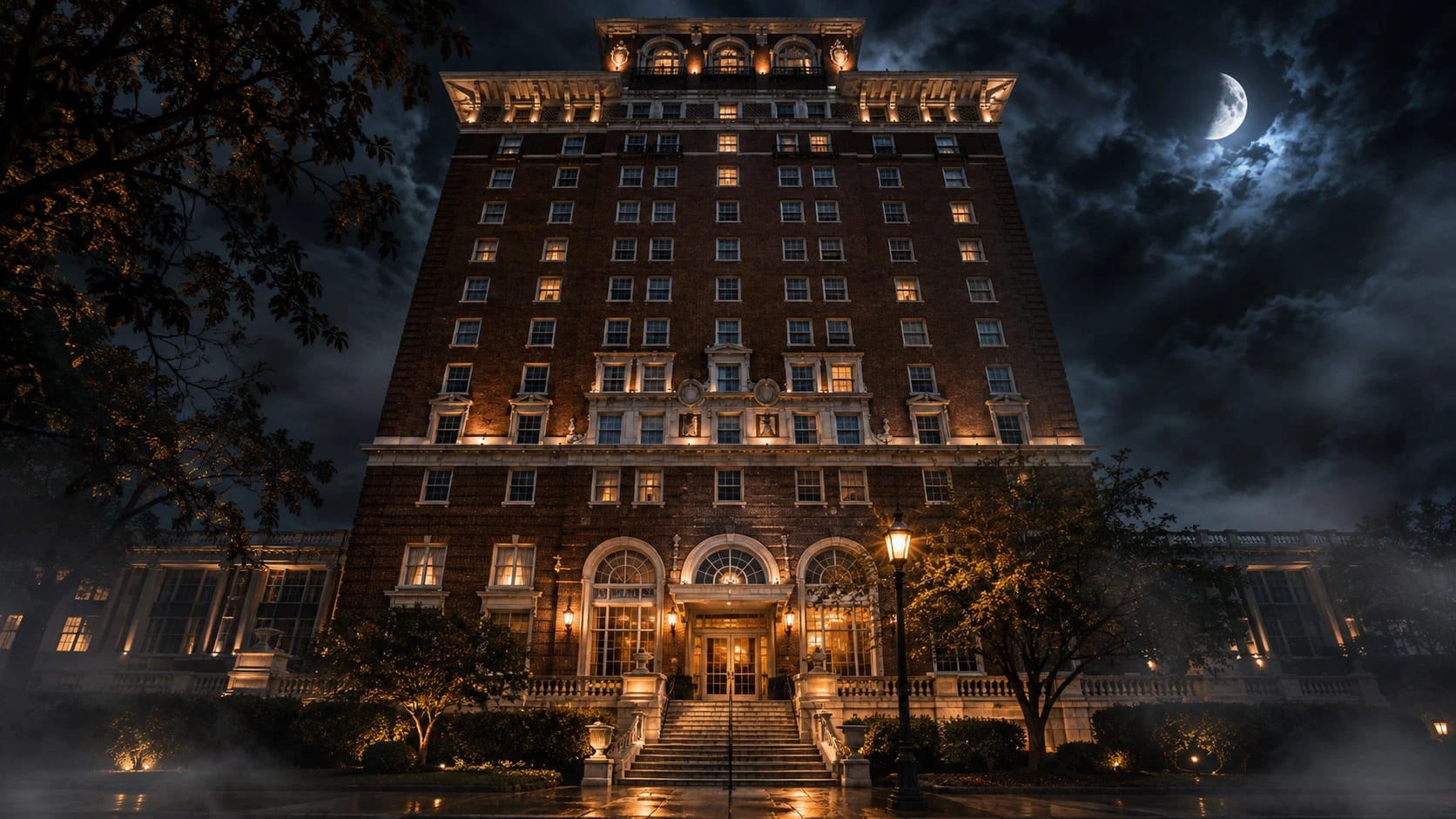
The Battery Park Hotel rises fourteen stories above downtown Asheville, its red-brick exterior and ornate roofline looking much as they did when the building opened more than a century ago. From the sidewalks surrounding the Grove Arcade, visitors can still look up at the rows of windows that once belonged to one of the city's most fashionable hotels.
During the 1920s and 1930s, the Battery Park welcomed businessmen, vacationers, politicians, and travelers arriving in Asheville for the mountain air. Its rooftop terraces offered sweeping views of the Blue Ridge Mountains. Its dining rooms hosted elaborate meals, while elevators carried guests between the lobby and hundreds of private rooms.
Then, during a violent thunderstorm in July 1936, someone murdered a nineteen-year-old college student in Room 224.
Her name was Helen Clevenger. She had come to North Carolina from Staten Island, eager to see a part of the country she had never visited. Instead, her death became a national sensation.
Within months, a young Black hotel employee named Martin Moore was convicted and executed for the crime. Moore insisted that police had beaten a confession out of him. Witness accounts, questionable evidence, and the circumstances of his prosecution have left historians doubting whether the real killer was ever brought to justice.
The story might have ended there.
But the Battery Park Hotel accumulated other tragedies, including deaths associated with falls from its roof. Over time, people began describing apparitions in its corridors, unexplained sounds, and figures that seemed to plunge from the building before disappearing.
According to local folklore, Helen Clevenger and Martin Moore may both remain inside the old hotel.
Today, the building is no longer a hotel. Its guest rooms have been converted into apartments for older residents, and the glamorous days of the Battery Park belong to another era.
The history behind its haunting, however, begins long before the murder.
The History of Asheville's Battery Park Hotel
A Civil War Battery on a Mountain Hilltop
Before the first Battery Park Hotel was constructed, the property overlooking downtown Asheville was known as Battery Porter Hill.
During the Civil War, Confederate forces positioned artillery on the hill, taking advantage of its commanding view of the surrounding landscape.
The military installation eventually disappeared, but the name remained.
In the decades following the war, Asheville began developing into a fashionable mountain destination. The arrival of the railroad in 1880 dramatically increased the number of visitors able to reach the city.
People came for the scenery, the cooler summers, and the mountain climate.
Physicians of the period frequently recommended Asheville to patients suffering from tuberculosis and other respiratory illnesses. Hotels and boardinghouses appeared throughout the city to accommodate the growing numbers of visitors.
Wealthy travelers wanted more than a place to sleep. They expected grand dining rooms, attentive service, attractive grounds, and the sort of social environment available at the finest resorts in the Northeast.
Railroad entrepreneur and businessman Franklin Coxe recognized the opportunity.
He purchased property on Battery Porter Hill and developed plans for a hotel that would become one of the most recognizable buildings in Asheville.
The Original Battery Park Hotel of 1886
The first Battery Park Hotel opened on July 12, 1886.
Designed in the Queen Anne style, the enormous Victorian building featured a collection of towers, turrets, steep roofs, and broad verandas overlooking the city.
It was anything but modest.
The sprawling structure stretched hundreds of feet across the hilltop and sat among landscaped grounds that covered approximately twenty-five acres.
Its guest rooms offered mountain views, while public spaces were designed for relaxation and entertainment.
The hotel was among the most technologically advanced resorts in the region. Its modern conveniences, including an electric elevator, attracted considerable attention at a time when such amenities were still unusual.
Guests could spend their days enjoying the grounds, attending social gatherings, or taking excursions into the surrounding mountains.
The railroad had made Asheville accessible. The Battery Park helped make it fashionable.
By the late nineteenth century, its guest list included some of the wealthiest families in the United States.
Among them was a young man whose visit would eventually change Asheville forever.
George Vanderbilt and the View That Changed Asheville
George Washington Vanderbilt II arrived in Asheville during the 1880s while searching for a location where he could establish a country estate.
According to a long-standing local tradition, Vanderbilt and his mother stayed at the original Battery Park Hotel.
From the hotel's elevated grounds, visitors could see across Asheville and the surrounding mountains.
The story holds that Vanderbilt was particularly impressed by the landscape visible from the property.
He began acquiring land south of the city and eventually commissioned architect Richard Morris Hunt and landscape designer Frederick Law Olmsted to create the Biltmore Estate.
The construction of Biltmore House, completed in 1895, transformed Asheville's reputation and economy.
Thousands of workers participated in the project, while Vanderbilt's investments helped encourage further development throughout the region.
The Battery Park Hotel had been built to serve affluent travelers. One of those travelers became responsible for the largest private home in America.
It is a fitting connection between two of Asheville's most important historic properties.
Unfortunately, the hotel Vanderbilt knew no longer exists.
Edwin Wiley Grove Destroys a Hotel and a Hill
By the early twentieth century, Asheville's tourism industry had changed.
Automobiles were becoming increasingly important, and travelers no longer depended entirely on railroad access.
The original Battery Park Hotel, with its extensive grounds and elaborate Victorian architecture, was expensive to maintain.
At the same time, Edwin Wiley Grove was reshaping Asheville through an ambitious series of real estate developments.
Grove had made his fortune selling patent medicines, particularly Grove's Tasteless Chill Tonic. He had already constructed the Grove Park Inn on Sunset Mountain, which opened in 1913.
In 1921, Grove purchased the aging Battery Park Hotel.
Initially, he indicated that the original hotel would remain in operation.
Then he announced a much more dramatic plan.
He would demolish the hotel.
And remove the hill beneath it.
The decision horrified residents who regarded Battery Porter Hill as one of Asheville's most recognizable landmarks.
Grove was unmoved.
He believed the old hotel occupied too much valuable real estate and that downtown Asheville needed a more practical commercial center.
Construction crews began tearing down the Victorian building in 1923.
Steam shovels, wagons, and other equipment removed an enormous quantity of earth from the hillside. Contemporary estimates placed the amount at approximately 250,000 cubic yards.
The project permanently altered downtown Asheville's geography.
Earth from the excavations was used to fill lower areas and create additional land for streets and commercial development.
Grove planned an entirely new district, with a modern Battery Park Hotel and a grand shopping arcade that would eventually become the Grove Arcade.
The beloved Victorian resort disappeared.
In its place rose a fourteen-story hotel designed for the automobile age.
The New Battery Park Hotel Opens in 1924
The second Battery Park Hotel officially opened on September 18, 1924.
Architect William Lee Stoddart designed the building, incorporating a reinforced-concrete structure faced with red brick and trimmed with limestone and terra cotta.
Its decorative details combined Classical Revival influences with a distinctive roof inspired by Spanish and Mediterranean architecture.
The new hotel contained approximately 220 guest rooms.
Unlike its sprawling predecessor, this Battery Park rose vertically above downtown.
Its upper floors provided views of Asheville and the Blue Ridge Mountains, while a rooftop dining terrace offered visitors a place to enjoy the scenery.
The building's entrance and public spaces reflected the taste of the Roaring Twenties.
Elegant interior furnishings, modern elevators, and carefully decorated dining rooms helped attract visitors seeking comfortable accommodations near the city's commercial center.
Grove wanted the Battery Park to serve businessmen and tourists who preferred staying downtown rather than at more expensive, secluded resorts.
The hotel quickly became a familiar part of Asheville's skyline.
Not everyone appreciated the change.
One particularly famous Asheville native regarded the destruction of the original hill as an architectural and cultural disaster.
Famous People and Events at the Battery Park Hotel
Thomas Wolfe and the Destruction of Old Asheville
Novelist Thomas Wolfe grew up in Asheville, where his mother operated the boardinghouse known as Old Kentucky Home.
Wolfe's childhood memories became central to his writing.
In his 1929 novel Look Homeward, Angel, he transformed Asheville into the fictional city of Altamont and drew upon the people, streets, buildings, and social changes he remembered.
The destruction of Battery Porter Hill particularly angered him.
Returning to Asheville in 1925, Wolfe found that the familiar hill had been dramatically altered by Grove's development.
He later described the new Battery Park Hotel with considerable disdain, comparing its standardized architecture to the interchangeable hotels appearing in American cities.
To Wolfe, the disappearance of the old landscape represented something larger than the destruction of a hotel.
Asheville was becoming a different place.
Yet Wolfe eventually stayed at the very building he criticized.
In August 1937, he checked into the Battery Park Hotel in an attempt to escape interruptions from friends and family and concentrate on his writing.
The visit was unsuccessful. He reportedly accomplished little work during his stay.
Wolfe died the following year, in September 1938, at just thirty-seven years old.
His connection to the Battery Park remains one of the building's most interesting literary associations.
Edwin Wiley Grove Dies in His Own Hotel
Edwin Wiley Grove did not live long enough to see the full realization of his plans for downtown Asheville.
On January 27, 1927, he died at the Battery Park Hotel.
He was seventy-six.
His death came while work on the nearby Grove Arcade was still underway.
The building had been envisioned as an enormous commercial development, complete with an ambitious tower that would dominate Asheville's skyline.
Following Grove's death, financial and construction challenges forced revisions to the plans.
The Arcade was eventually completed without its proposed skyscraper.
Grove's influence on Asheville remained enormous.
Between the Grove Park Inn, the Battery Park Hotel, the surrounding residential neighborhoods, and the Grove Arcade, his developments helped establish much of the city's twentieth-century identity.
There is no well-established ghost story identifying Grove as a spirit haunting his former hotel.
His death, however, is one of the building's documented historical tragedies.
The Battery Park Hotel During World War II
The Battery Park Hotel served an entirely different purpose during World War II.
As American servicemen returned from overseas assignments, the U.S. Army established redistribution stations where soldiers could rest, undergo medical examinations, receive information, and prepare for reassignment.
Asheville became one of these centers.
The federal government leased several prominent downtown hotels, including the Battery Park, the George Vanderbilt Hotel, and the Asheville-Biltmore Hotel.
These buildings accommodated soldiers participating in the Army Ground and Service Forces Redistribution Station.
The Battery Park's ground floor housed medical examination facilities.
Returning servicemen passed through the city as part of a larger program involving recreation, medical care, and preparation for future military service.
The State Archives of North Carolina preserves material relating to the Asheville Redistribution Station, including an instructional booklet distributed to arriving soldiers.
The program added an unusual chapter to the Battery Park's history.
A building created to accommodate vacationers had become part of the military's effort to manage the immense movement of personnel during wartime.
And by then, the hotel had already acquired a reputation that would follow it long after the soldiers departed.
That reputation began with the murder of Helen Clevenger.
The Murder of Helen Clevenger at the Battery Park Hotel
A Young Woman Visiting North Carolina
Helen Clevenger was nineteen years old in the summer of 1936.
She grew up on Staten Island, New York, and had graduated at the top of her high school class.
An excellent student with interests in writing and poetry, she had completed her freshman year at New York University.
Her academic achievements had earned her scholarships, and she appeared to have a promising future.
That summer, Helen traveled to North Carolina to visit relatives.
Her uncle, William Clevenger, taught at North Carolina State College in Raleigh and worked in agricultural extension services.
He invited Helen to accompany him while he traveled around the state visiting dairies and meeting people connected with his work.
For the young New Yorker, the trip offered an opportunity to see unfamiliar places and experience a different way of life.
Helen kept a diary and wrote postcards describing her travels.
She visited farms, met local families, and enjoyed the countryside.
Some of her writing survived through contemporary newspaper accounts, which later published excerpts while covering her death.
In July, Helen and her uncle traveled to Asheville.
They checked into the Battery Park Hotel, where they occupied separate rooms on the second floor.
Helen was assigned Room 224.
It would be the last room she ever occupied.
July 15, 1936: A Stormy Night in Asheville
On Wednesday, July 15, Helen and her uncle spent the day visiting acquaintances and enjoying their time in the mountains.
That evening, they dined with friends before returning to the hotel.
A thunderstorm was moving through Asheville.
Rain fell across the city, and thunder echoed through the surrounding mountains.
Helen and her uncle returned to the Battery Park after 10 p.m.
They took an elevator to the second floor and said goodnight before retiring to their separate rooms.
According to William's later account, his niece had been in good spirits.
She was enjoying her visit.
Inside Room 224, Helen prepared for bed.
Investigators would later find evidence that she had washed some clothing, changed into pajamas, and spent time reading and writing.
She had also written a postcard to her mother.
Nothing suggested that she was expecting trouble.
Shortly before or around 1 a.m. on July 16, someone entered her room.
Exactly how that person gained access remains one of the central uncertainties in the case.
The door may have been left unlocked, or the intruder may have possessed a key.
What happened next was violent.
Helen was shot in the chest with a .32-caliber firearm and struck repeatedly about the face.
Evidence indicated that she attempted to defend herself.
The injuries were fatal.
The Sounds Nobody Understood
Several guests reported hearing unusual noises during the night.
One man staying near Helen's room heard what he believed was a woman's scream.
Other guests later recalled sounds resembling a struggle, breaking glass, or raised voices.
The thunderstorm complicated matters.
Gunshots and crashes were easily mistaken for thunder.
One guest contacted the hotel desk to report a disturbance.
A night watchman went upstairs to investigate but found the corridor quiet.
He listened near the rooms without discovering anything that seemed to require further action.
Helen's body remained undiscovered.
Around the time of the murder, witnesses also observed a suspicious man moving through the hotel.
According to accounts collected during the investigation, the man hurried through portions of the lobby and escaped by jumping from an exterior balcony to the street below.
Witness descriptions initially indicated that he was white.
This unidentified man's appearance would become one of the most troublesome aspects of the investigation.
His identity was never conclusively established.
The Discovery in Room 224
On the morning of July 16, William Clevenger went to check on his niece.
When she failed to respond, he opened her unlocked door.
Helen was lying on the floor.
Her uncle immediately called for help.
Hotel employees and management were summoned, but the official response unfolded slowly.
Instead of immediately notifying police, hotel personnel contacted a physician and attempted to reach the coroner.
Manager Pat Branch was concerned about the commotion that a murder investigation could create in a hotel filled with guests.
While the second floor was quietly secured, ordinary hotel operations continued below.
Guests ate breakfast, employees carried luggage, and people checked out without knowing what had happened upstairs.
The sheriff's office was not notified until approximately 9:30 a.m.
By then, valuable time had passed.
Guests who might have witnessed important events had already departed, and numerous people had entered or approached the crime scene.
The handling of the investigation would later attract criticism.
And the consequences would extend far beyond the hotel.
A Murder That Captured the Nation
News of Helen's death spread quickly.
Newspapers across the United States reported the murder of the young New York college student.
The combination of a fashionable hotel, a violent crime, an attractive young victim, and mysterious circumstances made the case irresistible to sensationalist publications.
Journalists arrived in Asheville seeking interviews and developments.
The investigation became a matter of considerable public pressure.
Buncombe County Sheriff Laurence Brown, who was approaching a reelection campaign, faced growing demands to arrest someone.
Investigators questioned employees and guests.
Helen's uncle was scrutinized. Other suspects were detained or interviewed.
Police collected fingerprints and other evidence, but the forensic techniques available in 1936 were limited.
Some of the most important physical evidence consisted of partial bloody fingerprints found on a light bulb.
Investigators could not conclusively match those prints to a suspect.
Weeks passed.
The killer remained unidentified.
Then authorities turned their attention to a young hotel employee.
Martin Moore and the Questionable Conviction
The Hotel Employee from Hill Street
Martin Moore was twenty-two years old.
He lived in Asheville's historically Black Hill Street neighborhood with his mother, Celia, and his sister, Alice.
His family had moved to Asheville from Spartanburg, South Carolina, during his childhood.
Martin attended school through the sixth grade before leaving to help support his family.
He eventually found employment at the Battery Park Hotel.
By 1936, he had worked there for nearly three years as a hallboy and janitor.
His duties included cleaning rooms and public spaces, maintaining corridors, and performing other work required to keep the hotel operating.
His schedule was demanding, with shifts spread throughout the day.
During the trial, manager Pat Branch acknowledged that Martin had been a dependable employee and had caused little trouble.
There was no documented history of violent behavior.
Martin also had an account of his whereabouts on the night Helen died.
He had spent the evening with his girlfriend, Fannie Lee Gilliam, and acquaintances at her home.
According to his testimony, he fell asleep there and did not leave until approximately 2 a.m.
Other people supported portions of his account.
But Martin owned something that would become central to the prosecution.
A .32-caliber pistol.
The Gun That Changed the Investigation
Martin maintained that he had loaned his pistol to another hotel employee, Lem Roddy, before Helen's murder.
According to Martin's account, Roddy returned the weapon afterward.
The gun appeared to have a stain on it.
Frightened that he might become entangled in the investigation, Martin concealed it beneath his mother's house.
When police learned about the pistol, they arrested him.
Officers brought him to the courthouse for questioning in the early hours of August 9.
He initially denied murdering Helen.
According to the account he later gave, investigators subjected him to threats and physical violence.
One officer obtained a length of rubber hose and used it to beat him.
Martin claimed detectives also lied about evidence, telling him that his fingerprints had been found in Helen's room.
After prolonged questioning, he signed a confession.
He later insisted that the confession had been forced from him.
There were serious problems with the prosecution's case.
The physical evidence did not conclusively establish that Martin entered Room 224 during the murder.
Witnesses had originally described a white man leaving the hotel.
Martin's account of having loaned out the pistol introduced questions about who had possessed the weapon on the night of the crime.
And the circumstances surrounding the confession raised fundamental concerns about its reliability.
Nevertheless, prosecutors proceeded.
The Trial of Martin Moore
Martin's trial began in August 1936, barely a month after Helen's murder.
The proceedings took place in an atmosphere of enormous publicity and racial prejudice.
North Carolina was still governed by Jim Crow segregation.
Black residents faced systematic discrimination in public life, employment, and the courts.
Martin was defended by a court-appointed attorney.
His confession became a central element of the prosecution's case.
The defense raised questions about the circumstances in which it had been obtained, but the jury was not persuaded.
After a trial lasting only a few days, an all-white jury convicted Martin Moore of Helen Clevenger's murder.
The verdict came on August 22, 1936.
The jury's deliberations lasted less than an hour.
Martin was sentenced to death.
Efforts to appeal the conviction followed, with support from the NAACP, but the appeal was not successfully perfected and the conviction remained in place.
Martin continued to insist that he was innocent.
He would never receive another trial.
December 11, 1936: The Execution
On December 10, 1936, Martin Moore waited inside Central Prison in Raleigh.
The governor had declined to intervene.
Martin had recently requested baptism, and two ministers visited the prison to perform the ceremony.
He maintained his innocence until the end.
The following morning, December 11, he was executed in North Carolina's gas chamber.
He was twenty-two years old.
His family's circumstances added another tragedy.
They could not afford the expense of traveling to Raleigh to claim his body.
His remains were subsequently transferred for medical study, and his final resting place remains uncertain.
For decades, the public story of Helen Clevenger's murder frequently ended with Martin's conviction.
He was identified as her killer, and the case was treated as solved.
Modern historical research has challenged that conclusion.
Was Martin Moore Innocent?
In 2021, historian Anne Chesky Smith published Murder at Asheville's Battery Park Hotel: The Search for Helen Clevenger's Killer.
Her research drew on historical newspapers, trial material, and previously overlooked papers belonging to Sheriff Laurence Brown.
The documents had been preserved in a collection at the Swannanoa Valley Museum.
They provided new opportunities to examine the investigation and the circumstances surrounding Martin's conviction.
Chesky Smith identified serious concerns with the handling of the evidence, the changing witness accounts, and the treatment of Martin during interrogation.
Her work also restored attention to Martin's life before his arrest.
He was not simply a suspect in a notorious murder. He was a young Asheville resident with a family, a job, friends, and people who spoke on his behalf.
Whether Martin was innocent cannot be established conclusively from the available historical record.
His conviction has not been formally overturned.
But the investigation's shortcomings are substantial, and historians have raised compelling doubts about whether he committed the crime.
There is no reliable basis for identifying another individual as Helen's killer.
The murder remains unresolved in that historical sense, despite the conviction.
The possibility that the wrong man was executed has become inseparable from the Battery Park Hotel's story.
It has also influenced the ghost legends associated with the building.
Other Tragedies at the Battery Park Hotel
The Death of Clifton Alheit in 1943
Helen Clevenger's murder was not the last death associated with the Battery Park.
Historical summaries identify another tragedy on September 4, 1943.
Clifton Alheit, described in later accounts as a federal government official, reportedly fell or jumped from the hotel's roof in what was considered an apparent suicide.
The circumstances of his death are less thoroughly documented in readily available historical sources than the Clevenger murder.
Later ghost-story collections identify Alheit by name and connect his death to the building's reputation for unexplained sightings.
The story is significant because it introduced an entirely different kind of haunting.
Instead of a figure walking through a hallway, witnesses supposedly began seeing a man falling from the roof.
Another Reported Fatal Fall in 1972
Local histories and paranormal accounts also describe another apparent suicide involving the Battery Park Hotel in 1972.
The man's identity and the precise circumstances are not consistently established in the sources that repeat the story.
Some accounts describe him jumping from the roof, while others provide little information beyond the date and the alleged fall.
The lack of consistent details makes it difficult to reconstruct the event with the confidence possible in the Clevenger case.
Nevertheless, the reported death became part of the building's folklore.
By the late twentieth century, Battery Park had acquired a reputation not only for a murder but also for tragedies involving the upper floors and roof.
And people began claiming that those deaths had left something behind.
The Ghosts of the Battery Park Hotel
The Ghost of Helen Clevenger
The most frequently described spirit at the Battery Park Hotel is that of Helen Clevenger.
According to local folklore, her apparition appears in the building's corridors, particularly near the area once occupied by Room 224.
Some stories describe a young woman dressed in clothing resembling that worn during the 1930s.
She is said to appear briefly before disappearing.
Other accounts describe a shadowy female figure moving through the hallway, apparently unaware of the people around her.
The reports sometimes emphasize stormy weather.
As lightning illuminates the windows and thunder moves across Asheville, the apparition supposedly becomes visible.
The detail recalls the weather on the night Helen was murdered.
It also illustrates how closely the haunting has become tied to the circumstances of the crime.
There is an important limitation to these stories.
Most published accounts do not identify the witnesses, provide precise dates, or include original interviews that would allow the sightings to be independently investigated.
They are part of Asheville's established ghost folklore, but the evidence for individual experiences remains difficult to assess.
The uncertainty has not prevented the legend from spreading.
In October 2023, WYFF News 4 featured the Battery Park Hotel in a segment about Asheville hauntings, interviewing local ghost-tour guide Tadd McDivitt.
The story emphasized the murder and the belief that both Helen and Martin might still be present.
Nearly ninety years after her death, Helen remains one of the city's most frequently discussed ghosts.
Room 224 and the Anniversary of Helen's Murder
Room 224 occupies a special place in the hotel's haunted reputation.
It was the room where Helen was murdered.
Because the building no longer operates as a hotel, the original room numbering and layout should not be assumed to correspond directly to the apartments found there today.
The structure has undergone major renovations and changes in use.
Nevertheless, paranormal stories continue to refer to the former room and the surrounding corridor.
Some accounts claim that unusual activity becomes particularly noticeable around 1 a.m., the approximate time of Helen's murder.
Others describe a reddish haze appearing near a window associated with the former room on the anniversary of her death.
Those details appear in later ghost-story retellings rather than in independently verified reports.
There is no established evidence of a recurring anniversary phenomenon.
The story's appeal is understandable, however.
Helen died during a nighttime storm, inside a room that should have been safe.
The idea that some fragment of that night might repeat itself gives the legend a disturbing quality.
But the historical murder and the supposed recurring apparitions are different kinds of evidence.
One is documented.
The other remains folklore.
The Apparition of Martin Moore
Martin Moore is also said to haunt the former hotel.
In some versions, a male apparition is seen moving through the building, particularly in areas associated with the old service corridors and hotel operations.
Other accounts describe an unidentified man who appears briefly before vanishing.
Local storytellers sometimes identify the figure as Martin.
The explanation generally involves his disputed conviction.
If Martin was executed for a crime he did not commit, the story suggests, his spirit might remain restless.
Some versions portray him as searching for justice.
Others imply that his presence is connected to the woman whose murder cost him his life.
There is no verified historical testimony establishing that Martin's ghost has been identified by an eyewitness.
The association appears to come primarily from the circumstances of his execution and the later development of the hotel's haunted reputation.
It is worth treating the legend carefully.
Martin's documented experience was tragic enough without inventing motives or violent behavior for a supposed spirit.
He spent the final months of his life facing an execution he insisted was unjust.
Whether or not the hotel is haunted, his story deserves to be remembered independently of the ghost tales.
The Figures Falling from the Roof
Perhaps the most unsettling accounts associated with the Battery Park involve its roof.
Witnesses have supposedly looked toward the upper floors and seen a human figure falling from the building.
The figure appears to plunge toward the street.
Then it disappears.
No body is found.
No accident has occurred.
According to some versions of the story, startled witnesses have contacted authorities after seeing what they believed was someone jumping from the hotel.
Later ghost-story collections connect these reports to the deaths associated with the roof in 1943 and 1972.
Unlike a conventional apparition standing in a hallway, the falling figures are described as sudden, fleeting events.
The person witnessing the supposed fall initially believes a real emergency is taking place.
Only afterward does the experience become a ghost story.
There is no publicly established collection of police records verifying repeated reports of phantom falls.
Nor is there reliable evidence that a particular sighting can be connected to one of the historical deaths.
Even so, the legend has become one of the Battery Park's most distinctive paranormal traditions.
Unexplained Noises, Cold Spots, and Slamming Doors
Other accounts are less dramatic.
Stories associated with the former hotel include footsteps in otherwise quiet hallways, doors closing unexpectedly, flickering lights, and sudden changes in temperature.
Some describe a general feeling of uneasiness near the building's upper floors.
Many of these experiences appear in short haunted-location guides without specific witnesses or dates.
In a building this old, ordinary explanations deserve consideration.
Heating and ventilation systems can produce unexpected sounds. Doors may move because of differences in air pressure, while electrical and plumbing systems can create noises that travel between floors.
The Battery Park has also undergone substantial alterations over its lifetime.
Its original hotel interiors were redesigned for residential use, and major renovations have changed many of the systems within the historic structure.
None of those observations disproves a witness's individual experience.
They do make it difficult to treat every unexplained sound as evidence of a haunting.
The more interesting question is how the reports became associated with particular people.
At Battery Park, almost every unusual event is eventually connected to Helen Clevenger, Martin Moore, or the men said to have fallen from the roof.
The building's known tragedies provide the identities.
The ghost stories supply the encounters.
The Battery Park Hotel Becomes a Haunted Landmark
The Battery Park's reputation developed gradually.
The Clevenger murder drew widespread publicity in 1936, with newspapers and crime magazines describing the case in often sensational terms.
The hotel continued operating, but the crime became a permanent part of its public history.
Later deaths contributed additional stories.
By the late twentieth century, paranormal authors were including the Battery Park among Asheville's haunted locations.
Joshua P. Warren discussed the building in his 1996 book Haunted Asheville, helping bring renewed attention to its history and reported supernatural activity.
Subsequent ghost tours and local publications continued repeating the stories.
The 2021 publication of Anne Chesky Smith's book introduced a particularly important development.
It encouraged readers to reconsider the historical case rather than simply repeat the assertion that Martin Moore had murdered Helen.
That distinction matters.
The Battery Park Hotel is frequently described as a building haunted by a murder victim and her killer.
But the available evidence does not justify describing Martin as Helen's murderer without acknowledging the substantial doubts about his conviction.
A more accurate account recognizes that two young people lost their lives as a result of the events of 1936.
Helen was murdered.
Martin was executed by the state.
Whether the same person was responsible for both deaths, directly or indirectly, remains a matter of historical dispute.
What Happened to the Battery Park Hotel?
The Closing of the Hotel in 1972
The Battery Park continued operating for decades after the Clevenger case.
Over time, however, its importance as a downtown hotel declined.
Tourism habits changed, competing accommodations opened, and the building became increasingly difficult to maintain.
By the early 1970s, it was showing its age.
The property changed ownership, and demolition was considered.
On October 30, 1972, the Battery Park Hotel closed.
Its days as one of Asheville's most prominent hotels were over.
The building stood largely unused and deteriorated for several years.
Fortunately, preservation efforts prevented its destruction.
In 1977, the Battery Park Hotel was listed on the National Register of Historic Places.
The designation recognized its architectural and historical importance to downtown Asheville.
From Historic Hotel to Senior Apartments
During the early 1980s, the former hotel was renovated and converted into affordable apartments for older residents.
The project retained the building's historic exterior while adapting the interior to residential use.
Former hotel rooms and service spaces were reconfigured into apartments and shared facilities.
The property became known as Battery Park Apartments.
Further rehabilitation work took place in subsequent decades.
A substantial preservation and renovation program was completed in 2025, updating the residences and building systems while preserving the property's historic character.
Today, the building contains 122 affordable apartments for people aged sixty-two and older.
It is managed by National Church Residences.
The exterior remains one of downtown Asheville's recognizable architectural landmarks, and the building continues to serve the community.
The setting may be familiar to someone who visited the Battery Park in the 1930s.
Its purpose is entirely different.
Visiting the Historic Battery Park Hotel
The former Battery Park Hotel stands at 1 Battle Square, Asheville, North Carolina, directly beside the Grove Arcade in downtown Asheville.
The building is easy to recognize.
Its fourteen-story red-brick exterior, limestone ornamentation, and decorative roof distinguish it from many of the surrounding structures.
Visitors exploring the Grove Arcade or downtown Asheville's architectural landmarks can view the historic exterior from public sidewalks.
The property is also featured in Asheville's architectural walking-tour materials.
There are important restrictions.
The former hotel is now a private residential community. It does not offer overnight guest accommodations, and the residential floors are not open for ghost hunting or unscheduled exploration.
Room 224 should not be treated as a publicly accessible attraction.
Visitors should respect the privacy of the people who live in the building.
There is no need to enter the apartments to appreciate the property's history.
The exterior, its relationship to the Grove Arcade, and the surrounding streets provide an opportunity to see how dramatically Edwin Wiley Grove changed downtown Asheville.
Historic photographs are particularly useful when visiting.
Comparing images of the original Victorian hotel and Battery Porter Hill with the modern skyline reveals just how much of the old landscape disappeared during the 1920s.
For visitors interested in Asheville's ghost stories, the building is also a natural companion to other historic locations associated with the city's darker past.
The Grove Park Inn, with its famous Pink Lady, is another property developed by Edwin Wiley Grove.
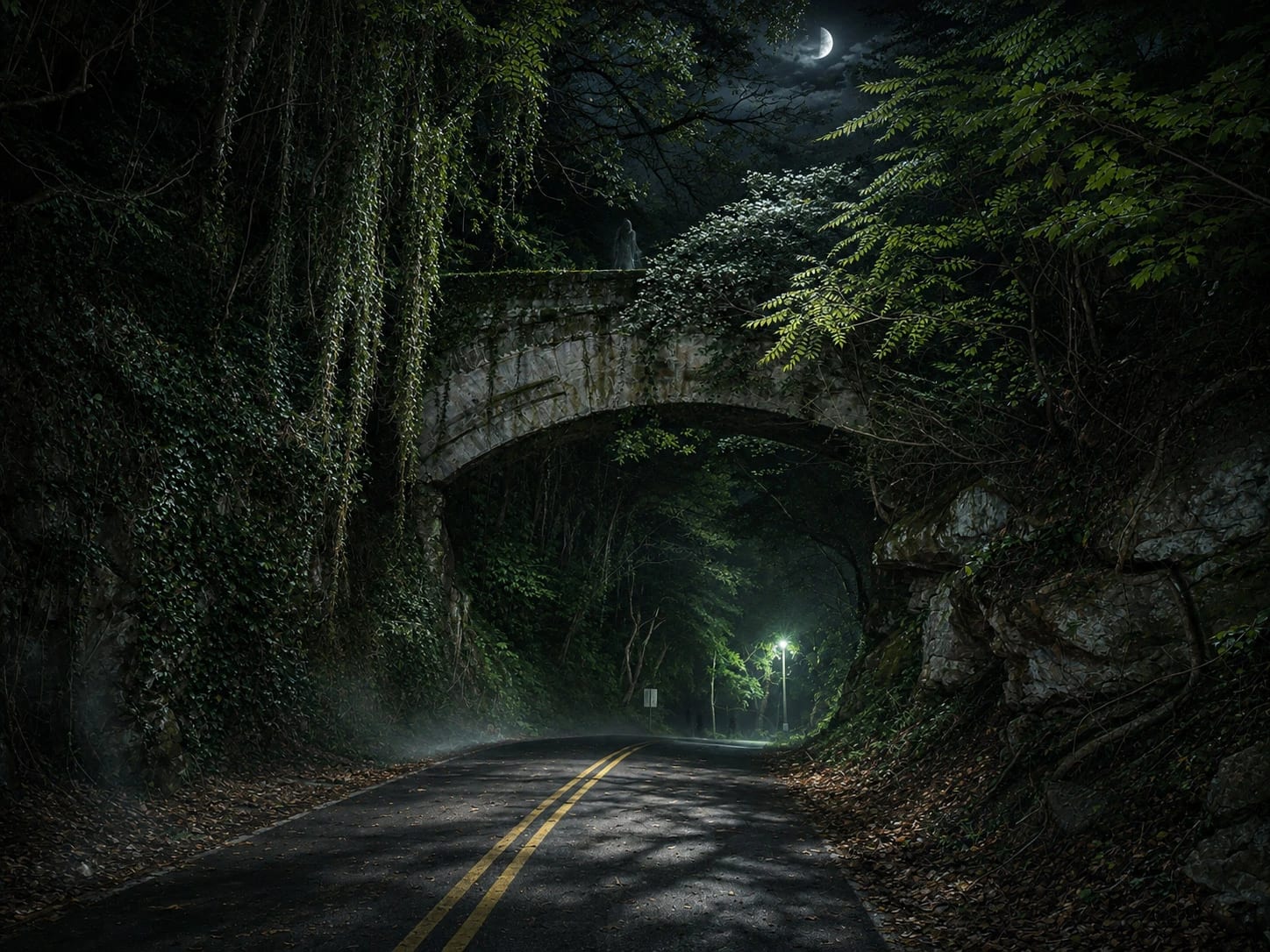
Helen's Bridge on Beaucatcher Mountain is associated with an entirely different woman named Helen. Although some storytellers have speculated about a connection between the two legends, there is no reliable evidence that Helen Clevenger's murder inspired the bridge's ghost story.
The Battery Park's tragedy belongs to its own history.
Is the Battery Park Hotel Really Haunted?
Few buildings in Asheville have a documented history as disturbing as the Battery Park Hotel.
A nineteen-year-old student was murdered while visiting the mountains with her uncle.
A twenty-two-year-old hotel employee was convicted after an interrogation that raised serious concerns about coercion.
He was executed less than five months after the crime.
Other deaths became associated with the building, including a reported fatal fall from its roof during World War II.
Those events have provided generations of storytellers with material for ghost tales.
The problem is that the most dramatic paranormal reports are difficult to trace to original witnesses.
Stories about Helen walking through the hallways, Martin appearing in the building, and figures falling from the roof have circulated for years.
But the identities of witnesses, the circumstances of individual encounters, and the evidence supporting them are often missing.
There is no verified proof that any of the dead remain at the Battery Park.
There is also no reason to dismiss the building's genuine historical significance simply because its ghost stories cannot be substantiated.
The historical record contains enough unanswered questions.
Who entered Room 224 in the early hours of July 16, 1936?
Who was the unidentified man seen leaving the hotel?
Why did witnesses' descriptions change during the investigation?
And did North Carolina execute an innocent man?
Those questions have persisted far longer than the hotel's original guests.
Nearly a century after Helen Clevenger's death, her murder remains an unsettling chapter of Asheville history.
The Battery Park Hotel is no longer the fashionable destination it once was. Its grand guest rooms have been replaced by apartments, and the people who live there lead ordinary lives in a carefully preserved historic building.
From the street, however, the old red-brick hotel still looks out over the city.
Some believe that Helen and Martin remain somewhere inside.
Whether their ghosts exist or not, their stories have never entirely left the Battery Park.
For more of the city's haunted history, read about the Pink Lady of the Grove Park Inn and Helen's Bridge, explore our guide to haunted Asheville, or join one of our Asheville ghost tours.
Research Sources and Further Reading
The following sources support the hotel's architectural history, the events of 1936, and its present-day use. Paranormal reports are identified separately in the article because they have not been established as historical facts.
-
Asheville Museum of History: September 18, 1924: The Second Battery Park Hotel Opens. Historical account of the original hotel, its replacement, and Grove's redevelopment.
-
Anne Chesky Smith: Murder at Asheville's Battery Park Hotel: The Search for Helen Clevenger's Killer (The History Press, 2021). An extensive examination of the murder, investigation, Martin Moore's conviction, and previously overlooked historical documents.
-
Asheville Museum of History: The Story Behind the Accused Murderer in the 1936 Battery Park Hotel Homicide. Detailed research into Martin Moore's life, confession, trial, and execution.
-
North Carolina State Historic Sites: Downtown Asheville Walking Tour. Architectural and historical information about the Battery Park Hotel and Thomas Wolfe's connection to the property.
-
State Archives of North Carolina: U.S. Army Asheville Redistribution Station Booklet. Documentation of the hotel's use during World War II.
-
National Park Service: Battery Park Hotel, National Register of Historic Places, listed July 14, 1977, reference number 77000990.
-
Joshua P. Warren: Haunted Asheville (1996). A frequently cited account of the city's paranormal folklore, including stories associated with the Battery Park.
-
WYFF News 4: Asheville Ghost Story: The Murder Hotel (October 2023). Modern reporting about the hotel's haunted reputation.
-
National Church Residences: Battery Park Apartments. Present-day residential use and the 2025 renovation.
The former Battery Park Hotel at 1 Battle Square, beside the Grove Arcade