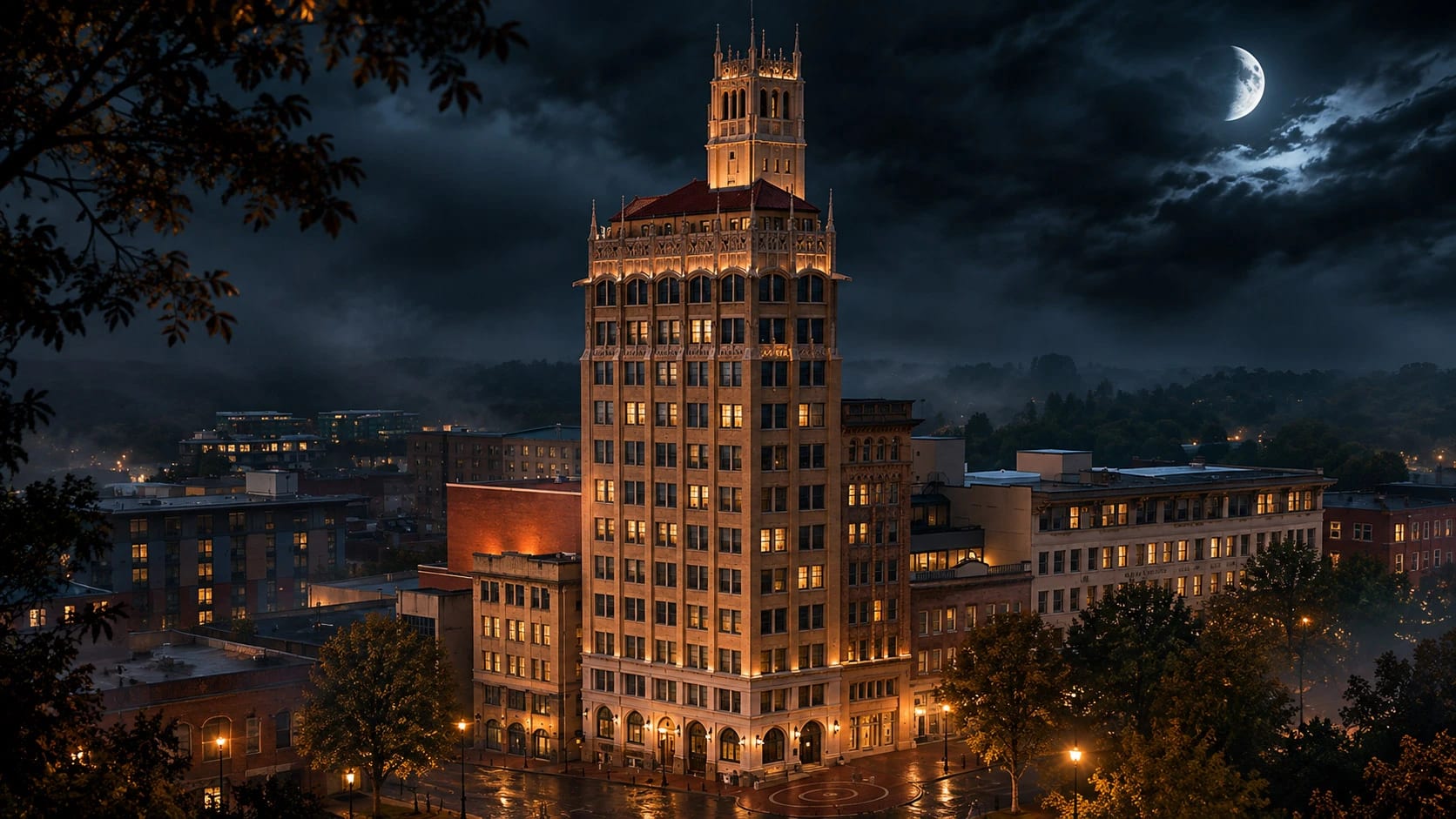
Thirteen stories above Pack Square, a narrow Gothic tower rises over downtown Asheville. Its pale brick walls are decorated with elaborate stonework, pointed arches, and strange carved creatures that stare down at the streets below.
The Jackson Building looks more like a piece of a European cathedral than a commercial office building. When it opened in 1924, it was the tallest building in North Carolina, a startling addition to a mountain town that was rapidly becoming one of the South's most fashionable destinations.
The tower was supposed to represent Asheville's prosperous future.
Five years later, the stock market crashed.
As the Great Depression devastated the city's economy, the Jackson Building acquired a reputation far removed from the optimism of its construction. Stories began circulating about wealthy businessmen who had supposedly climbed to the upper floors and jumped to their deaths after losing everything.
Some versions claim that so many men died this way that the city eventually placed a circular pattern of bricks in the sidewalk below, marking where their bodies had landed.
People began calling it the bullseye.
Others claimed to have seen a man's face staring from an upper window, even when the office behind the glass appeared empty. Another apparition supposedly wandered the rooftop, looking down over the city.
The stories remain popular on Asheville ghost tours.
But historical records reveal something quite different.
In April 1930, a sixty-six-year-old real estate businessman named Frederick M. Messler died by suicide inside the Jackson Building. Less than a year later, former Asheville mayor Gallatin Roberts took his own life in a nearby office after becoming entangled in the city's catastrophic banking collapse.
Neither man jumped from a building.
And the mysterious bullseye? Buncombe County archivists traced its origins to an entirely unrelated public art project from the early 1980s.
The truth behind the Jackson Building is therefore more complicated than its ghost stories suggest.
It is a story of extraordinary ambition, architectural achievement, financial ruin, and two very real tragedies. It also contains a remarkable connection to novelist Thomas Wolfe, a persistent legend involving Walt Disney, and a piece of public art whose original meaning has been almost entirely replaced by folklore.
To understand how Asheville's first skyscraper became one of its most famous haunted landmarks, it helps to begin with the small stonecutting shop that once occupied the property.
The History of Asheville's Jackson Building
Before the Skyscraper: Thomas Wolfe's Father's Monument Shop
Long before the Jackson Building dominated Pack Square, the property at 22 South Pack Square was occupied by a monument business.
Its owner was William Oliver Wolfe, a stonecutter who had moved to Asheville during the nineteenth century.
W.O. Wolfe, as he was commonly known, specialized in gravestones and funerary monuments. He carved lettering into stone, sold marble memorials, and supplied monuments to families throughout Western North Carolina.
His business occupied a prominent position near the center of Asheville.
Beginning in 1885, Wolfe operated his tombstone and monument shop on the small property that would eventually become the site of the Jackson Building.
The yard frequently contained unfinished headstones, stone blocks, statues, and monuments awaiting delivery.
For people passing through Pack Square, the sight of marble angels and grave markers was a familiar part of downtown life.
Wolfe's son, Thomas, grew up surrounded by these objects.
Born in Asheville in 1900, Thomas Wolfe would become one of the most important American novelists of the twentieth century.
His father's profession left a powerful impression on him.
The imagery of death, stone, memory, and unfinished monuments would appear repeatedly in his writing.
One particular marble angel became especially significant.
The statue was a funerary monument associated with the Wolfe family's business. It would eventually inspire the title of Thomas Wolfe's most famous novel, Look Homeward, Angel, published in 1929.
The book drew heavily upon Wolfe's childhood in Asheville, transforming the city into the fictional town of Altamont.
His father became the character W.O. Gant, a stonecutter whose relationship with his work and family was central to the story.
Wolfe was writing about a world he knew intimately.
That world included the monument shop standing on the very ground where Asheville's tallest building would soon rise.
By 1917, W.O. Wolfe's declining health had forced him to retire from the business.
He died in 1922.
The shop property had already been sold by then.
According to historical materials prepared by the Thomas Wolfe Memorial, Julia Wolfe sold the site for $25,000 in 1920.
A young real estate developer subsequently acquired it in 1923.
His name was Lynwood Baldwin Jackson.
And he had no intention of building another modest storefront.
Lynwood Baldwin Jackson: The Young Developer Who Wanted to Transform Asheville
Lynwood Baldwin Jackson was born in Cuthbert, Georgia, in 1896.
He arrived in Asheville with his family in 1914, when the city was experiencing a period of remarkable growth.
The railroad had turned Asheville into a major tourist destination. Luxury hotels, sanitariums, country estates, and residential neighborhoods were appearing throughout the surrounding mountains.
The city's population was expanding, and property developers were making fortunes.
Jackson's father, Edmond A. Jackson, became involved in real estate and construction after moving to the area.
Lynwood followed him into the business.
Known to friends and associates as L.B., the younger Jackson proved unusually ambitious.
He began building houses while still in his early twenties.
In 1919, he constructed a speculative residence on Macon Avenue. He soon became involved in larger developments, purchasing land, dividing it into residential lots, and promoting new Asheville neighborhoods.
By the early 1920s, he was participating in several substantial projects.
One was Linwood Park, a residential development near Fairview Road.
Another involved construction activity in the growing Grove Park neighborhood.
Jackson also became associated with some of Asheville's most recognizable commercial landmarks, including the Flatiron Building and work connected to the Grove Arcade.
Eventually, his company would be credited with constructing approximately 400 homes in the Asheville area.
But Jackson wanted more than a successful residential construction business.
He wanted a building that would advertise his name to everyone who came downtown.
Something tall.
Something unmistakable.
The tiny property beside Pack Square presented an unusual opportunity.
It contained little more than enough room for a narrow commercial building.
Jackson decided to build a skyscraper instead.
Ronald Greene and the Design of Asheville's First Skyscraper
To realize his plans, Jackson hired architect Ronald Greene.
Greene was among the architects responsible for shaping Asheville during its extraordinary construction boom of the 1920s.
His work included commercial buildings, schools, residences, and public facilities.
He would later design the city's Westall Building and contribute to other important projects throughout the region.
For the Jackson Building, Greene received an unusual assignment.
Jackson wanted the tallest building in Western North Carolina.
Beyond that requirement, the developer reportedly gave Greene considerable freedom in designing the structure's uppermost portion.
The architect took full advantage.
Instead of creating a conventional rectangular office tower, Greene designed a slender building in the Gothic Revival style.
The structure would rise thirteen stories from a parcel measuring approximately twenty-seven feet by sixty feet.
That footprint was extraordinarily small for a building of its height.
The design emphasized vertical lines, tall windows, pointed architectural details, and elaborate ornamentation near the roof.
A decorative tower projected above the upper floors.
Slender pinnacles and stone creatures decorated the upper elevations.
The result was unlike anything Asheville had seen before.
Where neighboring buildings relied on more conventional commercial architecture, Greene's skyscraper suggested medieval cathedrals and European towers.
It was theatrical without being impractical.
Beneath the decoration, the building incorporated modern engineering.
Its structural frame was steel, while the exterior was finished with brick and glazed terra cotta.
Merchant Construction Company served as the contractor.
Luther L. Merchant, the firm's founder, had become one of Asheville's most important builders. His company worked on numerous major commercial and residential projects during the city's boom years.
Stone and tile contractor Samuel Isaac Bean was also associated with the Jackson Building's construction.
The project demonstrated how quickly Asheville's building industry was advancing.
A relatively small mountain city now had contractors capable of erecting a steel-framed office tower whose appearance rivaled more elaborate buildings in larger American cities.
July 1924: The Jackson Building Opens
Construction began in 1923.
The Jackson Building opened on July 1, 1924.
It rose approximately 114 feet above Pack Square and immediately became one of Asheville's most recognizable landmarks.
At thirteen stories, it was the tallest building in North Carolina when completed.
Its proportions were particularly striking.
Most tall buildings relied on substantial footprints that gave them a broad, heavy appearance.
The Jackson Building occupied a narrow strip of downtown property.
Seen from certain angles, the tower appeared almost impossibly slender.
The building was primarily designed for commercial offices.
Attorneys, real estate businesses, and other professionals occupied the new space.
Historical accounts indicate that its approximately 200 offices were rented during the first year.
Jackson's real estate business occupied a prominent position within the development.
For a young businessman trying to establish his reputation, the building was an enormous advertisement.
He had succeeded in constructing something Asheville had never possessed before.
And he wanted people to notice it.
The Extraordinary Architecture of the Jackson Building
The Searchlight That Could Be Seen for Thirty Miles
One of the building's most unusual original features was a powerful searchlight installed at the top of the tower.
According to historical accounts, its beam could be seen from as far as thirty miles away.
The light served as both a landmark and a symbol of the city's growing importance.
At a time when the surrounding mountains remained much less developed than they are today, a sweeping beam from downtown Asheville would have been particularly noticeable after dark.
The searchlight also suited Jackson's flair for promotion.
His company used conspicuous advertising to attract attention.
One remembered advertisement encouraged potential customers to seek out L.B. Jackson for their real estate needs.
A tower that could literally project light across the mountains was an excellent extension of that ambition.
The original searchlight no longer exists.
Over time, the upper portions of the building underwent repairs and alterations.
A 1952 maintenance project addressed deteriorating terra-cotta ornamentation, and some of the original spires and rooftop equipment were removed.
Consequently, the building visitors see today is not identical to the one that appeared above Asheville in 1924.
Historical photographs reveal a somewhat more elaborate upper structure.
The Strange Creatures Guarding the Roof
Perhaps the Jackson Building's most memorable decorations are the creatures positioned along its upper elevations.
They are frequently described as gargoyles.
Technically, many are grotesques.
The distinction is architectural.
Traditional gargoyles function as waterspouts, carrying rainwater away from a building's walls.
Grotesques are decorative carved figures without that primary drainage function.
Both forms have long been associated with Gothic architecture.
Medieval builders placed extraordinary creatures on churches, cathedrals, and other stone buildings. Some represented animals, while others combined human and animal characteristics into unsettling imaginary beings.
The figures on the Jackson Building belong to that tradition.
Seen from street level, they can appear to be watching the people below.
Their presence has also encouraged a popular supernatural interpretation.
According to some traditions, grotesques were intended to frighten away malevolent forces or serve as symbolic guardians.
There is no evidence that Ronald Greene installed the Jackson Building's decorations because he believed the structure needed protection from ghosts.
They were architectural features consistent with the style he had chosen.
Nevertheless, their appearance has become an important part of the building's haunted reputation.
The tower already looked unusual.
Its stone creatures made it appear as though something was guarding the upper floors.
An Observation Post Above Asheville's Smoky Streets
The building's height also served a practical purpose that had nothing to do with real estate.
In the 1920s, many buildings in downtown Asheville were heated by coal-burning furnaces.
The smoke contributed to air pollution, particularly during cold weather.
The city used the Jackson Building as a vantage point for monitoring excessive emissions.
An inspector could stand near the top of the tower and look across the surrounding rooftops.
If a furnace produced excessive smoke for an extended period, the building owner could receive a citation.
The arrangement says something about how remarkable the Jackson Building was when it opened.
Its height made it useful for observing almost the entire downtown commercial district.
It also offers a fascinating contrast with the ghost stories that developed later.
Long before people began describing a mysterious man staring from the upper floors, an actual city employee regularly watched Asheville from the top of the building.
Famous People and Stories Connected to the Jackson Building
Thomas Wolfe Returns to His Father's Former Property
Thomas Wolfe was already becoming famous when the Jackson Building opened.
His debut novel appeared in 1929, five years after the tower replaced the site of his father's monument shop.
Wolfe's relationship with Asheville was complicated.
He drew much of his creative material from the city and its people, but his unflattering fictional portrayals offended numerous residents.
After the publication of Look Homeward, Angel, he stayed away from Asheville for years.
He finally returned in 1937.
By then, his hometown had changed dramatically.
Much of the downtown he remembered from childhood had been transformed during the construction boom of the 1920s.
Old buildings had disappeared.
Streets had been widened or altered.
New hotels, office towers, and public buildings occupied places familiar from his youth.
The Jackson Building stood where his father had once worked.
During his visit, Wolfe met friends who were now attorneys with offices inside the skyscraper.
He went upstairs and looked out over Asheville.
The experience provided an extraordinary perspective on the changes that had taken place since his childhood.
From the upper floors, he could see the city that had inspired his writing.
Yet the ground beneath him had once been occupied by his father's gravestones and marble monuments.
For a writer whose work was preoccupied with memory, loss, family, and the impossibility of returning to the past, the setting must have been particularly meaningful.
Wolfe died the following year, in September 1938.
His connection to the Jackson Building remains one of its most significant historical associations.
Did Walt Disney Once Work in the Jackson Building?
Another story connects the Jackson Building to one of America's most famous entertainers.
According to an old Asheville legend, Walt Disney once worked as a draftsman in an office associated with the building.
He supposedly lost his job because he spent too much time drawing cartoons instead of completing his assigned work.
The story includes an appealing detail.
After being dismissed, the young artist allegedly produced a final cartoon for his employer, depicting a down-on-his-luck man and a mocking comment about wealth.
The tale circulated for decades.
In December 1966, shortly after Disney's death, an Asheville newspaper published a claim from the widow of Major Thomas A. Coxe Jr.
She said her husband had fired Disney from a drafting position in 1924.
The story resurfaced during Asheville's bicentennial celebrations in 1997.
But the Disney connection does not withstand historical examination.
Disney's movements during the relevant years are well documented.
He was involved in animation work in Kansas City before moving to California in 1923, where he established the business that eventually became the Walt Disney Company.
The Disney organization rejected the Asheville employment story, explaining that the dates did not match his known activities.
In March 2026, Buncombe County Special Collections revisited the legend.
Its researchers concluded that Walt Disney had not worked in Asheville.
A drawing associated with the original story apparently existed, but it was unsigned.
Someone may indeed have been dismissed for drawing cartoons at work.
That person, however, was not Walt Disney.
The story is a useful reminder that the Jackson Building attracted legends long before its haunted reputation became a prominent part of Asheville tourism.
The supposed Disney employment is one of them.
The tale of businessmen jumping from the roof is another.
Unlike the Disney legend, however, the ghost story developed against the background of a genuine financial catastrophe.
The Great Depression and Asheville's Financial Collapse
Asheville's Extraordinary Boom Comes to an End
During the 1920s, Asheville experienced one of the most remarkable real estate booms in the southeastern United States.
Developers purchased mountain land, subdivided it into residential lots, and promoted new neighborhoods to investors and vacationers.
Hotels expanded.
Commercial buildings rose throughout downtown.
Property values climbed rapidly.
The city's leaders borrowed heavily to finance infrastructure projects intended to accommodate continued growth.
Roads, utilities, public facilities, and other improvements required enormous expenditures.
The prevailing assumption was that Asheville would keep expanding.
The Jackson Building represented that confidence.
When the stock market crashed in October 1929, the city was already vulnerable.
Land prices began falling.
Real estate speculation slowed.
Tourism declined, and investors found themselves holding property worth considerably less than they had paid.
The broader economic crisis soon exposed serious weaknesses in Asheville's financial system.
On November 20, 1930, Central Bank and Trust Company, one of the region's largest financial institutions, failed to open its doors.
The bank held more than $4 million in Asheville municipal funds.
Its collapse caused a financial and political emergency.
Other banks across Western North Carolina also closed.
Asheville's government struggled to meet its obligations, and years of accumulated debt became impossible to ignore.
The city dramatically reduced spending.
Public employees faced salary cuts, services were curtailed, and the ambitious construction projects that had defined the previous decade largely stopped.
The skyscraper that had symbolized Asheville's growth now stood above a city facing financial ruin.
The Downfall of L.B. Jackson
The man responsible for the Jackson Building suffered substantial losses during the Depression.
L.B. Jackson had built his career around the assumption that Asheville's property market would remain strong.
When land values collapsed, his extensive real estate interests became a liability.
He struggled through the early 1930s.
In 1935, Jackson declared bankruptcy.
Later accounts reported that his losses amounted to millions of dollars.
The contrast with his earlier achievements was extraordinary.
Only eleven years before, he had opened the tallest building in North Carolina.
Now the man who built it was confronting the destruction of much of his business empire.
But Jackson's life did not end in the tragedy associated with the building's ghost stories.
He eventually rebuilt his career.
By 1937, he was constructing facilities for National Linen Services.
Over the following decades, his work expanded into commercial laundry facilities across several southeastern states.
He lived until February 22, 1974, dying in Fort Lauderdale, Florida, at the age of seventy-seven.
He was buried in Asheville's Lewis Memorial Park.
This distinction is important because some casual retellings of the Jackson Building's history imply that its developer was one of the ruined businessmen who died during the Depression.
He was not.
The documented death inside the building involved another prominent member of Asheville's real estate industry.
Frederick M. Messler: The Real Death Inside the Jackson Building
A Successful Businessman Facing Financial Trouble
Frederick M. Messler was sixty-six years old in the spring of 1930.
He had lived in Asheville for decades.
Messler and his wife, Mary Ella, moved from New Jersey to North Carolina in 1889.
Over the years, he established himself as a real estate broker and insurance businessman.
He witnessed Asheville's transformation from a relatively small mountain community into a flourishing resort city.
His work placed him in the middle of the development industry.
As property transactions multiplied during the 1920s, men like Messler participated in the market that was reshaping Asheville.
He rented office space on the sixth floor of the Jackson Building.
By early 1930, however, Messler was struggling.
Contemporary accounts indicate that he had experienced declining health along with financial difficulties.
The collapse in real estate values had affected his business prospects.
On a morning in early April, Messler went to work at the Jackson Building.
He did not return home.
The Death on the Eighth Floor
The Asheville Times reported Messler's death on April 4, 1930.
The newspaper identified him as a longtime Asheville real estate businessman who had died by suicide inside the Jackson Building.
The details were later reconstructed by local researchers examining contemporary newspaper coverage.
Messler's office was on the sixth floor.
That morning, he reportedly took the elevator to the eighth floor and entered a vacant office.
He died there from a self-inflicted gunshot wound.
A secretary subsequently discovered his body.
Investigators found two notes, one addressed to his wife and another to his son.
The notes indicated that Messler had been distressed by his health and financial situation.
The news shocked people who had known him for years.
His professional life had been closely connected with Asheville's expanding real estate market.
Now, as that market collapsed, he had become one of the crisis's casualties.
There is an important distinction between the historical event and the legend.
Messler did not jump from the building.
He died inside an eighth-floor office.
The event occurred in April 1930, before Central Bank and Trust Company's November collapse and before the death of Asheville's mayor the following year.
Those dates matter because the two tragedies have often been blended into a single story about businessmen leaping from rooftops after the crash.
Messler's death was documented.
The supposed rooftop jump was not.
Is Frederick Messler the Ghost in the Window?
Because Messler is the only person confirmed to have died inside the Jackson Building during the Depression-era period commonly associated with the haunting, later storytellers have frequently connected him to its reported apparition.
A man's face is supposedly seen at an upper window.
Perhaps, the story suggests, the figure belongs to Messler.
Some versions identify him as the spirit lingering near the office where he died.
Others describe a man looking over Pack Square as though watching the city below.
There is no verified historical record establishing that a witness recognized Messler's face or clothing.
Nor has anyone demonstrated that the supposed apparition appears at the window of the former eighth-floor office.
The connection is an interpretation made long after his death.
Nevertheless, the actual circumstances of Messler's life and death offer a much stronger historical foundation than the familiar stories of unnamed businessmen jumping from the roof.
The man was real.
His presence in the building was documented.
His death was reported by the local press.
Whether anything remains of him there belongs to an entirely different kind of inquiry.
Mayor Gallatin Roberts: The Tragedy Next Door
The Collapse of Central Bank and Trust Company
The second major tragedy associated with the Jackson Building's Depression-era folklore occurred in a neighboring building.
Edward Gallatin Roberts was a prominent Asheville attorney and public official.
He served in the North Carolina legislature and became mayor of Asheville.
Roberts had a reputation for public service and had been involved in the city's government during a period of substantial growth.
But Asheville's financial collapse placed him in a terrible position.
Central Bank and Trust Company, where he served on the board, failed on November 20, 1930.
The bank held millions of dollars in public money.
The failure prompted investigations into the handling of city funds and the relationship between bank officials and municipal leaders.
On February 21, 1931, a Buncombe County grand jury indicted Roberts along with other officials.
They were accused of conspiracy in connection with the bank's financial dealings.
Roberts insisted that he had acted honestly.
He maintained that he had never intended to misuse public funds.
The accusations nevertheless devastated his reputation.
For a man who had spent decades pursuing a career in law and public office, the prospect of a criminal trial was deeply distressing.
February 25, 1931: The Mayor's Final Letter
Four days after the indictment, Roberts died by suicide.
He was found in an office above the former bank in the Legal Building, adjacent to the Jackson Building.
He had used a firearm.
Before his death, Roberts wrote a letter addressed to the people of Asheville.
In it, he defended his public service and explained how profoundly the accusations had affected him.
The letter was published in the Asheville Times on February 25, 1931.
One passage conveyed the depth of his distress: "My soul is sensitive, and it has been wounded unto death."
Roberts continued to maintain his innocence.
He was later formally exonerated of the charges.
His death became one of the most painful episodes of Asheville's financial crisis.
And because it occurred next to the Jackson Building, it eventually became part of the surrounding area's haunted folklore.
Why the Two Deaths Became Confused
The deaths of Frederick Messler and Gallatin Roberts took place less than a year apart.
Both men were prominent Asheville residents.
Both had professional connections to the city's business community.
Both experienced serious difficulties during the financial crisis.
And both died in offices at or immediately beside Pack Square.
Those similarities made the stories easy to combine.
Over time, the specific circumstances became less important than the larger narrative.
Asheville had prospered.
The stock market crashed.
Important businessmen lost their fortunes.
And supposedly, they jumped from the city's tallest building.
The story fits the popular image of the Great Depression.
The evidence does not.
Messler died by suicide inside the Jackson Building in April 1930.
Roberts died by suicide inside the neighboring Legal Building in February 1931.
Neither death involved a fall from the roof.
Their tragedies are real, and their individual histories deserve more care than the anonymous figures that eventually replaced them in the ghost stories.
The Ghost Stories of the Jackson Building
The Businessmen Who Supposedly Jumped from the Roof
The Jackson Building's best-known haunting begins with a story about the stock market crash of 1929.
According to the legend, wealthy businessmen learned that their fortunes had disappeared.
Some had invested heavily in property.
Others supposedly lost money in the stock market.
Unable to imagine a future without their wealth, they climbed to the upper floors or roof of Asheville's tallest building.
Then they jumped.
The most common versions claim that at least two men died this way.
Other versions suggest there were many more.
An especially dramatic retelling claimed that seventeen people jumped from the Jackson Building during the Depression.
That figure appeared in a 2014 article in the University of North Carolina Asheville's student newspaper, The Blue Banner.
The publication provided no historical source establishing the number.
Later researchers searching newspapers from the relevant period found no evidence supporting the claim.
Seventeen deaths from a prominent downtown skyscraper would have represented an extraordinary series of events.
Such incidents would almost certainly have attracted substantial attention from newspapers, police, and city officials.
The absence of contemporary documentation is significant.
The story has endured, however, because it provides a dramatic explanation for the building's supposed ghost.
The men who died are said to return.
And some visitors believe they can still be seen near the top of the tower.
The Mysterious Face in the Upper Window
One of the most frequently repeated paranormal reports describes a man's face appearing behind a window on an upper floor.
The figure supposedly looks out over Pack Square.
Sometimes the man is described as standing motionless.
In other versions, he appears briefly before disappearing from view.
The story has circulated in local haunted-location articles and ghost-tour accounts for years.
Some identify the figure as Frederick Messler.
Others believe he represents one of the businessmen supposedly killed in the rooftop suicides.
There is no consistently documented description of the apparition.
The reports generally lack named witnesses, exact dates, or information identifying the particular window involved.
That makes it difficult to determine whether the accounts originated from a single experience or developed through repeated storytelling.
The image itself is memorable.
A man in an office window would ordinarily attract little attention.
But the upper floors of a Gothic tower can appear unusually dark from the street.
Reflections, changes in lighting, and objects inside offices may create shapes that are difficult to identify from below.
The story encourages people to look upward.
And once someone knows that a ghost is supposedly watching from the windows, an indistinct figure becomes much more interesting.
The Man Who Walks the Rooftop
A second version of the haunting places the apparition outside the building.
According to local folklore, a man can occasionally be seen pacing along the uppermost portion of the structure.
He moves near the roof or tower, supposedly returning to the place where he met his death.
Some versions describe the spirit standing at the edge and looking toward the street.
Others suggest he simply walks back and forth before vanishing.
The association with the supposed rooftop suicides is obvious.
But there is a problem.
No historical evidence establishes that anyone jumped to their death from the Jackson Building during the Depression.
That does not make every reported sighting impossible to explain as an experience.
It does mean that the explanation commonly attached to the figure has no established factual foundation.
The rooftop is also not an ordinary public observation deck.
The building has long served primarily as commercial office space, and access to its upper areas has been restricted.
There is no publicly documented series of firsthand interviews that firmly establishes when the rooftop apparition was first reported.
Like the face in the window, the figure is best understood as part of Asheville's local ghost folklore.
Do the Grotesques Protect the Building from Spirits?
The carved creatures near the roof have acquired a supernatural role in some retellings.
Traditional Gothic architecture sometimes associated grotesques with the symbolic protection of buildings.
Their monstrous appearances were believed, in some interpretations, to frighten away evil influences.
This has led to speculation about the Jackson Building.
If the creatures were intended to guard the tower, why did the building supposedly become haunted?
The question makes for an entertaining ghost story.
Historically, however, the premise is weak.
The ornamental figures were part of Ronald Greene's Gothic Revival design.
There is no documentation establishing that Jackson commissioned them to ward off spirits or that they were associated with any particular supernatural belief.
The building's haunted reputation developed from later stories about Asheville's financial collapse.
Its decoration simply provided an especially atmospheric setting.
There is another interesting detail.
Several upper architectural elements were altered or removed during twentieth-century maintenance.
The creatures visible today do not necessarily reproduce every detail of the original 1924 rooftop.
For visitors interested in the architecture, comparing historical photographs with the current building is more revealing than attempting to assign a supernatural purpose to the stonework.
The Jackson Building Bullseye: The Most Famous Part of the Legend
At street level, one feature has done more than almost anything else to preserve the Jackson Building's haunted reputation.
In the sidewalk near its base is a circular arrangement of bricks.
The design resembles a target.
For years, Asheville ghost stories have described it as a bullseye marking where a businessman—or several businessmen—landed after jumping from the tower.
Some versions claim the city installed the pattern as a grim joke.
Others suggest it was a memorial to the dead.
The story is frequently repeated because visitors can actually see the circular design.
It appears to provide physical evidence for the legend.
Unlike an apparition seen fleetingly in a window, the brick circle is tangible.
But a detailed historical investigation published in March 2026 established that the bullseye story is false.
The Real Origin of the Circular Sidewalk Design
During the early 1980s, Asheville was working to revitalize downtown.
The city had endured decades of economic challenges, and officials were seeking ways to make Pack Square and the surrounding streets more attractive to pedestrians.
Improvements included new sidewalks, landscaping, and public art.
One proposal called for a sculpture in the vicinity of the Jackson Building.
The organization Quality Forward, now known as Asheville GreenWorks, helped select a design by Swannanoa artist Dirck Cruser.
The sculpture was called Energy Loop.
It was an abstract work made from weathering steel, with a flowing, curved form rising above the ground.
The circular brick design was intended as part of the setting for this public artwork.
It had nothing to do with the supposed deaths of businessmen in 1929 or 1930.
The history is supported by surviving planning documents, newspaper accounts, and promotional materials from the early 1980s.
Buncombe County Special Collections examined those records and published its findings on March 23, 2026.
The investigation identified a September 25, 1982, article in the Asheville Times discussing difficulties with the planned sculpture installation.
The problem involved the artwork's weight and anchoring requirements.
Its foundation presented complications for utility lines beneath the sidewalk.
The sculpture was eventually installed and later moved.
Today, Energy Loop is located on College Street, where it became part of Asheville's public art collection.
The circular arrangement near the Jackson Building remained.
Without its original context, it was easy for people to attach a new explanation.
Eventually, the ghost story became more familiar than the actual history.
What Is Monument Corner?
The area around the Jackson Building also became part of Asheville's Urban Trail, a collection of public artworks and markers interpreting the city's history.
The location is known as Monument Corner.
It commemorates the monument shop once operated by W.O. Wolfe, father of novelist Thomas Wolfe.
The interpretation includes references to the stonecutting business and its significance in Asheville's literary history.
The name is particularly appropriate.
Before a skyscraper occupied the property, the site had been associated with gravestones, memorials, and stone sculptures.
Those objects were an ordinary part of the business that operated there.
Visitors can therefore encounter two completely different stories within a few steps.
One concerns the actual monument shop and the family of Thomas Wolfe.
The other concerns the invented explanation for the sidewalk's circular design.
The original purpose of the brickwork was public art.
It was not a memorial to people who jumped from the Jackson Building.
And it was never intended to mock the deaths of Asheville residents during the Great Depression.
Why the Jackson Building's Ghost Story Has Survived
The Jackson Building is almost perfectly suited to a haunted legend.
Its Gothic architecture is unusual for a commercial skyscraper.
The tower is tall enough to dominate the surrounding streets but narrow enough to appear oddly isolated against the sky.
Its grotesques resemble creatures from a medieval church.
And the building's history contains a genuinely tragic death.
Those elements provide a setting that requires very little embellishment.
The economic history strengthens the story further.
Asheville experienced a devastating financial collapse after years of extraordinary optimism.
Prominent residents lost fortunes and reputations.
The city struggled with debt for decades.
Two men associated with the buildings around Pack Square died by suicide during that period.
The facts were gradually transformed into a simpler narrative.
Instead of two documented deaths in separate offices, there were supposedly numerous businessmen jumping from the rooftop.
Instead of a sidewalk designed for public art, there was a target marking the place where they landed.
The story was dramatic, easy to remember, and physically attached to a recognizable landmark.
Eventually, it became part of the city's haunted identity.
This is how many urban legends develop.
An actual event provides a historical foundation.
The details change as the story passes between people.
Separate incidents become confused.
Later architectural features are interpreted as evidence of events that occurred decades earlier.
The Jackson Building offers a particularly well-documented example because researchers have been able to identify the origins of the sidewalk design and the actual deaths behind the legend.
The more interesting historical mystery isn't why people jumped from the tower.
It's how a story about people jumping became so widely accepted when the documented tragedies involved no such falls.
Visiting the Jackson Building in Downtown Asheville
The Jackson Building stands at 22 South Pack Square, Asheville, North Carolina, near the intersection of Patton Avenue and Market Street.
Its location makes it one of the easiest historic buildings to visit while exploring downtown Asheville.
The tower is immediately recognizable.
Look for the narrow cream-colored facade, elaborate upper-story details, decorative spires, and unusual Gothic creatures near the roof.
The building is best appreciated from across Pack Square, where there is enough distance to see its full height.
Closer views reveal the architectural details that are difficult to distinguish from farther away.
Visitors can also examine the surrounding streetscape, including the adjacent Westall Building and other structures constructed during Asheville's 1920s development boom.
Can You Go Inside the Jackson Building?
The Jackson Building remains a working commercial property.
Its interior is not operated as a public historical museum or paranormal attraction.
There are offices and other private business spaces within the building.
Visitors should not assume that they can access the upper floors, roof, or offices associated with Frederick Messler's death.
There is no established public ghost-hunting program inside the tower.
The building's architecture and historic setting can be appreciated from public sidewalks without disturbing its occupants.
Where Is the Supposed Bullseye?
The circular brick pattern associated with the ghost story is located near the base of the Jackson Building, in the surrounding Pack Square sidewalk area.
Visitors should look for the circular arrangement in the pavement rather than expecting a painted target.
The design is part of the streetscape.
Nearby Urban Trail features commemorate the history of W.O. Wolfe's monument shop.
Because downtown sidewalks and public spaces may undergo construction or maintenance, visitors should follow current pedestrian routes and posted restrictions.
Other Haunted Places Near the Jackson Building
Several of Asheville's best-known haunted locations are within walking distance.
The former Battery Park Hotel, northwest of Pack Square, is associated with the 1936 murder of Helen Clevenger and the disputed conviction of Martin Moore.
Chicken Alley, near Woodfin Street and North Lexington Avenue, has its own legend involving a mysterious physician who supposedly walks through the passage carrying a cane.
The Thomas Wolfe Memorial preserves the former boardinghouse operated by Wolfe's mother, Julia, and has accumulated ghost stories connected with the family's history.
These locations offer different perspectives on Asheville.
Some are associated with documented crimes.
Others have legends whose historical foundations are uncertain.
The Jackson Building combines elements of both.
Is the Jackson Building Really Haunted?
There is no verified evidence that businessmen jumped from the Jackson Building during the Great Depression.
The commonly repeated claims of multiple rooftop suicides have not been supported by contemporary records.
Nor was the circular brick pattern installed to mark a place where anyone died.
Those conclusions are supported by historical research rather than simply an absence of modern paranormal evidence.
The documented events are different.
Frederick M. Messler died inside the Jackson Building in April 1930.
Gallatin Roberts died in a neighboring building in February 1931.
Their deaths reflected personal tragedies occurring during a period of severe economic distress.
Neither man's death needs to be embellished to make it significant.
The reported apparitions are another matter.
Stories about a man's face appearing in an upper window and a figure pacing the roof have circulated for years.
But there are no well-documented witness accounts establishing that either figure is the spirit of Messler, Roberts, or another person.
Their identities remain speculative.
The Jackson Building has now stood above Asheville for more than a century.
Its upper stories have watched the city change through the Roaring Twenties, the Depression, World War II, downtown decline, and later revitalization.
The searchlight that once shone across the mountains is gone.
Some of the original rooftop ornamentation has disappeared.
The building no longer holds the title of Asheville's tallest.
But its strange Gothic crown remains one of the most recognizable features of the downtown skyline.
From Pack Square, visitors still look upward toward the windows where a mysterious man is said to appear.
And below them, the circular pattern in the sidewalk continues to attract attention.
The bullseye isn't evidence of a tragedy.
The men supposedly falling from the roof were never identified because their deaths were never established.
Yet the ghost story persists.
Perhaps that's the Jackson Building's most enduring mystery.
A tower constructed to advertise Asheville's prosperity became famous for a catastrophe that never happened there.
The real tragedies unfolded behind office doors, while the city outside struggled through one of the darkest periods in its history.
And somewhere along the way, those events became a story about ghosts watching from the sky.
For more of the city's haunted history, read about Riverside Cemetery, where W. O. Wolfe is buried, Highland Hospital, the Grove Park Inn and the Basilica of St. Lawrence, explore our guide to haunted Asheville, or join one of our Asheville ghost tours.
Research Sources and Further Reading
-
Buncombe County Special Collections: Asheville's Weirdest Facts and Fictions, Part I: Dubious Legends (March 23, 2026). The most important source for this article. Archival research examining the sidewalk bullseye, the actual deaths associated with the Jackson Building, and the Walt Disney legend. Includes original newspaper citations and historical documents.
-
Asheville Museum of History: Douglas Ellington: Asheville's Boomtown Architect. Contains architectural research on the Jackson Building and Ronald Greene, including the original construction plans and the developer's expectations.
-
NC State University, North Carolina Architects and Builders: Jackson Building. Architectural documentation identifying Ronald Greene, Merchant Construction Company, Samuel Isaac Bean, the building's construction dates, and its original appearance.
-
WNC Magazine: A Towering Legacy (Winter 2024). A centennial history of the Jackson Building, including information about its architectural features, early tenants, rooftop searchlight, and preservation.
-
Asheville's 828 News NOW: Strangeville: Haunted History of Asheville's First Skyscraper (April 6, 2025). Historical investigation into the rooftop suicide legend and Frederick M. Messler's death. Includes information from contemporary newspaper coverage.
-
Asheville's 828 News NOW: Tombstone Tales: Developer of the Jackson Building Buried in Asheville (April 12, 2025). Biographical research into L.B. Jackson, his early career, Depression-era bankruptcy, subsequent recovery, and death in 1974.
-
Buncombe County Special Collections: A Stolen Suit and the Fickle Finger of Fate (April 25, 2014). Historical material concerning Mayor Gallatin Roberts, the Central Bank collapse, and his death in February 1931.
-
Public Art Archive: Energy Loop. Documentation of the public sculpture associated with the original circular sidewalk design, including its creation in 1982 and relocation.
-
Explore Asheville: Jackson Building Architecture Trail. Official visitor-oriented architectural information about the building, its location, materials, and historical features.
-
North Carolina State Archives: Buncombe County Wills. The state archive's estate index includes Frederick M. Messler's will among 1930 records, independently reinforcing the year of his death.
The Jackson Building rising above Pack Square in downtown Asheville