Just off Woodfin Street in downtown Asheville, a narrow passage slips between old brick buildings. It isn't particularly long, and during the day, visitors are more likely to notice its colorful murals than anything unusual about the place itself.
At the entrance, an enormous rooster painted in brilliant red, white, and black watches over the alley. Behind it, rows of blue chickens hang against the brick. Farther along the wall, a woman holds a jar of honey, surrounded by flowers, insects, and portraits of people who once worked in the neighborhood.
The artwork celebrates a time when this part of Asheville belonged as much to farmers, poultry merchants, and small family businesses as it did to the city's growing commercial district.
After dark, however, Chicken Alley has a very different reputation.
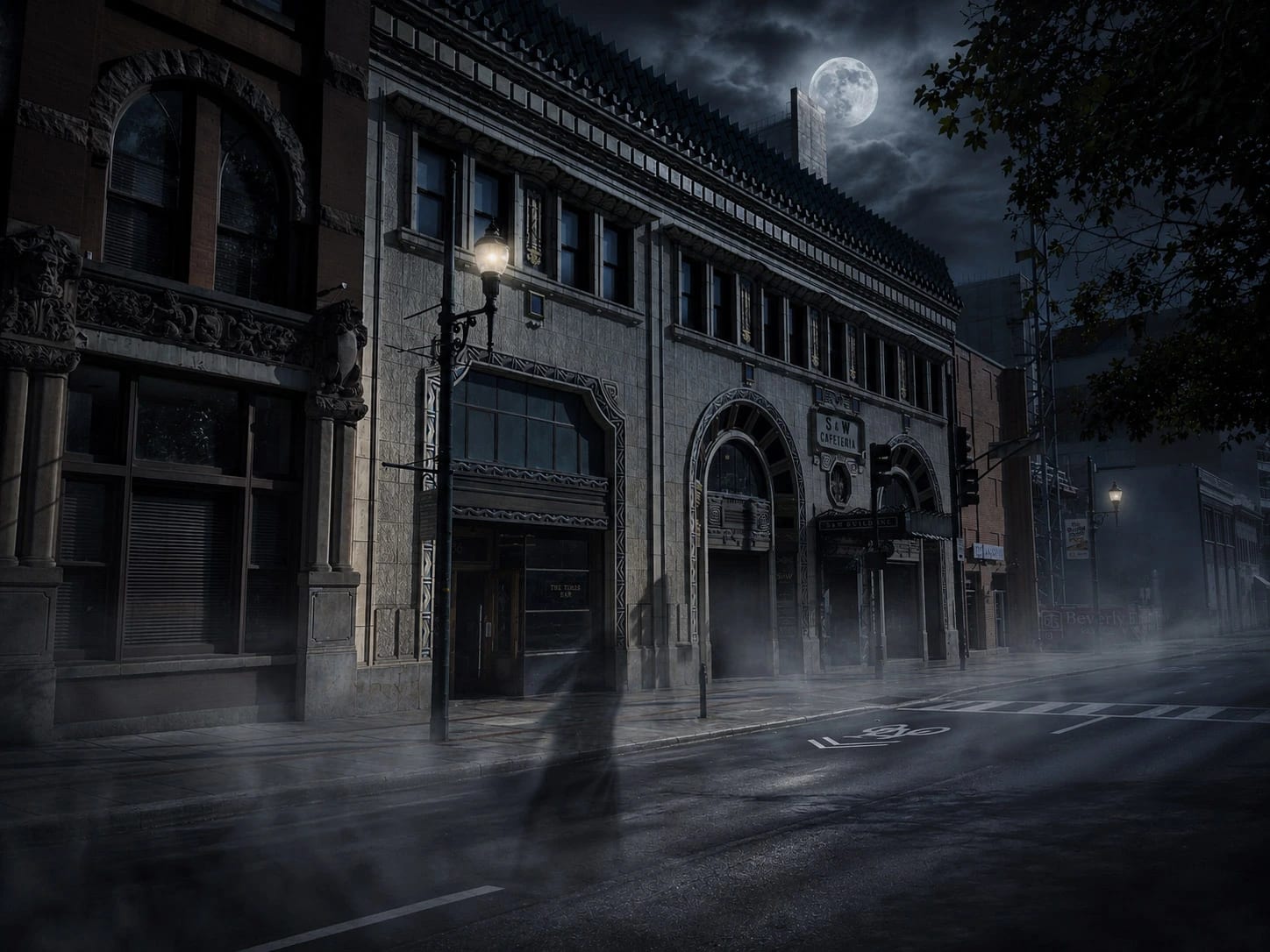
For years, people have told stories about a mysterious man walking between the buildings. He wears a long black coat, a wide-brimmed hat, and carries an old-fashioned doctor's bag. Those who claim to have encountered him describe the tapping of a cane against the pavement, sometimes continuing after the figure has disappeared.
According to Asheville folklore, the man is Dr. Jamie Smith, a physician murdered during a violent tavern fight in 1902.
His killer was never caught. The tavern supposedly burned down the following year. And Smith, apparently unwilling to abandon the place where he died, has wandered Chicken Alley ever since.
It's a wonderful ghost story.
There's just one problem.
Historical researchers have been unable to establish that Dr. Jamie Smith ever existed, much less that he was murdered in an Asheville tavern.
Even the age of Chicken Alley presents a problem. A historical study published in 2019 suggests that the passage may have assumed its present form sometime during the 1920s, approximately two decades after the supposed murder.
That doesn't necessarily settle the question of whether the alley is haunted. It does make the story considerably more complicated than most accounts suggest.
And the real history of Chicken Alley, involving a family poultry business, an artist determined to preserve its memories, and a neighborhood that nearly disappeared, deserves to be told alongside the legend.
The History of Chicken Alley in Asheville
The Working Streets Behind Downtown Asheville
The earliest history of Chicken Alley is closely connected to Asheville's transformation from a small mountain town into a commercial center.
For much of the nineteenth century, Asheville served as a trading point for people living throughout Buncombe County and the surrounding mountains. Farmers traveled into town to sell their produce, purchase supplies, conduct business, and exchange news.
The arrival of the railroad in 1880 accelerated that growth.
Visitors began arriving in larger numbers, hotels expanded, and merchants established businesses to serve both tourists and local residents.
But the commercial life of Asheville wasn't confined to the elegant storefronts and hotels that appeared along its principal streets.
Behind those buildings were workshops, stables, storage areas, delivery passages, and small businesses. These working spaces were essential to keeping the city supplied.
Chicken Alley belongs to that less glamorous history.
The passage sits near North Lexington Avenue, between the avenue's commercial buildings and Carolina Lane. Woodfin Street provides the most recognizable approach to the alley today.
In the early twentieth century, this part of downtown was a practical commercial neighborhood.
People came here to buy things they needed.
Poultry, eggs, honey, feed, farm supplies, and other agricultural products moved through the surrounding streets. Farmers and merchants conducted business in an area that would eventually become known for restaurants, independent shops, art galleries, and nightlife.
The neighborhood's history also includes small residences and businesses that rarely appear in conventional accounts of Asheville's development.
In 2020, Buncombe County Special Collections published research by local historian Rich Matthews examining old photographs and Sanborn fire insurance maps of North Lexington Avenue.
Matthews identified buildings near Chicken Alley, including a row of small dwellings known as Greer's Row.
The row appeared in Asheville city directories as early as 1912 and on a 1913 Sanborn map.
Some of the residents were Black Asheville citizens, whose names were distinguished in the directories under the racial classification practices of the period.
By the 1950s, portions of the area had been adapted for storefronts and other small businesses.
The research offers a glimpse into a part of downtown that was home to workers, families, and merchants long before the surrounding streets became fashionable destinations.
It also demonstrates how much the physical landscape has changed.
The commercial blocks around Chicken Alley developed in stages. Buildings were added, access routes changed, and old residential spaces were converted to other uses.
That history would later become relevant to the ghost story itself.
How Chicken Alley Got Its Name
There is nothing particularly mysterious about the name Chicken Alley.
The passage was once closely associated with Asheville's poultry trade.
One explanation, repeated in local accounts, is that live chickens frequently escaped or wandered through the narrow space between the buildings.
Another attributes the name to the poultry-processing business that operated nearby.
Both explanations reflect the same history.
For decades, chickens were part of the neighborhood's daily commerce.
Unlike the brightly painted murals visitors see today, the original activity was not created for entertainment. Poultry processing was a working business, supplying food to Asheville homes, restaurants, hospitals, and hotels.
The business most closely associated with Chicken Alley belonged to Sam and Argie Young.
Their family helped give the passage its identity.
Sam and Argie Young: The Family Behind Chicken Alley
Young Poultry and Egg Company
Sam and Argie Young operated a poultry-processing and food-distribution business along North Lexington Avenue.
The company, commonly identified in historical accounts as Young Poultry and Egg Company, occupied premises with access to the alley behind the building.
Old photographs also preserve signage associated with Young Produce Company.
The business was operating during the middle decades of the twentieth century, with newspaper advertisements documenting its presence from the 1950s into the 1970s.
Its products included chicken, eggs, and country hams.
The company's customers weren't limited to families purchasing groceries.
Historical advertisements show that it supplied institutions and prominent businesses throughout Buncombe County, including Mission Hospital and the Grove Park Inn.
That connection is particularly interesting.
Visitors staying at one of Asheville's most luxurious hotels may never have given much thought to where their meals originated. Behind the dining rooms and elaborate accommodations was a network of local farmers, suppliers, drivers, and merchants.
Young Poultry and Egg Company was part of that network.
The business was also a family operation.
Several generations participated in the work, and the family's agricultural interests extended beyond poultry.
Beekeeping was an important part of their lives.
Honey, like eggs and other farm products, was a commodity that could be produced locally and sold through the same network of markets and merchants.
For the Young family, Chicken Alley was not a spooky backstreet.
It was a place where people worked, made deliveries, maintained a business, and earned their living.
Sam Young and the Runaway Car
One episode from Sam Young's life survives in an Asheville newspaper report from 1955.
A nine-year-old girl found herself in a dangerous situation when a car began moving unexpectedly after her mother had stepped away.
The vehicle had been left running.
Sam Young rushed to help the child as the car moved out of control.
His intervention became the subject of a local news story.
It is a small incident compared with the dramatic legends associated with Chicken Alley, but it offers something most ghost stories cannot: a glimpse of a real person behaving in a moment of crisis.
Sam Young wasn't a character invented to explain a mysterious sound.
He was a businessman whose family left a documented mark on Asheville.
His work and the history of the neighborhood would eventually be preserved in one of the city's most recognizable public artworks.
Sandra Gudger and the Memories of Chicken Alley
As Asheville changed, much of its agricultural commercial district disappeared.
Businesses closed or relocated. New shops occupied old buildings. Later generations grew up knowing little about the people who had worked in the area.
But members of the Young family remembered.
Sam and Argie's granddaughter, Sandra Gudger, became an important source of information about Chicken Alley's history.
She preserved photographs, family stories, and memories of the businesses that once operated there.
Those memories included the poultry shop, the farmers market, neighboring feed stores, and the family's beekeeping activities.
Sandra also remembered the chickens themselves.
The birds were not always particularly cooperative. Some attempted to escape, flapping and squawking through the narrow passage.
Her recollections helped local artist Molly Must create a mural that would reconnect Chicken Alley with its past.
Molly Must and the Chicken Alley Mural
A Public Artwork Created in 2011
In 2011, Asheville artist Molly Must designed and painted the Chicken Alley mural.
The approximately 200-square-foot work transformed an ordinary brick wall into a colorful historical tribute.
Its most recognizable feature is the enormous rooster, standing roughly ten feet tall.
The bird's bright red comb contrasts with intricate black-and-white patterns across its body.
Behind it, blue chickens hang in rows, recalling the poultry-processing business that once operated in the neighborhood.
The design is bold enough to attract attention from Woodfin Street, where visitors can easily overlook the narrow entrance.
But the rooster is only the beginning of the mural's story.
Farther along the wall are portraits of Sam and Argie Young, incorporating the family photographs Sandra provided.
Other portions depict flowers, bees, honey, and memories of the agricultural businesses that once occupied the neighborhood.
Sandra herself appears as a young woman.
She wears a blue dress and holds a jar of honey toward the viewer.
At her feet is a black snake named Boy, a family pet remembered in the stories that informed the artwork.
The detail is wonderfully personal.
It would have been easy to paint an enormous chicken and leave the history at that.
Instead, Must created a mural about specific people who had lived and worked in this part of Asheville.
The Poem on the Wall
The mural also contains a poem developed through collaboration between Molly Must and Sandra Gudger.
Its verses recall the farmers market, local food, poultry processing, and the generations of workers who conducted business along Lexington Avenue.
The words are an important part of the artwork.
They preserve the neighborhood as Sandra remembered it rather than presenting an idealized version of Asheville's past.
Visitors who stop to examine the mural can learn about the agricultural businesses that once supplied the city.
The portraits identify people whose stories might otherwise have disappeared.
And the painted chickens explain a name that could seem strange to someone unfamiliar with the alley's history.
The mural has become one of Asheville's recognizable works of street art.
It appears in tourism guides, photography collections, and discussions of downtown's public murals.
But Chicken Alley almost didn't survive to become an artistic landmark.
How Downtown Asheville Nearly Lost Chicken Alley
The Proposed Downtown Mall of the 1980s
During the twentieth century, Asheville experienced periods of considerable economic difficulty.
The Great Depression had severely damaged the city's finances, and downtown's commercial fortunes fluctuated in the decades that followed.
By the late 1970s, some business leaders believed a large indoor shopping mall might provide the answer to downtown's problems.
The proposed development would have required substantial demolition.
Historic buildings, small businesses, and portions of downtown's traditional street pattern were threatened by the plan.
Opponents organized to save the area.
Their most memorable demonstration took place on April 19, 1980.
Members of Save Downtown Asheville and other supporters gathered to outline the proposed shopping mall's footprint using lengths of fabric tied together.
The event became known as the Wrap of Downtown Asheville.
By physically marking the enormous area affected by the proposal, preservationists made the scale of the threatened demolition visible.
The campaign helped convince voters to reject the public financing required for the mall.
The project failed.
Downtown Asheville retained much of the historic commercial district that might otherwise have disappeared.
Chicken Alley was part of the larger area whose future would have been shaped by these redevelopment plans.
The preservation effort allowed older buildings and streets to remain available for the small businesses, artists, and residents who later helped redefine downtown.
The Return of Art and Small Businesses
Asheville's downtown revival gathered momentum during the following decades.
Independent shops, restaurants, galleries, and creative businesses occupied buildings that had once been neglected.
Public art became an increasingly visible part of the city's identity.
Chicken Alley, formerly associated with food processing and deliveries, developed another purpose as a destination for people exploring Asheville's murals.
The neighborhood's future remained a subject of public planning.
In 2019, the Asheville Design Center and Center for Craft published the Broadway Cultural Gateway report, developed with assistance from UNC Asheville and community stakeholders.
The study examined Broadway Street, Carolina Lane, Chicken Alley, and surrounding public spaces.
Its recommendations included improvements to pedestrian access, lighting, public art, and the use of underutilized alleyways.
The report recognized Molly Must's mural as a significant cultural asset.
It also contained a historical observation that creates a major problem for the most famous ghost story associated with Chicken Alley.
According to the report, the alley appears to have been created sometime during the 1920s.
The date is an estimate, not a definitive reconstruction of every earlier passage through the block.
Still, it is important.
The ghost of Chicken Alley is supposedly a man murdered there in 1902.
If the alley was not established in its recognizable form until approximately twenty years later, the location of his alleged death becomes considerably harder to explain.
The Ghost of Chicken Alley: Dr. Jamie Smith
The haunted reputation of Chicken Alley centers on a single figure.
According to the legend, Dr. Jamie Smith was a physician practicing in Asheville near the end of the nineteenth century.
He was respected in the community, although stories suggest he enjoyed the city's taverns and nightlife as much as anyone.
Smith supposedly had a distinctive appearance.
He wore a wide-brimmed black hat, often described as a fedora, and a long duster coat.
He carried a physician's bag containing the instruments and medicines of his profession.
His cane was especially recognizable, with a decorative silver tip or handle that made a distinct sound when it struck the ground.
These details became important because they supposedly allowed people to recognize him long after his death.
The legend places his murder at a drinking establishment called Broadway's Tavern.
Broadway's Tavern and the Murder of Dr. Smith
According to the familiar version of the story, Asheville was a rougher town in 1902.
Men working in the surrounding logging camps came into the city seeking food, alcohol, and entertainment.
Taverns attracted laborers and travelers, and fights were not uncommon.
Dr. Smith was reportedly a regular visitor to Broadway's Tavern.
One evening, he arrived while a particularly violent fight was taking place.
Several men were involved, and the confrontation had already escalated.
Different versions of the legend describe what happened next.
In one account, Smith saw an injured man and attempted to provide medical assistance.
In another, he stepped between the men in an effort to stop the fight.
The result was the same.
One of the combatants turned toward the doctor and stabbed him in the chest.
The blade pierced his heart.
Some versions claim he died immediately.
Others describe him staggering out of the tavern and into the alley, desperately seeking help before collapsing on the ground.
Nobody saved him.
According to the story, Smith's murderer escaped and was never identified.
The physician who had spent his life treating the injuries and illnesses of others died violently outside a tavern.
His blood soaked the ground where he fell.
And that was only the beginning of the tragedy.
The Fire That Destroyed Broadway's Tavern
The next chapter of the legend takes place in 1903.
A year after Dr. Smith's supposed murder, Broadway's Tavern reportedly burned to the ground.
The cause of the fire is rarely explained.
Some retellings mention the destruction almost in passing. Others suggest a mysterious connection between the fire and the doctor's death.
Was the tavern deliberately set ablaze?
Was someone trying to conceal evidence?
Did the fire have anything to do with the murdered physician?
These are questions the legend invites, but none has a documented answer.
There is no verified historical evidence establishing that Broadway's Tavern existed at the location described, or that it was destroyed in a fire in 1903.
The supposed murder and fire have become linked in the folklore, giving the doctor's death an atmosphere of unresolved violence.
According to the story, the building vanished.
The doctor did not.
Ghost Sightings in Chicken Alley
The Man in the Long Black Coat
The most recognizable apparition associated with Chicken Alley is a shadowy man dressed in old-fashioned clothing.
Witness accounts collected in local ghost-story publications describe a tall figure wearing a black duster coat and wide-brimmed hat.
Some versions include the doctor's bag.
Others emphasize the cane.
The figure supposedly appears near the walls or moves slowly through the passage before disappearing into the darkness.
A 2025 local report described an account from a longtime neighbor who claimed to have seen a man wearing a coat vanish beyond the light of a streetlamp.
The report did not provide the witness's name or sufficient information to independently evaluate the experience.
Nevertheless, the description resembles the traditional image of Dr. Smith.
What makes the legend distinctive is that the ghost isn't usually portrayed as threatening.
He doesn't chase people down the street.
He walks.
The apparent ordinariness of the sighting is part of what makes the story unsettling.
A passerby might initially mistake the figure for another person moving through the alley.
Only when the man disappears does the encounter become something difficult to explain.
The Sound of the Doctor's Cane
Of all the reported phenomena at Chicken Alley, the tapping cane may be the most familiar.
People claim to hear a rhythmic clicking or knocking sound coming from the passage when no one is visible.
The sound is usually described as steady and deliberate, like the metal tip of a walking stick striking pavement.
According to the legend, the noise belongs to Dr. Smith.
His silver-tipped cane had been one of his most recognizable possessions, and its distinctive sound supposedly continued after his death.
A local account published in 2025 included a neighbor's recollection of hearing what sounded like a cane tapping against the brick outside a window.
The witness reportedly found no one there.
Other retellings describe footsteps accompanying the sound, sometimes approaching and then fading away.
The alley's construction makes it an interesting place for an acoustic experience.
Its narrow passage and hard surfaces can reflect noise from nearby streets. Footsteps, conversations, and sounds from neighboring buildings may travel unexpectedly through the enclosed space.
That doesn't establish what any particular witness heard.
It does offer a practical reason why someone might struggle to locate the source of a noise.
In the ghost story, the sound has a much simpler explanation.
The doctor is making his rounds.
Voices, Cold Air, and the Smell of Smoke
Some accounts of Chicken Alley include experiences that have little to do with the doctor's appearance.
Visitors and nearby residents have described hearing unexplained voices or experiencing sudden cold sensations while passing between the buildings.
Other reports mention the smell of smoke.
That detail is sometimes associated with the alleged destruction of Broadway's Tavern.
The connection is suggestive, although the historical fire itself has not been verified.
The 2025 Strangeville feature on Chicken Alley included reports of voices, smoke odors, and unusual changes in temperature.
These are anecdotal accounts rather than independently documented paranormal investigations.
Because the passage is surrounded by operating businesses and other downtown buildings, environmental explanations are also possible.
Air movement between structures, nearby cooking or heating equipment, and sounds carrying from adjacent properties can create experiences that seem disconnected from their source.
Still, the stories have become part of Chicken Alley's haunted identity.
Not everyone who claims to encounter something unusual sees a mysterious doctor.
Sometimes, according to the reports, the alley simply feels occupied when it appears to be empty.
Is the Ghost Still Trying to Stop the Fight?
Asheville storytellers have proposed several explanations for the doctor's supposed return.
One suggests that he is trapped in the moments surrounding his murder.
In this interpretation, his spirit continues returning to the tavern, perhaps attempting to prevent the violence that killed him.
Another version treats Smith as a man who simply enjoyed drinking and socializing.
Perhaps he has no desire to leave the neighborhood where he spent so many evenings.
The explanation is less tragic, even a little humorous.
A more unsettling variation suggests that the doctor is waiting for the man who murdered him.
None of these interpretations comes from a verified account of the historical physician.
They are ways people have attempted to explain the figure described in the ghost stories.
And there is a larger problem with all of them.
Before anyone can determine why Dr. Jamie Smith might be haunting Chicken Alley, it would help to establish that such a man actually lived.
Did Dr. Jamie Smith Really Exist?
Despite the confident way many websites tell the story, the historical evidence for Dr. Jamie Smith is remarkably thin.
His alleged murder is typically assigned to 1902.
The tavern fire supposedly occurred in 1903.
His profession, clothing, and personal habits are often described in considerable detail.
Yet modern researchers have been unable to locate reliable contemporary records establishing the murder.
In October 2022, WRAL journalist Heather Leah investigated the legend by searching historical newspaper accounts.
Her research uncovered no report of a physician named Jamie Smith being stabbed to death in the alley.
Nor did it uncover evidence of the alleged Broadway's Tavern fire.
Other researchers contacted during the investigation reported similar difficulties.
A local Strangeville investigation published in 2025 reached much the same conclusion.
No contemporary murder report, obituary, or other reliable record established the death of a Dr. Jamie Smith in Chicken Alley.
The lack of documentation is important.
Asheville had established newspapers by the beginning of the twentieth century.
A physician murdered during a violent bar fight, followed by an investigation in which the killer escaped, would have been a significant local event.
A tavern destroyed by fire the following year would also be the sort of occurrence likely to attract attention.
The absence of such records does not prove that every detail of the story is fictional.
Newspaper collections are incomplete, and historical records can be lost.
But it makes the detailed narrative difficult to accept as established history.
There is also the problem of the alley itself.
Was Chicken Alley Even There in 1902?
The 2019 Broadway Cultural Gateway study places the apparent creation of Chicken Alley sometime during the 1920s.
The surrounding neighborhood was certainly developed before that date.
Buildings, homes, businesses, and access passages already existed in the wider block.
Buncombe County Special Collections has documented portions of the nearby streetscape as early as 1912 and 1913.
But the historical study does not support the assumption that Chicken Alley existed in its familiar present-day form in 1902.
The distinction matters because the legend places the doctor at a specific location.
He supposedly walked out of Broadway's Tavern and collapsed in the alley.
If the passage was laid out or substantially reorganized decades later, the story's geography becomes questionable.
It remains possible that an earlier access route existed nearby, or that an older event was eventually attached to the modern alley.
Neither possibility has been demonstrated.
For now, the proposed date of the alley's creation adds another reason to question the standard narrative.
The Real James M. Smith
The 2022 WRAL investigation uncovered a historical detail that appeared, at first, to offer a solution.
A newspaper notice from 1904 referred to a man named James M. Smith and property associated with a tavern in Asheville.
Could James M. Smith have been the real person behind the Dr. Jamie Smith legend?
The connection is tempting.
Jamie can be a familiar form of James.
The names are similar, and both stories involve a tavern in Asheville.
But a closer look at the historical record reveals a serious problem.
Asheville did have a prominent businessman named James McConnell Smith.
Born in 1787, Smith became a successful merchant, landowner, and hotel proprietor during the city's early development.
He operated the Buck Hotel, which was also known as Smith's Hotel.
His business interests included property around what is now downtown Asheville, and his estate included a tavern.
In fact, the tavern appears in Smith's will.
But James McConnell Smith died in 1856.
That was forty-six years before the alleged murder of Dr. Jamie Smith.
Buncombe County Special Collections published a detailed account of James McConnell Smith's life in 2017, documenting his hotel operations, property ownership, family, and death.
The 1904 newspaper notice concerned property described in the will of a James M. Smith. Such a proceeding can occur decades after the person who originally owned the property has died.
A notice printed in 1904 does not mean that its deceased subject had been alive in 1902.
Nor does the existence of Smith's tavern establish that it was Broadway's Tavern.
The historical evidence points toward the nineteenth-century hotel proprietor as the likely subject of the property notice, not toward a murdered physician.
There is still no verified connection between James McConnell Smith and the ghost of Chicken Alley.
What initially looks like a promising clue may simply be a coincidence involving a common name.
Where Did the Legend Come From?
The origins of the Dr. Jamie Smith story remain uncertain.
Versions circulated online well before the more recent historical investigations.
A 2014 account repeated the essential details: the doctor, the black hat, the duster coat, the silver-tipped cane, the 1902 murder, and the tavern fire.
Those details reappear in later publications, sometimes with almost identical descriptions.
The repetition creates an impression of historical certainty.
A reader encounters the same story on several websites and reasonably assumes it must have been drawn from a well-established account.
But the existence of multiple retellings is not evidence that the underlying events occurred.
They may all descend from one earlier narrative.
Local folklore often develops this way.
A story is told, published, embellished, and repeated. Details become more precise with each retelling, even when the historical foundations remain uncertain.
Eventually, the story is familiar enough that people stop asking where it originated.
Chicken Alley's legend may have followed that pattern.
It is also possible that an actual incident elsewhere in Asheville gradually became attached to the alley.
Until an early, independently documented source is identified, neither explanation can be confirmed.
The doctor remains elusive.
And the haunting has become better documented as folklore than the man who supposedly caused it.
Why Chicken Alley's Ghost Story Endures
Chicken Alley is an unusually effective setting for a ghost story.
It is close to the busy center of Asheville, yet its narrow entrance makes it easy to overlook.
Visitors can step away from a lively street and find themselves surrounded by brick walls, old windows, doors, and unexpected corners.
The murals add another layer.
Their painted figures and bold patterns change appearance with the available light.
At night, shapes that look cheerful during the afternoon can become difficult to distinguish in the shadows.
The doctor fits naturally into the setting.
A man in a long coat, carrying a bag and cane, belongs to the imagined world of early-twentieth-century Asheville.
His supposedly violent death gives him a reason to remain.
The tapping cane provides a sound people can listen for.
Unlike some elaborate ghost stories, the Chicken Alley legend requires very little to become convincing to a frightened visitor.
A strange noise.
A movement at the far end of the passage.
Someone in a dark coat who disappears around a corner.
The location supplies the atmosphere, and the story tells visitors what they might expect to encounter.
That relationship between place and expectation is one reason the legend has survived even as its historical claims have been questioned.
Chicken Alley doesn't need a documented murder to remain an intriguing part of Asheville folklore.
It already has a story that people want to tell.
Visiting Chicken Alley in Downtown Asheville
Chicken Alley is located just off Woodfin Street in downtown Asheville, North Carolina, between North Lexington Avenue and Carolina Lane.
Visitors often use the area around 4 Woodfin Street as a landmark when locating the entrance.
The most recognizable feature is Molly Must's large rooster mural.
Look for the brightly colored chicken artwork on the brick building near the passage.
The surrounding neighborhood is within walking distance of downtown attractions, including the Thomas Wolfe Memorial, Lexington Avenue's shops and restaurants, and the Grove Arcade.
Chicken Alley itself is small.
Visitors do not need an extended walk to see it, although those interested in the artwork should allow time to examine the entire mural.
The most revealing details are not necessarily the enormous chickens at the entrance.
Look for the portraits of Sam and Argie Young.
Find Sandra Gudger holding the jar of honey.
Notice the painted insects, flowers, and her pet snake Boy.
Take time to read the poem, which preserves memories of the people whose businesses gave the alley its name.
The mural is part of the history, not simply decoration.
Can You Visit Chicken Alley at Night?
Chicken Alley can be viewed from the surrounding downtown streets, and visitors interested in its ghost story often seek it out after dark.
However, the passage and adjoining properties include working businesses, service access, and private areas.
Visitors should obey any posted restrictions, avoid blocking entrances or deliveries, and respect the people living and working nearby.
Lighting and access conditions can change.
Daylight is preferable for examining the mural and understanding the location's history.
After dark, the alley takes on the atmosphere associated with its haunted reputation, but visitors should use ordinary precautions appropriate to any urban passage.
There is no evidence that attempting to contact Dr. Smith produces paranormal activity.
Nor is it necessary to disturb neighboring businesses or residents to experience the setting.
For anyone interested in Asheville's ghost stories, Chicken Alley makes an unusual companion to other haunted locations downtown.
The Jackson Building is associated with legends of mysterious deaths during the Great Depression.
The former Battery Park Hotel is connected to the documented 1936 murder of Helen Clevenger.
The Thomas Wolfe Memorial preserves the history of another old Asheville building associated with reports of unexplained activity.
Chicken Alley is different.
Its most famous tragedy may never have occurred.
Is Chicken Alley Really Haunted?
The history of Chicken Alley presents two very different kinds of mystery.
One involves Dr. Jamie Smith, the murdered physician whose spirit supposedly walks through the passage carrying a silver-tipped cane.
Despite the details repeated in ghost-story collections, historians have not established that the doctor lived in Asheville or died in the circumstances described.
The alleged tavern has not been reliably identified.
The reported fire remains unverified.
Even the date when Chicken Alley took its present form creates difficulties for the story.
The other mystery concerns how a small working alley became one of Asheville's recognizable haunted locations.
That transformation is easier to understand.
For decades, this passage was connected to ordinary people conducting the city's daily business.
Sam and Argie Young operated a poultry company here. Their family supplied food to Asheville households and institutions.
Sandra Gudger remembered their work and helped preserve its history.
Molly Must turned those memories into a mural that gave the alley a new identity.
And somewhere along the way, the story of a murdered doctor became attached to the same narrow passage.
Today, the chickens that once gave the alley its name are gone.
Their replacements are painted on the walls.
The old businesses have changed, and the people who worked in them have passed into Asheville history.
As for Dr. Jamie Smith, the historical evidence has never quite caught up with the ghost story.
Perhaps there was a real physician whose death was forgotten or confused with another event. Perhaps the entire legend was created to explain a shadow, an unexplained sound, or the unsettling atmosphere of the passage after dark.
Nobody has established the answer.
But there is one detail that survives almost every version.
Late at night, when the businesses are quiet and the passage appears empty, people say they sometimes hear a cane striking the pavement.
A few measured taps.
Then silence.
The man who supposedly carried it has never been found in the historical record.
His footsteps, according to Asheville folklore, are another matter.
For more of the city's haunted history, read about the Battery Park Hotel, the Pink Lady of the Grove Park Inn and Helen's Bridge, explore our guide to haunted Asheville, or join one of our Asheville ghost tours.
Research Sources and Further Reading
-
Buncombe County Special Collections: Correcting the Record (2020). Research into North Lexington Avenue, historical photographs, Greer's Row, and early Sanborn maps of the neighborhood.
-
Asheville Design Center and Center for Craft: Broadway Cultural Gateway Final Report (2019). Historical context suggesting Chicken Alley developed during the 1920s, including a 1976 photograph and discussion of downtown preservation.
-
Molly Must: Chicken Alley (2011). The artist's photographic documentation of the mural, including the portraits, poultry imagery, honey, and historical artwork.
-
WRAL: Most Haunted Alleyway in North Carolina (October 29, 2022). Investigation of the Dr. Jamie Smith legend, historical newspaper records, and the Young family's poultry business.
-
Buncombe County Special Collections: Standing On One Corner in Asheville, Part One (2017). Historical research on James McConnell Smith, his hotel and tavern interests, and his death in 1856.
-
828 News NOW: Strangeville: Why Asheville's Chicken Alley Is One of the City's Strangest Ghost Sites (2025). Local reporting on the legend, mural, historical evidence, and reported encounters.
-
Explore Asheville: Takin' It to the Streets With Asheville's Urban Art. The city's tourism guide to public murals, including Chicken Alley.
-
North Carolina Ghosts: The Ghost of Chicken Alley. A traditional version of the Dr. Jamie Smith folklore, useful for understanding how the legend has been told.

Molly Must's rooster mural at the entrance to Chicken Alley, off Woodfin Street