On the slopes of Beaucatcher Mountain, just a short distance from downtown Asheville, an old stone bridge stretches across a narrow mountain road. Its weathered arch rises between steep banks of rock and earth, with ivy and other vegetation creeping across the masonry. The road bends beneath it, disappearing into the woods on the other side.
It is an unexpectedly beautiful structure. And, according to one of Asheville's most enduring ghost stories, a woman named Helen has been haunting it for generations.
People who visit the bridge after dark have reported seeing a woman standing above the road, hearing unexplained cries, and experiencing electrical problems with their cars. Others insist that calling Helen's name three times will summon her spirit. Those who try the ritual are sometimes warned that their vehicles may refuse to start when they attempt to leave.
The story is usually told as a simple tragedy: a mother loses her daughter in a fire, takes her own life, and remains at the place of her death, desperately searching for the child she could not save.
But Helen's Bridge has a much longer and more interesting history than the ghost story alone suggests.
The bridge was built in 1909 for one of Asheville's most remarkable private estates. It was designed by an architect associated with the Biltmore Estate, appeared in the work of novelist Thomas Wolfe, and narrowly escaped demolition during the twentieth century.
Its original name was Zealandia Bridge, after the extraordinary mansion that stood above it.
The identity of Helen, however, remains a mystery. No historical record has conclusively established that she lived on the mountain, that her daughter died in a fire, or that anyone matching her description took her own life from the bridge.
The stone arch is real. Its history is well documented.
The woman said to haunt it is another matter entirely.
The History of Helen's Bridge
Beaucatcher Mountain and Asheville's Early Development
Long before anyone referred to Helen's Bridge, Beaucatcher Mountain was an important landmark on the eastern side of Asheville.
During the nineteenth century, Asheville was a relatively small mountain community. Roads crossed the surrounding hills, connecting the town to farms, settlements, and travelers passing through Western North Carolina.
Beaucatcher Mountain stood directly along one of those routes.
Its unusual name has inspired several local explanations. One tradition associates the mountain with young couples who met along its trails, where young women might encounter, or "catch," their beaus. Another historical account traces the name to a summer house jokingly described as a woman's beaucatcher.
By the late nineteenth century, the mountain's proximity to downtown and its commanding views made it attractive to wealthy residents.
Asheville was changing.
Railroad connections had brought increasing numbers of visitors into the region. Affluent Americans traveled to the mountains seeking relief from summer heat, respiratory illnesses, and the pressures of city life.
Large homes began appearing on the surrounding hillsides.
George Vanderbilt would eventually construct his enormous Biltmore Estate south of town. Other prominent residents followed with homes inspired by European castles and country houses.
Among the earliest of these properties was Zealandia, a mansion built high above Asheville by a man whose life had taken him halfway around the world.
John Evans Brown: The Adventurer Who Built Zealandia
John Evans Brown had already lived an extraordinary life when he returned to Asheville in the 1880s.
Born in Pennsylvania in 1827, Brown moved to Buncombe County with his family while still a teenager. His father, William J. Brown, became a prominent local landowner.
In 1849, John joined the thousands of Americans traveling west during the California Gold Rush.
The journey failed to produce the fortune he had hoped for.
Instead of returning home, Brown continued across the Pacific. He eventually established himself in Australia and New Zealand, where he became involved in sheep and cattle ranching, business, and politics.
His career in New Zealand was particularly successful.
Brown served in colonial political office and became a member of the country's Parliament. He even named one of his political districts Swannanoa, borrowing the name from the river valley east of Asheville.
After spending decades overseas, Brown returned to North Carolina with considerable wealth.
In 1888, he purchased approximately five acres near the summit of Beaucatcher Mountain.
He wanted a home that reflected the experiences and success of his years abroad.
The result was Zealandia.
Completed around 1889, the original mansion resembled a small Gothic Revival castle. Its towers, battlements, and elevated position made it an unmistakable feature of the Asheville landscape.
Brown named the property in honor of New Zealand, the country where he had made his fortune.
From the windows and terraces of Zealandia, he could look across a rapidly growing city toward the mountains beyond.
He did not enjoy his mountain residence for very long.
Brown died at Zealandia in July 1895, leaving behind a property that would soon enter an even more elaborate period of development.
Philip S. Henry and the Transformation of Zealandia Castle
After passing through the ownership of real estate developer O. D. Revell and his wife, Caroline, Zealandia was purchased in 1904 by Philip S. Henry.
Henry was born in Australia and educated in Europe. A diplomat, businessman, scholar, and enthusiastic collector of art and historical artifacts, he had the resources and interests to transform Zealandia into something considerably grander than Brown's original home.
He began expanding the estate almost immediately.
The existing castle was enlarged with new rooms, decorative stonework, and architectural details inspired by English country houses. Its Gothic appearance gradually gave way to a more elaborate Tudor Revival design.
Henry also acquired neighboring property, including an estate called Beaumont, which stood on the other side of Beaucatcher Gap.
The acquisition created a practical problem.
The two properties were separated by a road passing through a narrow cut in the mountain.
Henry wanted a convenient carriage route between them.
His solution was a stone bridge.
Richard Sharp Smith and the Construction of the Bridge in 1909
The architect associated with the bridge was Richard Sharp Smith, one of the most influential designers in Asheville's architectural history.
Born in England in 1852, Smith came to Asheville in 1889 to supervise construction work on George Vanderbilt's Biltmore House.
He subsequently established his own practice and designed numerous buildings throughout Western North Carolina.
His work included important residences, commercial buildings, and churches. He was involved in the design of All Souls Church in Biltmore Village and collaborated on projects associated with the Basilica of St. Lawrence.
Henry employed Smith on several improvements to Zealandia, including the estate's remarkable Tudor-style buildings.
In 1909, the stone bridge was constructed across the mountain road.
Its design was relatively simple: a single graceful arch made from quarried stone, blending into the rocky landscape on either side.
The bridge carried the estate's private carriage route above the road.
Carriages could cross the gap without descending to the lower roadway, allowing movement between Henry's adjoining properties.
The structure was known as Zealandia Bridge.
There were no elaborate towers, decorative statues, or inscriptions commemorating a tragic death. Its appearance came from the carefully arranged stonework and its setting on the mountain.
That restraint would eventually become one of its most compelling features.
Over the following decades, vegetation began growing across the arch. The stone darkened with age. Trees spread over the road, and the bridge took on an appearance that made it seem much older than it actually was.
The bridge has outlasted much of the estate it was built to serve.
Famous People and Events Associated with Zealandia
Thomas Wolfe and the Bridge in *Look Homeward, Angel*
One of the most important historical connections to Helen's Bridge involves Asheville-born novelist Thomas Wolfe.
Wolfe grew up in the city during the early twentieth century, when Zealandia was one of the most prominent estates on Beaucatcher Mountain.
He knew the surrounding roads and hillsides.
In his 1929 novel, Look Homeward, Angel, Wolfe used a fictionalized version of Asheville called Altamont. The story drew heavily from his childhood, his family, and the places he remembered.
Zealandia and its bridge appeared in the novel.
Wolfe renamed Philip Henry as Philip Roseberry and described his protagonist, Eugene Gant, walking beneath the great stone arch with a young woman.
As Eugene passed underneath, he shouted toward the bridge.
His voice echoed against the stone.
It is a small moment in a much larger novel, but it preserves an image of the bridge decades before it became famous as a haunted location.
There is also a curious similarity between Wolfe's description and the modern ghost story.
Today, visitors are said to call Helen's name beneath the arch and wait for a response.
Wolfe's fictional character was shouting beneath the same bridge in a book published in 1929.
There is no evidence that the modern ritual originated with Wolfe's passage. The resemblance is nevertheless striking, especially because shouting beneath the arch has become such an important part of the location's folklore.
Long before ghost hunters were calling for Helen, Wolfe had already made the bridge a place where someone shouted into the darkness and listened to the echo.
The Art Collection of Philip S. Henry
Zealandia became one of Asheville's most unusual cultural attractions during Philip Henry's ownership.
Henry traveled extensively and collected art, antiques, weapons, and historical objects from around the world.
His collection included paintings, ancient artifacts, armor, ceramics, and decorative objects. Among the treasures described in historical accounts were works by Frederic Remington, objects associated with the Incas, and a lamp said to have come from Pompeii.
The collection became too substantial to remain merely a private hobby.
In 1924, Henry began allowing members of the public to view selected works at Zealandia, generally through invitations or appointments.
The growing interest eventually encouraged him to construct a separate museum building on the estate.
The museum, which opened around 1930, was among Asheville's most notable early art institutions.
It attracted thousands of visitors.
For a period, people made the journey up Beaucatcher Mountain not to search for ghosts but to see paintings, sculpture, and artifacts assembled by one of the city's most prominent collectors.
Henry even offered Zealandia as a possible summer residence for President Calvin Coolidge in 1928, although there is no documented evidence that the president accepted.
Henry died in London in 1933.
His daughters inherited Zealandia, and the family retained an interest in the property for decades afterward.
The mansion gradually changed as maintaining such an enormous estate became increasingly impractical.
The Disappearance of the Original Castle
At its largest, Zealandia contained more than sixty rooms.
The property included extensive residential wings, a stable, outbuildings, gardens, and facilities for Henry's collections.
By the middle of the twentieth century, maintaining the enormous house had become difficult.
During the 1950s, the family demolished substantial portions of the mansion, including the original section built by John Evans Brown.
Some of Henry's additions were also removed.
The surviving house was reduced to a fraction of its former size.
The property was later sold, and additional surrounding land was developed or transferred to other owners.
The construction of Interstate 240 through Beaucatcher Mountain brought still more dramatic changes.
Parts of the mountainside were excavated, altering the landscape near the estate. The museum building was demolished in 1976 as a result of highway construction.
Zealandia itself survived and was listed on the National Register of Historic Places in 1977.
Although portions of the mansion remain standing, the property is private and is not generally open for public exploration.
The bridge, however, remained visible from the road below.
It would soon face a crisis of its own.
How Helen's Bridge Was Nearly Destroyed
The construction of Interstate 240 presented a serious threat to the old bridge.
During highway work in the 1970s, crews blasted through sections of Beaucatcher Mountain.
The bridge was not directly in the path of the excavation, but engineers worried that vibrations from the explosions might damage its masonry arch.
Architect Robert S. Griffin recognized the danger and persuaded transportation officials to install temporary supports beneath the structure.
Those supports remained in place for approximately twenty-three years.
By the late 1990s, portions of the bridge's masonry had deteriorated, and stones were falling toward the road.
In 1998, authorities closed the roadway beneath the bridge because of safety concerns.
Demolition was discussed.
For preservationists, the prospect of losing a landmark designed by Richard Sharp Smith and immortalized by Thomas Wolfe was unacceptable.
A campaign to save the bridge followed.
Griffin helped organize restoration efforts, and supporters raised funds for repairs and structural testing.
The Zealandia Committee raised approximately $40,000. Asheville City Council contributed another $10,000, with additional support from the city's Public Works Department.
Engineers devised an unusual method for testing the bridge.
The scaffolding beneath the arch would be lowered approximately two inches, allowing the stone structure to carry a test load while the supports remained close enough to prevent a major collapse if the test failed.
The bridge passed.
Workers repaired damaged stonework, restored masonry joints, and removed the temporary supports.
The structure was saved in 1999.
A decade later, Asheville acquired the bridge, with its preservation and possible incorporation into a public greenway becoming part of the city's long-term planning.
That is the documented history of Helen's Bridge.
Its most famous story, however, concerns events that historians have been unable to verify.
The Ghost of Helen's Bridge
The Tragic Story of Helen and Her Daughter
According to the best-known version of the legend, Helen was a young mother who lived at or near Zealandia during the early twentieth century.
Some accounts describe her as a servant employed at the mansion.
Others suggest she lived in a nearby house or worked for one of the wealthy families on Beaucatcher Mountain.
Helen had a daughter whom she loved dearly.
One night, a fire broke out.
In certain versions, the blaze began inside Zealandia itself. Helen was supposedly working in the kitchen when she realized the house was burning.
Her daughter was somewhere else in the mansion.
One particularly detailed telling places the child in the library, where the flames spread rapidly among the books and furnishings.
Helen tried desperately to reach her.
She was too late.
The child died in the fire.
Unable to bear the loss, Helen wandered toward the stone bridge overlooking the road below.
There, overcome with grief, she took her own life.
The most familiar version says she hanged herself from the bridge. Another claims she jumped from the arch into the roadway.
Her body was eventually discovered, but according to the story, her spirit never found peace.
Helen remained on Beaucatcher Mountain, searching for her daughter.
The tragedy became the explanation for the strange figure allegedly seen around the bridge.
Over time, visitors began describing encounters with a woman who appeared confused, sorrowful, or desperate.
Some claimed she was still looking for her child.
Others believed that anyone who disturbed her would discover that the grieving mother's spirit could become hostile.
Another Version: The Secret Lover of Zealandia
The fire is not the only explanation attached to Helen's supposed death.
A different version describes her as the lover of one of Zealandia's wealthy residents.
According to this account, Helen became pregnant during a relationship that could not be publicly acknowledged.
The man either rejected her or refused to recognize the child.
Despondent and facing the prospect of scandal, she reportedly took her own life at the bridge.
This variation appears in collections of Southern ghost stories and discussions of the bridge's folklore.
It differs significantly from the story of the mother who lost her daughter in a fire.
There is no established historical evidence identifying Helen as a mistress of any Zealandia resident, and the accounts do not consistently identify the man supposedly involved.
The conflicting stories raise an important question.
Was there ever a single tragedy behind the haunting, or did several different narratives eventually become attached to the same bridge?
Ghost Sightings at Helen's Bridge
The Woman Who Appears Above the Road
The most familiar apparition associated with Helen's Bridge is a woman seen standing on or near the stone arch.
Descriptions vary.
Some witnesses claim she wears a long white dress. Others describe a pale, indistinct female figure emerging from the darkness near the bridge.
A few accounts describe her appearing to hang beneath the arch, recalling the manner of death attributed to her in local folklore.
Other visitors report seeing a woman moving along the road rather than on the bridge itself.
One variation describes Helen approaching motorists and asking whether they have seen her daughter.
The figure is sometimes said to vanish before anyone can answer.
These stories are difficult to substantiate individually. Most circulate as accounts passed among visitors, residents, ghost-story writers, and paranormal enthusiasts rather than as independently documented investigations.
Their consistency lies less in the woman's appearance than in her supposed purpose.
She is always waiting.
Or searching.
Calling Helen's Name Three Times
Perhaps the most famous tradition associated with the bridge involves deliberately trying to summon its ghost.
The ritual is simple.
According to local folklore, visitors stand beneath the arch and call out to Helen three times.
Some versions instruct them to say, "Helen, come forth!"
Others simply tell visitors to repeat her name.
If the ritual succeeds, the story goes, Helen may appear above the roadway, emerge from the surrounding trees, or make her presence known through an unexpected sound.
Some accounts claim that visitors feel a sudden chill or sense someone standing nearby.
Others describe unexplained movement in the shadows.
The ritual has made the bridge particularly popular among teenagers and people interested in paranormal investigations.
There is no documented historical connection between the ritual and any real woman named Helen.
Its structure resembles the familiar tradition of summoning a spirit by repeating a name, a practice found in numerous American urban legends.
What makes this particular ritual interesting is its history beyond Beaucatcher Mountain.
A nearly identical challenge has been associated with another haunted location in Buncombe County since at least the 1960s.
The Cars That Refuse to Start
The most frequently repeated warning about Helen's Bridge concerns automobiles.
Visitors who summon Helen are said to risk electrical or mechanical problems.
Some accounts describe headlights flickering unexpectedly.
Others involve dashboard lights, engines that stall, batteries that suddenly appear drained, or doors that lock and unlock without explanation.
One story claims that Helen touches the vehicle, leaving a mark as evidence of her presence.
The alleged disturbances sometimes occur at the bridge. In other versions, they begin after the visitors have driven away.
Paranormal writer Jamie Roush Pearce described an experience involving her vehicle's automatic door locks after visiting the bridge.
According to an account discussed by Southern Spirit Guide, Pearce had attempted to summon Helen and briefly noticed a figure near her car.
Afterward, the vehicle reportedly developed problems with its automatic locks.
The trouble continued for approximately a week.
Pearce eventually returned to the bridge and asked Helen to leave the car alone.
She later reported that the problem did not recur.
The sequence is an account of an unusual experience, not evidence that a ghost caused the malfunction.
Automotive electrical systems can behave unpredictably for entirely ordinary reasons, and no controlled examination established a paranormal cause.
Nevertheless, the story illustrates why the bridge has developed a reputation extending beyond apparitions and strange noises.
According to local folklore, Helen does not always remain behind when visitors leave.
Unexplained Cries and Movement in the Woods
Not every reported encounter requires visitors to call Helen's name.
Some people describe hearing cries or faint voices near the bridge after dark.
Others have reported footsteps, movement among the trees, or the sensation of being watched from above.
The landscape contributes significantly to the atmosphere.
The road is enclosed by wooded slopes and rock walls. Sounds can echo beneath the arch or travel unpredictably along the mountainside.
Wind moving through branches, animals in the undergrowth, and traffic approaching from around the bend can be difficult to identify immediately, especially at night.
Those conditions offer plausible explanations for some experiences.
They do not necessarily explain what every witness believes happened.
For people familiar with the legend, an unexpected sound or movement can quickly acquire a more unsettling meaning.
Helen is supposed to be somewhere nearby.
And the surrounding woods provide plenty of places for someone—or something—to remain unseen.
A Woman on the Stairs at Zealandia
Not all stories involving Helen take place at the bridge.
In Stories from the Haunted South, folklorist Alan Brown relates an account involving a female apparition reportedly encountered by owners of Zealandia.
The figure was said to appear on a staircase inside the mansion and was identified in the telling as Helen.
The story suggests that the haunting may have been associated with the estate itself, rather than exclusively with the bridge.
There is an important limitation, however.
The identification of the apparition as Helen does not establish who the woman was, whether she ever lived at Zealandia, or whether the experience was connected to the better-known bridge legend.
The account remains a reported haunting, not a verified historical event.
Was Helen a Real Person?
The question has troubled local historians and paranormal researchers for years.
The bridge was constructed in 1909. Zealandia's owners and the development of the estate are relatively well documented.
A fatal fire killing a child inside the mansion, followed by the mother's death at the bridge, would ordinarily have left some historical trace.
Researchers have not established a contemporary newspaper report, death record, or other reliable document confirming the commonly repeated tragedy.
No verified record identifies a woman named Helen as the person who died at the bridge.
Nor has a confirmed date been established.
Some versions place the tragedy early in the twentieth century. Others suggest the 1920s or 1930s.
The details have changed considerably over time.
What is particularly interesting, though, is that Zealandia's documented history contains a genuine fire-related tragedy.
The Real Fire in Philip Henry's Family
The National Register of Historic Places nomination for Zealandia, prepared in 1977, records that Philip S. Henry's first wife, Florine Lewisohn, died in a fire in 1903.
Henry subsequently brought his two young daughters to Asheville.
He purchased Zealandia in 1904.
The bridge was not constructed until 1909.
This is a remarkable detail because the most famous version of Helen's legend also involves a mother, a child, and a devastating fire.
But the documented circumstances are different.
Florine was the mother who died, not a woman who survived the loss of her daughter.
Her daughters survived, and the fire occurred before Henry purchased Zealandia and before Helen's Bridge existed.
The historical record therefore does not support identifying Florine as Helen.
It would also be a mistake to assume that her death inspired the ghost story without evidence showing how that story developed.
Still, the coincidence deserves attention.
A real family tragedy involving fire existed in the history of the household most closely connected with the bridge.
Whether that tragedy ever influenced the local legend remains unknown.
Is Helen's Bridge Connected to the Murder of Helen Clevenger?
Another theory involves one of Asheville's most notorious crimes.
In July 1936, nineteen-year-old Helen Clevenger was murdered while staying at the Battery Park Hotel in downtown Asheville.
The case attracted national attention.
A hotel employee, Martin Moore, was convicted and executed, although questions about the investigation and the reliability of his confession have complicated historical interpretations of the case.
Some local historians and ghost-story researchers have wondered whether the unusually prominent murder of a young woman named Helen influenced the later stories about Helen's Bridge.
There is no direct evidence establishing such a connection.
Clevenger did not die on Beaucatcher Mountain.
Her murder occurred decades after the construction of the bridge, and the circumstances bore little resemblance to the story of the grieving mother.
Nevertheless, the possibility illustrates how an infamous local tragedy can become entangled with later folklore.
The names may coincide without the stories sharing a common origin.
The Other Helen: A Ghost Story from Royal Pines Mountain
One of the strangest aspects of the Helen's Bridge legend is that another mountain in Buncombe County has a remarkably similar ghost story.
Near Royal Pines, south of Asheville, folklore describes a woman named Helen who lived with her daughter in a secluded cabin.
According to this version, a man entered the cabin and attempted to assault the mother.
During the confrontation, a kerosene lantern overturned, igniting the building.
Both mother and daughter supposedly died in the fire.
Helen's spirit was then said to haunt the mountain, continuing to search for her child.
The details differ from the Beaucatcher story, but the central elements are familiar: a woman named Helen, a daughter, a fire, and a restless spirit.
The resemblance becomes even more interesting when examining the ritual used to summon her.
In September 1964, the Goldsboro News-Argus published an account of teenagers from Hendersonville who traveled to Royal Pines Mountain to test its ghost story.
The group reportedly called for Helen three times.
Something moved in the darkness.
One of the teenagers believed they had seen a spirit, and the group fled in a panic.
A sheriff's deputy who responded to the incident reportedly found no evidence of anything supernatural, suggesting mist and imagination as possible explanations.
The 1964 account is important because it demonstrates that the name Helen and the threefold summoning ritual were associated with another mountain long before many modern internet accounts of Helen's Bridge appeared.
It does not prove that one legend originated from the other.
The available evidence does not establish which story came first.
But it suggests that Helen's haunting may belong to a broader tradition of Western North Carolina ghost stories rather than to one independently documented death.
The same name and similar ritual became attached to two different places.
Over time, the stone bridge on Beaucatcher Mountain became the better-known setting.
How Helen's Bridge Became One of Asheville's Most Famous Haunted Places
The bridge already possessed the qualities of a memorable local landmark.
Its old stone arch, secluded setting, and connection to a historic mansion made it visually distinctive.
The appearance of the bridge changed as the original estate declined and vegetation gradually covered the structure.
By the late twentieth century, people approaching it from downtown encountered something that looked almost forgotten.
An old private carriage bridge crossed above a public roadway, even though much of the estate it once served had disappeared.
The ghost story gave the structure a new identity.
Paranormal writers helped spread the legend beyond Asheville. Joshua P. Warren discussed local hauntings in his 1996 book Haunted Asheville, and other regional authors continued collecting stories associated with the bridge.
Tourism websites, newspaper features, and online discussions eventually introduced Helen to an even wider audience.
By 2012, the location had been featured on Atlas Obscura.
The City of Asheville published the legend in a Halloween feature in 2019, describing the alleged death and the reports of cars failing to start after visitors called Helen's name.
WRAL revisited the bridge and the neighboring Zealandia estate in 2022, exploring its architectural history and paranormal reputation.
Today, Helen's Bridge is frequently included in discussions of Asheville's most haunted locations.
Its fame rests on two different histories.
One is the documented story of a bridge built for a remarkable mansion, designed by a prominent architect, remembered by a great American novelist, and saved by preservationists.
The other belongs to Helen.
Only one of those stories has a confirmed historical record.
Visiting Helen's Bridge in Asheville
Helen's Bridge is located near 201 Beaucatcher Road in Asheville, North Carolina, close to the intersection of Beaucatcher Road and Vance Gap Road.
The historic stone arch stands above a winding mountain roadway, a short distance east of downtown Asheville.
Visitors can see the bridge from the road beneath it.
There is no admission fee for viewing the structure from a lawful public location, but this is not a developed tourist attraction with a dedicated visitor center or established parking facilities.
The roadway is narrow, curved, and used by local traffic.
That matters.
People stopping beneath the bridge to take photographs or attempt the familiar ghost-summoning ritual can create a hazard for passing drivers.
Visitors should not block traffic, walk in the travel lanes, or stop vehicles beneath the arch.
The upper portion of the bridge is not an unrestricted public walkway. The surrounding property, including Zealandia Mansion, is private.
Visitors should not climb onto the structure, enter restricted property, or attempt to reach the mansion through the surrounding woods.
Anyone interested in seeing the bridge should visit during daylight, when traffic and footing are easier to assess.
The bridge is visible without disturbing the surrounding neighborhood.
Beaucatcher Mountain also has a rich history beyond the haunting. The nearby landscape contains sites associated with Asheville's early development, historic architecture, and the dramatic changes caused by twentieth-century highway construction.
For those interested in the city's literary past, the connection to Thomas Wolfe makes the bridge particularly meaningful.
For ghost-story enthusiasts, the attraction is something else.
An old stone arch, a name that refuses to disappear, and a tragedy that no one has been able to prove.
Does Helen Still Haunt the Bridge?
There is something unusual about the enduring reputation of Helen's Bridge.
Most haunted places derive their legends from recognizable deaths. A murder occurs in a hotel room. A prisoner dies in a cell. A tragic accident becomes the explanation for footsteps, apparitions, or unexplained sounds.
At Helen's Bridge, the process is less clear.
The bridge existed for decades before the haunting became widely documented. Its appearance in Thomas Wolfe's novel established its place in Asheville's cultural history long before the modern ghost story became famous.
The alleged victim has no confirmed identity.
The supposed fire has no established date.
Even the manner of Helen's death changes depending on who tells the story.
And yet people continue to visit.
Some come because they believe the bridge is haunted. Others are drawn by the architectural history or the novelty of a nineteenth-century castle's surviving carriage bridge.
The most curious visitors are interested in a question that remains unanswered.
Where did Helen's story come from?
Perhaps it began with an encounter someone could not explain. Perhaps a real tragedy elsewhere in Buncombe County was gradually attached to the old arch. It may have developed through the familiar practice of sharing frightening stories about lonely roads and abandoned places.
There is not enough evidence to establish any of those explanations with certainty.
The bridge itself, however, has survived.
It escaped demolition, endured the blasting of Beaucatcher Mountain, and outlasted much of the remarkable mansion it once served.
Thomas Wolfe knew it as Philip Roseberry's arched bridge.
Its builders knew it as Zealandia Bridge.
Asheville now knows it by the name of a woman whose existence no one has been able to confirm.
And according to the legend, if someone calls her name beneath the old stone arch, she might still answer.
For more of the city's haunted history, read about the Pink Lady of the Grove Park Inn, explore our guide to haunted Asheville, or join one of our Asheville ghost tours.
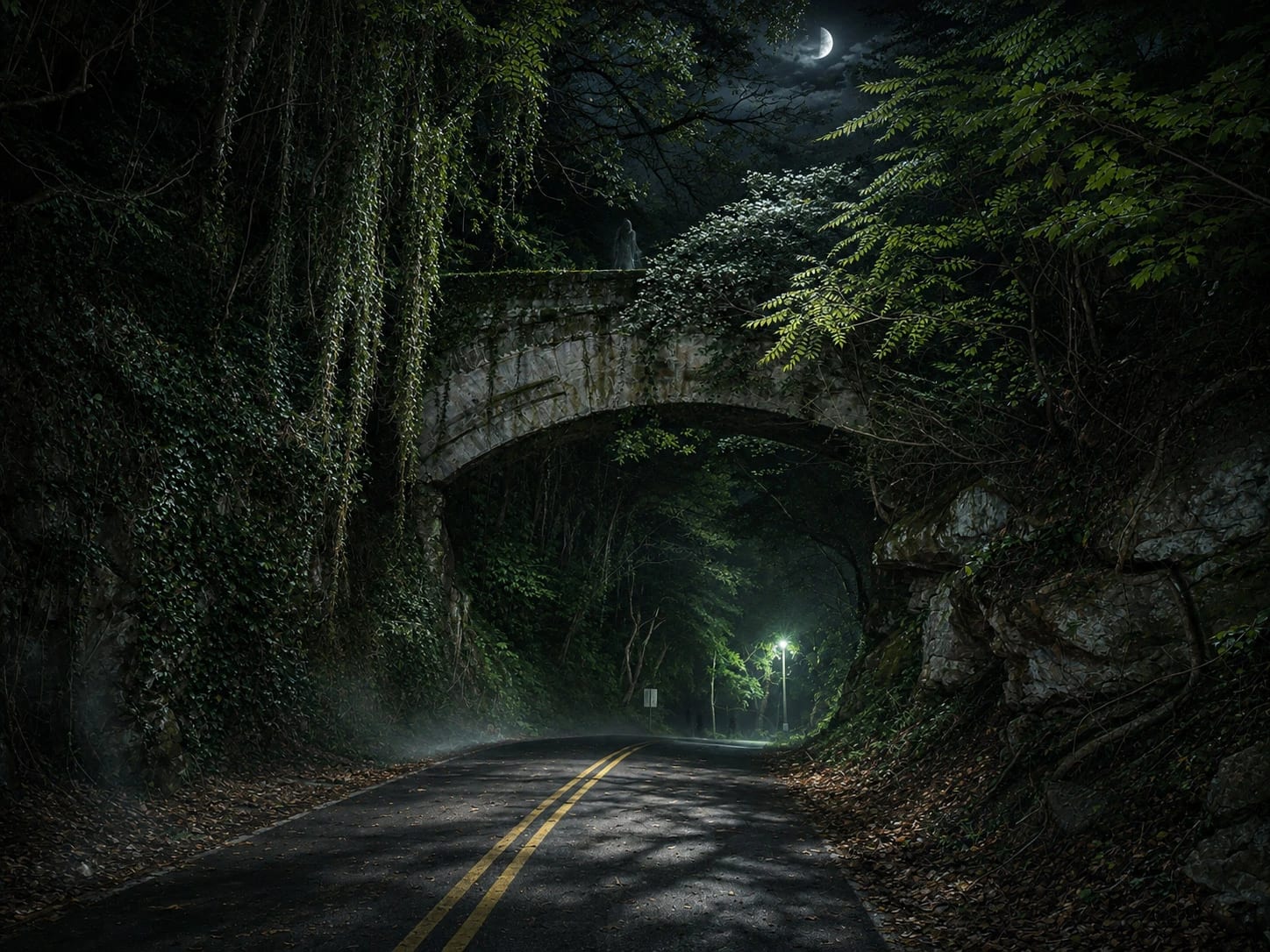
Helen's Bridge, built in 1909 as Zealandia Bridge, on Beaucatcher Mountain


