Music fills the historic house at 118 Third Avenue North almost every day.
Students practice scales in its rooms. Teachers give lessons behind closed doors. Pianos, guitars, and other instruments produce a mixture of melodies that has become part of the soundtrack of downtown Franklin.
Occasionally, however, employees and visitors report hearing or seeing something that does not belong to any lesson.
Footsteps cross otherwise empty rooms. A mysterious woman appears upstairs. Children claim to see someone walking through the building—and, in some accounts, directly through its walls. Above the entrance, an unexplained handprint reportedly returns to an old window even after the glass has been cleaned.
The woman is often identified as Sarah Ann “Sallie” Ewing Sims Carter Gaut, a Confederate sympathizer and reputed spy who lived in the house during the Civil War.
History confirms that Sallie called 118 Third Avenue North home. Whether she remains there is another question.
The Maney–Gault House
The historic residence occupied by Shuff’s Music is commonly identified in preservation records as the Maney–Gault House. Some historical and family sources spell the final name Gaut, reflecting the spelling used by Sallie and her third husband, John M. Gaut.
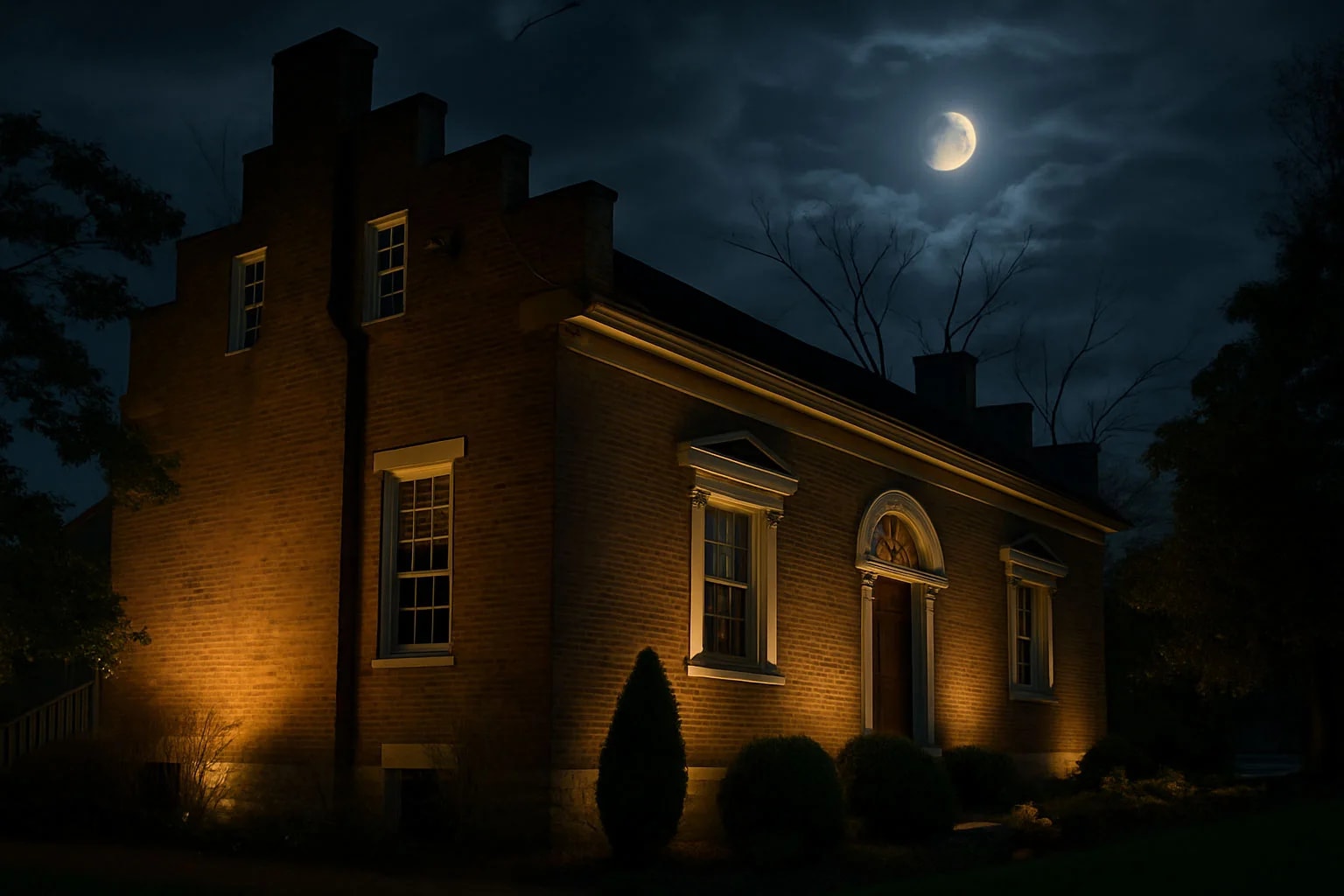
Constructed around 1828, the house belongs to a remarkable concentration of surviving nineteenth-century residences on Third Avenue North. Several neighboring homes predate the Civil War, creating one of downtown Franklin’s most historically intact residential streets.
The house was approximately thirty years old when Sallie Carter moved there with her children around 1860. Its position near Franklin’s public square placed the family close to the community’s commercial, political, and social center.
It also placed them inside an occupied town when war arrived two years later.
Sallie Ewing Carter Gaut
Sarah Ann Ewing was born on July 12, 1826. Known throughout her life as Sallie, she came from a prominent Middle Tennessee family and developed connections among some of the region’s wealthiest and most influential residents.
She married Boyd McNairy Sims and later Joseph W. Carter. By the beginning of the Civil War, she was a widow with children living at 118 Third Avenue North. She subsequently married John M. Gaut, whose name became attached to the property.
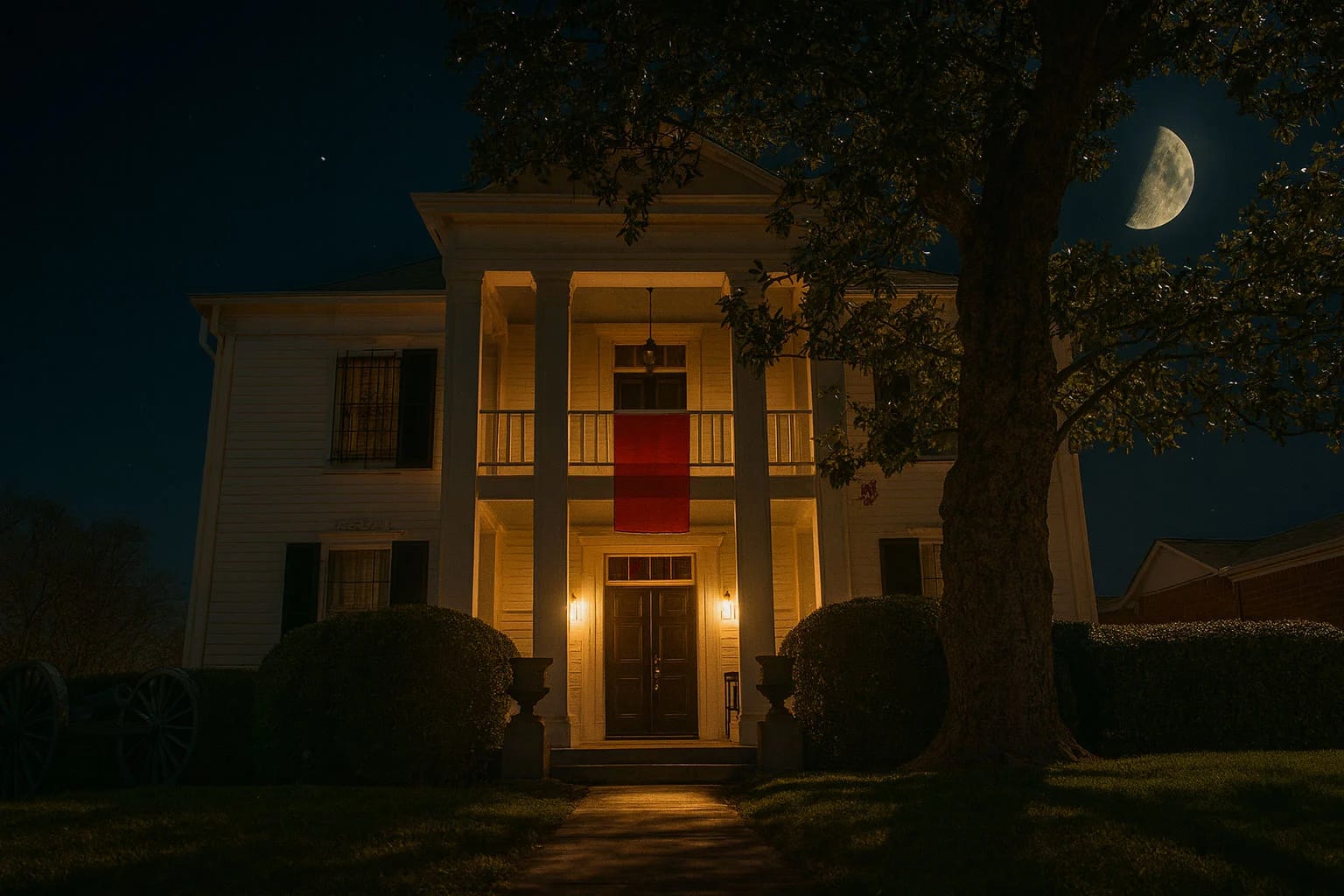
Sallie openly supported Southern secession. She is traditionally credited with making and displaying the first Confederate flag raised in Franklin, reportedly unfurling it at her home around the time a Confederate banner appeared over the Tennessee State Capitol.
That story became part of her local reputation, but her wartime activities went beyond symbolism.
After Federal forces occupied Franklin in 1862, Sallie reportedly gathered useful information from Union soldiers and passed it to Confederate contacts. Her social position gave her opportunities to converse with officers and other military personnel without immediately attracting the suspicion that might have followed a male Confederate operative.
Popular accounts claim that she invited Federal soldiers into her home, served them food and whiskey, and encouraged them to disclose military information. The precise details are difficult to verify, but historical and family accounts consistently describe her as an active Confederate supporter who provided intelligence whenever possible.
For that reason, Sallie is frequently remembered as one of Franklin’s female Confederate spies.
Cotton, Gold, and a Dangerous Journey
Sallie’s wartime associations extended beyond Franklin.
She was a cousin and confidante of Adelicia Acklen, the enormously wealthy owner of Nashville’s Belmont Mansion and several Southern plantations. Acklen possessed a vast quantity of cotton that became difficult to transport or sell as the war disrupted trade.
Accounts describe Sallie assisting her cousin in an extraordinary effort to move cotton for its sale abroad. The women reportedly traveled to Louisiana and eventually reached the Gulf, beginning a dangerous journey that carried them through hostile territory and international ports.
The venture allegedly earned Acklen a fortune in gold.
Some aspects of the story have been embellished through repetition, but Sallie’s relationship with Acklen and her participation in wartime cotton dealings reinforce her image as unusually resourceful, politically committed, and willing to accept considerable personal risk.
She returned to Franklin before one of the most catastrophic days in the town’s history.
The Battle Comes to Third Avenue
On November 30, 1864, Federal forces occupied Franklin while preparing defensive positions against the approaching Confederate Army of Tennessee.
The main battle line stood south of town, but the entire community felt the approach of combat. Troops crowded its streets. Wagons moved supplies and wounded men. Officers established temporary quarters in residences and public buildings.
According to a family account, Sallie’s daughters and several of their friends climbed through an opening in the roof of the Third Avenue house to watch Federal troops preparing for battle. Some sat on the roof while others remained on the attic steps.
Union soldiers across the street allegedly noticed them and threatened to fire if the young women did not go back inside. Those standing on the steps tumbled backward as the others hurried down from the roof.
Earlier that day, two Federal quartermasters had reportedly stopped at Sallie’s home and asked for breakfast. She explained that soldiers had confiscated wheat she had sent to a mill. The officers offered to obtain a barrel of flour for ten dollars and later returned with it.
After eating, the officers departed. They returned that afternoon with a warning: their expected withdrawal had been canceled. The Confederate army was advancing too quickly. A battle was imminent.
Sheltering in the Cellar
When the fighting began, Sallie and her family sought protection in the cellar.
The Battle of Franklin lasted only a few hours, but its violence was extraordinary. Artillery shook the town while rifle fire continued into the darkness. Bullets and shells traveled beyond the main lines and passed through Franklin’s residential streets.
Despite the danger, Sallie reportedly emerged from the cellar several times to determine what was happening. Friends, relatives, and neighbors were fighting or sheltering nearby, and she was desperate for information.
By the end of the evening, thousands of men had been killed, wounded, or captured.
Federal troops withdrew toward Nashville during the night. When Franklin’s residents emerged the following morning, they encountered a landscape filled with the dead, the injured, and the remnants of two armies.
The Maney–Gault House soon filled with hungry acquaintances and wounded soldiers. Some were Federal, although most were reportedly Confederate men left behind after the Union withdrawal.
The barrel of flour delivered by the quartermasters was turned into biscuits and other food. What began as a transaction with Union officers helped feed wounded Confederate soldiers after the battle.
A Visit from General Hood
Confederate General John Bell Hood reportedly stopped outside Sallie’s house as his army moved north toward Nashville.
Hood had lost the use of an arm and a leg in previous battles, making it difficult for him to dismount. He therefore asked Sallie to come outside and speak with him while he remained on horseback.
Despite the devastating Confederate losses at Franklin, Hood apparently believed his army had achieved some form of victory. He expressed confidence that his forces would defeat the Federal army at Nashville.
The prediction proved tragically wrong.
In December 1864, Hood’s army suffered a crushing defeat at the Battle of Nashville. During the Confederate retreat, he reportedly stopped at Sallie’s house again. This time, his confidence had disappeared. Accounts describe his face as marked by sorrow and exhaustion.
After a brief conversation, Hood continued south with what remained of his army.
If the story is accurate, the two visits formed grim bookends to the final collapse of Confederate military power in Tennessee.
Sallie’s Later Life
Sallie survived the war and remained connected to Franklin society for decades.
She married John M. Gaut and lived until August 21, 1912, reaching the age of eighty-six. She was buried at Mount Hope Cemetery in Franklin.
Her long life complicates the ghost stories associated with the house. Sallie did not die during the Battle of Franklin, nor is there evidence that she died violently inside the residence. If her spirit returned to the property, it would have been through attachment rather than sudden death.
The house represented one of the most consequential periods of her life. From its rooms, she watched a nation divide, an occupying army enter her town, and a devastating battle unfold nearby. She sheltered her children in its cellar and opened its doors to hungry and wounded men.
Those experiences may explain why later generations found it natural to associate Sallie with the building.
Franklin’s First Music Store
The house began a new chapter in 1978 when Ron and Alice Shuff purchased the property and established Shuff’s Music Sales & Studios.
At the time, Franklin did not have a dedicated music store. Alice believed the growing community needed one and proposed that she manage the business while Ron supplied his professional musical knowledge.
Ron Shuff had studied music extensively and worked as a teacher, music director, studio musician, and songwriter. Alice would operate the store while their children were at school, and Ron would assist after finishing his teaching responsibilities.
They purchased what was described as a neglected fixer-upper and began transforming it into a center for instrument sales, rentals, repairs, and lessons.
Soon after the business opened, the family received devastating news: Alice had cancer. She died approximately nine months later.
Ron continued the business, later crediting the people of Franklin with helping the family and the young store survive. With support from the Heritage Foundation, the Shuffs restored and preserved the exterior of their historic Third Avenue building.
Shuff’s Music became a fixture in the community. Generations of students took lessons there, while professional and aspiring musicians visited for instruments, supplies, and advice.
As the rooms filled with music, stories began circulating about another resident.
The Woman Upstairs
One of the house’s most frequently repeated paranormal accounts concerns a woman seen in an upstairs room.
A visiting artist reportedly encountered a female figure sitting in a rocking chair. At first, the woman appeared entirely real. Then she allegedly told the witness, “I used to live in this house.”
The encounter ended almost immediately when the frightened artist fled.
The woman was later identified in local tradition as Sallie Carter. No evidence proves that conclusion, but Sallie is the best-known woman known to have occupied the residence. Her personality and wartime reputation make her a natural subject for the story.
The rocking-chair apparition is not the only female presence reported inside the building.
Employees, customers, and children attending lessons have described an unfamiliar woman moving through rooms. Some accounts characterize her as elderly. Others offer few details beyond clothing, movement, or the immediate impression that someone was present.
Several children have reportedly seen a woman walk through a wall.
Children can be imaginative observers, particularly inside an unfamiliar old house. Yet the repetition of similar descriptions has helped the story persist.
The Returning Handprint
Another legend centers on an old pane of glass above the front entrance.
A handprint has reportedly appeared on the glass despite repeated cleaning. Employees say the mark eventually returns, occupying approximately the same position after it has been removed.
The print is traditionally attributed to Sallie.
There is no reliable method for determining who left it or why it reappears. Historic glass is often irregular, and oils or residue can settle into tiny imperfections. Changes in temperature and humidity may reveal marks that disappear under other conditions.
Even so, the handprint possesses the unsettling intimacy common to the most effective ghost stories. A shadow might be a reflection. A footstep might be a settling floorboard. A handprint suggests that something touched the glass.
If the mark genuinely returns after cleaning, it raises an obvious question: from which side was the hand pressed against the window?
Voices, Footsteps, and Music
Other reported activity at Shuff’s is less visually dramatic but equally persistent.
People inside the building have described footsteps when no one was walking nearby. Voices have reportedly been heard from rooms believed to be empty. Employees and visitors sometimes experience the sensation that another person has entered, only to find no one there.
A music school complicates paranormal investigation.
Lessons produce sounds that travel through walls and floors. Instruments resonate sympathetically when nearby notes are played. Piano strings can vibrate without being struck directly. Heating, cooling, and the natural movement of an old building create additional noises.
Human voices also behave unpredictably in a house divided into studios. A conversation in one room may seem to originate somewhere else.
These natural explanations should be considered before attributing an incident to a ghost.
Yet employees who spend years inside a building become familiar with its ordinary sounds. They know when a piano string is vibrating, when a student is practicing upstairs, and how voices usually carry between rooms.
It is the events that fall outside those familiar patterns that become part of the haunting.
Is Sallie Still Watching?
The historical Sallie Carter was bold, politically committed, and willing to place herself in danger. She gathered information under military occupation, undertook risky wartime travel, protected her family during battle, and assisted wounded soldiers afterward.
The ghost described at Shuff’s is quieter.
She sits in an upstairs chair. She crosses a room and disappears. She leaves a handprint above the door. She is glimpsed by children who have no reason to recognize her.
No evidence establishes that these apparitions represent Sallie Carter. The woman could be another former resident, a visual misunderstanding, or part of a legend strengthened through repetition.
It is also worth noting that Sallie was approximately thirty-eight during the Battle of Franklin. Reports of an elderly woman may reflect her appearance late in life—or may point to someone else entirely.
The uncertainty is part of the story.
History can demonstrate that Sallie lived in the house and experienced the Civil War there. It can document her family, political loyalties, and reported intelligence activities. It cannot prove that she returned after her death.
A House That Still Listens
The Maney–Gault House has experienced an unusual progression.
It began as an antebellum residence. It sheltered a family during military occupation and battle. Its rooms received wounded and hungry men. More than a century later, it became a place where children learn to make music.
Perhaps that contrast explains the building’s enduring appeal.
During the Civil War, Sallie Carter allegedly listened closely to conversations, searching for information hidden inside ordinary words. Today, teachers listen to their students, correcting a missed note or an uneven rhythm.
And occasionally, someone inside the house hears a voice that cannot be traced to any living speaker.
Most of the time, the sounds at Shuff’s Music have obvious sources. A piano is being played. A guitar lesson has begun. Footsteps belong to a student hurrying between rooms.
Then a woman appears upstairs.
A child watches someone pass through a wall. A mark returns to the glass above the entrance. Footsteps continue after everyone has stopped moving.
Those experiences may have natural explanations. They may also belong to someone other than Sallie Carter. The evidence does not permit certainty.
But if the Confederate spy still keeps watch over her former home, she has chosen an appropriate place to remain.
For more than forty years, generations of musicians have filled the house with melodies. Beneath the music are conversations, whispered instructions, and secrets carried from room to room.
Sallie Carter always did know how to listen.
Shuff’s Music is a stop on the What Waits in the Dark Tour, Ghost City Tours’ adults-only walk through the darkest chapters of the Battle of Franklin. For more of the town’s restless landmarks, explore our guide to the most haunted places in Franklin.
Historical note: Preservation records identify 118 Third Avenue North as the circa-1828 Maney–Gault House. Historical and family accounts document Sallie Carter Gaut’s residence, Confederate sympathies, wartime activities, and experiences during the Battle of Franklin. Shuff’s Music has occupied the property since 1978. Reports of apparitions, voices, footsteps, and the recurring handprint are presented as employee and visitor accounts rather than verified supernatural events.

Shuff’s Music in the historic Maney–Gault House at 118 Third Avenue North