A Building Where the Future Was Argued
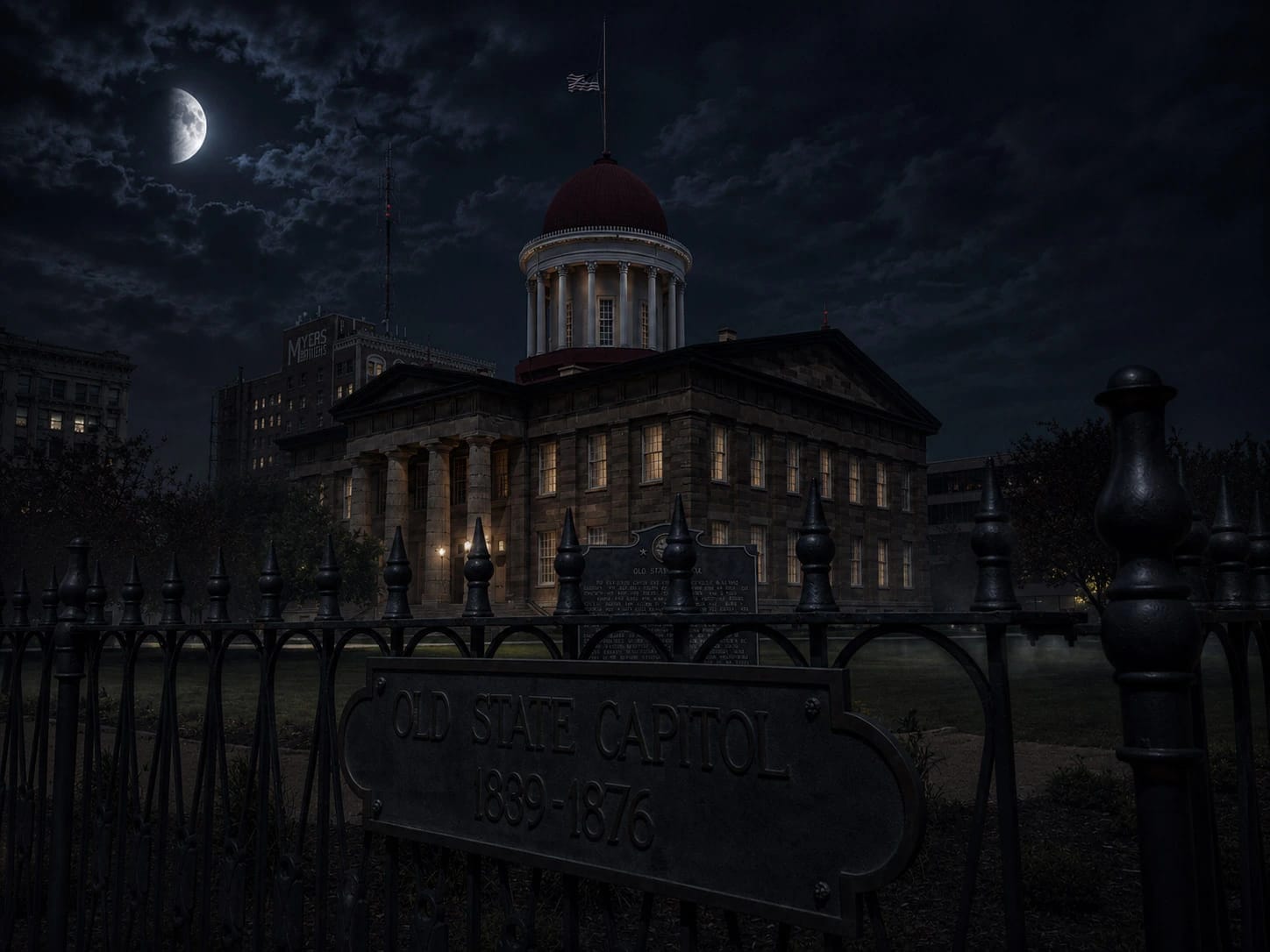
After the last tour group files out and the doors are locked, the Old State Capitol changes. The Hall of Representatives goes silent, rows of empty desks facing a vacant speaker's chair. The corridors feel wider without the crowds. The library, the governor's room, the supreme court chamber — all of it sits waiting, the way a stage waits between performances.
Some buildings are remembered for being old. This one is remembered for what was decided inside it. For thirty-odd years it was the center of Illinois politics, and the arguments that happened here didn't stay local. Men stood up in these rooms and made cases that would carry one of them all the way to the White House and the country into civil war.
That's the thing about a place like this. The words spoken here mattered, and they're gone — but the people who work the building, and plenty who only visit it, will tell you the rooms don't feel entirely empty after dark. Footsteps in halls no one is walking. A sense of being watched in the old chamber. The figure people always think they recognize, tall and stooped, moving where he used to move.
Whether any of that is real is a question the building doesn't settle. What it does, reliably, is leave people with the sense that they've walked into a room a conversation just left. To understand why, start with how this became the most important building in Illinois.
Building Illinois' Seat of Power
Springfield Becomes the Capital
Springfield wasn't always the capital. Illinois ran its government from Vandalia until the 1830s, and the fight to move it north was exactly the kind of backroom political brawl the new statehouse would come to specialize in. A group of Sangamon County legislators — remembered as the Long Nine for their unusual height — pushed hard to bring the capital to Springfield, trading favors and votes to make it happen. One of those nine was a young lawyer named Abraham Lincoln.
They won. In 1837 the capital was awarded to Springfield, and the town, suddenly the seat of state power, needed a building to match its new importance.
Construction of the Old State Capitol
Work began in 1837 on a Greek Revival statehouse of honey-colored limestone, designed by the architect John Francis Rague. It rose around a central rotunda and dome, with the legislative chambers, the state supreme court, and the state library all under one roof. By 1840 it was in use, and it would serve as the Illinois capitol for the next thirty-six years.
The Center of Illinois Politics
From the day it opened, this was where Illinois argued with itself. Laws were written and killed here. Careers were launched and ended here. The legislature met, the supreme court heard its cases, and lawyers and lobbyists and office-seekers packed the halls. For a generation, if something important was happening in Illinois politics, it was happening inside this building — and one lawyer in particular kept turning up in every part of it.
Abraham Lincoln and the Old State Capitol
Lincoln the Lawyer
It's easy now to picture Lincoln as the figure on the monument. In this building he was something far more ordinary: a working lawyer, hustling for clients and cases, one of dozens of attorneys who used the statehouse as their professional home.
He argued cases before the Illinois Supreme Court in its chamber here, hundreds of them over the years. He used the state library to prepare. He served in the legislature, traded in the political gossip of the halls, and made the alliances and enemies that come with that life. He was good at it, ambitious, and not above the maneuvering the work required. The building knew him as a fixture long before the country knew him at all.
The House Divided Speech
Then came the evening of June 16, 1858.
In the Hall of Representatives, Lincoln accepted the Illinois Republican nomination for the United States Senate with a speech he had labored over and that friends had warned him was too radical. It opened with a line borrowed from scripture and aimed straight at the country's deepest wound: 'A house divided against itself cannot stand.' He argued that the nation could not go on permanently half slave and half free — that it would become all one thing, or all the other.
It was a calculated risk, and in the short term it cost him; he lost that Senate race to Stephen Douglas. But the speech, delivered in this room, put him on the national map and framed the argument the whole country was about to have. People still stand in that chamber and try to feel the weight of saying those words out loud, in 1858, to a divided room.
The Road to the White House
The Senate loss didn't finish Lincoln; it elevated him. The debates with Douglas that followed made him a national figure, and within two years the lawyer who had worked these halls was president-elect. He kept an office nearby during the transition and remained a constant presence around the statehouse right up until he left for Washington.
By then the building and the man had grown inseparable. He had argued, schemed, won, lost, and finally risen here. It would also, though no one yet knew it, be where the state would say goodbye to him.
The Building That Became a Place of Mourning
Lincoln Returns One Last Time
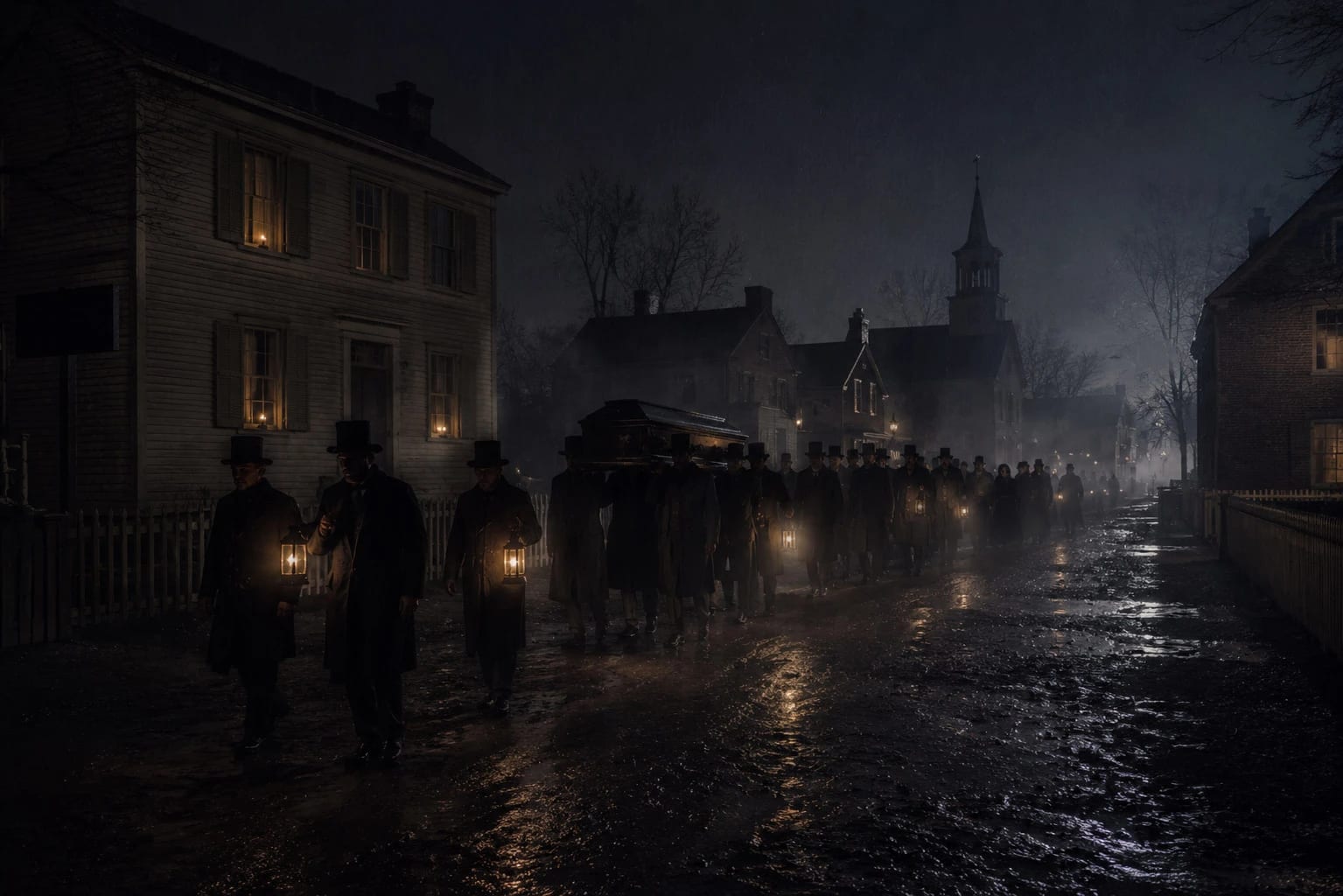
In May 1865, Lincoln came back to the statehouse for the last time, in a coffin.
The funeral train that had carried him across the country reached Springfield, and his body was brought to the Hall of Representatives — the same room where he had given the House Divided speech seven years earlier — to lie in state. For a building that had known him as a living, striving man, it was an almost unbearable kind of homecoming.
Grief Inside the Capitol
The people of Springfield came in enormous numbers. They lined up for hours and filed past the open casket through the day and into the night, neighbors and strangers alike, to look one last time at a man many of them had known personally. The chamber where he had once argued and won was draped in black and filled with the slow shuffle of mourners.
It's a hard scene to shake. The room that had hosted his ambition now held the grief of his death, in the same space, among many of the same people. A great deal of the building's later reputation traces back to those days — to the sheer concentration of feeling packed into one chamber, first the charged ambition of 1858 and then the crushing sorrow of 1865. If any room in Springfield was going to hold onto something, it would be this one.
The Ghost Stories of the Old State Capitol
The stories here have a particular flavor. They're less about death than about activity — a building that still seems, on some level, to be doing the work it was built for.
Lincoln's Apparition
Lincoln is, inevitably, the figure people report most. Visitors and staff have described a tall, lean, slightly stooped man in the chamber or the corridors, dressed in dark old-fashioned clothes, there for a moment and then not. Some see only a long shadow crossing a doorway. The descriptions match the man so closely that people rarely hesitate to name him — though, as always, what they actually saw is harder to pin down than the name they give it.
Footsteps in Empty Hallways
The most frequent reports are simpler: footsteps. People hear someone walking the halls and the stairs when the building is closed and empty — measured, purposeful steps, as if someone with business here is moving from one room to the next. Staff have gone to look and found no one. Old government buildings produce these stories constantly, partly because they're large, hard-surfaced, and full of echoes, and partly because of everything that happened in them. This one has both going for it.
Voices in the Chambers
Then there are the voices. People have reported the murmur of conversation in the legislative chamber when it's empty, the cadence of debate without distinct words, the sense of a room full of people just out of sight. Some hear a single voice; some hear what sounds like many. There are ordinary explanations — sound carrying from the street, the building settling, imagination running in a charged space — and the staff offer them readily. The reports keep coming anyway.
Strange Experiences Reported by Employees
The people who work here are the ones worth listening to, because they're in the building when no one else is. Guides, security, and staff describe doors and lights behaving oddly, cold spots in particular rooms, objects that don't stay where they're left, and the steady sense of not being alone after hours. What gives their accounts weight is consistency — new employees arrive skeptical, spend enough evenings locking up, and end up with their own version of the stories the last ones told.
The Feeling of Presence
More common than seeing or hearing anything is simply feeling something. Visitors describe walking into the old chamber and being struck by a change in the air — a heaviness, a prickling sense of being watched, the strong impression that the room is occupied. It tends to hit hardest in the Hall of Representatives, the room that saw both his greatest moment and his last. People who came in knowing none of the history sometimes feel it anyway, and only learn afterward what happened there.
Paranormal Investigations
As a famous Lincoln site, the building has drawn its share of paranormal interest, and investigators have reported the usual catalog — recordings that seem to hold a word, temperature swings, instruments reacting in the chamber. As a state historic site it isn't open to unrestricted ghost hunting, which keeps the claims modest. It deserves an even-handed look. A reconstructed stone building has drafts and noises, suggestion is powerful in a place this storied, and none of it amounts to proof. What's hard to dismiss is how the same handful of experiences keep recurring, reported by people across decades who never compared notes.
Why Government Buildings Create Ghost Stories
Government buildings turn up on haunted lists far more often than you'd expect from places that are, on paper, just offices. There's a reason for it.
Think about what actually happens in a building like this. People come here at the highest-stakes moments of their public lives. Careers are made and destroyed. Fortunes and reputations ride on a single vote. Decisions get made that change thousands of lives, sometimes millions, and the people making them are under enormous strain. That's a lot of concentrated human intensity to pour into one set of rooms, year after year.
Add the conflict. These are rooms built for argument — for people to face each other across deep disagreements and fight them out. The Old State Capitol hosted the argument over slavery itself, in the very years it was pulling the country apart. Whatever you believe about hauntings, that kind of charged history shapes how a place feels, and how the people inside it read a noise in an empty hall.
And then there's memory. We treat these buildings as something close to sacred because of what was decided in them, and a place we hold that sacred is a place we half expect to be occupied by something. The Old State Capitol gathers ghost stories for the same reason it gathers visitors: because what happened here still matters.
Lincoln's Shadow Over Springfield
You can't really tell the story of haunted Springfield without Lincoln, and the three places most tied to him form its spine.
There's the Lincoln Home, where he was a husband and father, where his family knew its happiest years and lost a child. There's the Lincoln Tomb, where a grieving nation finally laid him down, and where his body was guarded, stolen, and reburied. And there's the Old State Capitol, where he was none of those things — where he was an ambitious man at work, arguing his way toward history.
Together they trace a whole life: the home, the career, the grave. Springfield holds all three within a short walk of one another, and each has gathered its own kind of haunting — family grief in the home, national mourning at the tomb, restless ambition in the statehouse. The city's identity and Lincoln's memory are so tangled together that you can't pull them apart, and the same goes for its ghost stories. To talk about haunted Springfield is, sooner or later, to talk about him.
When the Building Finally Grows Quiet
At the end of the day the visitors leave, the lights go down, and the Old State Capitol settles into its quiet. The desks sit empty in the chamber. The speaker's chair faces a room with no one in it.
Think about how many words have been spoken inside these walls. Laws and verdicts, speeches and arguments, the ordinary business of running a state and the extraordinary business of arguing over its conscience. Some of those words changed Illinois. A few of them changed the country.
You can stand where they were spoken on a Springfield ghost tour, when our guides walk the history of haunted Springfield after dark and explain why this building still feels the way it does.
Perhaps the reason so many people sense a presence inside the Old State Capitol isn't that it's haunted in the ordinary sense. Perhaps it's that some rooms become so important to history that it's hard to imagine them ever truly empty — that a place where the future was argued out loud never quite stops listening for the next voice to stand up.