Standing at 115 Second Avenue South, the Franklin Masonic Hall does not surrender its secrets easily.
Its narrow Gothic windows reveal little of the rooms beyond them. Battlements rise above a brick façade that looks more like a medieval fortress than a meeting hall in a Tennessee town. Behind those walls, members of Hiram Lodge No. 7 have gathered for more than two centuries.
Presidents, Indigenous leaders, soldiers, ministers, and wounded men have all passed through the building. Decisions made there helped alter the future of an entire nation. During the Civil War, its rooms became military quarters and hospital wards. In later generations, visitors began describing footsteps, unexplained movement, shadowy figures, and the sense that some of the hall’s former occupants had never departed.
The Franklin Masonic Hall is not merely one of the city’s reportedly haunted buildings. It is Franklin’s oldest surviving public building and one of the most historically significant Masonic halls in the United States.
The Beginnings of Hiram Lodge No. 7
Hiram Lodge No. 7 traces its history to the earliest years of Tennessee Freemasonry.
The Grand Lodge of North Carolina—then exercising authority over lodges in both North Carolina and Tennessee—issued a charter to the Franklin lodge in December 1808. The organization later became one of the pioneering lodges involved in forming the Grand Lodge of Tennessee.
Before possessing a permanent hall, Franklin’s Masons met in several locations around town, including the Williamson County Courthouse. In 1817, the Tennessee General Assembly authorized the lodge to conduct a lottery to raise money for a dedicated building.
The hall was constructed with handmade bricks and completed around 1823.
At three stories, it was reportedly the first building of its height in Tennessee and the tallest structure west of the Allegheny Mountains. In a young frontier community, the massive brick hall must have appeared extraordinary.
More than two centuries later, Hiram Lodge No. 7 continues to use the building for its original purpose. It is among the oldest Masonic lodges in the country to remain continuously active in the same location.
Gothic Architecture Before Its Time
The Masonic Hall’s façade is as unusual as its history.
The building combines relatively restrained Federal-style proportions with Gothic Revival details that would not become fashionable in the United States until years after its construction. Its pointed windows, battlements, decorative finials, and crenellated parapet distinguish it from Franklin’s surrounding commercial architecture.
The façade is five bays wide. Tall, narrow openings rise through portions of the exterior, emphasizing the building’s height. Its upper edge resembles a fortified wall, reinforcing the impression that the structure was meant to conceal as much as it revealed.
Inside are large meeting spaces on the first and second floors. The upper level includes offices and a room associated with York Rite Masonry.
Freemasonry’s private ceremonies inevitably inspire public speculation, but mystery should not be confused with sinister activity. Masonic lodges traditionally restrict portions of their rituals to initiated members, much as many fraternal organizations maintain private proceedings.
Nevertheless, the combination of secrecy, age, and Gothic architecture has made the hall a natural source of local fascination.
A Church Begins Inside the Hall
The Masonic Hall also played an important role in Franklin’s religious history.
In August 1827, residents interested in establishing an Episcopal congregation gathered inside the building under the leadership of the Reverend James Hervey Otey. Otey, himself a Mason, helped organize what became St. Paul’s Episcopal Church.
He later became Tennessee’s first Episcopal bishop and one of the most influential religious leaders in the region.
Before St. Paul’s constructed its own sanctuary on West Main Street, the Masonic Hall provided a place for the new congregation to organize. The episode illustrates how the building functioned not merely as a private lodge but as an important civic gathering place in early Franklin.
An event of far greater national consequence followed three years later.
Andrew Jackson and the Chickasaw Nation
In 1830, the United States government was pressing Indigenous nations in the Southeast to surrender their ancestral homelands and relocate west of the Mississippi River.
President Andrew Jackson signed the Indian Removal Act on May 28 of that year. Three months later, Jackson traveled to Franklin with Secretary of War John Eaton and General John Coffee. Acting as federal commissioners, they met with leaders of the Chickasaw Nation.
Negotiations occurred at and around the Franklin Masonic Hall. Accounts place portions of the council on the building’s steps, while a ceremonial pipe gathering reportedly occurred inside.
The resulting agreement became known as the Treaty of Franklin.
Under its proposed terms, the Chickasaw would relinquish their lands east of the Mississippi in exchange for territory in the West. The agreement was never ratified because suitable western land had not been secured and Chickasaw leaders would not accept removal under those conditions.
The failure of the Franklin agreement did not end the government’s campaign. Subsequent treaties eventually forced the Chickasaw to surrender their homelands and relocate to Indian Territory.
This history deserves more than a passing reference to Andrew Jackson or a romanticized “peace treaty.” The negotiations held at the Masonic Hall formed part of the larger process of Indigenous dispossession under the Indian Removal Act.
The building is now a National Historic Landmark largely because of its association with that consequential—and deeply troubling—chapter of American history.
The Civil War Reaches the Hall
Three decades after the treaty negotiations, war transformed the Masonic Hall again.
Franklin became a Federal military post following the Union occupation of Middle Tennessee in 1862. Buildings throughout town were seized for military purposes, and the hall reportedly served at different times as barracks and a quartermaster’s facility.
Any sense that the building stood apart from ordinary civic life disappeared. Soldiers lived and worked in rooms once reserved for lodge meetings and community gatherings.
Then came November 30, 1864.
The Battle of Franklin produced thousands of casualties in only a few hours. Homes, churches, schools, businesses, and public buildings were converted into emergency hospitals. The Masonic Hall reportedly received wounded Union soldiers after the fighting.
Its large rooms offered space for rows of injured men. Surgeons and attendants worked in conditions overwhelmed by the number and severity of the casualties. Men who survived the battlefield faced shock, blood loss, infection, and the limited capabilities of nineteenth-century medicine.
No complete list identifies everyone treated inside the hall. It is also impossible to determine how many men may have died there. What is known is that the building became part of Franklin’s enormous network of improvised hospitals.
That history provides the most obvious explanation for traditions of spectral soldiers within its walls.
Shadows in the Upper Floors
Reports associated with the Masonic Hall do not point conclusively to one named ghost.
Instead, its reputation involves a collection of indistinct experiences: footsteps in empty rooms, movement on stairways, unexplained sounds from upper floors, and shadows that appear briefly in windows or doorways.
Some witnesses interpret the figures as soldiers. Given the hall’s military occupation and hospital use, that conclusion is understandable—but it remains an interpretation rather than an identification.
A dark shape glimpsed through a window does not reveal whether it represents a wounded soldier, a former Mason, an optical reflection, or nothing supernatural at all.
The building’s height and internal arrangement may contribute to the experiences. Sounds travel between its three floors. Old wood responds to temperature and humidity. Masonry holds and releases heat, while staircases, doors, and settling structural elements can produce noises that seem to originate in occupied rooms.
Yet people familiar with historic buildings often insist that certain incidents feel different from routine creaks and echoes. A measured footstep has a rhythm. A human-sized shadow suggests form and intention. The sensation of being watched can remain even after every room has been checked.
At the Masonic Hall, the question is not simply whether unexplained activity occurs. It is how many different periods of the building’s history might be represented by it.
Soldiers, Masons, or Memories?
If the hall is haunted, its history offers many possible identities for its spirits.
Wounded soldiers suffered inside its hospital wards. Military personnel occupied it for extended periods. Generations of Masons participated in ceremonies, mourned deceased members, and formed deep personal attachments to the lodge.
Ministers and worshippers gathered there before St. Paul’s Episcopal Church had a sanctuary. Chickasaw leaders negotiated over the future of their people within or immediately outside its walls. Townspeople attended meetings and public events there during Franklin’s earliest decades.
None of those associations proves a haunting. Nor does every emotionally significant event create a ghost.
The building’s atmosphere may instead arise from the accumulated weight of its history. Knowing what occurred in a room changes how that room is experienced. An ordinary sound becomes more noticeable when a visitor understands that wounded soldiers once lay nearby.
But history and paranormal tradition do not have to compete. A ghost story can be meaningful without being presented as scientific proof. It reflects how later generations experience a building and how they attempt to understand the impressions it leaves upon them.
Restoration and Survival
The Masonic Hall has survived more than two centuries, but survival has not come easily.
Time, water, structural movement, military occupation, and repeated use all affected the building. Its unusual architecture and great age made restoration especially complicated. Preservation work had to stabilize the structure while protecting original materials and historically significant interior features.
The hall’s National Historic Landmark designation, awarded in 1973, recognizes its importance far beyond Franklin. Few surviving American buildings combine such early Gothic Revival architecture with direct associations to Indigenous removal, the Civil War, religious history, and the continuing traditions of Freemasonry.
Preservation also creates an interesting tension in haunted places. Repairs expose hidden spaces. Workers enter rooms that may have remained undisturbed for years. Floors, walls, and doors change, sometimes coinciding with new reports of unusual activity.
Whether such disturbances awaken anything supernatural is a matter of belief. What restoration unquestionably does is bring people into close contact with layers of construction and evidence left by previous occupants.
Every opened wall has the potential to reveal another piece of the building’s story.
Franklin’s Hall of Secrets
The Franklin Masonic Hall has never been an ordinary building.
It was constructed through an unusual state-authorized lottery. It rose three stories above a frontier town when nothing around it approached its scale. An Episcopal congregation began inside. A sitting president negotiated with Chickasaw leaders on its grounds. Soldiers occupied its rooms, and wounded men received treatment there after one of the Civil War’s bloodiest battles.
Through everything, Hiram Lodge No. 7 endured.
The alleged spirits inside the hall have never provided names. The shadows do not remain long enough to identify their clothing. The footsteps do not explain whether they belong to soldiers, Masons, or someone forgotten by the historical record.
Perhaps every unexplained sound has a natural cause. Perhaps the hall’s reputation comes from its age, architecture, and the knowledge of what occurred behind its brick walls.
Or perhaps some buildings hold their history differently.
After more than two centuries, the Franklin Masonic Hall continues to conceal far more than it reveals. Its windows remain dark, its upper rooms remain private, and its reported shadows disappear before anyone can determine who cast them.
The ceremonies conducted inside belong to the living members of Hiram Lodge No. 7.
Whatever walks the halls after they leave remains a mystery.
The Franklin Masonic Hall is a stop on the Ghosts of Franklin Tour, Ghost City Tours’ nightly walk through the city’s haunted history.
Historical note: The lodge’s founding, construction, architecture, Episcopal connection, Treaty of Franklin negotiations, Civil War use, and landmark designation are documented by Hiram Lodge No. 7, the City of Franklin, architectural historians, and the National Park Service. Accounts of footsteps, shadows, and sensed presences are presented as paranormal reports and local tradition rather than verified fact.

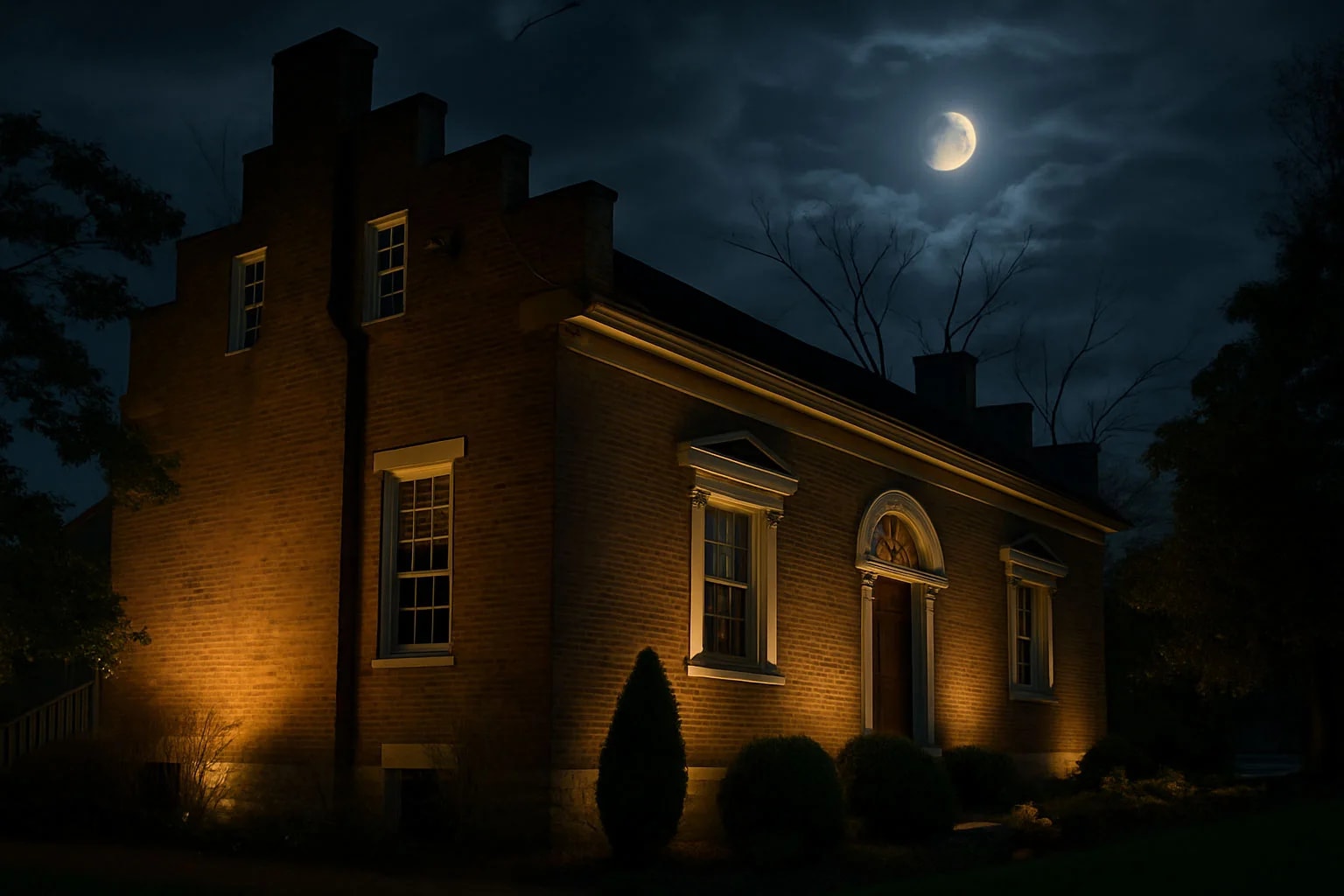
The Franklin Masonic Hall, home of Hiram Lodge No. 7 and Franklin’s oldest surviving public building