Explore Sacramento's Paranormal History
Haunted Sacramento
Why is Sacramento haunted? Explore the Gold Rush, epidemic, fires and floods behind the ghost stories of Sacramento, California, and how its legends compare with the record.
Sacramento grew from a river landing into a Gold Rush city in a matter of months, and became California's capital a few years later. Along the way it buried the victims of cholera, burned, flooded, and raised its own streets out of the water, and its old riverfront, cemetery and mansions gathered ghost stories of their own. Some of those stories rest on documented history and some are local folklore. This is the history behind Sacramento's ghost stories, and why so many people believe the city is haunted.
Ghost Tours in Sacramento
The haunted places below are stops on Ghost City Tours' Sacramento ghost tours — guided walks where our local storytellers bring this history to life after dark.
Why Is Sacramento So Haunted?
Discover the dark history and supernatural forces that make Sacramento one of America's most haunted cities
Long before anyone called it Sacramento, the land where the American River meets the Sacramento River was home to the Nisenan, also known as the Southern Maidu, and the Plains Miwok. In 1839 John Sutter arrived with a few Hawaiian and European settlers and founded New Helvetia on land granted by the Mexican government. The main adobe building of Sutter's Fort, put up between 1841 and 1843, was built with Indigenous forced labor. A malaria epidemic in 1833 had already killed many Native people in the valley, and the Gold Rush brought disease, violence and the loss of land; the Nisenan population fell from about 9,000 to about 2,500 by 1895.
In January 1848, James Marshall spotted gold at the site of the sawmill Sutter was building at Coloma, in the Sierra Nevada foothills. With his father deep in debt, John Sutter Jr. had the land between the river landing and the fort surveyed into a grid of lettered and numbered streets and sold the lots. The landing became the port for goods coming upriver from San Francisco to the goldfields, and Sacramento grew from about 150 residents in 1849 to 9,087 the following year.
The new city learned quickly how fragile it was. A flood in January 1850 put much of it underwater. That August, a fight over land titles between squatters and speculators ended in gunfire in the streets; the Squatters' Riot killed Sheriff Joseph McKinney, among others, and badly wounded Mayor Hardin Bigelow. In October, cholera reached the riverfront. Estimates of the dead run from about 800 to 1,000 in roughly three weeks, and most of the population fled. Bigelow, still recovering, died of cholera in San Francisco.
On the night of November 2, 1852, fire swept through the business district. By the City of Sacramento's count it burned 55 blocks, about 70 percent of the city's buildings, and another fire in 1854 destroyed 12 more. Sacramento rebuilt in brick and stone. That same year, after sessions in San Jose, Vallejo and Benicia, the legislature made Sacramento the permanent capital; the Capitol rose between 1860 and 1874.
Water was the bigger enemy. The city counts ten major floods between 1850 and 1893, and the winter of 1861–62 was the worst. After floods in 1852 and 1853, and again after 1861–62, Sacramento raised the streets of its business district, eventually by about 10 to 12 feet. First stories became basements, and hollow sidewalks were left beneath the new grade. That buried level is still there, and the Sacramento History Museum leads its own Underground Tours through it. Our tours stay above ground.
Sacramento was also where California's link to the rest of the country began. Four Sacramento merchants, Leland Stanford, Collis Huntington, Mark Hopkins and Charles Crocker, formed the Central Pacific Railroad in 1861, and ground was broken near the foot of K Street on January 8, 1863. The company began hiring Chinese workers in 1865; by 1868 about 12,000 of them made up roughly 80 percent of its workforce. Sacramento's Chinatown grew along I Street on the banks of China Slough, until the slough was cut off from the river, later filled, and the neighborhood pushed out by redevelopment.
Many of the city's early dead lie in the Sacramento Historic City Cemetery, established in 1849 on 10 acres donated by John Sutter Jr. Victims of the 1850 epidemic were buried in mass graves there and in the nearby New Helvetia Cemetery; a monument went up in 1852, but the exact location of the City Cemetery mass grave is unknown. Bigelow, Mark Hopkins and three governors are buried there too. It is a place of memory, and we tell its story as history.
Leland Stanford bought the house at Eighth and N Streets, built about 1856, in 1861, and it served as the governor's office through the 1860s. His only son, Leland Jr., was born there in 1868 and died of typhoid in Florence, Italy, in 1884, two months before his 16th birthday. After a troubled sleep, his father told Jane Stanford, "The children of California shall be our children," and they founded Stanford University in the boy's memory. Retellings turn that night into a ghost story, with Leland Jr. returning in a dream, and the mansion has become part of Sacramento's ghost lore.
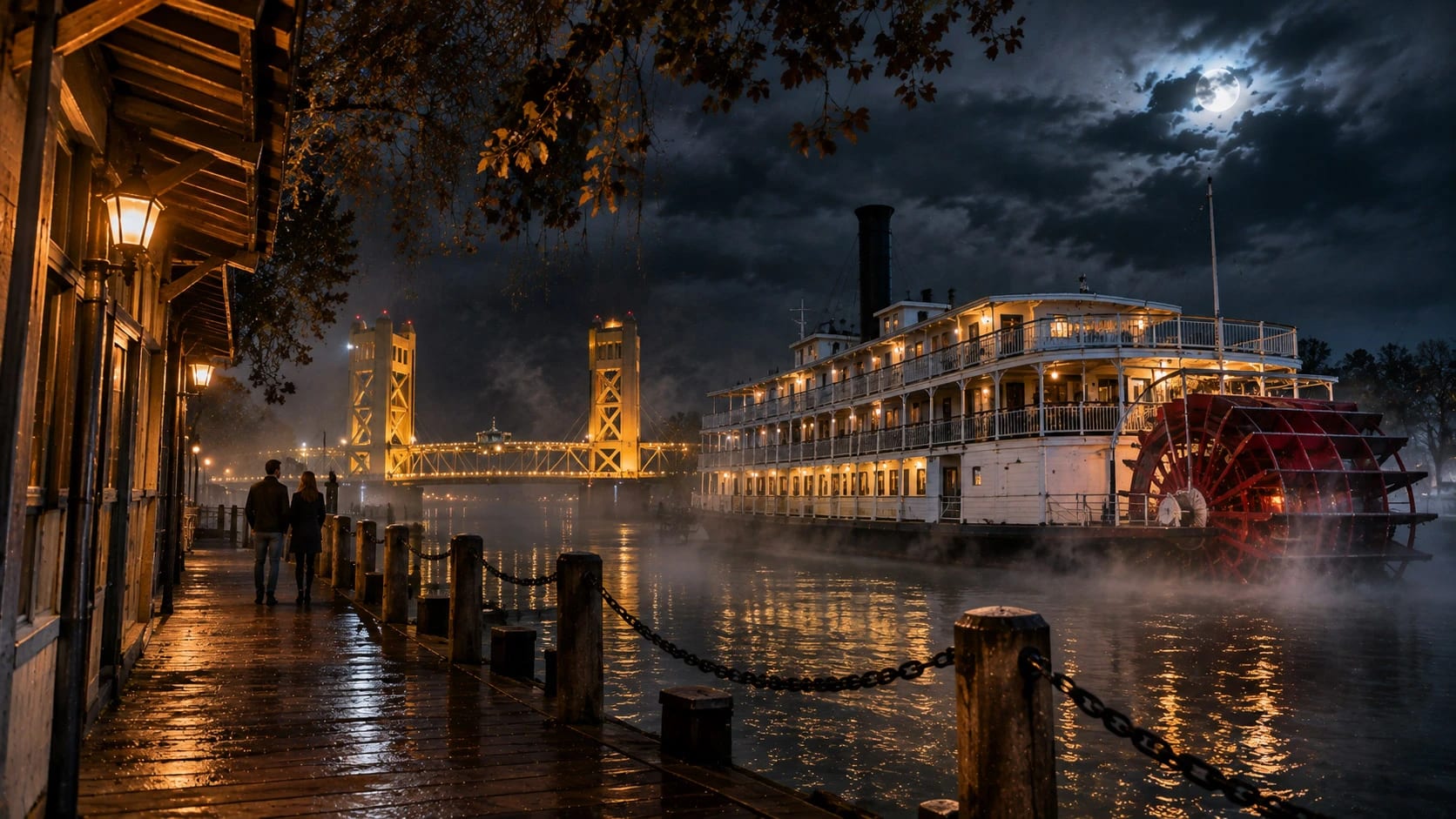
The best-known ghost stories today belong to the riverfront. The Delta King, a sternwheeler christened in 1927, carried passengers between Sacramento and San Francisco until 1940, sank at Richmond in 1981, and reopened in Old Sacramento as a hotel in 1989. A local ghost-tour host told Comstock's Magazine about a girl of eight to ten seen running and giggling in the halls and a man in a navy cap in the lobby, and staff describe hearing a glass break when nothing was broken. These are accounts, not records, and we tell them that way.
That is why Sacramento is considered haunted: a city built in a hurry on the Nisenan homeland, tested by cholera, fire and flood, raised out of its own streets, and enriched by a railroad built by thousands of immigrant hands. On Ghosts of the Golden Frontier, our family-friendly walk, and Every Fortune Has a Ghost, our adults-only tour through the city's darker history, our Ambassadors share the documented history and the local legends side by side, and always tell you which is which.
1848
Gold found at Coloma; Sacramento is laid out
55
Blocks burned in the Great Fire of 1852
10–12 ft
How high the business district was raised
Sacramento's Haunted Places: Coming Soon
We're writing up the story of each of Sacramento's haunted places. Until then, the best way to meet them is on one of our ghost tours.
Ready to Explore Sacramento's Dark Side?
Don't miss out on the #1 rated ghost tour experience in Sacramento. Book your adventure today!
Why Book With Ghost City Tours?
Multiple Tour Options
Choose from family-friendly, adults-only, or pub crawl experiences.
Top-Rated Experience
4.9 stars from thousands of satisfied ghost tour guests.
Tours 7 Days a Week
Rain or shine, we run tours every single night of the year.
Money-Back Guarantee
Love your tour or get a full refund - that's our promise!
Tours Sell Out Daily
Sacramento is a popular destination. Book now to guarantee your spot!
Book Your Ghost Tour Today
Book Online Now
SAVE TIME- Choose from all available tour times
- Instant email confirmation
- Secure, encrypted checkout
- 100% Money Back Guarantee
Prefer to Call?
Our Guest Services team is available 7 days a week to help you book the perfect tour.
CALL 855-999-04917am - 11:30pm Daily