240 Bourbon St, New Orleans, Louisiana 70112
Take a second and imagine something for me: it's a Saturday night and you're stumbling down Bourbon Street (things obviously went horribly awry, what're you doing here?). You're shielding your eyes from the neon lights, stepping over puddles of "Bourbon Juice" (as my sister likes to call it), and fist bumping strangers, all the while trying to avoid a flood of on-coming people and booze. So now strip away the dirt, the neon lights, the plastic Mardi Gras beads that are tossed down from balconies all year around, and see what it really is: a street rich in historical significance.
When faced with the swell of tourists, "big ass beers," and noise, it's easy to forget that this street has been hosting rowdy drunks in its taverns and speakeasies for centuries, some of which helped shaped the face of New Orleans today. One of the oldest, and most historic buildings on Bourbon Street, is the Old Absinthe House.
It is also widely regarded as one of the most haunted buildings in New Orleans' French Quarter. We stop at the Old Absinthe House on some of our famous New Orleans Ghost Tours, including our New Orleans Haunted Pub Crawl.
The History of the Old Absinthe House
Fire and a Grocery Store
 A clipping from "The Herald," 1921.
Begun in 1798 and completed in 1806, The Old Absinthe House's notoriety exists because of a few different reasons.
- It was allegedly the meeting location for General Andrew Jackson and the infamous New Orleans pirate, Jean Lafitte, prior to the Battle of 1815 (during the War of 1812), and;
- A century later, it was a hit spot during Prohibition, and was nearly shut down multiple times.
Local lore holds that an earlier structure on the site was destroyed in the Good Friday Fire of 1788, a conflagration that ravaged the city within hours, and that only its fireplace was left standing - a very solemn and eerie image to behold.
The building at 240 Bourbon Street was completed in 1806 by two merchants from Barcelona, Pedro Front and Francisco Juncadella, who first operated it as a grocery. They sold globally imported fine wines and tobacco products, and made a tidy profit off their business.
The Absinthe House Becomes "The Absinthe House"
Absinthe became hugely popular in New Orleans. By about 1836 the ground floor had become a coffee house, and by 1842 the Aleix family, Catalan immigrants like the building's owners, was running it.
During the 19th century, you went to a café for coffee and a coffee house for your other vices. "Coffee houses" worked similarly in Louisiana as they did in Europe, in that the other "vices" generally referred to the green fairy (absinthe) or drugs.
Aleix's Coffee House's popularity grew almost directly from the start. Tourists to New Orleans visited the bar regularly, spending their nights wiling away until dawn peeked over the horizon and workers headed to their jobs.
By 1869 it was being advertised as "the Absinthe House." Around 1870 the Aleixes hired Cayetano Ferrer, a celebrated bartender from the French Opera House, who soon took over the bar; he is credited with creating the Absinthe Frappé there in the 1870s, and the bar became known as the Old Absinthe House or Old Absinthe Room. If the Coffee House had been popular, the Absinthe Room was even more so.
Then came two blows. In 1912 the federal government banned absinthe, which a newspaper of the day called the house's "death knell." Then national Prohibition arrived in 1920, and federal officers eventually closed the bar.
But New Orleanians are nothing if not savvy humans, and so they did one thing better: owner Pierre Cazebonne had the bar's original fixtures - its bar and absinthe fountains - dismantled and moved a few blocks down Bourbon Street to 400 Bourbon, where they were saved from Prohibition's axes. Legend says the drinking carried on there for anyone in the know.
(Fun Fact: local lore says that spot is a daiquiri shop today.)
The Old Absinthe House itself carried on at 240 Bourbon after Repeal, but without its original fixtures, which stayed at 400 Bourbon for decades.
In 2004, decades later, the original bar and fixtures - and, some say, all the ghosts that once frequented them - came home to 240 Bourbon Street, where they were reinstalled in a back room of the newly renovated building.
According to the bar's lore, the Old Absinthe House has seen its share of celebrities, including writers such as Oscar Wilde, Walt Whitman, P.T. Barnum, Mark Twain, politicians and pirates such as Jean Lafitte, Robert E. Lee, and Franklin Roosevelt, as well as celebrities including Frank Sinatra and Liza Minelli. In fact, they say, 'everyone you have ever known or will ever know, eventually ends up at The Old Absinthe House."
The Ghosts of the Old Absinthe House
 An early sketch of the pirate, Jean Lafitte
That being said, since we're all fated to go there, it may be worth knowing why the Old Absinthe House is a worthy "haunt."
There's a lot more to this bar than its stubborn resilience through history (and Bourbon). When Jackson arrived in New Orleans, he found a city that was unprepared for battle, with neither hope nor time on its side until Jean Laffite, our favorite pirate and outlaw, approached Jackson with a deal.
Legend has it that on the second floor of the Old Absinthe House, Jackson agreed to release Lafitte's army of pirates from prison and to grant full pardons to anyone that would fight in the Battle of New Orleans. Lafitte and his men were experts on the swamps and surrounding waters, which proved instrumental for America's victory over the British.
Perhaps Jean Lafitte had a strategic plan for meeting at The Old Absinthe House. Legends tell of secret underground tunnels linking the tavern to his blacksmith shop further down on Bourbon. Though no evidence of these tunnels has been found, we could speculate that perhaps Lafitte wanted to meet in a place where he knew his exits, including secret ones.
It should be of no surprise that over it's over 200-year history, The Old Absinthe House has picked up a few … regulars.
In fact, the tavern still caters to some of its very first patrons. The ghost of Jean Lafitte himself is said to throw an occasional spectral party there, donning his signature pirate hat, and is blamed for the occasionally unexplained sounds of laughter and carousing.
Visitors and employees have also reported seeing the ghost of Andrew Jackson, as well as the ghosts of Marie Leveau and Benjamin Butler, whom visited here from time to time. In addition to these spirits, other ghosts have been seen or felt here: a woman in a long white dress, a child running around the third floor, as well as sudden drops in temperature. Perhaps these are the ghosts responsible for doors inexplicably opening, bottles and chairs moving about the bar, and mysterious whispers from unseen sources.
It's easy to see why haunted The Old Absinthe House has a hard time shaking its oldest patrons. Famous for its absinthe frappe and its immediate proximity to the Bourbon buzz, many of its still living patrons find themselves unable to resist its allure. The room is dark and antiquated and the exposed beams leave you feeling small and somewhat suspicious in the shadows. Patrons gather at the copper bar fixtures beneath football helmets lingering overhead like capsized balloons, unable to resist closer inspection or comment of the walls, which are covered haphazardly with business cards and vintage tavern signage.

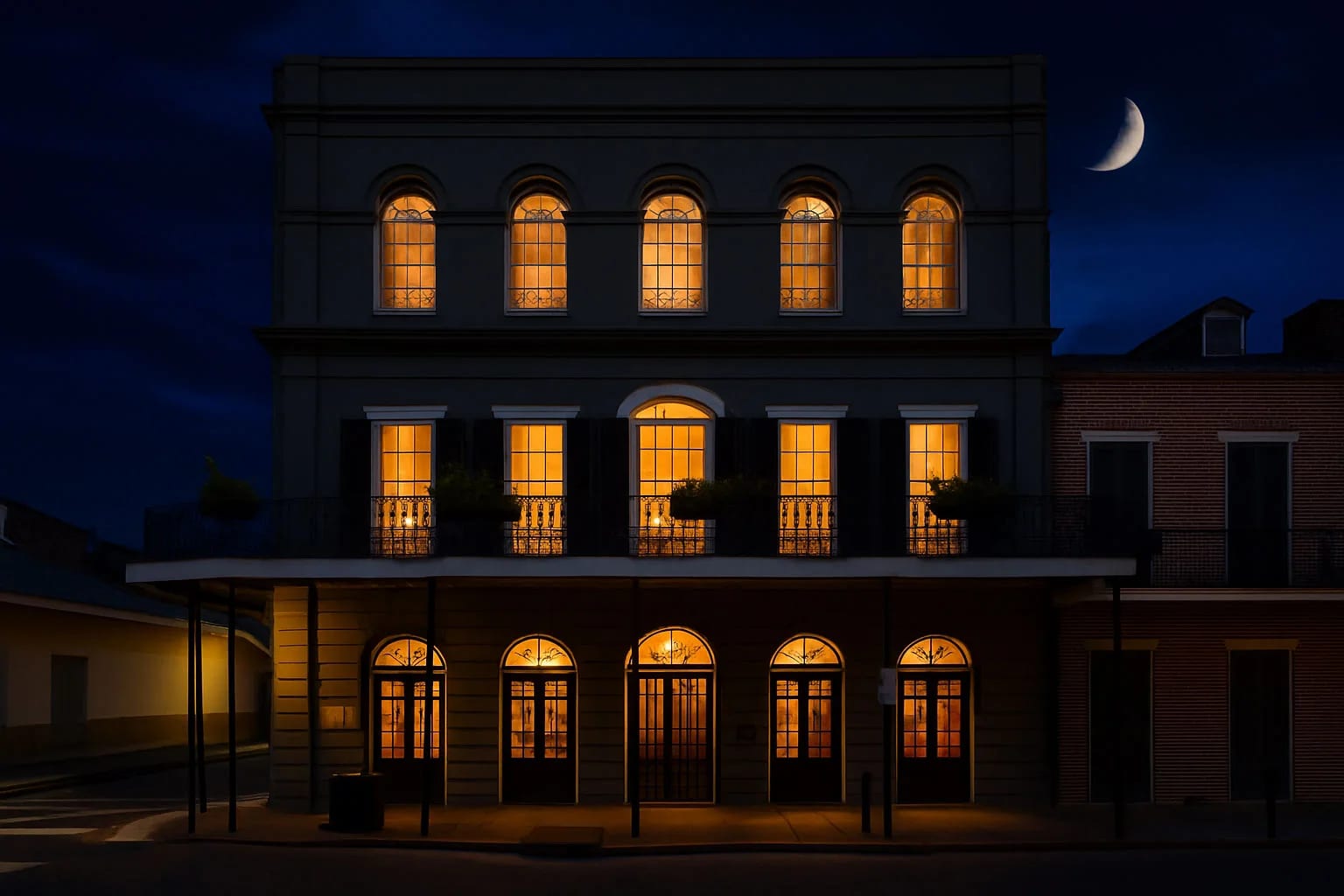
The legendary Old Absinthe House on Bourbon Street