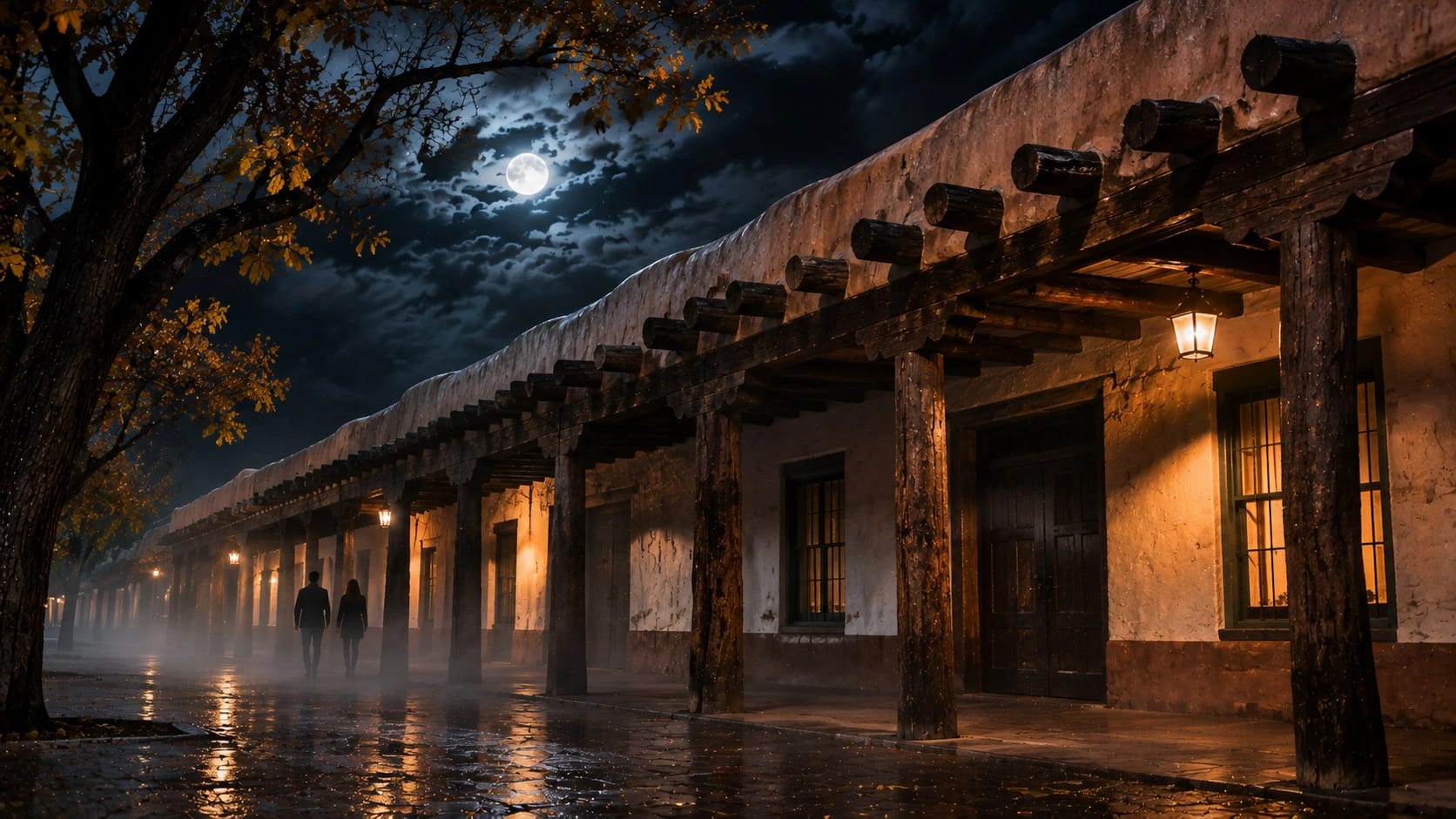
Haunted Santa Fe
Haunted Santa Fe
Discover why Santa Fe is considered haunted: more than four centuries as a capital, a revolt and reconquest, graves lost beneath the streets, and hotels with famous ghosts.
Santa Fe has been a capital for more than four hundred years, and a home to Pueblo peoples for far longer. Revolt and reconquest, war and epidemic all passed through its Plaza, and generations of its dead were buried in churchyards that later vanished beneath the streets. This is the history behind the City Different's ghost stories, and the legends still told in its oldest hotels and adobe walls.
- ghost tours
- 2
See it after dark
Ghost Tours in Santa Fe
The haunted places below are stops on Ghost City Tours' Santa Fe ghost tours — guided walks where our local storytellers bring this history to life after dark.
All Santa Fe ghost tours

Why Is Santa Fe So Haunted?
Discover the dark history and supernatural forces that make Santa Fe one of America's most haunted cities
Long before any Spanish settler arrived, Pueblo communities had lived along the rivers and mesas of northern New Mexico for generations. Juan de Oñate claimed the province for Spain in 1598, and Pedro de Peralta founded Santa Fe at the foot of the Sangre de Cristo Mountains around 1607, making it the provincial capital in 1610. The Palace of the Governors on the north side of the Plaza, begun under Peralta, may be the nation's oldest continuously occupied public building.
Colonial rule was hard on the Pueblo peoples, who endured forced labor and tribute and the suppression of their religion. On August 10, 1680, under the leadership of Popé, the Pueblos rose together. About 400 Spanish colonists and 21 Franciscan friars were killed, and the survivors were besieged in Santa Fe before retreating south to El Paso. For twelve years the Pueblo people governed from the Palace of the Governors itself.
Diego de Vargas returned in 1692 in what was long called a bloodless reconquest, but fighting broke out again in 1693, and 70 Pueblo warriors were executed after the battle for Santa Fe. Few public squares in America have seen as much as the Plaza: revolt and siege, reconquest and execution, all within sight of the same adobe walls that still stand today.
The centuries that followed brought one new flag after another. Mexico won its independence in 1821, and the Santa Fe Trail soon tied the town to Missouri traders. In 1846 General Stephen W. Kearny led the Army of the West into Santa Fe and claimed New Mexico for the United States. In March 1862 Confederate troops under Henry Sibley occupied the city for a few days before the Battle of Glorieta Pass turned them back, and in 1870 the government created the Santa Fe National Cemetery for the Union soldiers who died in the fighting.
The railroad reached Santa Fe in 1880 by a branch line from Lamy, the town was incorporated as a city in 1891, and when New Mexico became the 47th state in 1912, Santa Fe remained its capital. That same year the old United States Hotel on the Plaza burned down, and from its site rose the La Fonda that visitors know today. The Palace of the Governors, meanwhile, became the state history museum in 1909, a seat of power turned into a keeper of memory.
Santa Fe's oldest dead are closer than most visitors realize. The Historic Santa Fe Foundation notes that the first parish church, dedicated to St. Francis in 1610, and the parroquia that replaced it in 1714 served as the city's burial ground for well over two centuries. Some of the oldest Spanish colonial graves likely lie beneath the intersection of Palace and Washington avenues, under the floor of a vanished military chapel, and La Castrense, the chapel of Our Lady of Light, recorded burials from 1760 to 1859. Even the grave of Diego de Vargas himself has been lost.
As the city grew, churchyards were paved, chapels torn down and graves forgotten. Archaeologists working under the floor of the Santuario de Guadalupe in 1989 and 1990 found a large concentration of human remains, and construction crews near the Plaza still occasionally uncover burials no one knew were there. The people buried in those grounds, Indigenous and colonial alike, were real members of this community, many with descendants in New Mexico today. We talk about them as people, not props.
The most famous ghost in town belongs to La Fonda on the Plaza, on a corner that has hosted inns since the early 1600s. The current hotel opened in 1922, but in 1867, in the lobby of its predecessor, the Exchange Hotel, Chief Justice John P. Slough of the territorial supreme court was shot by legislator William Rynerson after a public quarrel; Slough died two days later, and Rynerson was acquitted. Guests and staff have reported a man in a long black coat walking the halls and vanishing into a stairwell. Others tell of a gambler said to have thrown himself into the courtyard well where La Plazuela restaurant now stands, and of a bride said to haunt Room 510.
A few blocks away, La Posada de Santa Fe grew around the brick mansion merchant Abraham Staab built in 1882 for his wife, Julia. After losing an infant child, Julia is said to have withdrawn to her room, and she died in 1896 at 52. Since the 1970s, guests and staff have reported a woman on the staircase and in her old second-floor suite. Across town, staff at the Inn and Spa at Loretto tell of Sister George, a nun who taught at Loretto Academy from 1953 to 1968; since the late 1970s, shop staff there have credited her with cigar smoke, flickering lights, a levitating clothing rack and an extra $10 bill that turned up in the cash drawer each morning. The Drury Plaza Hotel, once a hospital, has its own reports of slamming doors and crying children, while the so-called Oldest House on De Vargas Street, near San Miguel Chapel, has a darker reputation of its own.
Some of these stories have documentation behind them; others survive as legend and eyewitness claims passed down through families, hotel staff and guides. On our walks around the Plaza, our guides tell you which is which, and they tell these stories with respect for the Pueblo, Hispanic and religious traditions that are central to Santa Fe's identity. That is why Santa Fe feels haunted. It has been a capital under four flags, the scene of a revolution and its bloody aftermath, and the resting place of generations whose graves now lie under its streets. When the galleries close, the portal lanterns come on and the high desert air turns cold, it is easy to feel that the old city is still keeping company with its dead.
1610
Year Santa Fe became the capital
1680
Year of the Pueblo Revolt
1867
Chief Justice Slough shot in the Exchange Hotel
Santa Fe's Haunted Places: Coming Soon
We're writing up the story of each of Santa Fe's haunted places. Until then, the best way to meet them is on one of our ghost tours.
Ready to Explore Santa Fe's Dark Side?
Book your night on Santa Fe's newest ghost tours.
Why Book With Ghost City Tours?
Multiple Tour Options
Choose from family-friendly, adults-only, or pub crawl experiences.
Tours 7 Days a Week
Rain or shine, we run tours every single night of the year.
Money-Back Guarantee
Love your tour or get a full refund - that's our promise!
Book Your Ghost Tour Today
Book Online Now
SAVE TIME- Choose from all available tour times
- Instant email confirmation
- Secure, encrypted checkout
- 100% Money Back Guarantee
Prefer to Call?
Our Guest Services team is available 7 days a week to help you book the perfect tour.
CALL 855-999-04918 AM – 11:30 PM CT