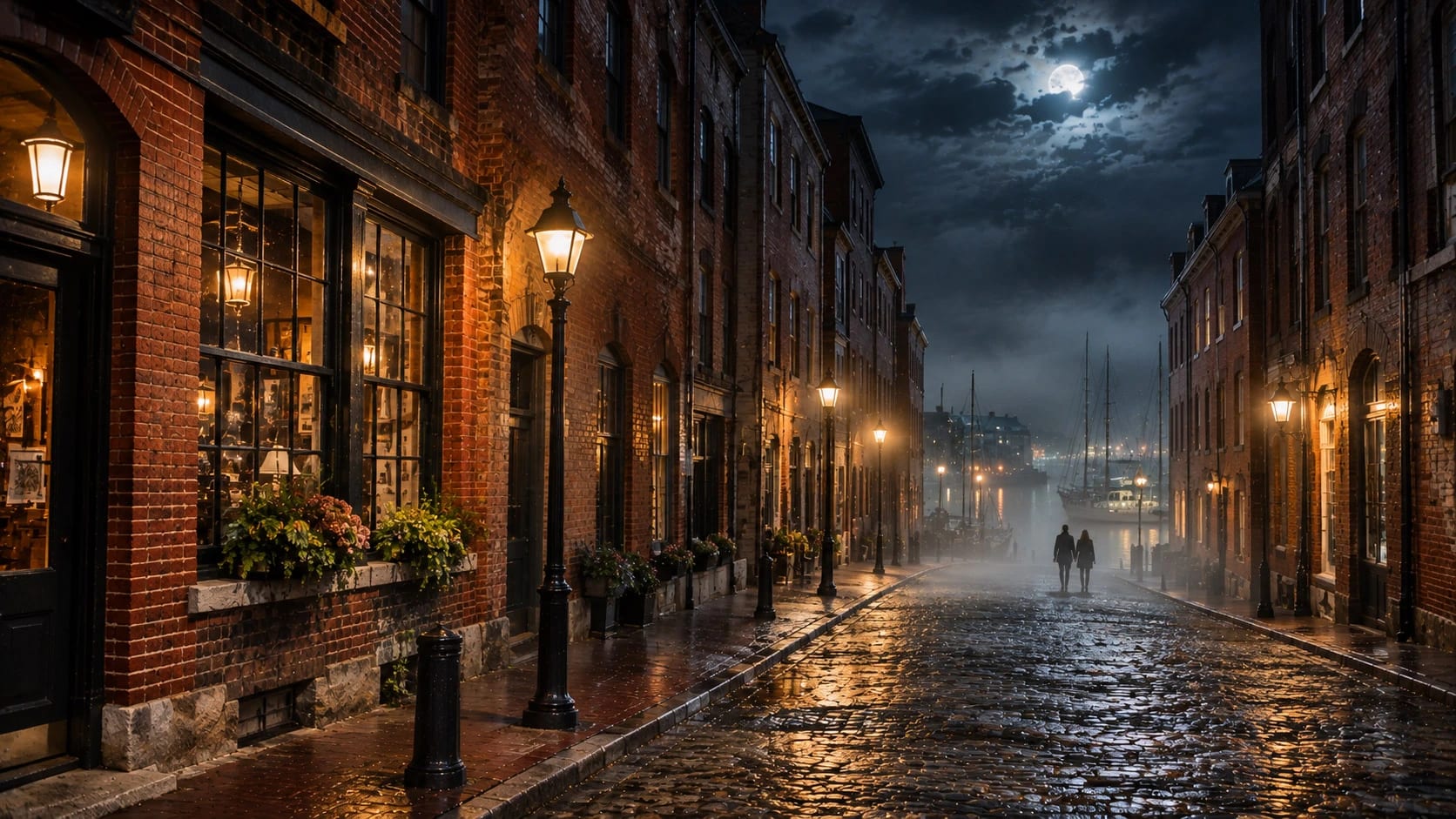
Explore Portland's Paranormal History
Haunted Portland, Maine
Why is Portland, Maine haunted? Explore the wars, fires, shipwrecks and local legends behind the ghost stories of New England's old seaport.
Portland, Maine has been burned to the ground more than once, and it has spent nearly four centuries sending ships out into the North Atlantic, not all of which came home. The city's motto, Resurgam, means “I will rise again,” and it has had to. This is the history behind Portland's ghost stories, from the cobblestones of the Old Port to the fog on Casco Bay, and why so many people believe the city is haunted.
Ghost Tours in Portland
The haunted places below are stops on Ghost City Tours' Portland ghost tours — guided walks where our local storytellers bring this history to life after dark.
Why Is Portland, Maine So Haunted?
Discover the dark history and supernatural forces that make Portland one of America's most haunted cities
Portland's first permanent settlement dates to 1633, when George Cleeve and Richard Tucker established a fishing and trading village on the neck of land jutting into Casco Bay. Life on the frontier was precarious. In 1676, during King Philip's War, the village was completely destroyed by the Abenaki. Colonists returned in 1678 and built Fort Loyal on what is now India Street, but in 1690 a combined force of 400 to 500 French and Native fighters destroyed the settlement again in the Battle of Falmouth. Twice in its first sixty years, the town that would become Portland was wiped off the map.
The Revolution brought a third destruction. On October 18, 1775, the British warship HMS Canceaux, under Lieutenant Henry Mowat, bombarded the town, then called Falmouth, for nine hours, and when it was over three-quarters of the town lay in ashes. The people rebuilt again, and in 1786 the community on Falmouth Neck became a separate town named Portland.
Through all of it, the town buried its dead on the same hillside. The Eastern Cemetery on Munjoy Hill dates to 1668 and is the city's oldest historic site. More than 4,000 marked graves stand there, with an estimated 3,000 more unmarked burials beneath the grass; an 1890 survey counted 4,189 individual markers, monuments and tombs. Among them lie Lieutenant William Burrows of the U.S. Navy and Commander Samuel Blyth of the Royal Navy, enemy captains killed when USS Enterprise fought and captured HMS Boxer off the Maine coast in 1813, buried side by side in Portland; Lieutenant Kervin Waters, mortally wounded in the same battle, was laid beside them two years later. The cemetery was largely closed to new graves by the 1850s. Its caretakers note that it is better known for its history than for hauntings, but ghost walks still tell of figures seen among the old slate stones after dark.
Portland's most famous disaster came on the Fourth of July, 1866. That afternoon, a fire accidentally ignited, probably by a firecracker or a cigar, on Commercial Street near the waterfront. It burned through the night and did not burn itself out until early on July 5. By then, 1,800 buildings were gone, 1,200 of them homes, and roughly 10,000 people had lost the roof over their heads. Most of the commercial district and half the city's churches were destroyed. The brick streets of today's Old Port were built in the years that followed, on the ashes of the town that burned.
The sea was the city's fortune and its graveyard. Construction on Portland Head Light began in 1787 at the direction of George Washington, and the lighthouse was first lit on January 10, 1791, at the entrance to the main shipping channel into Portland Harbor. But no light could protect every ship bound for Portland. On November 27, 1898, the passenger steamer Portland, named for the city that was her home port, sailed from Boston into the blizzard now remembered as the Portland Gale and was lost with everyone aboard. The only passenger list went down with the ship, so the toll will never be known exactly; modern estimates put the number aboard between 193 and 245. Nineteen men from Portland's Abyssinian Meeting House congregation were among them, a loss that hastened the congregation's decline. The wreck was located in 1989 and confirmed in 2002.
Casco Bay has its own ghost ship. The privateer Dash was built in 1813 at Porter's Landing in Freeport and captured 15 ships during the War of 1812 without losing a man. In January 1815, she sailed out of Portland Harbor racing the privateer Champlain, disappeared into an oncoming nor'easter and was never seen again. Ever since, fishermen have reported seeing her on foggy days, sails full in still air, near Pumpkin Nob, Crab Island and off Freeport, most often running up Harpswell Sound before vanishing. The poet John Greenleaf Whittier turned her legend into verse, and the ghost of the Dash was being discussed in Greater Portland ghost lore well into the twentieth century. The bay even has a sea serpent: a creature first reported in 1780 by Captain George Little of Boston, and seen again in 1958 by two fishermen who estimated it at 100 feet long. Locals have since nicknamed it “Cassie.”
On land, Portland's ghost stories cling to its old buildings. At the Time and Temperature Building on Congress Street, workers describe a red-haired woman who rides the elevators and walks the halls before vanishing; a security guard told Portland Magazine in 2007 that he once saw her cross the lobby and pass out through the exit doors without opening them. On State Street, local author Roxie Zwicker's book Haunted Portland recounts stories of a building said to be haunted by the patients of a doctor nicknamed “Dr. Death,” with footsteps in the basement and figures at the windows. And Victoria Mansion, completed in 1860 as a summer home for hotelier Ruggles Morse, is among the grand houses where visitors and staff have described footsteps and apparitions attributed to former residents.
That is why Portland is considered haunted: a town destroyed three times before it ever took the name Portland, burned again in 1866, and for nearly four centuries bound to a sea that took ships, crews and passengers and did not always give them back. On Ghosts of the Old Port, our family-friendly tour, and The Drowned Come Home, our adults-only walk through the city's darker history, our guides share the documented history and the local legends side by side, and always tell you which is which.
1633
First permanent settlement
1668
Eastern Cemetery's earliest burials
1,800
Buildings lost in the Great Fire of 1866
Portland's Haunted Places: Coming Soon
We're writing up the story of each of Portland's haunted places. Until then, the best way to meet them is on one of our ghost tours.
Ready to Explore Portland's Dark Side?
Don't miss out on the #1 rated ghost tour experience in Portland. Book your adventure today!
Why Book With Ghost City Tours?
Multiple Tour Options
Choose from family-friendly, adults-only, or pub crawl experiences.
Top-Rated Experience
From the world's #1 ghost tour company.
Tours 7 Days a Week
Rain or shine, we run tours every single night of the year.
Money-Back Guarantee
Love your tour or get a full refund - that's our promise!
Tours Sell Out Daily
Portland is a popular destination. Book now to guarantee your spot!
Book Your Ghost Tour Today
Book Online Now
SAVE TIME- Choose from all available tour times
- Instant email confirmation
- Secure, encrypted checkout
- 100% Money Back Guarantee
Prefer to Call?
Our Guest Services team is available 7 days a week to help you book the perfect tour.
CALL 855-999-04917am - 11:30pm Daily