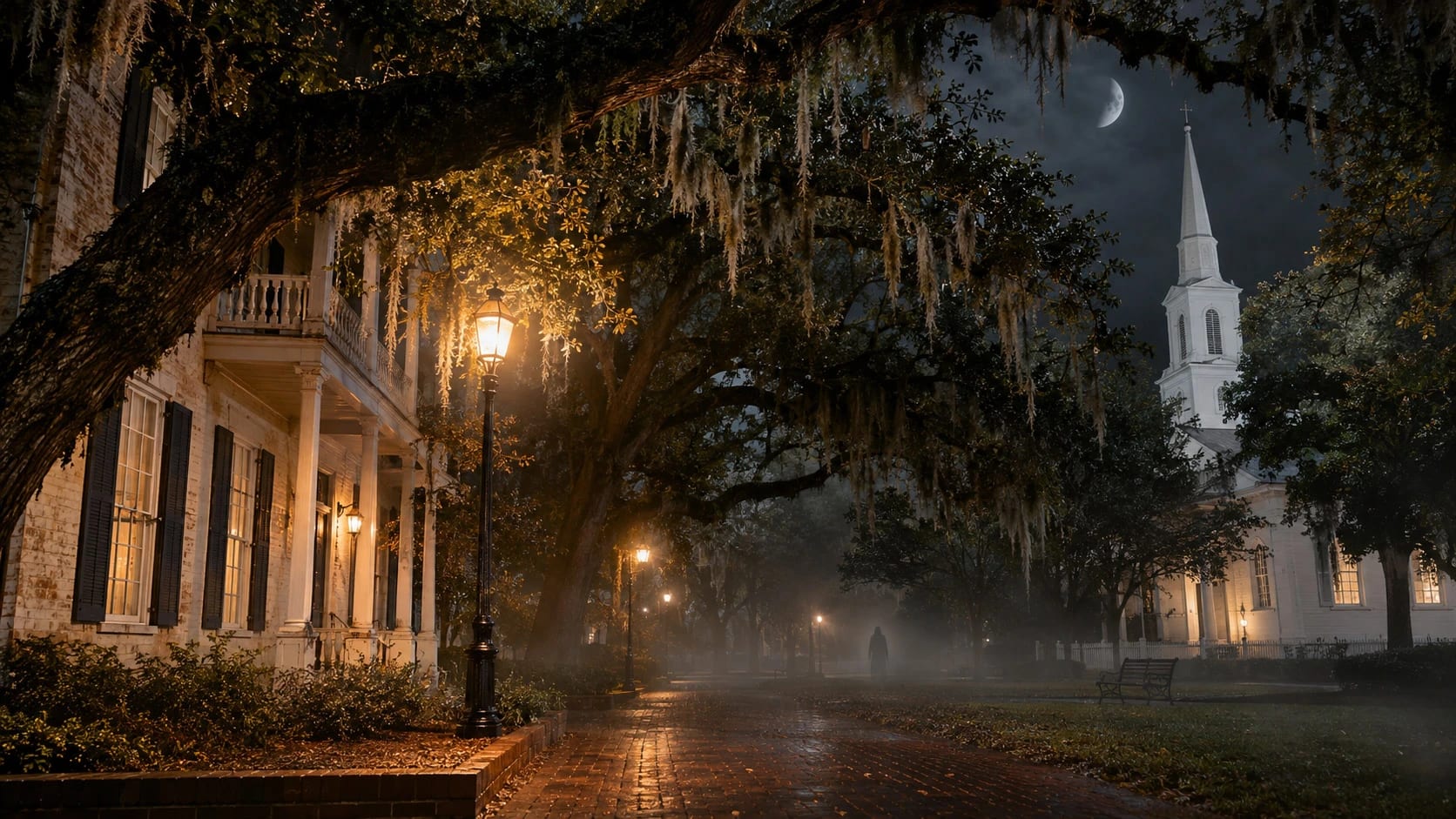
Explore Pensacola's Paranormal History
Haunted Pensacola: Ghost Stories, Legends, and Haunted Places
Pensacola's haunted places and ghost stories, and the history behind them: St. Michael's Cemetery, Seville Quarter, Old Christ Church, the old city jail, Sacred Heart Hospital, the Pensacola Lighthouse, and the forts at the mouth of the bay.
In May 1988, archaeologists from the University of West Florida dug beneath Old Christ Church on Seville Square, looking for three rectors who had been buried under the building in the nineteenth century. The congregation paid for the excavation because of a long-told story that Union soldiers had disturbed the graves while they used the church during the Civil War. The archaeologists found all three men, and they were reburied in cedar caskets. That's the documented part. The other part, told by a local guide years later, is that one of the students on the dig saw three barefoot men in robes standing together nearby. A great deal of haunted Pensacola works the same way: a real place, real people with names and dates, and a story that grew up beside them. This guide follows both, and keeps them apart.
The Haunted History of Pensacola
Discover the dark history and supernatural forces that make Pensacola one of America's most haunted cities
From Luna's Fleet to the American Flag
Pensacola's recorded history begins with a disaster. In August 1559, Tristán de Luna y Arellano brought eleven ships into Pensacola Bay from Veracruz, carrying about 1,500 soldiers, colonists, enslaved people, and Indigenous allies from central Mexico. About a month later a hurricane sank much of the fleet while it was still loaded with supplies. Most of the survivors left in April 1561, and the last few dozen soldiers were gone by the end of that year. The University of West Florida announced in December 2015 that it had found the settlement site, and UWF divers have located three of Luna's ships on the bay floor, the first in 1992, the second in 2006, and the third in 2016.
Spain tried again in 1698 with the Presidio Santa María de Galve. The French captured and burned it in 1719; the Spanish returned in 1722, moved to Santa Rosa Island, and in the 1750s came back across the water to the site of today's downtown. Britain took over in 1763 and made Pensacola the capital of West Florida. In 1781 Bernardo de Gálvez besieged the town for two months and won it back for Spain. Andrew Jackson marched in twice, in 1814 and 1818, and on July 17, 1821, he stood in what is now Plaza Ferdinand VII as Florida passed to the United States. Add the Confederacy, and Pensacola has lived under five flags, which is where the nickname comes from.
None of that makes a place haunted on its own. What it does mean is that Pensacola has an unusual number of surviving buildings, graves, and records connected to people who lived, fought, and died here, and those are what the city's ghost stories attach to.
The Most Haunted Places in Pensacola
These are the places Pensacola's ghost stories return to most often. For each one we've given the history first, then the stories, and who tells them. The two great historic cemeteries, St. Michael's and St. John's, have their own section below.
Seville Quarter
Seville Quarter, on Government Street, is a block of restaurants and bars built inside old commercial buildings. Bob Snow opened its first bar, Rosie O'Grady's, in 1967 in the former Pensacola Cigar and Tobacco Company building, and Lili Marlene's followed in 1971 in what had been the Pensacola Printing Company. Some of the timber and doors inside came from elsewhere: beams from the old Pensacola Beach Casino, and doors from the Ursuline Convent in New Orleans.
Seville Quarter calls itself Pensacola's oldest and most haunted restaurant, and it hosts ghost-story lunches. Its ghost has a name. Most accounts call him Wesley, a bartender, and say he plays with the lights and the hand dryers in the restrooms. The author Alan Brown identifies him as Wesley Gibbs, who tended bar there in the early 1990s. A local psychic told the Pensacola News Journal in 2022 that he died in a cooler, and customers have described distant voices and laughter. The details change depending on who's telling the story, which is often how you know a story is still being told.
Old Christ Church
Built between 1830 and 1832, Old Christ Church on Seville Square is one of the oldest church buildings in Florida. Union troops used it as a barracks and chapel during the Civil War. Later it served as a city library from 1937 to 1957, and it has been part of the UWF Historic Trust's Historic Pensacola Village since 1960.
Three of its rectors were buried beneath the original vestry: Joseph Saunders, who died of yellow fever in 1839, David Flower, who died of it in 1853, and Frederick Peake, who died of tuberculosis. The 1988 excavation that recovered them is described at the top of this page. The ghost story attached to it, the three robed men seen during the reburial, was told by the guide Beverly Stagg in VIE magazine and retold in Pensacola Magazine in 2025.
The Pensacola Museum of Art and the Old Jails
The Pensacola Museum of Art at 407 South Jefferson Street was built around 1906 as the city's first permanent jail, and it held prisoners until 1954. The Pensacola Art Association moved in after the jail closed, the building took the name Pensacola Museum of Art in 1982, and it became part of the University of West Florida in 2016. Visit Pensacola says visitors have experienced unexplained occurrences there, though we haven't found a specific story attached to the old cells.
Across the street, the Pensacola Cultural Center was built in 1911 as the Escambia County Building, with the county courts and jail. Hosea Poole was hanged there on July 31, 1920, the last execution carried out in the building. Staff have described a man in a worn suit sitting quietly in the building, and some have wondered whether it's Poole, though nothing connects the two beyond the guess.
Old Sacred Heart Hospital
The Daughters of Charity opened Pensacola Hospital on North 12th Avenue in September 1915, in a building designed by A. O. von Herbulis. Renamed Sacred Heart in the late 1940s, it served the city until the hospital moved north in 1965. The old building became a school, then was bought by a local group in 1980, listed on the National Register in 1982, and turned into offices, shops, and restaurants, including O'Zone Pizza Pub.
Visit Pensacola and Pensacola Magazine both report that guests and employees have described apparitions of nurses and patients, and Alan Brown tells of a Sister who still moves through the halls. One popular detail, the old basement morgue, is disputed: a representative of the building's owners told WEAR-TV in 2017 that the hospital never had a morgue.
The Saenger Theatre
The Saenger opened on Palafox Street in 1925, built partly from the bricks and fittings of the Pensacola Opera House, which the 1917 hurricane had wrecked. The city has owned it since 1976 and restored it in 2009. Alan Brown records an account from electricians with a touring show who watched the stage lights flash on their own. Voices heard in the balcony are often attributed to a worker killed in a boiler explosion in the basement. We haven't found a record of that death, so treat it as the theater's own story.
The Pensacola Lighthouse
Jeremiah Ingraham lit Pensacola's first lighthouse on December 20, 1824, and kept it until his death in 1840. His wife, Michaela, took over and kept the light into the 1850s. The present 160-foot tower, about half a mile west of the original, was first lit on January 1, 1859, by their son-in-law, Joseph Palmes.
The best-known legend says Michaela stabbed Jeremiah, and that he haunts the tower. The dates don't support it: no record says how Jeremiah died, and both Ingrahams were dead before the current tower existed. The lighthouse's reputation is real enough, though. Syfy's Ghost Hunters investigated it in 2009, and the lighthouse runs its own ghost hunts and after-hours investigations. It sits on Naval Air Station Pensacola, so check the current base access rules before you go.
Fort Barrancas
Fort Barrancas stands on the bluff above the bay where Spain, France, and Britain had all built forts before it; the Spanish water battery still survives below it. The U.S. Army finished the brick fort in 1844. On January 12, 1861, Florida and Alabama militia took it along with the navy yard, and Confederate troops held it until they abandoned Pensacola in May 1862. Ghost stories here come from local lore rather than the Park Service: a roundup in the Pensacola News Journal mentions apparitions of Confederate soldiers and moaning in the tunnels. The fort is part of Gulf Islands National Seashore but inside Naval Air Station Pensacola, so check access before you visit.
Fort Pickens
Construction began on Santa Rosa Island in 1829 and finished in 1834, and the National Park Service notes that enslaved men were among the builders. Union troops moved in on January 10, 1861, and held the fort for the entire war. On the night of October 9, 1861, Confederate troops crossed to the island and attacked the camp of the 6th New York Zouaves before being driven off. From 1886 to 1888 the Army imprisoned Geronimo and other Apache men here. Online accounts claim his spirit is seen near the fort at dusk. That's folklore, and it concerns a man who was a prisoner here against his will, so we tell it with that in mind.
Pensacola's Darkest History
Some of the hardest events in Pensacola's past never turned into ghost stories, and they don't need to. The 1781 siege ended in a single moment: on May 8, a Spanish shell fell into the powder magazine of the British Queen's Redoubt, and the explosion killed somewhere between 76 and about 100 men, depending on the source. Pensacola surrendered two days later.
Yellow fever was the city's most persistent killer. Epidemics came through the port again and again in the nineteenth century, including 1853, 1874, 1882, and 1905. In St. Michael's Cemetery, the Commyns tomb names the 1853 epidemic in its inscription, and two of Old Christ Church's three buried rectors died of the fever. Doctors didn't know mosquitoes carried it until 1900, and fear of it shaped the town; in 1888 the Apache prisoners were moved away from Fort Pickens because of a yellow fever scare.
The Civil War emptied Pensacola. Union troops held Fort Pickens across the bay, the two sides shelled each other in November 1861, and in May 1862 the Confederates abandoned the town. Storms took their turn too. The 1906 hurricane pushed an eleven-foot storm tide into Pensacola, and the 1917 hurricane wrecked the opera house whose bricks went into the Saenger. And on July 31, 1920, Hosea Poole was hanged in the county building on Jefferson Street. Each of these is part of the record. Only some of them have ghost stories, and we don't attach one where nobody tells it.
Ghost Stories and Legends of Pensacola
Some of Pensacola's stories don't belong to one famous building. The oldest written one we know of appeared in the Pensacola News in 1892. Under the headline "A Haunted Truck House," the paper reported that night watchmen at the Germania fire company's house, today Quayside Art Gallery, had seen a blue light and a white figure, and some of them suspected it was Jeff Lowe, a man who had been hanged years before.
The old town has quieter stories too. Folklore collected by the Pensacola Historical Society tells of a headless woman on Romana Street, said to have been killed in the 1820s, with similar figures reported along Government Street and Lady's Walk. At the Lear-Rocheblave House, where the tugboat captain Benito Rocheblave raised five daughters around the turn of the twentieth century, a painter working on the house said he saw a young woman dancing behind a locked upstairs window and then smelled a sweet perfume; Historical Society staff passed the story to VIE magazine. At the Arbona Building on Zaragoza Street, Wendi Davis of the Historical Society said she heard an unfamiliar male voice whisper her name late one night. And at the Gray House on South Alcaniz Street, now an architecture office, the architects working there have described footsteps, chairs that move, and a figure they connect to a Spanish sea captain.
Then there's the lighthouse legend of Michaela Ingraham, the keeper's widow accused by local lore of killing her husband. It's the most repeated story in Pensacola, and the one the records do the most to undercut. We tell it anyway, because it's part of the city's folklore, and we tell you what the dates say.
Haunted Cemeteries of Pensacola
St. Michael's Cemetery
St. Michael's, at 6 North Alcaniz Street, was being used for burials in the second half of the eighteenth century. King Charles IV of Spain officially designated it a cemetery in 1807, Vicente Pintado platted it in 1810, and its oldest surviving marker dates from 1812. It once covered about 25 acres; about 8 remain. Roughly 3,200 graves are marked, and the St. Michael's Cemetery Foundation says there may be several thousand unmarked graves. A University of West Florida ground-penetrating survey found 3,915 subsurface anomalies.
The people buried there tell Pensacola's history by themselves: Stephen R. Mallory, U.S. senator and then Confederate Secretary of the Navy; Don Francisco Moreno, Spanish vice consul and father of twenty-seven children; Dorothy Walton, widow of George Walton, a Georgia signer of the Declaration of Independence; and Dr. Eugenio Sierra, who died in 1849 at 99. The Pensacola News Journal and Visit Pensacola both mention reports of strange lights and voices in the cemetery. Some of the older stories, collected by Alan Brown and by the Pensacola Historical Society, are explanations as much as hauntings: an eerie green glow that turned out to be the neon sign of the San Carlos Hotel, a grieving grocer who slept on his family's graves and was taken for a ghost, and a white apparition that police discovered was an albino fox. The cemetery is open daily from 9 to 5.
St. John's Cemetery
Escambia Lodge No. 15 of the Freemasons founded St. John's in 1876 on 26 acres, and the state historical marker notes that it was open to everyone regardless of religion, race, or class. Its first burial was Martha Eleanor Screven Frierson, in 1876, and the gatehouse dates from 1908. Morris Slater, the train robber and folk figure known as Railroad Bill, was shot dead in Atmore, Alabama, on March 7, 1896, and buried here in an unmarked pauper's grave; years later his biographer, Larry Massey, paid for a headstone. The Pensacola News Journal has reported stories of children's spirits and of Railroad Bill himself in the cemetery, and there's a local superstition that touching the Mollie McCoy marker brings luck in love.
Both cemeteries are still burial grounds. Visit in daylight, keep to the paths, and leave the graves as you found them.
Haunted Downtown Pensacola
Downtown is where Pensacola's history is easiest to see. Seville Square sits at the heart of the colonial town, and the streets around it still carry Spanish names: Zaragoza, Alcaniz, Romana, Intendencia. Around the square, the UWF Historic Trust's Historic Pensacola Village preserves houses from across the city's history, including the Barkley House, built between about 1825 and 1835 and described on its historical marker as the oldest masonry building in Pensacola, and the Dorr House, built in 1871 for Clara Barkley Dorr.
A few blocks west, Plaza Ferdinand VII marks the spot where Florida became American in 1821, and Palafox Street runs north past the Saenger and the old commercial blocks toward the site of the San Carlos Hotel, the "Gray Lady of Palafox," which stood from 1910 until it was demolished in 1993. Every October the Historic Trust runs its own Haunted Happenings season, with ghost stories told inside Old Christ Church, the Dorr House, the Lear-Rocheblave House, and the Arbona Building, and a Victorian séance at the Barkley House. When the people who look after a city's historic buildings tell ghost stories in them, it says something about how much those stories belong to the place.
Explore Pensacola's Haunted History With Ghost City Tours
Reading about Seville Square is one thing. Standing in it after dark, with an Ambassador telling you who lived in the houses around you and what people have reported since, is something else. Ghost City Tours runs two walking ghost tours in Pensacola. The Ghosts of Pensacola Tour is our family-friendly introduction to the city's ghost stories and haunted history, and Pensacola's Darkest Secrets is an adults-only tour into the more disturbing parts of the record. You'll find both on our Pensacola ghost tours page.
Frequently Asked Questions About Haunted Pensacola
What are the most haunted places in Pensacola?
The places that come up most often are St. Michael's Cemetery, Seville Quarter, Old Christ Church, the Pensacola Lighthouse, Old Sacred Heart Hospital, the Saenger Theatre, St. John's Cemetery, and Fort Barrancas. Each has a documented history, and each has ghost stories told by the people who work there, local writers, or paranormal investigators.
Is downtown Pensacola haunted?
Downtown has the highest concentration of Pensacola's ghost stories, from Seville Quarter and Old Christ Church to the Arbona Building, the Lear-Rocheblave House, and the Saenger. The UWF Historic Trust even tells ghost stories in its own historic houses each October. Whether it's haunted is for you to decide.
What is the history of St. Michael's Cemetery?
Burials began there in the eighteenth century, Spain officially designated it a cemetery in 1807, and its oldest surviving marker is from 1812. It has about 3,200 marked graves and possibly thousands of unmarked ones, including Stephen R. Mallory and Dorothy Walton.
Are there haunted forts in Pensacola?
Fort Barrancas and Fort Pickens both have ghost stories, mostly local lore about Civil War soldiers, and at Fort Pickens, stories about Geronimo, who was imprisoned there from 1886 to 1888. Fort Barrancas is inside Naval Air Station Pensacola, so check base access before you go.
Does Pensacola have haunted hotels?
Not many with a well-documented story. The Pensacola News Journal has reported accounts from the Pensacola Victorian Bed and Breakfast, including music, children's laughter, and a woman in a long gown. The San Carlos Hotel, the city's grand hotel for most of the twentieth century, was demolished in 1993.
What ghost stories are associated with Seville Quarter?
The main one is Wesley, a bartender said to play with the lights and hand dryers in the restrooms. The author Alan Brown names him Wesley Gibbs, and customers have reported distant voices and laughter. Seville Quarter calls itself Pensacola's most haunted restaurant.
Can you take a ghost tour in Pensacola?
Yes. Ghost City Tours runs The Ghosts of Pensacola Tour, which is family-friendly, and Pensacola's Darkest Secrets, which is for adults only. Both are walking tours through historic Pensacola. See our Pensacola ghost tours page for details.
1559
A hurricane wrecks Tristán de Luna's fleet in Pensacola Bay
1781
Gálvez's siege and the Queen's Redoubt explosion
1821
Florida passes to the United States in Plaza Ferdinand VII
Pensacola's Haunted Places: Coming Soon
We're writing up the story of each of Pensacola's haunted places. Until then, the best way to meet them is on one of our ghost tours.
Ready to Explore Pensacola's Dark Side?
Don't miss out on the #1 rated ghost tour experience in Pensacola. Book your adventure today!
Why Book With Ghost City Tours?
Multiple Tour Options
Choose from family-friendly, adults-only, or pub crawl experiences.
Top-Rated Experience
From the world's #1 ghost tour company.
Tours 7 Days a Week
Rain or shine, we run tours every single night of the year.
Money-Back Guarantee
Love your tour or get a full refund - that's our promise!
Tours Sell Out Daily
Pensacola is a popular destination. Book now to guarantee your spot!
Book Your Ghost Tour Today
Book Online Now
SAVE TIME- Choose from all available tour times
- Instant email confirmation
- Secure, encrypted checkout
- 100% Money Back Guarantee
Prefer to Call?
Our Guest Services team is available 7 days a week to help you book the perfect tour.
CALL 855-999-04917am - 11:30pm Daily