Haunted Mobile
Haunted Mobile
Why Mobile, Alabama is considered one of the most haunted cities on the Gulf Coast: more than three centuries of epidemics, war, Carnival, mourning, and local legend.
Mobile has been collecting stories since 1702. Over more than three centuries, Alabama's oldest city has lived under four flags and endured epidemics, fires, war, and the legacy of slavery, while celebrating Carnival longer than almost anywhere in America. Here is why so many people believe some of Mobile's past still walks its streets after dark.
- ghost tours
- 2
See it after dark
Ghost Tours in Mobile
The haunted places below are stops on Ghost City Tours' Mobile ghost tours — guided walks where our local storytellers bring this history to life after dark.
All Mobile ghost tours

Why Is Mobile So Haunted?
Discover the dark history and supernatural forces that make Mobile one of America's most haunted cities
Mobile's story begins in 1702, when the French brothers Pierre Le Moyne d'Iberville and Jean-Baptiste Le Moyne de Bienville founded a settlement on the Mobile River to secure France's claim to Louisiana. For its first years, Mobile served as the capital of French Louisiana. Floods and disease plagued the first colonists, and in 1711 Bienville ordered the settlement moved downriver to the site of the present city. The original site was abandoned. From the very beginning, Mobile was a place where life on the Gulf Coast came with real danger.
Over the next century, the city changed hands again and again. Britain took Mobile in 1763 under the Treaty of Paris and renamed Fort Condé as Fort Charlotte. Spanish forces under Bernardo de Gálvez captured the city in 1780, and in 1813, during the War of 1812, American troops under General James Wilkinson seized it for the United States. French, British, Spanish, and American rule each left their mark on Mobile's streets, its churches, its burial grounds, and its traditions. The city grew into a major port, and cotton became its most profitable export, bringing wealth to some and immense suffering to the enslaved people whose labor produced it.
The port also brought disease. Yellow fever returned to Mobile again and again in the 1800s. In 1819, the epidemic killed approximately 430 people out of a population of about 1,000, and the city established Church Street Graveyard that year to bury many of the dead. Another epidemic in 1839 killed about 450 people along the Alabama coast, and civic-minded residents formed the Can't Get Away Club to care for the sick and bury those who could not afford it. The worst came in 1853, when yellow fever arrived with passengers from New Orleans and killed 1,191 people in Mobile. Death was a constant companion in the city's homes, and mourning became part of everyday life.
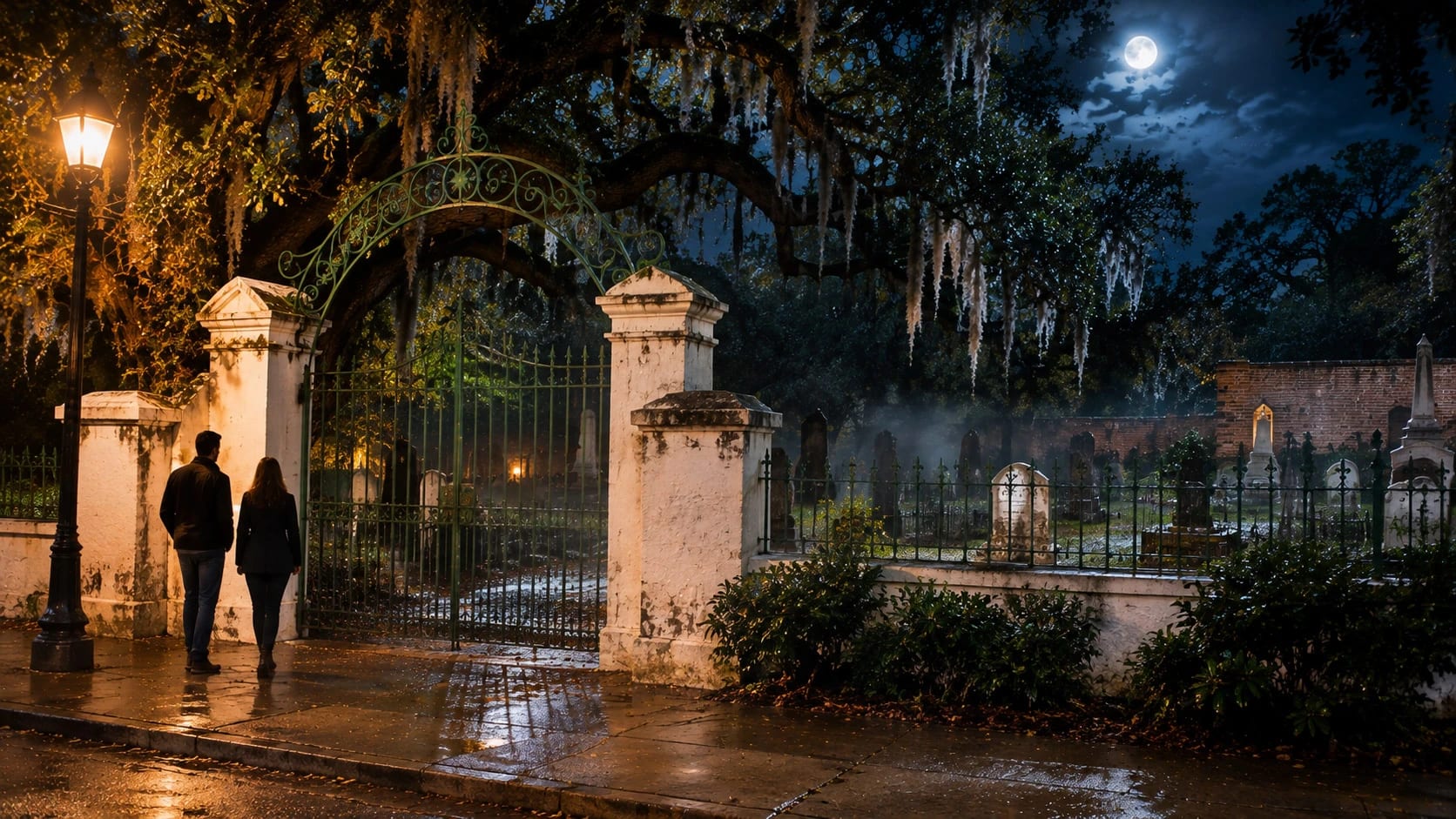
Church Street Graveyard remains one of the most atmospheric places in downtown Mobile. It closed to most burials in 1898, but its old tombs still hold early settlers, soldiers, and some of the city's most colorful characters, including Joe Cain. Just outside its walls grows the Boyington Oak. Charles Boyington was convicted of murdering Nathaniel Frost and is reportedly buried beneath the tree. According to local legend, Boyington insisted he was innocent and predicted that an oak would grow from his grave to prove it. An oak did grow there, and visitors still report strange sounds coming from its branches.
The Civil War brought Mobile its own share of tragedy. On August 5, 1864, Union forces won control of Mobile Bay, and the city surrendered on April 12, 1865, three days after Lee's surrender at Appomattox. But the worst came after the war had effectively ended. On May 25, 1865, a federal ammunition depot holding some 200 tons of ordnance exploded on the waterfront, killing about 300 people and devastating the docks. It was one of the deadliest disasters in the city's history, and it slowed Mobile's recovery for years.
Mobile's history also includes one of the darkest chapters in American history. In July 1860, decades after the international slave trade was outlawed, the schooner Clotilda arrived secretly in Mobile Bay carrying 110 African captives. The voyage was backed by Timothy Meaher, a wealthy Mobile shipyard owner, and the ship was burned and sunk afterward to destroy the evidence. After the Civil War, Cudjo Lewis and 31 other survivors founded Africatown just north of Mobile, a community that preserved West African traditions for decades. In 2019, the Alabama Historical Commission announced that the wreck of the Clotilda had been found. It is a history we tell with the seriousness it deserves.
Through all of it, Mobile celebrated. French Creole Carnival celebrations here date back to the first decade of the 1700s, and in 1830 Mobile hosted the first organized Carnival mystic society parade in the United States. After the Civil War, Joseph Stillwell Cain, a Civil War veteran, helped revive Mardi Gras with a parade the year after the war ended. Today, a group known as Cain's Merry Widows gathers in black mourning clothes each Carnival season to grieve theatrically for him. In Mobile, celebration and mourning have always lived side by side, and that is part of what gives its ghost stories their unusual character.
Many of the city's legends belong to its historic buildings. The Battle House Hotel first opened in 1852 on the site of Andrew Jackson's War of 1812 headquarters, burned in 1905, was rebuilt in 1908, sat empty for some 30 years after closing in 1974, and reopened in 2007. Guests and staff report faucets and lights turning on and off by themselves, and some tell of a woman in white said to be a heartbroken bride. At Oakleigh, the historic house built by James Roper, guests describe a female ghost in the parlor and shadowy figures throughout the home. At the Bragg-Mitchell Mansion, the best-known story is of the lady of the house and her phantom cat. The Malaga Inn is known for a woman in white pacing its balcony, and guests at the historic Fort Condé Inn tell of clawing sounds near the floor and furniture that moves on its own.
These stories are part of Mobile's living folklore, passed between residents, innkeepers, and visitors for generations. On our family-friendly Ghosts of Mobile tour and our adults-only Mourning Masquerade, guides explore the real history of the city, from its colonial founding to its epidemics, wars, and Carnival traditions, alongside the legends that have grown up around it. Some accounts are supported by historical records. Others belong to the world of folklore and unexplained experiences. You don't need to believe in ghosts to come away seeing Mobile differently.
1702
Year Mobile Was Founded
1,191
Yellow Fever Deaths in 1853
1830
First Carnival Mystic Society Parade in the U.S.
Mobile's Haunted Places: Coming Soon
We're writing up the story of each of Mobile's haunted places. Until then, the best way to meet them is on one of our ghost tours.
Ready to Explore Mobile's Dark Side?
Book your night on Mobile's newest ghost tours.
Why Book With Ghost City Tours?
Multiple Tour Options
Choose from family-friendly, adults-only, or pub crawl experiences.
Tours 7 Days a Week
Rain or shine, we run tours every single night of the year.
Money-Back Guarantee
Love your tour or get a full refund - that's our promise!
Book Your Ghost Tour Today
Book Online Now
SAVE TIME- Choose from all available tour times
- Instant email confirmation
- Secure, encrypted checkout
- 100% Money Back Guarantee
Prefer to Call?
Our Guest Services team is available 7 days a week to help you book the perfect tour.
CALL 855-999-04918 AM – 11:30 PM CT