Explore Memphis's Paranormal History
Haunted Memphis
Why is Memphis haunted? Explore the epidemics, war, river disasters and local legends behind the ghost stories of Tennessee's Bluff City.
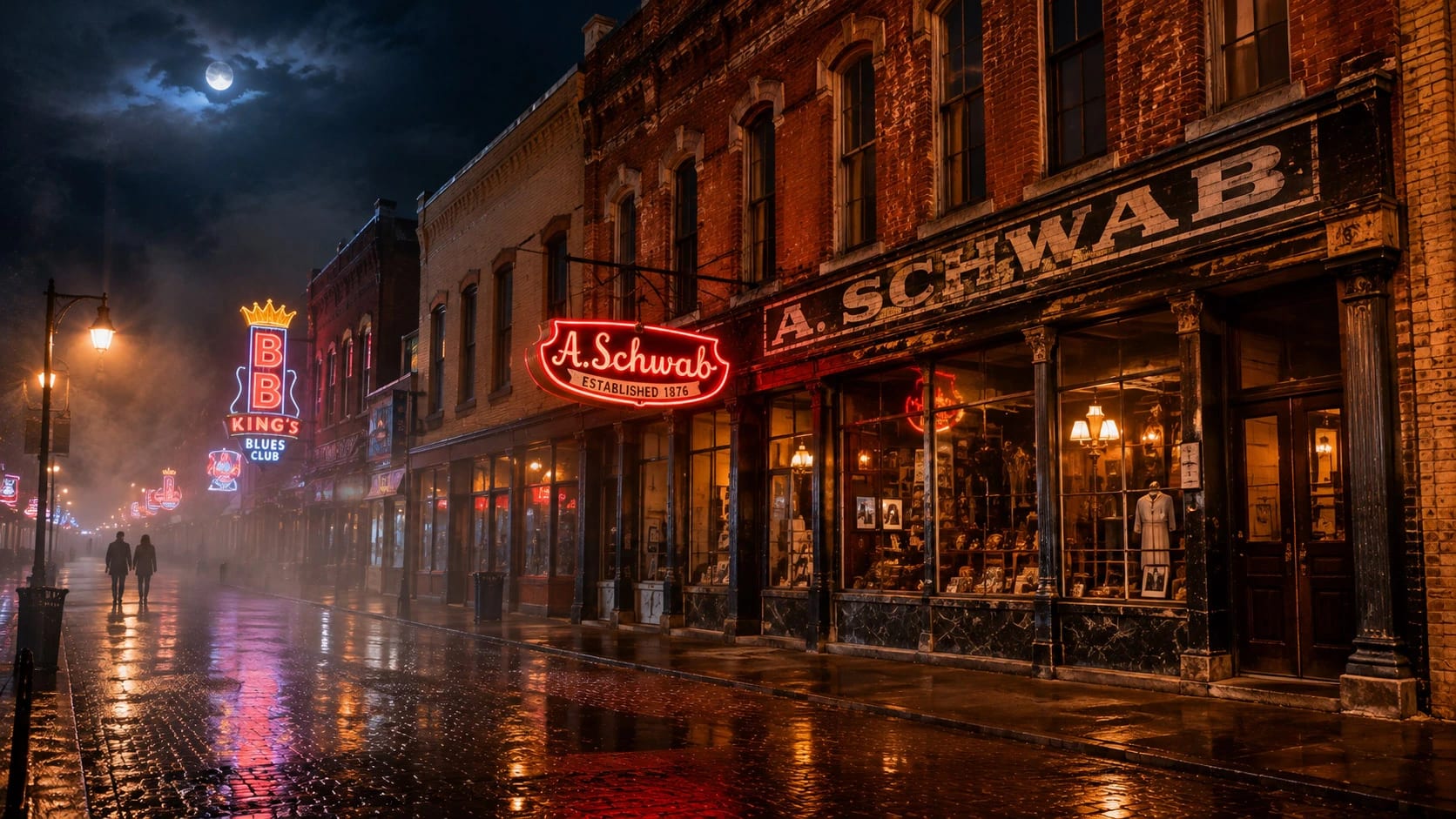
Memphis is famous for what happens after dark: neon on old brick, music spilling out of Beale Street clubs, and crowds that never seem to go home. But the Bluff City has a second nighttime reputation, built on epidemic, war, river disaster and a handful of old buildings where staff and visitors say the show never quite ends. Here is the history behind the city's ghost stories, and why so many people believe Memphis is haunted.
Ghost Tours in Memphis
The haunted places below are stops on Ghost City Tours' Memphis ghost tours — guided walks where our local storytellers bring this history to life after dark.
Why Is Memphis So Haunted?
Discover the dark history and supernatural forces that make Memphis one of America's most haunted cities
Memphis was founded on May 22, 1819, by John Overton, James Winchester and Andrew Jackson, on the Chickasaw Bluffs high above the Mississippi River, land the Chickasaw people had controlled for generations. Incorporated as a city in 1826, it grew into a hub of river trade and commerce, a place where fortunes were made on the water and where travelers, gamblers, laborers and musicians all passed through. From its first decades, Memphis was a city of arrivals and departures, and not everyone who arrived ever left.
The Civil War came quickly. Tennessee seceded in June 1861, and on June 6, 1862, Union forces captured Memphis at the First Battle of Memphis and held it for most of the war. The occupied city became a refuge: its Black population grew from about 3,000 before the war to roughly 20,000 by 1865, as people who had escaped slavery made their way to the river city. Then, in the war's final weeks, the river delivered one of its worst tragedies. Before dawn on April 27, 1865, the boilers of the overcrowded steamboat Sultana exploded about seven miles north of Memphis. The most recent research puts the dead at 1,164, most of them Union soldiers heading home. Memphis hospitals treated hundreds of survivors, and the soldiers who died were first buried at the Fort Pickering cemetery before being moved to the Memphis National Cemetery in 1866.
Peace brought violence of its own. From May 1 to 3, 1866, white mobs attacked Black residents, soldiers and their families in what became known as the Memphis riots, or the Memphis Massacre. Forty-six Black people were killed and dozens more injured, and 91 homes and four Black churches were burned along with several schools. It is one of the most painful chapters in the city's history, and the grounds of the old Marine Hospital, which stood on part of Civil War-era Fort Pickering, are among the places where local accounts of hauntings are told alongside that history.
Nothing shaped haunted Memphis more than yellow fever. An 1873 epidemic killed about 2,000 people, the highest toll of any inland city. Five years later came catastrophe. Yellow fever was diagnosed in Memphis on August 5, 1878, and within two weeks more than 25,000 people fled. Of the roughly 19,000 who stayed, about 17,000 fell ill and more than 5,000 died. Another outbreak followed in 1879. The city was bankrupt and depopulated, and it lost its charter that year; the state governed Memphis as a Taxing District until it regained home rule in 1893. With most of the city gone and most of those who stayed falling ill, the people who nursed the sick often died alongside them.
Many of those victims rest at Elmwood Cemetery, established in 1852 as one of the first rural cemeteries in the South. Some 2,500 yellow fever victims are buried in four public lots there, among them doctors, ministers, nuns and the women of the city's brothels who stayed to care for the dying, including the madam Annie Cook, who died in 1878. About 1,000 Confederate soldiers and veterans lie in Elmwood's Confederate Soldiers Rest. More than any single building, the cemetery is where the scale of the city's losses becomes real.
Memphis also carries a history that is remembered, not told as a ghost story. On April 4, 1968, Dr. Martin Luther King Jr. was assassinated at the Lorraine Motel, the day after his “I've Been to the Mountaintop” speech at Mason Temple. Our guides treat that chapter, and the long struggle against segregation in the city, as the serious history it is.
The best-known ghost in Memphis may be Mary of the Orpheum Theatre, at the corner of Beale and South Main. The site was once home to the Grand Opera House, which was destroyed by fire in the early 1920s; the current theater has stood there since 1928. Witnesses have long described a young girl of about twelve in a white dress, with long dark braids, seen in the balcony or running through the building. Accounts of how she died differ: some say she was struck outside the theater, others that she fell or was lost in the fire. Visitors report cold spots in the balcony, unexplained laughter and props that turn up where nobody left them. Some accounts say the theater is home to other spirits as well, but Mary is the one Memphis remembers.
Down the street at 531 South Main, Earnestine & Hazel's is one of the city's most storied bars. The building has reportedly been a church, a store, a beauty salon, a café and, upstairs, a brothel with a notorious reputation, before becoming the bar it is today. Patrons describe unexplained footsteps and noises on the second floor where the old rooms remain, and the bar's jukebox has a reputation for choosing its own songs, often with eerily appropriate timing. Across town in the Victorian Village, the Woodruff-Fontaine House museum is linked to Mollie Woodruff, who lost a stillborn daughter and her first husband there in the 1870s; staff and visitors describe slamming doors, footsteps and a woman seen pacing her old second-floor bedroom. Local lore around the 1830s Hunt-Phelan estate even tells of Nathan Wilson, who is said to have guarded the family's valuables during an 1873 fever outbreak and died before he could return them.
Put together, that is why Memphis is considered haunted: a river city that endured war, massacre, a steamboat disaster and three yellow fever epidemics in less than two decades, and then filled its old theaters, clubs and Victorian homes with music and stories. On After the Last Note, our family-friendly tour, The Devil's Encore, our adults-only walk through the city's darker history, and the Memphis Haunted Pub Crawl, our guides share the documented history and the local legends side by side, and always tell you which is which.
1819
Year Memphis was founded
5,000+
Yellow fever deaths in 1878
1852
Elmwood Cemetery established
Memphis's Haunted Places: Coming Soon
We're writing up the story of each of Memphis's haunted places. Until then, the best way to meet them is on one of our ghost tours.
Ready to Explore Memphis's Dark Side?
Don't miss out on the #1 rated ghost tour experience in Memphis. Book your adventure today!
Why Book With Ghost City Tours?
Multiple Tour Options
Choose from family-friendly, adults-only, or pub crawl experiences.
Top-Rated Experience
From the world's #1 ghost tour company.
Tours 7 Days a Week
Rain or shine, we run tours every single night of the year.
Money-Back Guarantee
Love your tour or get a full refund - that's our promise!
Tours Sell Out Daily
Memphis is a popular destination. Book now to guarantee your spot!
Book Your Ghost Tour Today
Book Online Now
SAVE TIME- Choose from all available tour times
- Instant email confirmation
- Secure, encrypted checkout
- 100% Money Back Guarantee
Prefer to Call?
Our Guest Services team is available 7 days a week to help you book the perfect tour.
CALL 855-999-04917am - 11:30pm Daily