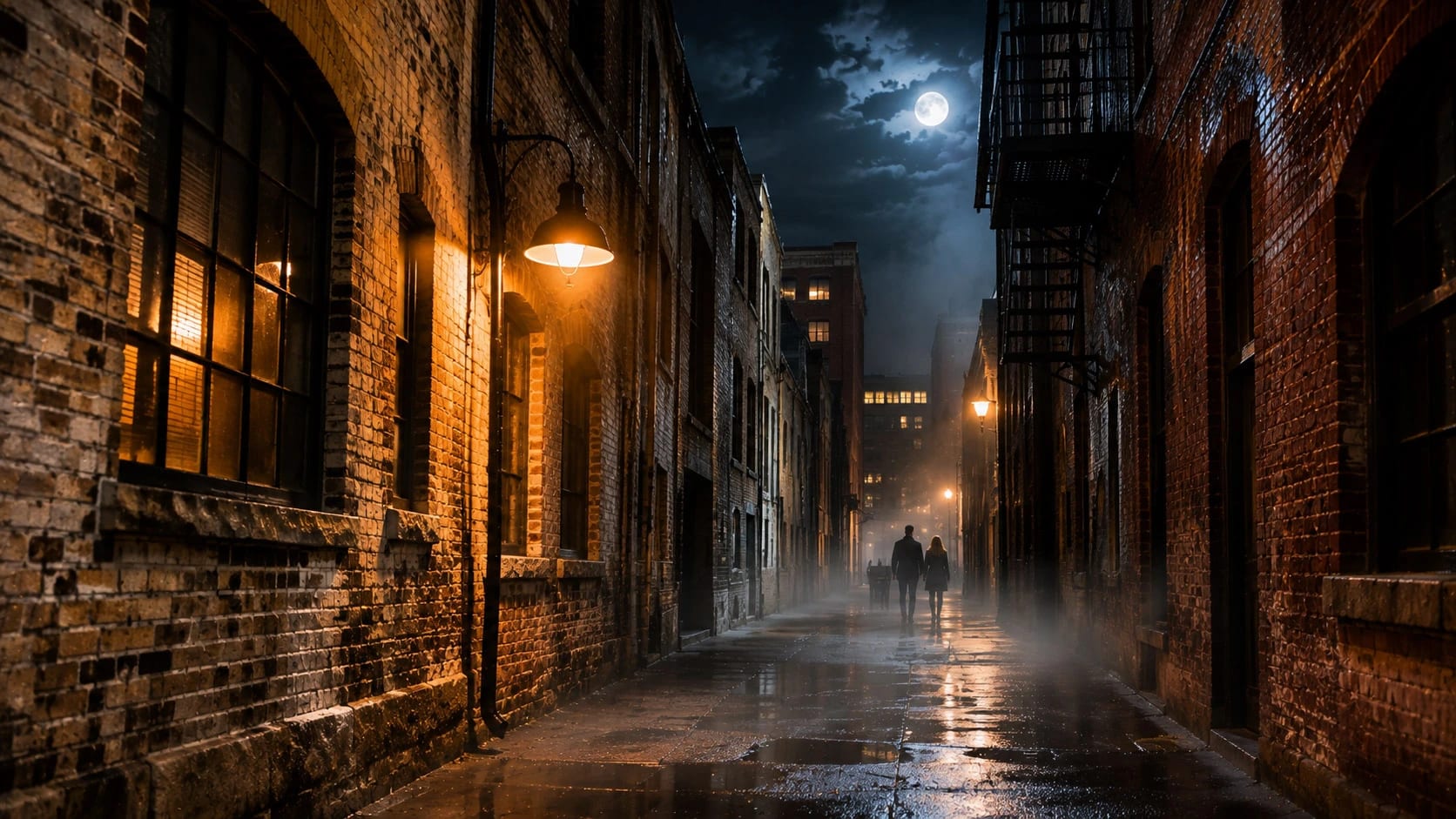
Explore Milwaukee's Paranormal History
Haunted Milwaukee
Why is Milwaukee haunted? Explore the lake disaster, deadly fires and Gilded Age landmarks behind the ghost stories of the Cream City.
Milwaukee grew from three quarreling river towns into one of the great cities of the Midwest, and it paid for that growth in fire and loss. A lake disaster, the deadliest hotel fire in the city's history and a blaze that swept away an entire neighborhood left their mark on the Cream City, and some of its grandest landmarks have reputations to match. This is the history behind Milwaukee's ghost stories, and why so many people believe the city is haunted.
Ghost Tours in Milwaukee
The haunted places below are stops on Ghost City Tours' Milwaukee ghost tours — guided walks where our local storytellers bring this history to life after dark.
Why Is Milwaukee So Haunted?
Discover the dark history and supernatural forces that make Milwaukee one of America's most haunted cities
Long before there was a city, the land where the Milwaukee, Menomonee and Kinnickinnic rivers meet Lake Michigan was home to the Menominee, Potawatomi, Ho-Chunk, Sauk, Meskwaki and Ojibwe. The name Milwaukee likely comes from an Algonquian word for a good or pleasant land, or a gathering place by the water. Fur traders followed, and Solomon Juneau arrived in 1818. By the 1830s three rival settlements had grown up along the river: Juneau's Juneautown on the east bank, Byron Kilbourn's Kilbourntown on the west and George Walker's Walker's Point to the south. Kilbourntown's streets did not line up with Juneautown's, which is why so many of Milwaukee's bridges still cross the river at an angle. In 1845 the feud boiled over into the Milwaukee Bridge War, weeks of skirmishes in which several people were badly hurt. On January 31, 1846, the three towns merged into the City of Milwaukee, and Juneau became its first mayor.
Then came the immigrants. Germans arrived by the thousands from the 1840s on, many after the failed revolutions of 1848, and by 1900 about a third of the city's residents were of German background. They built breweries, businesses and German-language theaters, and names like Pabst, Schlitz and Miller made Milwaukee a national leader in beer. Local brickyards turned out as many as 15 million cream-colored bricks a year, and the pale brick gave Milwaukee its nickname, the Cream City. By 1890 the city had 204,468 residents. Grand buildings followed: the Pfister Hotel opened in 1893, City Hall rose 393 feet in 1895, and that same year Captain Frederick Pabst rebuilt a burned opera house as the Pabst Theater, which opened on November 9, 1895.
The city's prosperity came with tragedy. In the early hours of September 8, 1860, the steamer Lady Elgin was returning from Chicago with members of Milwaukee's Irish Union Guard aboard when the schooner Augusta rammed her in a gale. More than 300 people died and 98 were saved; from the shore, a student named Edward Spencer is credited with rescuing 17 people over six hours. Most of the dead were from Milwaukee, and most of those were Irish. Nearly the entire Union Guard was lost, and the disaster is credited with shifting the city's political power from the Irish to the Germans. A historical marker in the Third Ward remembers them.
The deadliest fire in Milwaukee's history came on January 10, 1883. The Newhall House, at Michigan Street and Broadway, was one of the largest hotels in Wisconsin, and firemen had called it a tinderbox. The fire began in its wooden elevator shaft and spread with terrible speed. Guests jumped from upper-floor windows. Firefighter Herman Strauss raised a ladder across from a neighboring building and rescued ten women who worked as servants in the hotel; the famous General Tom Thumb and his wife, Lavinia Warren, were carried out. At least 71 people died, and the Encyclopedia of Milwaukee puts the toll at 72. Forty-three of the dead were never identified, and 64 were buried together beneath a monument at Forest Home Cemetery. Another monument stands at Calvary Cemetery.
Less than ten years later, the city burned again. At about 5:40 p.m. on Friday, October 28, 1892, a fire broke out in the Union Oil and Paint Company building on the Milwaukee River. Strong winds pushed the flames east toward the lake, and by midnight some twenty blocks of the Third Ward were partly or completely burned out. About 440 buildings were destroyed, most of them small wooden homes, and more than 1,900 people, mostly Irish families, lost their homes. They sheltered in the Third Ward School, the Cathedral of St. John the Evangelist and the old St. Gall's Church. Only about one in ten had fire insurance. Most never rebuilt; the Ward came back as a district of brick warehouses, and Italian immigrants soon replaced the Irish who had lived there.
Many of the city's dead rest at Forest Home Cemetery on the south side. A committee from St. Paul's Episcopal Church established it in 1847, its first burial took place on August 5, 1850, and Increase Lapham laid out its winding roads in the garden-cemetery style. Today it holds more than 110,000 burials, among them Frederick Pabst, Valentin Blatz and 28 Milwaukee mayors, along with a cenotaph for Joseph Schlitz. The mass grave of the Newhall House victims lies here too.
Milwaukee's ghost stories gather around its grandest buildings. At the Pfister Hotel, built by Guido Pfister and his son Charles, staff and guests have long described a heavyset, smiling gentleman who resembles Charles Pfister looking down on the lobby from the grand staircase. The hotel's general manager told the Associated Press in 2009 that "the ghost is described as a portly gentleman with a smile." Visiting baseball players have added their own accounts. Carlos Gomez said he heard voices in his room and that his iPod changed songs on its own; Bryce Harper said he woke to find his clothes on the floor and a table moved against the wall; and in 2025 a Dodgers player and his wife reportedly switched hotels during the playoffs after hearing the stories.
Captain Pabst is said to linger at home, too. At the Pabst Mansion on Wisconsin Avenue, where the family lived from 1892 until his death in 1904, volunteers and staff describe doors opening and closing on their own, chandeliers shaking, objects falling and the scent of perfume in empty rooms. In the best-known story, a workman complained that a man kept watching him, then picked him out of an old photograph: Captain Pabst. Farther west on the same avenue, the Brumder Mansion, built in 1910 by publisher George Brumder for his son and later a Prohibition-era speakeasy, is now a bed and breakfast whose owners speak of a woman in the Gold Suite, a melancholy figure on the third floor and a man crossing the stage of the basement ballroom.
In Walker's Point, Shaker's Cigar Bar occupies an 1894 building that once served as a cooperage for a Schlitz subsidiary and has been a tavern since 1933. Local lore holds that it was a speakeasy with a brothel upstairs, though records do not confirm it. Staff describe flickering lights, doors that close themselves and figures that appear and vanish, and they speak of a little girl called Elizabeth who is heard giggling, and a spirit in the basement who is said to help himself to the whiskey.
That is why Milwaukee is considered haunted: a city that lost hundreds of its own to the lake in a single night, watched its grandest hotel burn with its guests inside, saw a whole neighborhood swept away by fire, and filled its mansions, hotels and taverns with stories that have outlasted the people who first told them. On The Ghosts of Milwaukee Tour, our family-friendly walk, and The Woman in the Smoke, our adults-only tour through the city's darker history, our Ambassadors share the documented history and the local legends side by side, and always tell you which is which.
1846
Three towns become one city
70+
Killed in the Newhall House fire, 1883
440
Buildings lost in the Third Ward fire, 1892
Milwaukee's Haunted Places: Coming Soon
We're writing up the story of each of Milwaukee's haunted places. Until then, the best way to meet them is on one of our ghost tours.
Ready to Explore Milwaukee's Dark Side?
Don't miss out on the #1 rated ghost tour experience in Milwaukee. Book your adventure today!
Why Book With Ghost City Tours?
Multiple Tour Options
Choose from family-friendly, adults-only, or pub crawl experiences.
Top-Rated Experience
4.9 stars from thousands of satisfied ghost tour guests.
Tours 7 Days a Week
Rain or shine, we run tours every single night of the year.
Money-Back Guarantee
Love your tour or get a full refund - that's our promise!
Tours Sell Out Daily
Milwaukee is a popular destination. Book now to guarantee your spot!
Book Your Ghost Tour Today
Book Online Now
SAVE TIME- Choose from all available tour times
- Instant email confirmation
- Secure, encrypted checkout
- 100% Money Back Guarantee
Prefer to Call?
Our Guest Services team is available 7 days a week to help you book the perfect tour.
CALL 855-999-04917am - 11:30pm Daily