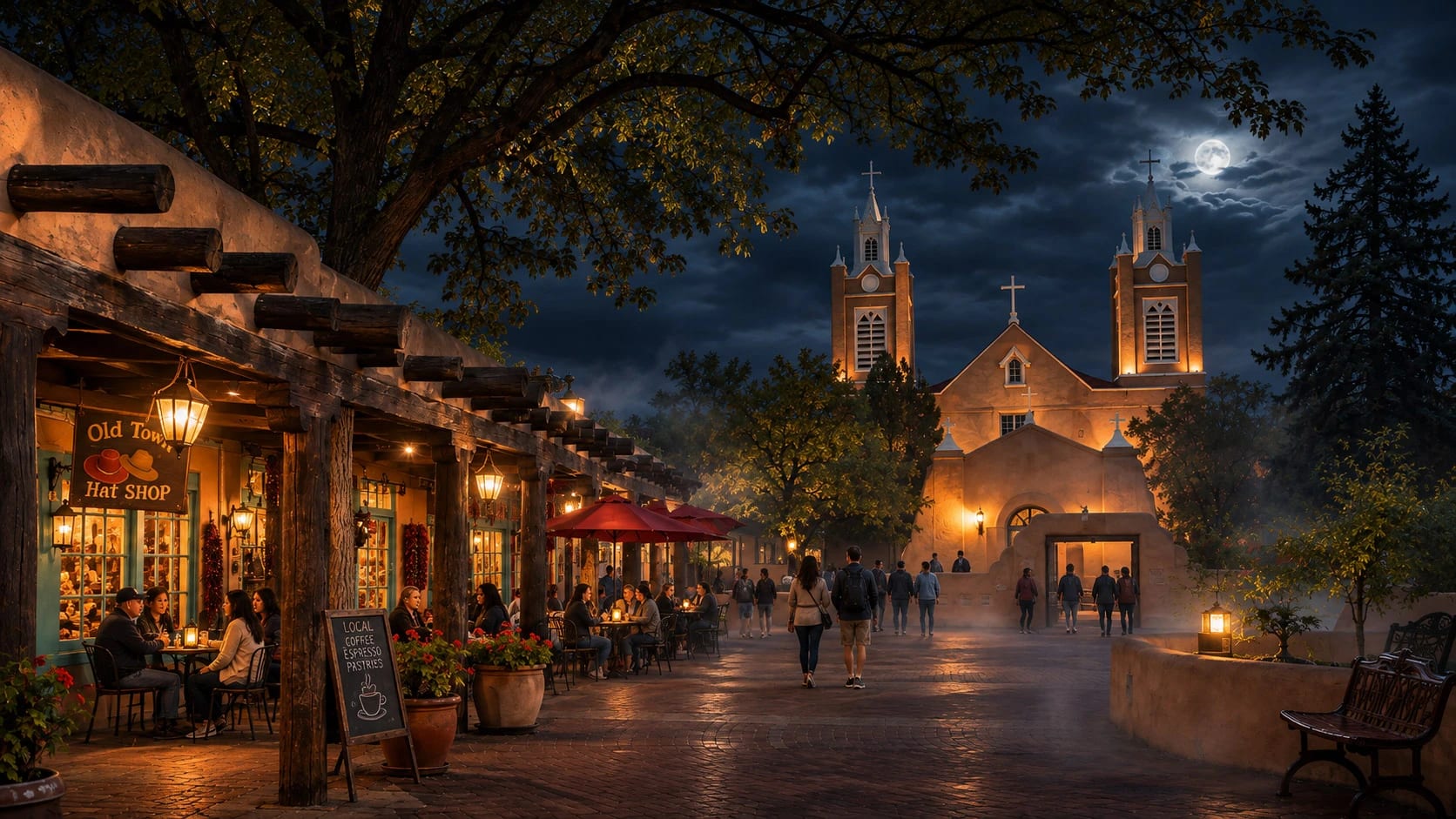
Explore Albuquerque's Paranormal History
Haunted Albuquerque
Discover why Albuquerque is considered haunted: an Old Town founded in 1706, Civil War cannons buried by the plaza, and adobe buildings with ghosts that never left.
Albuquerque has more than three centuries of history since its founding in 1706, and the Rio Grande valley was home to Pueblo peoples for many centuries before that. Its Old Town plaza has seen raids, war, epidemics and the long slow change of a frontier villa into a modern city. This is the history behind Albuquerque's ghost stories, and the legends told in its oldest adobe buildings after dark.
Ghost Tours in Albuquerque
The haunted places below are stops on Ghost City Tours' Albuquerque ghost tours — guided walks where our local storytellers bring this history to life after dark.
Why Is Albuquerque So Haunted?
Discover the dark history and supernatural forces that make Albuquerque one of America's most haunted cities
People have lived along this stretch of the Rio Grande for thousands of years. Ancestral Puebloan communities were building multistory pueblos in the region by around 750, and the Tiwa settled the middle Rio Grande valley around 1250. Coronado's expedition arrived in 1540, Spanish colonists followed Juan de Oñate's expedition of 1598, and by 1680 Spanish estancias dotted the valley, until the Pueblo Revolt drove the colonists out of New Mexico for twelve years.
In 1706 Governor Francisco Cuervo y Valdés founded a new villa on the river and named it for the Duke of Alburquerque, the viceroy of New Spain; English speakers later dropped the first "r." Cuervo claimed 35 founding families, but a 1712 inquiry found there had been only 19. Life on the frontier was precarious, and Apache and Navajo raids were a constant danger for the small farming community clustered around its plaza.
That plaza remains the heart of Old Town, about ten blocks of adobe buildings that still preserve the shape of the colonial villa. On its north side stands San Felipe de Neri Church, built in 1793, which has served generations of Albuquerque families through baptisms, weddings and funerals. The families who built the houses and shops around it are the people at the center of many of Old Town's ghost stories.
New Mexico changed hands again and again. Mexico won its independence in 1821, and in 1846 General Stephen W. Kearny brought the territory under American control. In 1862 Confederate troops captured Albuquerque, then fell back after the Battle of Glorieta Pass cost them their supplies. As they retreated toward Texas, they buried several mountain howitzers near the plaza, and the guns stayed in the ground until 1889. Few towns can say the Civil War literally lay buried beneath their main square for a generation.
In April 1880 the Atchison, Topeka and Santa Fe Railway arrived, but its depot sat more than a mile from the plaza, and a rival "New Town" quickly outgrew the old one. Albuquerque incorporated as a city in 1891, tuberculosis treatment drew newcomers to the dry desert air, and Route 66 brought travelers down Central Avenue after 1926. After World War II, Kirtland and Sandia drove a boom that nearly tripled the population between 1940 and 1950. Old Town declined until the city annexed it in 1949, and its old buildings changed hands again and again.
Many of Old Town's ghost stories begin in its oldest homes. The Church Street Café occupies the Casa de Ruiz, a house dating to the early 1700s and often called one of the oldest residences in the city. After the last of the Ruiz line, Rufina Ruiz, died in 1991 at 91, owner Marie Coleman has said she heard a voice during renovations, which she attributed to Rufina's mother, Sara Ruiz, a curandera, or traditional healer. Staff describe a woman in a long black dress in the dining room after hours, and say Sara still likes to rearrange things.
Around the plaza, locals tell of a "Lady in the White Dress" at the High Noon Restaurant and Saloon, in a building said to date to the 1750s, and of a "Lady in Black" who appears from nowhere in the Chapel of Our Lady of Guadalupe, sitting on a bench, praying or weeping. Downtown, along old Route 66, the 1927 KiMo Theatre is linked to a young boy killed when a water heater exploded in its lobby in 1951. Theater lore holds that he still plays tricks on productions, and performers have long left small gifts to keep him happy. Writer Benjamin Radford has traced that story as folklore, and the boy's siblings have said they felt exploited by it, a reminder that every legend starts with a real family.
Then there is La Llorona, the weeping woman in white of New Mexico folklore, said to wander the arroyos and waterways searching for the children she drowned. Generations of Albuquerque parents have told her story to keep their children away from the ditches after dark, and few legends in the Southwest are more widely shared.
The stories do not stop at Old Town's edge. At Hotel Andaluz downtown, guests have described a woman in 1940s clothing on the seventh floor and an older woman in an old-fashioned pink dress on the fourth, said to appear around sundown. Crews at the Albuquerque Little Theatre speak fondly of Manny, the late caretaker Manuel Jaramillo, whose presence they still feel in the hallways as doors open and close on their own. The Painted Lady Bed & Brew, a 19th-century former saloon and brothel, has an unknown female spirit of its own, and on the far eastern end of Menaul Boulevard, the place locals call Haunted Hill comes with a legend of a murderous recluse and an old man with a swinging lantern.
Some of these accounts have historical documentation behind them; others belong to folklore and eyewitness claims passed down through families and the people who work in these buildings. On our walks through Old Town, our guides tell you which is which, with respect for the Native American, Hispanic and other communities whose traditions are central to Albuquerque's identity. That is why Albuquerque feels haunted. Its plaza has kept watch through raids, revolution, war and the coming of the railroad, and its adobe walls have outlived nearly everyone who ever lived inside them. When the shops close, the Sandia Mountains fade into the night and the lamps come on along the old streets, it is easy to believe that a few of Old Town's earliest residents are still at home.
1706
Year Albuquerque was founded
1793
San Felipe de Neri Church built on the plaza
1889
Year buried Confederate cannons were unearthed
Albuquerque's Haunted Places: Coming Soon
We're writing up the story of each of Albuquerque's haunted places. Until then, the best way to meet them is on one of our ghost tours.
Ready to Explore Albuquerque's Dark Side?
Book your night on Albuquerque's newest ghost tours.
Why Book With Ghost City Tours?
Multiple Tour Options
Choose from family-friendly, adults-only, or pub crawl experiences.
Tours 7 Days a Week
Rain or shine, we run tours every single night of the year.
Money-Back Guarantee
Love your tour or get a full refund - that's our promise!
Book Your Ghost Tour Today
Book Online Now
SAVE TIME- Choose from all available tour times
- Instant email confirmation
- Secure, encrypted checkout
- 100% Money Back Guarantee
Prefer to Call?
Our Guest Services team is available 7 days a week to help you book the perfect tour.
CALL 855-999-04917am - 11:30pm Daily