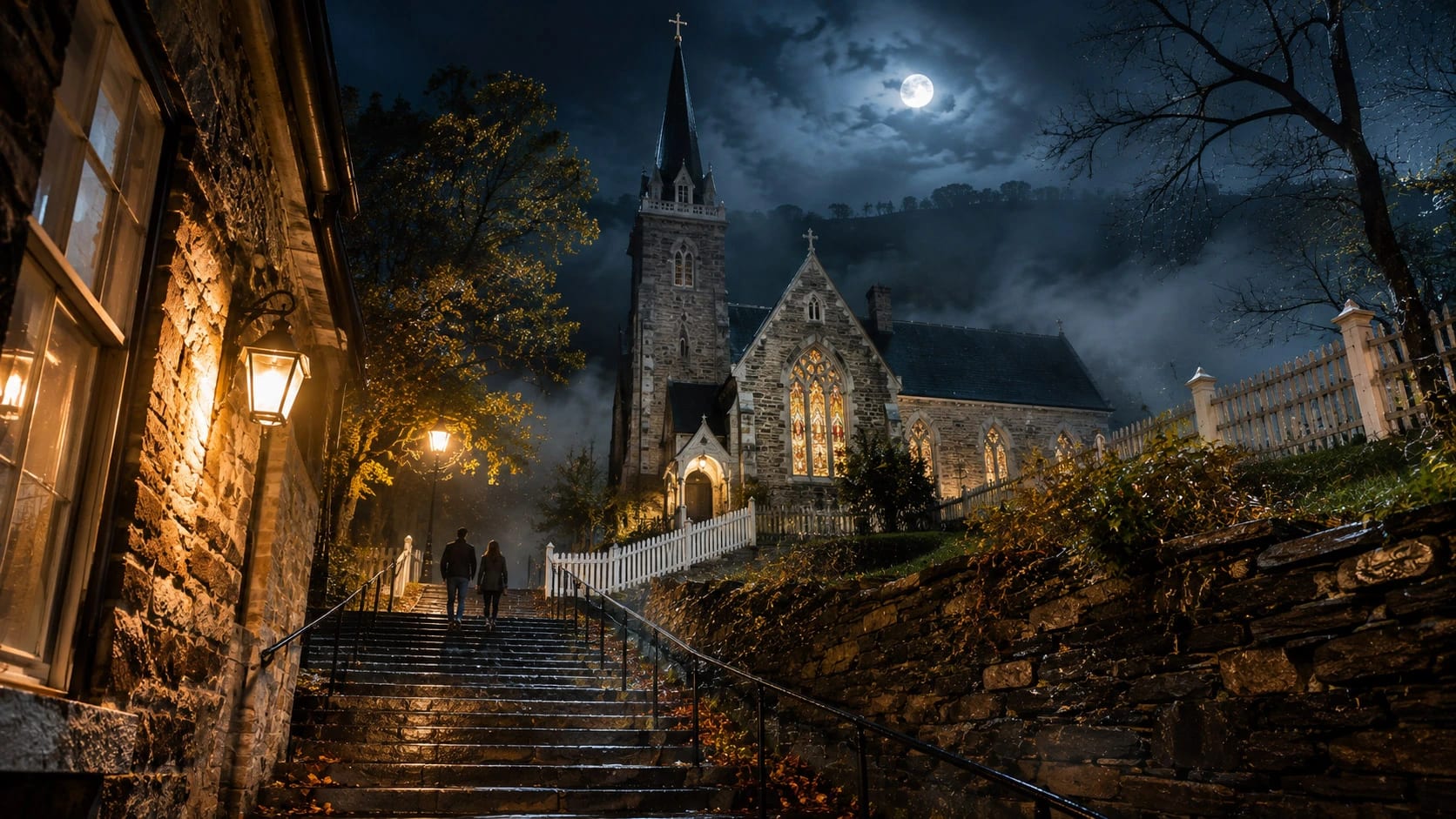
Explore Harpers Ferry's Paranormal History
Haunted Harpers Ferry
Why Harpers Ferry, West Virginia is considered one of the most haunted small towns in America: John Brown's raid, the Civil War, and the legends of its old streets.
Harpers Ferry is a small town with an enormous history. Where the Potomac and Shenandoah Rivers meet, it witnessed John Brown's raid, changed hands eight times during the Civil War, and saw one of the largest surrenders in American military history. Here is why so many people believe some of its past residents never left.
Ghost Tours in Harpers Ferry
The haunted places below are stops on Ghost City Tours' Harpers Ferry ghost tours — guided walks where our local storytellers bring this history to life after dark.
Why Is Harpers Ferry So Haunted?
Discover the dark history and supernatural forces that make Harpers Ferry one of America's most haunted cities
Harpers Ferry owes its existence to the rivers. Around 1733, a man named Peter Stephens began running a ferry across the Potomac at the point where it meets the Shenandoah. Robert Harper bought Stephens's rights, received official ferry rights from the Virginia General Assembly in 1761, and the Assembly established the town in 1763. Thomas Jefferson visited on October 25, 1783, and was so struck by the view that the outcrop where he stood is still called Jefferson Rock. But the same geography that made the town beautiful, two rivers cutting through the Blue Ridge, would also make it one of the most fought-over places in the country.
In 1796 the federal government bought land at Harpers Ferry, and construction of a national armory began in 1799. Between 1801 and 1861, the armory turned out more than 600,000 muskets, rifles, and pistols. The Chesapeake & Ohio Canal arrived in 1833 and the Baltimore & Ohio Railroad crossed the Potomac in 1837, turning the town into a crowded industrial and transportation hub. It was also a hard place to live for many of its residents. Workers crowded into shops and tenements on the narrow riverbanks, and one of the town's oldest legends, the story of Jenny, comes from that world of poverty beside the armory yard.
Then came October 16, 1859. Abolitionist John Brown led a band of 22 men, himself included, into Harpers Ferry to seize the federal armory and spark an uprising against slavery. The first person mortally wounded was Heyward Shepherd, a free Black baggage handler for the B&O Railroad. Over the next two days, the raiders were surrounded, and on the morning of October 18, U.S. Marines under the overall command of Colonel Robert E. Lee broke down the doors of the armory's engine house, now known as John Brown's Fort, in an assault that lasted about three minutes. Ten raiders were killed, including two of Brown's sons, Watson and Oliver. Brown was captured, tried, and hanged on December 2, 1859.
One of the raiders who died was Dangerfield Newby, a free Black man who had tried and failed to buy the freedom of his wife, Harriet, and their children, who were enslaved in Virginia. He joined Brown hoping the raid would free them. Harriet's letters were found on his body. Newby's body was left in the street for more than a day, and it was mutilated by townspeople; local tradition holds that the narrow lane known as Hog Alley takes its name from what happened there. It is one of the most painful stories in Harpers Ferry's history, and guides tell of a figure in old-fashioned clothing that visitors have reported in the area, as though Newby is still trying to get home.
Less than two years later, the country was at war, and Harpers Ferry sat on the line between North and South. Secessionists seized the armory on April 18, 1861, and the town would change hands eight times over the course of the Civil War. Homes and businesses were damaged or destroyed, families fled, and soldiers occupied the buildings of ordinary civilian life. St. Peter's Roman Catholic Church, built in 1833 and still standing above Lower Town, served the wounded during the war, and visitors have long reported seeing a wounded soldier and an old priest there.
In September 1862, Confederate forces under Stonewall Jackson surrounded the Union garrison, placing artillery on the heights that tower above the town. On September 15, Jackson captured 12,419 Union troops, the largest surrender of U.S. military personnel until the fall of Bataan in 1942. Civilians lived through the bombardment, too. A local guide has connected one of the town's best-known modern hauntings, the sound of a crying baby reported in a Harpers Ferry apartment in the 1980s, to a diary from 1862 describing a Confederate cannonball striking a house, killing a newborn and badly injuring the mother.
The war left the armory in ruins and the town's industry shattered, and the rivers kept testing what remained. The Bollman truss bridge, built in 1870, was swept away in the 1936 flood, and another flood in 1942 destroyed what was left of the buildings on the river islands. After the war, Storer College opened in 1868 to train teachers for formerly enslaved people, and in 1906 W. E. B. Du Bois led the first American meeting of the Niagara Movement on its campus. In 1944 Congress authorized Harpers Ferry National Monument, which became Harpers Ferry National Historical Park in 1963. Today fewer than 300 people live in the town itself, and the preserved streets of Lower Town look much as they did in the 1800s.
That preservation is part of why Harpers Ferry feels haunted. Stories of the town's ghosts have been collected for decades by local storytellers, most notably Shirley Dougherty, whose book A Ghostly Tour of Harpers Ferry gathered many of them. The most famous is Jenny, who, according to local legend, lived in a storage shed near the armory in the mid-1800s. One winter night her ragged dress caught fire, and she ran in flames down the railroad tracks into the path of a night train. Train engineers who claim to have seen her are said to slow to a crawl when passing the old armory yard, and some report a ball of fire that vanishes as the train reaches it.
Other stories follow the town's history street by street: John Brown, whose raid helped set the nation on the road to war; the soldiers who occupied the town again and again; and the families who lived through bombardment and loss. On our family-friendly Ghosts of Harpers Ferry Tour and our adults-only Silent Garrison Tour, guides share the documented history of Harpers Ferry alongside the legends that have grown up around it. Some stories are firmly rooted in the historical record. Others have survived as local folklore. We'll let you decide what you believe.
1859
John Brown's Raid
8
Times the Town Changed Hands in the Civil War
12,419
Union Troops Surrendered in 1862
Harpers Ferry's Haunted Places: Coming Soon
We're writing up the story of each of Harpers Ferry's haunted places. Until then, the best way to meet them is on one of our ghost tours.
Ready to Explore Harpers Ferry's Dark Side?
Don't miss out on the #1 rated ghost tour experience in Harpers Ferry. Book your adventure today!
Why Book With Ghost City Tours?
Multiple Tour Options
Choose from family-friendly, adults-only, or pub crawl experiences.
Top-Rated Experience
From the world's #1 ghost tour company.
Tours 7 Days a Week
Rain or shine, we run tours every single night of the year.
Money-Back Guarantee
Love your tour or get a full refund - that's our promise!
Tours Sell Out Daily
Harpers Ferry is a popular destination. Book now to guarantee your spot!
Book Your Ghost Tour Today
Book Online Now
SAVE TIME- Choose from all available tour times
- Instant email confirmation
- Secure, encrypted checkout
- 100% Money Back Guarantee
Prefer to Call?
Our Guest Services team is available 7 days a week to help you book the perfect tour.
CALL 855-999-04917am - 11:30pm Daily