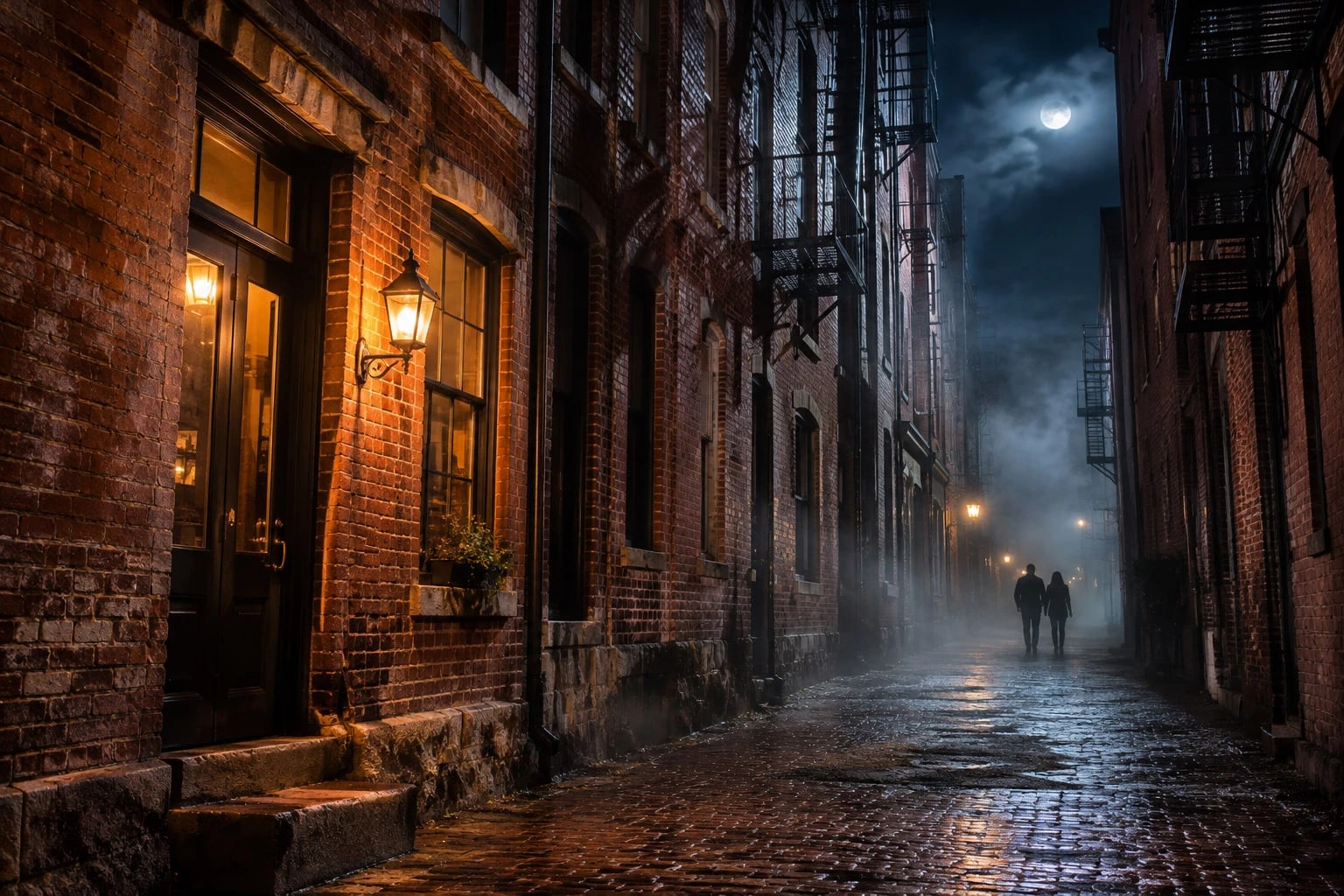
Haunted Cincinnati
Haunted Cincinnati
Why is Cincinnati haunted? Explore the epidemics, riots, river disasters and forgotten burial grounds behind the ghost stories of the Queen City.
Cincinnati grew from a frontier settlement into one of the largest cities in America, and it grew fast enough to build right over its own dead. Cholera, riots, floods and forgotten burial grounds left their mark on the Queen City, and some of its grandest landmarks have reputations to match. This is the history behind Cincinnati's ghost stories, and why so many people believe the city is haunted.
- ghost tours
- 2
See it after dark
Ghost Tours in Cincinnati
The haunted places below are stops on Ghost City Tours' Cincinnati ghost tours — guided walks where our local storytellers bring this history to life after dark.
All Cincinnati ghost tours

Why Is Cincinnati So Haunted?
Discover the dark history and supernatural forces that make Cincinnati one of America's most haunted cities
Cincinnati began on December 28, 1788, when a small party of settlers landed on the north bank of the Ohio River and founded a village called Losantiville. Fort Washington went up the next year to protect them, and on January 4, 1790, territorial governor Arthur St. Clair renamed the settlement Cincinnati, after the Society of the Cincinnati. The frontier town grew with astonishing speed: from about 750 people in 1800 to 115,435 by 1850, when it was the sixth-largest city in the United States. By 1819 a local writer was already calling it the Queen of the West, and the nickname Queen City stuck.
River trade, steamboats and the meatpacking houses that earned Cincinnati the nickname “Porkopolis” drew waves of German and Irish immigrants, who filled neighborhoods like Over-the-Rhine. Across the river lay Kentucky, a slave state, which made Cincinnati a major stop on the Underground Railroad and a city bitterly divided over slavery. In 1829 white mobs attacked Black residents, and some 1,200 Black Cincinnatians left the city for Canada. The prosperity was real, but so were the crowding, the danger and the violence that came with it.
Then came cholera. An 1832 outbreak killed about two percent of a population of roughly 30,000. The far deadlier epidemic began on Christmas Day 1848, when a dying man was carried off the steamboat Lewis Wetzel. By the end of 1849, some 6,000 Cincinnatians had died, about five percent of a city of roughly 115,000. Immigrants, who made up about 40 percent of the population and lived in the most crowded quarters, were far more likely to die. Churchyards and family plots could not keep up with the dead.
Spring Grove Cemetery was part of the answer. Chartered on January 21, 1845, with its first burial that September, it was laid out as a garden cemetery in the style of Paris's Père Lachaise. Today it covers 733 acres and is the third-largest cemetery in the United States. Many of the remains moved out of the city's older burial grounds over the following decades were reinterred here. Local lore has gathered around it too: an optometrist's bust whose eyes are said to follow visitors, and a pair of white hounds said to appear near the Dexter Mausoleum.
Not every grave made it to Spring Grove. As the city spread, several early burial grounds disappeared under new streets and parks, and the most famous of them lies beneath Cincinnati Music Hall in Over-the-Rhine. The site had served as a pauper's cemetery, used for burials after the 1832 cholera outbreak until 1857. When an elevator shaft was dug for an earlier exposition hall in 1875, workers removed more than a barrelful of skulls and bones. Clearing the ground for Music Hall in 1876 turned up numerous graves; an expansion in 1927 uncovered 65 more, earning that side of the building the nickname “Valley of Death”; and in May 1988 crews digging another elevator shaft found 207 pounds of human bones encased in concrete. Next door, the 2010 renovation of Washington Park, itself the site of early nineteenth-century cemeteries, unearthed 23 grave shafts, and the remains were reburied at Spring Grove.
The ghost stories at Music Hall are older than the building itself. In 1875 a night watchman at the exposition hall that stood on the site reported rappings, footsteps and dragging sounds in the empty halls; loud knocking at the front doors on a snowy night when no one was there and no footprints marked the snow; and the sound of a man marching across the floor, dragging a musket, which a medium of the day attributed to a soldier from a Civil War military hospital once on the grounds. Music Hall opened on May 14, 1878, and the stories never stopped. Cincinnati Opera's leadership has acknowledged “Music Hall ghosts,” and the late Cincinnati Pops conductor Erich Kunzel said of them, “when you go out into the house they're there.” Visitors describe a singing woman, figures in old-fashioned clothing and whispers in the elevators.
Cincinnati's violence had its own darkest hour. On March 26, 1884, a jury convicted William Berner of manslaughter rather than murder in the killing of his employer, and public outrage boiled over. From March 28 to 30, a crowd of about 10,000 tried to storm the jail; on the evening of March 29, rioters set fire to the Hamilton County Courthouse and blocked firefighters from saving it. When it was over, 56 people were dead and more than 300 wounded, making it one of the deadliest riots in American history. Half a century later, the Ohio River flood of 1937 crested at 80 feet, 55 feet above normal, reminding the river city how much of its history the water had shaped.
Downtown, the stories continue. Arnold's Bar and Grill, established in 1861 and known as the city's oldest bar, is a favorite of local paranormal lore: staff and customers describe wine bottles sliding off the shelves with no one behind the bar, footsteps on the stairs after closing, doors shutting on their own and the scent of roses, and some say a woman in Victorian dress has been seen upstairs. At the Taft Museum of Art, Charles and Anna Sinton Taft are rumored to watch over the collection they gave the city. And in Eden Park, local lore holds that Imogene Remus, shot by her husband, the bootlegger George Remus, in 1927, haunts the Spring House Gazebo near Mirror Lake.
That is why Cincinnati is considered haunted: a city that grew so quickly it built over its own cemeteries, buried thousands in a single epidemic season, burned its own courthouse in a riot, and filled its grand old buildings with stories that have outlasted the people who first told them. On The Ghosts of Cincinnati Tour, our family-friendly walk, and The Graves Are Listening, our adults-only tour through the city's darker history, our guides share the documented history and the local legends side by side, and always tell you which is which.
1788
Founded as Losantiville
6,000
Cholera deaths in 1849
207 lbs
Bones found under Music Hall in 1988
Cincinnati's Haunted Places: Coming Soon
We're writing up the story of each of Cincinnati's haunted places. Until then, the best way to meet them is on one of our ghost tours.
Ready to Explore Cincinnati's Dark Side?
Book your night on Cincinnati's newest ghost tours.
Why Book With Ghost City Tours?
Multiple Tour Options
Choose from family-friendly, adults-only, or pub crawl experiences.
Tours 7 Days a Week
Rain or shine, we run tours every single night of the year.
Money-Back Guarantee
Love your tour or get a full refund - that's our promise!
Book Your Ghost Tour Today
Book Online Now
SAVE TIME- Choose from all available tour times
- Instant email confirmation
- Secure, encrypted checkout
- 100% Money Back Guarantee
Prefer to Call?
Our Guest Services team is available 7 days a week to help you book the perfect tour.
CALL 855-999-04918 AM – 11:30 PM CT