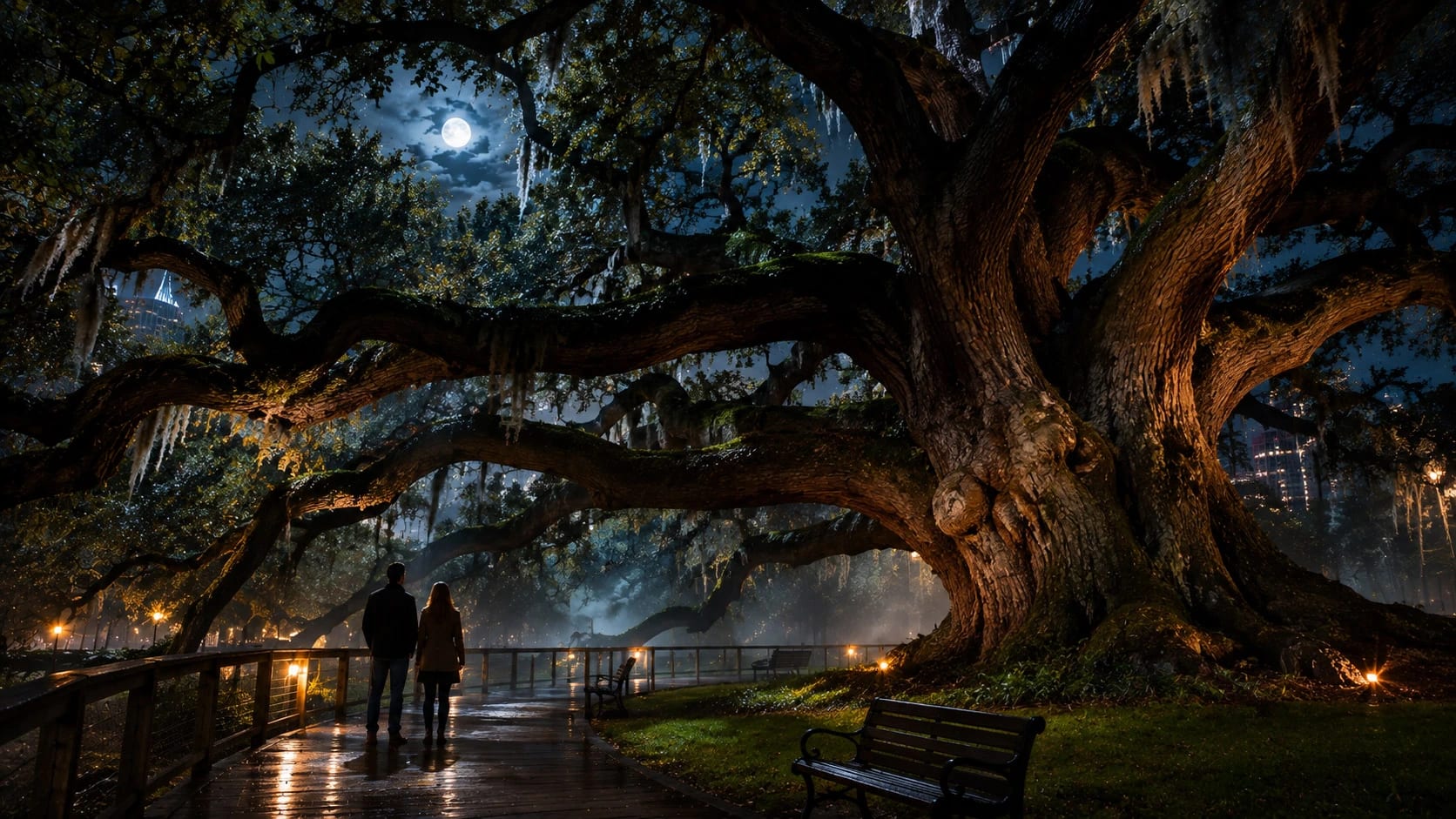
Explore Jacksonville's Paranormal History
Haunted Jacksonville
Why is Jacksonville haunted? Explore the war, epidemics, fire and local legends behind the ghost stories of Florida's River City.
Jacksonville looks like a modern city, but the ground along the St. Johns River has seen massacre, war, epidemic and one of the most destructive fires in American history. In a single afternoon in 1901, most of downtown burned, and the city that rose from the ashes kept its stories. This is the history behind Jacksonville's ghost stories, and why so many people believe the River City is haunted.
Ghost Tours in Jacksonville
The haunted places below are stops on Ghost City Tours' Jacksonville ghost tours — guided walks where our local storytellers bring this history to life after dark.
Why Is Jacksonville So Haunted?
Discover the dark history and supernatural forces that make Jacksonville one of America's most haunted cities
People have lived along the St. Johns River for some 6,000 years, and in the sixteenth century this coast belonged to the Mocama, a coastal branch of the Timucua. Europeans arrived early and violently. On June 22, 1564, French settlers founded Fort Caroline on the river. On September 20, 1565, Spanish forces under Pedro Menéndez attacked the fort and killed nearly everyone inside; only about 50 women and children and 26 men escaped. It was one of the first bloody chapters of European colonization in North America, and it happened on the river that would become Jacksonville's front door.
After Florida passed to Britain in 1763, the British called the river crossing here Cow Ford; the Seminole knew it as Wacca Pilatka. The town's new name, honoring Andrew Jackson, first appeared on a petition dated June 15, 1822, and Jacksonville received its town charter on February 9, 1832. From that small river crossing it grew into a bustling port on the St. Johns, and by the early twentieth century it was even a center of the silent film business, with Kalem Studios opening the first permanent studio there in 1908.
The Civil War hit Jacksonville harder than almost any Southern city. Union forces invaded and abandoned the city four times, first in March 1862 and again that October. The third occupation, beginning in March 1863, brought African American troops into Florida for the first time, and the fourth and final occupation began in February 1864. Today the Old City Cemetery, established in 1852 as Jacksonville's main burial ground, holds Confederate veterans alongside veterans of the Union Army's United States Colored Troops.
Disease followed. In 1888, yellow fever swept through Jacksonville. About 10,000 of the city's 25,000 residents fled, and of the more than 4,000 people who fell ill, nearly ten percent died. Eight city council members left town and two others died of the fever, leaving the council unable to reach a quorum. Like so many Southern port cities, Jacksonville came to know the fear of a fever season that could empty the streets in a matter of weeks.
Then came the fire. Around noon on May 3, 1901, sparks from a nearby chimney landed on Spanish moss drying outside the Cleaveland Fibre Factory, at Beaver and Davis Streets, while the workers were at lunch. In eight hours, the fire destroyed 146 city blocks and 2,368 buildings and left nearly 10,000 people homeless. Seven deaths were reported. Martial law held until May 17. Most of the downtown that stands today was built in the years after the fire, on the ashes of the city that came before it, and that is where many of Jacksonville's ghost stories begin.
The Old City Cemetery on East Union Street holds one of the city's most enduring stories. On April 20, 1897, nineteen-year-old Marie Louise Gato was shot five times outside her father's home in North Springfield. Before she died, she named a spurned suitor, Edward Pitzer. About a week later, a police lieutenant working the case was murdered, and Pitzer was found not guilty. The killing was never solved. Visitors to the cemetery report weeping, strange lights and the figure of a young woman near the back of the grounds. At Evergreen Cemetery, where the first burial took place in 1881, local lore tells of a “Lady in Violet” and a man in old-fashioned clothes near an unmarked mausoleum. And at TacoLu Baja Mexicana, a restaurant in an old log cabin, employees and bartenders say the building is haunted by Alpha Paynter, who once ran a boarding house there and is buried behind it; her figure is said to appear near the limestone fireplace in the main dining room.
Downtown, the Florida Theatre opened in 1927 and is the last of the movie palaces that once lined Forsyth Street. Its best-known resident is a ghost the theater's president calls “J,” said to sit in a particular balcony seat, with the seat beside it reserved for J's guest. One theory holds that J was a building engineer; another links the seat to Joseph Hilton, a theater organist in the 1920s. When the theater replaced its seating in 2020, it kept just two original seats in the balcony, so that, in the president's words, the ghost would not be left homeless. A local news promotions manager says she filmed one of those seats moving on its own during a paranormal investigation.
Jacksonville's most famous legend belongs to Annie Lytle Elementary, Public School No. 4, a 1917 school building in the Brooklyn neighborhood that has stood empty for decades. Its last classes ended in 1960, and it was shuttered in 1971. Stories of a boiler explosion, a murderous janitor and worse earned it the nickname “the Devil's School,” though local historians say those particular tales have no basis in fact. What is documented is darker in its own way: the building's architect, Rutledge Holmes, took his own life on May 2, 1929. The building is private property, and trespassers are arrested and prosecuted, so it is best appreciated from the street.
That is why Jacksonville is considered haunted: a river that saw a massacre more than four and a half centuries ago, a city invaded four times in one war, emptied by fever and burned to the ground in a single afternoon, and rebuilt on top of everything it lost. On Ghosts of River City, our family-friendly tour, and The Dead Beneath the Ashes, our adults-only walk through the city's darker history, our guides share the documented history and the local legends side by side, and always tell you which is which.
1822
Year the name Jacksonville first appears
2,368
Buildings lost in the Great Fire of 1901
4
Union occupations during the Civil War
Jacksonville's Haunted Places: Coming Soon
We're writing up the story of each of Jacksonville's haunted places. Until then, the best way to meet them is on one of our ghost tours.
Ready to Explore Jacksonville's Dark Side?
Book your night on Jacksonville's newest ghost tours.
Why Book With Ghost City Tours?
Multiple Tour Options
Choose from family-friendly, adults-only, or pub crawl experiences.
Tours 7 Days a Week
Rain or shine, we run tours every single night of the year.
Money-Back Guarantee
Love your tour or get a full refund - that's our promise!
Book Your Ghost Tour Today
Book Online Now
SAVE TIME- Choose from all available tour times
- Instant email confirmation
- Secure, encrypted checkout
- 100% Money Back Guarantee
Prefer to Call?
Our Guest Services team is available 7 days a week to help you book the perfect tour.
CALL 855-999-04917am - 11:30pm Daily