The Grand Pacific Hotel occupies a troubling place in San Diego's history. While the city celebrates its elegant Victorian hotels and resort destinations, the Grand Pacific tells a darker story—one of poverty, charity and survival among society's most vulnerable.
In the stories told about it, the hotel served as a waystation for those on the margins: seasonal workers between jobs, sailors between ships, people struggling with addiction or mental illness, and those who had nowhere else to go. It was a place of anonymity where few asked questions and fewer remembered faces.
The Grand Pacific's long, changeable history—fine lodging house, mission home for the poor, then a hotel again under a string of names—is what makes this one of San Diego's most haunting locations. Its ghost stories are not about famous names but about the forgotten people who passed through its doors, some of whom, the stories say, never found peace.
The History of the Grand Pacific Hotel
Construction of the Grand Pacific Hotel began in 1887, during San Diego's boomtown years. Attorney Frank Jennings and physician George Crippen hired architects Clements and Stannard to design a three-story, brick-veneered building with iron columns and balconies, and for its first years it operated as a fine lodging house over street-level shops. It is the only Victorian hotel of its era still standing on its original site.
Its later life was anything but settled. In 1901 it became the home of the Helping Hand Mission, a charity for the poor; it returned to hotel use in 1907, while the mission's children's department stayed on and grew into the Children's Memorial Hospital of San Diego. Over the following decades the building cycled through names (the Hotel Salem, the Pacific Hotel, the St. John's Hotel) and owners, housing workers and professional people alike.
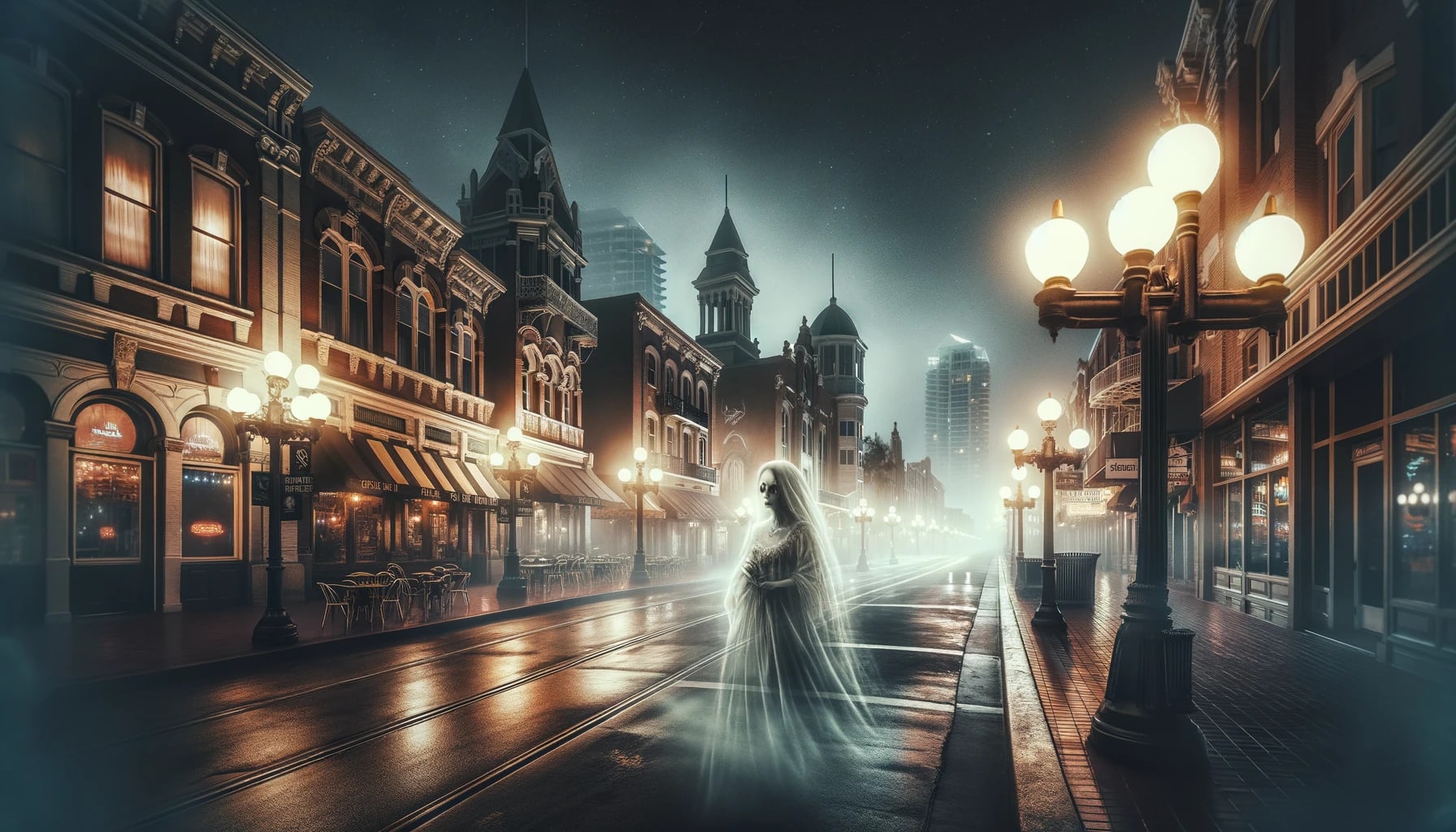
The hotel was located in an area of downtown San Diego that was rougher than the gentrified Gaslamp Quarter of today. Bars, gambling halls, and brothels operated nearby, and the streets saw regular violence. The Grand Pacific fit into this environment, providing cheap rooms and asking few questions of its guests.
In the stories told about it, the hotel developed a reputation as a place where people came to disappear—either temporarily or permanently. Some checked in under false names, others paid cash and left no records, and many came and went without anyone noticing or caring. This transient population, combined with the area's reputation for violence and crime, gave the building a dark reputation that still clings to it in local ghost lore.
A Building to Improve the Neighborhood
When Frank Jennings and George Crippen began building on the corner of Fifth and J in 1887, the San Diego Daily Bee reported that it would be "a building which would add much to the appearance of that part of the city." The plans called for a 50-by-100-foot, three-story building with galvanized iron cornices, plate glass fronts and balconies around the upper two stories, at a projected cost of about $18,000. The Coronado Brick Company supplied 25,948 bricks.
Its early managers included Alda M. Ferris and his wife, a vocal instructor, and, from 1897, Mrs. Virginia Bruscho, who with her husband Marco had apparently been living at the hotel since 1893. Several physicians and surgeons rented space in the building. One local landmarks guide also says the Grand Pacific went "from a hotel to a brothel" before the mission years, though the foundation's detailed history does not mention it.
The Helping Hand Mission
In 1901 the building became the home of the Helping Hand Mission, started by a missionary remembered as "Miss Johnson" who wanted an open door to aid the poor. Under its superintendent, Mrs. Agnes E. Dodson, the mission took in the sick and injured sent by the County Physician and families in desperate circumstances, ran a Sunday school and a wood yard, and sold goods sewn by residents.
A separate children's department, watched over by a matron, Mrs. Elizabeth J. Montague, let mothers go out and look for work. When the mission left in December 1907 and the building was sold and returned to hotel use, the children's department stayed on. It remained until 1920 and eventually grew into the Children's Memorial Hospital of San Diego.
A Hotel Once More
After 1907 the hotel changed names almost as often as managers: it was the Hotel Salem for a year from 1920, the Grand Pacific again for three years, then the Pacific Hotel for two, and from 1927 until 1930 the St. John's Hotel. David and Mary Estella Rose bought it in 1935 and kept it until May 1960.
In 1975 Shirley J. Bernard and her daughter took over the property and began renovating it room by room, living in the hotel while they worked, and earning an Orchid in San Diego's Orchids and Onions architecture awards. It was one of the first buildings restored in the Gaslamp, and when the Gaslamp Quarter Historic District was entered on the National Register of Historic Places in 1980, its nomination listed the Grand Pacific among the district's historically and architecturally significant buildings.
The Spirits of the Grand Pacific Hotel
The paranormal activity at the Grand Pacific Hotel is disturbing and sad rather than dramatic. The spirits here are not seeking attention—they seem trapped, confused, and still suffering from the trauma of their deaths.
The Forgotten Victims
Employees and visitors to the Grand Pacific Hotel report encountering female spirits throughout the building—in hallways, guest rooms, and common areas. These apparitions appear frightened and desperate, sometimes reaching out as if seeking help that never came in life.
Witnesses describe seeing women in clothing from various decades—1970s, 1980s, 1990s—suggesting these spirits represent victims from different time periods. The women appear confused, sometimes walking the halls as if looking for an exit they can't find, trapped in the moments before their deaths.
Some witnesses report hearing crying coming from empty rooms—desperate, hopeless sobbing that stops when the room is entered. Others describe feeling overwhelming fear and panic in certain areas, emotions so intense they've caused visitors to flee the building.
Paranormal investigators who have studied the Grand Pacific report that the spirits here are different from typical hauntings. These aren't residual energy or playful ghosts—they're tormented souls who experienced violent, terrifying deaths and seem unable to move beyond that trauma.
Room-Specific Hauntings
Certain rooms in the Grand Pacific Hotel are known for intense paranormal activity. Guests who stay in these rooms report nightmares of being attacked, waking to find someone standing over their bed, and experiencing physical sensations like being grabbed or pushed.
Some rooms reportedly maintain cold spots that can't be explained by air conditioning or windows. Temperature readings in these areas can be 15-20 degrees colder than surrounding spaces, and the cold is described as penetrating and unnatural.
Objects move in these rooms—personal belongings are found rearranged, doors open and close on their own, and lights flicker despite electrical systems functioning normally. Some guests report their belongings being hidden, only to reappear in obvious places after a thorough search, as if spirits are trying to get attention or express their continued presence.
The Hallways of Fear
The hallways of the Grand Pacific Hotel are reportedly the site of shadow figures and full-bodied apparitions. Employees describe seeing people walking down halls who vanish when approached or turn corners and disappear. Security cameras occasionally capture figures moving through the building during hours when it should be empty.
Some witnesses report hearing running footsteps—someone fleeing in panic—followed by sounds of struggle. These auditory phenomena seem to be replays of violent events, residual energy from attacks that occurred in these spaces.
The sensation of being followed is commonly reported in the hallways. Guests and employees describe feeling someone behind them, sometimes with the sensation of breath on the back of their necks, but turning to find no one there.
Overwhelming Sadness
Perhaps the most disturbing aspect of the Grand Pacific Hotel's haunting is the overwhelming emotional atmosphere. Many visitors describe feeling crushing sadness and hopelessness within the building—emotions that aren't their own but seem to seep from the walls.
Some sensitives and psychics report feeling the anguish of women who realized too late they were in danger, the terror of final moments, and the sorrow of lives cut short. The building seems saturated with trauma, generations of pain layered upon itself.
This emotional residue affects even skeptics. Security guards and maintenance workers, not inclined to believe in ghosts, report feeling depressed and anxious when working alone in the building late at night. Some have quit rather than continue experiencing the psychological weight of the place.
Understanding the Grand Pacific Hotel
The Grand Pacific Hotel represents a difficult chapter in San Diego's history—a reminder that beneath the city's sunny reputation lies a harder past of poverty, charity and second chances. The building no longer takes overnight travelers: renovated beginning in 1975 as one of the first restorations in the Gaslamp, it later housed living quarters and an antiques emporium, and after a 2016 sale its new owners began operating the upper floors as the Grand Pacific Executive Suites above street-level shops. Its history cannot be erased.
Our adults-only Specters and Sinners Ghost Tour, which walks the Gaslamp Quarter, includes the Grand Pacific Hotel among its featured stops and tells its story with appropriate seriousness and respect for the forgotten people whose lives passed through it. We focus not on sensationalism but on remembering those forgotten lives and understanding how places can become saturated with what they've witnessed.
Join our Specters and Sinners Ghost Tour to learn about the Grand Pacific Hotel and other locations where San Diego's darkest history left spiritual scars that remain visible to this day.