State Circle in Annapolis is one of the oldest pieces of urban design in America — a ring of streets laid out in the 1690s around the Maryland State House, the country's oldest state capitol still in legislative use. Walk its brick sidewalks and you're moving through the colonial capital of Maryland, a city that has changed less over three centuries than almost any other in the country. And on the circle, among the Georgian facades, stands a building whose foundations reach back nearly to the beginning of it all: the Governor Calvert House.
Annapolis, not Baltimore, was the seat of colonial Maryland, and the Calvert name belonged to the family that owned and governed the entire colony. A house carrying that name, on the capital's central circle, sits about as close to the origins of Maryland as any surviving structure can. Today it operates as a hotel, part of the Historic Inns of Annapolis, but beneath its comfortable rooms lie the bones of a far older building — including a remarkable piece of early colonial engineering preserved under glass for guests to see.
It also has ghosts, or at least the stories of them. Guests and staff have reported the kinds of encounters that gather in any building this old: figures that appear and vanish, footsteps in empty halls, a sense of company in an unoccupied room.
This is the first entry in our haunted Annapolis collection, and a fitting one. We'll start where the history starts — with the Calverts, with colonial Maryland, and with the house itself — before turning to the hauntings. It connects naturally to the wider Haunted Baltimore collection just up the bay, and to the kind of colonial history we tell on our Baltimore ghost tour, the nearest of our Maryland tours.
What Is the Governor Calvert House?
The Governor Calvert House sits at 58 State Circle, directly across from the Maryland State House, in the heart of Annapolis's historic district. It's one of several connected historic buildings operated together as the Historic Inns of Annapolis, alongside the Maryland Inn and the Robert Johnson House — a small collection of the city's oldest surviving structures repurposed as a single hotel.
What makes the Calvert House significant isn't one grand facade; it's the depth of history layered into the site. The visible building blends architecture from several eras, the product of centuries of rebuilding and expansion on the same ground. Beneath it, archaeological work uncovered something rare: the remains of an early colonial heating system — a hypocaust, a network of brick channels designed to carry warm air, associated with the Calvert family's tenure on the property. That feature, preserved and displayed under glass for guests, is among the oldest visible pieces of domestic engineering in the city, a literal window into how Annapolis's colonial elite lived.
For visitors unfamiliar with the colonial geography, it helps to reset expectations. Maryland's story did not begin in Baltimore, which remained a modest tobacco port well into the 18th century. It began in the south of the colony and matured here in Annapolis, which became the capital in 1695 and grew into one of the wealthiest and most cultured towns in British North America. The Governor Calvert House belongs to that older, grander Annapolis — the colonial capital, not the industrial city up the bay — and that is a large part of what makes it such an unusual survivor.
The house takes its name from the Calverts, and the connection is the key to its importance. To understand why a building on State Circle bearing that name matters so much, you have to understand who the Calverts were.
The Calvert Family and Colonial Maryland
Maryland was, in a real sense, a Calvert family possession. The colony began with George Calvert, the first Lord Baltimore, an English statesman and Catholic who sought a refuge in the New World where Catholics could worship freely. He died before the project was realized, but in 1632 the charter passed to his son, Cecil Calvert, the second Lord Baltimore, who became the founding proprietor of Maryland.
The charter the Calverts held was extraordinary. It made them not merely investors but proprietors — near-sovereign owners of an entire colony, with the power to grant land, establish government, and rule in the king's name. Maryland was named for the queen, Henrietta Maria, but it was governed for the Calverts, and for generations the family directed its affairs from England while relatives and appointees governed on the ground.
Several Calverts served directly in Maryland. Cecil's brother Leonard Calvert led the first colonists ashore in 1634 and served as the colony's first governor. Later members of the family, including Charles Calvert, the third Lord Baltimore, governed in person before inheriting the proprietorship. The Calvert name ran through Maryland's leadership from its founding into the 18th century, interrupted only by the periods when the crown stripped the family of control — most notably after England's Glorious Revolution, when Maryland briefly became a royal colony before the Calverts, having conformed to the Church of England, regained their rights.
Annapolis was the stage for much of this. As the colonial capital after 1695, it was where Maryland's proprietary government did its work, where the assembly met, where the colony's wealth and power concentrated. A house associated with the Calvert name on State Circle, then, isn't named for some distant celebrity. It carries the name of the family that owned Maryland — the people in whose name the entire colony was governed. Few American place-names hold that kind of direct line to a colony's founding, and that weight is part of what gives the Governor Calvert House its hold on the imagination, well before anyone mentions a ghost.
The Early History of the Governor Calvert House
The property's own history is harder to pin down than the family's, which is true of most colonial sites and worth admitting plainly. Centuries of rebuilding, incomplete records, and the ordinary churn of a working city have blurred the precise timeline.
What's clear is that the site has been built upon since the early 18th century, and that it carries an association with a Calvert governor — the connection that gave the house its name. The hypocaust heating system found beneath the building points to an early, substantial structure of real sophistication, the kind of thing only a wealthy and powerful household would have installed. Whoever first built here was building well, in the colonial capital, at a moment when Annapolis was entering its golden age.
Over the following centuries, the structure changed continually. Colonial Annapolis was a town of brick and timber that burned, decayed, and rebuilt itself in cycles; buildings were enlarged, subdivided, joined to their neighbors, and repurposed as fortunes rose and fell. The Calvert House site followed that pattern, accreting additions and alterations until the original colonial building was wrapped inside later construction. By the time anyone set out to document it carefully, the house had become a kind of palimpsest — colonial bones inside an 18th- and 19th-century body, with modern systems threaded through it.
The most important recent chapter came with the building's restoration and conversion into part of the Historic Inns of Annapolis in the latter 20th century. It was during renovation work in that era that the hypocaust was uncovered — a genuine archaeological find that confirmed the antiquity of the site and tied the standing hotel directly to its colonial origins. Rather than destroy or hide it, the developers preserved the feature and put it on display, turning a heating system from the age of the Lords Baltimore into a centerpiece of a working hotel.
That decision says a great deal about why the building feels the way it does. The Governor Calvert House doesn't merely sit on a historic site. It openly contains its own oldest layer, on view to anyone who walks in.
Life Inside the House Through the Centuries
Try to picture the people who moved through this ground over three hundred years, and the building stops being a hotel and becomes something more interesting.
In the colonial era, a substantial house on State Circle would have belonged to the upper reaches of Annapolis society — the proprietary officials, planters, lawyers, and merchants who made the capital one of the most cultured towns in the colonies. Such households ran on the labor of others: indentured servants and, in 18th-century Maryland, enslaved people, whose lives are far less documented but who were unquestionably present in the homes of the colonial elite. The grand front rooms and the working spaces behind them held very different lives under a single roof.
As Annapolis evolved from colonial capital to a quieter state capital, the building's cast of characters changed with it. Legislators and officials came and went with the assembly's sessions. The city's role as the seat of government kept a steady current of political figures, travelers, and visitors moving through its central buildings. By the time the property became a hotel, it had returned, in a sense, to one of its oldest functions: housing travelers and visitors to the capital, as inns and lodging houses on the circle had done for generations.
That continuity matters for the ghost stories. This is not a building that sat empty and forgotten. It has been occupied, in one form or another, for the whole of its long life — lived in, worked in, governed from, and passed through by an unbroken stream of people, most of whose names are lost. A house that full of human history rarely stays entirely quiet in the imagination of the people who use it now.
Tragedies, Deaths, and Historical Events Connected to the Property
Here the honest approach is restraint. A building on State Circle for three centuries has certainly seen death — in an era when people were born, sickened, and died at home, any long-lived house has — but the Governor Calvert House carries no famous murder, no notorious catastrophe, no single documented tragedy that obviously seeds a haunting. To invent one would be to do exactly what good history shouldn't.
What the site has instead is proximity to enormous events. This is State Circle, across from the building where the Maryland legislature has met since the colonial era, in the town that served as the temporary capital of the United States in the 1780s, where the Confederation Congress sat and where George Washington resigned his military commission in 1783. The Calvert House stood through the Revolution, through the Civil War in a bitterly divided border state, through epidemics and fires and the slow transformation of Annapolis around it. The drama here is less a private tragedy than the constant pressure of public history happening a few steps from the door.
The building's own hardships were the ordinary ones of old urban property: decay, changes of ownership, and the periods of decline that nearly cost Annapolis many of its colonial buildings before a determined preservation movement turned the tide in the 20th century. The Governor Calvert House survived an era when plenty of historic structures did not — which is its own kind of quiet drama, and arguably more important than any ghost story attached to it.
Why Is the Governor Calvert House Considered Haunted?
The Governor Calvert House earned its haunted reputation the way most genuinely old buildings do — through sheer accumulation, not a single dark event.
Three centuries of continuous occupation leave a residue, at least in the stories people tell. Guests staying overnight in a building this old, in a city this saturated with history, arrive primed to notice the unusual, and old structures supply plenty to notice: settling timbers, drafts moving through additions built in different centuries, the ordinary noises of a place that has been rebuilt many times over. Add the documented antiquity of the site — the colonial hypocaust under glass, the visible proof that you are sleeping atop something very old — and the imagination does the rest.
Reports from a working hotel also accumulate differently than reports from an abandoned house. Thousands of guests pass through every year, and a small fraction of them experience something they can't explain and mention it at the front desk. Staff who work the building in the quiet hours collect their own stories. Over decades, those individual accounts settle into a shared reputation, passed between employees and repeated to curious visitors.
None of this requires the supernatural to explain, and I'd rather say so than pretend the evidence is stronger than it is. But it does explain why the Governor Calvert House, like so many of Annapolis's colonial buildings, is widely considered haunted. The genuine surprise would be a building this old without such stories.
Reported Ghosts and Paranormal Activity
The reports attached to the Governor Calvert House fall into the familiar categories of an old, occupied building. They're best taken as exactly that — accounts gathered from guests and staff over the years, rather than a documented record of verified events.
Apparitions
The most memorable accounts involve figures. Guests and staff have described glimpsing people who don't belong to the present — a figure in a hallway, someone briefly present in a room before it's found empty, a shape on a stair. In a building so tied to the colonial era, witnesses sometimes describe period-dressed figures, which fits the setting almost too neatly; the power of suggestion runs strong in a place that openly advertises its colonial bones. The sightings are characteristically brief, the figure gone the moment it's looked at directly, leaving the witness uncertain of what they actually saw.
Unexplained Sounds
Sounds make up the largest share of the reports, as they do in most old hotels. Footsteps in rooms and corridors known to be empty. Doors that open or close on their own. Voices or fragments of conversation drifting from unoccupied spaces. A building stitched together from structures of different ages, full of old wood and uneven floors, produces a great deal of genuine, explicable noise — which is precisely why these reports are so common and so hard to either confirm or dismiss. The line between an old house settling and something stranger is exactly where ghost stories live.
Strange Experiences
Then there are the experiences that resist description: the sudden feeling of being watched, a cold spot in an otherwise warm room, an inexplicable unease in a particular hallway or guest room, the conviction of not being alone. These are the vaguest and most subjective of the reports, the most shaped by expectation, and the most universal. By the accounts of staff, they're also the ones guests most often mention — the quiet sense, in a building this old, that the past is closer than it should be.
The Most Famous Ghost Stories Associated with the Property
Unlike some haunted hotels, the Governor Calvert House isn't dominated by a single famous ghost with a known name and a tragic backstory. Its reputation is more diffuse — a collection of recurring experiences rather than one signature legend — and that's worth being honest about rather than inventing a marquee specter to fill the gap.
The stories that circulate tend to cluster around types rather than identified individuals. There are accounts that gravitate toward colonial-era figures, understandable given the house's deep history and the visible reminders of its origins. There are the standard hotel encounters — the guest who reports a presence in the night, the staff member with a story from a late shift. And there's the general, pervasive sense among people who spend time in the building that it is, in some hard-to-define way, occupied beyond its registered guests.
What's interesting is how the reputation developed. With no single dramatic event to anchor it, the Governor Calvert House became known as haunted through the slow compounding of small experiences, each new account drawing on the ones before it. Annapolis itself helped: the city's intense, pervasive sense of the colonial past primes nearly everyone who visits to feel history pressing close, and a hotel built on genuinely ancient ground, with its oldest layer on display, is the natural place for that feeling to crystallize into ghost stories. The legend grew from the building's history rather than from any one night of horror — which may make it more honest than the average haunted-hotel tale.
Historic Preservation and the Ghosts of Memory
There's a deeper reason buildings like this feel haunted, and it has more to do with preservation than with spirits.
A preserved historic building is a deliberate act of holding onto the past. The Governor Calvert House exists in its current form because people in the 20th century decided that Annapolis's colonial fabric was worth saving, and went to considerable trouble and expense to save it. The hypocaust under glass is the purest expression of that impulse — a conscious choice to expose and display the building's oldest layer rather than bury it. The whole property is arranged to keep the past visible and present.
Do that, and you create exactly the conditions in which people sense ghosts. Surround visitors with genuine colonial material, remind them at every turn that they are inside something three centuries old, light it warmly and let the floors creak, and the human mind supplies the rest. The feeling of presence that guests report is, in part, the intended effect of good preservation working as designed: the past made tangible enough to feel alive.
This is the relationship between memory and architecture that runs through so many haunted historic sites. We preserve buildings precisely because we don't want the people and the world they represent to vanish — because we want, in a sense, to keep them with us. We should not be surprised, then, when visitors to our most carefully preserved places report that the former occupants seem reluctant to leave. A haunted reputation may be the truest sign that preservation has succeeded.
Governor Calvert House and Maryland's Haunted History
Set the Governor Calvert House beside the better-known hauntings up the bay in Baltimore, and what stands out is how different a colonial capital's ghosts are from an industrial city's.
Baltimore's haunted landscape is largely a creation of the 18th and 19th centuries and the forces that built the modern city. The Admiral Fell Inn and the taverns of Fells Point come out of the rough world of the working waterfront. The Baltimore Almshouse reflects the poverty and disease of a booming port. The great houses — the Winans family's Crimea Mansion and the Garretts' Evergreen Mansion — are monuments to railroad fortunes. Even Edgar Allan Poe, buried at Baltimore's Westminster Burying Ground, is a 19th-century figure.
The Governor Calvert House reaches back further, to the colonial foundations beneath all of it. Its ghosts, such as they are, belong not to railroads or waterfronts but to the proprietary colony itself — to the age of the Lords Baltimore, when Maryland was a single family's possession and Annapolis was its capital. That makes it a rare thing in the region's haunted catalog: a genuine connection to the very beginning of Maryland, when Baltimore was barely a village and the Calverts still ruled.
It's a fitting first entry for a haunted Annapolis collection, and a natural companion to the Haunted Baltimore stories just up the road.
Can You Visit the Governor Calvert House Today?
Yes. The Governor Calvert House is a working hotel, part of the Historic Inns of Annapolis, and you can book a room and spend the night in one of the colonial capital's oldest buildings. Even if you're not staying over, the lobby and its preserved hypocaust are worth seeking out — a chance to stand directly above a piece of the Calvert-era colony, displayed where anyone can see it.
The house sits on State Circle in the heart of Annapolis's historic district, steps from the Maryland State House, the colonial streets, and the City Dock waterfront. It makes an ideal base for anyone exploring the colonial capital, and it draws the natural mix you'd expect: history travelers, legislators and visitors with business at the State House, and a steady trickle of the paranormal-curious who've heard the building has stories.
If you go, treat it as the working hotel and genuine historic site it is. And to set Annapolis's hauntings in the wider context of Maryland's haunted history, our Baltimore ghost tour — the nearest of our tours — and our Haunted Baltimore collection are the best places to keep exploring.
Where Maryland Began
The Governor Calvert House offers something almost no other haunted building in the region can: a direct line to the founding of Maryland. Its name belongs to the family that owned the colony, its ground has been built upon since the colonial capital's earliest days, and its oldest layer — the Calvert-era hypocaust — sits on display beneath a modern hotel. Whether or not anything walks its halls, the house is a genuine survivor from the age of the Lords Baltimore.
That's the real reason to seek it out. The ghost stories are an extension of the building's extraordinary age and the care taken to preserve it, not the main event. Come for the colonial history and you may leave with a ghost story; come for the ghost story and you'll leave understanding where Maryland began.
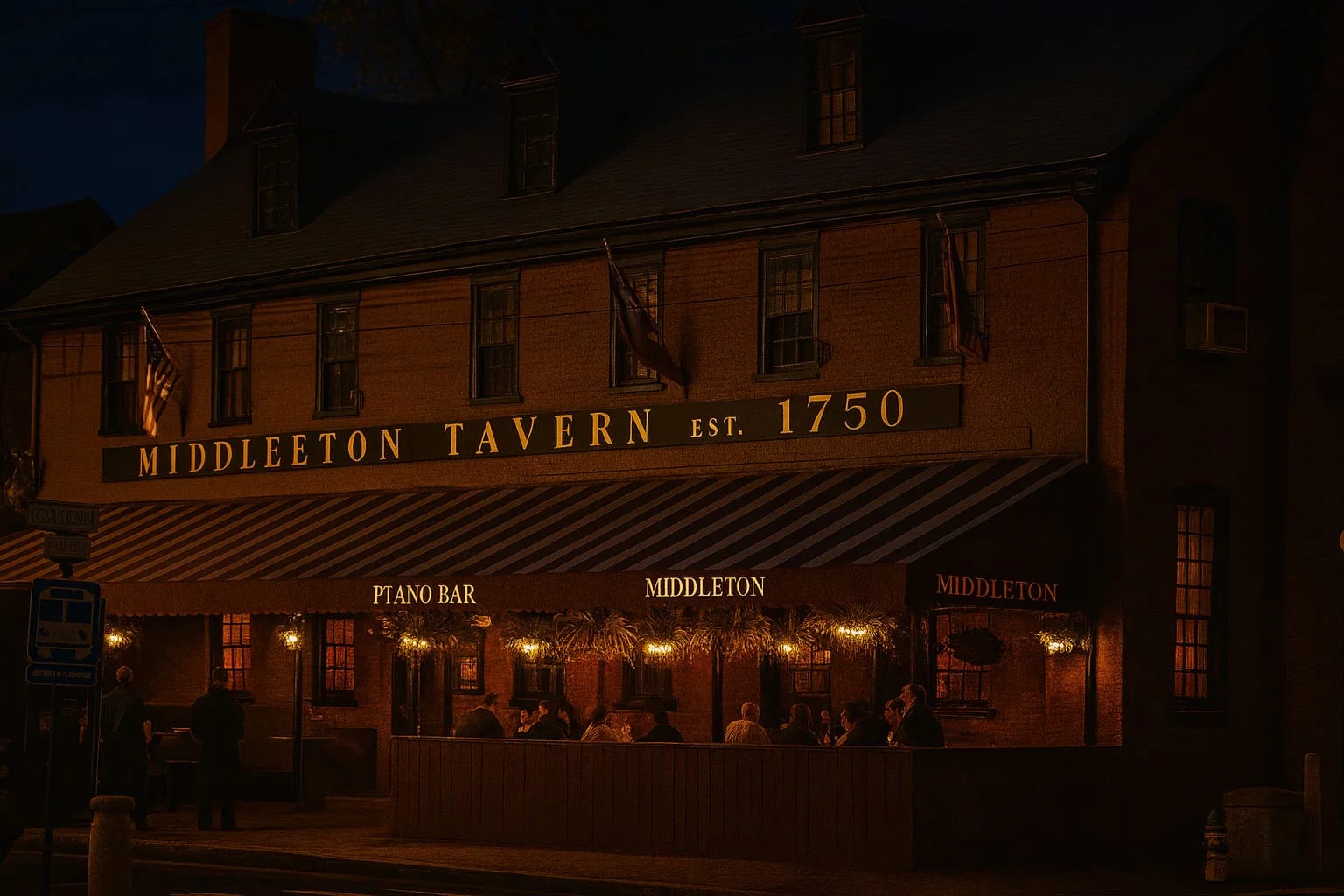
This is one of the first stops in our haunted Annapolis collection, alongside the ghosts of Middleton Tavern down at the City Dock, and there's far more of the region's haunted past to explore. Wander the Haunted Baltimore stories just up the bay, or come walk Maryland's haunted history with us on a Baltimore ghost tour.
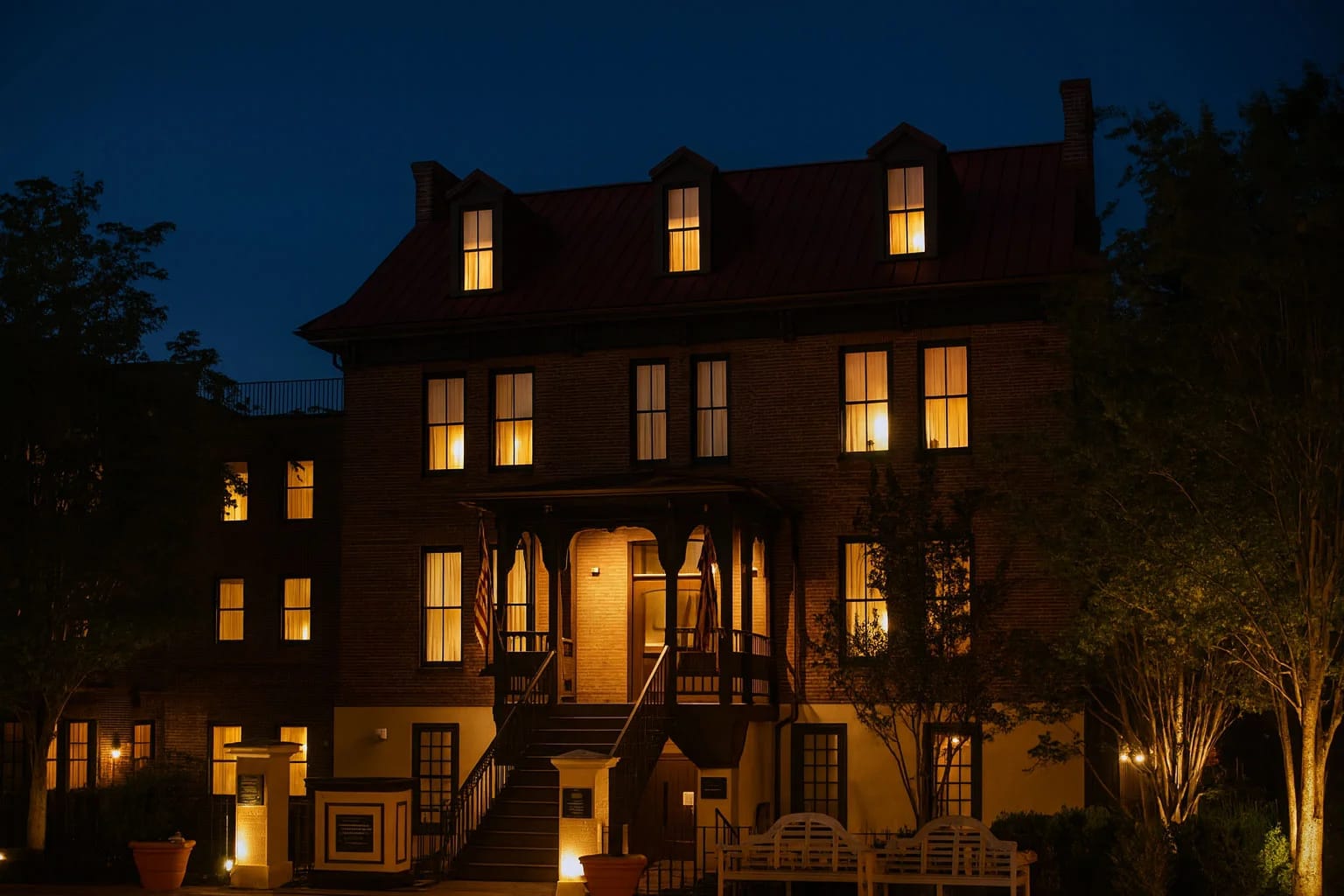
The Governor Calvert House on State Circle, part of the Historic Inns of Annapolis and one of the colonial capital's oldest surviving sites