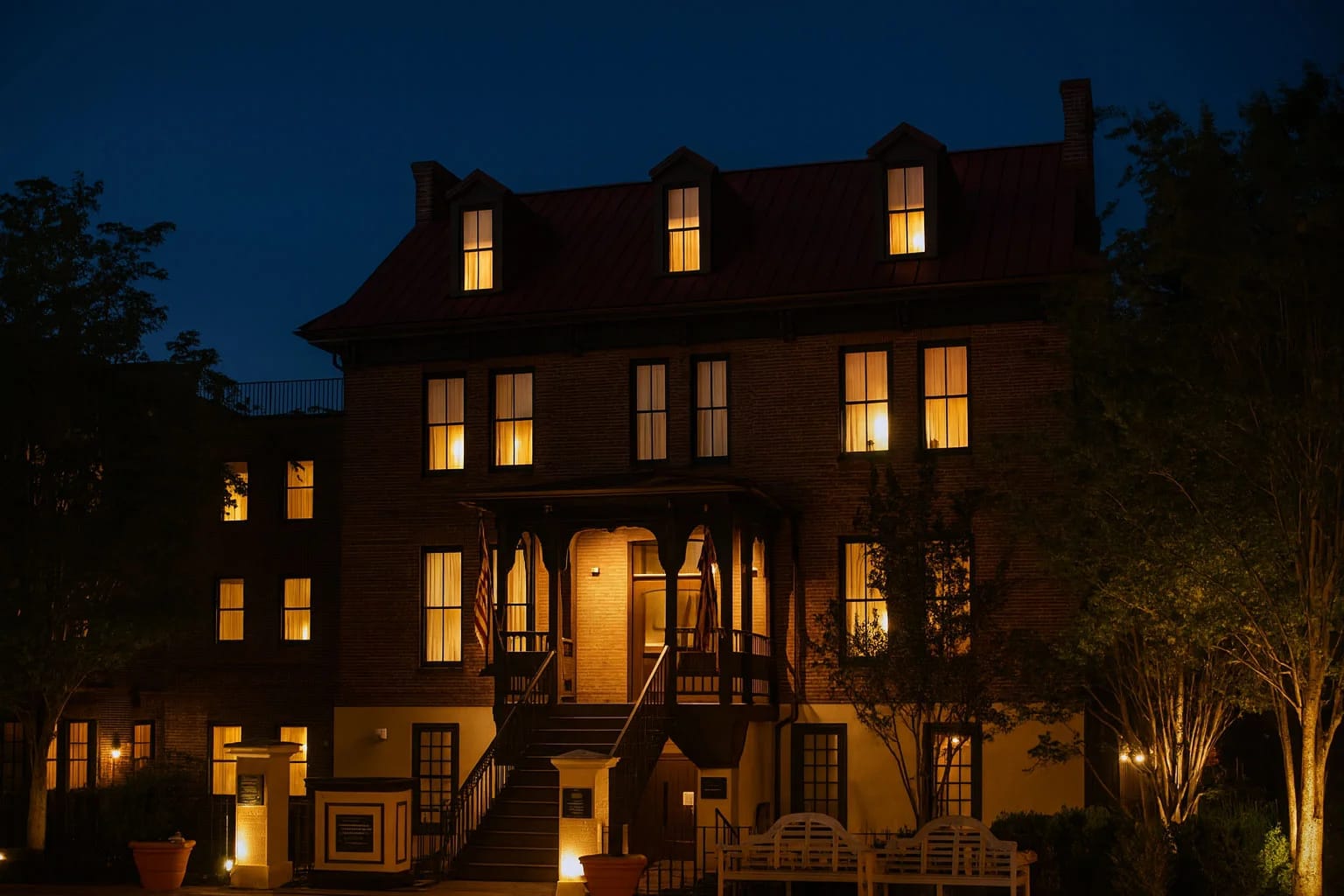
Stand at the head of the City Dock in Annapolis after dark and the harbor does the talking. Sailboats rock and creak at their moorings, the water throwing back the lights of the waterfront, and the colonial streets behind you glow warm against the night. At the corner of Market Space, where the town meets the water, light and conversation spill out of a brick building that has welcomed sailors, travelers, and statesmen for more than two and a half centuries. This is Middleton Tavern.
Middleton is one of the most famous historic buildings in Annapolis, and one of its best-known haunted ones. Most people come for the oysters, the harbor view, and the sense of sitting somewhere genuinely old — the same rooms where colonial Maryland did much of its business and its drinking. A fair number leave having also heard the other stories: the woman in white on the stairs, the colonial gentleman who appears and is gone, the glasses that move on their own after the crowd thins.
This is the second entry in our haunted Annapolis collection, after the Governor Calvert House up on State Circle, and it belongs to the same tradition: history first, ghosts as the layer that history leaves behind. We'll trace Middleton's beginnings, the colonial capital that made it, the famous names tied to its tables, and the hauntings reported by the people who work and drink there — keeping an honest line between what's documented and what's legend. You'll find it alongside the rest of our Haunted Annapolis stories, just down the bay from the Haunted Baltimore hauntings we cover in depth.
What Is Middleton Tavern?
Middleton Tavern sits at 2 Market Space, directly facing the Annapolis City Dock at the foot of the historic district. It's a brick building of clear age — the kind of solid colonial structure that has been patched, rebuilt, and adapted across generations without losing its essential character. Today it operates as a restaurant and oyster bar, a fixture of the Annapolis waterfront, but its roots run back to the colonial port that made the city.
The tavern ranks among the oldest in the country, established around the middle of the 18th century, when Annapolis was the thriving capital of colonial Maryland and its harbor was crowded with ships. From the beginning, its location was its purpose. Planted at the water's edge, beside the docks and the ferry landing, it existed to serve the constant traffic of a working colonial port — ships' captains, merchants, travelers, and the political class of the capital.
That position has kept it relevant for more than 250 years. The harbor that once brought tobacco ships and packet boats now brings sailboats and tourists, but Middleton has remained what it always was: a waterfront tavern at the busiest corner of the city. It survived the decline of Annapolis as a major port, the long quiet centuries when the capital became a sleepy government town, and the 20th-century revival that turned the historic district into one of the best-preserved colonial cities in America. Through all of it, Middleton kept its doors open and its tables full.
Before we get to the ghosts, that's the essential point. This is a genuine colonial survivor, not a themed attraction, and the stories attached to it are worth taking seriously precisely because the building itself is the real thing.
Colonial Annapolis and the Rise of Tavern Culture
To understand why Middleton mattered, you have to understand colonial Annapolis — a city very different from the quiet capital it later became.
Annapolis became Maryland's capital in 1695, and through the 18th century it grew into one of the wealthiest and most sophisticated towns in British North America. Its harbor handled the tobacco trade that drove the colony's economy, sending Maryland leaf to England and bringing back manufactured goods, enslaved people, and news. The proprietary government of the Calvert family — the story we tell at the Governor Calvert House — ran the colony from here. By the eve of the Revolution, Annapolis supported fine townhouses, a theater, horse races, and a social season that drew the planter elite from across the Chesapeake.
In that world, taverns were not merely places to drink. They were the essential public institutions of the age. With few public buildings and none of the modern infrastructure of business or politics, the tavern did many of those jobs at once. It was where members of the assembly lodged and argued, where merchants closed deals and read the latest Maryland Gazette, where clubs met, mail arrived, auctions were held, and travelers found a bed. Political faction and, later, revolutionary sentiment were nurtured over tavern tables. When colonial Americans wanted to gather, decide, celebrate, or conspire, they went to a tavern.
A waterfront tavern like Middleton sat at the busiest intersection of all this. Positioned at the docks, it caught the maritime traffic — the captains and sailors and merchants moving through the port — and folded it into the social and political life of the capital. That mingling of harbor and statehouse, sailor and senator, is what made a place like Middleton so central to colonial Annapolis, and it's the soil from which all its later legends grew.
Horatio Middleton and the Tavern's Early Years
The tavern owes its name to Horatio Middleton, who established the business around 1750. Middleton was a man of the water as much as of the bar: he operated a ferry service across the Chesapeake, carrying passengers, horses, and goods, and his tavern grew up alongside that enterprise as a place for travelers and seafaring men to eat, drink, and lodge while waiting on the tides and the boats.
That dual role — ferryman and tavern keeper — placed Middleton at the heart of the port's daily traffic. His notices appeared in the Maryland Gazette, the colonial newspaper printed in Annapolis, announcing his ferry and his accommodations to the traveling public. The tavern became known as a house catering to ships' captains and the maritime trade, a natural anchor at the water's edge.
After Horatio's death, the business carried on under his family, including his son Samuel Middleton, keeping the name and the trade alive into the Revolutionary era and beyond. The Middletons were exactly the sort of enterprising colonial family that built Annapolis — not aristocrats, but solid people of commerce whose ferry and tavern helped knit the port together.
The documentary record of these early years is thinner than we'd like, as it is for most colonial businesses. Precise dates, the exact sequence of buildings on the site, and the details of who passed through have to be reconstructed from scattered advertisements, deeds, and later accounts. What's clear is the shape of the thing: a waterfront tavern, founded near the middle of the 18th century by a ferry-running family, that quickly became one of the fixed points of life in the colonial capital.
Famous Visitors to Middleton Tavern
Few subjects attract more embellishment than the question of who drank where, and colonial taverns collect famous-visitor stories the way old ships collect barnacles. Middleton is no exception, and here more than anywhere the honest historian has to separate the documented from the merely repeated.
The strongest case is George Washington. Washington's connection to Annapolis is thoroughly documented: he visited the city many times, attended its races, did business there, and famously resigned his commission as commander of the Continental Army at the Maryland State House in December 1783. His own diaries record dining and lodging in Annapolis on numerous occasions. Local tradition places him at Middleton specifically, and given the tavern's prominence at the dock and Washington's frequent presence in town, it is entirely plausible — though the diaries don't always name the exact house, and certainty about any single visit is harder to come by than the confident plaques suggest.
Thomas Jefferson and Benjamin Franklin are also named in Middleton lore, and both men did pass through Annapolis in the Confederation era, when the city briefly served as the capital of the United States and the Confederation Congress met at the State House. Jefferson spent time in Annapolis as a delegate; Franklin traveled through more than once. Whether either dined at Middleton specifically is the kind of claim that lives in tradition rather than in firm record, and it should be held loosely.
What matters more than pinning down any single meal is the larger truth these stories point to. In the Revolutionary and early national period, the political life of the country genuinely did unfold in taverns like this one. Delegates, officers, and statesmen really did eat, drink, argue, and scheme in Annapolis's waterfront houses while the capital's formal business was conducted a few blocks uphill. The famous-visitor legends, even where they outrun the evidence, capture something accurate: Middleton stood at the center of a town where the founding generation regularly gathered. The specific anecdotes may be uncertain. The world they describe was entirely real.
Why Is Middleton Tavern Considered Haunted?
Middleton's haunted reputation rests on the same foundation as its history: age and continuity.
A building that has stood at the busiest corner of a port city for more than 250 years, serving food and drink to an unbroken stream of people the entire time, accumulates stories the way it accumulates wear. Generations of staff have worked its rooms in the quiet hours after closing. Generations of patrons have lingered over a last drink with the harbor dark outside the windows. Out of that long occupancy come the experiences — and the retellings — that become a haunting.
The setting helps. Middleton is old, low-ceilinged, and full of the creaks and drafts of a much-rebuilt colonial structure, sitting beside a harbor that has seen its own share of death by water. Annapolis as a whole carries an unusually strong sense of the past, its colonial fabric preserved more completely than almost any American city's. Visitors arrive already half-expecting to feel history pressing close, and an old waterfront tavern is exactly where that feeling tends to take the shape of a ghost.
As with any such place, the reports that follow are best understood as exactly that — reported experiences and inherited stories, part of the tavern's cultural life rather than proven fact. What's not in question is that people have been telling these stories about Middleton for a long time, and still do.
The Most Famous Ghosts of Middleton Tavern
The Middleton legends cluster around a few recurring figures. None comes with a verified name and a documented backstory; they live in the oral tradition of the tavern, passed between staff and repeated to curious guests. Here are the main ones, for what they are.
The Woman in White
The best-known is a woman in white, the most common of all American tavern and inn ghosts. At Middleton she's described as a female figure seen in various parts of the building — on a staircase, in an upstairs room, near a window — appearing for a moment and then gone. As with most ladies in white, no one can say with confidence who she was. The stories offer guesses (a tavern keeper's wife, a grieving woman who once waited at the harbor for a ship that never returned) without settling on any of them. That vagueness is characteristic. The woman in white is less a specific person than a shape the imagination reaches for in an old building, and Middleton's version follows the long tradition closely.
The Phantom Gentleman
More distinctive is the colonial gentleman. Witnesses over the years have described a man in 18th-century dress — a period coat, the bearing of another era — seen briefly in the tavern before he vanishes. In a building so tied to the colonial capital and its famous visitors, it's no surprise that some patrons reach for the grandest possible identification, and a few accounts cheerfully suggest the figure is Washington or another founding-era guest. That's almost certainly the legend embroidering itself; a glimpsed man in colonial clothing becomes, in the retelling, a specific great man. What the reports actually describe is simpler and more interesting — a figure who looks like he belongs to the tavern's earliest years, still keeping to its rooms.
Unidentified Spirits
Beyond those two, staff and visitors describe figures that resist any identification at all: a presence glimpsed in a doorway, someone seemingly seated at a table who isn't there a moment later, shapes on the upper floors. These unnamed encounters are, in a sense, the most honest part of Middleton's folklore — people reporting that they saw or felt something, without the tidy backstory that makes a ghost story satisfying. Over time, the named legends and the nameless sightings reinforce one another, until the whole building carries the reputation of being well-populated after hours.
Paranormal Activity Reported by Staff and Patrons
As with any haunted bar, the accounts are worth sorting by who's telling them.
Staff reports form the core. Employees closing up or working alone describe the familiar catalog: footsteps crossing empty rooms, particularly upstairs; voices or fragments of conversation with no one present; glasses and objects that move or fall on their own; the sudden sense of not being alone. Because these come from people who know the building intimately and spend time in it at its emptiest, they carry the most weight — which is not the same as proof, only that they're the hardest to dismiss as a tourist's overactive imagination.
Visitor experiences are more varied and more suggestible, gathered from diners and drinkers who often arrive already aware of the tavern's reputation. Guests report cold spots, a brief glimpse of a figure, the feeling of being watched over a meal, an unease in certain rooms. These accounts are easily colored by atmosphere and expectation, which doesn't make them worthless, only softer as evidence.
The building has also attracted the attention of paranormal enthusiasts and investigators, as a famous haunted tavern inevitably does. Their claims — recorded voices, temperature drops, instrument readings — add to the file without settling anything. None of it rises to proof, and ordinary explanations are available for most of it. Taken together, though, the steady accumulation of staff accounts, visitor reports, and investigation claims has kept Middleton firmly among the haunted landmarks of Annapolis.
Ghosts of the Waterfront: Maritime Legends and Tavern Spirits
Middleton's hauntings can't be separated from the harbor it faces, because the tavern has always been a waterfront place, and waterfronts breed their own kind of ghost story.
For most of its life, Middleton served the maritime world: ship captains, sailors, ferry passengers, merchants whose fortunes rode on the tides. The sea that fed the tavern also took its toll. Drowning, shipwreck, disease carried in on arriving vessels, accidents on the docks — death by water was a constant fact of a colonial port, and the men who passed through a harbor tavern were exactly the population most exposed to it. A sailor's last night ashore was often spent in a place like this.
Maritime communities everywhere have woven that danger into folklore — tales of phantom sailors on the docks, ghost ships appearing in the fog, drowned men returning to the taverns they drank in. Annapolis, an old sailing town on the Chesapeake, shares fully in that tradition. The bay has its own long catalog of wrecks and disappearances, and the waterfront at the City Dock has heard generations of such stories.
Middleton sits squarely in that current. Whatever specific figures are said to walk its rooms, the tavern's haunted reputation draws on the deeper maritime unease of a harbor town — the sense that the water gives and the water takes, and that some of those it took never quite left the last warm room they knew.
Paranormal Investigations at Middleton Tavern
With a reputation like Middleton's, investigators were always going to come, and they have. Ghost-hunting groups have spent time in the tavern with cameras, recorders, and meters, and the building turns up regularly in accounts of haunted Annapolis and on the lists and broadcasts that catalog such places.
The reported results are the usual ones: snippets of sound interpreted as voices, drops in temperature, anomalous readings, the occasional photograph with something unexplained in it. To enthusiasts, this amounts to confirmation of what staff and guests have described for years.
I'd urge more caution, and not out of hostility to the stories. Historic buildings are genuinely difficult places to investigate. A 250-year-old structure beside a harbor is full of drafts, temperature gradients, settling timber, ambient noise from a busy waterfront, and old wiring — exactly the conditions that generate false positives. The same age and atmosphere that make Middleton feel haunted also make it nearly impossible to gather clean evidence there. Add the powerful effect of expectation on people who arrive wanting to find ghosts, and the investigative claims become very hard to credit as proof.
What the investigations do confirm is the strength of the tradition. Middleton draws serious attention from people who study these things precisely because the underlying reputation is so durable. The evidence remains inconclusive, as it almost always does. The fascination, clearly, does not.
Middleton Tavern and Annapolis' Haunted Legacy
Middleton holds a particular place in haunted Annapolis: it's the city's tavern ghost story, the waterfront counterpart to its haunted houses and inns.
Annapolis is unusually rich in this kind of history. Its preserved colonial core is full of buildings old enough to have accumulated legends — historic inns, colonial townhouses, and government buildings, each with its own quiet reputation. The Governor Calvert House up on State Circle carries the weight of the colony's founding family and a preserved colonial heating system beneath a working hotel. Where the Calvert House represents the political and domestic side of colonial Annapolis, Middleton represents its public, commercial, maritime side — the tavern where the port and the capital met.
That's why Middleton has become one of the city's most recognizable haunted locations. It's accessible in every sense: a working restaurant anyone can walk into, at the most visible corner of the waterfront, attached to the famous names and the seafaring history that define Annapolis. A ghost story set there reaches far more people than one tied to a private home or a restricted building.
Seen together, the Calvert House and Middleton Tavern bracket the haunted history of the colonial capital — statehouse and harbor, proprietor and ferryman, the two poles of a small, dense, deeply historic city. They are the first entries in our Haunted Annapolis collection, a companion to the Haunted Baltimore stories just up the bay.
Can You Visit Middleton Tavern Today?
Yes — and you can do it over oysters. Middleton Tavern is a working restaurant and bar at 2 Market Space, facing the Annapolis City Dock, and it remains one of the most popular spots on the waterfront. It's known for its raw bar and its harbor-side setting as much as for its history, and on a busy night it's as lively as any colonial tavern keeper could have hoped.
The crowd is a true cross-section: history travelers drawn by the building's age and its founding-era associations, locals and boaters who treat it as a harbor institution, and a steady trickle of the paranormal-curious who've heard the stories about the woman in white and the colonial gentleman. The tavern wears its history openly, which is part of the appeal — you're eating and drinking in a genuine piece of colonial Annapolis, not a reconstruction.
If you go, take in the building and the harbor first, then ask a server or bartender about the ghosts; the people who work there tend to have their own accounts. To set Middleton in the wider context of the region's haunted past, our Haunted Annapolis collection and the Haunted Baltimore stories up the bay are the places to keep reading, and our Baltimore ghost tour — the nearest of our Maryland tours — is the best way to experience that history on foot.
History You Can Sit Down In
Middleton Tavern is one of the rare places where you can sit in the same rooms that helped shape early Annapolis — the harbor outside, the colonial capital uphill, the same trade in food and drink and conversation running for more than two and a half centuries — and hear, in the same breath, the ghost stories that long occupancy leaves behind.
That's the real value of the place, and the reason its legends endure. The history is genuine: a ferryman's tavern at the water's edge of a colonial capital, woven into the maritime and political life of early Maryland and visited, certainly in spirit and very likely in person, by the founders themselves. The ghosts are the city's way of keeping that history close — a woman in white, a colonial gentleman, the felt presence of everyone the tavern has outlived.
Whether you believe a word of the hauntings or not, Middleton remains one of the best places in Maryland to feel the past directly. Explore the rest of our Haunted Annapolis and Haunted Baltimore stories, or come walk the region's haunted history with us on a Baltimore ghost tour.
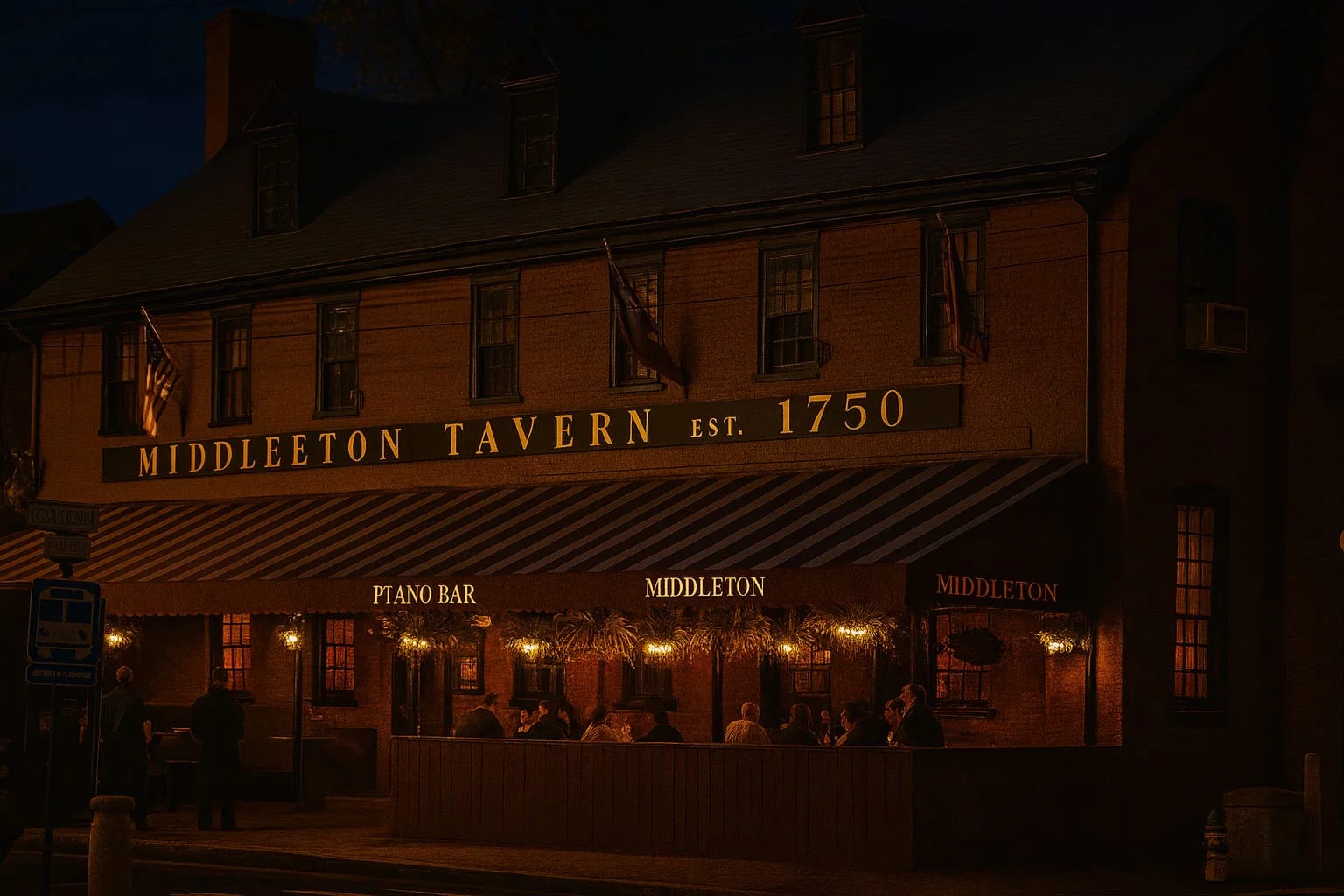
Middleton Tavern at the head of the Annapolis City Dock, one of the oldest taverns in America and a fixture of the colonial capital's waterfront