People who visit Evergreen often reach for the same word: untouched. You climb the steps of a grand Italianate mansion on North Charles Street, pass through rooms hung with art and lined floor to ceiling with rare books, and the modern city seems to fall away behind you. Gold-leaf surfaces. A private theater. Portraits of people dead for a century looking down from the walls. The furniture sits where the family left it. The effect is less museum than time capsule — a house where the past was never cleared out to make room for the present.
Evergreen is one of the most important historic homes in Baltimore, the former estate of the Garrett family, who turned a fortune from the Baltimore & Ohio Railroad into one of the country's great private collections of books and art. Generations of a single remarkable family lived, collected, mourned, and died under this roof, and almost everything they accumulated is still here.
That's the unusual root of Evergreen's haunted reputation. Most haunted places earn the label through violence or tragedy — a murder, a disaster, a prison's cruelty. Evergreen's comes from the opposite direction: from preservation itself, from the uncanny completeness with which the house holds onto the people who lived in it. Visitors and staff have long described a sense of presence here, a feeling that the family never entirely left.
This is a story about that family first. We'll walk through how Evergreen came to be, who the Garretts were, what they gathered inside these walls, and the quieter hauntings that a deeply preserved house seems to produce. It's one of the more unusual stops in our Haunted Baltimore collection, and exactly the kind of layered history we dig into on our Baltimore ghost tour.
What Is Evergreen Mansion?
Evergreen sits at 4545 North Charles Street, in the leafy northern reaches of the city near Roland Park and the Johns Hopkins campus. The core of the house — a 19th-century Italianate mansion — was built around 1858, but what stands today is the product of decades of expansion, until the original villa had grown into a sprawling estate of roughly 48 rooms set on landscaped grounds.
Among Baltimore's surviving great houses, Evergreen is in a category of its own. Plenty of Gilded Age mansions were demolished, subdivided, or stripped of their contents as the families that built them faded. Evergreen survived intact, contents and all, because the last of its owners arranged for exactly that — and because it passed not to heirs who might have sold it off piece by piece, but to an institution charged with keeping it whole.
That institution is Johns Hopkins University, which has operated the property as the Evergreen Museum & Library since the mid-20th century. The arrangement is the reason Evergreen feels the way it does. This is not a house restored to an imagined version of its past; it is a house preserved more or less as the family actually left it, down to the books on the shelves and the art on the walls.
Architecturally, Evergreen reads as a layered record of changing tastes. The Italianate bones of the 1850s gave way over time to additions and interiors reflecting the wealth and worldliness of its later owners — a gymnasium, a billiard room, a gold theater, the great library wing — each one a chapter in the family's growing ambition. The result is grand but personal, a house built for living in as much as for show. For anyone trying to understand how Baltimore's railroad aristocracy actually lived, there are few better windows than this one.
The Garrett Family and the Building of Evergreen
To understand Evergreen, you have to start with the railroad.
The Garrett family fortune was made on the Baltimore & Ohio, the pioneering line that helped turn Baltimore into a commercial powerhouse. John Work Garrett became president of the B&O in 1858 and held the post for more than a quarter century, building it into one of the most important railroads in the country. During the Civil War, the B&O under Garrett served as a crucial artery for the Union, moving troops and supplies, and Garrett himself became one of the wealthiest and most powerful men in Maryland.
It was his son, T. Harrison Garrett, who brought the family to Evergreen. In 1878, T. Harrison acquired the estate and made it the family seat, beginning the expansions and the collecting that would come to define the house. A serious bibliophile and connoisseur, he filled Evergreen with books, prints, coins, and art, laying the foundation of the extraordinary collections it still holds. His life was cut short in 1888, when he died in a boating accident on the Chesapeake Bay — a sudden loss that left the estate to a grieving widow and young sons.
Those sons carried Evergreen into the 20th century, and they made a striking pair. Robert Garrett, the elder, was an athlete of genuine distinction: competing for the United States at the first modern Olympic Games in Athens in 1896, he won events in the discus and the shot put, becoming one of the first modern Olympic champions — an improbable line in the history of a Baltimore banking family. The younger son, John Work Garrett, named for his railroad-magnate grandfather, became a career diplomat, serving as a United States ambassador and spending much of his life abroad.
It was this younger John Work Garrett and his wife, Alice Warder Garrett, who gave Evergreen its final and most dazzling form. Alice was a passionate patron of the arts — of painting, music, and theater — and under her the house became a cultural salon as much as a residence. The couple expanded the collections dramatically, bringing modern art and rare books to the estate, and Alice commissioned the Russian artist Léon Bakst, famed for his work with the Ballets Russes, to transform a room within the house into a jewel-box private theater, its surfaces ablaze with color and gold. Artists, musicians, and writers passed through Evergreen as the Garretts' guests.
When John Work Garrett died in 1942, he left Evergreen and its collections to Johns Hopkins University. Alice continued to live in the house until her own death about a decade later, the last of the family to call it home. Across roughly seventy years, three generations of Garretts had built, filled, and finally given away one of Baltimore's most remarkable estates — and left nearly all of themselves inside it.
Inside the Mansion: Art, Books, and Preserved History
What sets Evergreen apart from almost any other historic house is what's still inside it.
The library alone would make the estate significant. The Garretts assembled one of the great private book collections in the United States — tens of thousands of volumes, including rarities that would anchor a major institution's holdings. Among the treasures is a copy of John James Audubon's Birds of America, the enormous double-elephant folio that ranks among the most coveted books in the world. Shelves of early printed books, fine bindings, manuscripts, and first editions fill the library wing, the accumulated passion of more than one generation of collectors.
The art is just as remarkable, and far more eclectic. Alice Garrett's modern taste brought work by significant European artists into a house that already held older paintings, prints, Asian ceramics, and decorative objects gathered over decades. Tiffany glass, fine furniture, family portraits, and Bakst's astonishing painted theater share the rooms with the books. The collection isn't a tidy, museum-perfect survey; it's the personal accumulation of a particular family with particular enthusiasms, which is precisely what makes it feel alive.
That's the heart of why Evergreen unsettles people. Walk through most historic homes and you're looking at a careful reconstruction — period-appropriate pieces arranged to suggest how people might have lived. At Evergreen you're looking at the actual things: the family's own books, their own art, their own furniture, much of it in their own arrangements. The house doesn't represent the Garretts. It contains them. And a house that full of one family's belongings can feel, on a quiet afternoon, as though the family has only just stepped out of the room.
Death, Mourning, and Family Legacy at Evergreen
The Garretts, like every family, knew loss, and they lived in an age that took mourning seriously.
T. Harrison Garrett's sudden death in 1888 was the sharpest of these blows — a man in middle age, a collector at the height of his pursuits, gone in an instant on the water. The estate passed to a grieving widow and young sons, and the house absorbed the loss the way houses do. The 19th and early 20th centuries surrounded death with elaborate ritual: periods of formal mourning, memorial portraits, the careful keeping of a deceased person's rooms and possessions. Families of the Garretts' standing preserved memory deliberately — through objects, photographs, paintings, and architecture — refusing to let the dead simply vanish from the household.
Evergreen is, in a sense, the ultimate expression of that impulse. The Garretts did not merely live in the house; they curated it, generation after generation, keeping what came before and adding to it. When Alice Garrett spent her final years in the house after her husband's death, she was living among the accumulated belongings and memories of the entire family — surrounded, in a very real way, by everyone who had come before her.
Then she, too, was gone, and the house was preserved exactly as the family's long habit of preservation had always intended. Evergreen became a permanent memorial to the people who built it, which is worth keeping in mind as we turn to its ghosts. A house designed, consciously and unconsciously, to hold onto the dead should perhaps not surprise us when people say that it does.
Why Is Evergreen Mansion Considered Haunted?
Evergreen's haunted reputation is real, but it's a particular kind of haunting, and worth describing carefully.
You won't find a famous murder here, or a documented tragedy of the sort that anchors most ghost stories. What you find instead are decades of quiet reports — from visitors on tours, from staff who work in the house, from people who simply felt something while standing in a room full of another family's belongings. The recurring themes aren't terror or menace. They're presence, familiarity, attachment. People describe the sense that they are not alone in a room, that the house is occupied, that someone is aware of them.
Hauntings tied to historic homes tend to feel different from those attached to hospitals, prisons, or battlefields. Those places are about suffering and violence; a family home is about belonging. A house that held the same family for generations, and that still holds their possessions, produces ghost stories about people who loved the place and seem reluctant to leave it. At Evergreen, the reported presences feel less like trapped or tormented spirits than like residents — as though the Garretts are still, in some sense, at home, and the visitors are the intruders.
That framing matters, because it shapes nearly every story told about the house.
Reported Ghosts and Paranormal Activity at Evergreen Mansion
With the caveat that the documentation here is anecdotal — staff recollections, visitor accounts, stories traded over years rather than a verified record — these are the kinds of experiences people report at Evergreen.
Apparitions
The most striking reports involve figures. Visitors and staff have described glimpsing people in the mansion's hallways and rooms — a figure passing a doorway, someone seemingly present in a room a moment before it's found empty, a shape on a staircase. The descriptions tend toward the ordinary rather than the ghastly: people in period dress who look, for an instant, like part of the tour or part of the staff, until they're gone. Because the house is so full of portraits and photographs of the Garretts, witnesses sometimes feel they recognize the figures they've seen — though firm identifications are exactly the kind of claim that should be treated with caution.
Unexplained Sounds
Then come the sounds, the familiar repertoire of an old house with a long history. Footsteps in rooms and corridors known to be empty. Doors that open or close without a hand to move them. Voices, or fragments of them, carrying from unoccupied spaces. In a structure this large and this old, full of long galleries and quiet wings, mundane explanations are always available — settling timber, drafts, the ordinary noises of an aging building. The reports persist anyway, particularly among the people who spend the most time in the house alone.
Strange Experiences
Most common is the simplest experience of all: the feeling of being watched, and the sudden conviction of not being alone. Visitors describe walking into certain rooms and feeling an immediate change — a heaviness, a cold spot, the sense of attention turned toward them. Staff closing up, or working in distant parts of the house, report the same. None of it photographs or records reliably; it lives almost entirely in the realm of subjective experience. But it is consistent, and it is the thread running through nearly every Evergreen ghost story: the persistent feeling that the house is occupied by more than its catalog of objects.
The Ghosts of the Garrett Family
It's natural that the stories attach themselves to the Garretts. When you stand in a room surrounded by a family's books, art, portraits, and furniture, the imagination supplies the family to match.
Visitors who report apparitions at Evergreen often assume they've seen a Garrett — a former resident still moving through the rooms they furnished and loved. Some accounts gravitate toward a female figure, and given how strongly Alice Warder Garrett shaped the house, and how long she lived in it alone after her husband's death, it's understandable that people reach for her name. Others imagine earlier generations, the collectors and railroad heirs whose portraits hang on the walls. But I want to be clear about what the honest record requires: there are no documented, verified identifications of any Evergreen ghost. The connections people draw between the apparitions and specific Garretts are interpretations, not confirmed facts — the mind linking a half-seen figure to a face it has just been studying in a frame.
That link, though, is the most interesting part of the story, because it reveals how these hauntings actually work. Evergreen's ghost stories are a direct product of its preservation. The more completely a house holds onto a family, the more readily visitors populate it with that family's spirits. The portraits, the personal belongings, the rooms left as they were — all of it primes people to feel the former residents close at hand, and to name them. Whether or not the Garretts walk Evergreen's halls, they haunt it in the most concrete sense possible: their presence is everywhere in the building, because they never really took it down.
Why Historic Mansions Feel Haunted
Evergreen is far from alone in this. Across the country, historic house museums develop haunted reputations at a remarkable rate, and the reasons have less to do with the supernatural than with the nature of the places themselves.
Start with the belongings. A house museum is, by definition, full of the personal possessions of the dead — their clothes, their furniture, their portraits, the intimate objects of vanished lives, all carefully kept. Few environments are more saturated with the presence of specific people who are no longer alive. Add historic architecture: the dim light, the period rooms, the creak and chill of old construction, all of which prime visitors to expect something. Add the emotional weight that clings to places where families lived and died across generations. Then add the plain psychology of memory and attention — the human mind's deep tendency to sense presence, to read figures into shadows, to feel watched in a room full of painted eyes.
Put all of that together and a haunted reputation becomes nearly inevitable, no spirits required. The same qualities that make a preserved mansion historically priceless — its completeness, its intimacy, its uncanny fidelity to a vanished way of life — are exactly the qualities that make people feel the dead are near. Evergreen is simply one of the most complete examples of the type, which may be why its reputation runs as deep as it does.
Evergreen Mansion and Baltimore's Haunted History
Evergreen occupies a specific and revealing place in Baltimore's haunted landscape — the most domestic corner of it.
The city's better-known hauntings run to drama and the public sphere. The Admiral Fell Inn and the taverns of Fells Point belong to the rough world of the waterfront. The Baltimore Almshouse is a story of poverty and mass anonymous death, the opposite of Garrett wealth in every way. Even Edgar Allan Poe, buried at the Westminster Burying Ground, haunts the city as a public figure, claimed by everyone.
The closest cousin to Evergreen is the Crimea Mansion, the Winans family's secluded estate in Leakin Park — another grand private house tied to railroad wealth and a single dynasty. Even there, though, the comparison reveals a difference. The Crimea haunts through isolation and emptiness, a great house left largely alone in the woods. Evergreen haunts through fullness — through the overwhelming, intact presence of a family that never cleared out. One is a ghost of absence; the other, a ghost of belonging.
That makes Evergreen the most personal and family-centered haunting in the city. Its spirits, real or imagined, aren't strangers passing through. They're the people whose home this was, and whose home, in every visible sense, it remains. You'll find it alongside the rest of these stories in our Haunted Baltimore collection.
Can You Visit Evergreen Mansion Today?
Yes. Evergreen operates as the Evergreen Museum & Library, part of Johns Hopkins University, and it's open to the public for guided tours that take visitors through the mansion's rooms, collections, and grounds. Those tours are the only way to see most of the house, and they're worth taking on the history alone — the books, the art, the Bakst theater, and the sense of a Gilded Age estate preserved as its family left it.
Beyond the tours, the museum supports scholarship and education, opening its remarkable library and archives to researchers and hosting programs, exhibitions, and events through the year. The preservation that makes the house feel haunted is also what makes it one of Baltimore's genuinely important cultural institutions — a working museum and research library, not a roadside attraction.
If you go, go for the family and the collections first, and let any sense of presence arrive on its own. And if you'd like to set Evergreen in the context of the wider city after dark, our Baltimore ghost tour covers the stories that connect it to the rest of haunted Baltimore.
The House That Kept Its Family
Evergreen's deepest mystery may have nothing to do with ghosts. It's the completeness of the thing — the way one Baltimore family's entire world, three generations of books and art and ambition and grief, survives intact inside a single house, kept and catalogued and left almost exactly as they lived in it. Most families vanish into a few photographs and a headstone. The Garretts left a whole house.
That's what people are really responding to when they call Evergreen haunted. Whether or not a figure crosses a doorway or a footstep sounds in an empty gallery, the family is unmistakably present here, preserved more fully than the dead usually allow. The line between a deeply preserved home and a haunted one turns out to be very thin.
Evergreen is one of the most remarkable doors into Baltimore's past, and into the question of how the dead stay with us. To explore more of the city's history and its hauntings, wander our Haunted Baltimore stories, or come walk the city after dark with us on one of our Baltimore ghost tours, such as the Ghosts of Baltimore Tour.
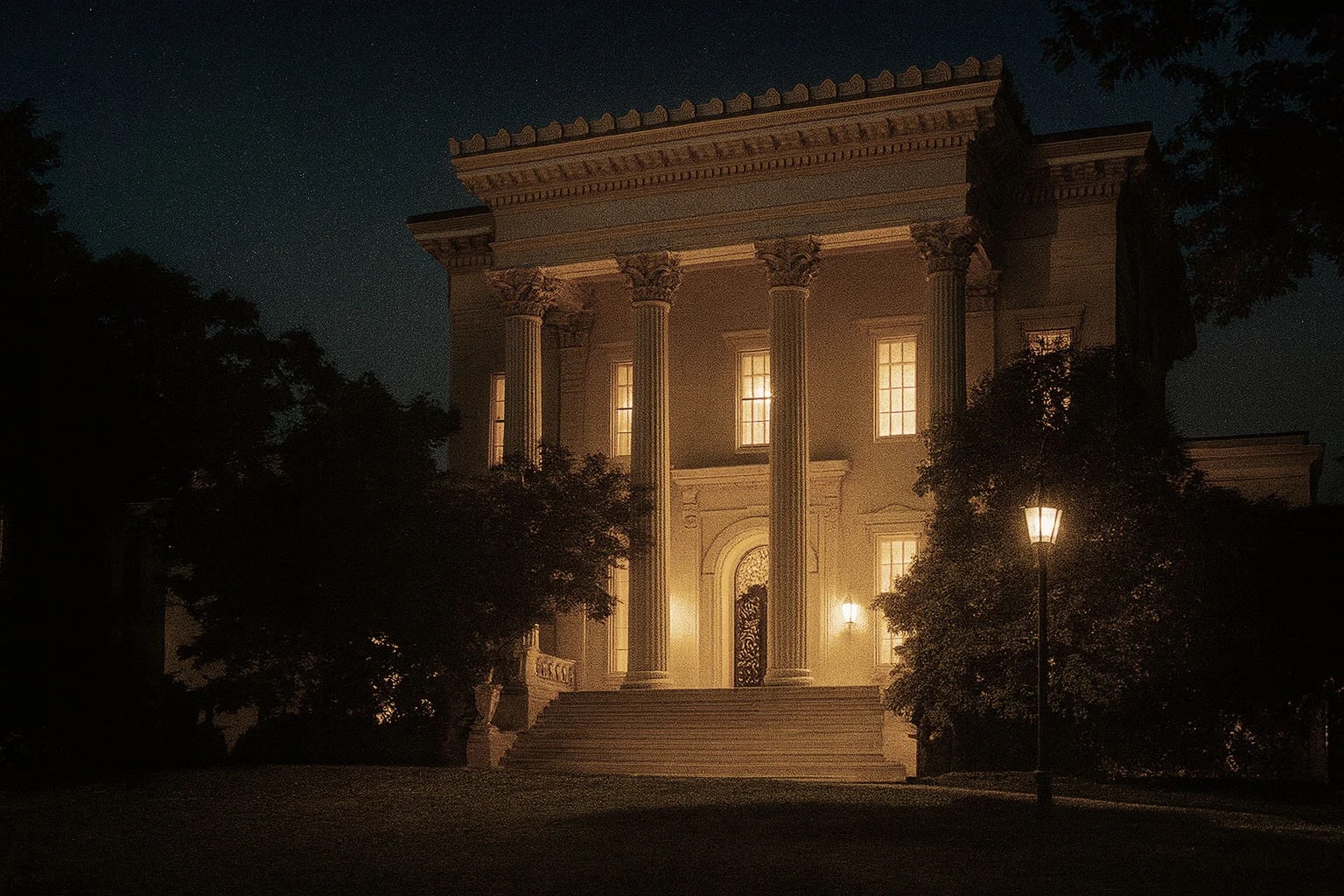
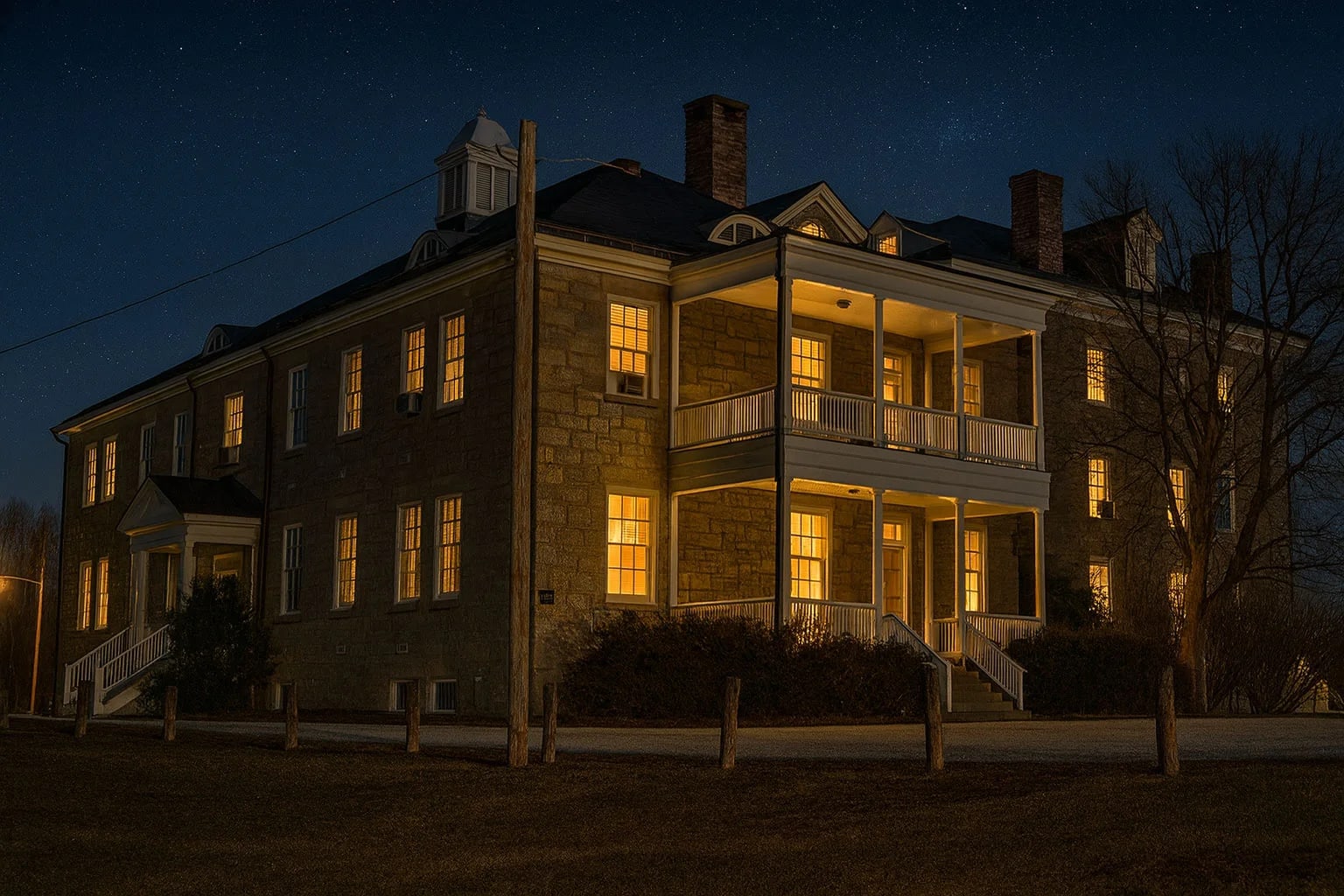
Evergreen Mansion on North Charles Street, the Garrett family estate now preserved as the Evergreen Museum & Library