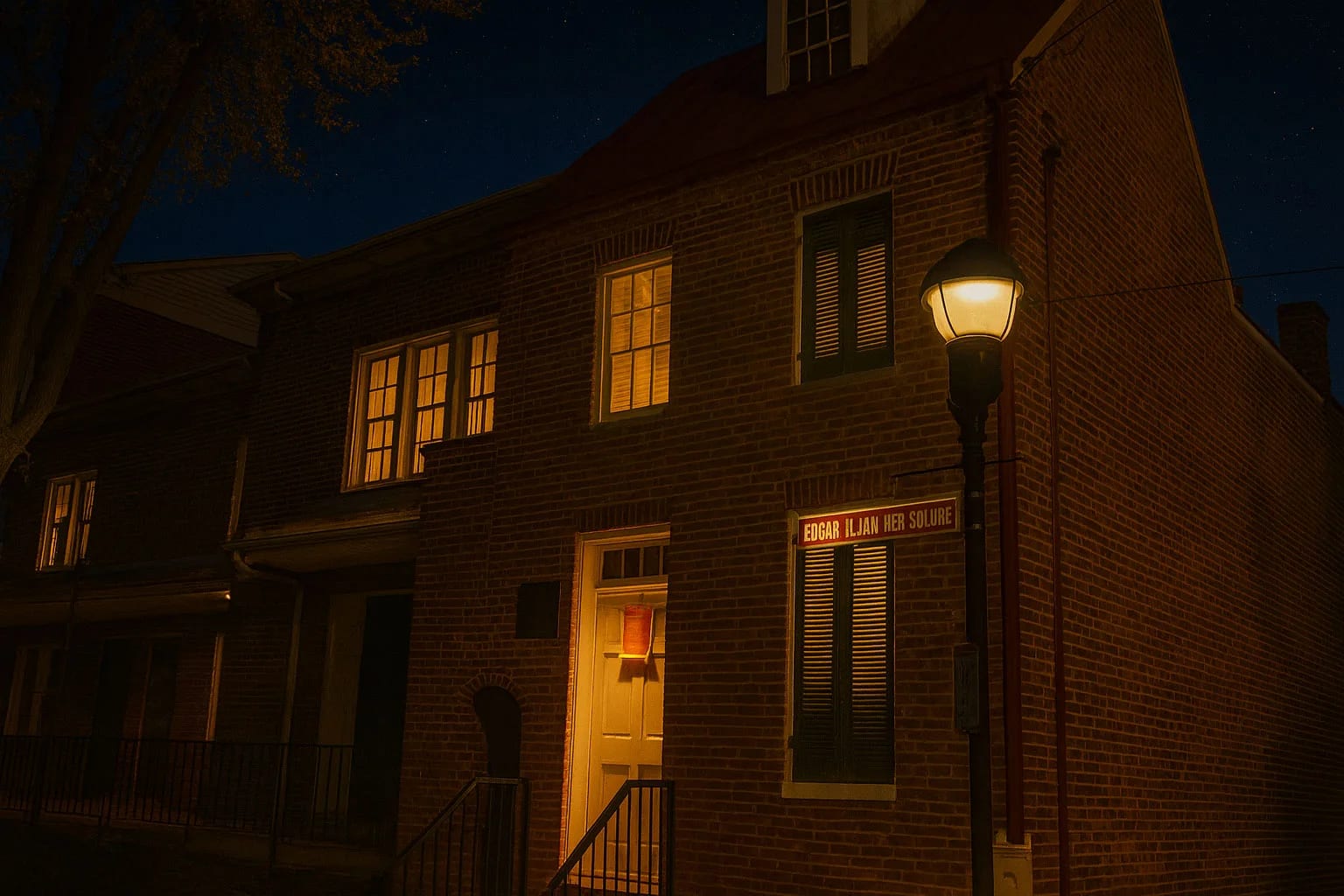
Most people who come to Baltimore never go looking for the Almshouse, and in a way that's the whole point. The city's haunted reputation gathers around the dramatic places — the waterfront taverns, the old hotels, the cobblestone streets of Fells Point where sailors drank and brawled and sometimes died. The Almshouse was none of those things. It was where Baltimore sent the people it would rather not think about.
For most of the 18th and 19th centuries, every American city had one: an almshouse, a poorhouse, a place where those who could not support themselves were taken in and, in theory, cared for. Baltimore's was among the largest and longest-running. Behind its walls lived the elderly with no one to keep them, the sick with nowhere else to go, orphaned children, abandoned mothers, the disabled, and the mentally ill. They arrived poor, and very often they died poor — buried in unmarked graves on the institution's own grounds.
This is not a ghost story, or at least not only one. It's the story of thousands of forgotten Baltimoreans whose names were never written down, or were written down and then lost. The hauntings came later, the way they always do around places of long suffering, and we'll get to them. But if this article does its job, the ghosts will feel almost beside the point by the end. The real haunting is how completely these people were forgotten.
In this guide we'll look at what the Almshouse was, who lived and died there, the conditions inside its walls, and the stories of restless spirits that have grown up around the institution's memory. It's one of the darker threads in our wider Haunted Baltimore collection, and exactly the kind of history we dig into on our Baltimore ghost tour.
Fast Facts
- Baltimore's first county almshouse was established in 1773, before the Revolution
- By the early 1820s the city and county almshouse occupied the Calverton estate west of Baltimore
- The Calverton almshouse buildings were destroyed by fire in 1874
- In 1866 the Bay View Asylum opened in southeast Baltimore, among the largest institutions of its kind in the country
- Bay View later became Baltimore City Hospitals and survives today as Johns Hopkins Bayview Medical Center
- Residents included the elderly, orphans, widows, the disabled, the chronically ill, and the mentally ill
- Disease, overcrowding, and high mortality were facts of daily life inside almshouse walls
- The poor who died were typically buried in unmarked graves in potter's fields on or near the grounds
- Record-keeping was inconsistent, and countless residents' names have been lost entirely
What Was the Baltimore Almshouse?
To understand the Almshouse, you first have to set aside the modern idea of a social safety net. There were no government pensions in early America. No unemployment insurance, no Medicaid, no Social Security. When a person became too old, too sick, too poor, or too alone to survive, the responsibility fell first to family, then to private charity, and finally — when those failed — to local government, which met the obligation in the bluntest way available. It built a house for the poor and put them in it.
This was "indoor relief," as the era called it, to distinguish it from "outdoor relief," or aid given to people in their own homes. The almshouse stood at the bottom of that ladder, the place of last resort. To "go to the poorhouse" was a genuine dread, not merely a figure of speech, because almost no one ended up there by choice.
Baltimore established its first county almshouse in 1773, in the years just before the Revolution, as the growing port town ran into the same poverty that shadowed every boomtown. As the city swelled in the early 19th century — with immigrants, with workers chasing the harbor's prosperity, with all the casualties of fast industrial growth — the need outgrew the original building. By the early 1820s, the Baltimore City and County Almshouse had moved to Calverton, a grand former estate west of the city, its elegant mansion repurposed to warehouse the poor. The Calverton buildings would later burn in 1874. Then, in 1866, the enormous Bay View Asylum opened in the city's southeast to take on the same role at a far larger scale — an institution so vast that it eventually grew into Baltimore City Hospitals and survives today, much transformed, as part of Johns Hopkins Bayview Medical Center.
Who ended up inside? Almost anyone life had broken. The elderly with no children to take them in. Widows left with nothing. Orphaned and abandoned children. Men disabled by industrial accidents or war. The chronically ill. The mentally ill, who had nowhere else to be confined. Pregnant women with no husband and no means. Immigrants who arrived sick or destitute. The almshouse was, in a real sense, a mirror of everything 19th-century society could not or would not fix — all of it gathered under one roof.
Life Inside the Almshouse
Life inside the Almshouse ran on a hard logic: the institution existed to keep the poor alive as cheaply as possible, and not much more. Comfort was never the goal. In many minds of the era, a measure of misery was actually the point — conditions were kept deliberately grim so that no one would prefer the poorhouse to honest work. The result was a daily existence that ranged from merely bleak to genuinely deadly.
Work, Food, and Discipline
Almshouses were rarely places of idleness. Able-bodied residents were expected to work — tending the institution's gardens and farm, doing laundry, cleaning, sewing, nursing the sicker inmates, and maintaining the buildings. Their labor offset the cost of running the place and reinforced the era's conviction that poverty was a moral failing best corrected by industry.
Food was plain and monotonous — bread, gruel, soup, whatever the farm and the budget could provide — and often inadequate. Discipline could be severe. Residents lived by the institution's schedule and its rules, their freedom sharply curtailed. Families were sometimes split apart, children separated from parents, husbands from wives. People who entered the almshouse surrendered much of their autonomy at the door, and for many the loss of dignity cut as deep as the physical hardship.
Overcrowding and Disease
The deeper danger was simply other people, packed too close together. Almshouses were chronically overcrowded and underfunded, and that combination turned them into incubators for disease. Respiratory illnesses moved easily through shared, poorly ventilated wards. Tuberculosis — consumption, as the age called it — was a constant presence, thinning the population year after year. And when epidemics swept Baltimore, the almshouse suffered terribly: the cholera that struck the city in 1832 tore through institutions like this one, and outbreaks of typhoid, smallpox, and other infectious diseases recurred across the decades.
Mortality, predictably, was high. The almshouse took in the old, the sick, and the frail, and a great many of them died there — sometimes within weeks of arriving. For the most vulnerable residents, the institution was less a refuge than a final address. The surviving records, incomplete as they are, make grim reading: long columns of admissions and deaths, of people who entered the system and never left it alive.
The Forgotten Ward
One population deserves particular mention, because their treatment was among the era's worst failures: the mentally ill. Long before the rise of dedicated asylums — and for a long time after — almshouses served as the default place to confine people with mental illness, who had committed no crime but had nowhere else to go and no one to care for them. Their conditions were often the harshest in the institution. Some were restrained or shut in cells. Understaffed and barely understood, mental illness inside the almshouse was managed rather than treated, and many of those residents lived out their entire lives within the walls, their stories almost completely unrecorded. If any group passed through these institutions more invisibly than the rest, it was them.
The Almshouse Hospital and Medical History
Medicine was woven into the almshouse from the start, because so many residents arrived sick and so many more became sick once inside. Most larger almshouses, Baltimore's included, ran an attached infirmary or hospital, and over time these medical wings grew into significant institutions in their own right. The connection between Baltimore's poorhouse system and the city's hospital system is direct: Bay View's medical functions expanded until the institution became Baltimore City Hospitals, a major public hospital, on its long road to becoming part of Johns Hopkins.
But the medicine practiced inside a 19th-century almshouse hospital bore little resemblance to anything we'd recognize today. This was the era before germ theory was understood or accepted, before antibiotics, before reliable anesthesia in the early decades. Treatments could be useless or actively harmful — bleeding, purging, dosing patients with mercury and other poisons. Sanitation was poor. The same overcrowding that spread disease through the wards spread it through the hospital too.
The diseases themselves read like a catalog of 19th-century death. Tuberculosis claimed residents steadily, year in and year out. Cholera arrived in waves and killed quickly and horribly. Yellow fever, typhoid, dysentery, pneumonia, and the ordinary infections that modern medicine now shrugs off all took their toll. For poor patients with weakened bodies and no resources, a stay in the almshouse hospital was very often where life ended. Death was not an aberration inside these walls. It was a daily fact, and everyone who lived there knew it.
Forgotten Deaths and Unmarked Graves
When a resident of the almshouse died — and they died often — the question of what to do with the body was answered as cheaply as everything else. The poor who passed through these institutions were, overwhelmingly, buried in potter's fields: paupers' grounds where the unclaimed and the indigent were interred in plain graves, frequently unmarked, sometimes several to a plot. No headstones. No monuments. In many cases, no surviving record of exactly who lay where.
Consider what that means at scale. Across the long life of Baltimore's almshouse system — from that first county poorhouse of 1773, through Calverton, and into the Bay View era — the number of people who passed through must have run well into the tens of thousands. A significant share of them died in the institution's care. And a great many of those were buried anonymously, their names recorded poorly if at all, their graves unmarked and, with time, simply lost. Burial grounds were built over, forgotten, paved, or absorbed into later development. People who had already been forgotten in life were forgotten a second time in death.
This is the part of the story I find hardest to shake. Baltimore is full of marked, remembered, even celebrated graves — Edgar Allan Poe's resting place at the Westminster Burying Ground draws visitors from around the world. The almshouse dead received the opposite. They got anonymity, and then erasure. Whatever you believe about ghosts, there is something genuinely haunting in the thought of thousands of human beings wiped from the record so completely that we cannot even speak their names.
Why Is the Baltimore Almshouse Considered Haunted?
It is no accident that almshouses, asylums, and old hospitals dominate the lists of supposedly haunted places. Institutions like these concentrate exactly the things that ghost stories are made of.
Think about what gathered inside the Almshouse: loneliness, on an enormous scale. Neglect. Chronic suffering. Sudden death, often far from anyone who loved the dying. And then, after death, anonymity — the final indignity of being forgotten altogether. If you set out to design a place that human culture would inevitably decide was haunted, you could hardly do better.
I want to be careful here, though, because the leap from a place of great suffering to a place full of ghosts is a cultural reflex, not a proven fact. We tell ghost stories about poorhouses and asylums partly because the real history is unbearable, and a haunting is, in a strange way, easier to sit with than the truth. A ghost at least implies the dead are still here, still felt, still mattering to someone. The actual fate of the almshouse dead — total erasure — is far bleaker than any ghost story. So when people say the Baltimore Almshouse is haunted, I suspect they're reaching, half-consciously, for a way to give those forgotten lives the attention they never received. The folklore becomes its own kind of memorial.
Reported Paranormal Activity
With that caveat firmly in place, here are the kinds of experiences that have attached themselves to the almshouse sites and the grounds around them over the years. I offer them as reports and local lore — the stories people tell — not as evidence of anything.
Apparitions
The most common reports involve figures that don't belong to the living. Witnesses on or near the old institutional grounds have described shadow shapes moving where no one should be — sliding along a corridor, crossing a window, standing at the edge of a room and gone the instant they're looked at directly. Others describe more distinct figures: elderly men and women in old-fashioned, institutional clothing, thin and worn, seen for a moment before they fade. A recurring note in these accounts is that the figures seem unaware of, or indifferent to, the living — not menacing, simply present, going about some routine of their own. People sometimes take them for patients or inmates, though of course no one can say for sure.
Voices and Cries
Then there are the sounds, and this is where the almshouse stories take on their particular, sorrowful character. The reports are unusually heavy on voices and weeping. People describe hearing crying with no source — a sound that seems to come from far off, or from an empty room. Some say they've heard names called, or low conversation just beneath the threshold of understanding, or the kind of moaning you'd expect from a hospital ward. Where waterfront hauntings tend toward footsteps and slamming doors, the institutional ones tend toward the human voice in distress. Given the history, that is its own quiet horror.
Physical Phenomena
Finally, the familiar physical phenomena that cluster around any reputedly haunted place: cold spots that drift through a room, doors that open or close on their own, unexplained sounds in the night, equipment that fails for no reason. These are the least distinctive reports — you'll hear the same from a hundred other locations — and the easiest to explain by ordinary means in old, drafty, much-altered buildings. I include them for completeness, but it's the apparitions, and above all the voices, that give the almshouse legends their unmistakable, mournful edge.
The Spirits of the Forgotten Residents
Strip away the shadow figures and the cold spots, and you find that almost every almshouse ghost story is, at heart, about the same thing: someone who was forgotten.
The spirits people describe are never the famous or the powerful. They're the old woman who died with no family to claim her. The child who grew up inside an institution and then vanished from the record. The man buried without a marker in a field that was later paved over. The legends gather around exactly the people history discarded, and I don't think that's a coincidence.
There's a reason these stories still land with modern audiences, even people who don't believe a word of the paranormal. We are, all of us, afraid of being forgotten. We want our lives to register somewhere, to have mattered to someone, to leave a mark that outlasts us. The almshouse dead are our deepest version of that fear made real: thousands of human beings who lived full, difficult, particular lives — who loved and feared and hoped — and were then erased so thoroughly that not even their names survive.
When someone tells me they saw an old man in a worn coat standing at the edge of the old almshouse grounds, I don't know what they saw. But I understand completely why the story endures. It's a refusal. It insists that those people were here, that they counted, that they will not be entirely forgotten after all. The ghost story does the remembering that history failed to do.
Connections to Baltimore's Larger Haunted History
The Almshouse belongs to a different category of Baltimore ghost story than the ones the city is famous for.
Most of Baltimore's celebrated hauntings are loud and dramatic. Down on the water, the Admiral Fell Inn has its phantom sailors and its Lady in White; the bars and cobblestones of Fells Point carry tales of drowned mariners, a poet's ghost at an old saloon, and ships that appear out of the fog. Those are stories of incident — sudden death, violence, shipwreck, the sea. They have villains and victims and vivid scenes.
The Almshouse is something quieter, and to me far sadder. Its hauntings aren't built on a single dramatic night but on the slow grind of institutional life and the sheer accumulation of forgotten death. There's no famous victim, no notorious crime, no romantic legend. Just thousands of ordinary people and the weight of their collective suffering. Institutions tend to produce this kind of ghost story — one rooted in memory and neglect rather than spectacle.
That contrast is worth holding onto, because it says something about how a city chooses to remember. Baltimore turned its waterfront tragedies into colorful legends you can hear on a night out. The almshouse it mostly chose to forget. Both belong to the same haunted city, and we try to do justice to both — the famous and the forgotten — across our Haunted Baltimore stories and our Baltimore ghost tour.
Historical Investigations and Modern Interest
In recent decades, the almshouse has slowly begun to be remembered. Historians and genealogists have worked to recover what the records can still tell us, combing through admission ledgers, death registers, censuses, and newspaper notices to reconstruct who these people actually were. It is painstaking work, because the documentation is so uneven — some years survive in detail, others are simply gone.
Elsewhere in the country, the rediscovery of forgotten institutional burial grounds has become a quietly powerful movement. When construction or research turns up a long-lost potter's field on the site of an old poorhouse or asylum, it forces a reckoning: suddenly there are remains to account for, names to try to recover, descendants to notify. Each such discovery is a reminder of how many of these sites are still out there, paved over and built upon and waiting.
There's also a broader surge of public interest in exactly this kind of history — the institutions earlier generations hid away and then erased. Almshouses, asylums, orphan homes, charity hospitals: places once considered too shameful to discuss are now the subject of serious research, preservation efforts, and genuine fascination. Baltimore's almshouse is part of that reckoning. The more we learn, the clearer it becomes that the institution's real story is larger and more important than any ghost legend attached to it.
Why the Baltimore Almshouse Still Matters Today
It would be easy to file the Almshouse under dark tourism and move on. I'd argue it deserves better, because the questions it raises are not historical curiosities. They are still ours.
The Almshouse existed because a society had to decide what it owed its poorest, sickest, oldest, and most vulnerable members — and then build something that embodied the answer. The answer Baltimore gave, like the answer most American cities gave, was bleak: keep them alive, keep them out of sight, spend as little as possible, and let a hard life serve as a warning to everyone else. The suffering inside those walls was not an accident. To a significant degree, it was policy.
We are still answering the same question, only in different language. How we treat the poor, the mentally ill, the aging, the disabled, the people who slip through every net — that remains one of the truest measures of any society. The almshouse is a mirror held up to the past, and the reflection isn't flattering. Looking at it honestly is uncomfortable, which is precisely why it matters.
And then there are the people themselves — not symbols, not statistics, but individuals. Every admission in those faded ledgers was a person with a name, a face, a history, fears and small joys, who arrived at the poorhouse because every other door had closed. They deserve to be remembered as more than a cautionary tale or a ghost story. Remembering them is the least we owe them now.
The Forgotten at the Heart of the Haunting
The Baltimore Almshouse is one of the city's most important forgotten stories, and the ghosts are the least of it. What lingers, when you really sit with the history, isn't the shadow figure at the edge of the grounds or the crying heard in an empty room. It's the scale of the forgetting — the tens of thousands of people who passed through, suffered, died, and were buried namelessly, erased so completely that even now we can recover only fragments of who they were.
If they haunt anything, maybe it's our conscience. The stories of restless spirits are, in the end, a way of insisting that those lives mattered, that they should not have been thrown away, that someone is still paying attention. That's a haunting worth taking seriously.
Baltimore's darker history runs far deeper than its famous waterfront legends, and the Almshouse is proof of it. If you want to understand the city's long relationship with poverty, death, and memory, come walk it with us. Explore the rest of our Haunted Baltimore stories and the haunted streets of Fells Point, or join one of our Baltimore ghost tours — like the Ghosts of Baltimore Tour — and hear the stories the history books left out.
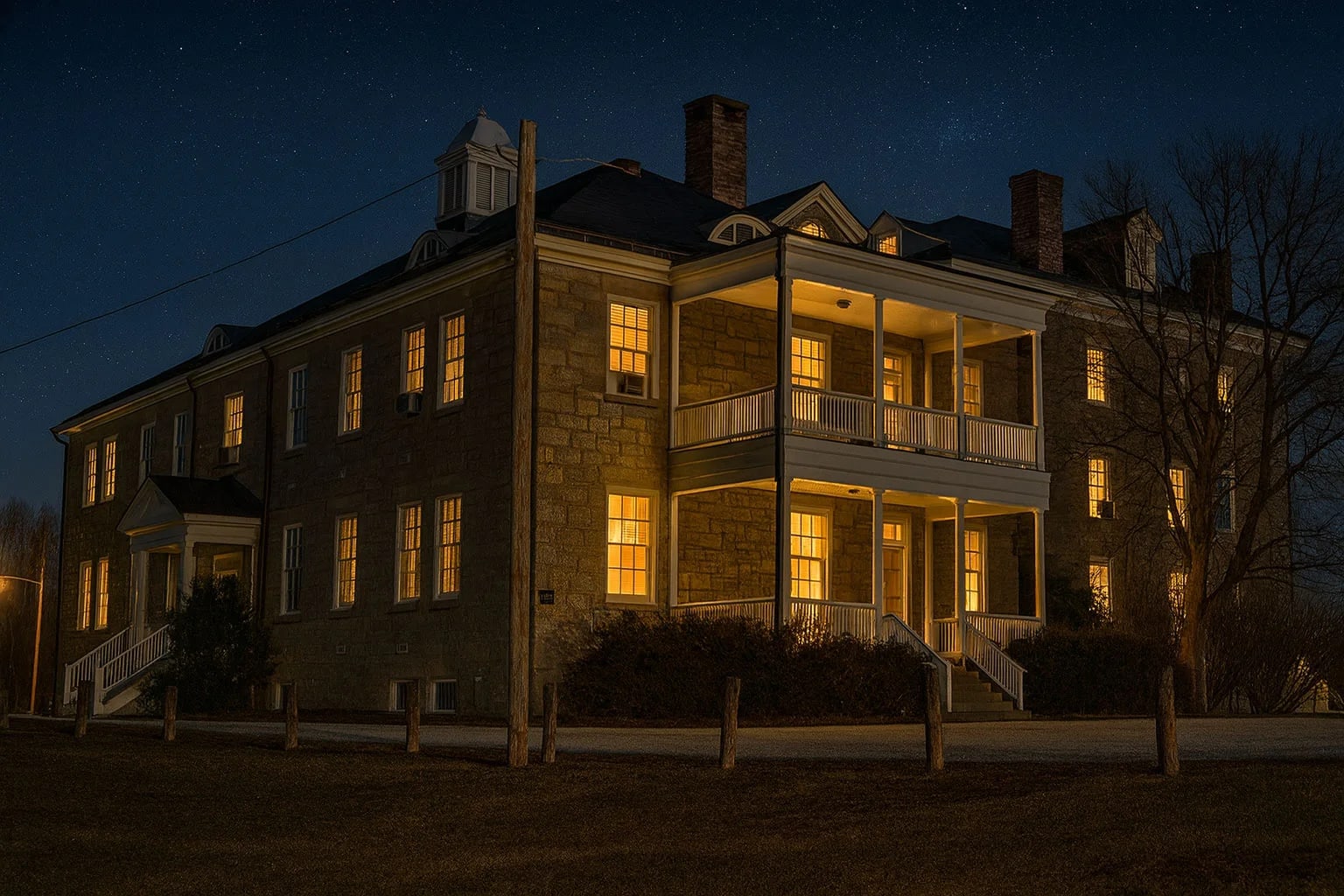
The Baltimore Almshouse, where tens of thousands of the city's poorest residents lived, died, and were too often forgotten