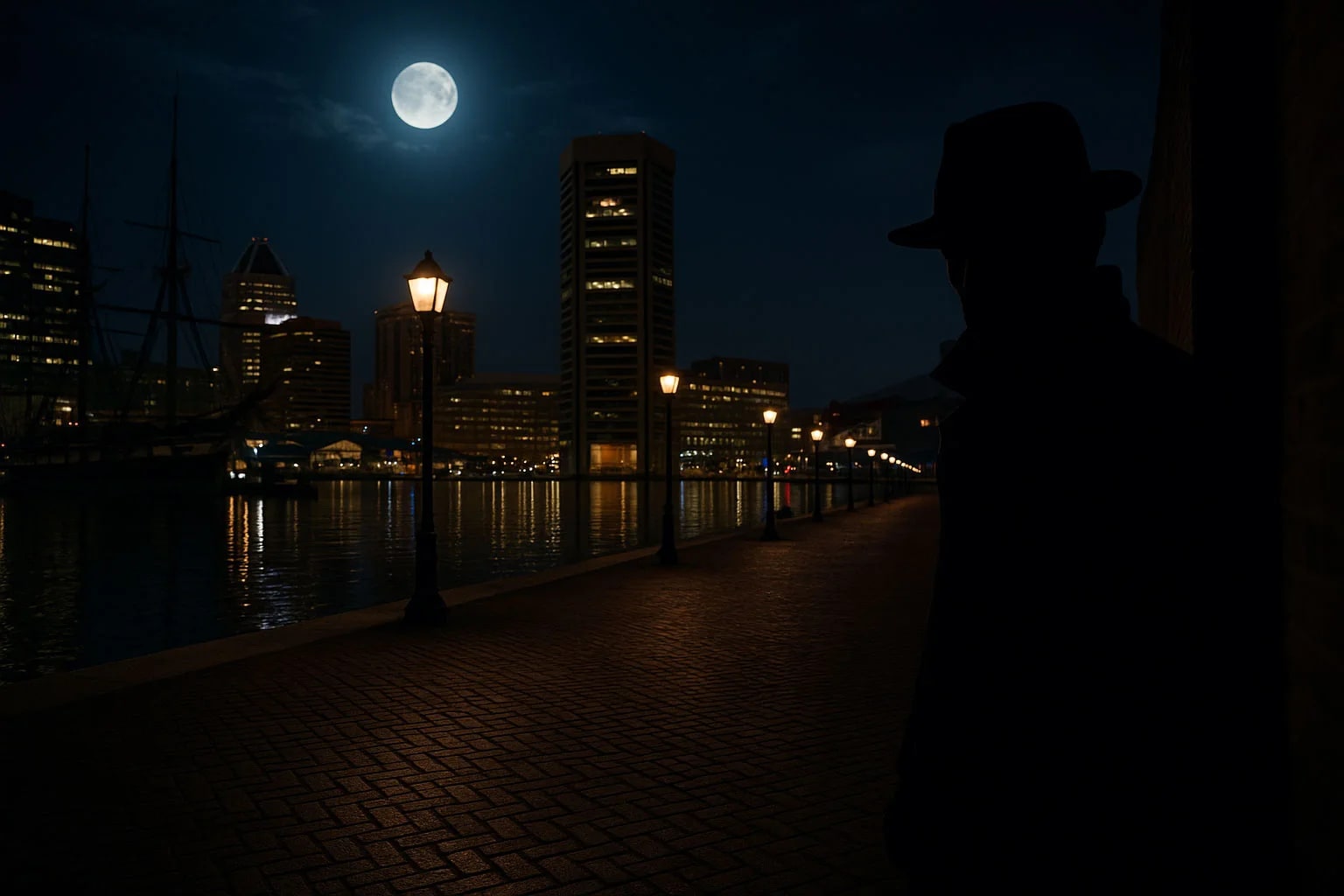
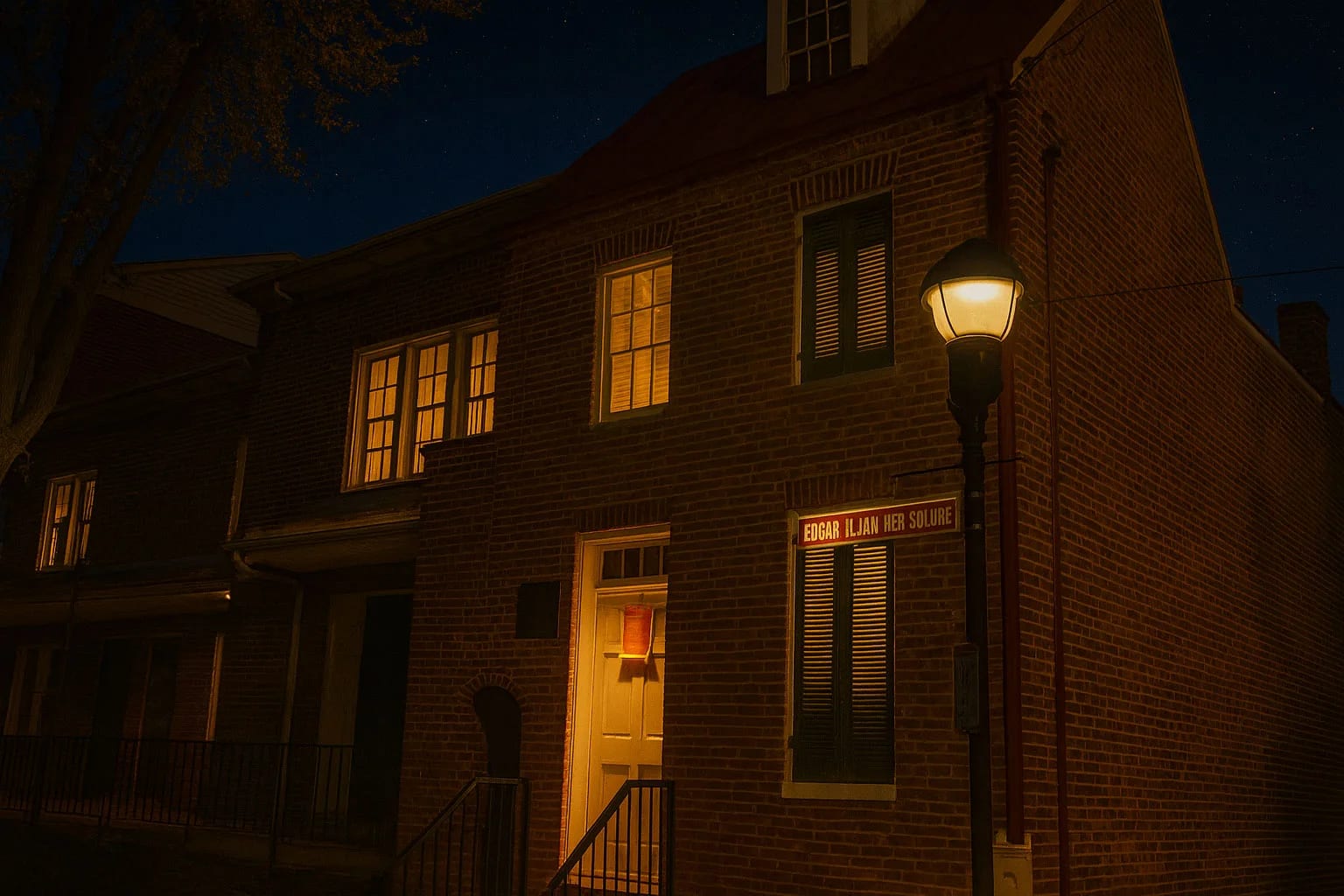
Come down to Fells Point on a damp night, after the restaurants have thinned out and the last tour buses are long gone, and you'll understand why we keep coming back here. The cobblestones are uneven underfoot — real ones, laid by hand two centuries ago, not the decorative kind. Fog slides up off the Patapsco and pools in the doorways. A halyard clinks somewhere out on the water. And the brick rowhouses, packed shoulder to shoulder, lean in close like they're trying to tell you something.
I've guided people through a lot of Baltimore neighborhoods. None of them feels quite like this one.
Fells Point sits on the north shore of Baltimore's harbor, a compact grid of streets that runs right down to the water at the foot of Broadway. For most of its life it was a working waterfront — shipyards, wharves, taverns, boarding houses — and the people who built it were sailors, immigrants, shipwrights, dockhands, and more than a few criminals. That mix is exactly why the neighborhood carries the reputation it does today. Where there are that many hard lives and sudden deaths, the stories pile up. And in Fells Point, the stories never really left.
This is the part of Baltimore where the past feels closest. Walk it long enough and you start to notice the things the daylight hides: the old saloon that counts a famous dead poet among its regulars, the inn where guests call the front desk about visitors who were never checked in, the square where dockworkers are still seen waiting for ships that sailed two hundred years ago.
In this guide we'll walk through all of it — how Fells Point was born, why it earned its haunted name, and the ghosts people still report along the waterfront. If reading about it isn't enough, our Baltimore ghost tour and our Baltimore Haunted Pub Crawl both spend their evenings in these streets. Consider this your preview.
Fast Facts
- Founded in 1763 by the family of William Fell, an English shipbuilder
- Located on the north shore of Baltimore's harbor, at the foot of Broadway
- One of America's great early shipbuilding centers — home of the Baltimore Clipper
- A major port of entry for immigrants in the 18th and 19th centuries
- Struck repeatedly by yellow fever and cholera epidemics
- Home to The Horse You Came In On Saloon, said to be among the oldest continuously operating saloons in the country
- Strongly associated with Edgar Allan Poe, who died in Baltimore in 1849
- Frederick Douglass worked as a caulker in the Fells Point shipyards
- One of Baltimore's most reported neighborhoods for ghost sightings and paranormal activity
The History of Fells Point
To understand why Fells Point is so haunted, you first have to understand what kind of place it was. This was never a polite neighborhood of merchants and church spires. It was a waterfront — loud, crowded, dangerous, and absolutely essential to Baltimore's rise. The history here runs deep, and a lot of it is hard. That's usually where the ghost stories come from.
The Founding of Fells Point
In 1726, an English shipbuilder named William Fell sailed into the Patapsco and saw something most people had missed. The deep water along the harbor's north shore was ideal for building and launching ships — better, in fact, than the shallower ground where Baltimore Town itself was taking shape. Fell bought up the land. His son Edward laid out the streets in 1763, naming them for the family and the places they'd come from, and Fell's Point was born.
The location did exactly what the Fells hoped it would. Ships could be built, repaired, loaded, and sent back out with ease, and the wharves filled quickly with cargo from the Caribbean, Europe, and up and down the American coast. Within a generation, Fells Point had become one of the busiest shipping points in the young United States, and Baltimore grew wealthy on the back of it.
Shipbuilding and Privateers
What made Fells Point famous, though, was a ship. The Baltimore Clipper — fast, sleek, and built for speed rather than cargo capacity — was perfected in these shipyards, and during the War of 1812 those fast ships became weapons. Baltimore's privateers, sailing with the government's blessing, slipped out of the harbor and preyed on British merchant vessels by the hundreds.
The British hated Baltimore for it. They called the city a nest of pirates, and in 1814 they came to burn it — an attack that broke against the walls of Fort McHenry and gave the country its national anthem. (If forts and bombardments are more your speed, we tell that whole story over at Fort McHenry, which has no shortage of ghosts of its own.)
Privateering made fortunes, and it cost lives. Men died at sea. They died in battle. They died of fever in foreign ports and were buried far from home. The waterfront that launched those ships also absorbed all of that loss, year after year, decade after decade.
A Rough Waterfront District
Then there was the everyday life of the place, which was often rougher than any sea battle. Sailors came ashore after months at sea with money in their pockets and a powerful thirst, and Fells Point was happy to relieve them of both. Taverns stood on nearly every corner. Boarding houses rented beds in shifts. Brothels operated openly, and so did the men who made their living separating sailors from their pay — sometimes with liquor, sometimes with a blackjack to the back of the skull.
"Crimping" was a real danger here: the practice of drugging or beating a man and selling him to a ship's captain as crew. A sailor could step out for one drink and wake up days later on a vessel bound for the far side of the world, with no say in the matter at all.
Fights were constant. Knifings and drownings were common enough that most of them never made the papers. The hardships of that life — the violence, the desperation, the sheer number of people who died young and far from anyone who loved them — laid the foundation for nearly every legend the neighborhood still tells. Keep that in mind as we get to the ghosts. The history and the hauntings here are never really separate.
Why Is Fells Point Considered Haunted?
Ask me why one neighborhood ends up with so many ghost stories while another stays quiet, and I'll point you straight back to the water.
Waterfronts collect tragedy. Death at sea was routine — storms, accidents, men washed overboard and never recovered. The docks themselves were dangerous places to work, where a snapped line or a shifting load could kill a man in a heartbeat. Disease was worse. Ships arriving from the Caribbean carried yellow fever, and cholera tore through the crowded, unsanitary waterfront more than once in the 1800s. Whole boarding houses emptied out. People died fast, often with no family nearby, and were buried in a hurry.
Add the ordinary violence of a sailor town to all of that and you get a place layered with sudden, unresolved death. That's the common thread in nearly every haunted district I've ever walked — not evil, exactly, but unfinished lives. People who never got the chance to say goodbye.
Fells Point has that in abundance. Whether you believe the stories or not, it's easy to see why they took root here. This has been a place where lives ended abruptly for more than two and a half centuries. Some say a few of those lives never fully ended at all.
Edgar Allan Poe and the Shadow Over Fells Point
No ghost is tied to Baltimore more tightly than Edgar Allan Poe — and I want to be careful here, because the truth is strange enough without anyone embellishing it.
Poe wasn't born in Baltimore, but the city claimed him all the same. He lived here in the early 1830s with his aunt and his young cousin Virginia, whom he later married. He did some of his earliest important work while connected to the city. And it was here, in October 1849, that his life ended in a way no one has ever fully explained.
Poe was found delirious outside a tavern that was being used as a polling place, wearing clothes that weren't his own, unable to say clearly what had happened to him. He was taken to a hospital and died a few days later, never lucid enough to explain himself. The cause is still argued over today — drink, a beating, illness, even the old practice of "cooping," in which men were kidnapped, drugged, and forced to vote again and again at multiple polling places. We may never know.
A death that mysterious leaves a mark. Baltimoreans have associated Poe with the uncanny ever since, and visitors who come looking for him sometimes report more than they bargained for: a figure in dark, old-fashioned clothing glimpsed near sites tied to his life, a sudden sense of being watched, a chill in a doorway with no draft to explain it.
I won't tell you Poe haunts one specific address in Fells Point. The honest record doesn't support that, and you deserve better than a story I can't stand behind. What I'll tell you is this: the man who taught America how to be afraid died in this city under circumstances worthy of one of his own tales, and his shadow falls over the whole waterfront. People feel it. That feeling is a big part of why they come.
The Horse You Came In On Saloon
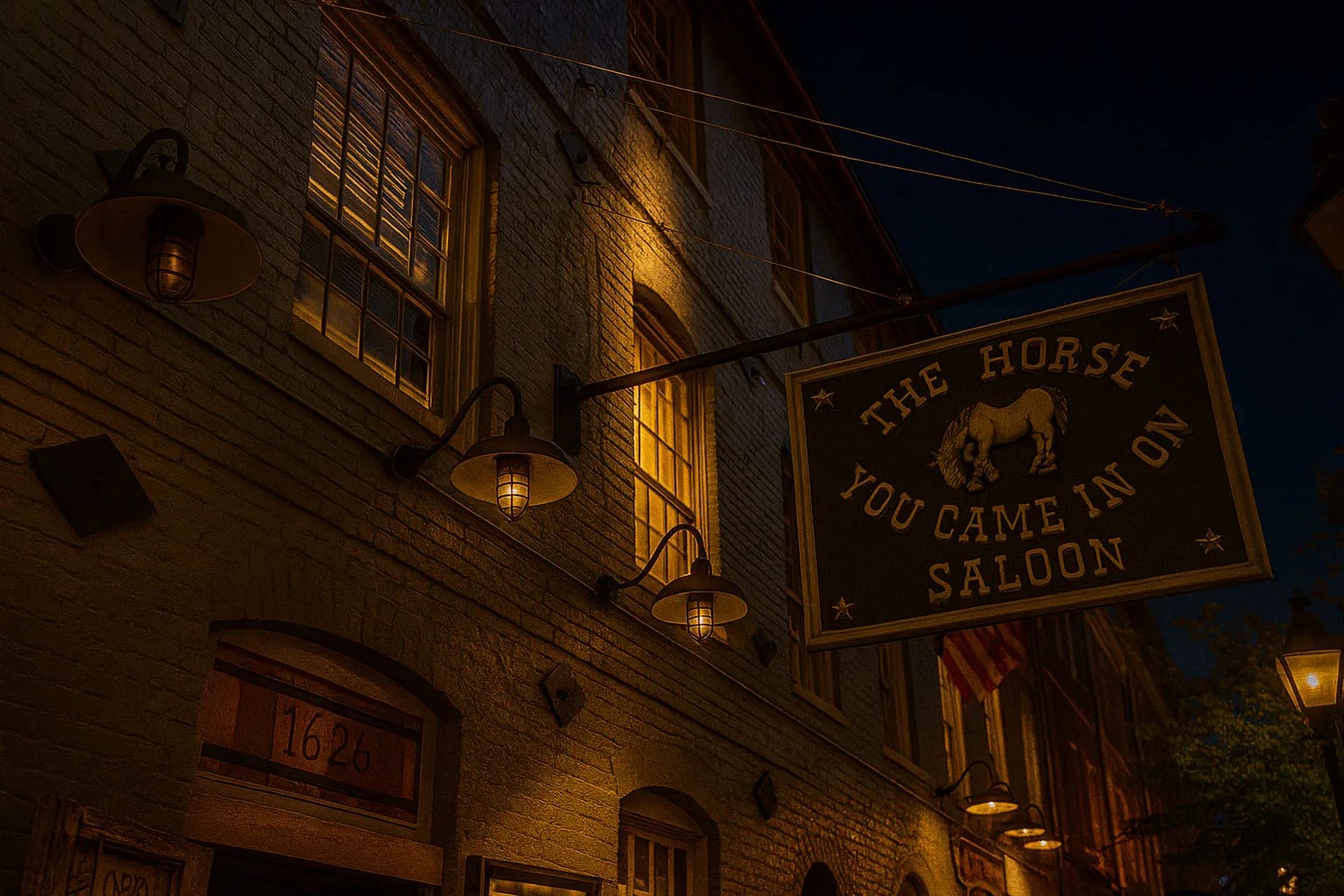
If there's one building in Fells Point you've probably already heard about, it's the one at 1626 Thames Street. The Horse You Came In On Saloon claims to be the oldest continuously operating saloon in America — open, the story goes, since 1775, through the Revolution, the Civil War, and even Prohibition, when it supposedly never quite stopped pouring. Whether or not it can document every single year of that boast, there's no arguing that it's old, and there's no arguing that the people who drink there take its ghost seriously.
The regulars call him Edgar.
The connection runs back to Poe. This is said to be one of the last places he had a drink before he was found dying nearby in 1849, and over the years the saloon has leaned into that history. But the staff will tell you the activity is more than marketing. Bartenders closing up alone describe the lights swinging on their chains after the doors are locked. Glasses slide along the back bar and drop. The cash register has been known to ring open on its own. Upstairs, people report footsteps crossing empty floorboards, cold pockets of air in a warm room, and the unmistakable sense of someone standing right behind them when no one is there.
A few employees have said they see a figure seated at the end of the bar late at night — there one moment, gone the next when they look again. Is it Poe? I can't tell you that, and I won't pretend to. What I can tell you is that the reports have stayed remarkably consistent for decades, from people who have no particular reason to invent them, and that most of them happen after last call, when the only person left in the building should be the one locking the door.
The Horse is exactly the kind of stop that makes our Baltimore Haunted Pub Crawl what it is: real bars, real history, and stories told where they actually happened, with a drink in your hand. And if you'd rather hear the unfiltered, adults-only version of the waterfront's darker history, our Devil in the Harbor tour digs straight into the grittier side of these streets after dark. For the full story of the saloon and its ghosts, see our guide to The Horse You Came In On.
Bertha's and the Lady in White
A short walk away, on Broadway, there's a green building you can't miss — and not only because of the famous "Eat Bertha's Mussels" bumper stickers that somehow ended up on cars all over the world. Bertha's has been a Fells Point fixture for decades, a restaurant and bar housed in a building far older than the business itself, and it comes with a ghost of its own.
Staff have long described a woman who doesn't belong to the living clientele. The Lady in White, as she's usually called, has been reported on the upper floors: a pale female figure who appears and then is simply gone, most often after the place has closed and the dining room has fallen quiet. Servers and bartenders over the years have talked about glasses moving on their own, lights and equipment behaving strangely, footsteps overhead when the upstairs is empty, and the distinct feeling of being watched while they finish their side work late at night.
Who is she? Nobody knows for certain — which is true of most of the best waterfront ghosts. A building this old in a neighborhood this old changed hands and changed purposes many times over, and the records of who lived and died inside are thin. What survives instead is the experience, passed from one shift of employees to the next, told and retold until it becomes part of the building itself. The Lady in White is folklore in the truest sense: a story the neighborhood keeps alive because the people who work there keep meeting her.
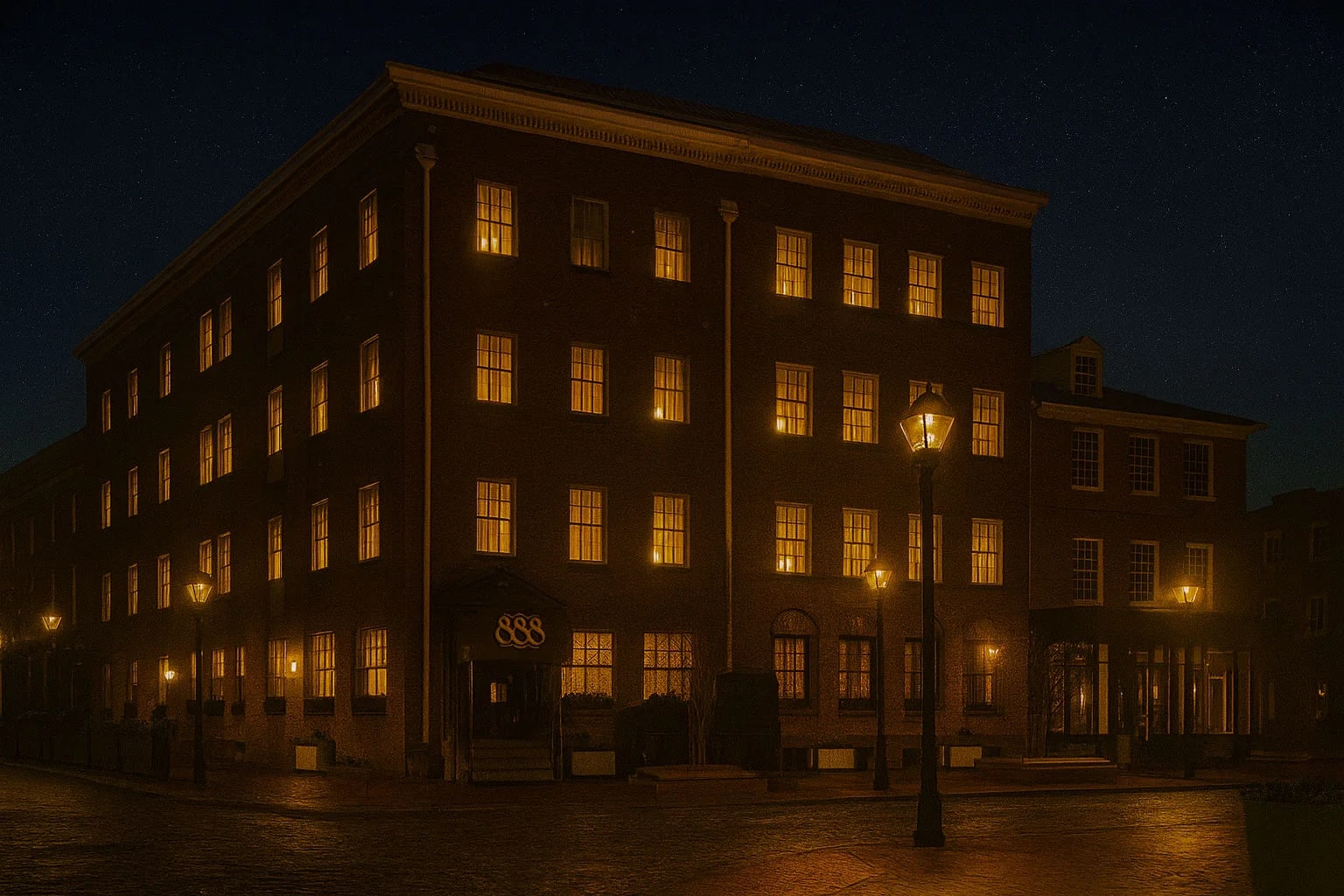
The Admiral Fell Inn
Down at the foot of Broadway, right where the cobblestones meet the water, stands the Admiral Fell Inn — and if you ask Fells Point regulars to name the neighborhood's most haunted address, this is the one that comes up first.
The inn isn't a single building. It's several, stitched together over time into one hotel, and parts of it reach back to the late 1700s. Over the centuries those buildings served as a boarding house for sailors, a vinegar factory, a theater, and a YMCA for seamen, among other things — which means generations of transient, hard-living people passed through these walls, and some of them never made it back out to sea. All of that history seems to have stayed behind.
Guests and staff report a long catalog of phenomena. Footsteps pace empty hallways at night. Voices and laughter drift out of unoccupied rooms. Doors open and close with no hand to move them. Guests call the front desk to complain about the noise from the room next door, only to be told that room is vacant. Some wake to find a figure standing at the foot of the bed, or feel the mattress sink as though someone has sat down beside them. A few describe a man in old sailor's clothing seen briefly in the corridors before he's gone.
One of the most repeated stories dates to a hurricane in the 1990s, when staff who sheltered in the inn overnight reported hearing a party on an upper floor — music, voices, the sounds of a crowd having a wonderful time — in a part of the building they knew to be completely empty. By morning it had stopped. No source was ever found.
I always tell guests that the Admiral Fell Inn is a perfect example of why Baltimore is so genuinely haunted: it isn't one tragic event, it's centuries of ordinary life and death stacked in a single place. There's far more to it than I can fit here — the phantom sailors, the Lady in White, the hurricane-night party heard in an empty wing — so we gave it its own full guide, The Ghosts of the Admiral Fell Inn. If haunted hotels are your weakness, the Lord Baltimore Hotel downtown carries the same kind of weight, and we cover all of them on our Baltimore ghost tour.
The Spirits of Broadway Square
Broadway Square — the wide market space running up the center of Broadway from the water's edge — has been the beating heart of Fells Point since the neighborhood's earliest days. This is where the public business of a port town happened: markets, gatherings, the constant churn of people arriving and shipping out. The Broadway Market has stood here in one form or another since the 1780s. For more than two centuries, nearly everyone who lived, worked, or passed through Fells Point crossed this square.
Places that hold that much human traffic tend to hold onto something. The square's ghost stories center on the people who actually made the waterfront run — sailors and dockworkers, mostly. Late at night, when the stalls are shuttered and the foot traffic thins, people describe figures near the foot of Broadway who don't move like ordinary pedestrians: a man in worn working clothes standing at the water's edge as though waiting for a ship, there until you look straight at him; shadow shapes that cross the open square and dissolve before they reach the far side.
None of it is especially dramatic, and that's exactly what makes it convincing. The Broadway Square stories aren't about monsters. They're about working people still going through the motions that filled their lives, in the oldest public space of one of Baltimore's oldest neighborhoods. The waterfront made them. Some of them, it seems, never left it.
Ghost Ships and Harbor Legends
Step away from the buildings and look at the water itself, and you find a whole other layer of Fells Point folklore — the kind that belongs to the harbor rather than to any one address. Sailors are superstitious people by trade, and the tales they carried ashore took root here and never washed out.
Phantom Sailors
For as long as anyone has kept track, people along the Fells Point waterfront have reported sailors who aren't there. They're seen on the docks and at the ends of the wharves, dressed in clothing decades or centuries out of date — a man coiling a line that doesn't exist, a figure walking the length of a pier and stepping off the end without a splash. Some are said to appear soaking wet, as though they've only just come up out of the harbor. Dockworkers and night-shift employees are the most common witnesses, which makes sense; they're the ones still out there in the hours when the waterfront empties and the fog rolls in.
Ghost Ships
Then there are the ships. Fells Point folklore is full of vessels that appear out of the fog where no vessel should be — old sailing ships, fully rigged, gliding in silence across water now crossed only by water taxis and pleasure boats. The classic version of the tale has a ship materialize in heavy fog, close enough that a witness can make out figures moving on deck, before it fades back into the gray and is gone. Stories like these aren't unique to Baltimore; every great old port has its phantom ships. But they're told here with real conviction, and usually about the kind of fast clipper that once made this harbor famous.
Harbor Apparitions
Beyond the sailors and the ships are the quieter reports: cold spots on the docks on warm nights, the toll of a bell out on the water when no boat is near, voices carrying across the harbor in no language a listener can place. I always present these for exactly what they are — folklore and local legend, not proven fact. But folklore is how a working community remembers its dead, and the harbor at Fells Point has a great many to remember. Our adults-only Devil in the Harbor tour leans all the way into this side of the waterfront, if the maritime dark is what draws you.
Frederick Douglass and the Weight of History
Not every story in Fells Point is a ghost story, and the neighborhood is the richer for it. One of the most important Americans of the 19th century spent some of his most formative years right here on this waterfront — and he was no sailor or privateer. He was an enslaved young man named Frederick.
Frederick Douglass was sent to Baltimore as a boy and later worked in the Fells Point shipyards as a caulker, sealing the seams of the same wooden ships that made the neighborhood rich. It was in Baltimore that he secretly taught himself to read and write, an act of quiet defiance that changed the course of his life. He worked these docks, walked these streets, and from this waterfront eventually made his escape north — to freedom, and to a place in history as one of the country's greatest voices against slavery.
I bring Douglass up on tours not to hang a haunting on him — he deserves far better than that — but because his story is part of what gives Fells Point its weight. The same shipyards that produced privateers and ghost legends also helped shape one of America's moral giants. Layers of history like that are exactly what give an old neighborhood its atmosphere. When people say a place "feels haunted," a good deal of what they're really feeling is the sheer density of lives that came before them. Few places in Baltimore are as densely lived-in as this one.
Can You Visit Haunted Fells Point Today?
The best thing about haunted Fells Point is that almost all of it is still standing, and you can walk it yourself.
The neighborhood remains one of the most intact historic waterfronts in the country. Thames Street still runs along the harbor on its original cobblestones. The Horse You Came In On is still pouring drinks. Bertha's is still serving mussels. The Admiral Fell Inn still rents rooms to travelers brave enough to spend the night. You can stand in Broadway Square, where markets have run since the 1780s, and look out at the same water that carried the clippers away.
A few things I always ask visitors to keep in mind. These are working businesses and real homes, not exhibits. The bartenders, servers, and front-desk staff are on the clock, so be respectful if you ask them about their experiences — many of them have stories, and most are glad to share if you're polite about it. The historic buildings here have survived because the neighborhood fought hard to preserve them; treat them with the same care.
If you'd rather have the stories told properly — in order, in place, with the history behind them — that's exactly what we do. Our Baltimore ghost tour is the family-friendly way to experience the haunted side of the city, while the Baltimore Haunted Pub Crawl takes you into the historic bars themselves. You can keep exploring the rest of the city's hauntings through our Haunted Baltimore collection.
The Waterfront After Dark
Fells Point is one of those rare places where you can read the whole history in the streets. Maritime trade and shipbuilding. Waves of immigrants stepping off boats into a brand-new country. War and privateering. Commerce and crime. Epidemics, accidents, and tragedies large and small — all of it stacked into a few tight blocks of brick and cobblestone at the edge of the water.
That's the real reason the ghosts feel at home here. Whether you believe a poet still nurses a drink at the end of an old bar, or a sailor still walks a wharf waiting for a ship that sailed two hundred years ago, the stories aren't separate from the history — they're woven straight through it. Take the legends away, and Fells Point is still one of the most fascinating neighborhoods in America. Leave them in, and it becomes one of the most haunted.
Come see it for yourself after dark. Browse all our Baltimore ghost tours and join us on the Ghosts of Baltimore Tour or the Baltimore Haunted Pub Crawl for the waterfront's stories, and if you want the unflinching, adults-only version, the Devil in the Harbor is waiting. The fog's already rolling in.
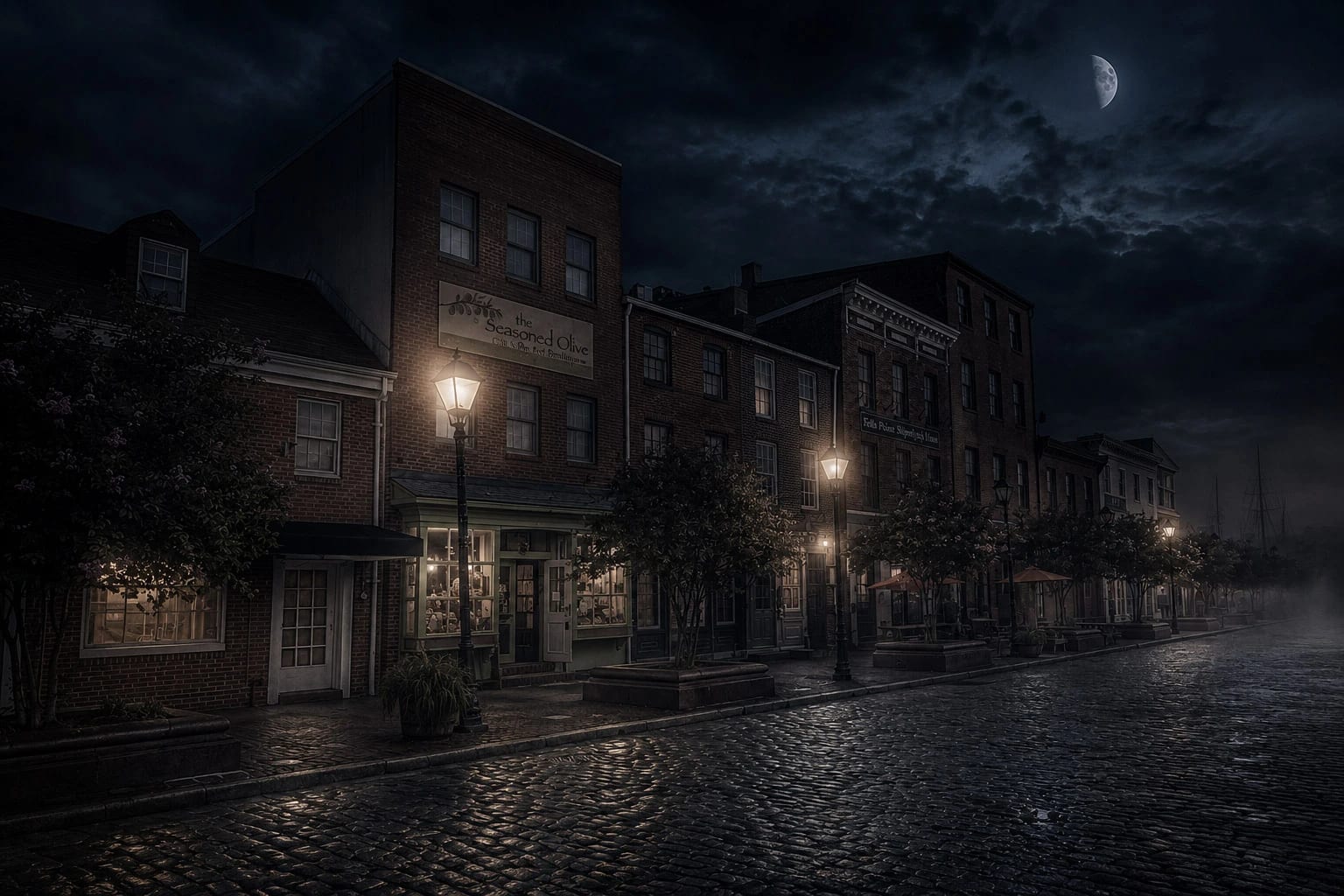
Fells Point after dark, where two and a half centuries of waterfront history linger along the harbor