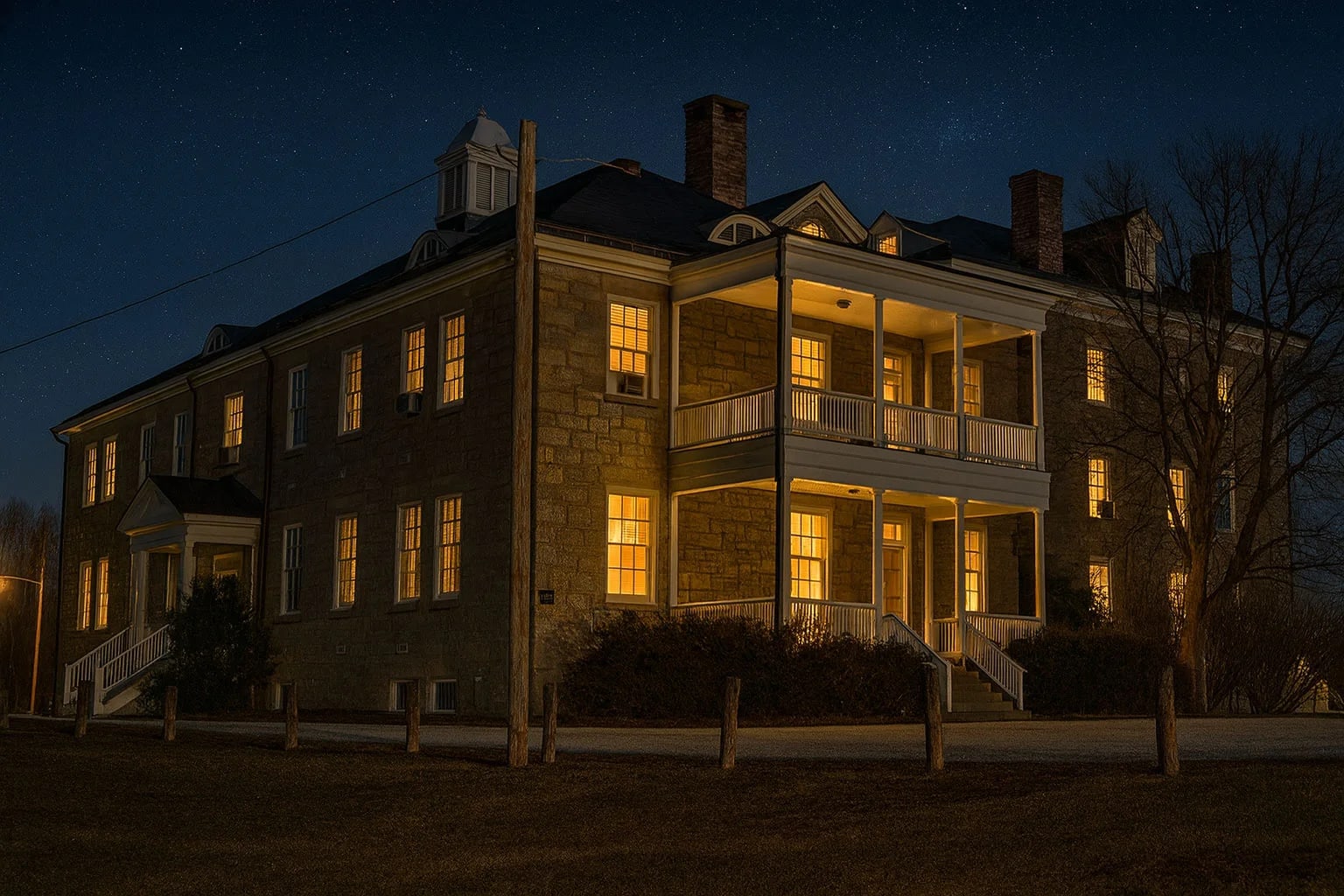
Drive deep enough into the woods of West Baltimore and you'll come upon something that doesn't fit. Past the trees of one of the largest urban forests in the country, a 19th-century Italianate villa appears at the end of a long approach — tall windows, deep porches, the quiet confidence of old money, set down in the middle of a park where most visitors never know it exists. This is the Crimea estate, and its centerpiece, the house the Winans family called Orianda, has watched over these grounds for more than 160 years.
Crimea Mansion is not one of Baltimore's marquee haunted attractions. There's no famous saloon ghost here, no waterfront tragedy retold on every tour. What it has instead is isolation, age, an unusual name, and a family story strange enough to feel half-invented: a Baltimore industrial fortune made in imperial Russia, a Confederate-sympathizing dynasty, and an estate that eventually disappeared into a notorious city park. The mansion's haunted reputation grew out of exactly that combination — a grand house standing alone in deep woods, attached to a history most Baltimoreans have never heard.
This is a piece of forgotten Baltimore as much as a ghost story. We'll look at how the mansion came to be, the remarkable family that built it, where its name comes from, and the legends that have gathered around the property since. You'll find the Crimea among the stranger entries in our Haunted Baltimore collection, and it's the kind of overlooked history we like best on our Baltimore ghost tour.
The History of Crimea Mansion
The Crimea estate was the creation of Thomas DeKay Winans, and to understand the house you have to understand where the money came from. The Winans family were among the most important figures in early American railroading. Ross Winans, the family patriarch, was a Baltimore inventor and engineer who made his name building locomotives and rolling stock for the Baltimore & Ohio Railroad in the 1830s — pioneering work that placed him at the center of the country's transportation revolution.
In the 1840s, that expertise carried the family to Russia. Tsar Nicholas I wanted a modern railroad connecting Moscow and St. Petersburg, and he hired American engineers to build and equip it. Thomas DeKay Winans and his associates spent years on the project, and the contract made them extraordinarily wealthy — wealthy on a scale few Baltimoreans of the era could match.
Thomas came home with a fortune and built accordingly. Beginning in the mid-1850s, he assembled a large country estate in the hills west of the city, on high ground above the Gwynns Falls valley, and around 1857 completed the Italianate villa that became the property's heart. Orianda was a gentleman's country seat in the fashionable style of the day: symmetrical, generous, designed for a family that had seen the palaces of Europe and wanted something of that world in Maryland.
Architecturally, the Crimea reflected a specific moment in American taste. The Italianate style — low-pitched roofs, deep bracketed eaves, tall narrow windows, an air of villa-like ease — was the height of fashion for wealthy homebuilders in the 1850s, a deliberate break from the severe Greek Revival that came before. For a man who had lived among the estates and palaces of imperial Russia, the choice made sense. The Crimea was meant to read as cultured, cosmopolitan, and unmistakably rich.
The grounds matched the house. Winans laid out gardens, water features, outbuildings, and carriage roads across hundreds of acres, turning working farmland into a private landscape. When it was finished, the Crimea sat well beyond Baltimore's edge, surrounded by countryside. The city has since grown around and past it, but the estate's seclusion never really ended. It simply changed from rural distance to the green isolation of the park that surrounds it now.
Why Is It Called Crimea Mansion?
The name is the property's first mystery, and the most satisfying once you trace it. Crimea — the Black Sea peninsula — was, in the 1850s, one of the most talked-about places on earth. The Crimean War, fought from 1853 to 1856, pitted Russia against an alliance of Britain, France, and the Ottoman Empire, and it dominated newspapers across the Western world. The Winans family had spent the preceding years working for the Russian crown, and their fortunes and sympathies were bound up with Russia at exactly the moment the Crimean conflict made the region famous.
Naming a new Baltimore estate Crimea in the mid-1850s was, in that light, a pointed gesture — a nod to the source of the family's wealth and to their deep Russian ties, planted at the very moment the name was on everyone's lips. It linked this quiet Maryland hillside to a war and an empire half a world away.
No competing theory really holds up against this one; the timing and the family's history line up too cleanly to ignore. And the choice tells you something about Thomas Winans and his father. They were not trying to blend in. They had made their money in the service of a foreign autocrat, and rather than hide the fact, they carved the connection into the name of their home.
The Families Who Lived There
The Winans family who built and held the Crimea were, by any measure, remarkable — and not always in comfortable ways.
Ross Winans, the patriarch, was a self-made industrial genius whose locomotive innovations helped launch American railroading. He was also, by the 1860s, a deeply controversial figure. A Maryland man with strong Southern sympathies, Ross Winans was arrested in 1861, early in the Civil War, on suspicion of aiding the Confederate cause — he had reportedly been involved in producing arms for secessionists. His arrest and brief imprisonment made him one of the more notorious Baltimoreans of the war years, in a city violently split between Union and Confederate loyalties.
Thomas DeKay Winans, his son and the builder of the Crimea, carried the same wealth and much of the same politics. During the Civil War, with Confederate feeling running high in the household and the estate sitting on defensible high ground, the family reportedly fortified part of the property — accounts describe a small fort or gun emplacement built to guard the Crimea, a striking thing for a private country house. Whether it ever amounted to more than a precaution is unclear, but the detail captures the family well: rich, willful, and prepared to defend what was theirs.
The Winanses held the Crimea for generations after Thomas, the estate passing down through the family into the 20th century — a private world maintained well past the era that produced it, until changing fortunes and a changing city finally pried it loose. Few Baltimore families left a stranger mark: railroad pioneers, agents of a Russian tsar, Confederate sympathizers, and the builders of a hidden hillside villa that outlived them all.
Tragedies, Deaths, and Local Legends
Here the honest historian has to slow down, because this is exactly the point where haunted-house writing tends to start inventing things — and the Crimea doesn't need invention.
The documented record is more ordinary than the legends would have it. The Winans family experienced the deaths, illnesses, and reversals that any large family spread across a century and a half would, but there's no verified massacre, no notorious murder, no single catastrophe that obviously anchors a haunting. What the property has instead is the slow, melancholy arc common to great private estates: a fortune built, a grand house raised, generations lived out within it, and then a gradual fading as the family's hold loosened and the world that supported such estates disappeared.
The larger turning point was institutional rather than tragic. In the 1940s, the City of Baltimore acquired the Crimea lands, combining them with a bequest from the estate of J. Wilson Leakin to create a large public park in the western part of the city. The Winans retreat became public ground, and the mansion, no longer a family home, settled into the ambiguous status it holds now — a preserved historic building inside a working park.
The darkest part of the property's modern reputation, though, has little to do with the Winans family at all. The surrounding park developed a grim notoriety over the late 20th century as a place associated with crime and with bodies found in its woods. That reputation seeped, fairly or not, into the atmosphere around the old mansion. A good deal of the Crimea's spooky modern image is really borrowed from the park's, which is worth keeping separate from the documented history of the house itself.
Why Is Crimea Mansion Considered Haunted?
So why does a quiet, well-preserved villa end up with a haunted reputation at all? The answer here is more about setting than about any single event.
Start with the isolation. The Crimea sits alone in deep woods, reached by winding park roads, out of sight and largely out of mind. An old mansion standing by itself in a forest is practically a blueprint for ghost stories — the imagination does most of the work before anyone reports a thing. Add the age of the place, the unfamiliar grandeur of a 19th-century estate dropped into a modern park, and the genuine strangeness of its history, and you have a property that feels haunted before a single specific claim is ever made.
Then there's the park around it. The woods of Gwynns Falls and Leakin Park carry their own heavy folklore, and that darker reputation bleeds naturally into the old house at their center. People already uneasy walking those trails arrive at the mansion primed to feel uneasy there too.
The documentation behind the Crimea's hauntings is thin, and I'd rather say so plainly than pretend otherwise. This is a property whose reputation rests far more on atmosphere, isolation, and a remarkable backstory than on any thick file of eyewitness accounts. That doesn't make the legends less real as folklore. It just means they grew from the place itself rather than from one terrible night.
Reported Paranormal Activity at Crimea Mansion
With that caveat in place, here are the kinds of reports and legends that circulate about the Crimea and its grounds. They're best understood as local lore — stories attached to an atmospheric old estate — rather than a documented catalog of events.
Apparitions
The most common stories involve figures. People who have spent time on the grounds — park visitors, event guests, the occasional caretaker — have described glimpsing figures in the mansion's windows when the house was supposed to be empty, a face or a shape at the glass that's gone on a second look. Others tell of figures on the grounds themselves: a person seen near the tree line or along an old carriage path who isn't there when approached. Given the property's age and its long association with a single family, the figures are usually imagined as Winanses or their household, though no account ties them to a specific, named person.
Unexplained Sounds
Then there are the sounds, the standard vocabulary of an old house: footsteps on floors above empty rooms, doors that close on their own, voices or fragments of conversation in a building known to be unoccupied. In a structure more than 160 years old, full of settling timber and drafty spaces, ordinary explanations come easily — which is exactly why these reports rarely rise above the level of a good story told after a long day on the grounds.
Strange Feelings
Most common of all is simple unease. Visitors describe a sudden heaviness near the house, the sense of being watched from its windows, cold spots in particular rooms, a reluctance to linger after dark. This is the vaguest category of report and the one most shaped by expectation — people who arrive at an isolated old mansion in a notorious park half-expecting to feel something usually do. But it's also the most consistent thread in the Crimea's folklore, and the one that keeps the property's haunted reputation alive even without dramatic encounters.
The Ghosts of Crimea Mansion: Fact or Folklore?
How you read the Crimea's ghost stories depends largely on what you bring to them.
The paranormal view takes the reports at face value. A property occupied by one family for generations, full of strong personalities and long lives, might plausibly hold some residue of all that — residual impressions replaying in the old rooms, or spirits attached to a place they never wanted to leave. For believers, the Crimea's very seclusion is a point in its favor; quiet, undisturbed places are exactly where such things are supposed to persist.
The historical view sees something more human. Legends grow through repetition. A strange, isolated mansion with an exotic name and a Confederate-tinged family story is precisely the kind of place a community builds tales around, each retelling adding a little. The grim reputation of the surrounding park only accelerated the process, lending the house a menace its own history doesn't quite supply. By this reading, the Crimea is haunted by storytelling more than by spirits.
The psychological view splits the difference. Isolation, darkness, grand old architecture, and the human fascination with forbidden places combine to produce real sensations — unease, the feeling of being watched, the figure half-seen in a window — without anything supernatural behind them. The mind supplies the ghost the setting seems to promise.
All three can be true at once, and at the Crimea they probably are. The honest answer is that the documentation doesn't settle the question, and the mystery is better for it.
Crimea Mansion and Baltimore's Haunted Legacy
The Crimea occupies an unusual corner of Baltimore's haunted landscape, because nearly everything else the city is known for is public.
The famous Baltimore hauntings are bound up with shared, civic history. The Admiral Fell Inn and the taverns of Fells Point belong to the working waterfront, places where thousands of strangers passed through. The Baltimore Almshouse is the story of the city's poorest and most vulnerable, an institution that touched countless lives. Even Edgar Allan Poe, whose grave at the Westminster Burying Ground draws visitors from around the world, is public property in the cultural sense — a writer the whole city claims.
The Crimea is the opposite. It was private from the start: a single wealthy family's retreat, deliberately set apart, hidden in the hills and closed to the public for the better part of a century. Its haunting, such as it is, is private too — not the collective tragedy of a poorhouse or the rowdy lore of a sailor's bar, but the quieter mystery of one family's grand, strange house standing alone in the woods. It rounds out Baltimore's haunted story with something the waterfront legends can't offer: secrecy.
That contrast is a large part of why the place stays with people, and why it earns its spot alongside the better-known stops in our Haunted Baltimore collection.
Can You Visit Crimea Mansion Today?
Yes, with limits and with respect. The Crimea sits within Gwynns Falls/Leakin Park, which is open to the public, and the parkland around the estate — the trails, the woods, the old grounds — can be explored during normal park hours. The mansion itself, Orianda House, has been preserved and is used for events; over the years it has been maintained with the help of preservation groups who recognize its significance as one of the few surviving estates of its kind in the city.
That said, this is not an abandoned ruin to be wandered through at will. The house is a managed historic property, not a haunted attraction, and much of it is accessible only for scheduled events or by arrangement. The surrounding park, for all its beauty, is large and remote in places, and ordinary common sense about visiting an isolated urban woodland applies. Treat the grounds as what they are — a genuine piece of Baltimore history that has survived against the odds, deserving of care rather than trespass.
The better way to approach a property like this is to learn its story first, which is exactly what we try to help people do.
A Forgotten Estate in the Woods
The Crimea's real fascination has never been its ghosts. It's the improbable fact of the place — a Baltimore family that built locomotives for a Russian tsar, came home with a fortune, named their hillside estate after a famous war, defended it during the Civil War, and held it in private seclusion until the modern city swallowed the land around it. The ghost stories are an extension of that strangeness, not the source of it.
What lingers at the Crimea, more than any apparition in a window, is the sense of a vanished world — of lives lived on a scale and in a style Baltimore no longer produces, in a house most of the city has forgotten is even there. Whether or not anything walks its halls, the mansion holds onto the people who built and filled it simply by surviving.
Baltimore's haunted history runs deeper and stranger than its famous landmarks suggest, and the Crimea is proof of it. To explore more of it, wander the rest of our Haunted Baltimore stories, or come hear the city's forgotten history in person on one of our Baltimore ghost tours, like the Ghosts of Baltimore Tour.
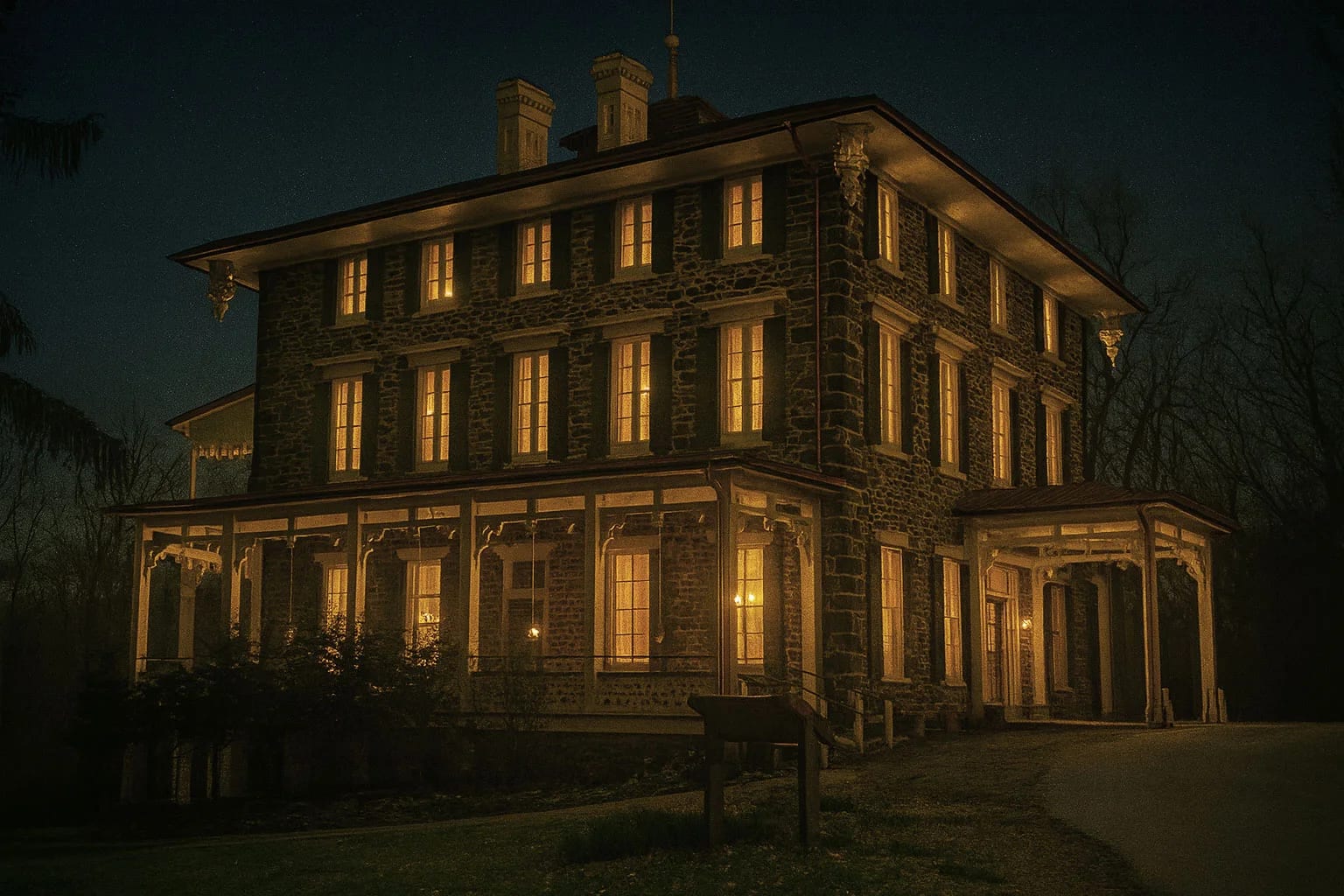
Crimea Mansion, the Winans family's Orianda House, secluded in the woods of Baltimore's Leakin Park